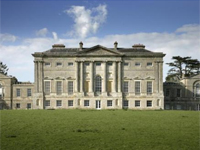
Conversion reversion? Wardour Castle, Wiltshire

Wardour Castle, Wiltshire (Image: Strutt & Parker)

With so many country houses lost in the twentieth century, almost any alternative which saved them from the demolition crew was to be welcomed; no matter how drastic.  For some this meant institutional use but for many others of all sizes the solution was conversion into flats and apartments – though with varying degrees of success.  However, as these properties come on to the market, is it perhaps time to consider converting them back into the single, glorious houses they were intended to be?

Launched this week (16 June 2010) in Country Life magazine is the principal apartment in what is considered James Paine’s finest creation; Wardour Castle, a supremely elegant essay in Palladian architecture.

Central stairwell and gallery, Wardour Castle, Wiltshire (Image: Strutt & Parker)

Built from 1770 – 76, for the eighth Lord Arundell the most impressive feature is a breath-taking central stairwell with first-floor gallery which Pevsner called ‘the most glorious Georgian interior of Wiltshire’ and which forms the core of Apartment One which is now for sale.  Wardour Castle house has proved to be adaptable becoming Cranborne Chase School in 1960 until it closed in 1990 when it was then converted into ten apartments.  As the divisions appear to have respected the natural sections of the house this seems to be a good example of where someone could convert the house back to a single home.

There are many examples of houses being rescued by conversion.  SAVE Britain’s Heritage have long campaigned to protect these houses and have worked in conjunction with one of the leading architects, Kit Martin, in supporting conversion.  A 1983 SAVE report entitled ‘The Country House: to be or not to be’, written by Kit Martin and Marcus Binney, includes particularly interesting studies of how these houses could be sensitively converted.  These show that although almost any country house could be sensitively adapted some are naturally more suitable particularly where the overall layout of the house is symmetrical, shallow and long.

The study was an important milestone in the practice of country house conversion and saved many houses from complete loss or inappropriate use including The Hazells in Bedfordshire, the grade-I Northwick Park in Gloucesterhire, Dingley Hall in Northamptonshire.  The sensitive approach they championed now means that it should be possible to consider converting a house back if the right opportunity arose.  It should be said that some houses are never going to be converted back due to a variety of factors including there being too many apartments involved such as at Thorndon Hall in Essex which contains 37 flats, or where not enough land has been retained to make the unified house valuable enough to justify reversion.

Perhaps the idea of reversion becomes more realistic where more than one part of the same house comes on the market at the same time such as recently happened with grade II*-listed Ampthill Park House, Bedfordshire.  Built by the Cambridge architect Robert Grumbold in 1687-9 and completed by John Lumley of Northampton in 1704-6, with major additions by Sir William Chambers in 1769 it is certainly one of the most impressive houses in the county. It was rescued from dereliction by conversion into just four large houses; two of which were put on the market in April 2010, the largest of which includes most of the principal rooms.

Although it’s nice to dream about these houses becoming single homes probably the biggest obstacles are not only being able to secure the other apartments but also that the value of the individual properties may be greater than the value of the unified house.  However, it’s not entirely beyond the bounds of possibility that someone with deep pockets and a desire to restore a house could take on one of these conversion reversions and recreate a superb country house.

Property details: ‘Apartment One – Wardour Castle, Wiltshire‘ [Strutt & Parker] – £2.75m

Detailed architectural description: ‘Wardour Castle, Wiltshire‘ [English Heritage: Images of England]
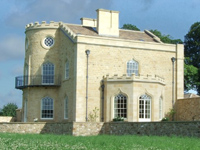
The modern smaller country house: Home Farm, Yorkshire

Home Farm, Yorkshire (Image: Francis Johnson & Partners)

Despite the rather understated name, Home Farm in Hartforth, Yorkshire is a classic example of the long tradition of grand downsizing which has been a hallmark of UK country house owners, particularly since 1900.  The pressures on the large country house in the 1930s and then again from the late 1940s until 1960s sparked a surge in the construction of new, smaller country houses which reflected the financial reality of the times.  Yet today smaller country homes are a deliberate choice for the discerning owner reflecting their own wishes and desires which has led to some very successful designs.

In previous eras (and particularly before the restrictions of the 1970s heritage legislation), a country house owner faced with a house which was too big could simply remove wings (as the 12th Duke of Bedford did at Woburn Abbey in the late 1940s) or floors of the house to make them more manageable (as happened at Hodnet Hall in Shropshire). Unfortunately for many owners it was simply easier to demolish the house entirely giving them the option to convert the stables into a home (the choice of the Earls of Lansdowne at Bowood in 1955) or rebuild either on the site of the old house or in a new location on the estate.  It was this latter course of action which offered the best opportunities for an owner to preserve their estate but dramatically reduce their expenses by building a new house.  John Martin Robinson in his 1983 book ‘The Latest Country Houses’ estimated that over 200 new country houses were built between 1950s-1980s.

The new country houses today are largely either grand statements but there are also examples of smaller houses which quietly succeed in delivering an important contribution to the traditions of the UK country house.  Winner of the 2009 award for ‘New building in a Georgian context‘, Home Farm was a carefully considered response to a particular location and circumstances.

The client behind the commission was Sir Josslyn Gore-Booth Bt. who had inherited the Hartforth estate but unfortunately not the main house, the early Georgian classical Hartforth Hall, which had been divorced from the estate and become a hotel.   The Gore-Booth’s family seat had traditionally been Lissadell in County Sligo, Ireland, built for the 4th Baronet in the 1830s.  In 2003, Sir Josslyn put the house on the market for €3m and was determined that the new house would be very different from the sombre and severe Neo-Classical house he had just left.

Home Farm, Yorkshire (Image: Francis Johnson & Partners)

Home Farm is a clever response to a number of challenges.  Firstly, both the new house and Hartforth Hall would be visible simultaneously due to their proximity and so had to make their own architectural statements without competing, ruling out a classical design.  Secondly, the new house was to replace an old estate farmhouse and would join the group of existing Georgian farm buildings.  The architect, Digby Harris, came up with a novel solution – a two-faced house which projected an elegant classical facade to complement the farm buildings but a Gothick facade contrasting to the classical Hartforth Hall.  Usually a client seeks a unified design so these type of buildings are rare in the UK and feel somewhat disconcerting; two examples are Castle Ward in Northern Ireland (Classical front / Gothick front) and Castle Goring in Sussex (Classical front / Gothick front).

The ‘classical’ front draws on a draft design by the late Francis Johnson but also historically the compact Georgian villas of Sir Robert Taylor (1714–1788), James Paine (1717-1789) and John Carr (1723-1807).   The Gothick facade mirrors the style applied to some estate buildings in the 19th-century and features an elegant ogee window on one side looking out on a small canal-type pond with the main front boasting a full height bow bringing to mind other older houses such as Corngreaves Hall with other elements taken from Batty Langley (1696-1751), specifically his ‘Gothic Architecture, improved by Rules and Proportions‘ (pub. 1747)

Home Farm proves that a modern classical country house can be both practical and architecturally interesting without needing to be physically large.  The long tradition of country house building in the UK seems to be alive and pushing forward the architectural boundaries which should prove inspiring to anyone contemplating the building of a new home of any size as the centrepiece of an estate.

More details and photos: ‘Home Farm, Yorkshire‘ [Francis Johnson & Partners]

Credits: thanks to Austen Redman of Francis Johnson & Partners for the photo and information on the house.

Shrubland Hall finally sold

When the Grade-II* listed Shrubland Hall near Ipswich in Suffolk was put on the market for £23m in 2006 it included over 40 cottages, several farms, over 1,400 acres and one of the finest Italianate houses in the country. The house was originally designed by James Paine in the 1770s it was extensively altered by Sir Charles Barry in the 1840s.  Lord de Saumurez had decided to start afresh with a grand country house auction rarely seen such a scale since the 1950s, and which included Meissen porcelain, paintings, and many fine pieces of Georgian furniture.  The sale was a roaring success but the house itself languished on the market as the especially as the growing global credit crunch limited the desire for buyers wealthy enough to take on the 40,000 sq ft. house.

However, after three years, and selling off much of the estate in smaller lots, the house plus a few hundred acres of parkland including the listed gardens designed by Sir Humphrey Repton, has now finally been sold for £6.5m to a London businessman.  It will now be interesting to see how the estate develops as without the larger estate it will be simply a home supported by income from elsewhere.  Here’s hoping that the new owner fully understands and appreciates the architectural gem they have acquired.

Full story: ‘Shrubland Hall sold‘ [Evening Star 24]