‘So you made the 2012 Sunday Times Rich List…’ – a selection of country houses for sale

Spring is upon us: the birds are singing, the flowers are blooming, the drizzle is almost incessant – *sigh*. One bright spot is each week’s increasingly heavy Country Life magazine; the extra weight from the greater number of property adverts which signal the launch of the late spring/early summer (hah!) country house sales push. Below is a round-up of some of the most interesting and beautiful properties currently for sale, all entirely and subjectively chosen by me.

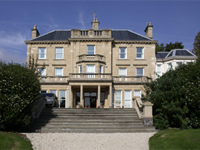
Bletchingdon Park, Oxfordshire (Image: Knight Frank)

The most impressive house to be offered for sale this year so far has to be the beautiful Bletchingdon Park, Oxfordshire [Knight Frank]. One of the relatively few Palladian villas in the county, it can easily hold its own with the others such as Kirtlington Park (completed in 1746) and Nuneham Courtenay (built 1756).  Bletchingdon Park was slightly late to the Palladian party, being built in 1782 for Arthur Annesley, Viscount Valentia, to the designs of James Lewis (b. c1751 – d.1820).  Lewis was mostly employed as surveyor of various charitable hospitals in London and near counties but he also completed a clutch of excellent country houses including Eydon Hall, Hackthorn Hall, and Lavington Park (now Seaford College). Owned since 1993 by Dr Michael Peagram, a philanthropist and chemicals industrialist, the grade-II* house has been obviously well cared for and offers the highly desirable combination of an imposing facade, superb views, 127-acres and elegant interiors which includes a wonderful sweeping, top-lit staircase – if you have £20m.
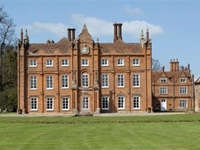
Cockfield Hall, Suffolk (Image: Savills)

For those who prefer an alternative to the architectural austerity of Palladianism, then Suffolk offers a wealth of brick houses; statements just as bold, but in a different language. Cockfield Hall, Suffolk [£5m, 74-acres, Savills] has a grand façade, galleried great hall, a wealth of rich plasterwork ceilings, and a range of estate buildings in the same style.  Although mainly built in 1613, the windows were sashed c1770 and the overall look is largely due to later Victorian enhancements, including the upper storey, gables, the great hall and various Tudor motifs.  That said, it is undeniably attractive as the changes work well together.

Highfields Park, East Sussex (Image: Knight Frank)

There is often something just so elegant about Regency houses, particularly the smaller country villas which echoed the style and features of much larger and grander houses. Highfields Park, East Sussex,  [£5.75m, Knight Frank] is set in 191-acres, and overlooks its own lake and out to the countryside.  The house has grown as the ambitions and wealth of the owners allowed; a ballroom being added to the east and a swimming pool beyond that. Awkwardly, access to latter is through the former so just be careful not to schedule a pool party at the same time as your formal dances; though, on the upside, it will be easy to tell which guest is supposed to be at which party.

Ayton Castle, Scotland (Image: Knight Frank)

Previously offered for sale in May 2011 for £3m and now re-listed, Ayton Castle, Scotland [offers over £2.2m / Knight Frank] is a sprawling confection of Scots Baronial motifs; the design the work of two of the best architects working in Scotland at the time, now set in 159-acres.  The house was originally built in 1851 for William Mitchell-Innes who commissioned the talented James Gillespie Graham. Graham was known for his work in the Scots Baronial style which became so popular in the Victorian era, notably on the praise of Sir Walter Scott and the Queen’s remodelling of Balmoral.  Yet, Graham was a rare architect comfortable working in various styles; neo-classical at Blythswood House or semi-ecclesiastical Gothic at Cumbusnethan Priory (now tragically a ruined shell).  Ayton was later extended in 1860, with the addition of a billiard room and an enlarged drawing room by David Bryce.  Bryce, perhaps, more than any other architect, can be argued to be responsible for the legacy of Scots Baronial, if only through his prolific output of more than 230 buildings including many country houses such as Craigends (dem. 1971), Panmure House (dem. 1955), Torosay Castle and Dalmore House (burnt out 1969). Considering the tragic swathe cut through his work, it’s a shame that legacy wasn’t appreciated.

Honourable Mentions

There are, of course, many other good houses featured in Country Life but some would not be regarded as the seat of an estate – but they are still wonderful country houses; albeit ones with very large gardens and worth a mention.  A couple here are proper country seats but just haven’t made it to the list above:

Bradwell Lodge, Essex (Image: Matthew Beckett) - for sale: £2.25m through Jackson-Stops & Staff
Bradwell Lodge, Essex (Image: Matthew Beckett) – for sale: £2.25m through Jackson-Stops & Staff

Bradwell Lodge, Essex – a house of contrasts and a mixture of architecture; a Tudor core, latter additions by Robert Adam, Robert Smirke the elder, and Quinlan Terry, with decoration by Angelica Kauffman. The library/small dining room in the projecting bay on the ground floor is particularly elegant with twisted-wire screens to the bookcases. Grade-II*, 26-acres, £2.25m [Jackson-Stops & Staff]

Broadwell Manor, Gloucestershire – grade-II*, 35-acres, excess £8m [Knight Frank]

Burnham Westgate Hall, Norfolk – a fascinating early house by Sir John Soane which has previously featured on this blog (‘For sale: a Soanian springboard‘). Grade-II*, 38-acres, £6.5m (down from £7m) [Knight Frank]

Glansevern Hall, Powys – an apparently unique property in that it is the only complete house designed and build by the architect Joseph Bromfield and which also features some impressive gardens. Grade-II*, 80-acres, £4.5m [Balfours]

Rainthorpe Hall, Norfolk – grade-I, 18.7-acres, excess £2.95m [Strutt & Parker]

Roundhill Manor, Somerset – grade-II, 280-acres, £6m [Savills]

—————————————————————————

For other updates on country houses for sale do sign up for the excellent British and Irish Stately Homes blog, which is written by Andrew Triggs who frequently contributes comments on this blog.
School’s out: seats of learning for sale

One of the many uses to which our country houses have been successfully adapted to is that of schooling – from the grandest such as Stowe and Bryanston to the many smaller houses which have delighted and terrified children in equal measure for many years.  Even as recently as April 2010, Wispers in Sussex, was sold to a London primary school as a satellite to their main campus. Yet for all the fond memories held by generations of youngsters, private schools and educational colleges are facing their own periods of austerity, forcing some to close.  With closure comes a rare opportunity for a house to once again become a home – though such a move is fraught with practical, and sometimes political, challenges.

Urchfont Manor, Wiltshire (Image: Augustus Photographic via flickr)

One of the bonuses of writing this blog is to discover houses so little known that, despite their obvious beauty, they seldom appear in books.  Urchfont Manor, Wiltshire is a classic example of this. Currently a residential college, this stunning smaller William and Mary country house was built around 1678 for William Pynsent, a wealthy London barrister, who would have been well-aware of the latest architectural fashions. The architect is unconfirmed but, with the hipped roof and projecting, pedimented centrepiece, it appears to draw inspiration from houses such as Horseheath Hall, Cambridgeshire (though 7-bays to Horseheath’s eleven) designed by Sir Roger Pratt in 1663-5 (dem.1777), and also clear stylistic similarities with houses such as  the north and south fronts of Fawley Court, Buckinghamshire (built 1684-5, by Sir Christopher Wren) and Puslinch, Devon (a late proponent of the style, being built c1720).  One curious anecdote, told to Sir John Julius Norwich, was that the house was substantially altered, creating the elegant east front, about twelve years after construction to designs by William Talman – but Colvin doesn’t mention it and no firm evidence has appeared to support this…so far.

Puslinch House, Devon (Image: Devon Rural Archive)

Urchfont is a fascinating and enchanting smaller manor house which successfully plays the neat visual trick of looking larger than it is – at least from some angles. The two key views of the house are from the main road from the village, which gave a clear view of the east front and the road running below the south front (the house was once more visible; maps from 1880s show only a few clumps of trees, much fewer than there are now).  If one only saw these two fronts, one might think this a large, cube-shaped house – but move round to the north and the house is clearly only one room deep on the east front. A lovely piece of social aggrandisement.  The house passed through various families and was tenanted before being bought by another lawyer, Hamilton Rivers-Pollock, in 1928, who lived there until his death in 1941.  It then became a home for London children suffering from tuberculosis, and was then bought in 1945 by Wiltshire County Council as a residential college.  Now, faced with cutbacks,  the council have decided to sell up, amid much local controversy, giving this beautiful house an opportunity to once again become a home.

The Hill, Abergavenny, Monmouthshire (Image: Cooke & Arkwright)

Across the country in Monmouthshire, The Hill, as the name implies, sits rather proudly on the edge of Abergavenny.  Built in the mid-18th century, the house sits in 20-acres of gardens (which are included on the Register of Parks and Gardens of Special Historic
Interest in Wales) from a once larger estate, the residential spread of the town having crept up towards it.  Sadly, poor planning has led to a small residential estate taking up the grounds to the east of the house, and further buildings associated with its time as a college now stand between them and the house.  This makes it exceptionally unlikely that the house would become a single-family home again but potentially a high-quality development, replacing the modern buildings and respecting the grounds, could offer a workable solution.

Bedgebury Park, Kent (Image: Knight Frank)

On a larger scale, the curse of the associated buildings also blights Bedgebury Park, Kent. The original house of the estate, seat of the influential Culpepper family, financed by a flourishing iron business based on the clay-ironstone on which it sits, was to the east of the current grand mansion (now a lake), and played host to Elizabeth I, who visited in August 1573.  The current house was built in 1688 for Sir James Hayes, a man who had become wealthy through  his wife’s inheritance and financing the recovery of jewels and gold from a sunken Spanish ship.  Sir John Cartier bought it in 1789 and added some impressive plasterwork and the chain of lakes on the estate.  Following Cartier’s death,  Bedgebury was bought by one of the Duke of Wellington’s most trusted men, Field Marshal Viscount Beresford.  He commissioned Alexander Roos c.1838 and the subsequent extensive alterations and the addition of the cross wings to create the H-shape, obscured the red-brick original behind an impressive cladding of warm, honey-coloured sandstone ashlar, creating a house which positively glows in the sun. Inherited by Alexander Beresford Hope in 1854, he made his mark on the house by adding the impressive Neo-Classical stairhall and the striking mansard roof.

Stairhall created c.1850s, Bedgebury Park, Kent (Image: Knight Frank)

The house was bought by the Church Education Corporation with 200-acres in 1919, opening as a school with just five pupils in 1920.  It quickly grew and new buildings were added in the grounds providing extra teaching and residential facilities, before closing in 2006.  Now offered at £7.5m, the grade-II* house sits in a 90-acre estate awaiting its future.  The brochure mentions that the local planning department are open to the idea of it becoming a single unit residence again – a possibly tempting prospect for a billionaire who needs an impressive house, a small estate, and doesn’t mind having to demolish the modern school buildings which have sprung up.  Considering the quality of the interiors, this must surely be a feasible prospect, especially in light of the recent sale of Park Place for £140m which proved that there are those willing to pay exceptional prices for the best quality properties.

Apethorpe Hall, Northamptonshire (Image: English Heritage)

For those seeking to move into a former school which has been partially restored to the highest standards and now only requires the finishing touches (if you have a couple of million pounds available), then possibly the finest option would be Apethorpe, Northamptonshire.  This fascinating Tudor/Jacobean/Elizabethan house has played a supporting role in royal entertainments for 500 years and features some of the finest plaster ceilings in the country – and became a particularly grand school between the late 1940s and 1982, when it closed. Bought by an absentee owner, it languished for years, flirting with dereliction.  Finally, intervention by English Heritage brought it into their care and it’s currently for sale for offers around £5m (English Heritage reputedly spent £7m on the rescue so far), and would require another approximately £4m to complete the restoration.  On an remarkable side note; the fact that Apethorpe was saved from the usual vandalism, arson and theft which so often afflicts empty buildings, was largely due to the tireless efforts of the caretaker, George Kelley, who carried on even though he wasn’t being paid to do so.

The most recent closure (at least partially) is of St Michael’s in Tawstock, Devon.  Originally known as Tawstock Court, it was built in 1787 in a provincial Gothick style to replace an Elizabethan house which burnt down that same year.  Although the staff and parents have made heroic efforts to save it, the concern for them is that the house will fall into the hands of developers who will convert it into flats – and considering the poor job most do of such a task, their concerns are very valid.

In these straitened times, sadly a number of parents and councils will be forced to economise and schools, usually private, may well close.  Sad though this will inevitably be for the many current and former pupils, it does also offer a possibility that these houses may revert to their former role for which they were designed – and few would argue that the spectacular Marshcourt in Hampshire, designed by Lutyens, was better off as a school. However, as the roll call of struggling schools lengthens, it is important that the future of the often wonderful buildings, which gave each school their character, are given due priority to ensure an appropriate transition and restoration if the opportunity arises for them to return to being family homes.

————————————————————————

Original story: ‘Urchfont Manor sale row erupts‘ [Gazette and Herald]

Listed building description: ‘Bedgebury Park, Kent‘ [British Listed Buildings]

The state of the country house market: Autumn 2010

Noseley Hall, Leicestershire (Image: Knight Frank)

Throughout September, the increasing weight of each week’s ‘Country Life‘ magazine heralds the starts of one of the busy periods for launches of country houses.  As an relatively unscientific barometer it would appear that the market is doing well with some impressive estates and houses being offered up to tantalise the armchair enthusiast and serious purchaser alike – but a few houses are still proving difficult to shift.

The September 1 magazine provided a summary of the successes of the year-to-date with glowing reports from estate agents who, despite some fears in January about an uncertain year ahead, are happy to highlight their successes.  The article quotes Crispin Holborow of Savills who rightly points out that ‘best in class‘ houses will always sell quickly and for above their guide price if the right buyers start competing.  He cites Ropley House in Hampshire which sold at over it’s guide price of £4.25m, as did the grade-I listed Shanks House in Somerset which was offered with 70-acres for £5.5m, but their biggest success was the coveted Chadacre estate in Suffolk with 680-acres which reputedly sold for more than double it’s £10m asking price.  Other houses such as the elegant grade-I Worlingham Hall – regarded by Norman Scarfe as ‘the most beautiful house of manageable size in Suffolk’ – also sold over it’s guide price of £3.9m.

Other houses sold close to their guide include Peatling Hall in Leicestershire (mentioned on this blog in July) which was offered at £4.75m, whilst the stunning Compton Pauncefoot Castle in Somerset suffered from an unfortunately timed launch in September 2008 at £17m which knocked buyer confidence meaning that it hung around until Febuary 2010 before selling at £15m.  Others had to drop their prices or accept being sold in lots with Kiddington Hall in Oxfordshire selling for £15m to Jemima Khan once the rest of the 2,000-acre estate had been sold (originally offered as one for £42m), whilst Fillongley Hall in Warwickshire has yet to find a buyer even after selling 400- out of the original 500-acres originally offered when it went on the market in 2005 (£3.5m, Savills).  Pusey House in Oxfordshire, which was originally launched with 643-acres but when featured as the lead property advert in the September 15 magazine it was offered with just 67.

So who are the awkward squad?  Grade-I listed Noseley Hall in Leicestershire is still with Knight Frank with the same acreage; though now at £12m rather than the original £14m asking price, and Iver Grove in Buckinghamshire, a pocket Palladian gem, is still being offered (again with Knight Frank) – though mysteriously with no price, so probably less that the £4.5m guide in February 2010; and way down from it’s original price of £6.5m when it was first launched in 2007.  Up country, Yester House in Scotland is still available despite having had it’s price halved from £15m to £8m since the original launch in August 2008.

So, although the property market does seem buoyant, it does seem that some are struggling.  Perhaps the flurry of launches will bring an influx of new buyers who may take a renewed interest in the harder-to-sell properties, but they equally may well wonder why they are still available and pass them over.  It seems that some owners who are keen to sell are being flexible, either dropping the price or selling in lots, but for owners who refuse to budge the market may take a very long time to rise to meet what they think their property is worth.  It seems flexibility is still a vital attribute whatever rung of the property ladder you are on.

If in doubt, rent: Faringdon House, Oxfordshire

Faringdon House, Oxfordshire (Image: Knight Frank)

Renting a property has long been associated with those starting out on the property ladder but there is a long history of country houses, large and small, being tenanted for long periods of time.  Now the focus is very much on the sale of country houses with rentals being in the shade of their high-spending counterparts but there are still many fine houses available to those wishing to experiment with the country life or as a short-term solution.

Jane Austen was well-known for reflecting the social conventions of the aristocracy in her work and it’s interesting that one of the main characters in ‘Pride and Prejudice’, the wealthy Mr Bingley, rents ‘Netherfield House’ whilst he considered which house and estate he would establish himself in.  This again is a pattern that still holds true today with those seeking to move to either a new area or out of town, renting to get a better understanding of an area.  These opportunities are available today where houses such as Puddletown Manor in Dorset are available for rent (£9,000 pcm) but also for sale (£6m) at the same time.

Country houses have been let for a variety of reasons.  One of the most common was simply that it might be a subsidiary seat and rather than simply leave it empty it was often let as a source of income.  Sometimes this included the entire working estate so that the new occupant could fully assume the role and responsibilities of the country gent.  Increasingly though in the Victorian era the house was let separately from the estate which would continue to be managed and run by the original family.  This was often the preferred option for the newly wealthy who aspired to the status and amenity of a ‘country seat’ but did not require the estate to generate an income.

This is why houses such as the Faringdon House in Oxfordshire [pictured above] are attractive as they allow someone else to simply move in (albeit for a significant monthly rent of £10,000) and enjoy a grade-I listed Palladian villa without the added burdens of ownership.

Letting was a handy solution when the family finances were insufficient for they themselves to live there.  The Marquess of Lansdowne became first Governor General of Canada and then Viceroy of India from 1883-1894 specifically to improve his financial position and keep hold of his estates.  These jobs came with benefit of government accommodation which freed up the family seat for letting.  In a letter to his mother he explained,

“India means saving Lansdowne House for the family.  I should be able while there not only to live on my official income, but to save something every year.  If I can let Lansdowne House, I might by the time  I come home have materially reduced the load of debt which has become so terrible an incubus to us all…”.

(n.b. when the Marquess refers to Lansdowne House, he is referring to Bowood House rather than their London townhouse of the same name which was sold by the family in 1783.)

The Second World War also offered a convenient escape route for some owners as country houses were taken over by evacuated schools who then stayed on such as at Motcombe House in Dorset.  Although the use of country houses as schools had been an established practice for many years (the 1920s saw Stowe, Canford and Bryanston all become schools) the widespread use during wartime meant that it gained even greater acceptability.   For the Earl Fitzwilliam at Wentworth Woodhouse who had seen his spectacular house vandalised by troops and a vindictive Minister for Fuel and Power, Manny Shinwell, ordering the needless open cast mining of the gardens right up to the house, it was all too much and he let the house to become a training college for female PE teachers.

The letting of country houses has a long and varied history but it has mostly been driven by the need for country house owners to maximise their incomes.  Once the country house had ceased to be the physical embodiment of local political power following the reforms of the early 20th-century it became easier for families to simply move out and bring in tenants turning a costly extravagance into revenue.

Property details: ‘Faringdon House, Oxfordshire‘ [Knight Frank]

For those who like their houses with pedigree: Plumpton Place, Sussex

Plumpton Place, Sussex (Image: Knight Frank)

One of the greatest of the UK’s country house architects was Sir Edwin Lutyens – a man with undoubted talent who was also able to use thoroughly modern techniques of collaboration and media exposure to boost his career and win business.  His main media connection was the tireless promotion of his work by Country Life magazine which was, in no small part, due to his close friendship with the founder and editor Edward Hudson.  So when Hudson needed to restore and modernise a manor house he’d bought it was inevitable who he would call on.   Plumpton Place in Sussex is now considered to be one of Lutyens’ best country houses and it’s for sale.

Lutyens (b. 1869 – d. 1944) was a master at the creation of houses which evoked what many would have in their minds as the ‘ideal’ country house.  He was able to marry the romanticism of the Arts & Crafts movement to his own clear ideas as to how a house should look both inside and out.  A strong proponent of using local materials he, more importantly, was able to use them in innovative ways which made his houses distinctive.

Marsh Court, Hampshire (Image: Clicks_1000 @ flickr)

A classic example of this was his use of chalk at Marsh Court in Hampshire which gave this house a brilliant white appearance, and which contrasted with small tiles of knapped flint set into the walls and the red-brick chimneys.  Marsh Court (finished in 1904 and for sale in 2007 for around £13m) was the last of Lutyens’ ‘Tudor’ style houses but it would never be considered an old house – again showing his genius of matching local materials with an assured architectural design.

Much of Lutyens’ fame can be attributed to the unstinting support he received from Edward Hudson who had cleverly exploited the growing urban middle-classes interest in a nostalgic view of ‘olde’ England and the country lifestyle.  Founded in 1897 it chronicled not only the best of the grand old country seats but also sought to keep the tradition alive at a time when the lifestyle was beginning to come under threat. One of his writers was the renowned garden designer Gertrude Jekyll who had met Lutyens in 1889 and had collaborated with him to create some of the best regarded house-and-garden compositions in the country.  Jeykll introduced Lutyens to Edward Hudson in 1899 thus creating a life-long friendship between the two.  To Hudson, Lutyens’ ability to create these idealistic visions of country life were the perfect material for his magazine.  Coupled with the extensive use of their distinctive, high-quality black & white photos it provided an unrivalled opportunity for Lutyens to built fame with the middle-classes but also advertise his talents to the aspirational wealthy or the existing gentry.

Hudson was a man to put his money where his magazine was and commissioned Lutyens to work on three houses; Deanery Gardens, Lindisfarne Castle and Plumpton Place – all now considered to be Lutyens’ best work.  Hudson had bought Plumpton, a derelict, moated manor house, in 1928 for £3,300, to be used as a weekend retreat and a place to entertain.  In some ways Lutyens’ work there was a surprising contrast to the grand Classical-style banks and corporate work he was engaged with in London and elsewhere.  Lutyens created a new route to the house which used a theatrical sense of surprise to hide the house except for glimpses through arches and trees.  Inside the most notable addition was that of a music room with huge, almost mullioned, windows with small panes of glasses set into wooden frames rather than the then fashionable steel, flooding the room with light.

The house was bought in 1983 for £800,000 by an American venture capitalist called Tom Perkins who has since lavished ‘millions’ on careful restoration.   So if you have £8m, this is a rare opportunity to live in a genuine Lutyens masterpiece which has played its own part in shaping our national impression as to what a country house should look like.

Property details: ‘Plumpton Place, Sussex‘ [Knight Frank]