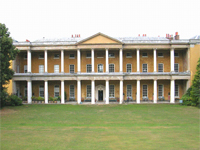
Ferne Park, Wiltshire: the building of a modern Classical masterpiece

Ferne House, Wiltshire (Image: Q&F Terry, Architects)

The English country house is considered our greatest contribution to the field of architecture – the unified vision of house and landscape combined with fine interiors, superb furnishings and exceptional art collections.  Yet in the 20th-century, it seemed that after Lutyens we largely lost our ability to excel in their creation – the new country houses seemed shadows of our earlier confidence, lacking the grand flair, and certainly the detailing, which had so defined the Georgian Classical house.  This was partially due to financial circumstances but also due to the influence of modernism which sought to re-interpret the country house in a new language – and it often didn’t translate well.

Yet, there are signs that given the right client and the right architect, we can again create the sort of country houses which will be admired in 200 years. Country Life magazine this week (5 May 2010) features one of the best country houses to be built in the last 70 years; Ferne Park in Wiltshire, winner of the Georgian Group award for the Best Modern Classical House in 2003.

This is a house built in the finest traditions of the English country house – with its clear use of the Palladian vocabulary but skilfully reinterpreted for the location and the needs of the client, Lady Rothermere.  The architect responsible, Quinlan Terry, has been responsible for some excellent buildings but this may well be his best.  The new house, built in 2000-2, was on the site of a previous Georgian mansion called Ferne House which was demolished in 1965 having fallen into a poor condition.  By rebuilding on the same site, Terry had a setting which was simply waiting for a new house to be created.

The local authority had already set the requirement that the new house must be Classical so both client and architect drew on other houses they knew such as Came House (Dorset) and Castletown Cox (Ireland), and were able to develop a distinctive plan for the site.  The house also cleverly has contrasting fronts with the dramatic views to the north matched by the stately columns and pediment, whilst the south, with the gentler views into Dorset, using a simpler facade.

Ferne Park has revived hope that it is possible to build a successful Classical house which is recognisably a continuation of the the glorious Georgian traditions which have created so many of the houses we love today.

More pictures of the house: Ferne House, Wiltshire [Quinlan & Francis Terry, Architects]


Part II of the article will be published in the 12 May 2010 edition of Country Life.

An architectural gem – but still slow to sell: Iver Grove

Iver Grove, Buckinghamshire (Image: The Listed Property Owners Club)

When it was completed in 1724, Iver Grove was one of the first houses in Britain built using the then radical Palladian styling; pre-dating even Lord Burlington’s famous Chiswick House.  Iver Grove is a beautiful and compact red brick essay in the use of the Classical elements with a Doric portico and topped with an elegant pediment.  Although originally attributed to either Sir Christopher Wren or Nicholas Hawksmoor, it’s now more widely accepted to be the work of John James who worked with Wren on St Paul’s Cathedral and succeeded him as the surveyor of the Commissioners’ Churches.  The front steps lead into a spacious and light entrance hall featuring the original oak staircase.

That the house is here today is remarkable in itself as after WWII it was in a parlous state and at risk of becoming one of the many hundreds of country houses demolished in the 1950s.  The house was smothered in ivy, riddled with dry rot and had been subject to various thefts of lead and fixtures and vandals who had smashed all but one of the Wedgewood stained-glass panels in window over the staircase.  The house was one of the first to be bought by the Government in an effort to save it – although this led to angry questions in the House of Commons from philistine MPs who demanded to know why we had spent more saving an “extremely beautiful house” (Lord John Hope) than we had sent to aid the Congo.  Such amazing short-sightedness still prevails today with those asking why we spend any money on heritage with similarly spurious justifications.

Anyway, thanks to the Government, the house was rescued through a programme of works which included demolishing the collapsed Victorian wing – and in so doing bring the house back to it original scale, and conveniently making it more manageable.  So when the this grade-I listed house was first launched in 2007 with much press coverage including a glowing write-up by Marcus Binney in The Times (‘A fast track to perfection‘) and later in Country Life (‘Georgian estate for sale‘) it was thought it would sell quickly.  However, £6.5m price tag was probably boosted by its architectural importance above the fact that it was a six-bedroom house with just 17-acres near to the M25.  The price was probably quickly identified as the issue as in The Times article in May the price is £6.5m, by the time the Country Life article was published in December the price was given as ‘offers over £5m’.  Now, two and half years later the price has dropped to a more reasonable £4.25m, and hopefully this will entice a new sympathetic purchaser with a desire to live in an important country house with manageable grounds but who will appreciate being just 17 miles from Hyde Park corner.  Actually, if I win the lottery, I’ll probably go for it.

Full details: ‘Iver Grove, Buckinghamshire‘ [Knight Frank]

West Wycombe House at risk from high-speed rail link?

buckinghamshire-westwycombehouse
West Wycombe House

Concerns have been raised that the proposed route of the £34bn Network Rail project to provide a high-speed link to Scotland will severely compromise many areas of natural beauty and a large number of listed buildings including the setting of the Grade-I listed West Wycombe Park in Buckinghamshire.

The main problem lies in the fact that to achieve high speeds, the 1,500 miles of railway lines would need to be laid in the most direct line between two locations.  This would mean that the line would simply carve through the landscape, destroying areas of Special Scientific Interest and unspoilt countryside in the heart of the Chilterns such as the Misbourne valley.

One proposal of particular concern is to build tunnels beneath High Wycombe but the Chilterns Conservation Board (CCB) fear that the tunnel would surface near the historic village of West Wycombe – threatening the  stunning setting of the architecturally important West Wycombe House.  The Italianate-style house with it’s rococo gardens were built by Sir Francis Dashwood – of Hellfire Club fame – over a period of 60 years from 1740. The defining exterior feature is the rare double colonnade (see picture) which was certainly inspired by Palladio’s work in Italy such as the Palazzo Chiericati which Dashwood would have seen on his Grand Tour.  Further Palladian and neo-Classical flourishes in both the house and parkland make this house worthy of protection from crude spoilation by the planners.

More details: ‘High speed rail line will blight Chilterns‘ [Chilterns AONB]

So why this blog?

My great love is country houses, particularly those which grace the counties of England.  Each is a fascinating example of the hopes, aspirations, aesthetics and wealth of someone.  One of the best aspects of what has been called the UK’s most significant contribution to architecture, is that each is different – whether the grand Palladian palaces sitting in parkland, to the mid-size expressions of Victorian industrialists to the smaller manor houses which nestle in countless small villages.  However, it must be recognised that many have been demolished or otherwise lost and many exist now only to be abused by unsympathetic owners or to be used as schools, hospitals and offices.

The aim of this blog is to highlight interesting stories relating to country houses in the UK with the occasional comment from me.  I hope to bring greater awareness of the vast heritage we have within the UK and hopefully to build a greater appreciation and respect for it.