The glory of the great hall; Dundarave, Co. Antrim

Dundarave, Co. Antrim, Northern Ireland - for sale, June 2012, £5m (Image: Savills)
Dundarave, Co. Antrim, Northern Ireland – for sale, June 2014, £5m (Image: Savills)

Where is the centre of a country house? For some it may be a favoured study or library, or a sunlit parlour facing the gardens. Yet, from the time of the earliest large residential buildings, the great hall has often enjoyed that rare status of being at the core of daily life. However, as times changed, so too did the function, becoming less a space for the whole household to meet and eat, more a statement about the wealth and status of the owner.  The Victorians were keen revivalists for the patterns and forms of ancient aristocratic life and although few used their halls for dining, their role as an impressive reception area, both for receiving guests and entertaining, meant that some embraced the opportunity for grandeur, as can be seen in the recently launched for sale, Dundarave, Co. Antrim, in Northern Ireland.

A medieval country house still reflected the social arrangements of a castle with the lord and his family congregating in the central hall as this was safest and also warmest.  As the designs of homes changed from fortifications to the form we recognise today, the family would still wish to be seen and to entertain in the grandest space in the house.  It was also still probably the warmest.  The huge processions of the Tudor monarchs required a large enough area to accommodate the existing household plus the royal retinue and to have such a capacity was a sign of prestige.  The great hall was therefore as much a practical space as it was a statement of the wealth and power of the owner, as shown by the lavish construction, including spectacular hammer-beam roofs, such as at Eltham Palace (built in 1470s) and Burghley (built much later in 1578 – and the last to have an open timberwork roof), and windows with glass.

Wollaton Hall, Nottinghamshire - view of the inside of the great hall (Image: © d-kav / flickr)
Wollaton Hall, Nottinghamshire – view of the inside of the great hall (Image: © d-kav / flickr)

For the Elizabethans, the great hall was becoming increasingly symbolic, with Burghley the last extravagant flourish of that earlier age.  For houses closely associated with the monarchy or the favoured courtiers, the decorative opportunities that a space such as a great hall offered were irresistible.  At Wollaton Hall, Nottinghamshire, built between 1580-88 by the brilliant Robert Smythson, a soaring central tower was designed to not only be topped by a prospect room from which to watch the hunting but also to contain a lofty interior, rising 50ft to a hammer-beam roof (though this one is decorative rather than structural).  Already the role of the great hall as a daily practical space was diminishing in favour of a more exhibitionist one.

Montacute, Somerset - View of the Great Hall, looking towards the screen which separates the Hall from the Screens Passage (Image: ©National Trust Images/Nadia Mackenzie)
Montacute, Somerset – View of the Great Hall, looking towards the screen which separates the Hall from the Screens Passage (Image: ©National Trust Images/Nadia Mackenzie)

Just over ten years later, in c.1601, the completion of the great hall at Montacute, Somerset, marked the first clear departure in design.  Although at the ground level it still had the same traditional features – porch, screen, bay window, steps at the high end – this hall was only a single story, rejecting the customary double-height space.  The hall was still an important part of the house with the other rooms designed to lead from it, but decisively its role as the daily venue for the entire household to meet and eat together had passed.  Instead the hall became less a space for living and more a space for occasional entertaining; for banquets, balls, and concerts.

Plan showing transverse hall - Worksop Manor Lodge, Nottinghamshire. c1595 (Image: Andor Gomme / Alison Maguire)
Plan showing transverse hall – Worksop Manor Lodge, Nottinghamshire. c1595 (Image: Andor Gomme / Alison Maguire)

The hall was often the centrepiece of the ‘polite’ rooms for guests which formed the main front to a house.  This meant that the main entrance would usually lead to a screens passage separating it from one end, with the hall orientated east-west (especially in H-plan houses).  As the overall plan of country houses started adopting the double-pile, this arrangement was increasingly awkward and so the hall was re-orientated to north-south, often running through the centre of the house, as can be seen in one of the earliest examples of a transverse hall at Worksop Manor Lodge, Nottinghamshire, also designed by Robert Smythson, in c.1595 (which has been shockingly treated over the last 20 years, including a suspicious fire in 2007).  Although exterior fashions were changing to a more austere form, houses such as Forty Hall, Enfield, built in 1629, were still organised internally around a recognisable great hall.
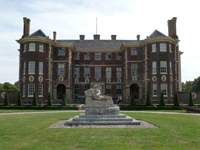
Ham House, Surrey (Image: Matthew Beckett)

The next major change was the elevation of the bedroom into a formal receiving room, a French practice adopted by Charles II after his return at the Restoration in 1660. This is reflected in the layout of Hampton Court Palace, as redesigned by Sir Christopher Wren between 1689–1700, where the state apartments form the centre of the procession towards the presence of the king (though the existing great hall, added in 1532-35, was the last to be built for a monarch).  This fashion had already been adopted by other members of the court, with Charles II’s friend and minister, the Duke of Lauderdale, having created a state apartment  in 1672 at Ham House, Surrey (though, as a rebuilding of an earlier house, it still retained a great hall).

Central stairwell and gallery, Wardour Castle, Wiltshire (Image: Strutt & Parker)
Central stairwell and gallery, New Wardour Castle, Wiltshire (Image: Strutt & Parker)

With the decline in the importance of the hall, it seemed almost inevitable that it would be used as a convenient setting for the ever grander staircases so beloved by the Georgians or even just as a convenient circulation space to pass through between the fine rooms. The broadening of wealth to those who made their money from trade and therefore preferred to live closer to the cities, led to the development of the villa.  Adapted from the Italian model, most famously those of Palladio and Scamozzi, there was neither space nor the social requirement for a great hall.  Chiswick House, designed in 1726, by the arch-Palladian Lord Burlington, had a central octagonal hall.  In larger houses, such as New Wardour Castle, Wiltshire, built 1769-76, is one of the finest examples of the Georgian interpretation of the hall, a cathedral-like space, with curved staircases leading to a columned gallery with a circumference of 144-ft.  Of course, for those favouring the gothic, a great hall was still a core statement of lineal antiquity and so was still included in the plans, leading to beautiful examples such as the Gothic Hall for Henrietta Howard, Countess of Oxford, at Welbeck Abbey in 1751, or as at Ashridge House, Hertfordshire for the Duke of Bridgewater built between 1803-17, decorated with statues of kings.

It was those same intentions to either emphasise a family’s existing heritage or to give the impression that a family had a distinguished past, which led to a broader revival of the great hall in the Victorian era.  By having the benefit of eight centuries of the development of the great hall, a family would be able to design for accuracy, for comfort, but almost always for show. Fuelled by romantic visions of the past by books such as Joseph Nash‘s 4-volume ‘Mansions of England in the Olden Time‘, published in 1839-49,  the hall was now to be a grand display of whatever values they wish to imprint on this most useful of architectural motifs.

A late-Georgian recreation was at Charlecote Park, Warwickshire, in 1830, where the Elizabethan great hall was reinstated.  In 1836, two examples were started independently with accurate medieval revival great halls at Alton Towers, Staffordshire for the Earl of Shrewsbury, and the other for Eustace Tennyson D’Eyncourt at Bayon’s Manor, Lincolnshire.  Each of these represent the two strands to the historic revivalism; Alton Towers being a religious statement, designed by A.W.N. Pugin, and Bayons Manor, of giving substance to a family line. Pugin was one of the keenest exponents for the revival of the great hall. A gothic evangelist who promoted the style as the only true architecture for the country as it was linked to a pre-Reformation England of Roman Catholicism.  The great hall was a symbol of a paternal system which Pugin related strongly to and which could be incorporated into daily life through the use of a great hall where the family could meet and the estate tenants and workers could be fed.

Derelict great hall in 1960s - Bayon's Manor, Lincolnshire (Image: W.T. Jones via Drakes Family)
Derelict great hall in 1960s – Bayon’s Manor, Lincolnshire (Image: W.T. Jones via Drakes Family)

The great hall at Bayons Manor was equally impressive as Pugin’s but was designed by Anthony Salvin. He had probably developed an affection for them whilst working on the restoration of the one at Brancepeth Castle, Co. Durham, in 1829 at the start of his career, throughout which he would create other notable examples including at Harlaxton (1831-38), Mamhead House (1835), and Peckforton Castle (1844). Firmly in the ‘family heritage’ camp is Arundel Castle, West Sussex, where between 1893-98 a vast Baron’s Hall was built, perhaps one of the closest recreations in form and spirit of the medieval great hall.  Although designed by renowned gothic scholar and architect Charles A. Buckler, he worked in exceptionally close co-operation with the 15th Duke, to whom a near constant stream of designs and decisions were passed for his comment and approval. This work was designed to emphasise the great age of the Norfolk family, a re-assertion of their status as one of the premier ducal families.

However, as the nature of the ownership moved increasingly towards those owners whose wealth came from industry and finance rather than landowning, so the need to entertain in large numbers such as the estate workers was less common.  Houses were often for weekend entertaining; smaller groups of business and political associates who would wish to dine in convivial intimacy conducive to discussion.  The role of the great hall moved back towards being a circulation space at the centre of the house, a place where pre-dinner drinks may be served but little more – though, equally, it still had to amaze.

Great Hall - Dundarave, Co. Antrim, N. Ireland (Image: Savills)
Great Hall – Dundarave, Co. Antrim, N. Ireland (Image: Savills)

The hall was often the first room your guests stepped into and so it had to create that all important first impression of your wealth and status.  Lofty, substantial rooms were created with muscular columns, galleries, niches for statues, and space for art.  It’s in this tradition that Dundarave was built between 1846-49 to designs by Sir Charles Lanyon. This top-lit space evokes something of the grand Roman baths and certainly fulfils the requirement to thrill.  The house is currently for sale and I imagine that potential buyers will step through the closed hallway, step out into the great hall and express similar amazement as has been the intention of all owners who have used spaces such as this for centuries; to impress.

—————————————————————-

Sales particulars: ‘Dundarave, Co. Antrim‘ [Savills] – £5m, 549-acres

Article: ‘Selling off the holiday home for £5 million‘ [The Irish Times]

Purchasing the picturesque: Hampton Court and Lasborough Park for sale

Hampton Court, Herefordshire - £12m, 935-acres (Image: Knight Frank)
Hampton Court, Herefordshire – £12m, 935-acres (Image: Knight Frank)

What is beauty? Though it is often in the eye of the beholder, some have attempted to define just what it is. In architecture, this can be seen in the development of the Picturesque ideal which sought to combine natural and man-made elements to compose a vision which would delight the eye and uplift the soul. Hampton Court in Herefordshire, and another house launched this week, Lasborough Park in Gloucestershire, can both be considered part of the Picturesque movement, even though the former took shape before the theory of the sublime and beautiful was brought to life and the latter was built just before the revival took hold.

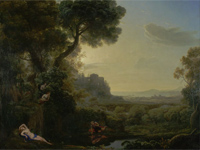
'Landscape with Narcissus and Echo' - Claude Lorrain, 1644 (Image: National Gallery)
‘Landscape with Narcissus and Echo’ – Claude Lorrain, 1644 (Image: National Gallery)

The origin of the Picturesque movement can, in part, be found in the philosophical writings of a much under-rated figure of the 17th-century, Anthony Ashley Cooper, the third Earl of Shaftesbury.  To him, nature ought to be imperfect and that, in turn, we ought to celebrate the untamed trees and serpentine rivers, those dark glades and tumbling crags. Unsurprisingly, the Earl found that the early Italian landscape paintings by Nicolas Poussin, Gaspard DughetClaude Lorrain and Salvator Rosa, reflected best this vision of a wilder natural world.  Landscapes had been unfashionable when Lord Shaftesbury first arrived in Italy in 1686, but by the turn of the century, they were in high demand amongst the grand tourists who carried these canvases back to the UK and into the popular taste of the nation.  These views married with Vanbrugh‘s early call in 1705 for a more natural approach to landscaping at Blenheim Palace, but found its true champion in William Kent in the 1730s, especially in his work at Rousham, Claremont and Stowe. The ideas were then developed further in 1757 in Edmund Burke’s ‘The Origin of our Ideas about the Sublime and the Beautiful‘ which, in its musing on aesthetics, distinguished between the latter, which was all about smooth lines and bold colours, whereas the former is about an awesome beauty on an almost fearful scale.

The death of Lancelot ‘Capability’ Brown in 1783 created a vacuum which led to the revival of the debate as to the most tasteful approach to landscaping.  The arguments were largely between Humphry Repton (who defended Brown’s ‘contrived natural’ approach of smooth curved borders and sweeping lawns which ran right up to the house) versus Sir Uvedale Price, 1st Baronet (b.1747 – d.1829), author of the ‘Essay on the Picturesque, As Compared with the Sublime and The Beautiful’ (1794), who, along with Richard Payne Knight, sought to create a more ‘robustly natural’ approach, where blasted tree stumps and ruins were also important.  This mirrored the first wave of the Picturesque to some extent, but this later flourish created a new passion to rediscover the beauty of the same painters whom Lord Shaftesbury had admired decades earlier.  Although neither Price or Knight worked on any gardens other than their own, their ideas were to have a dramatic impact on the settings of country houses, which were now considered as part of the overall composition rather than separate from it; formal gardens were swept away and snaking carriage drives now swept visitors through glades and past vistas before their arrival.

Detail from 'The Southeast Prospect of Hampton Court, Herefordshire' by Leonard Knyff, c1699 (Image: Wikimedia)
Detail from ‘The Southeast Prospect of Hampton Court, Herefordshire’ by Leonard Knyff, c1699 (Image: Wikimedia)

The grand formalism of the gardens of Hampton Court c1699 (above) contrasted with the asymmetrical grouping of the house. ‘The Southeast Prospect of Hampton Court, Herefordshire‘ by Leonard Knyff, shows how the grounds were a vision of control; of formal avenues and canals (see also the companion North prospect view). The house was, at this time, owned by the Coningsby family, having been bought by Sir Humphrey Coningsby in 1510 from a fellow courtier. His son became the first Earl of Coningsby and it remained in their family for 300 years.  Sir Richard Arkwright (1732-1792), who famously made his fortune from bringing the industrial revolution to the cotton industry, bought the house and 6,220-acres in 1810 for £226,325 (approx. £6.2m). His son, also Richard (1755-1843), made another fortune, before inheriting from his father in 1792, and invested in significant country houses, one for each of his five sons. However, the most significant changes came under his (fourth) son, John, who decided that ‘…of all the situations I know, there is none which suits my taste so well as Hampton Court‘ (funny that). After John’s marriage, the requirements of a growing family persuaded his father that the house needed to be enlarged.

The man chosen to design the work was Charles Hanbury-Tracy, a gentleman architect who had built his own home, Toddington Manor, between 1819-40, in his favoured ‘gothic collegiate’ style at a cost of £150,000 .  Though the style was sympathetic to Hampton Court, the relationship between architect and client became difficult. Another architect, John Atkinson, had pleaded with Hanbury-Tracy not to ‘make Hampton Court a cell to the Abbey of Toddington‘ but his determined views were at odds with Arkwright’s wife, who fell out with Hanbury-Tracy over the nursery arrangements, which led to nearly a decade of alterations and disagreements, especially as the costs mounted to eventually total over £30,000. John certainly preferred working with Joseph Paxton, who created the new conservatory, which was added in 1845-46. That said, the end result is one which successfully married old and new, creating a successful interpretation of domestic gothic and the picturesque.

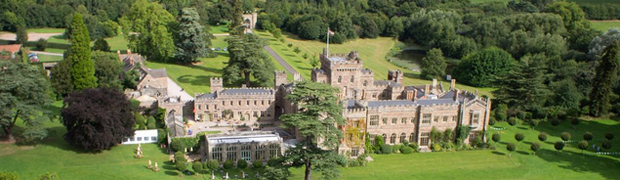
Lasborough Park, Gloucestershire - £12m, 55-acres (Image: Savills)
Lasborough Park, Gloucestershire – £12m, 55-acres (Image: Savills)

The Picturesque was a constant presence throughout the 18th-century but enjoyed a revival of interest in the 1790s and Lasborough Park represented the style just at the cusp of this.  Built in 1794 for Edmund Estcourt, his architect was James Wyatt, who enjoyed a rare skill in being able to master a number of different architectural styles – something which led later to his being unjustifiably underrated.  At Lasborough, Wyatt provided a continuation of the theme which John Martin Robinson in his book on the architect called a ‘toy-fort model‘; that is, a symmetrical house with battlements and corner turrets.  Wyatt had been using this pattern when working on various schemes for remodelling the interiors of Slane Castle since 1773 but it was only over ten years later that he was able to remodel the exterior, taking an irregular L-shape and bringing symmetry by adding matching towers.

Slane Castle, Co. Meath (Image: Slane Castle)

Wyatt’s design developed the tradition of the castellated residence; houses which had been either adapted from an older fortification or made to look like they might have done. Six decades before Wyatts’ work at Slane Castle, earlier versions, such as Howth Castle, Co. Dublin, which was altered significantly in 1738, are evidence that the style was already favoured and also incorporated an effort to create symmetry with the original keep on the left, mirrored in a new tower on the right.

The Picturesque style was popular in Ireland but initially as an import of the Protestant aristocracy and was viewed by some as an attempt to import a ‘little England’, a form of architectural and landscape colonialism. However, Ireland was particularly suited to the forms of the Picturesque which often worked in harmony with its natural beauty to form a unified creation which led the eye of the visitor from the grounds near the house, towards the middle distance, and then out to the wider landscape – much as a painter would structure their picture.

Hampton Court from south west (Image: Knight Frank)

Hampton Court is one of the most important and impressive country houses to come to the market this year.  As part of our heritage, it embodies architectural developments which brought the country house from fortification to domestication, with a landscape which started with formal terraces but finished with flowing lawns.  The genesis of the more structured medieval revival form of Lasborough Park can be seen in the core of Hampton Court and in each of the subsequent alterations.  Both houses are valuable pieces of the nation’s architectural record and deserve owners who will appreciate them and hopefully both will remain as single family homes, enjoyed as they have for generations, for their Picturesque beauty.

——————————————————————-

For a more in-depth history of the Arkwrights and their time at Hampton Court, I recommend: ‘Champagne & Shambles – The Arkwrights and the Country House in Crisis‘ by Catherine Beale [Amazon]

Sales details:

Articles:

Mynde the gap; 2013 country house market finally comes to life

For followers of the country house market, for pleasure or profession, the spring launch period is always of great interest as an indicator of the how it may go for the rest of the year. In previous years, the trophy houses often started making their débuts via glossy double-page adverts in the bible of country house property, Country Life magazine, around Easter.  However, this year, the chocolate eggs came and vanished with few of the expected houses appearing. And so we waited, ticking off the houses being re-launched at a slightly lower price, along with a few ‘minors’. Thankfully, the 2013 launch has finally happened, starting with The Salutation and then Tyringham Hall, and now others join the throng.

Kingston Lisle, Oxfordshire (Image: Strutt & Parker)

Estate agents usually say that the most common reasons for houses coming to market are ‘death, divorce, and down-sizing’ and for Kingston Lisle, Oxfordshire, although the latter two reasons are there, ‘death’ has been replaced by – ‘opera’.

Entrance corridor, Kingston Lisle, Oxfordshire (Image: Country Life Picture Library)

Kingston Lisle, according to John Julius Norwich, is an ‘…absolutely fascinating house…[which]…got itself into a muddle‘ – though this makes it all the more interesting.  With a core dating from 1677, the wonderfully attractive Palladian entrance front was added around c.1720 – so far, so good.  However, the later additions create a hybrid of styles which, taken individually, you may think belong to separate houses. The garden front still retains an Elizabethan look, even though it dates from between c.1820-25 when significant changes were made for the then owner, Edwin Martin-Atkins, whom Marcus Binney has also suggested might have been his own architect (which may explain a few things).  The remarkable interior also dates mainly from then and has two eye-catching features.  The first is as you enter, as once inside, you are in a strikingly bold corridor featuring carytids and fan vaulting, which then leads to the second feature: the dramatic flying staircase.

The current owner, Jamie Lonsdale, has made frequent use of the setting when giving his opera recitals.  The house was bought by Lonsdale’s grandfather, Leo (founder of Lonsdale Investment Trust), for £26,000 in 1943, and his wife spent a lifetime and a fortune on filling it with the finest quality antiques.  Set in 1,000-acres, the house has been passed through the family but now Jamie Lonsdale has decided that he would rather pursue his singing ambitions and so, for a ‘telephone figure sum‘ – approximately £35m, he would trade the life of a squire for that of a singer.

Another house where the staircase, in this case an impressive space rising through the full height of the house, is the principle interest is Sholebroke Lodge, Northamptonshire. Designed by James Morgan, a pupil of John Nash in 1807 who was later better known as a canal engineer, the exterior lacks coherence but with refurbishment it could be an elegant home – even just a coat of white paint would bring back a certain Regency air.

King's Hall, The Mynde, Herefordshire (Image: Knight Frank)
King’s Hall, The Mynde, Herefordshire (Image: Knight Frank)

Fine interior decorative plasterwork is something of a lost art in modern country houses  – in fact, if anyone knows of examples I’d be very interested to hear about them. However, the modern dearth also throws into sharp relief the exceptional quality and craftsmanship which previous generations lavished on their houses and which we can sometimes be seen today.  For the lucky future owner of The Mynde, Herefordshire, (OIEO £15m, Knight Frank) that includes the King’s Hall, so beautiful that Pevsner described it as ‘the finest room in Herefordshire‘.  The work which created it was at the behest of the owner from 1709, the 1st Duke of Chandos.  A controversial figure, his own house at Cannons, Middlesex, was an exuberant display of wealth but mocked by Alexander Pope and later demolished in 1747, with the church sold and moved to Witley Court.  Yet, hidden within the restrained yet imposing façade of The Mynde, this hall is a careful balance of elements to create a magnificent room.  Set in a 1,180-acre estate, this is the quintessential country house and fine estate, a rare combination where so often today one fails to live up to the other.

Tavy Hall, Devon (Image: Knight Frank)

For those seeking a more coastal air, it would be difficult to beat the spectacular waters-edge setting of Tavy Hall, Devon.  With houses usually built in more protected sites inland, the location chosen nearly 900 years ago was certainly unusual. The house itself was largely rebuilt around the 12th- and 13th-century core between 1825-32, creating a larger, symmetrical front.  The house is surrounded by 32-acres of gardens, including a stretch of the foreshore, with a further 20-acres of woodland, which the new owner would be strongly advised to buy to ensure a reasonable estate.

Brent Eleigh Hall, Suffolk (Image: Savills)
Brent Eleigh Hall, Suffolk (Image: Savills) – do click through for more photos

Some houses seem to be a contradiction; grand but small, spacious but manageable – and the impressive Brent Eleigh Hall, Suffolk falls into that category.  The early history of the house is unclear, at its heart may be an Elizabethan E-plan building, but one which has now been wholly encased in a fine Georgian cloak.  The garden front features two projecting three-bay wings but which supports between them a much grander Tuscan portico.  The entrance front is a more subtle arrangement but with variety to enliven; two shallow pilasters, a 4-bay stepped-forward projection, and a rather flamboyant shield in the pediment – but of most interest is a wonderfully elegant doorcase, the work of one Sir Edwin Lutyens in 1933-34 when commissioned for some minor alterations.  Inside, the most dramatic feature is the grand staircase with its oval ceiling painting and stucco surround.

The house is offered at £3m with 39-acres but the photos show that this is a house which probably needs a substantial amount spent (probably at least £500k-£1m) to bring it to a modern standard.  That said, I hope the new owners tread lightly in their restoration; the temptation will be to scrub it to a high-shine but in doing so it may lose something of that patina of character that has been built up over time.  Hotel chic is fine in a hotel but one hopes for a more human touch in the end result for this wonderfully attractive house.

Brownshill Court, Gloucestershire (Image: Strutt & Parker)

Still, for me, the enduring allure of a Classical house, with it’s beguiling symmetry, is where I would head with my as-yet-elusive lottery win. With those criteria, at the moment, I would be straight off to Painswick in Gloucestershire to rescue the sadly neglected Grade-II* Brownshill Court (£2m with 18-acres).  Completed c.1760, the brochure photos now show in clear detail the scale of the work involved in bringing this gem back to life, with masonry missing, degraded stonework and a lifeless interior.  Yet, underneath that is clearly the original, very fine house, designed by Anthony Keck (who was also responsible for Highgrove), struggling to shake off its recent mistreatment.  With deep pockets, architectural sensitivity and vision, Brownshill Court could again stand as one of the finest houses in the Cotswolds.

Estate agents and the specialist buying agencies will be hoping that 2013 continues the ascent from the doldrums of 2008/9 (though a surprising number of houses are launched and also fail to sell before being quietly withdrawn).  For country house watchers, the spring launch again shows what fine and varied houses are available, tucked away in quiet valleys and parks, sometimes little known even to those living closest – but what a delight to see them when they do appear. Who knows what the rest of the year might bring?

———————————————————–

For a listing of the top 100 homes for sale, do check out the BISH100 on the British and Irish Stately Homes blog

Further information

Kingston Lisle, Oxfordshire

Other sales particulars:

‘So you made the 2012 Sunday Times Rich List…’ – a selection of country houses for sale

Spring is upon us: the birds are singing, the flowers are blooming, the drizzle is almost incessant – *sigh*. One bright spot is each week’s increasingly heavy Country Life magazine; the extra weight from the greater number of property adverts which signal the launch of the late spring/early summer (hah!) country house sales push. Below is a round-up of some of the most interesting and beautiful properties currently for sale, all entirely and subjectively chosen by me.

Bletchingdon Park, Oxfordshire (Image: Knight Frank)

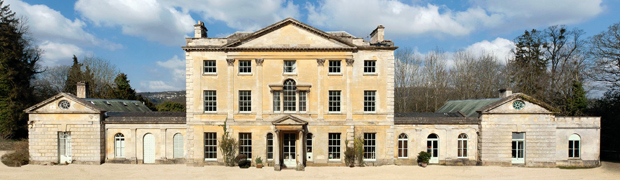
The most impressive house to be offered for sale this year so far has to be the beautiful Bletchingdon Park, Oxfordshire [Knight Frank]. One of the relatively few Palladian villas in the county, it can easily hold its own with the others such as Kirtlington Park (completed in 1746) and Nuneham Courtenay (built 1756).  Bletchingdon Park was slightly late to the Palladian party, being built in 1782 for Arthur Annesley, Viscount Valentia, to the designs of James Lewis (b. c1751 – d.1820).  Lewis was mostly employed as surveyor of various charitable hospitals in London and near counties but he also completed a clutch of excellent country houses including Eydon Hall, Hackthorn Hall, and Lavington Park (now Seaford College). Owned since 1993 by Dr Michael Peagram, a philanthropist and chemicals industrialist, the grade-II* house has been obviously well cared for and offers the highly desirable combination of an imposing facade, superb views, 127-acres and elegant interiors which includes a wonderful sweeping, top-lit staircase – if you have £20m.

Cockfield Hall, Suffolk (Image: Savills)

For those who prefer an alternative to the architectural austerity of Palladianism, then Suffolk offers a wealth of brick houses; statements just as bold, but in a different language. Cockfield Hall, Suffolk [£5m, 74-acres, Savills] has a grand façade, galleried great hall, a wealth of rich plasterwork ceilings, and a range of estate buildings in the same style.  Although mainly built in 1613, the windows were sashed c1770 and the overall look is largely due to later Victorian enhancements, including the upper storey, gables, the great hall and various Tudor motifs.  That said, it is undeniably attractive as the changes work well together.

Highfields Park, East Sussex (Image: Knight Frank)

There is often something just so elegant about Regency houses, particularly the smaller country villas which echoed the style and features of much larger and grander houses. Highfields Park, East Sussex,  [£5.75m, Knight Frank] is set in 191-acres, and overlooks its own lake and out to the countryside.  The house has grown as the ambitions and wealth of the owners allowed; a ballroom being added to the east and a swimming pool beyond that. Awkwardly, access to latter is through the former so just be careful not to schedule a pool party at the same time as your formal dances; though, on the upside, it will be easy to tell which guest is supposed to be at which party.

Ayton Castle, Scotland (Image: Knight Frank)

Previously offered for sale in May 2011 for £3m and now re-listed, Ayton Castle, Scotland [offers over £2.2m / Knight Frank] is a sprawling confection of Scots Baronial motifs; the design the work of two of the best architects working in Scotland at the time, now set in 159-acres.  The house was originally built in 1851 for William Mitchell-Innes who commissioned the talented James Gillespie Graham. Graham was known for his work in the Scots Baronial style which became so popular in the Victorian era, notably on the praise of Sir Walter Scott and the Queen’s remodelling of Balmoral.  Yet, Graham was a rare architect comfortable working in various styles; neo-classical at Blythswood House or semi-ecclesiastical Gothic at Cumbusnethan Priory (now tragically a ruined shell).  Ayton was later extended in 1860, with the addition of a billiard room and an enlarged drawing room by David Bryce.  Bryce, perhaps, more than any other architect, can be argued to be responsible for the legacy of Scots Baronial, if only through his prolific output of more than 230 buildings including many country houses such as Craigends (dem. 1971), Panmure House (dem. 1955), Torosay Castle and Dalmore House (burnt out 1969). Considering the tragic swathe cut through his work, it’s a shame that legacy wasn’t appreciated.

Honourable Mentions

There are, of course, many other good houses featured in Country Life but some would not be regarded as the seat of an estate – but they are still wonderful country houses; albeit ones with very large gardens and worth a mention.  A couple here are proper country seats but just haven’t made it to the list above:

Bradwell Lodge, Essex (Image: Matthew Beckett) - for sale: £2.25m through Jackson-Stops & Staff
Bradwell Lodge, Essex (Image: Matthew Beckett) – for sale: £2.25m through Jackson-Stops & Staff

Bradwell Lodge, Essex – a house of contrasts and a mixture of architecture; a Tudor core, latter additions by Robert Adam, Robert Smirke the elder, and Quinlan Terry, with decoration by Angelica Kauffman. The library/small dining room in the projecting bay on the ground floor is particularly elegant with twisted-wire screens to the bookcases. Grade-II*, 26-acres, £2.25m [Jackson-Stops & Staff]

Broadwell Manor, Gloucestershire – grade-II*, 35-acres, excess £8m [Knight Frank]

Burnham Westgate Hall, Norfolk – a fascinating early house by Sir John Soane which has previously featured on this blog (‘For sale: a Soanian springboard‘). Grade-II*, 38-acres, £6.5m (down from £7m) [Knight Frank]

Glansevern Hall, Powys – an apparently unique property in that it is the only complete house designed and build by the architect Joseph Bromfield and which also features some impressive gardens. Grade-II*, 80-acres, £4.5m [Balfours]

Rainthorpe Hall, Norfolk – grade-I, 18.7-acres, excess £2.95m [Strutt & Parker]

Roundhill Manor, Somerset – grade-II, 280-acres, £6m [Savills]

—————————————————————————

For other updates on country houses for sale do sign up for the excellent British and Irish Stately Homes blog, which is written by Andrew Triggs who frequently contributes comments on this blog.

If a moat floats your boat: for sale; Playford Hall and Giffords Hall, Suffolk

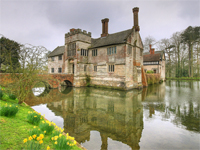
Baddesley Clinton, Warwickshire (Image: Nala Rewop / flickr)

Moated houses are an architectural short cut to a more functional time when where a family lived had to be defensible and not simply a place of relaxation.  Today, of course, we admire them for their ancient charm, the weathered bricks reflected in gently rippling waters.  These houses are an older expression of our love of the natural, which found a more formal form in the later Picturesque movement, their more organic outlines in contrast with the more rigid classicism which followed.

Though once numerous, time has taken its toll and excellent examples are less common – and especially appealing when they come to market, as two have recently. The moated manor house was a result of many factors; the decline of the traditional castle, a more peaceful society, and increased wealth, but still with a need to provide some defence against thieves and attackers.  The latter category was increasingly rare but a moat with gatehouse and even drawbridge had a practical advantage.  However, for families which wished to visually bolster the perceptions of the grandeur of their lineage, a moated house was very evocative of permanence and status, drawing on their architectural ancestry with castles.  As each manor required somewhere for the local owner to stay (sometimes only occasionally if they owned many) each had a house of varying size and status depending on the wealth of the owner.  As each manor often covered a relatively small area this led to the building of thousands of these houses (though not all with moats), particularly in England.

Groombridge Place, Kent (Image: Hans Bernhard / wikipedia)

The organic growth of a moated house often created a pleasing historical collage of styles, such as at Ightham Mote, Kent, though this was sometimes swept away to be replaced by a new house such as at Groombridge Place, also in Kent.  This beautiful house was build in 1662 though in a traditional Jacobean/Elizabethan ‘H’ plan on the footprint of the older, more fortified house – though the diarist John Evelyn thought, following his visit in August 1674, that “…a far better situation had been on the south of the wood, on a graceful ascent.” indicating not everyone found a moat romantic.

Yet not every grand family felt the need to abandon the old house.  The Lygon family (Earls Beauchamp between 1815-1979) have lived at the evocative Madresfield Court, Worcestershire for 28 generations.  At its core, a 15th-century moated manor house, the current building is largely the work of the architect Philip Hardwick in 1865 for the 6th Earl Beauchamp.  The house is a prime example of late Victorian taste; a clever blend of Anglo-Catholic Pugin gothick with extensive Arts-and-Crafts interiors including a wonderful library by C.R. Ashbee of the Cotswold Guild of Handicraft (to read more about this remarkable family and house I can recommend ‘Madresfield: the Real Brideshead‘ by Jane Mulvagh).

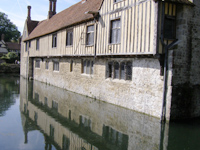
Ightham Mote, Kent (Image: Matthew Beckett)

The physical security of a moated house was also a factor in its decline as it limited the space available for expansion as either the family, wealth or ambition of the owner grew. Many a grand country house was constructed elsewhere to replace a smaller manor with the old house either being abandoned, demolished (sometimes for building materials), or used as a secondary or dower house.  Yet, as a harsher economic reality came to pass from the 1880s, and as these smaller houses were lauded in magazines such as Country Life, so their attractiveness grew with many rescued from neglect and sometimes reinstated as a principle house on the estate.

H. Avray Tipping, one of the most influential of the Country Life writers, was a prime supporter of the smaller houses as reflected in his choice of house for the weekly ‘Country Houses and Gardens’ section – nearly a fifth of them in 1910, for example.  This was also a time when John Ruskin was arguing for more honesty in architecture and against the over-enthusiastic renovations of the Victorians which he regarded as ‘ignorant’. This regret at the neglect of manor houses in general can be seen even in the earliest Country Life articles.  Writing in 1897 (the year it was founded), John Leyland writing about Swinford Old Manor, Oxfordshire, said;

“There are manor houses through the length and breadth of the land as charming, it may be, as this, but awaiting, like sleeping beauties, the kiss that is to arouse them to fresh and unsuspected charm, the needed touch of the loving hand invested with creative skill.”

Plumpton Place, Sussex (Image: Knight Frank)

Perhaps one of the best examples of this loving restoration can be seen at Plumpton Place, Sussex for Country Life proprietor Edward Hudson by the architect Sir Edwin Lutyens.  When Hudson bought the it in 1928 the house was semi-derelict though with an intrinsic beauty from its setting on an island in the middle of the uppermost of three lakes.  Lutyens successfully restored and adapted the house to create one of the best current examples of a moated manor house – which was also offered for sale in July 2010 for £8m (and featured in another post: ‘For those who like their houses with pedigree: Plumpton Place, Sussex‘)

So having whetted our collective appetites, those with £3.5m to spare currently have a choice of two historic moated manor houses in Suffolk; Playford Hall, near Ipswich (£3.25m), and Giffords Hall, in Wickhambrook (£3.5m).

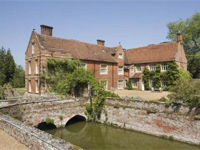
Playford Hall, Suffolk (Image: Savills)

Playford Hall has the beauty of the warm red-brick with two wings placed off-centre, hinting at the further wing demolished in the 1750s after a devastating storm in 1721 blew holes in the roof and following a long period of dereliction from 1709 following the death of the owner, Sir Thomas Felton, who had remodelled the house in its current style.  The house then passed by marriage into the estate of the Earls of Bristol, in which it remained until sold after WWII.  The house has been restored and updated – though whoever buys it will probably want to re-do the eye-wateringly pink dining room.

Giffords Hall, Suffolk (Image: Savills)

No such concerns about the wonderful interiors of Giffords Hall – the house abounds with historic woodwork, from the masses of exposed beams to the extensive panelling.  The exterior, in contrast to Playford, is almost entirely timber-framed, with an Arts-and-Crafts style north wing added in 1908 by the owner Mr A. H. Fass who also carefully restored the house following a period of neglect.   Now cleverly brought up-to-date, in co-operation with English Heritage, the house now has a full suite of reception rooms, a new kitchen and a full quota of bathrooms.

So, proving the folly of those who allowed these romantic houses to decay and the wisdom of those who restored them – with thanks to the evangelism of Country Life – another important branch of the nation’s architectural history has been redeemed and now, once again, attracts high valuations which reflect the immediate attraction these houses can exert on us all.

—————————————————————————-

For further reading, the excellent ‘The English Manor House – from the archives of Country Life’ by Jeremy Musson – though unfortunately this appears to be out of print and surprisingly expensive. One for the second-hand bookshop search, I think.

For those looking to visit, a handy list: ‘Manors in England‘ [Britain Express]