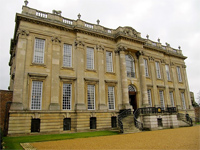
Romancing the stone; country houses built by love

Many a man has been driven to great lengths by love – and architecture is often a rewarding though insatiable mistress for such a passion.  Whether as an expression of love for a wife or a demonstration of a yearning, aching heart, each found that their country houses were caught in that very human desire to make real those Romantic desires which otherwise are sometimes only expressed in far more transient ways. Though sometimes love’s labours are lost to unrequited desires, often country houses were the ideal means to commemorate the passions which had created their happiness.

Osborne House, Isle of Wight - holiday home of Queen Victoria and Prince Albert (Image: English Heritage)
Osborne House, Isle of Wight – holiday home of Queen Victoria and Prince Albert (Image: English Heritage)

The motivations behind the choice of architecture or design or even the starting of the construction of a new country house is sometimes overlooked in the literature. The occasion of ennoblement was an important catalyst for a grander house and equally a marriage and new building project are often keen bedfellows – though often the new house was financed through the newly acquired wealth of the husband from his bride and was more an expression of his newly-bolstered financial strength.  With the status of the married woman somewhere equal to that of the china plates, for many, their influence was limited to the running of a home.  The choice of some furnishings and the interiors of the ‘female’ areas of the houses were often the accepted limits of the wife’s contribution – though there were exceptions such as Lady Leicester who, after 1759, was left £2,000 a year to finish several of the state rooms at Holkham Hall (n.b. website annoyingly plays birdsong automatically).

Syon House, Middlesex (Image: Syon House)

The choice of architect, interiors, furnishings, furniture and art were all reserved for the man as an expression of his taste and power. Writing of his design for Kimbolton Castle, the architect Sir John Vanbrugh said, “I’m sure this will make a Noble and Masculine Shew‘, and that in the exterior visitors would “See a Manly beauty in it when tis up…‘. Clearly reflecting the female taste, or even necessarily their comfort, was not high on an architects priorities. Although some enjoyed a level of luxurious indulgence, such as the Dowager Lady Egerton for whom James Wyatt created a sumptuous Pompeiian-style dressing room at Heaton Hall in the 1770s, perhaps the experience of the Duchess of Northumberland was more common.  When Robert Adam remodelled their London seat, Syon House, in the 1760s, he was careful to place the Duke’s private apartments in a separate area, accessed via a private staircase, whilst the Duchess’ dressing room enjoyed a much less secluded arrangement, as it was included in the main circuit of entertaining rooms.
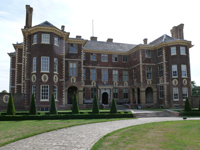
Ham House, Surrey - now owned by the National Trust (Image: Matthew Beckett)
Ham House, Surrey – now owned by the National Trust (Image: Matthew Beckett)

Wives and widows were slowly asserting greater independence, often due to their personal wealth, but slowly changing attitudes did provide greater opportunities for their views and tastes to be heard and seen.  In the 17th-century, couples such as the Duke and Duchess of Lauderdale were acting very much in concert together in the design and furnishing of their home, Ham House. It had been the home of the Duchess and her father and she had fiercely held on to it during the dark years of the Civil War when he had been forced to escape abroad. After her marriage in 1672, Ham House became not only a symbol of their wealth, but also a testament to their shared love of travel and the finer things in life.

Dobroyd Castle, West Yorkshire (Image: wikipedia)

Romance was surely often part of the motivation to build; a golden word that could turn a mere building into architectural poetry. Dobroyd Castle in Todmorden was the creation of a wealthy local mill owner, John Fielden, to honour a promise after his intended bride, Ruth, a poor labourer’s daughter, had said, during their extended courtship, “Build me a castle and I’ll marry you.“.  This can be said with either a romantic or mercenary inflection but, in honour of St Valentine, let’s believe that her request was for a fairytale expression of their marriage.  At least it was not a pre-condition, as they married in 1857 and work started on the castle in 1866 with completion in 1869.  Designed by the little known architect John Gibson, throughout the house the initials of John and Ruth are carved into the building many times as a constant reminder of their love.

Luscombe Castle, Devon (Image: Country Life Picture Library)

The desire to do all one can for a wife, especially one who is ill, creates opportunities for love to be the patron of great architecture.  The delicate health of Dorothea Robinson, wife of Charles Hoare, a partner in the eponymous family bank, necessitated a more temperate climate and so an estate outside the small Devon coastal town of Dawlish was purchased. Requiring a house and not lacking in funds, Hoare commissioned the fashionable John Nash and Humphry Repton to create a retreat for rural recuperation.  With Repton’s help, Dorothea chose a most Picturesque site nestled in a secluded valley. Repton then recommended to Nash that it be in the ‘Character of a Castle’, and so Luscombe Castle was built between 1800-1804.  Considered one of the finest Regency houses, the external beauty is matched with a domestically convenient interior; a distilled version of Nash’s rather grander castle designs, but which perfectly suited the location and as a romantic reminder of a husband’s concern for his wife.
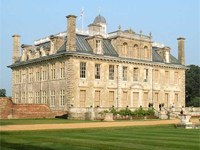
Kingston Lacy, Dorset (Image: wikipedia)

A love unrequited or thwarted is often a powerful force which can inspire many things.  For some, such as William Bankes, a prominent MP and renowned traveller, his enforced exile to escape a possible death penalty for being caught in a compromising situation with a soldier in Green Park in 1841, meant leaving his life’s work; the building and beautification of his Dorset home, Kingston Lacy. Subject to a punitive ‘outlawry‘ order, Bankes first escaped to France before settling in Venice. Bankes had been forced to give up, under threat of forfeiture, any legal title to his estates and contents to his brothers but he continued to be relatively well-funded and managed the building works at Kingston Lacy via detailed correspondence with the Clerk of Works.  One can only guess at the frustration of Bankes as he could only imagine how his plans were turning out, not only in relation to the building works but also the numerous pieces of art which he sent to Dorset.  Proving that for love, some will risk all, it is thought that Bankes risked imprisonment to be smuggled back into England in 1854 so that he might see his house and collection, which he had only been able to dream of, and give direction as to how it might be finished.

Wallington Hall, Northumberland (Image: Visit Northumberland)

By the Victorian era, it was often both the husband and the wife who would take increasingly equal roles, especially as the role of the house was firmly centred on entertaining; a role traditionally taken on by the wife. It also reflected a relatively more accommodating age when women were at last more broadly considered intelligent equals to men.  The increasing importance of women can also be seen in the literature where discussion of the creation of a house now talks more husband and wife, though still often with their roles demarcated to exteriors/interiors.  The wives often had their own circles of interest leading to interesting contributions such as at Wallington Hall in Northumberland where the Pre-Raphaelite painted decoration in the central hall is by the artist William Bell Scott, whom Lady Pauline Trevelyan met through her literary activities.

Osborne House, Isle of Wight (Image: English Heritage)

Perhaps the most famous husband and wife architectural collaboration in the Victorian era was the creation of the summer retreat at Osborne House on the Isle of Wight by Queen Victoria and her beloved husband, Prince Albert.  With a society leaning towards a more moral aspect, Victoria was determined that the royal family should be seen in step with it and so the planning of Osborne is not only to meet the needs of the family for entertaining but also, equally, that it be a family home. Indeed, writing to her daughter in 1858 from Windsor Castle, she tells how “I long for our cheerful and unpalacelike rooms at Osborne.”.  Her husband’s influence was the Italianate exterior, with the stucco work and belvedere towers, designed by the Prince and the London builder Thomas Cubitt, which matched his passion for Italian art, though Victoria was perhaps also influenced by the design of Trentham Hall, Staffordshire (by Sir Charles Barry) which was the home of her close friend the Duchess of Sutherland.  Osborne became the place she perhaps most associate with her husband and, after his death in 1861, it was one of the places she felt most at ease.

So, the building of a country house isn’t simply to mark ennoblement or new wealth, but can be an expression of love or passion between a couple, which one hopes might be more inspiring.  Certainly a love of country houses is something to be celebrated any day of the year.

—————————————————–

If you know of any other examples (and I’m sure there are many) please do add a comment below.

Happy Birthday Sir John Vanbrugh; the master of English Baroque

Portrait of John Vanbrugh (1664-1726) by Sir Godfrey Kneller (Image: Wikipedia)

One of the most exciting eras of British architecture was the Baroque; a unique fusion of Continental influences, leavened with a dash of characteristic restraint, which created something elegant, strident and theatrical – words which could equally describe the best known architect of that time, Sir John Vanbrugh, born 350 years ago this month.

Although much is known about his later life, his exact date of birth is not; simply that he was baptised on the 24 January 1664 (though he .  Born into a wealthy and well-connected family (his father was a sugar trader), his schooling and early career are still subject to some debate, with suggestions that he spent time working at a trading post in India.  The first solid evidence is his commission in January 1686 in the Earl of Huntingdon‘s foot regiment, though he was to leave in August that same year. After this, Vanbrugh engaged with the Whig cause and played a minor role in the Glorious Revolution of 1689 – though he was to miss the event itself as he spent four and half years in French prisons, including the Bastille, from September 1688 on (what Kerry Downes believes to be trumped up) charges of spying. Emerging in 1692, he had three months of enforced leisure in Paris until he could return to England, where he promptly joined the Navy, taking part in an attack on the French.  In the mid-1690s, he returned to London and became a playwright but also started developing his architectural career, perhaps in response to the changing social tastes in the late-1690s which found his bawdy Restoration comedies increasingly unacceptable.  A witty, intelligent and convivial character, Vanbrugh was never short of friends or connections.

Once Vanbrugh had decided to be an architect, he appears to have passionately embraced his new vocation – something noted by his contemporaries, including Jonathan Swift, who remarked that ‘Van’s genius, without thought or lecture, Is hugely turn’d to architecture‘. Most architects have to prove their skill with smaller projects but Vanbrugh was to start with possibly one of the most important commissions then available, Castle Howard for the Earl of Carlisle, and make such a dramatic entrance that his reputation was firmly established from then on.

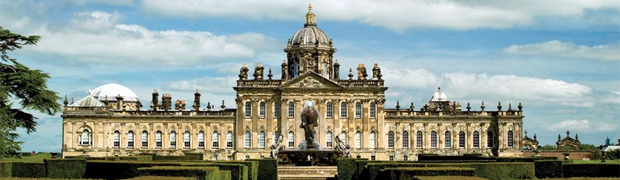
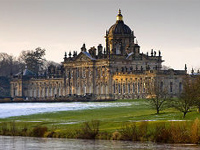
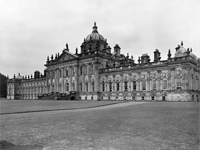
Castle Howard, Yorkshire (Image: Yorkshire Country House Partnership)

Broadly, the designs produced by Vanbrugh can be seen as a distillation and development of the work of three other architects; William Talman, Nicholas Hawksmoor and Sir Christopher Wren.  Talman had created the first Baroque country house, with his south and east fronts of Chatsworth House, completed in 1696.  Baroque had originated and developed in Italy with architects such Bernini, Borromini and da Cortona using the language of ancient Rome to express the majesty of the Catholic church, and also by French monarchs as a statement of their absolute power. Its use by the resolutely Whig Protestant 1st Duke of Devonshire, was perhaps a carefully calculated statement to both the monarch, to remind him that power now lay with them, and a snub to the Catholic church, that their chosen style across Europe was firmly owned by the Protestants in England.

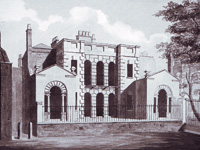
'Goose Pie House', Whitehall - designed by Sir John Vanbrugh 1700 (Image: copyright of The Trustees of Sir John Soane's Museum, London)
‘Goose Pie House’, Whitehall – designed by Sir John Vanbrugh 1700 (Image: copyright of The Trustees of Sir John Soane’s Museum, London)

Vanbrugh, although closely allied with the Whigs and sympathetic to their preferred style, also showed a medieval influence, with a clear interest in the military architecture of the period. In both his commissions and his own home in London, ‘Goose Pie House‘ in Whitehall, he incorporated the martial vocabulary of turrets and towers, giving his work a more monumental aspect, a solidity which played well with the aristocratic patrons who wished to evoke their family history but also wished to live in contemporary luxury.

With Baroque as an astute political choice, Vanbrugh was also able to bring his theatrical flair to play with the rich language it provided.  Castle Howard is one of the finest buildings in the world, and certainly one of the grandest in the country – not a bad start for a novice.  Horace Walpole visited in 1772 and afterwards wrote:

Nobody had informed me at one view I should see a palace, a town, a fortified city, temples on high places, woods worthy of being a metropolis of Druids, the noblest lawn fenced by half the horizon and a mausoleum that would tempt me to be buried alive: in short, I have seen gigantic places before, but never a sublime one.

Lord Carlisle was a well-educated and well-travelled man whose Grand Tour had taken him across Europe, including, naturally, Rome.  Although William Talman had been first given the job, his irascible nature led to his firing, and so, in 1699, Carlisle gave his fellow Kit-Cat Club member, Vanbrugh, the chance of a lifetime.

Here, it is worth making clear that Vanbrugh’s houses, and especially Castle Howard, were joint enterprises with another exceptional architect; Nicholas Hawksmoor.  Assistant to Sir Christopher Wren, Hawksmoor was an expert on Classical architecture and drafting and also a sound project manager who helped deliver Vanbrugh’s ideas from paper to stone. Hawksmoor has often been given credit for the designs of Vanbrugh’s houses but it seems that, as John Summerson said, both were exceptional men, and that each was the perfect compliment to the other.

Drawing showing original plan for Castle Howard (Image: via Visiting Houses and Gardens)

Construction started on the east wing of Castle Howard in 1699 and was completed by 1703, with the main block finished in 1706, the principal apartments by 1712 and the most important interiors by 1715, at a total cost of £38,000.  And what a house Lord Carlisle got for his money – a composition of low wings, leading to a grand central block, decorated with vibrant stonework, culminating in the first dome to be used on a country house in the UK, with interiors which cleverly used light and space to create a theatrical effect to awe any visitor.  Drawing from an earlier design for Greenwich Hospital by Sir Christopher Wren, Vanbrugh’s imagination had been given full reign to develop a most remarkable response to his client’s commission, fused with the crisp execution of the work overseen by Hawksmoor.  Carlisle was delighted with his new palace – which proved both domestically convenient and warm – but the architectural ripples the house created led to wide admiration, with it even being included in the ‘bible’ of Palladianism, Vitruvius Britannicus.  The additional triumphs of the parkland buildings, also mostly by his hand, cemented the reception of this house and setting as one of the most brilliant to have been created anywhere in the country.

Blenheim Palace, Oxfordshire - entrance front (Image: Blenheim Palace)
Blenheim Palace, Oxfordshire – entrance front (Image: Blenheim Palace)

Vanbrugh’s success led to his second great commission, Blenheim Palace – though it was to be a much less happy experience for both client and architect. Whilst still working at Castle Howard, construction at Blenheim began in 1705.  Intended as a monumental tribute from a grateful nation to the Duke of Marlborough, it was also supposed to be a home. That demand for something which spoke not only to the stature of the recipient but also the generosity of the Royal patron, was perhaps the perfect commission for Vanbrugh and his imagination.  Sadly, relations between the architect and the Countess of Marlborough were fractious and Vanbrugh was eventually banned from the site and never visited his completed design.

Despite this, the building is an immense display of bravura – a vast testament to the breadth of imagination, which was reflected in the cost which spiralled from the Duke’s original suggestion of £40,000 to £300,000 by the time it was complete.  The design is broadly similar to that of Castle Howard but with an added degree of magnificence which elevates it using not only the sprawling scale but also the extensive decorative martial stonework to attain monumental status.  That the building had to be finished by Hawksmoor – who described himself as ‘a Loving Nurse that almost thinks her child her own‘ – doesn’t detract from one of the defining buildings of that age, a magnificent testament to Vanbrugh’s skill.

Kings Weston House, Bristol (Image: Country Life Picture Library)

Driven by his interest in military architecture, Vanbrugh’s other country house designs can also be seen to be drawing on his personal preference for the spirit of fortifications.  In 1707, whilst working on Kimbolton Castle, Huntingdonshire, he wrote in a letter ‘…I thought twas absolutely best, to give it Something of the Castle Air, tho’ at the Same time to make it regular‘.  With his next commission, Kings Weston House, in 1709-10, what starts as a compact and elegant villa is given the flavour of a castle above the roofline, with the chimneys grouped together in a central stack, evoking the idea of a keep.  At Lumley Castle it was the reverse, with an Italianate air being applied to a truly ancient castle.

The last three country houses Vanbrugh designed in the years before his death were perhaps some of his finest – concentrated distillations of his ideas but each given its own distinctive approach.  Seaton Delaval Hall is perhaps the best expression of the castle as country house; a central block with a keep-like mass in the centre, a bold entrance taking the form of a gatehouse, flanked by two turrets.  This formula is almost a hallmark of Vanbrugh (bar Kings Weston and Kimbolton which deviate) but the inventiveness of each shows that as with the English language, the architect was also a master of this architectural vocabulary.  Eastbury House in Dorset, merged elements of Blenheim, Kings Weston and Seaton Delaval whilst Grimsthorpe Castle is perhaps the best expression of the blend between that outline and the Classical style, creating a deeply satisfying design which delights to this day.

Grimsthorpe Castle, Lincolnshire (Image: Grimsthorpe estate)

Within his lifetime and much later, Vanbrugh was hugely influential, yet the fashion for Baroque was quickly to wane after his death in 1726 – Summerson points out that by 1728 it was the subject of caricature, and by 1730 presumed dead.  Anglo-Baroque offered an attractive stylistic path with a symmetry which felt natural to the British, but combined with a flair that gave real vibrancy wherever it was used.  350 years later, in our more pluralistic and accommodating age, Vanbrugh – and by extension Hawksmoor – would have been able to co-exist with Burlington and Flitcroft and the stage would have been set as with each new building they vied to win the architectural hearts of the nation. Perhaps our greatest regret with regards to Vanbrugh should be that the coming of Palladianism and its zealous evangelism was to end the development of Sir John’s more exciting and theatrical approach but today we can at least admire and fully appreciate his genius in stone.

———————————————————–

Further reading and visiting details

Biographies 

Houses

Castle Howard – still owned by the Lords Carlisle, open to the public

Blenheim Palace – still owned by the Dukes of Marlborough, open to the public

Kimbolton Castle – now a school, occasionally open to the public

Kings Weston House owned by Bristol Council, leased to a private individual, not open to the public, though the parkland is.

Lumley Castle – now a hotel

Seaton Delaval Hall – owned by the National Trust, open to the public

Eastbury House (demolished bar one wing) – privately owned, not open to the public

Grimsthorpe Castle – owned by a charitable trust for the de Eresby family, open to the public

‘On behalf of a grateful nation’: country houses given to military leaders

Nations have always found ways to reward those subjects who have rendered some greater or lesser service.  In earlier centuries, this often took the form of positions at Court which came with a salary, prestige, and unrivalled opportunities to feather one’s nest.  Titles have also always been popular, ranging from a baronetcy for those who have hosted the monarch for a weekend, to dukedoms and earldoms for the upper echelons of Court and on the battlefield – and it’s this latter category who have also enjoyed that rare gift of an entire country estate, in recognition of their services.  Such largesse is now unthinkable but the practice of rewarding military leaders in this way only fell from favour perhaps later than might be imagined.

Blenheim Palace, Oxfordshire (Image: Blenheim Palace via flickr)

The grandest and most spectacular of these gifts is Blenheim Palace in Oxfordshire – though the intrigues for both monarch, recipient, recipient’s wife, and architect make it something of a mixed blessing.  The recipient was certainly worthy of such a grand prize; John Churchill, 1st Duke of Marlborough had risen through numerous victories to elevate and secure Britain’s place in the world, defeated the ambitions of various European leaders, and created the peace which ushered in the Georgian era.  These glorious victories provoked such a feeling of patriotic pride that even his critics praised him.  So how to reward such a man for such remarkable achievements?

Great Hall and Eastern Corridor, Blenheim Palace (Image: Country Life Picture Library)

Blenheim Palace was to represent many things – explicitly a national monument to the defeat of Louis XIV’s plans for European domination at the Battle of Blindheim in 1704, the considerations of it as a house were somewhat secondary. It embodied the idea that whereas previously the glory of the nation was demonstrated through the palaces of the Monarchy, Blenheim was the first which sought to do this though a private individual.  However, Marlborough’s close ties with Queen Anne would inevitably mean the prestige would reflect onto her and the nation. Work started in 1705 and, writing in 1709, the architect of the house, Sir John Vanbrugh stated,

‘Tho’ ordered to be a Dwelling house for the Duke of Marlborough and his posterity [it was] at the same time by all the world esteemed and looked on as a publick edifice, raised for a Monument of the Queen’s glory.’

The Queen had already resolved to gift the estate at Woodstock but the agreement on paying for the construction of the house was a murkier affair.  Royal patronage could cut both ways as the Marlboroughs and Vanbrugh found out.

Vanbrugh was the ideal choice for a building of this nature.  His background in theatre design gave him an understanding of dramatic effect and his relative inexperience and lack of formal training meant his imagination was bolder than others.  The commission at Blenheim required such a mind; the resulting spectacular building was a monument to power and prestige, incorporating military forms and details to reflect the occasion, but was also one of the most complete expressions of English Baroque.  Yet despite his fabulous wealth, the Duke was determined that the state would show its gratitude by paying for the construction, though he had originally intended the budget to be no more than £40,000 (approx £5m).  Wren had estimated £90,000 – £100,000, however the final cost totalled nearly £300,000 (approx £38m) for which the Treasury eventually was liable (proving that for government projects it was ever thus!).

Castle Howard, Yorkshire (Image: Castle Howard)

Such overruns were to be expected where the intention had been to build something like Castle Howard – only bigger. However, the Duchess opposed such a scheme saying: ‘I never liked any building so much for the show and vanity, as for its usefulness and convenience.‘ With such an attitude, friction with Vanbrugh was inevitable. Political changes hadn’t helped; a new government and Treasurer in 1710 slowed payments to almost nothing.  In 1711, the Duchess also fell out quite acrimoniously with her childhood friend, the Queen, leading, in part, to the Duke losing his official posts and the Marlborough’s going into self-imposed exile.  The accession of George I in 1714 brought them back into favour and work progressed again, though constant conflict between the Duchess and Vanbrugh led to his resignation in November 1716, saying: “You have your end Madam, for I will never trouble you more.  Unless the Duke of Marlborough recovers so far [he had suffered a stroke in 1716], to shelter me from such intolerable Treatment.‘ Work proceeded under Vanbrugh’s right-hand man, Nicholas Hawksmoor, to the original plans, with the family taking up residence in 1719, and work largely complete by 1725. Sadly though, the Duke never got to see this, having died in 1722; his monument incomplete, his reputation assailed, and his architect grievously estranged from his masterpiece.

It seems only some of the lessons of Blenheim had been remembered by the time the next gift was proposed for an equally illustrious general, Arthur Wellesley, 1st Duke of Wellington.  Again, a superb leader who had defeated plans for European domination, Wellington – the Iron Duke – was certainly worthy of such a reward. Rather than receiving a direct gift from the monarch, it was decided that the nation would provide £600,000 (approx £38m) for the purchase of an estate and the building of a suitable house. Rather than just provide the money, in 1817, Parliamentary trustees were appointed to oversee the purchase.  The Duke knew his limitations and called upon the architect Benjamin Dean Wyatt (son of James Wyatt) who promptly, even before a site had been found, drew up plans for a ‘Waterloo Palace’ which, in his words, would have “…a very magnificent & imposing effect” without “the monstrous expense of a Fabrick extended to the dimensions of Blenheim [or] Castle Howard“.  Despite his professed aim, this would have been an enormous house; designed around three sides of a courtyard, it featured two flanking pavilions, with the main house centred on a huge domed hall, with suites of grand rooms surrounding it.  Perhaps of particular interest was the severely Neo-Classical decoration, with few of the architectural flourishes which distinguish Blenheim.  This might have reflected the notably austere Duke’s taste but even this plan was rejected.

Stratfield Saye, Hampshire (Image: Historic Houses Association)

Given the Duke’s preference to be near London, the house and estate chosen was Stratfield Saye in Hampshire, after rejecting Uppark in Sussex due to the poor land, and was bought from the Pitt family for £263,000; a significant portion of the funds available. Though this may have been a factor in the eventual rejection of the plans in 1817, another was that the Duke was in the process of spending £40,000 anonymously purchasing Apsley House in London, for the use of his almost bankrupt brother who had previously lived there with his soon-to-be-ex wife.  That house also required significant work and, faced with the need to maintain two houses, the Duke abandoned the plans for the new palace, and concentrated on updating and modernising the existing house at Stratfield Saye.  Both houses are still lived in by the Wellesley family, though Apsley is now part-owned by English Heritage and open to the public – and absolutely worth a visit if in London.

Bemersyde House, Scotland (Image: Kevin Rae / Geograph)

We may think the practice of the nation buying a country seat for a military leader was the product of the more deferential Georgian and Victorian eras when such actions by government would be less subject to widespread scrutiny, but the latest example occurred in the 1920s.   Field Marshal Douglas Haig, 1st Earl Haig, was a controversial figure as commander of British forces in WWI. Although he won, the horrendous loss of life left him with battered reputation which has only recently been revised. In the immediate aftermath of WWI, we, the victors, did feel grateful and Haig was created the 1st Earl Haig (with a subsidiary viscountcy and a subsidiary barony), given the thanks of both Houses of Parliament, plus £100,000 (though he had asked for £250,000) to enable him to live in the manner befitting a senior peer.  Haig chose Bemersyde House in the Scottish Borders, originally built in 1535 as a pele tower, to become, as it still is, the seat of the Haig family, the purchase funded by the grateful taxpayer.

Cefntilla Court, Monmouthshire (Image: Knight Frank)

It wasn’t only the ultimate leaders who could benefit from public largesse, though in the case of Cefntilla Court, Wales, the gift missed the mark by a generation.  Field Marshal FitzRoy James Henry Somerset, 1st Baron Raglan, was the Duke of Wellington’s right-hand man who was later blamed (then exonerated) for the huge losses resulting from the ill-fated Charge of the Light Brigade in the Crimean War.  Lord Raglan’s health suffered from the stress of the campaign and he died whilst on duty in June 1855.  However, such was the admiration for the man that a ‘Raglan Memorial Committee’ was formed and by 1858 was able to present Cefntilla Court, as commemorated by a plaque at the house which reads:

This house with 238 acres of land was purchased by 1623 of the friends, admirers and comrades in arms of the late Field Marshal Lord Raglan GCB and presented by them to his son and his heirs for ever in a lasting memorial of affectionate regard and respect.

Sadly, it seems that ‘for ever’ is a shorter time than they imagined as the house and estate are now for sale following a strange inheritance whereby the 5th Lord Raglan wrote his younger brother, now the 6th Lord Raglan, and the brother’s son, out of his will.  The house was instead left to another nephew, Henry van Moyland, who currently lives in Los Angeles and works as a recruitment consultant. With no deep ties to the estate, he has chosen to sell, splitting the title and estate for the first time since the gift was bestowed.  Legally, there is nothing to be done but it does seem regrettable that the whim of one Lord Raglan should lead to such an outcome, especially as it was the express intention of the donors that it should remain in the family.

That said, it is remarkable that three out of the four houses featured here are still owned by the families who were given them – a continuous link to the thanks of the nation as expressed through architecture and prestige. Though it may not happen now, or again in the future, such gifts are another part of the rich tapestry of our country house history.

——————————————————————–

Sales particulars: ‘Cefntilla Court‘ [£2m, 350-acres – Knight Frank]

More details: ‘The disinheritance of Lord Raglan’s nephew and future title holder causes split in family‘ [Wales Online]

Want to lease a Vanbrugh? Kings Weston House, Bristol for sale

Kings Weston House, Somerset (Image: Knight Frank)

For some, the height of connoisseurship is to own a Picasso or a Rembrandt, and, in the same way, one can also aspire to live in a house designed by one of the great architects.  Yet, although some were prolific, the best were often to be found working on the largest projects, limiting their capacity to turn their hands to other projects, making their surviving buildings rare.  The damage and devastation which subsequent generations have wrought on our architectural heritage have also made these special houses all the rarer.  So it is always of particular interest when the opportunity to own one of these houses arises; such as Kings Weston House, Somerset, designed by the wonderful Sir John Vanbrugh.

Vanbrugh (b.1664 – d.1726) was one of the most interesting architects this nation has ever produced.  Yet to think of Vanbrugh is inevitably to also think of Nicholas Hawksmoor (b.1661 – d.1736) who provided the technical support necessary to ensure that Vanbrugh’s flights of architectural fancy were realisable as solid buildings worthy of his aristocratic patrons. However, this was not a partnership which diminished one through association with the other – both were brilliant architects who each gained from their collaboration. As John Summerson put it in Architecture in Britain (1530-1839): ‘The truth can only be that both Hawksmoor and Vanbrugh were very exceptional men.

Vanbrugh was an intensely private person – the few hundred surviving letters in his hand betray few family details or about his early adventures as a soldier, spy, hostage, East India Company trader, or playwright.  His time in the Forces seems to have imbued his style with a tendency towards the militaristic, most clearly expressed in his work in landscapes where huge sham fortified ‘defenses’ march across parkland, defending nothing and fooling few.  Yet this bombastic nature is part of the flamboyant and theatrical nature of the man, part of what gave him the flair to succeed architecturally in an age when statements in stone were as important as any made in print or Parliament.

Castle Howard, Yorkshire (Image: Country Life Picture Library)

In his grandest buildings, Vanbrugh appears to almost be designing monuments which happen to have living accommodation – but he was especially pleased that Castle Howard was as practical as it was impressive. Writing in 1713 to Edward Southall, his client at Kings Weston, he states:

“I am much pleased here (amongst other things) to find Lord Carlisle so thoroughly convinced of the Conveniencys of his new house, now he has had a years tryall of it.”

Proud of how draught-free the house was, which helped retain heat, Vanburgh stated;

“He likewise finds, that all his Rooms, with moderate fires Are Ovens.”

Kings Weston House, Somerset (Image: Country Life Picture Library)

Kings Weston (built between 1710-19) was to be Vanbrugh’s fourth commission (after Castle Howard, Blenheim Palace and Kimbolton Castle) and was a house very much to Vanbrugh’s style, creating a ‘Noble and Masculine Shew‘.  The house, dramatically sited above the Bristol Channel, was built for Sir Edward Southall, a well-educated civil servant, well-versed in architecture who had spent considerable time travelling in Italy. Southall clearly had strong ideas as to the influences and design of his house; and Vanbrugh, with his long history of collaboration, was the ideal architect to work with this knowledgeable client.  That said, this is clearly a Vanbrugh house – the imposing giant pilasters, the strong Classical detailing, the almost military look which is reinforced by the unusual arcaded design of the chimneys which emphasised a castle-like quality of a central bastion.

(By the way, it’s interesting the close similarity between the entrance to Kings Weston and that of the smaller Iver Grove in Buckinghamshire (built 1722-24) by John James, who had worked with Sir Christopher Wren).

The house passed through several generations of Southalls including Edward’s great-grandson who employed Robert Mylne in 1763 to add stables and the Shirehampton Lodge and also remodel the principal rooms. Edward’s son, also Edward, lived there until his death in 1832 without issue. The house was then sold in 1833 to Philip John Miles for £210,000 (approx. £17m today) who became the local MP, as had the Southalls been before him.  Three generations of the Miles family lived there until the death of Philip Napier Miles in 1935, marking the last time the house was used as a home. The house was sold at auction for £9,800 (approx. £500,000) with the intention of using it as a school.  This was interrupted by the Second World War when it became a hospital – a role it has also fulfilled in the Great War.  Post-war, it became the Bristol College School of Architecture, before becoming a Police training centre from 1970-1995.

Perhaps one of the saddest aspects is how the setting of this fine house has been compromised: to the north, a road and housing estate, to the west, more houses, and to the south, a golf course.  This is often the outcome of houses which lack a determined owner with the need to keep a large estate, and particularly of houses which fall into the clutches of local authorities who are only too happy to build over the parkland, often with little sensitivity as to the overall setting.

With the departure of the Police, the house was boarded up, neglected and facing an uncertain future.  However, in 2000, it was bought by a local businessman, John Hardy, who converted the house in to a successful wedding and conference venue, apparently pouring significant funds into the project.  His commitment ultimately cost him his marriage and the remaining lease – probably 115-years – is now for sale for £2m (the freehold is still owned by Bristol City Council).  Although this would still make an ideal family home, Mr Hardy has expressed a desire that it remain open to the public.  Whoever buys Kings Weston will certainly be buying one of the finest houses in the country. Perhaps it will remain open to the public, but it would be equally exciting to see the house restored as a home, a private retreat overlooking the Bristol Channel where the owner can contemplate the genius of Vanbrugh and enjoy knowing that an architectural DNA links their domain with the palaces of Castle Howard and Blenheim, a smaller scale distillation of the grand flamboyance which came to define English Baroque.

————————————————————-

Original story: ‘Bristol’s Kings Weston House up for sale for £2 million to help pay for owner’s divorce‘ [Bristol Evening Post]

More details: ‘Love affair with a £2m mansion that ended in divorce… King Weston House’s owner was ‘totally consumed’ by major Georgian renovation‘ [Daily Mail]

Property details: ‘Kings Weston House‘ [Knight Frank] – £2m

More images: ‘Kings Weston House‘ [Country Life Picture Library]

History of the house: ‘Kings Weston House‘ [kingsweston.com]

The Country House Revealed – Easton Neston, Northamptonshire

Easton Neston, Northamptonshire (Image: Trish York)

The stated objective of Dan Cruickshank’s series ‘The Country House Revealed‘ is to “…explore Britain’s finest country houses” and after the relatively low-key start with South Wraxall Manor, it upped the ante with the elegant Kinross House, and now it truly reaches one of the finest houses in the country: Easton Neston, Northamptonshire.  The only country house by one of the finest architects of his generation, when it was put up for sale in 2005, it marked the end of one of the great family estates.

Although many fine adjectives can be applied to Easton Neston, one seems to sum it up: noble.  Sitting on a slight rise of ground, this beautifully proportioned house neither lords it over the area but neither does it shirk from elegantly dominating its environment.  That the house looks as it does is due to a unique set of circumstances which gave the opportunity for Nicholas Hawksmoor (b. c.1662 – d.1736) to design his only country house – though he did help with others.

Hawksmoor was born in Nottinghamshire and, after finishing school, was employed as a clerk by a local landowner.  Such was his ‘early skill and genius‘ that word of his talent reached the finest architect in the country, Sir Christopher Wren, who took him on as a clerk at the age of 18.  This employment gave Hawksmoor a role in almost all Wren’s projects from c.1684 onwards, including Winchester Palace, the London City churches and St Paul’s Cathedral. In 1689, thanks to Wren, Hawksmoor obtained the post of Clerk of Works at Kensington Palace – the first in a series of official state roles he was to hold throughout his life, which provided both opportunities and frustrations.

It was this close relationship with Wren which gave Hawksmoor the opportunity to design the house at Easton Neston for Sir William Fermor.  Wren seemed not to display much of an interest in designing country houses but, as he was related by marriage to Sir William, he had originally been consulted about a new house in 1682 and had provided designs for two wings built in the early 1690s, of which one now survives (despite a serious fire in 2002).  Importantly, these two facing wings were 125-feet apart, limiting the size of the main house which would site between them.

Oak model of Easton Neston, c.1690 (Image: Sotheby's?)
Oak model of Easton Neston (as proposed? as built?) (Image: Sotheby's?)

Due to the lack of virtually any drawings or documents relating to Hawksmoor and Easton Neston, there seems to be some debate between such distinguished historians as Howard Colvin, John Julius Norwich and Kerry Downes as to exactly what Hawksmoor designed.  The couple of surviving letters relating to the build from Wren and others indicate that there was possibly a brick house, to Wren’s design, which looked similar but the house as it is today differs in several notable ways, not least the use of engaged columns and giant pilasters.

The first use of the giant pilaster order in English residential architecture can be seen in the south front of Chatsworth, designed by William Talman in 1687 and which also introduced the rectangular silhouette, the echoes of both of which can be seen in Easton Neston.  If the house as modelled is what was proposed or built then it is Wren’s design as Talman’s influence was not yet to be felt.

Staircase, Easton Neston (Image: English Heritage / NMR)

Norwich argues that the form of the house was substantially Wren’s, as was the interior, though Downes argues that, on the evidence of Hawksmoor’s sophisticated alterations for the interior at Ingestre Hall in 1688, with its clever use of internal screens of columns and dramatic spaces, and similarly demonstrated with the original hall and the brilliant cantilevered, shallow-stepped staircase at Easton Neston, he comes down firmly on the side of Hawksmoor.

The overall look of the house as it stands today is clearly Hawksmoor – it’s exciting, erudite, and draws on his extensive knowledge of classical architecture to create  bold fronts but with brilliant proportions which make perfect use of the form.  Hawksmoor also had the advantage of the use of Helmdon stone which, due to its durability and exceptional crispness when carved, ensures the house looks as good today as when it was first built.

Easton Neston as shown in 'Vitruvius Britannicus' (Image: wapedia)
Easton Neston as shown in 'Vitruvius Britannicus' - click for larger image (Image: wapedia)

Hawksmoor never undertook the usual Grand Tour to Italy so his architectural style was essentially drawn from a close study from various books of earlier classical architects.  This gives his work an intellectual quality which others lacked but also gave him the vocabulary to be inventive.  Easton Neston appears as a much bigger house, including a huge forecourt, in Colen Campbell‘s ‘Vitruvius Britannicus‘ though, thankfully they were never executed.  However, the drawing clearly show a clear link between Hawksmoor’s country house and the six London churches (of the 12 built from the proposed 50) he designed: St Alfege’s Church, Greenwich, St George’s Church, Bloomsbury, Christ Church, Spitalfields, St George in the East, Wapping, St Mary Woolnoth, and St Anne’s, Limehouse.

Hawksmoor was also to work, from 1702, with that other genius architect of that age; Sir John Vanbrugh; the playwright turned architect who came to rely on Hawksmoor’s practical skills to translate his fanciful visions into a reality at Castle Howard and Blenheim Palace (even more so when he had to take over following Vanbrugh’s bitter falling out with the Duchess of Marlborough).  Hawksmoor can therefore be seen as a link between Wren’s classicism and the exuberance of Vanbrugh’s particular brand of English Baroque.

Easton Neston remained essentially unchanged (except for some later flamboyant and slightly rampant interior plasterwork by a local artisan in the 18th-century) and in the Fermor-Hesketh family for nearly 500-years until in 2004 Lord Hesketh decided that he was not willing to burden his children with running a house and estate which “…in a good year it loses £500,000 and in a bad year it could lose £1.5m.” and risk seeing the family wealth slowly ebb away on maintenance. He was possibly also influenced by the likely cost of the restoration of Wren’s badly-damaged East wing which suffered a serious fire in 2002. Originally the house and 3,000-acres were put on the market for £50m in a once-in-a-generation opportunity to purchase one of the finest estates to come on the market for decades. Yet with no takers for the whole, Knight Frank sold over 2,200-acres for around £20m leaving just the house and 600-acres for £15m.

In July 2005 it was announced that Easton Neston had been sold to the American clothing retail tycoon Leon Max, the Russian-born owner of the California-based Maxstudio.com retail chain.  For all the fear about overseas buyers, Mr Max appears to have taken his custodianship of this grade-I masterpiece very seriously; hiring the architect Ptolemy Dean to oversee the work and investing an estimated £5m on the restoration to update the services of the house but also to restore the damaged wing to create a European headquarters for his company.  The interiors are equally splendid, overseen by Henrietta Spencer-Churchill (who grew up at Blenheim), with Max taking an ‘almost pedantically historicist approach‘ to sourcing furnishings and furniture which includes Aubusson tapestries from a chateau in France, Louis XVI chairs, and even a couple of the paintings sold by Lord Hesketh as he emptied the house of everything in a series of grand country house sales before moving out.

Easton Neston probably now looks better now than it has done since it was built, with the investment from the new owner likely to have secured the future of one of our greatest and most interesting country houses.

——————————————————————–

Book of the series: ‘The Country House Revealed‘ [Waterstones]

Official listing: ‘The Country House Revealed‘ [BBC2]

Quotes, figures and details in final paragraph come from an interview with Leon Max in the Sunday Times ‘Home’ section – 3 October 2010.