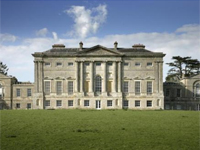
Conversion reversion? Wardour Castle, Wiltshire

Wardour Castle, Wiltshire (Image: Strutt & Parker)

With so many country houses lost in the twentieth century, almost any alternative which saved them from the demolition crew was to be welcomed; no matter how drastic.  For some this meant institutional use but for many others of all sizes the solution was conversion into flats and apartments – though with varying degrees of success.  However, as these properties come on to the market, is it perhaps time to consider converting them back into the single, glorious houses they were intended to be?

Launched this week (16 June 2010) in Country Life magazine is the principal apartment in what is considered James Paine’s finest creation; Wardour Castle, a supremely elegant essay in Palladian architecture.

Central stairwell and gallery, Wardour Castle, Wiltshire (Image: Strutt & Parker)

Built from 1770 – 76, for the eighth Lord Arundell the most impressive feature is a breath-taking central stairwell with first-floor gallery which Pevsner called ‘the most glorious Georgian interior of Wiltshire’ and which forms the core of Apartment One which is now for sale.  Wardour Castle house has proved to be adaptable becoming Cranborne Chase School in 1960 until it closed in 1990 when it was then converted into ten apartments.  As the divisions appear to have respected the natural sections of the house this seems to be a good example of where someone could convert the house back to a single home.

There are many examples of houses being rescued by conversion.  SAVE Britain’s Heritage have long campaigned to protect these houses and have worked in conjunction with one of the leading architects, Kit Martin, in supporting conversion.  A 1983 SAVE report entitled ‘The Country House: to be or not to be’, written by Kit Martin and Marcus Binney, includes particularly interesting studies of how these houses could be sensitively converted.  These show that although almost any country house could be sensitively adapted some are naturally more suitable particularly where the overall layout of the house is symmetrical, shallow and long.

The study was an important milestone in the practice of country house conversion and saved many houses from complete loss or inappropriate use including The Hazells in Bedfordshire, the grade-I Northwick Park in Gloucesterhire, Dingley Hall in Northamptonshire.  The sensitive approach they championed now means that it should be possible to consider converting a house back if the right opportunity arose.  It should be said that some houses are never going to be converted back due to a variety of factors including there being too many apartments involved such as at Thorndon Hall in Essex which contains 37 flats, or where not enough land has been retained to make the unified house valuable enough to justify reversion.

Perhaps the idea of reversion becomes more realistic where more than one part of the same house comes on the market at the same time such as recently happened with grade II*-listed Ampthill Park House, Bedfordshire.  Built by the Cambridge architect Robert Grumbold in 1687-9 and completed by John Lumley of Northampton in 1704-6, with major additions by Sir William Chambers in 1769 it is certainly one of the most impressive houses in the county. It was rescued from dereliction by conversion into just four large houses; two of which were put on the market in April 2010, the largest of which includes most of the principal rooms.

Although it’s nice to dream about these houses becoming single homes probably the biggest obstacles are not only being able to secure the other apartments but also that the value of the individual properties may be greater than the value of the unified house.  However, it’s not entirely beyond the bounds of possibility that someone with deep pockets and a desire to restore a house could take on one of these conversion reversions and recreate a superb country house.

Property details: ‘Apartment One – Wardour Castle, Wiltshire‘ [Strutt & Parker] – £2.75m

Detailed architectural description: ‘Wardour Castle, Wiltshire‘ [English Heritage: Images of England]
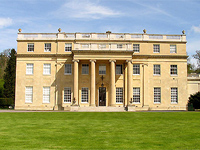
Converting country houses from commercial to residential: a sound investment?

Benham Valence, Berkshire (Image: wikipedia)

As the pressures of the twentieth century forced more country houses owners to face the reality that they could no longer live as they had and would have to move out of their homes they then had to decide what to do with it.  Unfortunately this meant demolition of hundreds of large houses but some owners were more creative and many houses became commercial premises, either as hotels, schools or institutions, and others became some of the grandest office buildings in the country.  However, recent pressures of this century have now seen some of these offices being converted back into homes or being offered for sale as an opportunity to do so.

In many ways the country house has always had an element of the commercial to it with the estate offices usually being based either in a part of the main house or in a nearby building to enable the owner to deal with business without having to travel far from home. The changes of the twentieth century were on an altogether more comprehensive scale with the entire house being changed to accommodate the demands of business.  This not only meant the conversion of the main house with all that entailed for the interiors but also the building of further offices in the grounds.

Sometimes the development was kept a good distance from the main house such as at Ditton Park in Berkshire.  This became the office of the Admiralty Compass Observatory from 1917 until it was sold in the 1990s to Computer Associates who built a huge office building to the west of the main house (which became a conference centre) leaving the setting intact.

Sometimes though it’s possible for smaller businesses to be accommodated just within the main house such as at Gaddesden Place in Hertfordshire.  The house, built in 1768, is a elegant Palladian villa (similar to the White Lodge in Richmond Park) and was James Wyatt’s first country work.  The site is said to have some of the best views in the home counties and the sensitive use of the house has allowed to remain in splendid seclusion.

However, modern concerns mean that a country house has lost some of it’s appeal as offices.  One key issue is that by their nature the houses are isolated meaning that employees must have cars to reach it leading to more cars on the roads and the need to provide huge areas of parking.  Stronger heritage legislation now also means it’s much harder to alter the houses to meet modern business requirements such as air conditioning and computer networking.  The nature of the houses also means that maintenance costs are higher than for a purpose built office.

This has led to some houses which were formerly offices to be converted back into homes.  Mamhead House in Devon, built between 1827-33 and regarded as one of Anthony Salvin‘s finest designs, it was, for many years, a school before becoming offices for a local building company.  It was bought by a businessman who converted the main part of the house back into being a home whilst still letting out part of the house to the Forestry Commission.

Perhaps the grandest and largest opportunity for many years to restore a house into a home is the mansion at Benham Valence in Berkshire.  This superb house was built in 1772-75 for the 6th Earl of Craven and was designed by Henry Holland in collaboration with his father-in-law, Lancelot (Capability) Brown, the famous landscape architect.  The south front features a grand tetrastyle Ionic portico which looks out over a large lake with views into the parkland.  Inside, there are many fine chimney-pieces bought from the sale at Stowe in 1922, including one from the State Dining Room.  It also features a small circular double-height vestibule adjoining the inner hall, a design later adopted by Sir John Soane.

The house was empty in 1946 and remained so until it was sold in 1983 and converted to use as offices with a large wing to the north east of the house being demolished and replaced, in part, by an ugly 80’s complex providing over 100,000 sq ft of space.  Luckily though the main house was largely spared and remains Grade II* with the 100-acres of Grade-II parkland. Now offered for sale at £6m this is a rare opportunity to create a wonderful country house – providing it’s possible to obtain planning permission to convert it back – which, once restored, could be worth £10-12m.  One key requirement would be the demolition of the office complex and the ripping up of the huge car park – but give me a pickaxe and I’ll be happy to lend a hand.

Full property details: ‘Benham Valance, Berkshire‘ [Strutt & Parker]