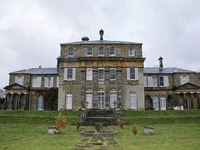
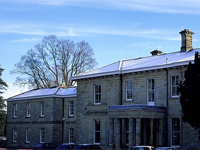
For those who like their houses with pedigree: Plumpton Place, Sussex

Plumpton Place, Sussex (Image: Knight Frank)

One of the greatest of the UK’s country house architects was Sir Edwin Lutyens – a man with undoubted talent who was also able to use thoroughly modern techniques of collaboration and media exposure to boost his career and win business.  His main media connection was the tireless promotion of his work by Country Life magazine which was, in no small part, due to his close friendship with the founder and editor Edward Hudson.  So when Hudson needed to restore and modernise a manor house he’d bought it was inevitable who he would call on.   Plumpton Place in Sussex is now considered to be one of Lutyens’ best country houses and it’s for sale.

Lutyens (b. 1869 – d. 1944) was a master at the creation of houses which evoked what many would have in their minds as the ‘ideal’ country house.  He was able to marry the romanticism of the Arts & Crafts movement to his own clear ideas as to how a house should look both inside and out.  A strong proponent of using local materials he, more importantly, was able to use them in innovative ways which made his houses distinctive.

Marsh Court, Hampshire (Image: Clicks_1000 @ flickr)

A classic example of this was his use of chalk at Marsh Court in Hampshire which gave this house a brilliant white appearance, and which contrasted with small tiles of knapped flint set into the walls and the red-brick chimneys.  Marsh Court (finished in 1904 and for sale in 2007 for around £13m) was the last of Lutyens’ ‘Tudor’ style houses but it would never be considered an old house – again showing his genius of matching local materials with an assured architectural design.

Much of Lutyens’ fame can be attributed to the unstinting support he received from Edward Hudson who had cleverly exploited the growing urban middle-classes interest in a nostalgic view of ‘olde’ England and the country lifestyle.  Founded in 1897 it chronicled not only the best of the grand old country seats but also sought to keep the tradition alive at a time when the lifestyle was beginning to come under threat. One of his writers was the renowned garden designer Gertrude Jekyll who had met Lutyens in 1889 and had collaborated with him to create some of the best regarded house-and-garden compositions in the country.  Jeykll introduced Lutyens to Edward Hudson in 1899 thus creating a life-long friendship between the two.  To Hudson, Lutyens’ ability to create these idealistic visions of country life were the perfect material for his magazine.  Coupled with the extensive use of their distinctive, high-quality black & white photos it provided an unrivalled opportunity for Lutyens to built fame with the middle-classes but also advertise his talents to the aspirational wealthy or the existing gentry.

Hudson was a man to put his money where his magazine was and commissioned Lutyens to work on three houses; Deanery Gardens, Lindisfarne Castle and Plumpton Place – all now considered to be Lutyens’ best work.  Hudson had bought Plumpton, a derelict, moated manor house, in 1928 for £3,300, to be used as a weekend retreat and a place to entertain.  In some ways Lutyens’ work there was a surprising contrast to the grand Classical-style banks and corporate work he was engaged with in London and elsewhere.  Lutyens created a new route to the house which used a theatrical sense of surprise to hide the house except for glimpses through arches and trees.  Inside the most notable addition was that of a music room with huge, almost mullioned, windows with small panes of glasses set into wooden frames rather than the then fashionable steel, flooding the room with light.

The house was bought in 1983 for £800,000 by an American venture capitalist called Tom Perkins who has since lavished ‘millions’ on careful restoration.   So if you have £8m, this is a rare opportunity to live in a genuine Lutyens masterpiece which has played its own part in shaping our national impression as to what a country house should look like.

Property details: ‘Plumpton Place, Sussex‘ [Knight Frank]

A country seat of learning: Wispers, Sussex

Wispers, Sussex
Wispers, Sussex (Image: Daily Mail)

There has been a long tradition of country houses being converted to schools.  Indeed, the practice has saved many hundreds from being demolished all together, denying us today the pleasure of houses such as Stowe and Bryanston.  In recent years fewer houses have passed into institutional use with a preference for modern school buildings.  However, despite some difficulties in the last couple of years for private schools, the recent sale of Wispers in Sussex has shown that there is still the appetite for the country house based school.

Grade-II listed Wispers was built in 1874-76 by Richard Norman Shaw for stockbroker Alexander Scrimgeour and was sold in 1928 to the Bedford estate for Dame Mary Russell (the wife of the 11th Duke of Bedford) as a weekend retreat to which she added the huge eastern wing in the 1930s.  Dame Mary was known as ‘The Flying Duchess’ due to her interest, later in life, in aviation which led to her regularly flying her Tiger Moth – including from the Bedford’s main home, Woburn Abbey, to Wispers.  To help accommodate her new mode of transport, at the same time as the new wing was being added to the house, she had an airplane hanger built as well.  Dame Mary’s love of flying did eventually lead to her death when, at the age of 71 in 1937, her plane disappeared over the North Sea as she flew from Woburn to Cambridge.

Following her death, the house was sold in 1939 and became a school known as St Cuthman’s before West Sussex council bought it as a special needs facility.  After this closed in 2003, the house was sold and a planning application lodged to convert the main house into 7 flats with other buildings on the estate being either converted or demolished.  However, this plan was never implemented and after lying empty for 6 years was sold for £3m (against an original asking price of £4.5m) with 20 of the original 35 acres in April 2010 to Durand Primary, near Brixton, South London. The school was able to use the profits from its successful leisure and student accommodation business to provide Wispers as a weekly boarding environment for secondary age pupils.

Educational use has saved many country houses from being demolished or converted – though sometimes the alterations required or the heavy wear and tear on these buildings could be quite damaging.  When English Heritage took on Apethorpe Hall in Northamptonshire they discovered light switches and other fittings had been poorly installed, usually by simply hacking through the plasterwork.  However, on balance, these minor issues are the lesser of two evils compared to possible complete loss.  It’s not known precisely how many country houses have been used for educational purposes at some point in their lives (and many took on this role temporarily in WWII, most famously Blenheim Palace and Castle Howard) but it certainly shows the versatility of our country houses.  Use as a school can also help preserve a house so that one day it might possibly be converted back to being a home.

More details: ‘Inner-city school buys mansion to keep pupils safe from knife crime‘ [Daily Mail]

A labour of love: the restoration of Hammerwood Park

Hammerwood Park, Sussex (Image: South Downs Living)

Once a house has sunk to such a level of dereliction that even the developers won’t take it on, this can easily lead to an application for demolition and the loss of another piece of our architectural heritage.  Yet, as we see in the media, there are often people willing to commit themselves and their money towards saving these beautiful homes – Hammerwood Park is one which certainly falls into this category.

The house was built in 1792 for Benjamin Sperling and is particularly important as the design of the house was the first commission of Benjamin Latrobe (b.1764 – d.1820) who was later to be hugely influential in the direction of American architecture.   Latrobe had studied architecture privately and served for a year from 1789 as an architectural draughtsman in the office of neo-Classical architect S.P. Cockerell. Howard Colvin suggests that Latrobe was also strongly influenced by the work of French architects such as Étienne-Louis Boullée whose own strictly neo-Classical style emphasised the paring back of unnecessary ornamentation and the use of grand scale with repetitive elements.  Through Hammerwood Park it’s possible to see this philosophy in practice with the giant pilasters on the garden front and the miniature temples on the flanking wings.

The early death of Latrobe’s wife in 1793 caused him to abandon Britain and head to America where he made friend’s with President George Washington’s nephew.  It was these contacts which enabled him to obtain further commissions including the Bank of Pennsylvania in Philadelphia which has been described as the ‘first monument of the Greek Revival in America’ (dem. 1867).  It was this and his later work designing the first Capitol building in Washington which so greatly influenced the future of American architecture towards the ne0-Classical which is so evident even today.

That a building as interesting as Hammerwood Park was ever allowed to deteriorate to that extent was unfortunately all too common in the post-WWII era. It is only the dedication of it’s current owner, David Pinnegar, that has probably saved the house from conversion or even demolition.  After various owners it was requisitioned during WWII for use by the Army who left it in their usual poor condition.  Post-war, the Chattell family, who then owned the house, sub-divided the house into flats but as dry rot took hold, the residents moved out and the house was sold in 1973 to the rock group Led Zeppelin for use as a country retreat to work on their music. However, touring commitments meant they never moved in (and rumour has it they even forgot they owned it) and whilst empty, thieves took the roof lead leading to massive wet rot outbreaks.  The house was boarded up in 1976 before finally being offered for sale in 1982 in Country Life magazine with the marvellous understatement that it was ‘in need of modernisation’.

David Pinnegar, then only 21, bought the now grade-I listed house and has since dedicated his life to its restoration.  The vast house has revealed many interesting architectural nuances as he and many volunteers have worked through the vast catalogue of repairs. Although he has secured some grants from English Heritage, the vast majority of the work has been financed through day visitors, B&B guests, and its use as location for a wide variety of films and music video shoots.  In many ways, David’s dedication is proof that all houses, no matter how poor their condition, can find a saviour.

Full story: ‘Hammerwood Park, East Grinstead: Whole Lotta Love‘ [South Downs Living]

House website: ‘Hammerwood Park

A house and it’s garden to be reunited? Leonardslee, Sussex

Leonardslee House, Sussex (Image: tom@picasaweb)

Often the course of the country estate over the last 100 years has been for the land to be gradually sold off, starting with the outlying areas, and moving closer until just the house and it’s immediate gardens remain intact.  At Leonardslee in Sussex the process was eventually taken one step further with the house being sold off.  This, however, may about to be reversed.

Sir Edmund Loder bought the manor house and 225-acre gardens from his inlaws in 1889 and soon opened them to the public.  Over the next five generations, the Loder family added to the planting and landscaping to create what is now one of the only 163 grade-I listed gardens in the country.  Despite the family still owning the gardens the grade-II listed Italianate manor house, built in 1853 and featuring a 900 sq ft central hall decorated with Ionic columns, was sold off separately in the 1980s and became offices.  The gardens grew in reputation so it was something of a shock when in April 2008 it was announced that they were being put up for sale by Robin Loder for £5m through the estate agency Savills.  Cleverly, the company who owned the house also announced they were open to offers at around £3.25m for the house.

The Times is now reporting that after nearly two years on the market, the gardens have been sold to a private businessman and are likely to close to the public.  They are also reporting that the house may also be under offer at £2.75m to the same businessman giving him a perfect  opportunity to once again recreate a stunning small estate which, with the addition of the house, could be worth in the region of £10m.  Though a sad day for the many garden-lovers who have made many a pilgrimage to wander among the wallabies, it’s an encouraging reversal of the trend for houses to lose the control of the landscape which so often perfectly frames them.

Full story: ‘Leonardslee Gardens to close to the public after being sold‘ [The Times]