A family tradition: the restoration of Dissington Hall

Dissington Hall, Northumberland (Image: dissingtonhall.co.uk)

Dissington Hall was largely derelict when it was bought by Eric Brown in 1968, despite the then preference for new properties.  A senior dentist and dental lecturer, he was not the obvious buyer for such a large Georgian house but he and his wife had fallen in love with it and now were determined to rescue it from its long decline. Their success and love of the building has been passed on to his son Michael, who was just four when he moved in, and it is now he and his family who have completed this labour of love and brought back into use this elegant house.

The house was originally built for the Collingwood family in 1797 who had been commissioned the architect William Newton (b.1730 – d.1798) in 1794.  Newton had designed a number of significant local country houses including Capheaton Hall (1758), Backworth Hall (1778), Howick Hall (1782), Whitfield Hall (1785) before his work at Dissington.  Dissington Hall is an elegant design with a first-floor string course to relieve the mass of the vertical elevation and a ground floor cornice which was a Newton characteristic.  It was built in the local sandstone in fine Ashlar with the blocks being so finely cut that the joins are near-invisible.  Further changes where made between 1820 and 1850 with a new clock tower, stables, porch, alterations to the roofline and the additions of a new servant’s stair.

Despite the obvious quality of the house, it was to suffer much during World War II when it was requisitioned.  It served as a dormitory for 50 WAFF ladies who worked at the Polish Airforce Headquarters at Ousden Aerodrome, a hospital and, at one point, a TNT storage depot.  These various roles caused many poor quality or poorly planned alterations along with the general damage caused by huge numbers of people.  Perhaps the single biggest cause of damage was a bomb dropped in 1940 which caused cracking to the east and south elevations.  Following the war, the house was unoccupied and so was the target of thieves who, in 1947, stole all the lead from the main roof.  Water penetration followed, combined with some earlier alterations which lead to long and inefficient guttering which frequently leaked.  This led to extensive outbreaks of  both wet and dry rot which have all had to be conquered.

The story brightens from 1955 when it was bought by the local Sharrett family who lived there and carried out some restoration before selling it to the Brown family in 1968.   Michael recalls that they only lived in a small part of the house as much of the rest was then uninhabitable with sections of the roof having fallen in.  Since then, the house has been painstakingly restored and is now filled with antiques and appropriate fittings.  The Browns have even managed to acquire the original architectural plans.  The house has been a wedding and conference venue since 1992 but is also, perhaps most importantly, still their family home; a heartening example of how dedication can rescue and protect a key piece of our local architectural heritage.

Full story: ‘Living History: Dissington Hall‘ [journallive.co.uk]
Woolsington Hall restoration stalls again

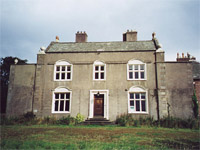
Woolsington Hall (Image: English Heritage)

Grade-II* listed Woolsington Hall, set in 340 acres of fine parkland, was bought in 1994 by Sir John Hall, who had successfully turned Wynyard Hall into a palatial hotel.  Though on a much smaller scale, Woolsington was to also be converted into a small, luxury hotel at a cost of £8m – 10m.  However, after several years of inaction, its deteriorating condition led to it being placed on the English Heritage ‘buildings-at-risk’ register in 2002. Despite work in 2008 to make the building watertight and in prepartation of the main conversion, work has been halted again.  Sir John insists the money is still available but that he is so busy with his many other ventures that he is unable to commit to it at the moment.

Though this is somewhat understandable in the current economic climate, as a Grade-II* listed building it must not be forgotten and allowed to decay again.  The building remains on the English Heritage register but hopefully work will start again to rescue this charming smaller country house in 2010 and bring it back to life.

Full story: ‘Plans for Woolsington Hall on hold yet again‘ [journallive.co.uk]

Shrubland Hall finally sold

When the Grade-II* listed Shrubland Hall near Ipswich in Suffolk was put on the market for £23m in 2006 it included over 40 cottages, several farms, over 1,400 acres and one of the finest Italianate houses in the country. The house was originally designed by James Paine in the 1770s it was extensively altered by Sir Charles Barry in the 1840s.  Lord de Saumurez had decided to start afresh with a grand country house auction rarely seen such a scale since the 1950s, and which included Meissen porcelain, paintings, and many fine pieces of Georgian furniture.  The sale was a roaring success but the house itself languished on the market as the especially as the growing global credit crunch limited the desire for buyers wealthy enough to take on the 40,000 sq ft. house.

However, after three years, and selling off much of the estate in smaller lots, the house plus a few hundred acres of parkland including the listed gardens designed by Sir Humphrey Repton, has now finally been sold for £6.5m to a London businessman.  It will now be interesting to see how the estate develops as without the larger estate it will be simply a home supported by income from elsewhere.  Here’s hoping that the new owner fully understands and appreciates the architectural gem they have acquired.

Full story: ‘Shrubland Hall sold‘ [Evening Star 24]

New Hudson’s Guide 2010 launched

The latest edition of that ‘bible’ of country house visiting, ‘Hudson’s Historic Houses and Gardens, Castles and Heritage Sites‘, has just been launched. Described in their own words as “a definitive guide to the best historic houses and gardens, castles and heritage sites that Britain has to offer.”.  Useful not only for your weekend trips but also for events and weddings – so get out there and support our beautiful houses!

Yaldham Manor application delayed again

The application to restore Yaldham Manor, near Wrotham in Kent, has been delayed again with the decision deferred until a site visit has taken place in February. After a first application, submitted three years ago, was withdrawn as it was thought likely to fail, the new application [pdf] was first submitted back in January 2009 and has been the subject of extensive discussions as to the appropriateness of the enabling development.

Yaldham Manor has a 14th-century great hall, which also features a large Tudor window, and also impressive ornamental chimneys.  Latterly the home of the Lade and Cory families it is now falling into a poor state of repair and requires urgent work.  To fund the restoration of the main house, the application seeks permission to create a ‘hamlet’ with new cottages being built to replace ones which have been demolished and also new homes in the derelict outbuildings.  The main house will remain as a single residence.

It seems a shame that they all couldn’t be bought by someone who could restore the house and outbuildings as a single family mini-estate.  However, if this is not possible, and much as I’m usually against most enabling development, this seems to be a sensitive proposal.  I fully support the council in taking a very close look at the application however it does seem a shame that it will have taken over a year to reach a decision but it must be recognised that our heritage requires a careful balance between protection and ensuring that appropriate works can be carried out.

Full story: ‘Historic manor in jeopardy‘ [thisiskent.co.uk]