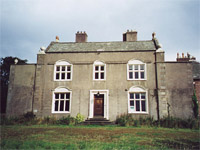
Caldwell House – a nearly-lost Adam classic

Caldwell House, Scotland (Image: intriguing_rly@livejournal)

Sometimes houses suffer in so many ways and yet, despite their eventual condition, it’s still possible to imagine them being restored to something approaching their former glory.  Caldwell House near Paisley in Scotland is definitely one that would require a purchaser with deep pockets and a slightly cavalier approach to budgeting – but they would be rescuing a classic house by the famous Scottish architect Robert Adam.

In 1773, Baron Mure of Caldwell commissioned Adam to design a grand home for him. For Adam it was to be the last of the ‘castle’ houses he designed, a style he’d started with at Ugbrooke House in Devon (1760s) and Mellerstain House in Berwickshire (1770).

It remained the family home of the Mures until 1909.  In the 1920s the House was sold to Glasgow Corporation and became a hospital for mentally handicapped children. The institutional changes were severe and included the removal of the main staircase to accomodate a lift shaft and the addition of numerous poor-quality outbuildings.  After the hospital closed in 1985 the usual pattern of neglect and vandalism set in, with a major fire in 1995 resulting in serious damage to the interiors and the loss of the roof.  In spite of being a Grade A listed building, it is now empty and has sadly been neglected and allowed to decay and has been on the Scottish Civic Trust’s Buildings at Risk register for some years.

As this shocking set of photos show, the house is now in a terrible condition.  However, the shell still evocative and it’s rural location would ensure privacy and so ought not to be written off yet.  Perhaps the family motto of the Mures – “Duris Non Frangar”, which means, “not to be broken by adversity” – would be an appropriate one to bear in mind when taking on this monumental restoration.

Call for country houses to get tax breaks

 The Historic Houses Association have highlighted that there is an estimated backlog of repairs totalling £390m.  In recognition of local and sometimes national importance of these houses and their role in stimulating local economic activity, Edward Harley, president of the HHA has urged politicians to provide sympathetic tax breaks and also to allow those house with significiant public benefit to be allowed to apply for lottery funds.

Full story: ‘Country house owners ‘need tax breaks and lottery funds’‘ [Daily Telegraph]

Castle Drogo under seige – from rain

Castle Drogo, Devon (Image: wikipedia)

The last castle to be built in the UK, Castle Drogo, occupies a commanding position far up the Teign Gorge in Devon.  Designed by Sir Edwin Lutyens and built in the 1910s and 1920s and finally finished in 1931 for the wealthy businessman Julius Drewe, the Grade-I listed house is a brilliant modern interpretation of a castle combined with the comforts of a country house.

It was also one of the last houses to be built entirely in granite, the local stone of the area.  The grey stone and the clever massing of towers and wings give the house a solid, impregnable air but the house is under attack from the elements, with rain penetration causing serious concern.  The many flat roofs hidden behind the battlements started causing problems only two years after the house was finished and ever since it has been a constant battle to keep the house watertight.

House manager Bryher Mason told BBC News: “I wouldn’t be surprised to walk into a room one morning and find a section of the ceiling having fallen in because the metalwork in the ceiling has failed.”

The National Trust, who have cared for it since it was handed to them in 1974, have instigated a restoration and repair programme on the many roofs, which will include the replacement of all 13,000 window panes, and has been estimated to cost £10m, and will be completed by 2016.

Full story: ‘Leaking castle needs £10m repairs‘ [bbc.co.uk]

Forty Hall ‘renovation’ gets approval from council but probably not from everyone else

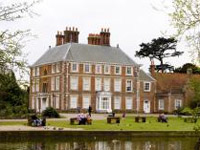
Forty Hall, Enfield (Image: Enfield Independent)

Enfield Council’s proposed renovation plan for Forty Hall in Enfield has been given the go-ahead by the council planners. However, the plan seems to verge on invasive and to contravene best practice guidelines from organisations such as the Society for the Protection of Ancient  Buildings which recommend preserving as much historic material as possible to show how a building has developed.  The changes are part of plan funded with nearly £2m in grants from the Heritage Lottery Fund.

The Grade-I listed house was originally built in 1629 for Sir Nicholas Rainton, a City Alderman, President of St Bartholomew’s Hospital and Lord Mayor of London.  The house passed through various owners until bought in 1895 by Major Henry Bowles who  made many changes including a new staircase with stained glass incorporating his family’s coat of arms.

However, rather than respect it as an important example of one of the many smaller mansions built on the edges of the then city but now subsumed into the suburbs, the council seem determined to make their own extensive changes.  An illuminating quote was given when the HLF grant was announced: “This gives us a unique chance to re-model the Hall completely to make sure that every aspect of it is planned and coordinated to make it the top visitor attraction that it should be.” [enfield.gov.uk].  Among the changes the council have proposed are:

  • installation of a lift shaft,
  • removal of the entrance porch,
  • construction of a glazed roof to the central courtyard, and
  • replacement of the main staircase.

It’s the latter that seems to be the most worrying change as the staircase was an important part of the history of the house.  The Victorian Society has raised their objection to this loss.  Interestingly, the press release inspired news story doesn’t mention whether English Heritage or the Society for the Protection of Ancient Buildings have given their approval.

Also of concern is the intention to redocorate the interior which will be carried out “by detailed investigation of historic finishes” – which doesn’t say that they will follow the evidence of the past.

All in all this seems to be a council who have approved their own plans to make many insensitive and substantial changes to a Grade-I listed building in an attempt to create a  ‘theme-park’ pastiche of an old house.  Perhaps a more considered approach would not only preserve more of the historic fabric the council seem so willing to rip out but would also offer cost savings.

The plans still require approval from the Secretary of State, John Denham, before they can be implemented so there is hope yet that this apparently inappropriate scheme might yet be modified so that whilst still meeting the council’s aim of increasing access and improving facilites it’s much more sensitive to this elegant house.

Full story: ‘Forty Hall renovation gets thumbs up from planners‘ [Enfield Independent]

Woolsington Hall restoration stalls again

Woolsington Hall (Image: English Heritage)

Grade-II* listed Woolsington Hall, set in 340 acres of fine parkland, was bought in 1994 by Sir John Hall, who had successfully turned Wynyard Hall into a palatial hotel.  Though on a much smaller scale, Woolsington was to also be converted into a small, luxury hotel at a cost of £8m – 10m.  However, after several years of inaction, its deteriorating condition led to it being placed on the English Heritage ‘buildings-at-risk’ register in 2002. Despite work in 2008 to make the building watertight and in prepartation of the main conversion, work has been halted again.  Sir John insists the money is still available but that he is so busy with his many other ventures that he is unable to commit to it at the moment.

Though this is somewhat understandable in the current economic climate, as a Grade-II* listed building it must not be forgotten and allowed to decay again.  The building remains on the English Heritage register but hopefully work will start again to rescue this charming smaller country house in 2010 and bring it back to life.

Full story: ‘Plans for Woolsington Hall on hold yet again‘ [journallive.co.uk]