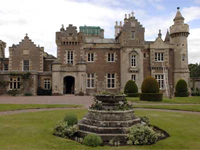
The danger of interpretation: Abbotsford House, Scotland

Abbortsford House, Scotland (Image: The Scotsman)
Abbotsford House, Scotland (Image: The Scotsman)

For Abbotsford House in Scotland, home of the famous author Sir Walter Scott, the recent news that it was to receive a £4.85m Heritage Lottery Fund grant is the sort of news which should be welcomed as that level of funding can usually remedy any necessary maintenance or repairs.  However, the grant is not actually to be spent on the house (despite headlines such as ‘Lottery cash means Walter Scott’s beloved Abbotsford will get £10m facelift‘ [The Scotsman]) but mainly on a new, separate visitors centre.

Sir Walter Scott (b.1771 – d.1832) played a key part creating a literary context for the developing Picturesque movement which sought to reject the rigid formality of the Georgians and create a more organic architecture, which he developed in the construction of his own house.

The theory of the Picturesque raised the importance of how one ‘felt’ about a scene or view – a definite break with the austere, ‘correct’ classicism which so dominated.  The exploration of more fluid forms had started in the 1750s and had been adopted by such noted figures as Sir Horace Walpole for his own house at Strawberry Hill in Surrey.  However it was a local Surrey parson, the Rev. William Gilpin, whose guidebooks were to lead the way for those who came afterwards such as Herefordshire squires Sir Uvedale Price and Richard Payne Knight who had the funds to realise these ideas.

Inspired in part by the idealised landscapes of the artists Nicholas Poussin or Claude Lorrain, architects sought to provide an almost ‘arcadian’ vision of buildings integrating naturally with an environment, forcing them to think of the building and environment as a whole rather than simply viewing their particular work in isolation. This also affected the plan of the house, with rooms now being aligned along the best viewing lines rather than simply lined up. One architect who took on this new style was John Nash who met Uvedale Price in about 1790 during Nash’s time in Wales.  Price was at the time building a small summer house and Nash, after meeting him, proposed a typical villa – a design antithetical to Price’s own philosophy.  Price instead guided Nash to design a new house where rooms followed views, and the overall design echoed its rocky coastal location; as he wrote ”The form of it is extremely varied from my having obliged him [Nash] to turn the rooms to different aspects‘.  Castle House, sadly demolished in 1897, was a watershed in the rejection of the dominant Georgian style and Nash quickly developed new designs based on these radical principles which became his distinctive ‘cottage orne‘ style.

Sir Walter Scott didn’t set out to link literature and architecture – in fact his ‘Waverley’ novels were simply a quick way to make some money after financial difficulties.  The books, which he initially wrote anonymously, were the first truly successful historical fiction, and brought Scott considerable wealth and, once his authorship was known, praise.  It was this wealth that enabled him to set about creating his ideal house.  Raised in the Scottish borders he had a close affinity for the natural landscape and so the Picturesque style would have appealed.  However, Scott ensured the existing designs for Abbotsford House had a distinctly Scottish twist, creating what is known today as the ‘Scots Baronial’ style so closely associated with our romantic notions of Scotland today.

Scott bought a small farmhouse in 1811 and engaged William Atkinson (b.c1774 – d.1839) who, between 1814-24, created the house we see today.  Atkinson was not considered one of the best ‘Gothick’ architects, with Howard Colvin thinking that his designs lacked the elegant charm of the 18th-century work and the scholarly accuracy of the 19th-century.  However at Abbotsford, the architectural vocabulary he employed – steeply pitched slate roofs, turrets, bartizans, and crowstepped gables – became the standard language of Scots country houses for anyone not following the Classical style.

So Abbotsford House is an architectural genesis – the first of it’s kind.  It seems a shame to lavish millions on a separate interpretation centre in a modern design which will only compete with the existing architecture of the house and estate.  It’s also a competition the new building is unlikely to win.  Perhaps it would be better for the money to be spent on sensitively incorporating the displays and materials from Scott’s life and work into the home he so lovingly and thoughtfully created.

More details: ‘Lottery cash means Walter Scott’s beloved Abbotsford will get £10m facelift‘ [The Scotsman]

Official website: ‘Abbotsford House

Background: the Picturesque movement [Wikipedia]

What may come? Ireland’s country house property crash

Bellamont Forest, Ireland (Image: Knight Frank)

One side effect of the exceptionally buoyant Irish property market which made areas of Dublin as expensive as central London was a similar rise in value of their country houses.  Now with the drastic drop in property values, Irish country houses have proven to be far from immune and offer a useful indicator of what might happen in a similar situation on this side of the Irish sea.

The country house market in Ireland truly rode the boom when property became a sure-fire route to riches in the republic.  Houses which had been neglected for many years were suddenly ‘discovered’, bought and lavishly refurbished as private houses for the newly wealthy.  This is actually unsurprising as a key aspiration for anyone acquiring riches over the last 400 years has been to establish themselves in a rural domain.  Owning land was the route to power since time immemorial with greater acreage giving greater influence.  Despite the breaking of that link in the UK between 1870 and 1920 (and most decisively with the passing of the Lords Reform Bill of 1911) the idea of the country estate as the acme of achievement had become embedded as the ultimate status symbol.  Therefore any boom in the economy has usually led to a rush to the country.

Ireland’s situation was slightly different in that, unlike in the UK with it’s stricter planning laws, the purchase of a country house was also viewed with residential development potential in mind. For those projects which completed this meant that the house was simply a means to an end leaving fine houses stranded in the middle of a new suburb (many of which are now half-empty) thus ruining a perfectly good house. This also meant that some houses were bought with over-inflated ‘development value’ built into the price.

So now the crash has hit, what has happened to the houses?  For those owners who were simply in the family home and managed to sell a few acres for development they have ‘won’ as they still have their house and estate but also gained money to sustain the estate and complete much needed restoration and improvements.  For others who didn’t capitalise there must be a certain disappointment as they’ve gone from lying in bed thinking about how the house is now worth ten times what it was a few years ago, back to lying awake wondering how to pay the bills again.

Worse though are those who paid hyped prices and now are stuck either with a home they may have paid for but which is now worth much less than they paid for it – country houses prices can race ahead of the trend in a bull market but can easily do the same when it falls.  On a positive note, for those owners who can afford to, they are likely to stay longer than otherwise they might, providing stable ownership and perhaps a commitment to invest in the estate to sustain what value they can.  For those who bought on finance or who now lack the funds to meet the running costs they may now be forced to sell at a loss.  Declines of 30-50% aren’t unheard of, even for the very best properties.  The Lyons Demesne, one of the finest estates in Ireland and former home of Tony Ryan, founder of Ryanair, is currently for sale with 600-acres at €50m, down from its former valuation of €80m.  Even on the less stratospheric level, Bellamont Forest, the first Palladian house in Ireland (and ridiculously beautiful) was initially marketed at €10m but is now offered at €7.5m.

So what could happen over here?  UK country houses prices, certainly for the best properties, have risen dramatically over the last 10-20 years.  However, that rise has been on the back of a broader boom in the economy which, despite some aspects turning out to be smoke and mirrors, did actually generate real money. In addition, the commodity value of UK farmland which has risen from £2,000 per acre to around £7,000 per acre has also provided a stronger capital base for the estates.  The natural British caution does have its advantages.

The dangers are where owners are left with over-priced houses unable to meets the cost of maintenance and there is the risk that basic tasks are put off leaving the houses at risk from any number of ailments such as water ingress due to blocked gutters.  Unfortunately government austerity means that at a time when local councils need to be most vigilant they are going to be less likely to fund the necessary heritage conservation staff.

Country houses are never immune from the challenges of the wider economy but they can also be insulated if the owner has the resources to weather the storm.  Luckily for the UK, many owners are in a strong position but there is always the danger that the over-excited may get carried away and over-pay leading to problems if the property market weakens. The situation in Ireland should be watched as a useful case study in the dangers of an over-heated market.

Full story: Crash-landed gentry [ft.com]

If in doubt, rent: Faringdon House, Oxfordshire

Faringdon House, Oxfordshire (Image: Knight Frank)

Renting a property has long been associated with those starting out on the property ladder but there is a long history of country houses, large and small, being tenanted for long periods of time.  Now the focus is very much on the sale of country houses with rentals being in the shade of their high-spending counterparts but there are still many fine houses available to those wishing to experiment with the country life or as a short-term solution.

Jane Austen was well-known for reflecting the social conventions of the aristocracy in her work and it’s interesting that one of the main characters in ‘Pride and Prejudice’, the wealthy Mr Bingley, rents ‘Netherfield House’ whilst he considered which house and estate he would establish himself in.  This again is a pattern that still holds true today with those seeking to move to either a new area or out of town, renting to get a better understanding of an area.  These opportunities are available today where houses such as Puddletown Manor in Dorset are available for rent (£9,000 pcm) but also for sale (£6m) at the same time.

Country houses have been let for a variety of reasons.  One of the most common was simply that it might be a subsidiary seat and rather than simply leave it empty it was often let as a source of income.  Sometimes this included the entire working estate so that the new occupant could fully assume the role and responsibilities of the country gent.  Increasingly though in the Victorian era the house was let separately from the estate which would continue to be managed and run by the original family.  This was often the preferred option for the newly wealthy who aspired to the status and amenity of a ‘country seat’ but did not require the estate to generate an income.

This is why houses such as the Faringdon House in Oxfordshire [pictured above] are attractive as they allow someone else to simply move in (albeit for a significant monthly rent of £10,000) and enjoy a grade-I listed Palladian villa without the added burdens of ownership.

Letting was a handy solution when the family finances were insufficient for they themselves to live there.  The Marquess of Lansdowne became first Governor General of Canada and then Viceroy of India from 1883-1894 specifically to improve his financial position and keep hold of his estates.  These jobs came with benefit of government accommodation which freed up the family seat for letting.  In a letter to his mother he explained,

“India means saving Lansdowne House for the family.  I should be able while there not only to live on my official income, but to save something every year.  If I can let Lansdowne House, I might by the time  I come home have materially reduced the load of debt which has become so terrible an incubus to us all…”.

(n.b. when the Marquess refers to Lansdowne House, he is referring to Bowood House rather than their London townhouse of the same name which was sold by the family in 1783.)

The Second World War also offered a convenient escape route for some owners as country houses were taken over by evacuated schools who then stayed on such as at Motcombe House in Dorset.  Although the use of country houses as schools had been an established practice for many years (the 1920s saw Stowe, Canford and Bryanston all become schools) the widespread use during wartime meant that it gained even greater acceptability.   For the Earl Fitzwilliam at Wentworth Woodhouse who had seen his spectacular house vandalised by troops and a vindictive Minister for Fuel and Power, Manny Shinwell, ordering the needless open cast mining of the gardens right up to the house, it was all too much and he let the house to become a training college for female PE teachers.

The letting of country houses has a long and varied history but it has mostly been driven by the need for country house owners to maximise their incomes.  Once the country house had ceased to be the physical embodiment of local political power following the reforms of the early 20th-century it became easier for families to simply move out and bring in tenants turning a costly extravagance into revenue.

Property details: ‘Faringdon House, Oxfordshire‘ [Knight Frank]

In need of resuscitation: Firbeck Hall, Yorkshire

Firbeck Hall, Yorkshire (Image: Paul Eggleston/English Heritage)

Some houses languish for years slowly deteriorating, much to the annoyance of interested locals who care about their architectural heritage.  For some houses, the obstacle in the way can sometimes be a difficult owner, for others it’s just the sheer scale of the job. Certainly falling into the latter category is Firbeck Hall near Rotherham in South Yorkshire; once palatial home, then a country club, a hospital, and now a cause for serious concern.

Firbeck Hall was originally built in 1594 for William West, a wealthy lawyer who was also connected between 1580 to 1594 to Gilbert Talbot, 7th Earl of Shrewsbury.  After his death in 1598 it passed through various branches of the family via inheritance until bought by Henry Gally in the late 18th-century.  It was his son, Henry Gally-Knight, who, in 1820, substantially remodelled and extended Firbeck in the Elizabethan style we see today. Sold in the mid-19th-century it passed through the Ecclesiastical Commissioners who sold it to Mrs Miles of Bristol who left it to the Jebb family who remained there until 1909 when it was put up for sale.  The early 20th-century was a particularly hard time for country house owners with falling rental and agricultural income affecting all landowners but particularly those caring for the architectural extravagances of previous owners.

Firbeck Hall was badly damaged by fire in 1924 but it’s fortunes improved when it was eventually sold in 1934 to businessman Cyril Nicholson who invested £80,000 (approx £4m – 2008 values) who created the premier country club in the nation, visited by royalty and celebrities.  World War II put an end to the gilded lifestyle and it became a hospital in 1943, a role it was to fulfil until c.1990 when it eventually closed.

Firbeck Hall, Yorkshire (Image: Rookinella @ Pretty Vacant)

Since then the house has deteriorated significantly – despite it’s grade-II listing it has suffered from lead theft from the roofs, neglect, and a series of failed plans to rescue what is still one of the largest houses in the area with over 200 rooms.  It’s this last fact which is the root cause of the difficulties with any plans for conversion and restoration requiring significant financial resources which banks are unwilling to provide in these tough economic times.  Too large for private solutions, the house is also probably too large for our stretched national heritage organisations to take on (such as English Heritage did with Apethorpe Hall, Northamptonshire) – especially as the institutional use has degraded the interior.

The house was bought by a local construction firm in 1996 but little seemed to happen apart from further thefts and vandalism and with little reaction initially from Rotherham Council and active interest from a local conservation group, the ‘Friends of Firbeck Hall‘. However, a major theft in 2005 prompted a complete change of heart from the owner who forged links with a new conservation officer leading to new plans for conversion, active security and some remedial restoration works.  Although progress was slow, at least it was progress – until July 2009 when a fire broke out during works on the roof causing serious damage.  More bad news followed when the construction firm went into liquidation in May 2010 – joining the ranks of developers with grand plans who have been beaten by the scale of the task, as seen at Gwrych Castle in Wales.

There does seem to be a gap in the provision of solutions for larger houses where private initiatives are insufficient.  A more active local conservation department may have slowed the decay in the early stages but the longer houses of this size continue to be unused the greater the cost of restoration, reducing the chances that they can be saved.  Hopefully there is some hope for Firbeck Hall as the house was sold again in July 2010 – but as yet there’s no news as to future plans, or more importantly, how they will be financed.

Campaign group: ‘Friends of Firbeck Hall

Detailed architectural description: ‘Firbeck Hall, Yorkshire‘ [Heritage Gateway]

A justifiable replacement? Parkwood House, Surrey

Parkwood House, Surrey (Image: Peter Lind & Co)

There is a long tradition of replacing country houses going back hundreds of years ever since the first non-fortified mansions were built in the early Tudor period. Since 1974 when the V&A exhibition ‘The Destruction of the Country House’ did so much to highlight the hundreds which had already been lost across the UK and particularly in England the presumption has rightly been against the demolition of country houses – a position which this blog very firmly supports.  Yet to stop the replacement entirely could be seen as preventing the improvement of existing estates and seems to presume that no modern architect could match the skill of those who went before.  The case of Parkwood House in Surrey could be a useful case study in showing that replacement can be ‘creative destruction’.

Since 1800, of the nearly 1,800 English country houses which have been lost, over 150 have been replaced by a new house.  In the austere times of the post-WWII era, the new house was often smaller and easier to manage.  However, before 1930, houses which were demolished were often replaced by much larger houses to reflect the newly established status of the modern captains of industry and finance or to mark an inheritance.

Fonthill Splendens, Wiltshire (Image: RIBA)

This process of renewal could strike again and again – I think the record is held by the Fonthill estate in Wiltshire which has had seven principal houses of varying sizes including the infamous Fonthill Abbey which replaced the superb Fonthill Splendens. James Wyatt’s Fonthill Abbey is widely regarded as one of the most interesting (if ultimately unsuccessful) houses ever built in the UK – yet its creation led to the destruction of the old house.  Do we deny country house architects the ability to develop and improve just to preserve every older country house regardless of its merits?  Is it worse to stagnate estates with unsuitable (or unsightly) houses or must new houses only be built where a house has already been lost or on greenfield sites?

Parkwood House in Surrey is unlisted – and probably rightly so.  Built in the late nineteenth-century, it is, in the words of the architects of the new house “…an unremarkable and diluted essay in the ‘Old English’ or ‘Arts and Crafts’ style of the time” – but of course they would say that.  However, looking at it architecturally, there does seem little to recommend it – a rambling house, pebble-dashed, with an unexciting entrance front with an only slightly more interesting garden front.  The house is not connected with any noted architect, nor any particularly notable family (the only one of interest is the Australian 1st Baron Ballieu who was living there in the 1950s). The house then became the Rank Hovis conference and training centre with all that damage that entails during institutional conversion.

Proposed Parkwood House, Surrey (Image: Candy & Candy)

Planning permission was originally submitted in September 2007 and approved in November 2007 – a remarkably quick approval which might indicate that the planners had few qualms about the loss of the house.  In fact it might be said that Parkwood is simply a big house a countryside setting – and ‘big’ does not automatically mean it is of merit.  However, if the new house designed by the eminent Robert Adam Architects was not of such a high quality would the presumption fall on the side of retaining the old house?  The new house is an elegant essay in the use of the Palladian vocabulary to create a design which obviously provides the space and comfort that someone who would live in such a house would demand but is also architecturally interesting.  This is no mere cobbling together of a few weak ideas – this is a house which would rightly enter the list of good country houses in Surrey.  Robert Adam Architects are one of the leading practices in the country working in the Classical style and have completed other similar projects such as this house in Surrey which also replaced an earlier country house or this house in Sussex.

So if we can be confident that the new house would be high quality replacement is it justified to demolish the existing house?  In this case, as the earlier property is so unremarkable it would seem that the 91-acre estate would be better served through the keeping alive of the tradition of country house replacement – but this can only be justified where the original house is unlisted and of a poor design and the new house would be of the highest quality.  Demanding the destruction of one house to provide another has a long tradition but is a very risky path and any such application must be open closely scrutinised to ensure that we are not simply throwing away architecturally interesting houses just to build hideous ‘McMansions‘ where bigger is automatically assumed to be better.

Credit: thanks to Andrew for flagging this up.

More details and images: ‘Parkwood Estate, Surrey‘ [Candy & Candy]

More work by Robert Adam Architects: Residential portfolio