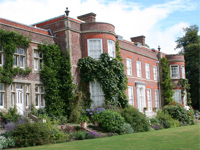
A minor prodigy: Brereton Hall for sale

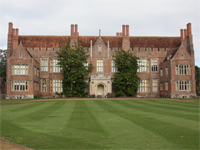
Brereton Hall, Cheshire (Image: Jackson-Stops & Staff)

Advancement in Elizabethan society depended largely on being noticed by the Queen. In an age where the monarch wielded enormous powers of patronage and with so many others jostling for her attention, your house and the hospitality you could provide were effectively the biggest advert you could make.  As a result of this, the houses of courtiers became destinations for the monarch as she made her way around the kingdom, and these homes developed both architecturally and stylistically to not only accommodate, but to also impress.  Known as Prodigy houses, they are now some of the most beautiful in England, and a fine smaller example, Brereton Hall in Cheshire, is currently for sale.

Surprisingly, the genesis of the Prodigy house actually lies far from the bucolic charm of the countryside, and instead can be found on the banks of the Thames in central London. Built in 1547-1552 (dem. 1776), the old Somerset House was the home of Lord Protector Somerset, and was the first classical building in the UK – a remarkable symmetrical façade which proclaimed the dawn of a new architectural style.  Although the core of the building was late-medieval, the decoration was resolutely classical; the gateway on the Strand was a development of the Roman triumphal arch, combining the three orders with pedestals and the pairing of windows and pediments.

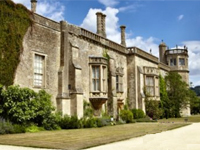
The influence of Somerset House began to spread with the style adopted by those in the Lord Protector’s circle.  In the 1540s, at Lacock Abbey, Sir William Sharington, who was close to the Lord Protectors brother, added Renaissance features to his newly acquired monastic home.  So although elements of the new language began to be used elsewhere first, Longleat, built in 1572-80 by the Lord Protectors steward, Sir John Thynne, was the first of Prodigy houses; a new, larger style of country house which embraced the classical and which were explicitly designed for show.

Longleat House, Wiltshire (Image: Christ Church Association)

Few can mistake the remarkable façades of Longleat, a glittering statement of confidence, wealth and architectural learning.  Thynne was part of the Lord Protectors circle and therefore out of favour under Queen Mary’s rule after 1553, so he wisely retired to Wiltshire to concentrate on applying what he had learned of classical architecture to the new house he was building. Sadly, the early results are unknown as the house burnt to the ground in 1567, forcing Thynne to start again. A new model was created in 1568 (this time in conjunction with that genius of the age Robert Smythson), the new façades were added in 1572, and when the Queen visited in 1575, it was complete up to the second floor.  Interestingly, the third floor may have only been completed after his death in 1580, Thynne having spent a lifetime and a fortune creating one of the greatest examples of Elizabethan architecture.

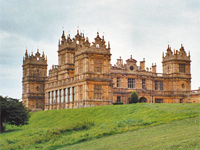
Wollaton Hall, Nottinghamshire (Image: stuartmcq84 via flickr)

Smythson was to become one of the most accomplished of the new breed of specialist; the architect.  Officially his title was ‘Queen’s Master Mason’ but his influence, though the Royal Office of Works, was such that his architectural guidance was to become pre-eminent.  After the success of Longleat, Smythson’s next project was the grand extravaganza that is Wollaton Hall, Nottinghamshire, built between 1580-88.  Sir Francis Willoughby, the High Sheriff of Nottinghamshire, had entertained Her Majesty previously but now wished to create as great a statement as any member of Court.  Drawing on the traditional broad plan of a castle, with all its heraldic and chivalrous echoes, Smythson adapted it to accommodate the new classical language (though even this was inspired by the Poggio Reale in Naples, which Serlio mentions in his third book).  Although the plan of the house still followed the processional structure of royal apartments, the house radically dispensed with the central courtyard arrangement and instead created a huge central ‘keep’, but one without any pretence of defence. This was about glass, power, ornament and display.

Worksop Manor, Nottinghamshire - burnt down 1761 (Image: Nottinghamshire History)
Worksop Manor, Nottinghamshire – burnt down 1761 (Image: Nottinghamshire History)

Wollaton Hall was the last house with a documented link to Smythson but there is strong circumstantial and stylistic evidence that he was linked to two of the other great houses of the age; Worksop Manor, Nottinghamshire, and Hardwick Hall, Derbyshire, both seats of the Shrewsbury family.  Worksop Manor was another departure for Smythson; another variation of the castle plan but now much more loosely applied.  Completed by 1585, the design was a compressed and heightened version of Longleat and without clear precedent in earlier Italian work.  Hardwick Hall – famously ‘more glass than wall‘ – neatly fits into this narrative of Smythson and the nascent English Renaissance. Built between 1590-97, it is a simplified and reduced version of Worksop – and all the more elegant for it.  Built by Bess of Hardwick, it enjoys a prominent site (as with Longleat and Worksop), to better display its charms.  Where Hardwick can claim renown is as the first house to be built with a cross-hall, running from front-to-back in the centre, a derivation of Palladio‘s Villa Valmarana, and is therefore some of the earliest evidence of the use of Palladio’s teaching.

Palace of Theobalds, Hertfordshire - from an article in the Gentleman's Magazine, 1836
Palace of Theobalds, Hertfordshire – from an article in the Gentleman’s Magazine, 1836

Influential though Longleat was, a wealthy man may always wish to find his own way of expressing conformity and so it proved with another group of the Prodigy houses built by William Cecil, 1st Baron Burghley from 1571 (b.1520 – d.1598), the Queen’s Secretary of State and then Lord Treasurer.  Powerful and politically astute, Cecil became one of the most important men in the country and one very close to the Queen.  As such, her progresses often took advantage of his hospitality, leading to the creation of two of the great Prodigy houses.  The first was perhaps one of the largest and grandest non-royal residences ever built; Theobalds in Hertfordshire.  Originally a smaller house, as Burghley said, ‘[it] was begun by me with a mean measure but encreast by occasion of Her Majesty’s often coming‘, and then completely rebuilt in her honour.  It was a grandiose gesture which spread across five courtyards covering a quarter of a mile and anyone seeing it could not fail to be awed by the size and the statement it made of homage to the Queen, who visited 13 times in all, often treating it as one of her own palaces.  Sadly, the house became one of the many casualties of the Commonwealth; listed for disposal, it was largely demolished by 1650.

Burghley House, Lincolnshire (Image: xposurecreative.co.uk via flickr)

Cecil’s other house, Burghley in Lincolnshire, was more conservative and, in comparison, modest, though still on a grand scale.  Built between 1558-57, the house displayed all the typical Elizabethan swagger but in a compact form with an impressive entrance front which was one of the last to use the style of the high turreted gatehouse and towers at each end. One of the most innovative architectural feature of Burghley is the celebrated three-storey tower which dominates the inner courtyard.  Developed from the gateway at Somerset House, the Burghley tower features stacked arches, surmounted by a clock which acts as a plinth for a huge obelisk.  The house today survives as the seat of descendants of the Cecil family.

New Hall, Essex (Image: New Hall School)

Though there are many other examples, two other houses are of particular note in this era of extravagant architecture.  One that can still be seen today, though is now enjoyed more by the pupils in its current use as a school, is New Hall in Essex, where the great stretch of the main lodgings is lavishly fenestrated.  Built by Thomas Radcliffe, Earl of Sussex, around 1573, it was explicitly designed for the Queen’s use with a full suite of royal apartments: great chamber, presence chamber, privy chamber, withdrawing chamber, bed chamber and inner chamber.

Reconstruction of the South front of Holdenby Palace, Northamptonshire (Image: Holdenby Hall)

The other, now sadly lost, is the vast palace of Holdenby Hall, Northamptonshire, a house which influenced those who later also wished to build to impress.  A late starter, Sir Christopher Hatton (b.1540 – d.1591), began the construction of his new house in 1571 as a direct, though amicable, challenge to William Cecil, though with an element of flattery in that it sought to mimic Theobalds.  Expressly designed to accommodate a Queen who never actually visited, by the time of its completion in 1583, Holdenby had few equals as possibly the largest house in the country; an enormous Renaissance palace with symmetrical façades stretching 380ft on the garden front, almost all of it glass. Hatton’s ambitions sadly ran far ahead of his wealth and his attempt at establishing himself as Cecil’s successor failed, partly due to being bankrupted by the enormous expense of building Holdenby, but also by his death less than ten years after completing the house.  Holdenby became a royal palace of James I in 1607 but was sold under the Commonwealth and demolished by 1651, with a smaller house later rebuilt as a new Holdenby Hall, one clearly linked architecturally to its more grand forebear.

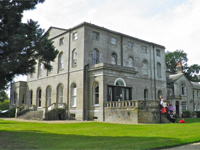
The plan of the early prodigy houses still owed much to the traditional pattern of the Royal progress which required that courtiers accommodate the monarch and their retinue according to the strict rules of precedence and access practised in London.  This meant a series of courtyards and state apartments, each stepped back with a clear route of progress through them.  This naturally forced compromises in the early use of classical, leading to it being external decoration applied to an essentially medieval plan.  However, change was taking hold and in the now-for-sale Brereton Hall, it was reversed with a non-courtyard layout married to a distinctly historical feature, that of the grand gatehouse entrance.

Brereton Hall, Cheshire - 1819 - from George Ormerod's 'History of the County Palatine and the City of Cheshire'
Brereton Hall, Cheshire – 1819 – from George Ormerod’s ‘History of the County Palatine and the City of Cheshire

Whilst the courtiers were engaged with their vast and expensive projects, others also wished to show their allegiance through architecture, adopting the style of those close to the Queen, but scaled to their own circumstances.  Brereton was completed in 1577 but was in one way, curiously behind the times as it was one of the last to be built with a grand gatehouse (added in 1586) – though it was more impressive than it appears today.  The design was novel in that one tower was, in fact, a staircase leading to a small room in the domed turret (similar to Barlborough Hall, designed by Smythson) but with the addition of a bridge which crossed to a banqueting room in the other turret.

Gatehouse, Brereton Hall (Image: Jackson-Stops & Staff)

The rest of the house is typical of the smaller gentry Elizabethan houses, such as Cobham Manor in Kent (completed 1597), or Easton Lodge in Essex (burnt down 1847), which rejected the local vernacular and instead adopted that of the Court.  In doing so, Brereton was a fine example, decorated with the Queen’s coat of arms both inside and out.  The Brereton line died out in 1722, with the house passing to the Holtes of Aston Hall, before being sold in 1817 to John Howard of Hyde. He unsympathetically set about altering the house, radically changing the internal layout and removing the turrets of the gatehouse, adding instead what, in 1909, Country Life magazine called ‘battlements of outrageous proportions and cumbersome mouldings‘.  The house later became a school which closed in 1992 and then passed to the headmistress’ daughter who, with her husband, carefully and sensitively restored it as a home before it was sold in the late 1990s to a technology millionaire, who then sold it in 2002 for around £2.25m.  The house is now again for sale at £6.5m; certainly expensive, but by comparison with the illustrious and much grander architectural ancestors, not prodigiously so.

—————————————————–

Property details: ‘Brereton Hall, Cheshire‘ [Jackson-Stops & Staff]

Article: ‘Country Houses as Family Homes‘ [Country Life]

Photos of the house in 1909: ‘Brereton Hall‘ [Country Life Picture Library]

Further reading: ‘Prodigy house‘ [RIBA]

Soane’s happy commission: Tyringham Hall for sale

Tyringham Hall, Buckinghamshire (Image: Savills)

Six of the most happy years of my life‘ is how Sir John Soane described his commission to build what is regarded as one of his finest works: Tyringham Hall, Buckinghamshire.  Although altered, the house forms an important link in the development of both Soane’s architectural and professional skill; an ideal commission which gave full scope to his genius.  It also has the rare distinction of benefiting from another British architectural giant, Sir Edwin Lutyens, who created some of his best but also smallest work there. Now having been restored, the house is for sale; an early and clear candidate for the most important house to be sold in 2013.

Letton Hall, Norfolk (Image: Chris & Angela Pye via Flickr)

Sir John Soane built only eighteen complete country houses, mainly between 1780-1800, so each house is an important step in tracing the evolution of his distinctive style.  Burnham Westgate was Soane’s first major remodelling (covered in an earlier blog post: ‘For sale: a Soanian springboard‘ Oct 2011) but his first entirely new house was Letton Hall, Norfolk. Built between 1784-92 for B.G. Dillingham, Soane had convinced Dillingham to demolish, rather than alter, the existing Old Hall which he had inherited that year.  Soane’s early working practices, honed through smaller commissions, emphasised extensive discussions with the client at the early stages, and the creation of a wooden model to help them visualise the proposed scheme (created in 1785 – after work had started – at the cost of £6 11s).  Letton also demonstrated several of what we regard as ‘Soanian’ architectural traits: the compact villa design, pale bricks, beautiful proportions and the cantilevered, top-lit staircase.

Stowe House, Buckinghamshire (Image: e-architect)

Soane’s practice now progressed steadily with commissions for new houses at Tendring Hall and Shotesham, along with other works on varying scales.  His growing reputation for not only excellent designs but also for completing work on time and within budget led to his name being circulated amongst the right type of clients who could provide the opportunities Soane hoped for. Drawn by his friend, Lord Camelford, into increasingly political circles, he became friends with the powerful Marquis of Buckingham, who owned two great estates at Stowe and Wotton.  In August 1792, it was Buckingham who took Soane to visit the banker William Praed at his property, Tyringham, which his wife had inherited and which was conveniently close to the Marquis, in whom rested his political and business ambitions.  Needing a house to match his intended status, Praed initially commissioned Soane to remodel the existing Elizabethan manor house. However, after some Soanian persuasion, in June 1793 he decided that an entirely new house would best serve his needs – much to the architect’s undoubted relief.

Soane displayed a particular flair when designing an entirely new house.  Although at the  core of his houses was a Palladian villa, as John Summerson notes, Soane was able to ‘…twist it into something much more complicated with sequences of shaped rooms ingeniously interlocked, and lobbies introduced to effect harmonious transitions‘.  It was this imagination which Soane brought to the Tyringham commission and which created one of his early masterpieces, with flashes of brilliance, both inside and out.

One of the first is the now Grade-I listed monumental arch gateway leading from the main road; a building of such elegance and novelty that it had Pevsner in raptures, describing it as ‘a monument of European importance…it is entirely independent of period precendent, a sign of daring only matched at that moment by what Ledoux was designing in France [e.g. Hôtel Thellusson] and Gilly in Germany‘.  Leading to the house, the drive curves gently away, allowing the house to slowly come into view.  Soane designed the approach, incorporating an elegant humpbacked bridge with balustrades which curve at each end, away from the road, creating a delicate curl.  Arriving at the house, the exterior can also immediately be identified as by Soane, with typical details including the bow-front, the beautiful proportions and the superb detailing, such as the giant Ionic columns and Greek-key frieze.

The interior was to be the finest conception of the whole scheme; a dramatic, exciting series of spaces which would have delighted the visitor.  At the core of the plan was a device which Soane would re-use in later projects but on a monumental scale; the ‘tribune’, a top-lit inner hall.  To look at the plan is to understand the level of trust that William Praed displayed in Soane as, on entering the house, the first space encountered was dramatic as it was domestically redundant: a windowless ante-chamber lit only by the front door and flanking windows behind you, and through another doorway at the far end.  Passing through the room, flanked by four columns supporting a typical Soane shallow dome, you then stepped through the doorway and into the brightly lit central tribune; a Damascene moment of drama.  Forming the top of the T to the dark antechamber, the tribune then led to either the library, the drawing room or the stairs; each decorated in a typical Soane style. Though compact, the house and estate are both impressive and manageable, the perfect combination for a rising, ambitious banker who mixed in aristocratic company.

However, the house and estate today is not the same one Soane created.  Between 1907-19, a series of unfortunate changes were made to designs by the architect Ernst Eberhard von Ihne, his decorator Florian Kulikowski and another architect, Charles Rees, who implemented Von Ihne’s plans which swept away much of Soane’s interior decoration.  They also added an ill-proportioned copper dome, a tea cosy on a champagne bottle, which has the strange visual effect of elongating the columns.  With an estate of only 59-acres, it’s unfortunate that a series of 9 or 10 houses were built to the immediate north-east of the main house. Equally sad, the most important section of Soane’s considered drive to the house is now in separate ownership; the humpbacked bridge part of the public highway and worse, the road then continues down through that wonderful arch which so delighted Pevesner (how long before some careless driver seriously damages one or the other?) – follow the drive via Google StreetView.

Bathing and Music Pavilions, Tyringham Hall (Image: Country Life Picture Library)

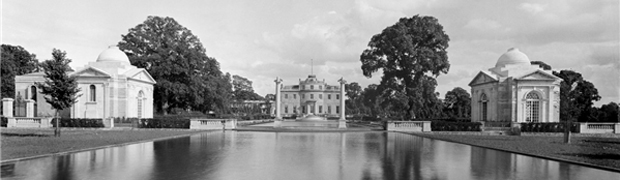
Thankfully what is still intact is one of Sir Edwin Lutyens‘ finest garden schemes.  Between 1924-28, Lutyens was commissioned by the then owners, the Koenigs, a family of Silesian bankers, to create a garden ‘for the recreation of spirit and body‘.  Standing each side of a huge 72m pool, once thought to be the largest of its type in Europe, are two temples; one a bathing pavilion, the other of Music.  Reminiscent of Thomas Archer‘s sublime Pavilion at Wrest Park (1709-11), Lutyens’ interpretation is pared back, less ornamented, but equally impressive – indeed, he himself thought it faultless and would apparently sit in there on his own.

The current vendor, Anton Bilton and family, has lavished millions on restoring the house and grounds (though, he confirms not as much as the £10m previously reported) since buying it for £2.5m in 2001.  However, the £18m asking price quoted in The Sunday Times Home section (28/04/13) seems ambitious; £10m-12m feels more appropriate considering the way the house and estate have been compromised with the now non-private approach, the small housing estate to the east of the main house and the loss of Soane’s original interiors.  Make no mistake, this is still a superb house and sets the bar high for any other house offered for sale this year to be considered as attractive or as interesting.

——————————————————————

Property details: ‘Tyringham Hall‘ – £18m, 59-acres [Savills] Strangely, there is no brochure yet and the launch, through double fold-out spread in Country Life (1 May 2013), feels a touch late.  One wonders whether the Bilton’s were offered a chance to do the Sunday Times piece before Savills were ready and took it anyway?

Excellent selection of photos:

If you wish to find out more about Sir John Soane and are in London, visit his house at Lincolns Inn Fields, which is a museum to his life and work: ‘Sir John Soane’s Museum

Welcome to the market: Lutyens’ The Salutation, Kent

The Salutation, Kent (Image: Knight Frank)

The analogy between language and architecture is one that has often been made, particularly as fluency is the key measure of success in both fields.  An immature architect can make elementary mistakes with the grammar of a building style as much as any tourist abroad can when ordering dinner. In most cases, both novice architect and linguist can be understood but when compared to the more experienced practitioner, skill and mastery come sharply into relief.  Such a lesson by a master architectural linguist has just been launched on the market; The Salutation, in Sandwich, Kent; a beautiful piece of poetry which demonstrates the fluency of the architect in the language of Classicism.

Heathcote, Ilkley (Image: Thursday Dave via Flickr)

Lutyens’ career can largely be seen in three phases; the early years of the ‘Surrey-Tudor’, which evolved into the middle ‘Arts & Crafts’, and then the divergence into the bold ‘Classical’, and its particular variant, ‘Edwardian Baroque’.  That last switch can be seen quite dramatically in the brilliant Heathcote, Yorkshire, built 1906, where Lutyens playfully adopted and adapted the Classical motifs and style of Palladio and Scammozzi to create a wonderfully detailed villa, rich in style and quite unlike his previous work.  After the exuberance of Heathcote (which annoyed Pevsner, who although he commented that it was ‘Only a villa, but how grand the treatment!‘, also dismissed features such as the pilasters which ‘disappear’ into the continuous rustication (see ground floor either side of the windows) as ‘silly tricks‘). On a side note; Heathcote recently sold having previously been bought by a developer/vandal who wished to split the house into two, thus ruining Lutyens’ interior planning – fingers crossed the new owner is sympathetic to this wonderful house.

Lutyens was, of course, part of a longer tradition starting with the first English classical architects practising around the time of Sir Christopher Wren in the mid-17th Century including Hugh May, William Samwell, and Roger Pratt. These pioneers displayed a similar skill in Anglo-Classicism producing buildings such as Cassiobury House (May), the first Eaton Hall (Samwell) and the revolutionary Coleshill (Pratt).  Classicism has long had a place in British architecture, despite other fashions, and has shown its versatility in being used for all sizes of house, from palaces to the smaller country retreat – and it was in this latter requirement that Lutyens was commissioned to build The Salutation.

Located on the site of an old inn of the same name, it was built in 1911-12 in the Queen Anne style as a retreat for Gaspard Farrer, a partner in Barings Bank, and his two bachelor brothers. Lutyens’ clients were typically those who had made money in the decades either side of 1900; that high-point of the country-house lifestyle when staff, materials and labour were relatively cheap. If there is a ‘criticism’ of Lutyens it’s his generosity with regards to space with hallways, alcoves, and large staircases, such as at The Salutation where an extended landing serves as an overflow from the library.  Yet, each space serves a purpose in the plan, typically framing views along axes or as part of a route to the principal rooms which Lutyens often incorporated into houses.

Great Maytham, Kent (Image: Stephen Nunney via Geograph)

The exterior of the house is a smaller derivation of his earlier and much grander Great Maytham, built 1910, for the Liberal MP, H.J. Tennant.  Following the exuberance of Heathcote (which most commentators seem to think came very close to pomposity), Lutyens took a more restrained path through Classicism (compared say, to Richard Norman Shaw at Bryanston House for Viscount Portman) and Great Maytham can be seen as a larger version of Samwell’s Eaton Hall, built 1675, or the smaller Puslinch in Devon, built 1720, with the latter showing clear similarities with The Salutation.

East terrace, The Salutation, Kent (Image: Country Life Picture Library)

The plan of The Salutation is based on the Palladian 3×3 grid but, importantly, Lutyens is able to adapt and amend this without losing the beauty of the proportions.  Gavin Stamp comments that, for Lutyens, his houses were ‘essentially romantic creations; that is, their form is determined by a picture in the architect’s mind‘ and another writer H.S. Goodhart-Rendel compared his ability to that of Wren in that they both had ‘the sculptor’s capacity of making beautiful shapes‘.  Country Life magazine said that it was a ‘dazzlingly suave yet restrained reinterpretation of the old Georgian idiom‘. It was this ability to combine a profound understanding of the Classical rules of architecture with originality which marked Lutyens out as one of the great architects.

To be given a measure of the importance the house, in 1950, it was the first 20th-century building to be given a Grade-I listing.  However, The Salutation suffered in the later 20th-century with the 1980s a particularly difficult time. Repeated attempts by developers were made to either split those graceful internal spaces into apartments or simply demolish it entirely and build on the 3-acre site, over which Lutyens (and possibly his long-term collaborator Gertrude Jekyll) had spent so much time and care crafting.

The Salutation from the garden (Image: Knight Frank)

Salvation for The Salutation came in the form of Dominic and Stephanie Parker who bought it in 2004 for £2.6m and have subsequently spent £3m on its restoration and who now run it as a luxury B&B. Now for sale at £4.5m, for someone with the budget, this could again be a superb home; combining the finest elements of the last boom of the country villa, designed by one of the greatest architects Britain has produced.  For the rest of us, if you’d like to see and experience staying in one of Lutyens finest small houses, I’d suggest booking soon.

———————————————————-

Sale particulars: ‘The Salutation‘ [Knight Frank]

If you’d like to stay; you can book through their website: ‘The Salutation

Video of Mr Parker talking about his decision to buy: ‘The Salutation was ‘like finding a diamond in a river‘ [2009, Kent Online]

Watch the Parker’s competing in a B&B TV competition: ‘Four in a bed‘ [Channel 4]

For more on Lutyens, I recommend Gavin Stamp’s ‘Edwin Lutyens Country Houses‘ [Amazon]

Support the legacy: ‘Lutyens Trust

Listing description: ‘The Salutation‘ [British Listed Buildings]

Houses of gods: country houses converted to religion and the sale of Hawkstone Hall

The 1920s and 30s may be remembered for many things, but it probably wouldn’t be for having any great public affection for the grand houses which had so dominated the landscape agriculturally, economically and politically.  Faced with the reality of the long slump in revenue from the land and wider economic difficulties, country house owners found themselves between the rock of their own financial situations and the hard place of a nation broadly unsympathetic to their difficulties.  Many an owner may have offered up a prayer for some form of divine intervention to alleviate their situation – and the miracle which appeared which saved their house, though not their lifestyles, was religious orders purchasing these grand piles for their ministries.  With the recent launch on the market of the impressive Hawkstone Hall in Shropshire, the cycle turns again, as it looks like the wealthy will rescue the religious.

Hawkstone Hall, Shropshire (Image: Gerard Carroll via flickr)

A nobleman’s residence in the medieval period was often a castle but this dramatically changed following Henry VIII’s Dissolution of the Monasteries between 1536-41.  The aftermath created one of the greatest transfers of land (in the 1530s, they were estimated to hold approx 16% of England) and property as the riches of these institutions were either given to favoured courtiers or sold, creating instant country estates.  Yet, at that time, they were seen more as industrial units; great agricultural establishments which brought in great wealth, with the beautiful priory churches often stripped for their materials. However, for some owners, the buildings were a fine opportunity to create a house – and what better way of creating the impression of an ancient family than with an ancient seat, especially if it came with prized feudal rights.

Lacock Abbey, Wiltshire (Image: Arnhel de Serra / National Trust)

The suppression of the monasteries and convents brought to an end many of the longest standing communities but did give a boost to the secular, non-defensive country house. Many older houses today, both large and small, can trace their origins back to monastic roots, including (a small sample, admittedly):

Mapledurham, Oxfordshire (Image: scoutjacobus via flickr)

Of course, there is a long history of country houses being used for religious purposes as many recusant families continued practising their Catholic faith at great risk to themselves both financially and physically, such as at Mapledurham in Oxfordshire or Hintlesham Hall in Essex.  This secrecy led to the creation of many ingenious methods of hiding not only the chapels (either in attics such as at Ufton Court, Berkshire, or by being disguised as bedrooms) and items of their faith but also the priests themselves, usually in ‘priest holes‘ which could be concealed behind panelling and walls (e.g. at Harvington Hall – still owned by the Archdiocese of Birmingham), in chimneys, under fireplaces and so on.

Despite Catholic worship becoming legal again in 1791, there were still restrictions on Catholics in public office until 1829, and it was still viewed with some suspicion. A further influx in the 1790s was due to the French Revolution which forced many orders back across the Channel.  For any order seeking to establish itself, it was certainly easier to take over a country house as it would often meet their requirements in terms of seclusion and accommodation but without the challenges of trying to build a new convent or monastery. One of the earliest was the purchase of East Bergholt Old Hall, Suffolk which was bought in the 1850s but there have been many others since, including:

Mentmore Towers, Buckinghamshire (Image: EPR Architects)

Catholics may have had the longer history but others have also taken the same route. Perhaps the most famous of these was the spectacular Mentmore Towers, Buckinghamshire, designed by Joseph Paxton and built between 1852-54 for the Rothschilds, which was bought by the followers of the Marharishi Yogi to serve as the UK headquarters for the World Government of the Age of Enlightenment. This followed the scandalous refusal by the then Labour government to accept it for the nation with its incredible collections in lieu of just £2m inheritance tax and the subsequent sale which netted several times that. Others include:

There don’t appear to be any clear records of which houses have been used as convents/monasteries so it remains anecdotal (there’s probably a good PhD topic in there somewhere) but it’s possible that hundreds of houses have served in this use, especially if convent schools and retreats (e.g Capernwray Hall and Kinmel Hall) are included. For many of these, it’s likely that this alternative use saved them from joining the ranks of those demolished.

For the past 85 years, grade-I listed Hawkstone Hall has been a seminary and also a retreat for Catholic clergy.  The house was originally built in 1720 for Richard Hill (b.1655 – d.1727), a traveller and diplomat who had made a fortune through what was described as ‘lucrative arithmetick‘, and consisted of just the main block.  The design of this section is quite unique, certainly to the area, and pre-dates designs later shown in Campbell’s ‘Vitruvius Britannicus‘ published in 1715-25.  Although it shares certain elements with other houses (Buckingham House, Chatsworth – east front), neither the listing description nor Colvin have details on the original architect so it is open to conjecture as to who designed it and where they got their inspiration (if anyone does know/have any suggestions, please do add a comment below or contact me).

Hawkstone Park, Shropshire (Image: Peter-snottycat via flickr)

Hawkstone was then inherited by his son Sir Rowland Hill, 1st Baronet (1705–1783), who added the wings as part of an enlargement in 1750, but who also, more importantly, started the landscaping for which the estate was to become famous.  Taking advantage of a natural rocky outcrop, Hill created a series of walkways on the cliffs, view points and follies which attracted many visitors.  This grew to such an extent that Sir Richard Hill, 2nd Baronet (b.1733 – d.1808) wrote the first guidebook for the park and also built the ‘Hawkstone Inn’ to cater for the visitors. Such was its reputation that Dr Samuel Johnson came to see and was duly impressed, remarking on “…the awfulness of its shades, the horror of its precipices….“. Johnson also commented that he thought there ought to be more water and so Sir Richard commissioned landscape designer William Emes, who created the Hawk River which still flows to the north-west of the house.  Hawkstone Park had become one of the most popular attractions in the country by the time of his death in  1808 and remained so under the care of his brother, Sir John Hill, 3rd Baronet (b.1740 – d.1824), who inherited.

Sadly, it was to be the next generation who sowed the seeds of the families financial troubles.  The house and park were inherited by Sir Rowland Hill, 4th Baronet Hill of Hawkstone, 2nd Viscount Hill (1800–1875) who, through extravagance or mismanagement, lost much of the family fortune. Inside, he commissioned, between 1832-4, various alterations including a new drawing room from Sir Matthew Wyatt, whilst in the grounds he carved a hugely expensive new drive through a cliff and built The Citadel, a strange castle-like dower house.  He even toyed with the idea of relocating the entire house to the other side of the river.

Such spending was always likely to lead to difficulties and the 3rd Viscount, Rowland Clegg-Hill, (b.1833 – d.1895), never managed to re-establish the fortune and was bankrupt by the time of his death.  This forced a sale of the contents and then the splitting up of the estate in 1906.  The park, with the many follies, tunnels and caves, was sold off and is now run as part of the Hawkstone Park hotel. The Hall was bought by George Whitely, later Baron Marchamley of Hawkstone, a wealthy mill and brewery owner and MP, who made minor alterations; reducing the height and length of the projecting wings and to the interior.

The house was then sold to the Roman Catholic Redemptorists who have remained there until a recent review of their activities prompted them to put the house, with its 7-acres of gardens and 81-acres of grounds, up for sale for £5m.  Any purchaser looking to make this a home again will need to demolish the ugly accommodation block tucked away behind the left wing and will also have to consider what they wish to do with the large chapel which was added in 1932; perhaps if bought by a non-religious family it would make a superb music room.  For a house which exhibits such architectural interest and grandeur, it seems like a fair price and one hopes it will attract someone willing to invest to recreate what could be one of the finest homes in Shropshire.

———————————————————–

Property details:

News story: ‘Hawkstone Hall goes up for sale with a £5m price‘ [Shropshire Star]

Official website: ‘Hawkstone Hall

Possibly for sale – a landmark for landowners: Crichel House, Dorset

Crichel House, Dorset (Image: BNPS / Daily Mail)

When to believe the rumours? Occasionally one of the old families will decide that they no longer wish to hold onto the estate which has been the family seat for many years – sometimes centuries. When these estates come to market they usually attract a significant price-tag which truly reflects their beauty, significance and acreage.  If the unconfirmed rumours which feature very prominently on page 2 of the Sunday Times (26 June 2011) are to be believed, then the Marten family of Crichel House in Dorset have decided to sell – almost 60-years after the family won a decision against the government of the day which became a landmark in the rights of landowners against government.

Crichel House is widely regarded as one of the best houses in the county – indeed, John Julius Norwich states that it “…possesses the most spectacular series of state rooms in all Dorset.“.  Crichel started off as a modest house in 1743; hastily built to replace a charming Elizabethan house which was burnt down in 1742.  This smaller seat of a country squire – brick-built and just five bays by seven – was for Sir William Napier, who left it to his nephew, Humphry Sturt, in 1765.  Sturt had inherited not only his uncle’s house and wealth but had also married well. He didn’t feel the house was grand enough for a man of his fortune, and so embarked on an impressive rebuild, creating a house “…so immensely enlarged that it has the appearance of a mansion of a prince more than that of a country gentleman.” (Hutchin’s ‘History of Dorset‘ – 1774).

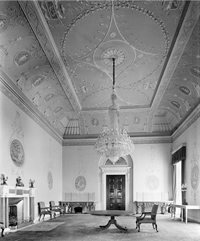
Dining Room, Crichel House, Dorset (Image: A. E. Henson / Country Life Picture Library)

Sturt, using an unknown architect (though thought to be from nearby Blandford), effectively wrapped a new house around the old one to the east and the west, and linking the two on the south front with an impressive recessed portico and suite of rooms on the first floor.  However, the need to accommodate the dimensions of the old house created a slightly cramped feeling to the first floor elevations.  However, all is forgiven by the splendid interiors which are, in parts, a curious mix of early Georgian created late (e.g. the staircase, the library), and fashionable later Georgian, particularly in the stunning Hall, Dining Room and Drawing Room where Adam-style plasterwork reigns.  The latter rooms were probably designed by James Wyatt who was working nearby at Milton Abbey and at Bryanston.  The Dining Room is considered the finest room in the house; a coved ceiling framing delicate plasterwork and decorative panels in the style of Cipriani and Angelica Kauffmann.

So, how did part of the Crichel estate become so significant that it became immortalised as a set of planning procedures known as the ‘Crichel Down Rules’? In part, it was due to the bureaucratic arrogance of the post-War era which meant the Civil Service felt able to deal rather high-handedly with anyone, and particularly landowners who were not popular under Attlee’s socialist government. In 1937, 742-acres of Crichel Down had been compulsorily bought as part of a larger area for use as a bombing range. Churchill had given a very public commitment in the House of Commons in 1942 that land purchased in this way would be offered back to the original owners once it was no longer required for the original purpose.

Hinton Ampner, Dorset (Image: ec1jack / flickr)

However, there was an even greater danger of compulsory purchase for houses which had been adapted for wartime use under the ‘Requisitioned Land and War Works Act (1945)’ (sections 8 & 9 Geo. 6 c.43 in case you were wondering!) which gave officials the right to buy, regardless of the wishes of the former owner or any previous assurances. At Hinton Ampner in Hampshire where Ralph Dutton (the 8th and last Lord Sherborne), having just finished an extensive remodelling in 1939 only to be turfed out by a girls school, received a letter saying that the Royal Observatory were interested as a new Royal Observatory.  Dutton took the day off work at the Foreign Office and was on the doorstep when the officials arrived and gave an impassioned speech about the importance of the house, how it had been in the family for generations and that losing it would be akin to an amputation. The officials apparently looked somewhat embarrassed but gave no sign of retreating until a short note arrived a little later confirming that they were taking Hurstmonceaux Castle instead.

At Crichel Down, the government had decided to retain the land as a new model farm.  Lt-Cdr George Marten (who had married Mary Sturt, the only child of the 3rd Lord Alington), began a vigorous one-man campaign to examine the conduct and procedures of the relevant departments.  In doing so, he exposed a series of administrative errors as officials tried to evade the requirement to offer back the land and retain it for the government’s use.  Eventually, in 1954, public and press criticism led to the minister in charge, Sir Thomas Dugdale, resigning in one of the first examples of a minister taking responsibility even though he had not been involved in the earlier decisions and the land was sold back to the Martens.  To avoid a repeat of such failings, new planning rules regarding compulsory purchase were drawn up which are today known as the ‘Crichel Down Rules’ and are a vital part of the framework protecting landowners from the sometimes autocratic decisions of officials.

The death of Mary Marten in 2010 (her husband pre-deceased her) led to the recent sale of some of the contents of the house including a small collection of Asian jade ornaments which raised some £12.5m.  However, if the rumours are right, the rest of the house and 5,000-acre estate are also quietly on the market with an estimated price tag of around £100m, which, if it sold as a whole estate, would make it the most expensive sale ever outside of London.  It’s always a regret when families no longer wish to keep an estate which has been in the family for centuries, however, with the demands of sibling equality it is understandable that each of the six children – five females, one male – should wish to share their inheritance.  It would be a wonderful outcome if it could be bought in its entirety and remain one of the most important estates in Dorset, with the glorious Crichel House at it’s heart.

————————————————————————-

Update – 7 July 2013: Crichel House has been sold

Daily Mail confirms that the house plus 400-acres has been bought by Richard L. Chilton, a US hedge fund billionaire.  Initial reports indicate that he is a ‘conservationist’ having rescued other houses in the States so it seems promising that he is the right buyer; one with both the right attitude and pockets deep enough to do the house justice.  Though sadly it’s the end of an era for the Marten family, one hopes that this next phase will see the house restored to its former glory.

And if Mr Chilton happens to read this, it would be great to get your perspective – please do email me.

————————————————————————-

More images – both interior and exterior: ‘Crichel House, Dorset‘ [Country Life Picture Library]