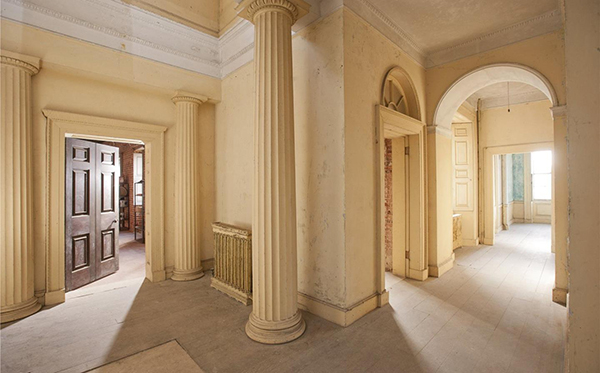
A gilded cage: country houses as prisons

Country houses have been slightly glibly described as ‘prisons’, usually due to the restrictive social conventions, which stifled the freedom of the occupants. However, country houses have occasionally been repurposed as true custodial institutions, serving as prisons, youth detention centres, approved schools, prisoner-of-war (POW) camps from the 18th century to the present. This role is one which has been often overlooked in the history of the country house.
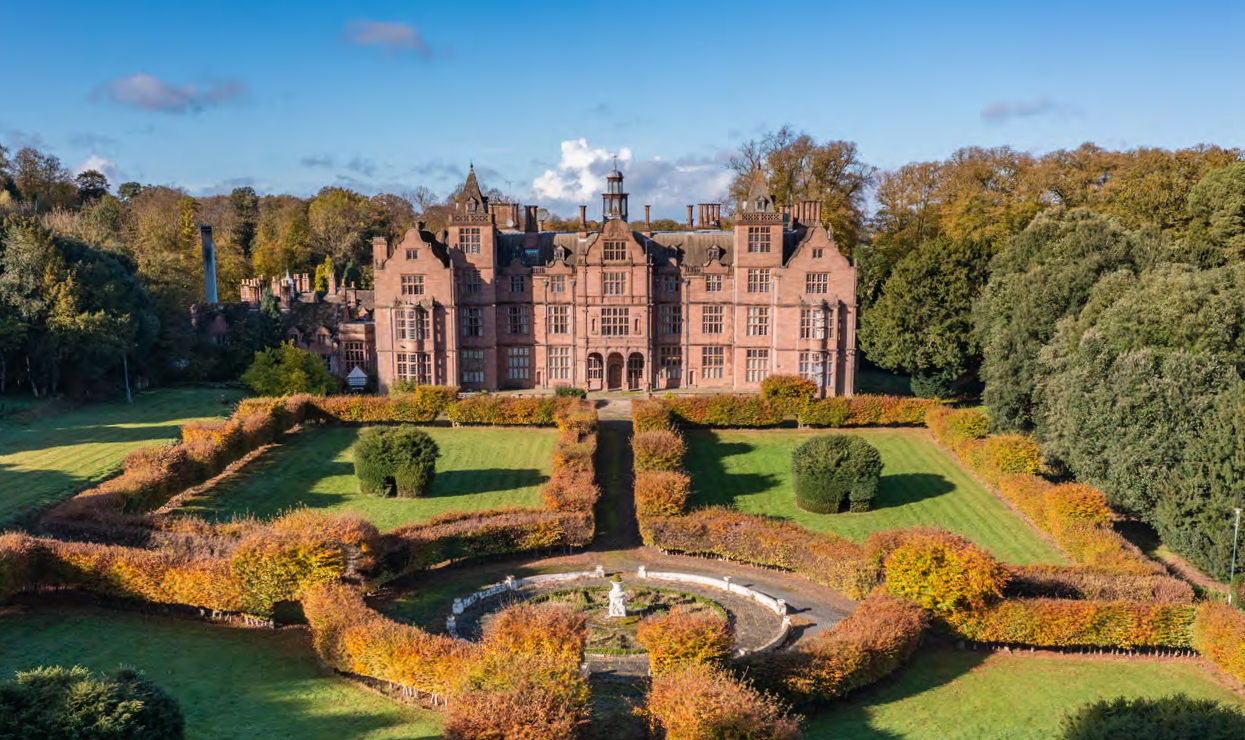
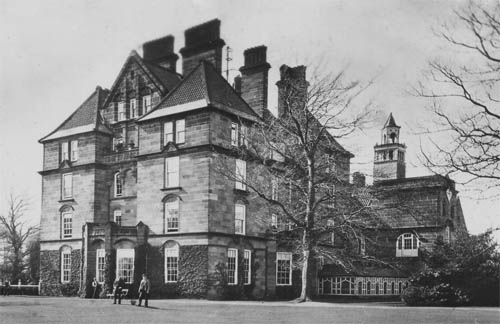
Hewell Grange, Staffordshire aka HM Prison Hewell Grange 1946-2019 (Image © Cushman & Wakefield)

A fictional prison

If one wished, it was always possible to cast the country house as a prison, of sorts. The restrictions placed on everyone who lived in one, whether as the lord or the lowliest servant, was a web of both explicit and implicit rules. Although they could, in theory, walk out of any unlocked door, the reality was that they were trapped, bound to the building.

Fiction has long played on this idea, weaving physical incarceration, with its psychological equivalent. There are the self-imposed emotional bonds which confine the jilted Miss Havisham to her decaying Satis House in Charles Dickens’ ‘Great Expectations‘ (1861), or the fear which entraps the governess at Bly House in ‘The Turn of the Screw‘ (1898) by Henry James. In ‘Rebecca‘ by Daphne du Maurier (1938), Manderley, the grand estate in Cornwall, becomes a place of psychological imprisonment for the unnamed narrator. Haunted by the lingering presence of her husband’s first wife, Rebecca, the narrator feels trapped by the oppressive atmosphere of the house and the expectations imposed upon her. More recently, in Sarah Waters’ ‘The Little Stranger‘, the decaying Georgian mansion of Hundreds Hall (played by Newby Hall, Yorkshire in the film), becomes a symbol of entrapment for its inhabitants as their financial decline echoes that of their place in society, leaving them isolated.

Newby Hall, North Yorkshire, represented the fictional Hundreds Hall in the 2018 adaptation of Sarah Waters’ ‘The Little Stranger’

Beyond these intangible confines, the house as a cell was perhaps most famously portrayed with Bertha Mason, Mr Rochester’s wife, confined as the ‘mad woman in the attic’ of Thornfield Hall in Charlotte Brontë’s ‘Jane Eyre‘ (1847).

Royal confinement

Beyond fiction, the country house has, at times of need, served in reality as a place of confinement – pressed into service as a working prison when circumstance demanded.

On 16 May 1568, Mary Queen of Scots fled to England seeking refuge from political turmoil in Scotland after the battle of Langside and spent her first night at Workington Hall, Cumbria. Mary had come to England in the hope of gaining support from the Catholic nobility and of appealing to her cousin, Queen Elizabeth I, for political assistance in regaining her Scottish throne. However, because both women were descended from Henry VII, Mary possessed a strong claim to the English crown. This made her presence in England a direct threat to Elizabeth, particularly as Mary was a Catholic alternative to Elizabeth’s Protestant rule.

Although Mary was technically a guest, she was heavily guarded and this effectively marked the beginning of her nearly 19-year imprisonment before her execution. Mary was moved around regularly to thwart plots to free her, from castles to eventually the country houses of George Talbot, the 6th Earl of Shrewsbury (b.1522 – d.1590). The Earl of Shrewsbury, famously married to Bess of Hardwick, played a pivotal role in the confinement of Mary, having been appointed her custodian by the Queen. Throughout various periods, he held Mary at his family’s houses including Wingfield Manor, Hardwick Hall, Chatsworth House, and Sheffield Manor – all situated within a 15-mile radius in Derbyshire. Mary was finally moved to Fotheringhay Castle, Northamptonshire, arriving on 25 September 1586. She was put on trial in October, and then executed in the Great Hall on 8 February 1587. Her long confinement within such grand yet guarded houses stands as a stark reminder of how the architecture of luxury could so easily become the architecture of captivity.

A prisoner of war

In wartime, country houses have been pressed into service in a wide variety of roles, with prisoner-of-war camps among the least glamorous. Stepping beyond the more obviously martial associations of castles, one of the earliest – and most notorious – examples was at Sissinghurst in Kent during the Seven Years’ War (1756–1763). The house, by this time had been allowed to fall in to a significant state of disrepair by the then owners, the Baker family. The government rented the property and adapted it to hold around 3,000 French naval prisoners, during which time it was further mistreated with the inmates destroying panelling, fireplaces, the chapel furniture, and leaving the garden a wasteland.

In 2008, a newly identified watercolour emerged that provides the most complete known view of the Elizabethan house during this period when it was a prison – and includes the chilling depiction of a double murder.

Watercolour (c.1761) showing the Killing of a Group of French Prisoners at Sissinghurst Castle Garden, Kent. Sissinghurst Castle © National Trust Images / John Hammond 2016
Sissinghurst Castle with the Killing of a Group of French Prisoners English School, circa 1761. Ink and dye on laid paper. (© National Trust Images / John Hammond 2016)

On 9 July 1761, whilst guarded by local, poorly-trained, armed militia, three prisoners who had escaped were being brought back to the camp. Their arrival caused a group of prisoners to rush to the fence out of curiosity.  One of the militia, a hot-head called John Bramston, shouted that they were to come no closer or he would fire. He loaded his musket with three balls and fired at the group. One ball struck the wall, the other two each hitting a prisoner. One by the name of Baslier Baillie was wounded (shown top-left being helped by two friends), but another, Sebastien Billet, was killed instantly. Bramston was unrepentant. The picture is thought to have been painted by a Frenchman to record the crime – but in doing so also left a powerful visual record of a now much-altered house and its time as a prison.

World War II

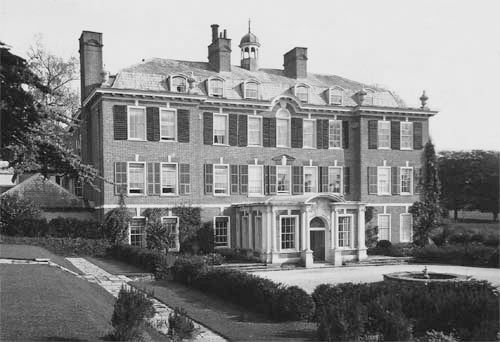
During the twentieth century, several distinguished country houses were temporarily repurposed to serve the needs of war, their refined architecture providing an incongruous backdrop to confinement. At Huntercombe Hall in Oxfordshire, the late-Victorian mansion, with its commanding stone façade and landscaped setting, was requisitioned during the Second World War as a secure detention site, most notably for high-ranking German prisoners including Rudolf Hess, whose isolation lent the house an unlikely role in wartime diplomacy and intelligence. In north London, Trent Park, a neo-Palladian villa by Sir William Chambers, was adapted as a special interrogation centre, where senior German officers were held in conditions of deceptive comfort while their conversations were secretly recorded – its grand rooms thus becoming instruments of psychological warfare.
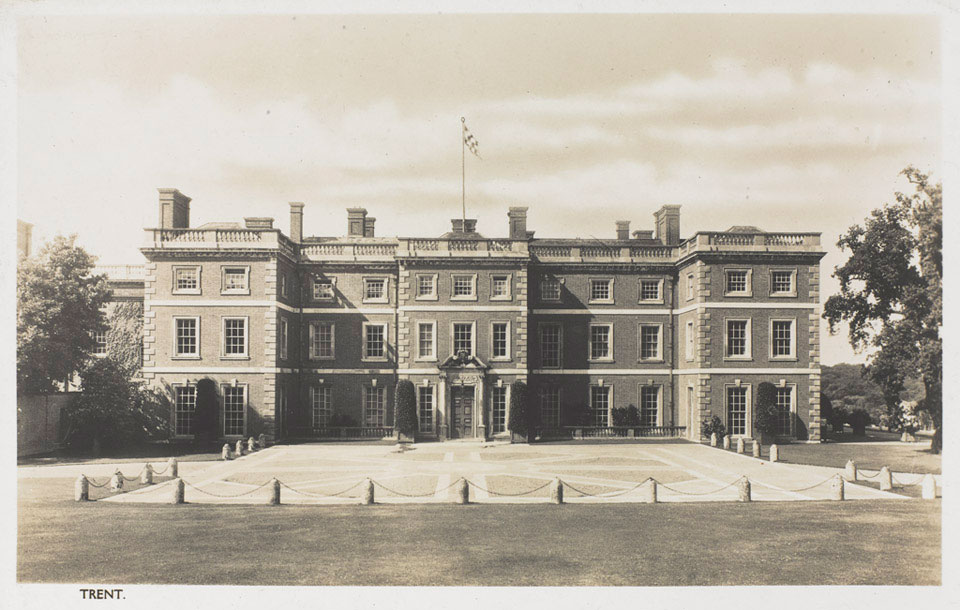
Entrance front of Trent Park, Enfield, north London (Image © National Army Museum ref: NAM. 1993-10-163-1)

Similarly, Mytchett Place, Surrey, during 1941–42, this Victorian mansion was fortified and codenamed “Camp Z,” serving as a one-man prison wired for surveillance for the detention of Deputy Führer Rudolf Hess.

Further north, the Huntroyde Hall estate in Lancashire, long the seat of the Starkie family, was similarly turned over to military purposes, its once-private parkland accommodating prisoners and personnel within hastily erected compounds. As with Sissinghurst, the mistreatment during the harsh use as a prison was a significant factor in its later demolition. Earlier, in the First World War, the partly medieval Badsey Manor House in Worcestershire was similarly employed to house prisoners of war, marking a utilitarian phase in its long domestic history.

The changing attitude to the role of prisons

The use of country estates and their houses was partly one of necessity in wartime, but in the post-war period also reflected a change in attitudes towards a more therapeutic approach towards incarceration from the 19th-century focus on harsh conditions and hard labour as a deterrent.

Why country houses? They offered several advantages: privacy (away from cities, escapes less dangerous to public), space for agriculture and workshops (important for training prisoners in trades), and an existing infrastructure of accommodations and kitchens. Also, symbolically, placing prisoners in a “less oppressive” environment was meant to encourage self-respect and responsibility – a deliberate contrast to the austere walled prison. Askham Grange’s homely appearance was cited as beneficial for women.

The open-prison concept drew heavily on Alexander Paterson, who joined the Prison Commission in 1922. He argued that imprisonment should actively shape behaviour for the better, with inmates encouraged to develop through structured physical and mental activity.

In the 1940s, there had been a steady increase in the total number of people convicted of indictable offences. During a House of Lords debate on Penal Reform in November 1946, the Lord Chancellor, Lord Jowitt, lamented the tendency towards increasing crime before WWII, stating that,

I take the five years 1934–1938. The number of young persons found guilty of indictable offences moved up from 10,000 odd in 1934 to 14,000 odd in 1938 – that is males; females from 1,300 odd in 1934 to 1,600 odd in 1938. …When we have the figures of 14,000 young men and 1,600 young women going up to the sort of figures we have to-day [1947], for the total number of persons – 78,000 in 1938, moving up in 1945 to 116,000…it is quite obvious that we have here a very real problem. (Source: Hansard – column 442)

The noble Lord’s figures indicated a serious issue so whilst not everyone convicted was incarcerated, there was a steady rise in the prison population:
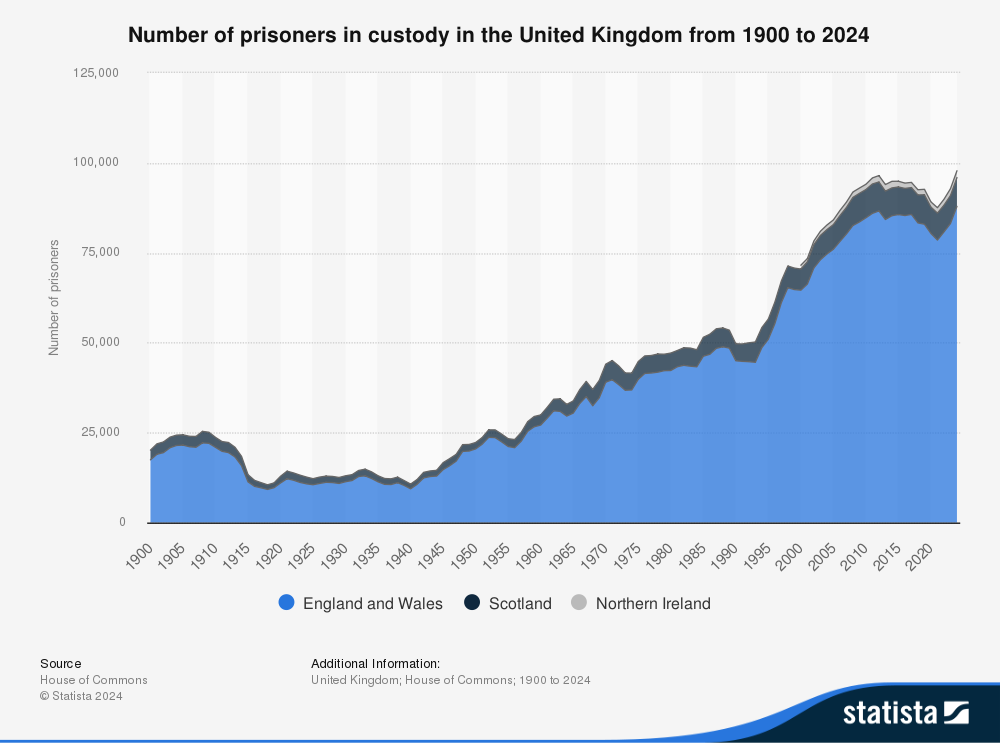
Number of prisoners in custody in the United Kingdom from 1900 to 2024 (Image source: Statista. Data source: UK prison population statistics – published July 2024. House of Commons Library)

The sustained increase in the total population by over 50% from 1940-1950, would place significant stress on any system of incarceration. However, attitudes had changed and the harsh conditions of punishment of the nineteenth century were now considered to do more harm than good, especially for young offenders. The Criminal Justice Act of 1948 introduced major reforms for young and habitual offenders. It barred sending under-21s to prison except as a last resort, directing them instead to borstal training or, for shorter terms, to detention centres.

This more enlightened perspective, which the Lord Chancellor was fully supportive in that same debate, created a requirement for a system which emphasised a more probationary approach via the borstal system. By relying on less stringent security, and often promoting training and useful labour – particularly agricultural – this created a means to reform and improve the lives of those who had been convicted. The Lord Chancellor welcomed that:

Thank goodness, we are now approaching the time when it will no longer be necessary to detain in prison for long periods persons who are ultimately going to serve their sentences in Borstal. The institutions we now have are of very varied types. Sometimes they are in a camp and sometimes they are in a country house, where the inmates can be engaged on agricultural work. We have also opened a new Borstal institution for girls at East Sutton Park in Surrey. That is a small institution and will take some fifty girls. (Source: Hansard – column 447)
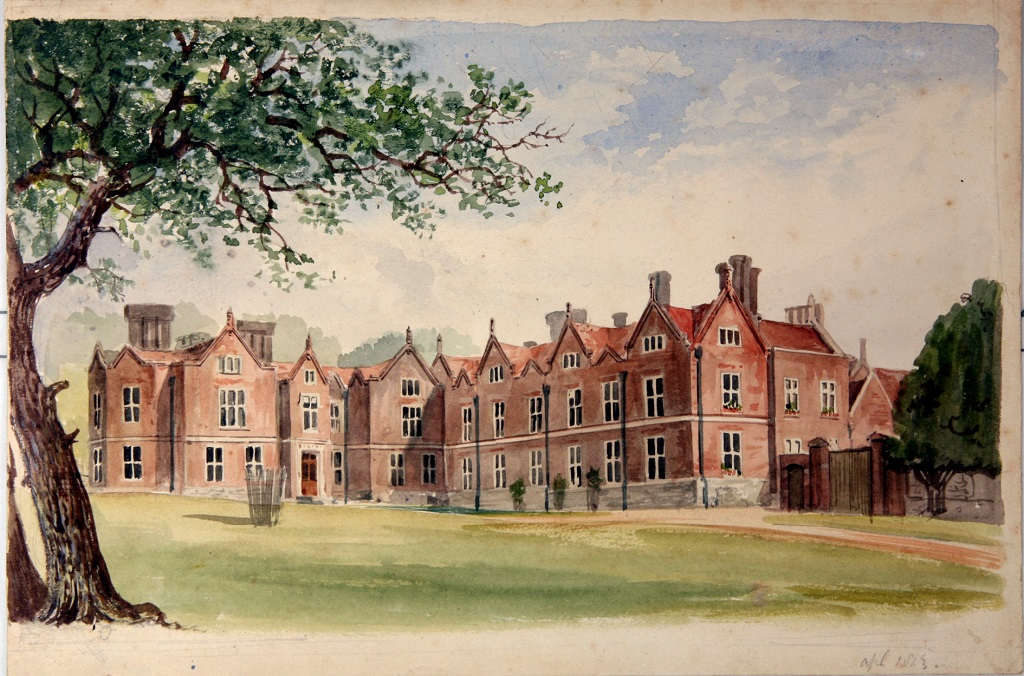
East Sutton Place [Park], Kent, which became the first open female Borstal in 1946 (Image © Kent Archives)

Interest also developed in adapting elements of the short-lived but influential “Wakefield experiment,” introduced during the First World War to manage the most uncompromising conscientious objectors – the Absolutists – who refused all military orders. Previously held in ordinary prisons, they became the focus of MPs arguing for more humane treatment. The government resisted releasing them but agreed to trial a compromise by placing all COs under a new regime at Wakefield.

This system relied on a high degree of trust. Cell doors were left unlocked, prisoners could move freely within the prison, and a small allowance allowed them to buy writing materials and tobacco. Conditions were not freedom, but a clear improvement. Leisure and work were timetabled, with expectations of diligence and no “singing, shouting, whistling, or reading” during working hours. The experiment collapsed when the men rejected the rules they had helped draft, leading to their return to standard prisons. Even so, its central idea – combining restrictions with opportunities for responsibility and reform – would influence later thinking about penal regimes.

Entrance to Tortworth Court, Gloucestershire (Image from private collection)

Speaking during the same debate in 1946, the Lord Chancellor again highlighted that such facilities were being developed:

We have recently taken over a former hospital at Tortworth [Court] in Gloucestershire as what is called a minimum security prison for selected convicts. In that way we can do much towards their rehabilitation and their ultimate reassimilation into ordinary civilian life. (Source: Hansard – column 447)

This approach influenced the selection of suitable locations for the new prisons. At HMP Leyhill, the government repurposed an ex-American Army hospital camp on the Tortworth estate to create the first open prison in 1946. The adjacency of Tortworth Court (then still with the Earl of Ducie) gave the model of a country setting if not using the main house. Interestingly – the house was not taken as it was returned to the Earl; but by the 1950s, Leyhill expanded and did start using some estate buildings, thought the wider estate is still owned and managed by the Earl of Ducie’s family as Tortworth Estates.

Hewell Grange

Hewell Grange epitomizes the pattern for long-term penal conversion. An existing country house could be successfully integrated into the penal system for decades, effectively becoming a self-contained village (with a chapel, workshops, and housing all on site).

The grand main house, last great prodigy houses of its era, provided an environment, even when not used directly as cells for prisoners, was arguably more humane than a typical prison – former inmates often remarked on the beauty of the lake and gardens, which were part of a 250-acre landscape park laid out by Capability Brown, with formal terraces, a lake, and extensive service buildings. By the lake are also the ruins of Old Hewell Grange, the classical predecessor to the current house. After being superseded by the new Hewell Grange in the 1890s, it was accidentally gutted by fire and abandoned, and now survives as a roofless ruin, its classical form still partly visible among collapsed walls and encroaching vegetation.
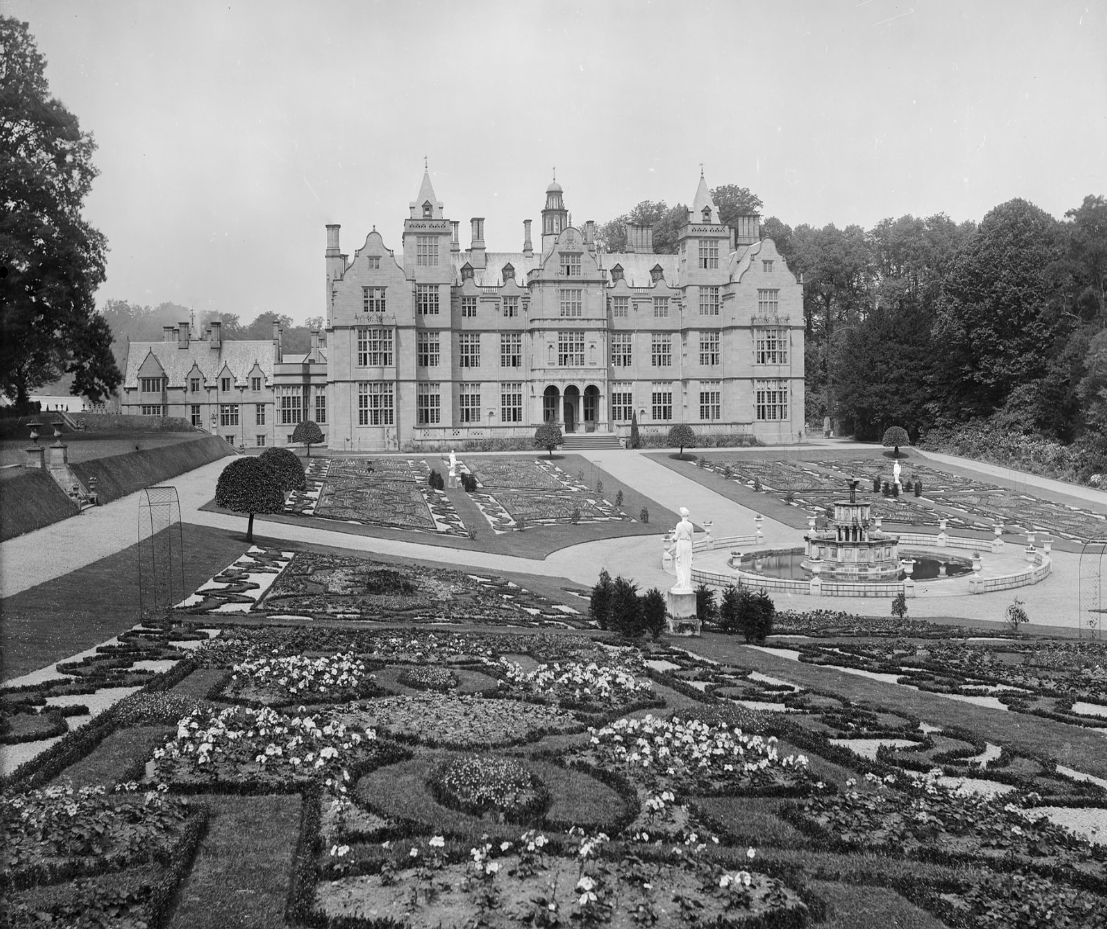
View of Hewell Grange and the formal garden to the south-east of the house c.1892 (Image © Historic England, ref: BL11660/016)

The new house was built between 1884 and 1891 for Robert Windsor-Clive, later 1st Earl of Plymouth, Hewell Grange cost approximately £250,000 (equivalent to spending c.£39m today). Designed by George Frederick Bodley and Thomas Garner in the Jacobethan style, the red brick house with stone dressings features an E-plan, steeply pitched gables, clustered chimneys, and mullioned-transomed windows. Interiors include carved oak panelling, a double-height Great Hall with a minstrel gallery, and elaborately modelled plaster ceilings.
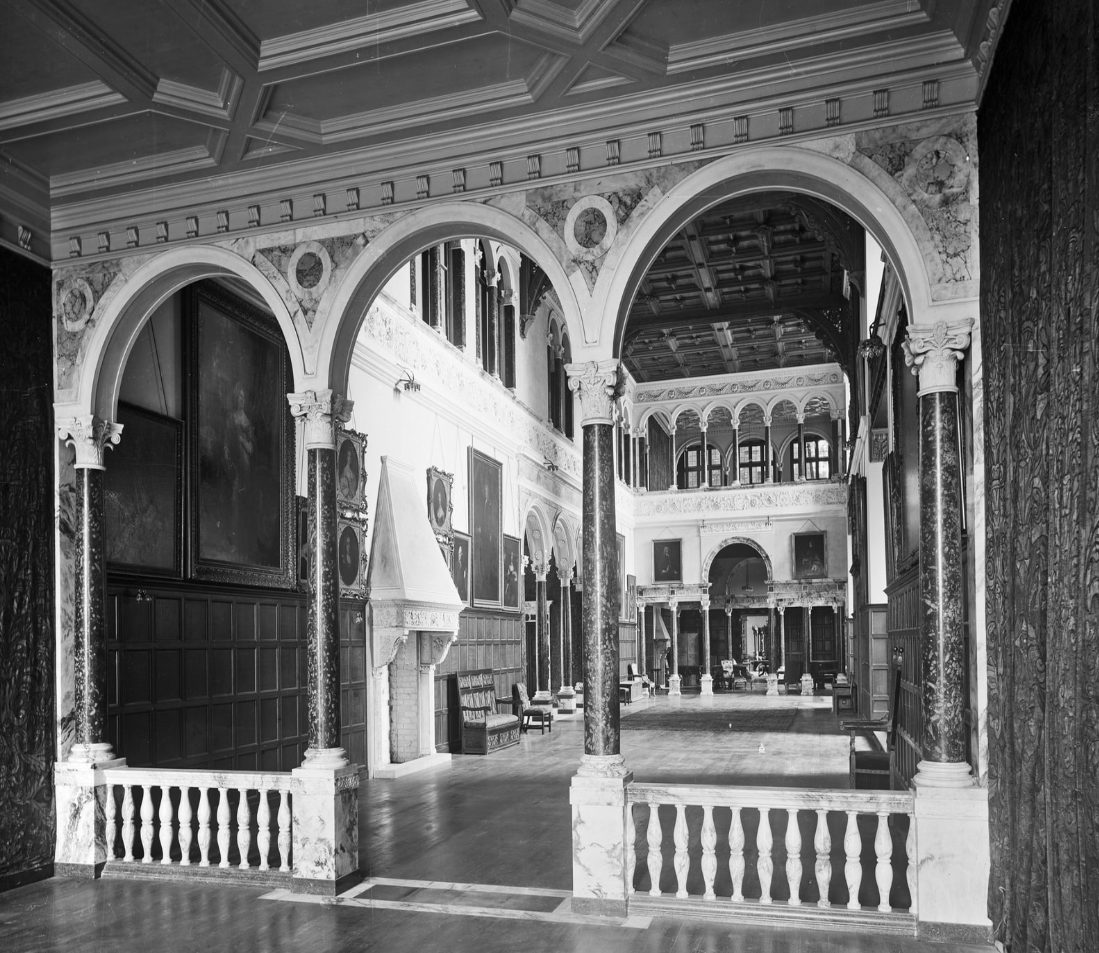
Interior of the Italianate style Great Hall of Hewell Grange, 1891 (Image © Historic England, ref: BL11026)

However, Hewell Grange also reveals both the potential and limitations of prison use: spacious and already built, the house saved the state construction costs in 1946; but by 2019, it was anachronistic and expensive to run. By the 2010s, the UK prison estate was being rationalized. In 2019 the Ministry of Justice announced the closure of the open prison at Hewell Grange, following a critical inspection report and also reflected the cost of maintaining an ageing mansion for modern custody standards. The prison formally closed in 2020, and the entire site was consolidated into one (closed) prison to the north east of the house, around 600 meters away.

Hewell Grange house is now vacant and lacking a clear future, beyond occasional use for filming and events. As is so often the case for heritage without a viable and sustainable purpose, its condition has deteriorated to ‘poor’ after closure, with concerns about lack of maintenance, resulting in it being placed on the Heritage at Risk Register. As of early 2022, the government put the property up for sale, seeking a new custodian to repurpose the historic estate once again.

It was apparently sold in 2023 to a hotel group but it’s unclear whether this fell through or they immediately put it back on the market, as it has been offered through Cushman & Wakefield, with 247 acres, for an undisclosed price. This inevitably raises questions about the future: will it return to a private residence, become a hotel or institution, or will it just be allowed to deteriorate until it becomes another country house to succumb to neglect, urban exploration or a mysterious fire?

Conclusion

The pattern of country house reuse reflects adaptability to historical moment. In wartime, necessity drove usage; in peacetime, policy experimentation and economic forces did. This practice peaked in the mid-20th century and today it would exceptionally unlikely for a house to be taken over for this purpose, with a clear preference for building dedicated facilities.

From a wider heritage perspective, Hewell Grange’s story is instructive as, unlike so many country houses that were demolished in the mid-20th century, the use as a prison provided a value and so it was preserved precisely because it found an institutional function. Now its preservation will depend on finding a sympathetic new use after its institutional life has ended.


A list of country houses used (either currently or previously) for incarceration by the state since 1900

Prison nameCountry houseCounty
Askham GrangeAskham GrangeYorkshire
BlundestonBlundeston LodgeSuffolk
Buckley HallBuckley HallLancashire
Bullwood HallBullwood HouseEssex
East Sutton ParkEast Sutton ParkKent
ErlestokeErlestoke ParkWiltshire
Foston HallFoston HallDerbyshire
HewellHewell GrangeWorcestershire
Hill HallHill HallEssex
HumberEventhorpe HallYorkshire
Kirklevington GrangeKirklevington GrangeYorkshire
Latchmere HouseLatchmere HouseSurrey
LittleheyGaynes HallCambridgeshire
Lowdham GrangeLowdham GrangeNottinghamshire
Morton HallMorton HallLincolnshire
Penninghame HousePenninghame HouseDumfriesshire
Spring HillGrendon HallBuckinghamshire
StockenStocken HallRutland

If I have missed any others, please share the details in the comments or contact me directly and I’ll update the list.

Sites associated with nearby country houses

Prison nameCountry houseCounty
Eastwood ParkEastwood ParkGloucestershire
LeyhillTortworth CourtGloucestershire
Swinfen HallSwinfen HallStaffordshire


Selected references


Further research

Interestingly, the subject of the use of the country house for incarceration doesn’t appear to have been covered in depth academically, as far as I could discover. Given the numerous angles, this would appear to be an area which someone may wish to investigate further as the official records and related information would probably reveal a richer story than I have been able to share here. Happy to have a chat if anyone wishes to take it on.

The growing silence: how many UK country houses were lost?

Slowly, then suddenly, many estates grew silent. Carriages no longer clattered down the drives. Entrance halls no longer echoed to voices. Kitchens went cold. Staff quarters were emptied. Then, the contents were sent to the auctioneers. Finally, the house was broken apart; hammers and pickaxes the new sounds as hundreds of years of history were reduced to rubble.

One key questions which architectural historians have been trying to answer for a number of years is just how many UK country houses have been lost? The answer, for now, is over three thousand. Each was a world on its own, but also part of the complex jigsaw of our national heritage.

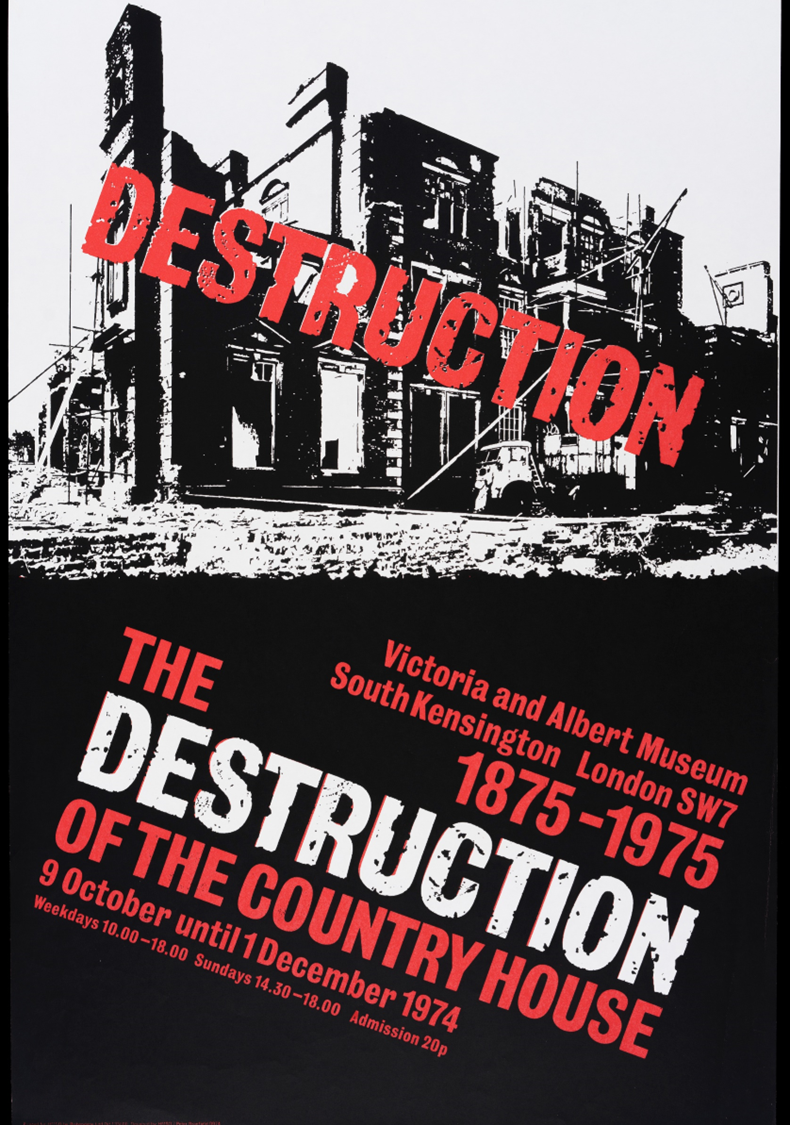
The genesis for this area of research was ‘The Destruction of the Country House‘ exhibition, which ran from 9 October – 1 December 1974 at the Victoria & Albert Museum in London. I have written about it on a number of occasions so if you would like more insights into it, you can read my article on the 40th anniversary or my reflections on the 50th anniversary.

The position of the landed elites was considered the bedrock of society. The families provided political leadership, social aspiration, and were the centre of the local economy through their employment and expenditure. Land ownership was the passport to this elite status; the open market a safety valve which enabled ‘new money’ to mix with the old, to want to emulate them rather than remove them. This allowed new families to fluidly move up from merely wealthy to established gentry or nobility. After a few generations, the land functioned as an older form of ‘green-washing’, the verdant parkland obscuring where the family had started. Within a few short centuries (though sometimes it was just decades), they had become the elite.

Rounton Grange, Yorkshire – seat of the Bell baronets, of Rounton Grange and Washington Hall (1885). House demolished 1954.

However, the first half of the twentieth century was, for the owner of these large houses, often financially, socially, and politically challenging. The repeal of the Corn Laws in 1846, which opened our markets to cheaper overseas produce, combined with the agricultural depressions of the latter-half of the nineteenth century, had undermined many of the assumptions about the financing of the country house. As debts grew, so the stark financial reality of the situation they were in began to dawn. For many, the path to recovery seemed to be to sell non-core assets such as artworks or outlying estates and hope that this would tide them over until their incomes, usually agricultural, recovered. For those who sold their land early and invested in the stock market, the crash of 1929, was another blow to their planning. As is so often the case, the markets remained against them longer than they could remain solvent.

When Aldous Huxley published his first novel, ‘Crome Yellow‘, in 1921, the challenge to the country house was already significant enough to feature as the fate of the imaginary Gobley Great Park;

‘A stately Georgian pile, with a façade sixteen windows wide; parterres in the foreground; huge, smooth lawns receding out of the picture to right and left. Ten more years of the hard times and Gobley, and all its peers, will be deserted and decaying. Fifty years, and the countryside will know the old landmarks no more. They will have vanished as the monasteries vanished before them.’.

Thankfully, Huxley’s apocalyptic vision wasn’t fully to come to pass. However, from the relatively low levels of losses in the nineteenth-century, the twentieth-century would bring decade after decade of destruction. It’s worth remembering that this was largely a crisis of the country house, not the wider estate. The land was considered more valuable as an income-generating asset and for the social prestige it conferred. Without the expense of the house – the maintenance, the staff, the general running costs – so the income was better able to meet their expenditures. Mr Micawber would be beaming with pride.

So, when seeking to bring their expenditure within the available income, the house was considered a necessary sacrifice. And with so many other families also facing a similar situation, the loss of any one house would be obscured by the loss of so many others. The problem with simple data is that it belies the dramatic local impact the loss of a house would have been. The country house and its estate embodied the idea of stability. The idea of a family owning the house and land and passing it down through the generations was – and arguably still is – embedded firmly in our national psyche, even if the family did change every few hundred years. The key difference in the twentieth-century was that there was often no other family to take their place.

In this dark era, houses languished on the market. This was often evidenced by adverts for the same properties appearing with sad regularity in magazines such as Country Life. It brought reminders of the increasing threats to the established order of the countryside into the drawing rooms and libraries of those most at risk.

Typical advert in Country Life magazine. Key aspects to note: the house is unnamed (though I think it is the infamous Burwell Hall, demolished in 1958), the language emphasises cheapness: ‘moderate price’, ‘modern conveniences’, ‘inexpensive gardens’. (Advert from Country Life, 10 November 1923, pg. XIII)

Each week, beyond the adverts in Country Life, ‘The Estate Market’ page offered a running commentary on the changes. For example, the headline for that page on May 5th 1922, was stark: ‘Demand for small properties’, with the opening paragraph stating, ‘The brightest section of the market is that in which the smaller properties are dealt with…’. Coverage includes the sale of Sudbourne Hall, Suffolk, saying it had sold with 500 acres, having first been offered as a whole but failing to find a buyer, it had been split up. The house was later demolished in 1953.

Another paragraph is headed ‘Mansions as sanatoria’ and writes approvingly of how Lords Londonderry and Boyne have both ‘generously offered’ Seaham Hall and Brancepeth Castle respectively for ‘hospital purposes’. Specifically, it states that Seaham Hall ‘…has had to be closed in consequence of taxation and the heavy cost of upkeep.’ (it survived and is now a hotel). It also mentions that Rendlesham Hall, Suffolk, has been sold for use as a ‘…retreat for drug-addicts and inebriates…’. It was also later demolished in 1949.

Sudbourne Hall, Suffolk, demolished in 1953 (Source: www.lostheritage.org.uk | More images)

During the nineteenth-century, the available data shows that there were fewer losses; approximately one a year. However, when considering the data, there are a few caveats to remember. Critically, the data for the nineteenth-century is thinner than the twentieth-century. Fewer books had been produced, research was sparse, and even confirming if a property was of sufficient stature to be classed as a country house is sometimes challenging. Fire and replacement by a new house were two of the most common reasons.

So how many have been lost?

Quoted in The Daily Telegraph magazine in 2007, the leading country house historian of the lost houses, the late John Harris, said that:

‘At the time [before the V&A exhibition], we reckoned that about 750 houses [in the UK] had been pulled down between 1880 and 1970. Now we know it’s about 1,800.’1

Sadly, John’s estimate was still too low – 1,800 doesn’t even cover England alone.

The gazetteer at the back of ‘The Destruction of the Country House‘ exhibition catalogue listed a total of 1,099 houses (740 for England, 313 Scotland, 46 Wales, with NI not included). This list had been compiled by John, Marcus Binney, and another researcher, Peter Reid, and explicitly stated it was not exhaustive. The total for England was updated with the publication in 2002 of ‘England’s Lost Houses‘ by Giles Worsley which added 445, to total 1,185 for England. However, Ian Gow’s ‘Scotland’s Lost Houses‘ in 2006 listed only 308 (5 fewer than before) but also included examples of houses in cities (which I have excluded from that total).

The task of taking the ground-breaking earlier research forward and to resurrect the memory of these otherwise obscured houses, has now been taken up by amateur enthusiasts, supported by the invaluable work of historians who have focused on specific areas. I started researching the English lost houses in 2006, compiling what I hoped would become the most comprehensive record. All the details, including detailed histories and thousands of images, are shared on the Lost Heritage website.

Using the same model, this was followed over the years by Dr Alastair Disley for Scotland, Dr Mark Baker for Wales, and Andrew Triggs for Northern Ireland (he also took on the much larger task of the Republic of Ireland).

Distribution of English lost country houses since 1800. Source: Matthew Beckett / www.lostheritage.org.uk

The scorecard of architectural losses

Each of these personal efforts has significantly increased the totals of lost houses with Scotland now standing at 545 (Disley), 390 for Wales (Baker), and 100 for Northern Ireland (Triggs – a particular achievement as they hadn’t been tallied previously).

The total number of lost houses for England alone has now exceeded John Harris’ original estimate for the whole of UK, having reached 2,019 (as at November 2024).

Overall, we can be confident that the number of UK country houses lost since 1800 now totals a remarkable 3,054.

Why does this matter? These houses and their particularly grand and hierarchical era and way of living has gone. It died, not in our leafy lanes, but in the battles and social change of the World Wars. The changes forced an evolution – and in that process, there are winners and losers. The tragedy was that the losers were often not inherently weaker houses, and in so many cases, they were some of the most interesting and significant. Beyond the random losses from fire and environmental causes, often what determined whether a house survived was their owners and their circumstances. For some, they were determined to ensure that the houses were reborn, albeit in a new way of living. For others, they were equally determined that that they would not pass what they saw as a burden to another generation.

In the specific losses to a family, and a locality, and to our architectural heritage, they were to be lamented. But in all of them, they possessed something of our shared heritage, and their loss, and the losses of the future, are pieces of the national jigsaw of our identity. As Simon Jenkins said, ‘Through them we hear the echo of our collective selves – and remember who we are.’2. We remember these parts of our history through the memory of these houses, and the roles they played in the life of our nation, both locally and nationally.

Request for help

If anyone has any further information on the lost country houses of England – either history, dates for losses, or family photos or recollections – please do contact me.


References:

1 – Campbell, Sophie, ‘Brideshead Detonated’ Telegraph Magazine, 20/01/2007
2 – Jenkins, Simon, ‘England’s Thousand Best Houses‘ (Penguin, 2004), vii

50 years on from ‘The Destruction of the Country House’ exhibition at the V&A


Below is the first of two exclusive articles marking the 50th anniversary. This piece delves into the inception of the exhibition and offers some additional reflections. The next article, to be published shortly, will provide an eagerly anticipated update on current research efforts to identify all the lost houses, featuring some significant news on the total count.


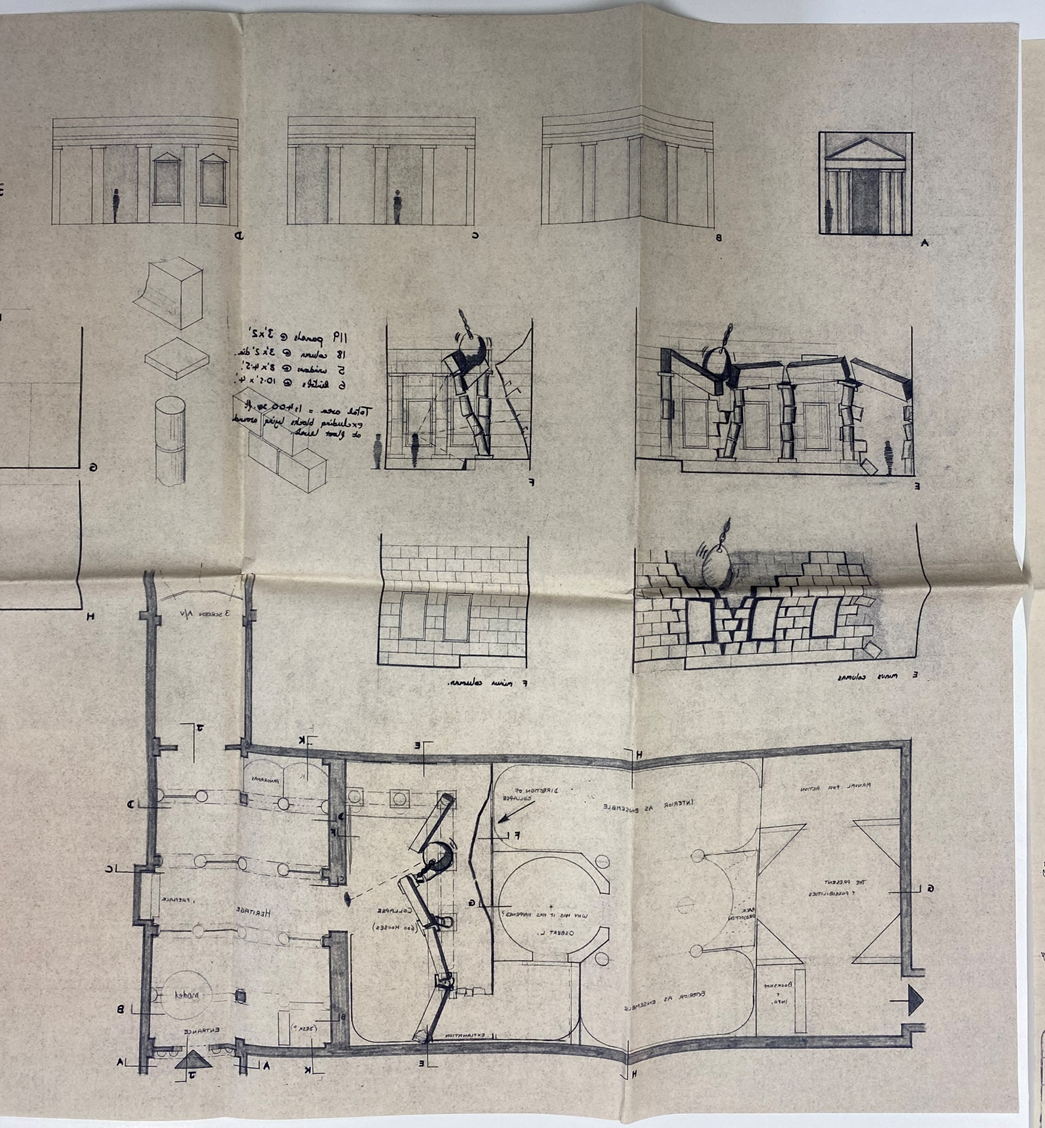
On 9 October 1974, on the day before the second general election of that year, the first visitors started making their way to the Victoria & Albert Museum to view the newly-opened exhibition: ‘The Destruction of the Country House: 1875 – 1975.’. Passing through the grand entrance to the monumental museum and then along the stately corridors would have heightened the shock as they entered a room to be faced with the toppling columns and seemingly endless photos of similar architecture which had been so ruthlessly demolished. However, as bad as the situation seemed – might the losses, though deeply regrettable, have been a catalyst for a better future for the country house?

Hall of Lost Houses, from the 1974 Destruction of the Country House exhibition at the V&A
Hall of Lost Houses, from the 1974 Destruction of the Country House exhibition at the V&A (Image © Robin Wade / Victoria & Albert Museum) reproduced by kind permission

Immersed in designer Robin Wade’s collapsing neo-classical portico, and as the late John Harris’ voice grimly intoned a roll call of the fallen, they may have wondered how such destruction could have been allowed.

Robin Wade, ‘V&A Museum: Gone, Going, Going’ (10th March 1974) (Image © Robin Wade / Victoria & Albert Museum) reproduced by kind permission

To survey the country houses losses in the UK over the last century is to be staggered as to the diversity of beauty and history which has been destroyed. That’s not to say that everything that’s been built should or can be preserved, but the sustained pattern of losses of country houses was cumulatively one of the largest of a particular building type since the Dissolution of the Monasteries. Although each loss was individual, collectively, it was certain to be noticed and mourned. As the then head of the V&A, Roy Strong, considered the situation, it was clear that the time had come to raise awareness of the losses – but could it also help prevent further destruction?

For Strong, working with Marcus Binney and John Harris, the aim of the emotionally-charged exhibition was to:

…draw the public’s attention to the country house as a major part of our national heritage, showing the tragic losses over the last century, stressing the need to preserve important houses with their contents and setting intact, emphasising the positive achievements over the past twenty-five years, and forcibly pointing to the problems that lie in the future.

Strong also wrote that:

…the threatened Wealth and Inheritance Taxes if applied to historic house owners will see … the end of a thousand years of English history and culture, as pell-mell the contents are unloaded into the saleroom, the houses handed over to the Government or demolished. I can’t tell you the horrors looming unless one fights and intrigues at every level behind the scenes.

The V&A exhibition was a landmark in a number of ways. Rarely has an exhibition in a major national museum been so overtly polemical – and political. The Observer newspaper stated that it was ‘the most emotive, propagandist exhibition ever to grace a public museum’s walls’. The Daily Mirror took a rather more dismissive tone, rather snarkily observing that:

Gad…our stately homes are grim! Life in Britain’s stately homes is becoming simply too awful for the coronet set. Dukes, baronets and earls have to use buckets to catch rain dripping through the roofs. They shiver in front of electric fires because the central heating is faulty. (Roger Todd, Daily Mirror, 9 October 1974)

The stark reality of life in the country house had been at the forefront of Roy Strong’s mind when considering their presentation. In a letter from Strong, dated 24 June 1974, to Sir Osbert Lancaster, the social cartoonist and proposed contributor to the exhibition, he highlighted some of the threats to the country house in the twentieth century, including; taxes, loss of heirs in WWI, partial demolition or dereliction, sales of art, land…everything, motorways, urban expansion, conversion to some other purpose, even the National Trust, before culminating in…opening to the public.

Roy Strong to Osbert Lancaster (21 June 1974) V&A Archive, MA/28/243/1

Although the tone is ambiguous, flippant or haughty depending on your perspective, it is interesting that many of the eventual solutions to the problem of the demolition of country house are included. Conversion to alternative uses, be it offices, schools, or hotels, has saved hundreds of houses. The National Trust have been saviours of some of the crown jewels and helped to change the narrative around the purpose of the country house. This has included developing new ways to engage the public and future generations (and continuing to do so), solidifying the cultural foundation of the country house as part of our national recreational and cultural identity.

The November 1974 general election ushered in a new Labour government, during the midst of turbulent economic times. A government which would be considering how to implement their manifesto commitment of “…a fundamental and irreversible shift in the balance of power and wealth in favour of working people and their families.”. It was a bold move by the V&A to try to defend the mansions of the wealthy – but this was also a collective national heritage, even if privately owned. Counter-intuitively, by highlighting that another strand of the national fabric was not only fraying but had serious holes, it may have skilfully blended into general concerns about the overall fate of the nation.

The V&A was not acting alone. As Adrian Tinniswood highlights in ‘Noble Ambitions‘, 1974 was the year in which the country house owners got organised. John Cornforth’s report ‘Country Houses in Britain – can they survive?‘, published that year (by the then almost activist Country Life magazine), painted a dramatic picture of the almost perfect storm which he felt might have led to a crisis within 8-15 years, but was now looming large in the immediate future. Despite his pessimism, Cornforth later wrote ‘The Country Houses Of England 1948-1998‘ in which he strikes a much happier tone, saying:

‘The history of the English houses in the past twenty-five years has proved to be infinitely more positive, and the view of the future more optimistic, than seemed conceivable at the time of The Destruction of the Country House exhibition…when their very existence was threatened by new taxes.’

Back in 1974, Cornforth’s rather gloomy views were echoed elsewhere. In June, Lord Grafton (qualifications: Duke of Grafton, chairman of SPAB, member of Historic Buildings Council, the National Trust’s Historic Buildings Representative in the East of England, and owner of Euston Hall) spoke in the House of Lords to raise with his noble friends/fellow house owners, and the government, that the proposed wealth tax, and a transfer tax to replace death duties, spelled disaster for the country house. The influential Times newspaper editorial also weighed in, and the newly formed lobby group, the Historic Houses Association, emphasised the economic benefits, whilst also organising a petition which garnered a remarkable 1.25m signatures. This level of public support was in some ways unsurprising given that by 1972, 43 million visits were made to the 800 houses and ancient monuments open to the public.

Looking back now, the assumption seemed to be that owners of country houses had almost a right to perpetually live in them, and that the state should subsidise this. There is an argument that the state should look after the interests of all subjects, to a greater or lesser extent, but the preservation of the institution of the country house was certainly presented as one where protecting the elite benefited the nation, tapping into a deep cultural reserve of respect or deference – rightly or wrongly.

The Destruction of the Country House exhibition poster (V&A Archive MA/24/132) produced by Peter Branfield for Her Majesty’s Stationary Office (reproduced with kind permission of Dr Oliver Cox/V&A)

So, although the exhibition was one of the most high profile actions in defence of the country house, it was not without wider support and deep foundations. A preservationist ‘ley line’ can be drawn through the exhibition, connecting it to Historic Buildings and Ancient Monuments Act of 1953, which extended heritage protection to inhabited buildings, leading to a dramatic decline in the number of houses being lost. Although there were other earlier voices raised in defence of our built heritage, including Sir John Vanbrugh’s argument, in 1709, to preserve Woodstock Manor. Of particular note was Philip Kerr, the 11th Marquess of Lothian (1882–1940), who was the catalyst for the National Trust Act of 1937, which created the Country Houses Scheme which saved so many more houses from destruction. Also intersecting our ‘ley line’ is the establishment of the various amenity societies; the Victorian Society in 1958, the Georgian Group in 1937, the Ancient Monuments Society in 1924, and the Society for the Protection of Ancient Buildings in 1877.

It’s also worth noting that the dates referenced in the title of the exhibition extended into the future, if by only a year. The implication was that the destruction was still an on-going process to be feared, though this underestimated the almost immediate positive impact that it would have. The genesis of the exhibition was usefully covered in a blog article I wrote for the 40th anniversary which I would recommend if you’d like some further thoughts.

The exhibition exemplified the challenge of the definition of the reason for the country house; was it a home, a rural business, or museum? Or did, by the nature of the sometimes competing, sometimes intersecting interests of the owners, society, and the state, demand it be all these at once. Legislation crafted to protect or promote one aspect, may impinge on the ability for it to fulfil its other roles, creating a tension which actively threatened the long-term sustainability of the house.

Yet, one reason the exhibition was so successful, and had such a positive impact, was that it also gave hope. Despite the tone of Strong’s letter to Osbert Lancaster, displays showed how country houses could be adapted to survive with many a house escaping demolition through conversion to a school, offices, or hospitality. Sensitive sub-division into apartments by thoughtful developers such as Kit Martin, also offered long-term solutions. Indeed, a number of Kit Martin’s conversions, such as Gunton Park, Burley on the Hill, and Stoneleigh Abbey, are still prized today.

View of the south front of Stoneleigh Abbey, Warwickshire. An Anglo-Baroque facade by Smith of Warwick surrounded by lush gardens and colorful flowers, set against a vibrant blue sky.
View of the south front of Stoneleigh Abbey, Warwickshire, which was converted into apartments in the late 1990s by Kit Martin. (Image © Stoneleigh Abbey Events)

John Harris not only credits the demonstration of alternative uses, but also that there was grant support (though this has now been largely removed). As Giles Worsley noted in his magisterial book ‘England’s Lost Houses‘ (2002) that by the time the exhibition opened, the tide had already turned and the numbers of houses being lost had abated. The demolition of large houses such as Warter Priory (Yorkshire) in 1972, or the threatened total loss of The Grange, Hampshire, (even if it was gutted) was now more of an outlier than a regular occurrence.

South front of Warter Priory, Yorkshire, which was significantly enlarged by the architects Smith and Broderick of Hull for Lord Nunburnholme. Demolished 1972. (Image: Lost Heritage)

Perhaps most importantly for country house conservation, the preservation of our wider architectural heritage, was the founding of SAVE Britain’s Heritage in 1975, by Marcus Binney, one of the co-curators of the exhibition. Binney has been an immense presence in campaigning across the country not only to fight for specific buildings but to change attitudes and the whole perception of the value of our nation’s architecture. Although he has been rightly recognised with an OBE and CBE, how he has not been given a knighthood for his work is one of those inscrutable mysteries. Sadly, the other curator, John Harris died in 2022 and will rightly be remembered as a brilliant architectural historian, with a sparkling wit and enormous fount of stories, particularly relating to his post-war exploration of these derelict mansions.


That the country house remains an easily accessible, and deeply symbolic, cultural touchpoint is a testament to strength of the concept, even though it is now rightly subject to a more honest examination of the history. A greater transparency only adds to the weight of interest in the houses and their extraordinary past, creating a flywheel effect to support further research. This doesn’t diminish the shorthand that the country house represents: beauty, tradition, continuity. To ensure that the concept of the country house remains viable, it has to be refreshed and reinterpreted. This synthesis of the realities of the present and the inheritance of the past, is what creates new opportunities for the country house, not only as an area of academic study, or as place of public culture and entertainment, but also, most critically, as a home.

Perhaps one of the most significant pieces of legislation in creating a sustainable future for the country house was not any of the heritage Acts. Until the Marriage Act 1994 the only ‘approved premises’ for a wedding ceremony was a church or registry office. After 1994, country houses were also considered appropriate venues, ushering in a new avenue for owners to secure an income from their asset. This brought about a fundamental change in the attitude towards the house, both from the owners, and now the wider public, who were now welcomed into these exclusive spaces. The emotional value invested in each occasion, has ensured that there is a ready army of those who will think fondly of a specific house, and often, the idea of the country house more generally.

Wedding ceremony taking place in Holkham’s famous Marble Hall (Image © Holkham Hall)

So what is the future of the country house? To imagine that their current situation and the opportunities they have are guaranteed is fanciful. A recent Law Commission report suggested that weddings could be held in “any safe and dignified location” including family homes, forests, and village halls. Given the rising cost of hiring premium venues such as country houses, this risks driving them back into the more gilded edges of society. The sharply rising cost of maintenance and operating such a house, either as a venue or as a home, increases the risk of benign or malign neglect – the former from the family who don’t wish to leave, but struggle to afford to stay, or the latter; those who only see the opportunities to replace an existing house with something more modern, whilst enjoying the benefits of a location which has been carefully crafted by previous generations.

However, the concept of the country house remains surprisingly endurable. As an aspirational token of success, it has rarely been bettered. Ultimately, the ‘Destruction of the Country House’ exhibition continued the evolution of the country house, further democratising the concept and ultimately helping to build the political and social framework which underpins their survival and success. The fortunes which provides the funding are continually made and lost, with the country house and estate hopefully continuing to stand proud of such vicissitudes for future generations to enjoy.

Acknowledgements

I am indebted and very grateful to Dr Oliver Cox, Head of Academic Partnerships at the V&A South Kensington, who very kindly shared the materials from his lecture in May 2024 on the genesis and impact of the exhibition and gave his permission to use them. His research was facilitated by the excellent V&A Archives team and I echo his gratitude to them.

Further reading

If you are interested in finding out more, then my Amazon bookshop as well as a range of non-fiction and fiction books on country houses has a specifically-selected list of books on lost country houses.

#Repton200: Humphry Repton, landscape gardener – and architect?

Although principally known as a ‘landscape gardener’ – a job title he invented even if the role was already well-defined – Humphry Repton was clearly a man who understood that an estate was a composition of many parts and that architecture had a vital role to play in the success of his schemes. The challenge in assessing Repton’s contribution to architecture is that of his collaborations; what sprang from his inventive and knowledgeable mind, and what came from those he worked with, including his sons, John and George, and also that leading proponent of the Picturesque, John Nash.

Detail from Humphry Repton by Henry Bryan Hall, published by Longman & Co, after Samuel Shelley (1839) (NPG D5801 © National Portrait Gallery)
Detail from Humphry Repton by Henry Bryan Hall, published by Longman & Co, after Samuel Shelley (1839)
(NPG D5801 © National Portrait Gallery)

Humphry Repton (b.1752 – d.1818) had a lifelong passion for gardening, but it was not his first career.  After starting in business as a general merchant in Norwich, which failed, Repton decided to retire to the countryside and live with his sister and husband in Sustead, near Aylsham, in Norfolk.  With his father’s prosperity and sister’s indulgence, he developed his interest in botany and gardening.  After a brief period in 1783 as private secretary in Ireland to his neighbour William Windham of Felbrigg (he resigned after a month), Repton took a cottage near Romford, Essex, and decided to focus on turning his interest into a career.  Fortunately, circumstances meant that he was well placed to do so with his deep horticultural knowledge, his superlative skills as a watercolourist, which he used to create his visions in his beautifully produced Red Books, plus opportune timing, with the death of Lancelot ‘Capability’ Brown in 1783 creating a gap for someone with Repton’s grand ideas.

Although the setting of a house was a key consideration for any architect of the era, few  thought of themselves as landscape gardeners (Decimus Burton (b.1800 – d.1881) was something of an exception).  However, those who were of that profession seemed to not only have an opinion on architecture but also apparently felt confident that they could also practice in this as well as their primary domain. For Repton, although not trained as an architect, he saw architecture as ‘an inseparable and indispensable auxiliary‘ to his efforts. Repton was usually brought in after the house was complete and his plans would be presented in one of his famous Red Books, leather-bound volumes of his ideas for a specific property, in which he set out his vision of the landscape as it was, including the current house.  In it, Repton would often include his criticisms of what was there and include his suggestions for sympathetic alterations which would better enable the house to fit within his vision.

Detail showing example of possible changes to example house - Plate III of Repton's 'Sketches and hints on landscape gardening' (1794)
Detail showing possible changes to example house – Plate III, State B from Repton’s ‘Sketches and hints on landscape gardening‘ (1794) – source: copy held by University of Wisconsin and kindly shared online

A measure of Repton’s boundless confidence in his own abilities can be seen in whom he felt able to criticise for their architectural efforts, including Sir John Soane, probably the leading architect of his era.  Repton was commissioned to create a landscape at several of Soane’s commissions, usually appearing a year or two after completion, including at Mulgrave Castle, Moggerhanger House, Aynhoe Park, Holwood House and Honing Hall. In the case of the latter house, Soane had made extensive alterations in 1788, and in Repton’s Red Book, produced in 1792, he criticised Soane’s work saying:

The proportions of the house are not pleasing, it appears too high for its width, even where seen at any angle presenting two fronts; and the heaviness of a dripping roof always takes away from the elegance of any building above the degree of a farm house; it would not be attended with great expence to add a blocking course to the cornice, and this with a white string course under the windows, would produce such horizontal lines as might in some measure counteract the too great height of the house. There are few cases where I should prefer a red house to a white one, but that at Honing is so evidently disproportioned, that we can only correct the defects by difference of colour, while in good Architecture all lines should depend on depths of shadow produced by proper projections in the original design. (1)

In the illustrations in the Red Book for Honing Hall, Repton boldly showed the house, not as it was, but with his suggested improvements. Repton had form for his criticisms of Soane, having been asked, in 1790, to review the newly completed Tendring Hall, Suffolk, (demolished 1955) where he wrote:

…had I been previously consulted the house would neither have been so lofty in its construction nor so exposed in its situation.

For a man with no formal architectural training to be so forthright in his judgements gives a sense of Repton’s confidence in his own abilities.  Luckily (for Repton), it’s likely that the notoriously sensitive Soane never saw these criticisms and they maintained cordial relations for many years. Repton’s comment about rarely preferring a red house to a white one is also corroborated by other Red Books, including the designs for Stansted Hall, and Rivenhall Place, in Essex and Hatchlands Park, Surrey.

Images showing proposed exterior changes from H. Repton's Red Book for Hatchlands Park, Surrey (1800)
Images showing proposed exterior changes from H. Repton’s Red Book for Hatchlands Park, Surrey (1800) – source: The Morgan Library & Museum

Repton’s architectural contributions are often overlooked as he was never enough of an architect to be considered as one, and, in general, those primarily interested in his landscapes are insufficiently interested in his architecture.  A prime example of this (not mentioned in Colvin, or Stephen Daniels’ book, except buried in an endnote) is Repton’s vision for Port Eliot, Cornwall, the seat of Lord Eliot.  In 1792, in one of his earlier commissions, he was brought in for his advice on the estate. Repton assumed the role of architect and provided, in the Port Eliot Red Book, a broader set of broadly Gothic proposals which brought house, church, estate and even the nearby town into his remit. This expansive approach to his brief was a challenge for Sir John Soane who was asked in 1794 to contribute his ideas – but now within a Gothic framework set by Repton (a style to which Soane was hostile), whose designs had found a level of favour with Lord Eliot, and which he adapted.

One of the key questions when considering the architectural improvements suggested by Repton is to what degree they were his and what had been conceived by his eldest son John Adey Repton (b.1775 – d.1860). J.A. Repton had been a pupil to William Wilkins where he developed a profound understanding of Gothic architecture.  He had then moved in 1796 to the office of John Nash, with whom the elder Repton had established an arrangement to pass on any architectural commissions in exchange for 2.5% of the cost of the work – an agreement which Nash failed to honour, leading to the partnership being terminated in 1800.

Nash has a chequered reputation professionally and this extended to those in his office, including J.A. Repton but left to become his father’s assistant when the agreement between Nash and his father ended.  Nash was unfortunately a champion of the Picturesque but not of his assistants; he never acknowledged J.A. Repton’s significant contribution in various schemes. Unfortunately, John was to suffer the same issue to a certain extent with his father, though he was later clearly credited for his assistance ‘in the architectural department‘ for designs for a number of houses including Stratton Park, Scarisbrick, Panshanger, and others.

Detail from Port Eliot Red Book showing the house as found (© Eliots of Port Eliot)

Detail from Port Eliot Red Book showing the proposed changes to the house (© Eliots of Port Eliot)

In the Port Eliot Red Book, eighteen of the drawings are signed by the son and are probably his designs, however the scheme as a whole is attributed to the elder Repton, though he may have been angling for this to be a major commission for his son. Unfortunately for the Reptons, their grand vision for Port Eliot was never going to be realised, mainly due to financial constraints, though Soane was to provide an alternative scheme which he diplomatically managed to agree with Lord Eliot – much to Repton’s chagrin, later writing:

my beautiful plan for Port Eliot…my design for bringing together the house and the Abbey did not suit the fancy of my fanciful friend [Soane] (who knows but little about Gothic) so the plan was totally changed.

Repton’s architectural work was significant enough to merit inclusion in Howard Colvin’s seminal reference work, ‘A Biographical Dictionary of British Architects 1600-1840’.  The most important was the work at Welbeck Abbey in 1790 to remodel the east and west fronts (and the Red Book contains designs for an entirely new house) but the other entries are relatively insignificant – minor works in 1792 at Honing Hall, the enclosing of the courtyard at Sarsden House in 1795 to create a domed ‘hall of communication’, and a new entrance to Uppark in 1805. Beyond that, his association with John Nash meant he had an insight into the ‘cottage orne’ style and which Repton used in his design for a new ‘lodge of a new and singular description‘ comprising two thatched cottages on the Isle of Wight, one either side of the road.

Lodges at the entrance to Mr Simeon's grounds on the Isle of Wight, designed by H. Repton (Image from 'A New Picture of the Isle of Wight' by W. Cooke (1808)
Lodges at the entrance to Mr Simeon’s grounds on the Isle of Wight, designed by H. Repton (Image from ‘A New Picture of the Isle of Wight‘ by W. Cooke (1808)

Beyond that, his architectural contributions were mainly the designs within the books on landscape gardening.  The most important of these were ‘Sketches and hints on landscape gardening : collected from designs and observations now in the possession of the different noblemen and gentlemen, for whose use they were originally made : the whole tending to establish fixed principles in the art of laying out ground’, published early in his career in 1794, and the posthumous collection published in 1840, ‘The Landscape Gardening and Landscape Architecture of the late Humphry Repton’.

So, can Repton be considered an architect as well as a landscape gardener? On balance, his position seems to be more that of ‘frustrated architect but successful critic’. Repton doesn’t seem to have been able to establish a reputation as an expert on architecture, possibly because his commentary was often only available in the Red Books, with their naturally limited circulation. Also, his work was usually after the house was already built and often only recently finished, meaning the owner was unlikely to consider making significant changes very quickly, leaving few opportunities for him to showcase the talents he clearly thought he had.

However, his work was influential on the practices of contemporary and later architects, forcing them to acknowledge that their buildings did not exist in splendid isolation and had to be considered as whole; a three-dimensional, interactive, ever-changing landscape painting. Open, expansive parklands had the effect of placing the building on a visual plinth, majestic but with an aloof air. Repton firmly brought all the elements together, blending both Gothic with greenery and the Palladian with the planting.  His architectural contributions reflect this sensitivity and with more opportunities he may have been even more influential in the field of architecture, much as he dominated the landscapes represented so beautifully in his famous Red Books.


Further reading:


Sources:

(1) – Humphry Repton, Red Book for Honing Hall [1792], quoted in ‘The Surprising Discretion of Soane and Repton’ by Gillian Darley, in the Georgian Group Journal vol. XII 2002


Apologies for the long gap between articles – happily, just after I posted the last one in September 2017, our beautiful son was born. Mother and baby were, and remain, fine and his sister clearly loves him. However, as anyone with experience of small children knows, they’re justifiably demanding and, combined with having a day job, it’s meant I haven’t had the time to write, but as he gets a little older hopefully I should now be able to again…at least in some capacity, though they’ll remain sporadic.  Tweeting is easier to do regularly, so please do follow @thecountryseat and @lostheritage.  OK, on with the show…


Greeks bearing gifts: Nicholas Revett, Trafalgar Park and the Origins of UK Neo-Classicism

William Blake poetically argued that it was possible to ‘To see a World in a Grain of Sand’; in the miniature is a reflection of something much greater.  With that in mind, to look upon the manifest beauties of a house such as Trafalgar Park in Wiltshire, it could seem strange to argue that one of the most important aspects of it is, in fact, a small hallway in the north wing. Yet, this hallway is one of the earliest architectural examples which form the genesis of neo-classicism; one of the most recognisable and prolific architectural styles which has proved to be enduringly influential in the design of country houses and also has come to dominate civic architecture.

Trafalgar Park, Wiltshire (Image © Savills)

Neo-classical architecture permeates our built environment; banks, council and government buildings, and particularly country houses.  Drawing on the ancient monuments of Greece, the structured, hierarchical designs provided a convenient vocabulary that institutions, the state, and individuals could use to express their permanence and place in the natural order of society. Of course, this is the interpretation and not an objective set of laws but neo-classicism’s rationalist perspective, with its reliance on mathematical rigour, gave the impression that architecture and society both shared an underlying harmony in their precision and structure.

The Classical language of architecture had arrived in England through the widely admired and imitated Vitruvian principles as interpreted in Andrea Palladio’s I quattro libri dell’architettura. Inigo Jones had adopted this language and had created the foothold for the new style with his the Queen’s House in Greenwich (1616) and Banqueting House in Westminster (1619). However, his sources were Italian; the great monuments of Rome as measured and shown by Palladio. For some, though, this was derivative as the earliest Classical monuments were in Greece.

It ought to remembered that the fashion for the neo-classical was one which swept across Europe, not just the UK. As a rejection of the seemingly frivolous Rococo movement, it sought to instil a more high-minded set of ideals across the arts. To do this, writers such as Johann Joachim Winckelmann (regarded as one of the fathers of neo-classicism), stated that ‘The only way to become great is to imitate antiquity’. This required no mere slavish copying but a profound understanding obtained through study which enabled principled use of the Classical architectural language. Books such as Piranesi’s Le Antiquita Romane, a series of topographical views of Rome published in 1748, determined to prove the glory of Rome. However, others such as Richard Dalton (Museum Graecum et Aegyticum, 1751), le Comte de Caylus (Recueil d’Antiquities Eygyptiennes, Etrusques, Grecques et Romaines, 1752) and Julien David Le Roy (Les Ruines des plus beaux monuments de la Grece, 1758) argued for the superiority of the Hellenic originals.

Les Ruines des plus beaux monuments de la Grece (1758) - J.D. Le Roy
‘Ruines d’un Portique Dorique’ from Les Ruines des plus beaux monuments de la Grece (1758) – J.D. Le Roy

If true knowledge of Classical architecture required detailed study the options were limited unless fortunate enough to be able to undertake the arduous and expensive Grand Tour. The Society of Dilettanti, formed in the 1730s as a scholarly drinking club for aristocrats and others who had visited Italy, deliberately sought to influence fashion by sponsoring a more rigorous approach to the recording of the ancient ruins. Scholars had realised the value and fame which could be garnered from publishing books on the ruins they had visited but these were often the Roman versions of the Grecian originals and were often more decorative than accurate delineations.

Antiquities of Athens (Vol I) - James Stuart and Nicholas Revett (1762)
Antiquities of Athens (Vol I) – James Stuart and Nicholas Revett (1762)

In contrast, the most successful and influential of these publications was Antiquities of Athens by James ‘Athenian’ Stuart and Nicholas Revett, published in three folios in 1762, 1787 and 1794. Sponsored by the Society of Dilettanti, their approach produced detailed, measured architectural drawings from which other architects could accurately reproduce Grecian details. Stuart and Revett were both better known as connoisseurs of painting rather than as architects, but having lived in Rome for ten years prior to their departure in 1751 for Athens, they had a thorough knowledge of Roman artefacts.  This was crucial in establishing the authority of Antiquities of Athens when the first folio was published in 1762.

James Stuart (1713-1788) became known as James ‘Athenian’ Stuart on the reputation he established. He originally started his artistic career as a painter of fans and he was to continue with this work even after becoming an architect – the large allegorical ceiling painting in the tapestry room at Hagley Hall, painted in 1758-59, is one notable example. However, having established his fame, his drinking and erratic work habits meant that although he had a steady stream of work, patrons were sometimes reluctant to commission him, leaving his reputation somewhat diminished.  This is in contrast to his early years when having arrived in Rome in 1742, he established himself as judge of pictures, acting as a guide to aristocrats on their Grand Tour. In this manner he met Revett when he accompanied him, along with Matthew Brettingham and Gavin Hamilton, to Naples in 1748. That same year, he and Revett drafted their first Proposals for publishing an Accurate Description of the Antiquities of Athens, which, once accepted by the Society who became their sponsors, enabled them to undertake their investigation.

Nicholas Revett (1721-1804) was the second son of minor Suffolk gentry, his father being John Revett of Brandeston Hall. At the age of 21, Nicholas left Suffolk and moved to Rome to study under Marco Benefial, an important early neo-classical painter. It’s unclear where Revett was tutored in the precise skill of architectural drawing but clearly as a man of some talent and training he was undoubtedly proficient and it was he, not Stuart, who was principally responsible for the measured drawings of the monuments. According to one account in the Gentleman’s Magazine of March 1778 ‘Mr Stuart first caught the ideas of that science, in which (quitting the painter’s art) he afterwards made so conspicuous a figure.’  So why is the pupil known better than the master?

One of the key reasons is that although Revett’s name appeared on the title page, before publication he had sold his interest to Stuart after editorial differences.  Secondly, Revett, as a gentleman with a private income, wasn’t under the same financial pressure to practice and so his executed architectural commissions are scarce, primarily working for his friends. One such in his circle was Henry Dawkins; owner of Standlynch, later renamed Trafalgar Park.

Portico (added in 1766), Trafalgar Park, designed by Nicholas Revett (Image © Matthew Beckett)

This commission, in 1766, was limited but Revett drew on his knowledge and the rich seam of material he had accumulated to produce a fine portico, based on the Temple of Apollo, Delos. Revett’s skill was in being able to take the elements of the temple and extend it to create a sophisticated composition. In addition to this, Revett was tasked with creating a vestibule at the junction of the north wing.  Within this limited space, Revett chose to create a miniature six-column temple apparently based on the Establishment of the Poseidoniasts, also at Delos, representing one of the (and possibly the) earliest interior use of Greek neo-classical architectural features.

North Vestibule, Trafalgar Park, Wiltshire (Image © Savills)
North Vestibule , Trafalgar Park, Wiltshire (Image © Savills)

Detail of Trafalgar Park floorplan showing north vestibule layout (Image © Savills)

Revett contributed few other architectural examples, working mainly for friends such as Dawkins at Standlynch. Other commissions including adding a grand Ionic portico to the west front of West Wycombe Park, Buckinghamshire, for Sir Francis Dashwood in 1771, and later the Temple of Flora and the Island Temple between 1778-80.  Revett’s only other notable contribution is the church at Ayot St Lawrence, Hertfordshire, for Sir Lionel Lyde in 1778, which he designed as a temple with small, detached wings, linked with a columnar screen. James Lees-Milne thoroughly disliked it saying ‘It is stark, cold and foreign to its surroundings, in fact admittedly unsympathetic to its ostensible purpose as a christian conventicle in a small and humble parish. Quite frankly it was meant to be enjoyed as an ornamental temple of a nobleman’s park in a focal view from the mansion.’ Which is correct – and probably exactly what Revett had intended.

So if Revett has the garland for earliest neo-classical interior, who can claim the earliest exterior use? Although Antiquities of Athens was published in 1762, the drawings were at the disposal of Stuart and Revett.  The earliest Greek revival building is agreed to be the garden temple at Hagley Hall, built for Lord Lyttelton in 1758-59, which Stuart designed was based on The Hephaisteion in Athens. However, in 1985, Giles Worsley identified the earliest use of a Greek architectural element in a building as being two years earlier in 1756 when Earl Harcourt, a prominent member of the Society of Dilettanti, was rebuilding Nuneham House, Oxfordshire. Although the architect of the house is noted as Stiff Leadbetter, Lord Harcourt asserted such influence that the house can be regarded as more by the former than the latter.  Writing to a friend he stated that,

I have not placed my Venetian windows under an arch. Instead of springing the arch or compass point of the Venetian window from the cornish as other people have done, I have boldly adventured to follow a design of an old building which I have seen among Mr Stuart’s drawings of Athens, where the arch or circular part springs from the architrave itself, which, besides having a very good effect, obviates an objection which upon some occasions had been made to Venetian windows, that the light is too high in the room.

Harcourt’s inspiration for his variation on the standard Venetian window was Stuart’s drawing of the Aqueduct of Hadrian, a structure largely ruined when he visited and demolished by the end of that century. Stuart would go on to use this form of the window at only three other houses; once at The Belvedere, Kent, c.1775, once at the Prospect House, Wimpole, Cambridgeshire, c.1775, and once at Montagu House, London, c.1775-82, though unfortunately all these have now been demolished.

(left) Aqueduct of Hadrian from Antiquities of Athens (1794) (Image source: Aikaterini Laskaridis Foundation Library) | (right) Nuneham House, Oxfordshire (1754) (Image © Isisbridge on flickr)

The 1750s and 1760s saw the idea of architecture drawn from classical sources, whether Greek or Roman, become more widespread.  The birth of Greek neo-classicism in the UK can, in part, be traced to these examples and the men behind them, the wider adoption of this stylistic source was relatively slow. Neither Stuart nor Revett appeared to wish to be the figureheads for a new fashion, simply content to work as much as they wished, with Stuart taking more but his delivery tempered by his dissolute habits. Different strands of neo-classicism were being picked up by more ambitious architects such as Robert Adam, who had undertaken his own Grand Tour to Italy and Croatia and whose publication in 1764 of the Ruins of the Palace of the Emporer Diocletian at Spalatro gave his a scholarly foundation from which to launch his own style of neo-classicism which soon supplanted the previous Burlingtonian standard.

The overlooked North Vestibule at Trafalgar Park represents the quiet experimentation which was to plant seeds of the Hellenic neo-classical movement. This would find its true expression in the late-Georgian era when evangelists such as Thomas Hope would create a resurgence in interest and further burnish the reputations of both Stuart and Revett; men whose unequal fame has obscured the contribution which Revett made in enabling architects, regardless of experience or first-hand exposure, to all claim antiquity as their source.


Sales particulars: Trafalgar Park, Wiltshire – 33 acres, £12m (Savills.com)

Introduction to neo-classicism: ‘Style Guide: Neo-classicism‘ [V&A Museum]