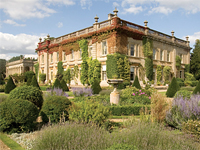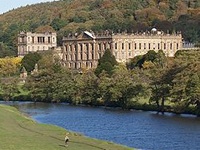
The glory that is Chatsworth House today

Chatsworth House, Derbyshire (Image: Wikipedia)

The modern era has, in many ways, not been kind to our country houses.  Faced with massive social changes in the early part of the 20th-century staff became harder to find leading to reduced maintainence.  Often this started a spiral of decline which led to the demolition of hundreds of our largest and finest country houses.  Even today, faced with the costs of conservation standard repairs, it can be a struggle for owners to keep their houses looking at their best.   This is why the recently completed £14m restoration of possibly England’s finest country house, Chatsworth, is such an achievement.

Chatsworth House exemplifies the best in the fine tradition of the development of our country houses.  Passed down through generations of the Dukes of Devonshire, the south and east fronts of the house we see today were built for the 1st Duke by the architect William Talman in 1696 in a grand Baroque style around the origianal Elizabethan courtyard.   The west and west fronts are thought to be the work of another great architect Thomas Archer, with further work in the 19th-century by Jeffry Wyattville to modernise the house for the 6th Duke.  Within the fine exterior the Devonshires also had acquired one of the finest art collections in the world.  Unfortunately many have been sold off in the 20-th century to meet the rapacious demands of death duties but the house still holds works by some of the finest artists of the day.

With its spectacular interiors, grand exteriors and palatial grounds, the responsibilities are immense for the 12th Duke.  Happily for this wonderful example of the glory of the English country house, the wealth of the Devonshires allows them to maintain the house in a way many other owners can only dream of, and is allied with his own determination to ensure that the house and estate is maintained in the best possible condition.  Considering the ravages that economics and circumstance have visited on so many of our houses, it’s a remarkable testament to the care of the Devonshires that this house looks as fine as it does, as the covers come off and the house opens again to the curious public this weekend for another season.

More details: ‘Chatsworth reopens to public with exhibition amid £14m restoration‘ [The Times]

Ury House restoration project still in doubt a year on

Ury House, Scotland (Image: Geograph)

When the developers FM Developments went into administration in 2009, it put in jeopardy a huge development scheme which was to fund the restoration of the historic Ury House.  The size of Ury House meant that any scheme was going to have to be ambitious to provide sufficient funding and this one involved the building of 230 homes and the creation of a Jack Nicklaus-designed golf course.  The developers had been praised for consulting with local residents and had the full support of the council for bringing jobs and no small measure of glamour to Stonehaven. Now, a year after the collapse, it’s still not clear if the scheme will proceed at all, leaving the spectacular ruins of Ury House at further risk of decline.

The first house had burnt down in 1645, and the second house was subsequently completely rebuilt as the Ury House we see today in 1855 for Alexander Baird in a fine Elizabethan style by the architect John Baird.  Baird was one of the most successful of the architects working at this time even if he rarely followed fashion.  His work at Ury was a continuation of the style of Wilkins and Burns they had developed 40 years earlier but was of a high quality which is still visible even today in the shell of the house. As a first stage of the work of the restoration, extensive scaffolding had been erected around the house in January 2009.

The proposals for redevelopment of the 1,500-acre estate included the conversion of the house into nine townhouses.  Unlike in many other cases of ‘enabling development’ where the setting of the house is compromised through the encroachment of the housing, the plan put forward placed the residential estate well to the east of the house, thus protecting it.  With the bankruptcy of FM Developments these plans have  been thrown into doubt and local planning officers are now working on the assumption that the development will not go ahead – despite local councillors being determined to resurrect the scheme.  Unfortunately the danger is now that another, less sympathetic, developer will take on the project but may try to cram more houses in or extend the area of the estate taken for housing. This would be a real shame. Although the ideal but unlikely outcome would be the restoration of the house as a single family home, this project had developed as a good example of enabling development practiced in the right way, with sensitive restoration of the main house, protection of the setting of the house, and productive use of the estate.

More details: ‘Future of Ury mansion site in doubt‘ [The Press and Journal]

Future of Ury mansion site in doubt

A religious conversion: Rempstone Hall

Rempstone Hall, Leicestershire (Image: Country Life)

In the early part of the 20th-century one option for a country house to avoid demolition was to be converted to institutional use.  In this way, many houses became schools, hospitals or offices, but also some became religious institutions – for example, in the 1940s and 50s, Gloucestershire lost seven houses but twenty-two were converted to institutional use.  Now with property prices rising but membership of convents falling, houses used for holy purposes are now being sold – and could once again be homes.  Rempstone Hall in Leicestershire, currently the Holy Cross Convent, is on the market for £2.5m, as the nuns move to a purpose-built home nearby.

Rempstone Hall is a classically beautiful Georgian red-brick house, originally built in 1792 for William Gregory Williams, a major local landowner.   Various families passed though the house usually keeping it as a secondary house to much grander seats elsewhere.  By the beginning of the 20th-century it was unoccupied as probably, as with many other houses, at risk of demolition as the houses became surplus to requirements and a drain on finances already under pressure.  Rempstone Hall was saved in 1909 when P.W. Carr moved in and made significant additions including a new north wing and a fine stable block before selling it in 1920 to the Derbyshire family from whom the Convent bought it in 1979 for just £110,000.

During their time at Rempstone, the nuns have removed the exterior stucco to expose the warm red-bricks giving the house a bold appearance, the two red blocks framing an elegant loggia which faces the gently sloping lawn.  At 21,000sqft this is undeniably a large house with 20 bedrooms, a large entrance hall with possibly Jacobean staircase, a sizable chapel and many other rooms.  One downside of institutional use is the rather functional decor and Rempstone is no exception, with lino, acres of red carpet and various partitions which the new owner would need to remove; total renovation costs are estimated to be in the region of £500,000.

This fine and beautiful house, well-located in the Midlands, with 60-acres and several estate buildings, cries out for someone with taste to restore this house back to being a family home – which is helpfully the outcome favoured by the local planners.

More details: ‘Your prayers have been answered‘ [Sunday Times: Home]

The economics of selling a country house: Kiddington Hall

Kiddington Manor, Oxfordshire (Image: Country Life)

An article regarding the sale of Kiddington Hall in the Financial Times has highlighted that the asking price of a country house when put on the market is not the amount which will end up in the buyer’s pocket.

When grade-II listed Kiddington Hall was launched on the market in September 2009, the price tag of £42m reflected its status as one of the most important houses to be offered since the sale of Easton Neston in 2004.  The main house was built in 1673 and sits in the centre of it’s 2,000-acre estate in Oxfordshire, with parkland designed by ‘Capability’ Brown. The house was remodelled in the 1850s by Sir Charles Barry in his trademark Italianate style which included the creation of a large courtyard and extensives terraces in the gardens.

The beautifully elegant house is being sold by Erik Maurice Robson, whose father bought the house for £115,000 in 1950. The sale was court ordered to fund his £8m divorce settlement, and valued his freehold interest in the house and estate at just £16m. This article states that this value is what remains after “excluding furniture, capital gains tax and sale costs”.  Mr Robson has now asked the court to reduce the value of the settlement as, due to a fall in property values, his interest is now worth only £13.18m.  This seems a remarkably small amount to be able to realise from such a high asking price and perhaps emphasises that a country house is not the pot of gold many imagine it to be.

Full story: ‘Stately home at heart of divorce appeal‘ [Financial Times]

Townhead House, untouched since 1939, to be restored

Townhead House, Lancashire (Image: SAVE Britain's Heritage)

Townhead House is a rare thing indeed – a house which has not been altered since before the last people to use it left in 1939 but also is not in a dire state of dereliction.  Its unoccupied status was a cause for concern and although parts of the house required attention, overall the house was in remarkable condition.

Built in 1729 for Henry Wiglesworth using parts of a 17th-century building, the architect is unknown but achieved an elegant if somewhat austere house using large blocks of coursed limestone.  Inside, the main rooms with their fine Georgian panelling and particularly the staircase indicated the architect was influenced by other such as Wren, Jones and Gibbs.  This can be seen with the use of certain architectural elements before they became widely known through pattern books such as Batty Langleys.

The grade-II listed house was used just a shooting lodge between the 1890s and 1930s.  Now finally, a local man, semi-retired businessman Robert Staples, has bought the house and has promised to sensitively restore it to use as his home:

“The works will ensure that the integrity and longevity of Townhead is not compromised and that the building has a continued and long future.”

All this bodes well for this important part of the local architectural heritage. Also encouraging is Mr Staples’ professed desire to return the house to being the centre of a ‘gentleman’s estate’ – a welcome reversal of the pattern of the last 50 years when small estates were increasingly broken up and lost.

Full story: ‘Historic Slaidburn house set to become a home again after 100 years‘ [Lancashire Telegraph]