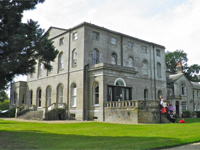
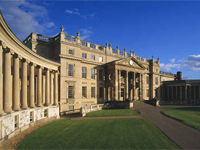
The glory of the great hall; Dundarave, Co. Antrim

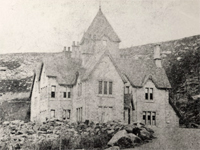
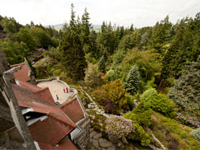
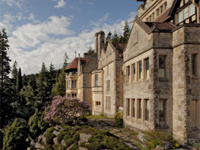
Dundarave, Co. Antrim, Northern Ireland - for sale, June 2012, £5m (Image: Savills)
Dundarave, Co. Antrim, Northern Ireland – for sale, June 2014, £5m (Image: Savills)

Where is the centre of a country house? For some it may be a favoured study or library, or a sunlit parlour facing the gardens. Yet, from the time of the earliest large residential buildings, the great hall has often enjoyed that rare status of being at the core of daily life. However, as times changed, so too did the function, becoming less a space for the whole household to meet and eat, more a statement about the wealth and status of the owner.  The Victorians were keen revivalists for the patterns and forms of ancient aristocratic life and although few used their halls for dining, their role as an impressive reception area, both for receiving guests and entertaining, meant that some embraced the opportunity for grandeur, as can be seen in the recently launched for sale, Dundarave, Co. Antrim, in Northern Ireland.

A medieval country house still reflected the social arrangements of a castle with the lord and his family congregating in the central hall as this was safest and also warmest.  As the designs of homes changed from fortifications to the form we recognise today, the family would still wish to be seen and to entertain in the grandest space in the house.  It was also still probably the warmest.  The huge processions of the Tudor monarchs required a large enough area to accommodate the existing household plus the royal retinue and to have such a capacity was a sign of prestige.  The great hall was therefore as much a practical space as it was a statement of the wealth and power of the owner, as shown by the lavish construction, including spectacular hammer-beam roofs, such as at Eltham Palace (built in 1470s) and Burghley (built much later in 1578 – and the last to have an open timberwork roof), and windows with glass.

Wollaton Hall, Nottinghamshire - view of the inside of the great hall (Image: © d-kav / flickr)
Wollaton Hall, Nottinghamshire – view of the inside of the great hall (Image: © d-kav / flickr)

For the Elizabethans, the great hall was becoming increasingly symbolic, with Burghley the last extravagant flourish of that earlier age.  For houses closely associated with the monarchy or the favoured courtiers, the decorative opportunities that a space such as a great hall offered were irresistible.  At Wollaton Hall, Nottinghamshire, built between 1580-88 by the brilliant Robert Smythson, a soaring central tower was designed to not only be topped by a prospect room from which to watch the hunting but also to contain a lofty interior, rising 50ft to a hammer-beam roof (though this one is decorative rather than structural).  Already the role of the great hall as a daily practical space was diminishing in favour of a more exhibitionist one.

Montacute, Somerset - View of the Great Hall, looking towards the screen which separates the Hall from the Screens Passage (Image: ©National Trust Images/Nadia Mackenzie)
Montacute, Somerset – View of the Great Hall, looking towards the screen which separates the Hall from the Screens Passage (Image: ©National Trust Images/Nadia Mackenzie)

Just over ten years later, in c.1601, the completion of the great hall at Montacute, Somerset, marked the first clear departure in design.  Although at the ground level it still had the same traditional features – porch, screen, bay window, steps at the high end – this hall was only a single story, rejecting the customary double-height space.  The hall was still an important part of the house with the other rooms designed to lead from it, but decisively its role as the daily venue for the entire household to meet and eat together had passed.  Instead the hall became less a space for living and more a space for occasional entertaining; for banquets, balls, and concerts.

Plan showing transverse hall - Worksop Manor Lodge, Nottinghamshire. c1595 (Image: Andor Gomme / Alison Maguire)
Plan showing transverse hall – Worksop Manor Lodge, Nottinghamshire. c1595 (Image: Andor Gomme / Alison Maguire)

The hall was often the centrepiece of the ‘polite’ rooms for guests which formed the main front to a house.  This meant that the main entrance would usually lead to a screens passage separating it from one end, with the hall orientated east-west (especially in H-plan houses).  As the overall plan of country houses started adopting the double-pile, this arrangement was increasingly awkward and so the hall was re-orientated to north-south, often running through the centre of the house, as can be seen in one of the earliest examples of a transverse hall at Worksop Manor Lodge, Nottinghamshire, also designed by Robert Smythson, in c.1595 (which has been shockingly treated over the last 20 years, including a suspicious fire in 2007).  Although exterior fashions were changing to a more austere form, houses such as Forty Hall, Enfield, built in 1629, were still organised internally around a recognisable great hall.
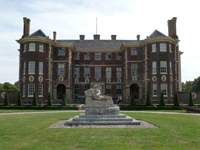
Ham House, Surrey (Image: Matthew Beckett)

The next major change was the elevation of the bedroom into a formal receiving room, a French practice adopted by Charles II after his return at the Restoration in 1660. This is reflected in the layout of Hampton Court Palace, as redesigned by Sir Christopher Wren between 1689–1700, where the state apartments form the centre of the procession towards the presence of the king (though the existing great hall, added in 1532-35, was the last to be built for a monarch).  This fashion had already been adopted by other members of the court, with Charles II’s friend and minister, the Duke of Lauderdale, having created a state apartment  in 1672 at Ham House, Surrey (though, as a rebuilding of an earlier house, it still retained a great hall).

Central stairwell and gallery, Wardour Castle, Wiltshire (Image: Strutt & Parker)
Central stairwell and gallery, New Wardour Castle, Wiltshire (Image: Strutt & Parker)

With the decline in the importance of the hall, it seemed almost inevitable that it would be used as a convenient setting for the ever grander staircases so beloved by the Georgians or even just as a convenient circulation space to pass through between the fine rooms. The broadening of wealth to those who made their money from trade and therefore preferred to live closer to the cities, led to the development of the villa.  Adapted from the Italian model, most famously those of Palladio and Scamozzi, there was neither space nor the social requirement for a great hall.  Chiswick House, designed in 1726, by the arch-Palladian Lord Burlington, had a central octagonal hall.  In larger houses, such as New Wardour Castle, Wiltshire, built 1769-76, is one of the finest examples of the Georgian interpretation of the hall, a cathedral-like space, with curved staircases leading to a columned gallery with a circumference of 144-ft.  Of course, for those favouring the gothic, a great hall was still a core statement of lineal antiquity and so was still included in the plans, leading to beautiful examples such as the Gothic Hall for Henrietta Howard, Countess of Oxford, at Welbeck Abbey in 1751, or as at Ashridge House, Hertfordshire for the Duke of Bridgewater built between 1803-17, decorated with statues of kings.

It was those same intentions to either emphasise a family’s existing heritage or to give the impression that a family had a distinguished past, which led to a broader revival of the great hall in the Victorian era.  By having the benefit of eight centuries of the development of the great hall, a family would be able to design for accuracy, for comfort, but almost always for show. Fuelled by romantic visions of the past by books such as Joseph Nash‘s 4-volume ‘Mansions of England in the Olden Time‘, published in 1839-49,  the hall was now to be a grand display of whatever values they wish to imprint on this most useful of architectural motifs.

A late-Georgian recreation was at Charlecote Park, Warwickshire, in 1830, where the Elizabethan great hall was reinstated.  In 1836, two examples were started independently with accurate medieval revival great halls at Alton Towers, Staffordshire for the Earl of Shrewsbury, and the other for Eustace Tennyson D’Eyncourt at Bayon’s Manor, Lincolnshire.  Each of these represent the two strands to the historic revivalism; Alton Towers being a religious statement, designed by A.W.N. Pugin, and Bayons Manor, of giving substance to a family line. Pugin was one of the keenest exponents for the revival of the great hall. A gothic evangelist who promoted the style as the only true architecture for the country as it was linked to a pre-Reformation England of Roman Catholicism.  The great hall was a symbol of a paternal system which Pugin related strongly to and which could be incorporated into daily life through the use of a great hall where the family could meet and the estate tenants and workers could be fed.

Derelict great hall in 1960s - Bayon's Manor, Lincolnshire (Image: W.T. Jones via Drakes Family)
Derelict great hall in 1960s – Bayon’s Manor, Lincolnshire (Image: W.T. Jones via Drakes Family)

The great hall at Bayons Manor was equally impressive as Pugin’s but was designed by Anthony Salvin. He had probably developed an affection for them whilst working on the restoration of the one at Brancepeth Castle, Co. Durham, in 1829 at the start of his career, throughout which he would create other notable examples including at Harlaxton (1831-38), Mamhead House (1835), and Peckforton Castle (1844). Firmly in the ‘family heritage’ camp is Arundel Castle, West Sussex, where between 1893-98 a vast Baron’s Hall was built, perhaps one of the closest recreations in form and spirit of the medieval great hall.  Although designed by renowned gothic scholar and architect Charles A. Buckler, he worked in exceptionally close co-operation with the 15th Duke, to whom a near constant stream of designs and decisions were passed for his comment and approval. This work was designed to emphasise the great age of the Norfolk family, a re-assertion of their status as one of the premier ducal families.

However, as the nature of the ownership moved increasingly towards those owners whose wealth came from industry and finance rather than landowning, so the need to entertain in large numbers such as the estate workers was less common.  Houses were often for weekend entertaining; smaller groups of business and political associates who would wish to dine in convivial intimacy conducive to discussion.  The role of the great hall moved back towards being a circulation space at the centre of the house, a place where pre-dinner drinks may be served but little more – though, equally, it still had to amaze.

Great Hall - Dundarave, Co. Antrim, N. Ireland (Image: Savills)
Great Hall – Dundarave, Co. Antrim, N. Ireland (Image: Savills)

The hall was often the first room your guests stepped into and so it had to create that all important first impression of your wealth and status.  Lofty, substantial rooms were created with muscular columns, galleries, niches for statues, and space for art.  It’s in this tradition that Dundarave was built between 1846-49 to designs by Sir Charles Lanyon. This top-lit space evokes something of the grand Roman baths and certainly fulfils the requirement to thrill.  The house is currently for sale and I imagine that potential buyers will step through the closed hallway, step out into the great hall and express similar amazement as has been the intention of all owners who have used spaces such as this for centuries; to impress.

—————————————————————-

Sales particulars: ‘Dundarave, Co. Antrim‘ [Savills] – £5m, 549-acres

Article: ‘Selling off the holiday home for £5 million‘ [The Irish Times]

Purchasing the picturesque: Hampton Court and Lasborough Park for sale

Hampton Court, Herefordshire - £12m, 935-acres (Image: Knight Frank)
Hampton Court, Herefordshire – £12m, 935-acres (Image: Knight Frank)

What is beauty? Though it is often in the eye of the beholder, some have attempted to define just what it is. In architecture, this can be seen in the development of the Picturesque ideal which sought to combine natural and man-made elements to compose a vision which would delight the eye and uplift the soul. Hampton Court in Herefordshire, and another house launched this week, Lasborough Park in Gloucestershire, can both be considered part of the Picturesque movement, even though the former took shape before the theory of the sublime and beautiful was brought to life and the latter was built just before the revival took hold.

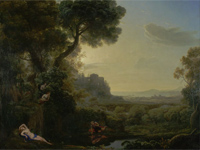
'Landscape with Narcissus and Echo' - Claude Lorrain, 1644 (Image: National Gallery)
‘Landscape with Narcissus and Echo’ – Claude Lorrain, 1644 (Image: National Gallery)

The origin of the Picturesque movement can, in part, be found in the philosophical writings of a much under-rated figure of the 17th-century, Anthony Ashley Cooper, the third Earl of Shaftesbury.  To him, nature ought to be imperfect and that, in turn, we ought to celebrate the untamed trees and serpentine rivers, those dark glades and tumbling crags. Unsurprisingly, the Earl found that the early Italian landscape paintings by Nicolas Poussin, Gaspard DughetClaude Lorrain and Salvator Rosa, reflected best this vision of a wilder natural world.  Landscapes had been unfashionable when Lord Shaftesbury first arrived in Italy in 1686, but by the turn of the century, they were in high demand amongst the grand tourists who carried these canvases back to the UK and into the popular taste of the nation.  These views married with Vanbrugh‘s early call in 1705 for a more natural approach to landscaping at Blenheim Palace, but found its true champion in William Kent in the 1730s, especially in his work at Rousham, Claremont and Stowe. The ideas were then developed further in 1757 in Edmund Burke’s ‘The Origin of our Ideas about the Sublime and the Beautiful‘ which, in its musing on aesthetics, distinguished between the latter, which was all about smooth lines and bold colours, whereas the former is about an awesome beauty on an almost fearful scale.

The death of Lancelot ‘Capability’ Brown in 1783 created a vacuum which led to the revival of the debate as to the most tasteful approach to landscaping.  The arguments were largely between Humphry Repton (who defended Brown’s ‘contrived natural’ approach of smooth curved borders and sweeping lawns which ran right up to the house) versus Sir Uvedale Price, 1st Baronet (b.1747 – d.1829), author of the ‘Essay on the Picturesque, As Compared with the Sublime and The Beautiful’ (1794), who, along with Richard Payne Knight, sought to create a more ‘robustly natural’ approach, where blasted tree stumps and ruins were also important.  This mirrored the first wave of the Picturesque to some extent, but this later flourish created a new passion to rediscover the beauty of the same painters whom Lord Shaftesbury had admired decades earlier.  Although neither Price or Knight worked on any gardens other than their own, their ideas were to have a dramatic impact on the settings of country houses, which were now considered as part of the overall composition rather than separate from it; formal gardens were swept away and snaking carriage drives now swept visitors through glades and past vistas before their arrival.

Detail from 'The Southeast Prospect of Hampton Court, Herefordshire' by Leonard Knyff, c1699 (Image: Wikimedia)
Detail from ‘The Southeast Prospect of Hampton Court, Herefordshire’ by Leonard Knyff, c1699 (Image: Wikimedia)

The grand formalism of the gardens of Hampton Court c1699 (above) contrasted with the asymmetrical grouping of the house. ‘The Southeast Prospect of Hampton Court, Herefordshire‘ by Leonard Knyff, shows how the grounds were a vision of control; of formal avenues and canals (see also the companion North prospect view). The house was, at this time, owned by the Coningsby family, having been bought by Sir Humphrey Coningsby in 1510 from a fellow courtier. His son became the first Earl of Coningsby and it remained in their family for 300 years.  Sir Richard Arkwright (1732-1792), who famously made his fortune from bringing the industrial revolution to the cotton industry, bought the house and 6,220-acres in 1810 for £226,325 (approx. £6.2m). His son, also Richard (1755-1843), made another fortune, before inheriting from his father in 1792, and invested in significant country houses, one for each of his five sons. However, the most significant changes came under his (fourth) son, John, who decided that ‘…of all the situations I know, there is none which suits my taste so well as Hampton Court‘ (funny that). After John’s marriage, the requirements of a growing family persuaded his father that the house needed to be enlarged.

The man chosen to design the work was Charles Hanbury-Tracy, a gentleman architect who had built his own home, Toddington Manor, between 1819-40, in his favoured ‘gothic collegiate’ style at a cost of £150,000 .  Though the style was sympathetic to Hampton Court, the relationship between architect and client became difficult. Another architect, John Atkinson, had pleaded with Hanbury-Tracy not to ‘make Hampton Court a cell to the Abbey of Toddington‘ but his determined views were at odds with Arkwright’s wife, who fell out with Hanbury-Tracy over the nursery arrangements, which led to nearly a decade of alterations and disagreements, especially as the costs mounted to eventually total over £30,000. John certainly preferred working with Joseph Paxton, who created the new conservatory, which was added in 1845-46. That said, the end result is one which successfully married old and new, creating a successful interpretation of domestic gothic and the picturesque.

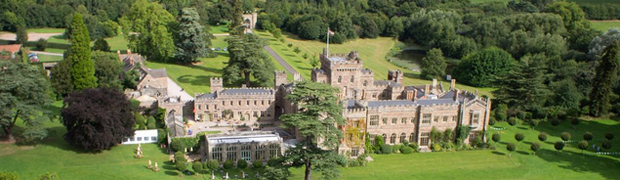
Lasborough Park, Gloucestershire - £12m, 55-acres (Image: Savills)
Lasborough Park, Gloucestershire – £12m, 55-acres (Image: Savills)

The Picturesque was a constant presence throughout the 18th-century but enjoyed a revival of interest in the 1790s and Lasborough Park represented the style just at the cusp of this.  Built in 1794 for Edmund Estcourt, his architect was James Wyatt, who enjoyed a rare skill in being able to master a number of different architectural styles – something which led later to his being unjustifiably underrated.  At Lasborough, Wyatt provided a continuation of the theme which John Martin Robinson in his book on the architect called a ‘toy-fort model‘; that is, a symmetrical house with battlements and corner turrets.  Wyatt had been using this pattern when working on various schemes for remodelling the interiors of Slane Castle since 1773 but it was only over ten years later that he was able to remodel the exterior, taking an irregular L-shape and bringing symmetry by adding matching towers.

Slane Castle, Co. Meath (Image: Slane Castle)

Wyatt’s design developed the tradition of the castellated residence; houses which had been either adapted from an older fortification or made to look like they might have done. Six decades before Wyatts’ work at Slane Castle, earlier versions, such as Howth Castle, Co. Dublin, which was altered significantly in 1738, are evidence that the style was already favoured and also incorporated an effort to create symmetry with the original keep on the left, mirrored in a new tower on the right.

The Picturesque style was popular in Ireland but initially as an import of the Protestant aristocracy and was viewed by some as an attempt to import a ‘little England’, a form of architectural and landscape colonialism. However, Ireland was particularly suited to the forms of the Picturesque which often worked in harmony with its natural beauty to form a unified creation which led the eye of the visitor from the grounds near the house, towards the middle distance, and then out to the wider landscape – much as a painter would structure their picture.

Hampton Court from south west (Image: Knight Frank)

Hampton Court is one of the most important and impressive country houses to come to the market this year.  As part of our heritage, it embodies architectural developments which brought the country house from fortification to domestication, with a landscape which started with formal terraces but finished with flowing lawns.  The genesis of the more structured medieval revival form of Lasborough Park can be seen in the core of Hampton Court and in each of the subsequent alterations.  Both houses are valuable pieces of the nation’s architectural record and deserve owners who will appreciate them and hopefully both will remain as single family homes, enjoyed as they have for generations, for their Picturesque beauty.

——————————————————————-

For a more in-depth history of the Arkwrights and their time at Hampton Court, I recommend: ‘Champagne & Shambles – The Arkwrights and the Country House in Crisis‘ by Catherine Beale [Amazon]

Sales details:

Articles:

The finest SAVE, now for sale: Barlaston Hall, Staffordshire

Barlaston Hall, Staffordshire (Image: Knight Frank)

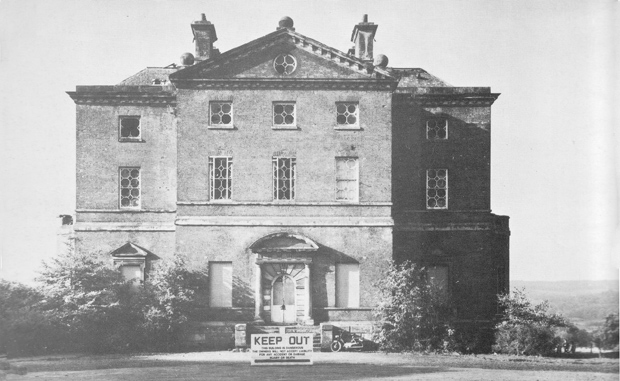
The wholesale destruction of UK country houses in the 1930s and 1950s was undoubtedly a tragic waste; not only of materials but also the embodied beauty and history of the hundreds of houses lost. Barlaston Hall, recently launched on the market for sale, and which was so valiantly fought for by SAVE Britain’s Heritage who famously bought it for £1, provides a case study which shows what might have been possible if circumstances had been different. How many more of our country houses might have survived to still be found nestled at the end of a tree-lined drive?

Collapse of Hague Hall, Yorkshire, due to mining subsidence, 1910 (Image: Lost Heritage)

The plight of the country house in the 20th-century struck at both the large and the small, the grand and the intimate.  A financial crisis could, in a generation, take a family from a secure status enjoying thousands of acres to one of ruin and a forced retreat from the family seat.  For some houses the demise was swift – for sale intact one year but the following year could see sales of contents, then fixtures and fittings, and finally the materials. The alternative fate for a number of houses was a lingering demise – abandoned, at risk from thieves and the weather, to an increasingly hostile environment with threats coming from every angle, even from below.

The elegant Barlaston Hall in Staffordshire was one house which fell firmly into the latter category. A remarkable house, it represented an important development of the Palladian tradition; the moment it moved from ‘copying’ to evolving.  The house was built c.1756-58 for Thomas Mills, a local lawyer, with the design convincingly attributed to Sir Robert Taylor (b.1714-1788).

Architecture was not his first choice of career. Taylor was the son of a master mason and sculptor, also called Robert, who was successful enough to build a villa in Woodford, Essex, but who was also rather profligate.  The father managed to get his son apprenticed to the sculptor Henry Cheere and on completing his time, found his father had just enough to send him on to Rome to study.  Whilst there, his father died so he came back to find his inheritance was no more than debts, but friends enabled him to set up as a sculptor and by 1744 he was sufficiently accomplished to be commissioned by Parliament and to carve the pediment of the Mansion House in the City of London.  It became clear that he paled in the shadow of his contemporaries – Roubiliac, Rysbrack and Scheemakers – so at the age of 40 he turned to architecture.

Outside influences often act as catalysts for development. In the same way that Blenheim Palace was enriched by Vanbrugh‘s theatrical experience, so Taylor had the advantage of his earlier, if unsuccessful, sculptural career which brought a more developed sense of shape, form, and movement to his architecture.  Colvin praises him as an architect of ‘considerable originality‘ and that ‘his villas…represented a new departure in country-house architecture‘. What Taylor provided was an evolution of the strict Palladian designs of the previous generation, marrying them to a more tolerant approach that allowed the interiors to be more Rococo, with decorative plasterwork and patterns, drawing on his knowledge of the original sources in Italy. Taylor created wonderfully elegant villas for his clientèle of bankers and merchants, who needed smaller houses for entertaining rather than seats for a rural family empire.

Braxted Park, Essex - note the octagonal window frames (Image: Braxted Park)
Braxted Park, Essex – note the octagonal window frames (Image: Braxted Park)

Although Taylor undoubtedly designed many buildings, he seems to have almost conspired to make it impossible to attribute them as he left no record of his practice and also apparently never signed his drawings.  There are, therefore, large gaps in both his chronological and stylistic history but starting with his first country house, Braxted Park, Essex in 1753-6, it is clear that his skill and legendary capacity for hard graft meant a sizeable output.

Harleyford Manor, Buckinghamshire (Image: Stephen Richards via Geograph)

Of particular note, in relation to Barlaston Hall, is Taylor’s design for Harleyford Manor, Buckinghamshire, in 1755. Part of a group of second-generation Palladians – along with Flitcroft, Keene, Paine, Ware, and Wright – Taylor saw Palladio as an inspiration but was not a slavish disciple.  The core principles relating to proportion and preserving a necessary elegance were respected but it was in the interpretation that they introduced variety.  At Harleyford, Taylor took a more vernacular style to the idea of the Villa Rotonda (a standalone villa with four equal fronts, allied with its landscape) but also combined with a sculptors appreciation that it should be attractive from all angles.

Asgill House, Richmond, Surrey (Image: Matthew Beckett)

Built between 1756-58, the layout and style of Barlaston Hall clearly shows the kinship with Harleyford. The elegant simplicity of the ground floor layout with the four principal rooms pushing out into the arms of the cross with a double-height central hall clearly can be derived from the Villa Rotonda but rotated on the axis to create more interior space, as opposed to the Rotonda’s open loggias.  One of the most distinctive features is the pleasing ‘chinese’-style woodwork, with octagonal window tracery on the exterior, a pattern mirrored in the library in the bookcase doors.  For one so early in his career, Taylor was showing remarkable invention, elegance and practicality, all of which served to launch his practice, which continued for 35 years. After Barlaston, further commissions such as Asgill House (1761-64) on the riverside at Richmond, Surrey, for his friend Sir Charles Asgill, also helped establish Taylor’s reputation.

Not that any of this innovation and elegance mattered to the Wedgwood company who applied twice in the early 1980s to demolish Barlaston Hall.  The house and estate had been bought by the famous pottery firm in 1937 as part of a scheme to create a new factory and model village for their workers.  These were built some distance away but the now grade-I listed house was badly neglected with serious water damage causing it to become increasingly derelict, with ceilings and the staircase collapsing, and the structure affected by subsidence caused by coal-mining.  The house also sat across a geological fault and future mining plans risked the whole area sinking by about 40 feet.  Clearly, this was a house very much at risk.

Entrance front, Barlaston Hall, Staffordshire (Image: SAVE Britain's Heritage)
Entrance front, Barlaston Hall, Staffordshire (Image: SAVE Britain’s Heritage)

In 1981, the second application to demolish was called to public inquiry, due to the importance of the house, where the architectural conservation charity SAVE Britain’s Heritage argued the case for the preservation and restoration of the house. As Barlaston Hall had been designated as ‘outstanding’ this placed certain obligations on the National Coal Board who would be required to pay for not only repairs but also preventative measures, such as the huge concrete raft they devised to prevent further movement.  After a few days of arguments, Wedgwood decided that they would make a bold move and offer the house to SAVE for £1 on the condition that it was restored within five years or they could buy it back for £1 (after which the house would no doubt be swiftly demolished).  The then Secretary of SAVE, Sophie Andreae, immediately phoned the President, Marcus Binney (who was in the USA) with the news.  Conscious that he had to make a decision there and then, Marcus called Wedgwood’s bluff and bought Barlaston Hall.

Dining Room, Barlaston Hall, Staffordshire - 1981 (Image: SAVE Britain's Heritage)
Dining Room, Barlaston Hall, Staffordshire – 1981 (Image: SAVE Britain’s Heritage)

A few days later when Marcus was able to visit the house for the first time, the scale of the challenge became starkly apparent.  Stepping into the debris-strewn hallways, light shone through all three floors from gaping holes in the collapsed roof and 4″ cracks indicated where the subsidence was taking hold.  Although most of the fireplaces had been stolen, the good news was that much of the original plasterwork on the walls and the distinctive woodwork had survived.  SAVE immediately organised a temporary roof, after which, the house took nearly 2 years to fully dry out.  Specialist heritage builders and professionals swiftly set to work on both the structural and conservation issues.

East front, Barlaston Hall - 1981 / 2014 (Images: SAVE Britain's Heritage / Knight Frank)
East front, Barlaston Hall – 1981 / 2014 (Images: SAVE Britain’s Heritage / Knight Frank)

Although work had started well, delays in securing the necessary certificates from the Secretary of State meant that the National Coal Board then decided to try and renege on their agreement to fund the work.  SAVE sought leave for a judicial review which prompted the Secretary of State to immediately fulfil his promises, which ultimately forced the National Coal Board to capitulate from their shameful position and fund the repair and preventative works – and SAVE’s legal fees too.  With immediate funding secured, which was followed by further grants, the conservation work continued.  It was put up for sale in 1992 and bought by the current owners who have sensitively completed the restoration of this captivating and fascinating house.

That the value of a house can go from £1 to £2.3m in the space of 30 years shows that the fortunes of country houses can rise as swiftly as they fall.  Barlaston Hall not only represents an important link in our understanding of the domestic Anglo-Palladian tradition, but is also a testament to how determined action can succeed even against larger opponents.  Today, the house still stands proudly displayed from the road, a bold statement of hope and preserved beauty.

——————————————————————

If you would like to support the fight to preserve our architectural heritage, please do become a Friend of SAVE Britain’s Heritage.  You will receive a regular newsletter plus access to the online database of ‘buildings at risk’.  You can also follow them on Twitter: ‘@SAVEBrit‘.  I am on the Committee of SAVE.

——————————————————————

The sale was announced in Country Life magazine: ‘A Country House Reborn‘ [16 April 2014]

Sales particulars: ‘Barlaston Hall‘ [Knight Frank]

A more detailed account of SAVE’s fight: ‘Barlaston Hall‘ – the Wedgwood Museum also has a brief history of the house on their website but which skips over the bit where Wedgwood tried to have it demolished. For historical images, see ‘Neville Melkin’s Grand Tour of the Potteries‘.

A theatre of innovation: Cragside, Northumberland

Cragside, Northumberland (Image: ©National Trust Images/Simon Fraser)

One hundred and fifty years ago, as 1863 drew to a close, the great industrialist Lord Armstrong may have reflected on a year in which innovation was sweeping across so many areas of life and, perhaps, his own future plans for his new country house at Cragside, Northumberland.  Country houses have often been at the nexus of innovation as they contain just the right mix of elements; namely a fashion for novelty, complex issues to be solved and a desire to impress others, along with the resources to experiment.  Cragside was to be a fine example of all these desires, a joint effort between an inventor owner and an inventive architect.

1863 was another year of great industrial developments as diverse as the running of the first Underground trains in London and the patenting of TNT, both of which would have far-reaching consequences.  That driving spirit of creativity spurred the Victorian engineer to look at many challenges, both large and small, seeking solutions which provided greater utility and comfort, though often tempered by the conservatism or financial reluctance of the owner.

Comfort and luxury are not always as synonymous as they are today and tales are legion of freezing country houses where one bathroom (used only for bathing naturally) served a whole house.  Owners of older aristocratic houses often felt little need to modernise; after all, if you had hot and cold running servants ferrying coal and water about the house this was often cheaper than a full refurbishment.  Worse, such improvements might be seen as nouveaux-riche (and therefore vulgar), unhealthy, or, worse, American. By contrast, the new money aristocrats in the Victorian era often had worked their way from less distinguished backgrounds and were keen to use anything which provided a better life – and also gave them the social bragging rights of novelty.

Bowood House, Wiltshire (demolished 1955-56) (Image: Lost Heritage - England's Demolished Country Houses)
Bowood House, Wiltshire (demolished 1955-56) (Image: Lost Heritage – England’s Demolished Country Houses)

Open fires have been the mainstay of country houses for hundreds of years but central heating – either steam, hot air or hot water – started making a comeback in the late Georgian period (remember the Romans introduced it first). The library at Bowood House, Wiltshire was thought to be the first modern room to be centrally heated when it was introduced in the 1790s (although it wasn’t all that successful).  Other centrally heated single rooms were to be found at Pakenham Hall, Co. Westmeath in 1807 where ‘The immense hall so well-warmed by hot air that the children play in it from morning to night‘.  The first multi-room ducted hot-air arrangements could be found at Coleshill, Berkshire in 1814, and Abercairny, Perthshire in 1829. Steam proved difficult to control (though it was installed by Sir Walter Scott at Abbotsford in 1823) so other early examples were either hot air (Osmaston Manor – 1846-49, Flixton – 1847, or Tortworth Court – 1849-52) or hot water via radiators (Mentmore Towers – 1850-55).  These systems rarely extended beyond the entrance areas, hallways and main downstairs rooms.

Osmaston Manor, Derbyshire (demolished 1965) (Image: Lost Heritage - England's Demolished Country Houses)
Osmaston Manor, Derbyshire (demolished 1965) (Image: Lost Heritage – England’s Demolished Country Houses)

Ventilation was always a challenge and the unpleasant accumulation of stale air and the smell of gas was exacerbated by the higher building standards of the Victorians which reduced drafts.  Many houses such as Kelham Hall, Mentmore, Dobroyd Castle and Wykehurst Place had ventilation shafts fitted in individual rooms but they were fairly inefficient.  One of the most advanced systems was created in 1846-49 for Francis Wright, a wealthy ironmaster, at his home Osmaston Manor in Derbyshire.  A single intake near the kitchen drew air from outside before heating it and distributing it around the house.  Coal fires in individual rooms then drew the stale air towards them but the flues all took the air downwards into a central extractor system which vented though a single huge 150-ft chimney in the kitchen garden, thus eliminating the need for huge chimneys in the main house (though it had smaller ones).  Sadly the house was demolished in 1965, thus denying us the chance to marvel at the ingenuity.

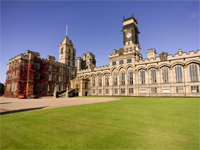
Carlton Towers, Yorkshire (Image: Landed Houses)

Bathrooms and indoor plumbing were often a great source of inconvenience. Even as late as 1873, such a grand house as Carlton Towers, Yorkshire, had no bathrooms with washing still undertaken via hand-filled basins and hip baths.  By contrast, Stoke Rochford Hall in 1839 had fifteen and by 1874 Wykehurst had the then radical innovation of each bedroom being a suite with its own bathroom.  A number of country houses were demolished for reasons of inconvenience with a  lack of bathrooms often cited, especially as the complexities of adding them to older houses was to prove insurmountable, either technically or financially.

Such challenges were often a catalyst for innovation – particularly if the owner was one of the industrial titans of the age, a man as comfortable in the workshop as the boardroom. Although William Armstrong (b.1810 – d.1900), 1st Baron Armstrong (after 1887), started his professional life as a solicitor he was able to turn his analytical mind to practical challenges as much as legal ones.  The genesis of his engineering career stemmed from his love of fishing where he noticed how inefficient waterwheels were and so designed a much more efficient water-powered engine. He successfully showed it could be used to hydraulically power cranes and thus improve the speed of cargo unloading at the docks.  This formed the basis for Armstrong’s engineering firm in 1847 and his first fortune.  The firm’s greatest fame/infamy came due to the later armaments work which Armstrong had turned to when he read that the British Army had difficulties with heavy field guns during the Crimean War. Success here with his revolutionary design and, later naval versions, led to the creation of a shipbuilding firm which won orders throughout the world, generating his second fortune.

The Lodge 'Cragside', dated 1864-6, before Norman Shaw's editions at Cragside, Northumberland (Image: ©National Trust Images)
The Lodge ‘Cragside’, dated 1864-6, before Norman Shaw’s editions at Cragside, Northumberland (Image: ©National Trust Images)

Armstrong’s obviously busy and productive life gave him great status in Newcastle-upon-Tyne and beyond and his main home in the city was a grand, if heavy, suburban creation called Jesmond Dene House.  As befitted any Victorian man of wealth and social stature and due to the pressures of running his businesses, Armstrong sought a country retreat.  Having visited the Rothbury area as a child, he looked there for a suitable estate, eventually buying in 1863 the then small shooting lodge and 20-acres of land which formed part of a steep-sided valley through which ran the Debdon Burn. Over the next few years, as Armstrong came to reduce his involvement in his businesses, Cragside became a passion; a place to retreat but also to enjoy more domestic challenges with the help of one of the most brilliant architects of the age, Richard Norman Shaw. Armstrong eventually came to own 16,000-acres of Northumberland, including Bamburgh Castle, of which 1,759-acres surrounded Cragside in which he had planted over 7m trees and innumerable rhododendrons.

View from the Terrace, Cragside (Image: ©National Trust Images/John Millar)

Between 1869-84, Cragside was transformed into a modern Victorian plutocrats palace, but one incorporating all conceivable innovations, powered by his own hydraulic engines. The first challenge was the location, which was ideal for a small lodge but cramped for the house which it eventually supported.  The steep hillside meant that space for expansion either had to be created through excavation or by building up the ground.  What it lost in convenience, it gained in views; spectacular vistas overlooking the remote Northumberland countryside.  Unfortunately, those views – both from and of the house – are now somewhat obscured by some of those same trees planted by Armstrong.

One of four of the original electric lamps at Cragside (Image: ©National Trust Images/James Dobson)

It was inside the house that the inventive mind of both owner and architect could really find effect.  For Shaw, Armstrong was an ideal patron, offering none of the conservative reticence he might have found in other clients, able to offer either his innovations or those of his friends. By December 1880, Cragside was the first private house in the UK (and Girouard thinks possibly in the world) to have electric light comprehensively installed, thanks to Armstrong’s friendship with Joseph Swan, with his eponymous filament bulbs throughout. Power for these innovations came from Armstrong’s own hydroelectric engines, running from the Burn below.

With the luxury of his own cheap and apparently limitless power supply, Armstrong and Shaw’s opportunities were myriad.  In addition to the lighting, the central heating system was also driven by a hydraulic engine.  That same power source also enabled the kitchen to boast a hydraulically-powered spit with the heavy pots in the conservatories moved by hydraulic machinery, with an electric sewing machine and electric communication throughout the house and even out to a shooting lodge on the moor.

View of Cragside (Image: ©National Trust Images/John Millar)

To his contemporaries, Cragside must have seemed beyond ingenious – a place grown from an inhospitable hillside, packed with innovations.  The house became a significant marketing tool for Armstrong as visits from his prospective customers, including the King of Siam, the Shah of Persia and the Crown Prince of Afghanistan, gave him the chance to demonstrate the advanced technology they could be buying into, a true theatre of innovation.  The Prince and Princess of Wales also visited in August 1884, thus giving the royal seal of approval to such a modern approach to the traditions of the country house.

Cragside passed to the National Trust in 1977, sadly missing the best of Armstrong’s picture collection (sold in 1910), but cared for and open so we can enjoy seeing the products of two great Victorian minds.  Despite being the genesis of domestic hydroelectric power, a gas turbine was installed in 1895 to provide more power before being connected to the National Grid in 1945.  However, in early 2014, the National Trust is again installing a modern hydroelectric screw to once more generate electricity for the house providing a welcome return of innovation.

———————————————————

Article: ‘Hydro-electricity restoration work starts at Cragside‘ [BBC News]

Official site: ‘Cragside‘ [National Trust]

160+ images: ‘Cragside‘ [National Trust Images]

Soane’s happy commission: Tyringham Hall for sale

Tyringham Hall, Buckinghamshire (Image: Savills)

Six of the most happy years of my life‘ is how Sir John Soane described his commission to build what is regarded as one of his finest works: Tyringham Hall, Buckinghamshire.  Although altered, the house forms an important link in the development of both Soane’s architectural and professional skill; an ideal commission which gave full scope to his genius.  It also has the rare distinction of benefiting from another British architectural giant, Sir Edwin Lutyens, who created some of his best but also smallest work there. Now having been restored, the house is for sale; an early and clear candidate for the most important house to be sold in 2013.

Letton Hall, Norfolk (Image: Chris & Angela Pye via Flickr)

Sir John Soane built only eighteen complete country houses, mainly between 1780-1800, so each house is an important step in tracing the evolution of his distinctive style.  Burnham Westgate was Soane’s first major remodelling (covered in an earlier blog post: ‘For sale: a Soanian springboard‘ Oct 2011) but his first entirely new house was Letton Hall, Norfolk. Built between 1784-92 for B.G. Dillingham, Soane had convinced Dillingham to demolish, rather than alter, the existing Old Hall which he had inherited that year.  Soane’s early working practices, honed through smaller commissions, emphasised extensive discussions with the client at the early stages, and the creation of a wooden model to help them visualise the proposed scheme (created in 1785 – after work had started – at the cost of £6 11s).  Letton also demonstrated several of what we regard as ‘Soanian’ architectural traits: the compact villa design, pale bricks, beautiful proportions and the cantilevered, top-lit staircase.

Stowe House, Buckinghamshire (Image: e-architect)

Soane’s practice now progressed steadily with commissions for new houses at Tendring Hall and Shotesham, along with other works on varying scales.  His growing reputation for not only excellent designs but also for completing work on time and within budget led to his name being circulated amongst the right type of clients who could provide the opportunities Soane hoped for. Drawn by his friend, Lord Camelford, into increasingly political circles, he became friends with the powerful Marquis of Buckingham, who owned two great estates at Stowe and Wotton.  In August 1792, it was Buckingham who took Soane to visit the banker William Praed at his property, Tyringham, which his wife had inherited and which was conveniently close to the Marquis, in whom rested his political and business ambitions.  Needing a house to match his intended status, Praed initially commissioned Soane to remodel the existing Elizabethan manor house. However, after some Soanian persuasion, in June 1793 he decided that an entirely new house would best serve his needs – much to the architect’s undoubted relief.

Soane displayed a particular flair when designing an entirely new house.  Although at the  core of his houses was a Palladian villa, as John Summerson notes, Soane was able to ‘…twist it into something much more complicated with sequences of shaped rooms ingeniously interlocked, and lobbies introduced to effect harmonious transitions‘.  It was this imagination which Soane brought to the Tyringham commission and which created one of his early masterpieces, with flashes of brilliance, both inside and out.

One of the first is the now Grade-I listed monumental arch gateway leading from the main road; a building of such elegance and novelty that it had Pevsner in raptures, describing it as ‘a monument of European importance…it is entirely independent of period precendent, a sign of daring only matched at that moment by what Ledoux was designing in France [e.g. Hôtel Thellusson] and Gilly in Germany‘.  Leading to the house, the drive curves gently away, allowing the house to slowly come into view.  Soane designed the approach, incorporating an elegant humpbacked bridge with balustrades which curve at each end, away from the road, creating a delicate curl.  Arriving at the house, the exterior can also immediately be identified as by Soane, with typical details including the bow-front, the beautiful proportions and the superb detailing, such as the giant Ionic columns and Greek-key frieze.

The interior was to be the finest conception of the whole scheme; a dramatic, exciting series of spaces which would have delighted the visitor.  At the core of the plan was a device which Soane would re-use in later projects but on a monumental scale; the ‘tribune’, a top-lit inner hall.  To look at the plan is to understand the level of trust that William Praed displayed in Soane as, on entering the house, the first space encountered was dramatic as it was domestically redundant: a windowless ante-chamber lit only by the front door and flanking windows behind you, and through another doorway at the far end.  Passing through the room, flanked by four columns supporting a typical Soane shallow dome, you then stepped through the doorway and into the brightly lit central tribune; a Damascene moment of drama.  Forming the top of the T to the dark antechamber, the tribune then led to either the library, the drawing room or the stairs; each decorated in a typical Soane style. Though compact, the house and estate are both impressive and manageable, the perfect combination for a rising, ambitious banker who mixed in aristocratic company.

However, the house and estate today is not the same one Soane created.  Between 1907-19, a series of unfortunate changes were made to designs by the architect Ernst Eberhard von Ihne, his decorator Florian Kulikowski and another architect, Charles Rees, who implemented Von Ihne’s plans which swept away much of Soane’s interior decoration.  They also added an ill-proportioned copper dome, a tea cosy on a champagne bottle, which has the strange visual effect of elongating the columns.  With an estate of only 59-acres, it’s unfortunate that a series of 9 or 10 houses were built to the immediate north-east of the main house. Equally sad, the most important section of Soane’s considered drive to the house is now in separate ownership; the humpbacked bridge part of the public highway and worse, the road then continues down through that wonderful arch which so delighted Pevesner (how long before some careless driver seriously damages one or the other?) – follow the drive via Google StreetView.

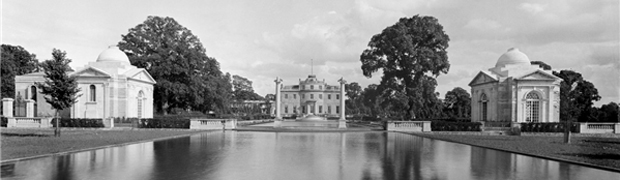
Bathing and Music Pavilions, Tyringham Hall (Image: Country Life Picture Library)

Thankfully what is still intact is one of Sir Edwin Lutyens‘ finest garden schemes.  Between 1924-28, Lutyens was commissioned by the then owners, the Koenigs, a family of Silesian bankers, to create a garden ‘for the recreation of spirit and body‘.  Standing each side of a huge 72m pool, once thought to be the largest of its type in Europe, are two temples; one a bathing pavilion, the other of Music.  Reminiscent of Thomas Archer‘s sublime Pavilion at Wrest Park (1709-11), Lutyens’ interpretation is pared back, less ornamented, but equally impressive – indeed, he himself thought it faultless and would apparently sit in there on his own.

The current vendor, Anton Bilton and family, has lavished millions on restoring the house and grounds (though, he confirms not as much as the £10m previously reported) since buying it for £2.5m in 2001.  However, the £18m asking price quoted in The Sunday Times Home section (28/04/13) seems ambitious; £10m-12m feels more appropriate considering the way the house and estate have been compromised with the now non-private approach, the small housing estate to the east of the main house and the loss of Soane’s original interiors.  Make no mistake, this is still a superb house and sets the bar high for any other house offered for sale this year to be considered as attractive or as interesting.

——————————————————————

Property details: ‘Tyringham Hall‘ – £18m, 59-acres [Savills] Strangely, there is no brochure yet and the launch, through double fold-out spread in Country Life (1 May 2013), feels a touch late.  One wonders whether the Bilton’s were offered a chance to do the Sunday Times piece before Savills were ready and took it anyway?

Excellent selection of photos:

If you wish to find out more about Sir John Soane and are in London, visit his house at Lincolns Inn Fields, which is a museum to his life and work: ‘Sir John Soane’s Museum