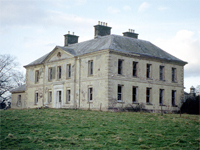
A shock return: Abbey Dore Court

Abbey Dore Court, Herefordshire (Image: Sykes Cottages)

Memories of a happy childhood can seem all the stronger as time passes, yet when confronted with the reality when revisiting once familiar haunts it can make any changes seem all the more jarring.  For Clare Sage, her return aged 27 to her grandmother’s home, Abbey Dore Court in Herefordshire, was a particularly hard welcome as the house had been effectively abandoned by her grandmother for several years so she could concentrate on the garden.  Despite Clare’s determination she needed some help and so her family’s home is the subject of Ruth Watson’s Country House Rescue.

After coming back from years living away, walking through her former childhood home, Clare was shocked to discover the many leaks, falling ceilings, holes in the floors, and a general air of neglect.  Built in the 1870s, the house, although comparatively large with 11-bedrooms and 6 acres of gardens, is only a minor country house and much smaller than those usually featured in Country House Rescue.  However, it shows that even the smaller houses can be as problematic as the much larger ones. Again, it’s a familiar pattern of ageing owner with insufficient income to employ full-time staff for maintenance, who does what she can but then find it’s has become just too much. These houses can then deteriorate quick rapidly if the problems are ignored – and with country houses being naturally isolated this is all too easy.

Thankfully, in this case, it appears that Clare’s dedication has enabled the restoration of the house and it is now available for rent which will not only create an income but, perhaps most importantly, will ensure that the house is lived in, keeping it warm and ensuring any problems will be spotted quickly and dealt with.  Here’s hoping that one day, Clare’s hard work with be rewarded with her being able to move back in and live in her family’s home.

Official website: ‘Abbey Dore Court

Rental details: ‘Abbey Dore Court‘ [Sykes Cottages]

Programme to be broadcast at 20:00 on 15 April 2010 on Channel 4.

A problem shared? Whitbourne Hall visited by Country House Rescue

Whitbourne Hall, Herefordshire (Image: David Cronin on flickr)

The great wealth generated by the Victorians led to the creation of some of our grandest country houses.  Designed to impress guests and provide a showcase for the collections and taste of the owners, these houses were remarkable and beautiful expressions of the power and preferences of the age.  However, in the more straitened circumstances of the 20th-century, this left owners with running costs which far outstripped their wealth and which unfortunately led to hundreds of our country houses being demolished.

Some escaped the wreckers pickaxe through conversion into apartments – but this doesn’t always solve the questions about the long term sustainability of a house, as shown by the visit of the TV programme Country House Rescue to Whitbourne Hall in Herefordshire.

The grade-II* listed house was built for vinegar magnate Edward Bickerton Evans whose father founded the Hill Evans Vinegar works in Worcester in 1830, which was, by 1905, the biggest vinegar producer in the world.  As was standard practice for the discerning Victorian millionaire he decided to build a grand country house and chose a cornfield in Whitbourne as the perfect location.

Despite its Georgian appearance, it was built between 1860 and 1862 to a design by Edmund Wallace Elmslie and inspired by the Erectheum on the Acropolis in Greece. The house was a lavish example of neo-Palladian architecture with a six-column portico, whilst on the south front a huge orangery, now known as the palm house, was added in 1875 and was thought to be the tallest in Europe.  The interior features a fine pillared main Hall with a rare blue and white glass ceiling, and the main reception rooms retain many original features.  At it’s height in 1876, the estate extended to over 2,500 acres with the classically beautiful Whitbourne Hall sitting proudly at the centre.

Remarkably, the Hall remained in the Evans family until 1980, when it was purchased by Whitbourne Hall Community Ltd to be run as a communal housing project with individual apartments and set in eight acres of gardens.  This original arrangement floundered and a commercial company was created to run the house as a more conventional managed community of 23 apartments.  The main rooms have been preserved much as they were with the Morning and Drawing Rooms retaining their original wall coverings.  However the sheer scale of the house means that the average annual maintenance bill is about £42,000 – and due to extensive and significant work required to maintain a house of this quality, that bill is expected to double in 2011, posing serious problems for the residents.  Extensive restoration is now required as the house is now suffering from a catalogue of issues including failing plasterwork as water penetrates through the coffered ceiling of the main hall.    Curiously Whitbourne Hall doesn’t seem to be on the English Heritage Buildings at Risk Register – it would be interesting to know why not.

One of the perennial difficulties of owning a country house is not just the huge costs such as heating but also the ongoing maintenance (as demonstrated by the Earl Spencer’s sale), the costs of which, rise significantly the higher the classification.   With the paucity of public grants for maintenance it falls to the owners to seek innovative ways to make these wonderful houses financially self-sufficient if possible.  However, as Country House Rescue often shows, it’s the owners who can sometimes be the problem who need to be convinced before they become part of the solution.

More details: ‘Country House Rescue‘ [Channel 4]

A glimmer of hope: ‘Country House Rescue’ visits Kelly House

Kelly House, Devon (Image: English Heritage)

Kelly House has a series of long associations; there has been a house there for over 900 years, it has been the seat of the Kelly family for that entire time, and, sadly, has been on the English Heritage Buildings at Risk Register for over five years.  Now the latest twist in the tale is that the house will feature in Channel 4’s ‘Country House Rescue’ on Thursday 1 April when expert Ruth Watson offer possible solutions which will help the Kelly family remain in their ancestral home.

The Kelly’s are one of the very rare families able to trace their lineage back to pre-Conquest times.  Warin Kelly is the 31st squire of the family to live in a house which has been passed down since 1100 through fathers, grandfathers, and brothers.  Described as being ‘in a class of its own’ by Marcus Binney*, the elegant Palladian house was built in 1743 -45 for Arthur Kelly by Abraham Rundle (d.1750), a joiner and provincial but obviously skilled architect who lived in Tavistock.  The house is grade-I listed and features a Portland stone doorcase, sash windows glazed with Crown glass and made in London, with local slat stone walls with moorstone quoins. Inside, the extensive high quality woodwork  features superb carving including panelling, chair rails, and a particularly good staircase with chunky corkscrew balusters.

However, the fine panelling hides serious issues such as the periodic bouts of dry rot which break out. Mr Kelly, as a conservation architect advocating minimal intervention, admirably refuses to treat it with chemicals or by stripping out the panelling.  This ongoing damage is largely the fault of death duties, with two demands being levied in swift succession which have severely limited the family’s ability to maintain the house.  Kelly House is exactly the sort of house which the Historic Buildings Councils would have provided grants for when they were set up in the 1950s.  Today, with English Heritage’s budgets under severe pressure, Mr Kelly was told in 2005 that they were unable to provide funds as the increase in the value of the restored house would be greater than the grant – meaning that they force owners towards the sale of their ancestral homes.

Much as it would appear difficult to argue for the provision of public money to preserve private residences, there has to be a better solution than just letting them slowly grow more derelict despite the often heroic efforts of the family involved.  The current generation doesn’t want to be the one which is remembered for having to sell the family seat, leading to a battle against the elements of decay which saps finances and families and often doesn’t provide a long-term solution.  Outside expertise is to be welcomed as it may show the way to a sustainable future for these beautiful homes. Hopefully Ruth’s suggestions can be taken on by the Kellys and other families to ensure their homes are self-financing and not a burden to either the state or the owners who are then able to look forward to the prospect of handing a home and not a liability to their descendants.

Programme details: ‘Country House Rescue‘ (Channel 4)

More information: ‘TV show could help manor restoration‘ [Western Morning News]

Official Kelly House website: ‘Kelly House

* – ‘Houses to Save’ – article by Marcus Binney in Country Life magazine (8 September 2005)

New series of ‘Country House Rescue’ starts 4 March

Plas Teg, Wales (Image: Plas Teg website)

The fascinating first series of ‘Country House Rescue’ showed all to clearly that ownership of a country house is no passport to an easy life of luxury.  In fact, it demonstrated that being the ‘lord of the manor’ brings with it many responsibilities which can take a significant toll both physically but most importantly financially.

On Thursday 4 March at 20:00 on Channel 4 the next series of ‘Country House Rescue‘ starts in Wales with the owner of Plas Teg; a grade-I listed Jacobean house which has remained remarkably unchanged since it was built in 1610.  However, for the owner who gave up her glamorous life in Notting Hill when she moved to this 20,000sq ft house, it has proved to be a constant struggle to maintain this important house.  Hopefully Ruth can provide some of her usual robust advice to help get Plas Teg on the path to a more secure future.

More details: ‘Country House Rescue‘ [Channel 4]