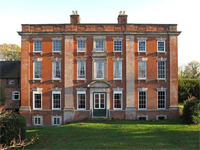
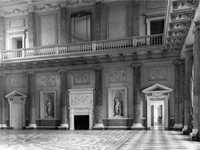
A rural power house; literally – Fairfield House, Somerset

Fairfield House, Somerset (Image: Anthony Kersting)

To describe a country seat as a ‘power house’ was usually to allude to its status economically, politically, certainly as a local employer, usually even in matters of style. Yet, these houses also indirectly, and sometimes very directly, played an important part in the provision of the electricity which has grown to power our everyday lives.  Power stations play an obvious central role and their expansion has often been controversial.  In earlier decades, a local power house was sometimes sacrificed to the demands of industry and the needs for power stations, but now, for some, particularly Fairfield House in Somerset, they have proven to be a windfall.

Country estates have a long history of being the beneficiaries of the need for power. In medieval times, the natural resources of an estate, such as a fast-flowing river or extensive woodland would be harnessed or harvested to drive local industry.  The most productive land could prove especially valuable if it could support the entire production cycle such as for bread, with corn grown on the estate, being ground in the windmill or mill on the river, before being sold in the market in a town owned by the local lord, who, at each stage would profit.  As the Industrial Revolution flourished, so the need for power grew, leading landowners to fully exploit the natural resources which lay beneath their land as well, with coal becoming a leading creator of Victorian fortunes.

Methley Hall, Yorkshire - demolished 1963 (Image: Lost Heritage)

Yet, the almost insatiable need for power, and the coal which generated it, has also consumed some of our country houses, including one of the grandest, and threatens some even today.  One of the greatest threats from mining is subsidence caused by extensive mine workings which simply followed the coal seam – wherever it may lead.  Given the choice between a loss of income or the loss of the family seat, it was rarely the house which won.  It was, of course, the northern counties which were worst affected; Methley Hall, seat of the Earls of Mexborough, was eventually ruined by the coal workings which surrounded it (an issue even when Country Life visited in 1907) and demolished in 1963.  Kippax Park, once the second longest country house in the country, stood in the way of an open-cast coal mine which eventually consumed it in the late 1950s.  In County Durham, Coxhoe Hall, was eventually bought by the local coal board who proceeded to demolished it in 1956 to avoid having to fix the structural issues they had created.
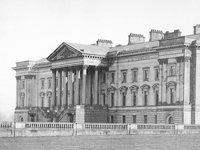
Hamilton Palace, Lanarkshire, Scotland - demolished 1919 (Image: Wikipedia) - more info from Virtual Reconstruction website

This is, inevitably, just a small selection of some of the many losses but easily the most spectacular casualty of coal mining would be Hamilton Palace in Lanarkshire. Built for the Dukes of Hamilton, the Palace was the epitome of aristocratic wealth, creating both a home and a collection which would rival the best in Europe.  Built on the incredible wealth generated by the Lanarkshire coalfields they owned, the 10th Duke, Alexander, enclosed the existing house in a grand Classical embrace. The one-room deep extension of the house, in 1819, accommodated not only the many works of art he had acquired on his Grand Tour but also many of the treasures inherited from the fabulous collection of William Beckford which came via the Duke’s wife, who was Beckford’s youngest daughter.  Yet those same coalfields eventually fatally undermined the house, and faced with such a substantial problem, and not lacking other houses to move to, the decision was taken in 1919 to demolish the Palace – the most serious loss to Scottish country house architecture in the last 200 years.

Others houses were even more directly affected by the need for power stations which, ironically, shared similar requirements with the aristocracy for their homes; a level site with good access to roads (and later rail), a ready water supply and space to expand.  In the dark days of the mid-twentieth century, for an impoverished owner, the offer to be bought out by the local power company must have been very attractive – and perhaps may have helped their guilt by feeling that it was contributing to national infrastructure; though often the house had already gone.

Drakelow Hall, Derbyshire (Image: Lost Heritage)

One house which certainly matched these criteria was Drakelow Hall, Staffordshire, seat of 28 generations of the Gresley family and which, declared Country Life in 1902, “…is one of those seats of ancient eminence which win the regard of all Englishmen.“. Situated above the River Trent, the house was perhaps best known for the Painted Dining Room by Paul Sandby which was completed in 1793.  Sadly, declining family fortunes led to its sale in 1933, followed by ill-fated ventures such as a country club and motor racing circuit before the house was demolished in 1938, though, fortunately, a section of the Dining Room was saved by the V&A.  In 1948, the huge Drakelow Power Station rose on the site, attracted by the sizable 707-acre estate and its proximity to the river, and railways, road and, most importantly, the East Midlands coalfields. Hams Hall in Warwickshire similarly vanished under the same demands. One house which was rescued was Barlaston Hall in Staffordshire, a wonderful small villa by Sir Robert Taylor, which was bought for £1 by SAVE Britain’s Heritage to prove that it was possible to restore it.  The house is now again a home as a result of their valiant efforts. However, even today, subsidence from old coal workings threatens other houses such as at Wentworth Woodhouse, where the owner, Clifford Newbold, has lodged a claim for £100m in compensation to fund the stabilisation and restoration of this magnificent house.

The requirements for nuclear power stations were different in that they were obviously less dependent on proximity to the raw fuel but they did require vast quantities of water for cooling so were often sited on the coast – which thankfully also meant fewer houses would be affected. Of those, the small manor house at Calder Hall had already gone by the time the decision was taken to built the UK’s first nuclear reactor on the site in 1947. So although the opportunities for landowners are now primarily around wind turbines, a report in the Sunday Times (13 Nov 2011) highlights the windfalls from owning the land adjacent to a nuclear power station scheduled for expansion.

Main entrance - Fairfield House, Somerset (Image: Anthony Kersting)

Lady Elizabeth Gass, Lord Lieutenant of Somerset, and current owner of the 6,000-acre family estate, recently accepted a £50m offer from EDF to purchase 230-acres of farmland which will become the proposed Hinckley C power station.  The Fairfield House estate (a prime candidate for the Handed On blog of lesser-known seats) has descended through the Palmer-Acland-Wood-Fuller families for 800 years and has never been sold. The current part-Elizabethan house was begun in about 1580, but with later changes in 1633 to change it from a medieval courtyard layout to the more familiar E-plan which we see today.  Excitingly, traces of the old house are still embedded in the fabric today, with a cell for those awaiting the justice of the local magistrate and, once revealed behind some 19th-century plasterwork in the attics, the original finely-carved late-medieval roof timbers of a first floor hall.

The future of this wonderful estate is now secure and stands as a testament to how changing patterns of land use which once threatened and toppled grand houses can also enrich a country estate.  That it is going to support a rare survivor of familial descent is an added bonus and I hope Lady Gass feels rightly proud of her success.

————————————————————————————-

More details: ‘£50m deal as Somerset wind turbine land goes to nuclear plant‘ [This is Somerset]

Listing description: ‘Fairfield House, Somerset‘ [British Listed Buildings]

————————————————————————————-

An apology: you may have noticed that I haven’t been able to publish as frequently as I’d like but just to reassure you that this is definitely not due to any slackening of interest on my part but simply due to my day job requiring a greater commitment at the moment.  This hopefully will be temporary and as we go into the Spring I can pick up the pace again – but in the meantime, please do take time to re-read some of the old posts you may not have seen, and hopefully discover something new amongst the archives.

Thanks for your patience.

Matthew
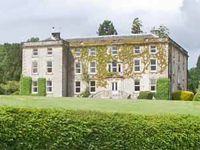
Inspired by Park Place? Other country houses for sale to restore

The recent restoration and sale of Park Place was certainly on an epic scale – £42m to buy, a further £100m to complete – but thankfully not all projects need be so expensive (though they’ll never be cheap).  The story of the country house has, for many, featured a cycle of ascendency, enlargement, and enjoyment, followed by neglect but – hopefully – rescue. As the annual SAVE Britain’s Heritage ‘Building’s at Risk’ Register sadly makes all too clear there are any number of country houses which have reached quite a serious state of disrepair, even dereliction. Yet even for these there may be someone who is willing to step up and rescue part of the nation’s architectural heritage. Houses in need of a saviour are often for sale, their forlorn state in Country Life magazine a stark contrast to their better loved brethren.

The UK generally has a much more positive attitude towards restoration than many other countries.  The Victorians would often be tempted to restore an ancient seat due to the contemporary popularity of the romantic notions of ‘Ye Olde England’.  Living in an Elizabethan or Jacobean house gave the owner associations with older family lines (not necessarily their own) and was a short-cut to perceived greater respectability.  Today, those who take on a restoration of one of our beautiful older houses are rightly lauded over those who simply buy a super-sized Barrett home.  Yet, restoration requires sensitivity and a willingness to submit an individual’s grand designs to work within the boundaries of the listed building regulations and the character of the house.

Marske Hall, Yorkshire (Image: Carter Jonas)

One house with hidden character and which will require careful planning is Maerske Hall, Yorkshire.  Originally built by the Hutton family in 1597, they were still in residence in 1730 when the house was rebuilt and extended in a Classical style. The grade-II* house was mainly used for shooting parties by the family in the 19th-century saving it from alteration but in the 20th it was threatened with requisition by the Army in WWII.  Luckily the family were able to arrange for pupils from Scarborough College to take up residence instead which saved it from the worst damage.  After the war, it again came near to destruction, as it was sold in 1947 to local builders George Shaw and his son George William who intended to demolish it for the materials.  However, they baulked at taking down such a lovely house and so sympathetically converted it into 10 apartments.  Still divided but now empty it is for sale at £2.5m with 19-acres of beautiful, mature gardens, and presents a fascinating opportunity to recreate a single family home. For more on the history, there’s a brochure: ‘Marske Hall‘ PDF [Carter Jonas].

Walton Hall, Derbyshire (Image: Knight Frank)

For those wanting a more straight-forward restoration, Walton Hall, Derbyshire perhaps offers a more appealing option.  This fine and elegant grade-II* house, prominently sited above Walton on Trent, was built between 1724 -1729 to designs by the architect Richard Jackson. The most striking feature are the full-height pilasters, giving dignity to a slowly deteriorating house which has become such a concern as to be listed on the English Heritage ‘At Risk’ register.  Inside, the most impressive feature is the grand staircase, reputedly copied from a building in The Hague.  The house is basically habitable but requires significant sensitive restoration, hence the price; £1.5m for the house plus just 7.5-acres.  That said, once restored this will be a quintessential Georgian  house to be enjoyed for generations.

Felix Hall, Essex (Image: Savills)

For those who prefer a real challenge then the next two houses could be ideal.  The first is Felix Hall, situated just outside Kelvedon, Essex – the picture (right) immediately showing the scale of the challenge.  At its core, this house is firmly in the tradition of the Palladian villa with a compact footprint but featuring wonderful architectural flourishes such a fine portico (added in 1825) and, to the rear, four engaged columns and a pediment.  Originally built between 1760-2, it was purchased by the Weston family of Rivenhall Place in 1793 and was significantly extended with flanking wings in the early 19th-century, possibly on the occasion of Charles Callis Weston’s  ennoblement as Lord Weston of Rivenhall in 1833.  However, as with many larger houses, a reduction in  size was thought prudent and so in 1939 the two wings were removed, leaving just a 7-bay central section.  Sadly, during the course of renovations it caught fire, completely gutting the fine interiors leaving the gaunt shell with the proud Ionic columns we can see today.  The remains were bought in 1953 and the basement rooms restored as an occasional country retreat but this is a house crying out for a full restoration (for which there is planning permission).  However, the estate buildings such as the nearby stables have been separately converted and there is only a small amount of land – it would be lovely if the new owner could also purchase the buildings and gardens and if they could also acquire the field in front, they could create a superb small parkland in which to truly display the house.

Piercefield House, Monmouthshire (Image: darkcell / flickr)

Another shell available is the one I would be heading for: Piercefield, near Chepstow, Wales.  Designed by the peerless Sir John Soane in 1785 for George Smith, the actual completion of the house was delayed until 1793.  Of particular interest  here is that the design is not entirely unique – Soane appears to have used very similar plans for Shotesham Park in Norfolk which was also built in 1785, although that house was brick with stone dressings, whilst Piercefield is faced entirely with stone. The house was sold 1794 as Mr Smith had run into some financial difficulties and it was bought by Sir Mark Wood who employed Joseph Bonomi to add a saloon and a winding staircase – though not the two pavilions as has been suggested.  The house was sold in 1926 by the Clay family, who had bought it in 1861, to Chepstow Racecourse who abandoned it, leaving it become increasingly derelict, apparently helped by American troops stationed nearby in WWII who used the house for target practice.  After 90 years of neglect, the house still has the power to impress with its refined façade and elegant temple pavilions.  Although on the market for over six years the price has remained at a rather ambitious £2m (although it does include 129 grade-I listed acres of parkland). However, recent comments by the director of the race course have indicated that they might entertain offers of around £1m; though, of course, the restoration bill would be many times that – but what a prize at the end!

Ruperra Castle, Wales (Image: Jeffrey Ross - Estate Agent)

Even further down the scale of dereliction is another important house, also in Wales, which has been stubbornly mis-priced.  Ruperra Castle near Newport is one of the few ‘mock’ castles designed for pleasure and not as defensive installations – a subject examined in more detail in an earlier blog post related to Ruperra: ‘Developer shows sense; Ruperra Castle for sale‘ (Sept 2010).  Few of these style of houses were built and Ruperra’s importance derives from it being one of the earliest of the country houses of this type, having been built in 1626.  Sadly, many of the other examples have been lost (most recently, fire gutting the interior of Lulworth Castle in 1929) so for someone Ruperra offers the opportunity to not only restore an architectural gem but also to be able to enjoy the same stunning views which attracted Thomas Morgan to build there in the first place.  Unfortunately, although the owner has now switched agents, the price is still ambitious at £1.5m – especially considering the immense challenges and costs of restoration and the location.  Hopefully, as with Piercefield, the owner ought to be willing to entertain realistic offers and allow the house to be saved before it is lost forever.

Perhaps the last is stretching it to call it a restoration opportunity as Bellamour Hall, Staffordshire now exists only as two walls and a few piles of stones!

Restoration is never a cheap or easy approach but the satisfaction and pride in knowing that the work has saved another part of our architectural heritage must be immense.  For too long our country houses have been under threat from neglect, vandalism and poor maintenance and the selection above (and there are more) show that the degrees of restoration and commitment required can vary dramatically.  That said, I can only hope someone is out there with the wealth and sensitivity to take on these houses and bring them back to life.

Finest prospects: the artist and the country house (and a challenge)

The country house has always been a trophy to be admired and enjoyed.  Yet, in the age before mass media and transportation made it easier to see these fine houses, often the only way to remind yourself and, more importantly, guests to your London townhouse, of your rural wealth and power was through the rather special branch of art that is the country house portrait.  Though originally European, it found new and invigorating life once it had crossed the Channel, creating an important and fascinating record of the lives, tastes and architecture of the landed classes. We also have a mystery house in a painting to find…

The country house first started appearing in paintings in France, with one of the very earliest depictions being that of the Duc de Berry’s houses and estates in 1416 by Pol de Limbourg.  These paintings served not only as reminders of wealth but also as practical tools for the running of extensive estates. The earliest English contemporary of these paintings is a 15th-century portrait of John of Kentchurch with a view of Kentchurch Court, Herefordshire in the background.  Although the depiction of the country house was a primarily European feature, it was still a relatively niche pursuit until the late 1500s, with painters more usually employed to portray the religious, historical or mythological.

Detail of 'An Aerial View of Tottenham Park, Wiltshire' by Pieter Andreas Rysbrack (after 1737) - this picture hung for many years in the estate office.

The trade in country house views was particularly popular in the Netherlands, where a demand for topographical engravings combined with many estates created a ready market.  The genesis of the English tradition is also to be found here as the Royalist aristocracy fled to the region during the Civil War. The connections made at this time were to prove fruitful for the many painters who followed their current and prospective patrons back across the Channel after the the Restoration in 1660. Before then, views of a country house were usually part of an estate survey, bar a few exceptions such as those of Conway Castle in c.1600, Nonsuch Palace and Richmond Palace c.1620, and the ‘King’s houses’ by Alexander Kierincx in 1639-40.  It was the famous engraver Wenceslas Hollar who completed the first significant set; five views of Albury House in Surrey in the late 1630s. Hollar was also significant in establishing the new fashion for these views once confidence was restored in the late 1650s.

The Restoration of Charles II gave new life to the art, with Dutch artists eager to record the newly invigorated estates of the aristocracy.  Without the artistic constraints often found in Europe, the style of the art in England was largely determined by the owner rather than royal preference.  By the 1680s, the country house portrait was as well established, as well  as those of the family, and reflected both pride and change.  Views were often painted to record the old house before it was swept away or remodelled or after the work had finished to showcase their new seat.

One of the finest artists of this period was Leonard Knyff who had arrived in England in around 1676 but whose first country house painting, completed in 1696, is of Dunham Massey, Cheshire.  A few more paintings followed, but his master work was a collection of eighty engraved views published (by Johannes Kip) in 1707 under the title ‘Britannia Illustrata: Or Views of Several of the Queen’s Palaces, also of the Principal seats of the Nobility and Gentry of Great Britain…’.  It remains one of the finest records of the country houses of the period – today, even individual prints can sell for hundreds of pounds and full copies of the book for tens of thousands.

Detail of 'Westwood, Worcestershire' published 1709 for "Britannia Illustrata: Or Views of Several of the Queen's Palaces, also of the Principal seats of the Nobility and Gentry of Great Britain...." by Johannes Kip & Leonard Knyff
Detail of 'Westwood, Worcestershire' published 1709 for "Britannia Illustrata" by Johannes Kip & Leonard Knyff

From the 1700s, the composition of the paintings shifts to include, and give greater prominence to, sporting activities and also the setting of the house, particularly the gardens. With sports such as riding and hunting being such a key part of the enjoyment and reputation of an estate, it was natural that these should feature in any artistic celebration.   As the fashions for landscaping and elaborate gardens took hold, so to did a desire for these to also be included in such detail that the house became a much smaller element, subsumed into a wider bucolic vision.  The more ‘survey’-like paintings showed in almost cartographic detail the layout of the gardens with the tree-lined rides radiating away from the house.

'Lowther Castle, Westmorland, Seen from a Distance by 'Day' in 1810' - J.M.W. Turner

This trend was not only driven by the owners who were very proud of their new environment but also because it was a natural continuation of the earlier work of these artists, as recorders of landscapes. John Harris argues that it would be difficult to confirm the exact influence which art exerted over landscaping but the popularity of landscape painters such as Claude Lorrain, coincided with the popularity of advocates of the more natural landscape such as Humphrey Repton and Lancelot ‘Capability’ Brown in the 1760s.  Parkland now moved from the more formal ‘boxes’ which Knyff had so accurately portrayed, and was now shown as a more rural, naturalistic form, the landscape now dominating the picture.  How far this style departed from formal country house portraiture can be seen in the works of J.M.W. Turner who frequently reduced the house to a mere smudge in the distance – and even when the house featured clearly, it was subordinate to the overall setting and atmosphere.  That’s not to say that the ‘Claudian’ view was the only one – the preferences of the owners for clear visions of their seats kept artists such as William Hodges, James Barret, William Marlow, and Theodore de Bruyn busy too.

By the mid-1800s there had been a marked decline in the demand for these type of paintings. Improved communications meant that houses were no longer so remote, and with the advent of mass printing, publishing filled the demand for images of the houses as typified by the eleven volumes of J.P. Neale’s ‘Views of the Seats of Noblemen and Gentlemen‘ (1818-1829).  Owners of houses were also now increasingly from the new wealthy who had their powerbases in cities and the country house was merely a retreat. By 1880, photography was also firmly supplanting oil paint as the medium of choice, as shown by the success of photographers such as Bedford Lemere, and, by the 1900s, the success of magazines such as Country Life which placed a high priority on using only the best photos.

Detail of 'Carclew, Cornwall' by Algernon Newton (house built 1720s, burnt out in 1934) - painting commissioned for the family which owned it at the time of the fire

However, in the last twenty years, a resurgent interest amongst country house owners has again created a demand for the country house portrait.  Artists such as Algernon Newton, Julian Barrow, James Hart Dyke, Jonathan Warrender, and Marcus May have led the way in continuing the tradition.  One artist has even been responsible for creating a country house which only existed in one of his paintings. Felix Kelly had painted an imaginary scene of Palladio’s Villa Rotunda within an English landscape; inspired by this, Sebastian de Ferranti then commissioned the architect Julian Bicknell to translate this art into reality, completing the house in 1986.

These important paintings are now, for some houses, the only record of how they were before later changes obscured or obliterated them forever. For many others, they are a wonderful reminder of the beauties of architecture and are a unique and invaluable record of our country houses.

—————————————————————-

Detail from 'Portrait Group' (1936) - William Bruce Ellis Ranken
Detail from 'Portrait Group' (1936) - William Bruce Ellis Ranken - click for full painting

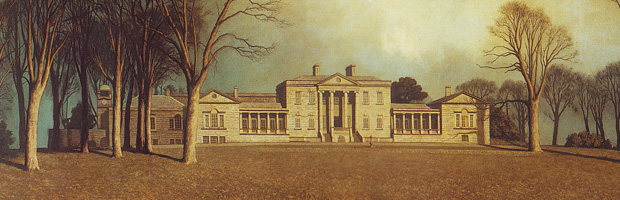
The Challenge: can you identify the mystery house in this painting?

Detail from 'Portrait Group' (1936) - William Bruce Ellis Ranken

The catalyst for this post about country houses in paintings was an email I received from Wendy & Gordon Hawksley who are working to re-establish the reputation of William Bruce Ellis Ranken (1881-1941). A famous artist in his day, he socialised with the great and good and painted many of them before fading into obscurity after his death.  This painting was exhibited at the Royal Academy in 1936 (this is also the year it was painted) under the title of ‘Portrait Group’ but as yet it has not been possible to identify either the sitters or the house. And so to the challenge: simply, can we identify the house – almost certainly English or Irish, Palladian, engaged columns to the front (a la Kedleston Hall) with flanking curved colonnaded wings facing a large reflecting pool.  Obviously there may be some degree of artistic licence but it seems likely that this was the home of the subjects of the portrait. Suggestions either via the comments below or via email to me.  No prizes I’m afraid beyond a credit here and the happy thought that art history is slightly richer for your efforts.

—————————————————————-

For a more in-depth history and many images (and to which this post is much indebted)  I recommend ‘The Artist and the Country House: from the Fifteenth Century to the Present Day‘ by the ever-brilliant John Harris – unfortunately now out of print.

The Country House Revealed – Marsh Court, Hampshire

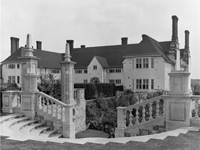
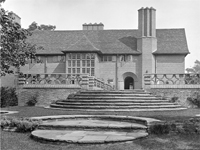
Marsh Court, Hampshire (Image: Country Life Picture Library)

As with artists, some architects start well and then just get better, culminating in masterpieces which are rightly praised.  With buildings, and particularly the usually distant country house, it can be difficult to truly appreciate them; their beauty a pleasure reserved for those invited.  Thus one of the delights of ‘The Country House Revealed‘ series has been to elevate us mere viewers into guests of some lesser known, but wonderful houses – and Dan Cruickshanks’ visit to Marsh Court in Hampshire proves just what gems are nestled in the countryside.

The house is the work of one of the best architects to have been produced by this country; Sir Edwin Landseer Lutyens.  A master at the re-interpretation of traditional building forms and styles, his work is, in many cases, instantly recognisable. Yet, in others, his sensitive updating of existing historic buildings blends so seamlessly it’s hard to distinguish between old and new (one of the best examples of this is Great Dixter, Sussex).  Lutyens was working at the end of the Victorian era and his work grew into the perfect response to the glory days of the Edwardian period; those long summers of country house entertaining from the turn of the 19th-century which were so firmly ended by the horrors of WWI.  Yet this was also a time of a confident nation, with fortunes being made (and lost) in an increasingly mercantile world, in which wealth was not related to the land. This fact was reflected in a new style of country house which required the trappings of the traditional entertainments and accommodation but which didn’t require a vast estate to support it.

Deanery Garden, Berkshire (Image: Country Life Picture Library)

Lutyens was the right man at the right time – and with the right connections.  His rise coincided with a new interest in the countryside, which was now being opened up to the new middle class with their leisure time and the rail network.  Spotting an opportunity, Edward Hudson started ‘Country Life‘ magazine in 1897, which quickly became the publication of the country set – and, more importantly, those who aspired to join them.  Hudson had been impressed with Lutyens’ work, to the extent that he had him design his own house, the brilliant Deanery Garden in Berkshire.  The distinguished architectural writer (and Country Life writer) Christopher Hussey said that it:

“…may be called without overstatement a perfect architectural sonnet, compounded of brick and tile and timber forms, in which his handling of the masses and spaces serve as a rhythm: it’s theme, a romantic bachelor’s idyllic afternoons beside a Thames backwater.”

Replace ‘Thames’ with ‘Hampshire’ and this praise might equally, and perhaps more so, be applied to Marsh Court. However, one other key difference would be the material used in the construction of Marsh Court; clunch, the local hard chalk stone; used for centuries in churches and cottages but never for an entire country house.  It’s a mark of Lutyens’ mastery of materials and style that he would even consider it – and the effect is what helps elevate this house to being one of the finest in the country.

Marsh Court echoes something of the character of the client, Herbert Johnson, who was as an “adventurer, stockjobber, and sportsman” who made a fortune, lost it, and made another.  Lutyens came to the attention of Johnson through the regular articles in Country Life featuring his various commissions which Hudson was only to happy to publicise.  In many ways, Johnson was an ideal Lutyens client – willing to think big, with a suitable budget and, although wishing to join the country life, not excessively bound by tradition.  This suited Lutyens as he was able to develop his ideas around the ‘Tudor’ style house, but marry them with a modern take which dramatically elevated the design to ensure no-one could ever call it ‘pastiche’.

West front - Marsh Court, Hampshire (Image: Country Life Picture Library)

The house, built between 1901 and 1904 with later additions also by Lutyens, is essentially an ‘H-plan’, though without the south-east leg, and goes back to his earlier interest in historic English architecture.  As the architectural writer Lawrence Weaver highlights, this house only works because Lutyens has perfected the balance of local materials through clever groupings of shapes and elevations, combined with contrasts in size and stone.  But even a good design might become too dominant in such an exposed location, sitting on a rise above the river Test.  Again, Lutyens has the ideal answer in his use of the sloped site to create terraces which ease the house into the landscape – note the change from two-storey on the north front to three on the south.  The stark white stone is also softened through the introduction of slates, flint and red-brick into the walls to create a mix of regular and irregular patterns, such as on the west front which gives the impression of tiles sliding down the walls like rain to pool at the bottom.  Only someone of Lutyens’ skill could attempt and succeed with such an architectural fancy.  The interiors are similarly impressive, with grand, almost Baroque, plasterwork in the hallway, combined with the fine panelling elsewhere.

Herbert Johnson moved out in sometime after 1940 and the house became home to evacuated children, and then, in 1948, a prep school.  It remained in this role for nearly 50 years before it was bought, for £800,000, in 1994, by Sir Geoffrey Robinson; industrialist, Labour MP but, most importantly, a heritage-minded multi-millionaire. Working with Michael Edwards, Sir Geoffrey and his wife Marie Elena undertook a comprehensive, yet sensitive, restoration of the house; removing partitions, restoring the ceiling plasterwork and updating the services. It was then sold for £6m in 1999 and then offered at £13m in 2007, before being relaunched in June 2008 at £10m before selling at £11m later that year.

Lutyens’ brilliant output was somewhat overlooked by the wider contemporary architectural world which was more interested in the developing Modern movement. Hudson’s constant championing of this visionary architect ensured that Lutyens’ work and reputation were assured even if he had never gone on to his later, much grander, projects designing the Viceroy’s Palace in New Dehli. In 1909, G. Lloyd Morris, although talking specifically about Marsh Court, provided an elegant summary of the essence of Lutyens’ skill in that the;

‘ unity’ which ‘…is the pre-eminent quality underlying the orderly and tranquil beauty manifest in [his] houses.  He never fails in this respect; one may cavil at certain details, or question the use and treatment of a material, but in the handling of the general conception there is always a breadth and a certainty in the composition that remains in the memory long after the details may have been forgotten.’

Certainly, Marsh Court succeeds overwhelmingly in this respect and is a worthy inclusion in any series looking at the finest country houses in the UK.

————————————————————————————-

Official website: ‘The Country House Revealed‘ [BBC2]

Superb photos of the house and gardens: ‘Marsh Court, Hampshire‘ [Country Life Picture Library]

More on the house and Lutyens:

The Country House Revealed – Wentworth Woodhouse, Yorkshire

Wentworth Woodhouse, Yorkshire - east front (Image: dykwia / flickr)
Wentworth Woodhouse, Yorkshire – east front (Image: dykwia / flickr)

If asked to name the largest and grandest country houses in Britain, many would list obvious candidates; Chatsworth, Belvoir, Castle Howard, Petworth, but few would name Wentworth Woodhouse in Yorkshire, the house featured in the next episode of Dan Cruickshank’s ‘The Country House Revealed‘ [Tuesday 31 May – 21:00 – BBC2]. One of the largest private homes in Europe, this leviathan slowly slipped into obscurity since family feuds and a vindictive Socialist minister caused the house to decline from being the greatest to being neglected.  Now, after ten years of hard work by the current owner, the house makes its first steps back towards the public stage – but is the price of the resurrection perhaps too high?

Wentworth Woodhouse - west front (Image: Matthew Beckett)

One of the triumphs of Wentworth Woodhouse is that the design of the house is coherent and powerful despite its size – extending to 606ft from tower-to-tower, to create the longest front in the country*.  Yet, the house is also one of two sides, the grand Classical east front, and the earlier, Baroque west front.  To have a house of such contrasting styles might indicate very separate plans of construction, yet a plan of proposed works dating from before 1725 and possibly as early as 1716, shows that the Earls Fitzwilliam had every intention to build on such a scale, with just the design itself changing.  The west side, the luxurious, decorated Baroque face, was raised between 1724-28 was long thought to be to a design by Ralph Tunnicliffe, a local architect who had worked on Wortley Hall and Calke Abbey, Derbyshire (1722). Yet, his work bears more familiarity with the Classical east front – so who designed the first stage?

Beningbrough Hall, Yorkshire (Image: nickrick90 / flickr)

Richard Hewlings in an article in Country Life magazine (17 February 2010) makes a solid case for the work being by the very well-regarded York architect, William Thornton (b. c.1670 – d.1721), who had previously worked on the joinery at Castle Howard, and designed Beningborough Hall. The latter of these (according to Colvin) showed a familiarity with Roman Baroque architecture as shown in Rossi’s ‘Studio d’architecttura civile‘ (pub. 1702-21).  Hewlings argues that because Beningbrough can be attributed to Thornton and that the same Rossi-inspired architectural elements can be seen in both houses, it makes Thornton (having definitely owned a copy of Rossi) the one most likely to have designed Wentworth Woodhouse – with his early death contributing towards his obscurity.

Wanstead House III, Essex - proposed design by Colen Campbell as shown in 'Vitruvius Britannicus'

So Tunnicliffe designed the east front. Well, mostly. His 1734 design can very clearly be seen as derived from that most important of Palladian houses, Wanstead House, in Essex (built 1715 – dem. 1822).  The original architect of Wanstead, Colen Campbell, produced three designs (known as I, II, and III) which drew on the form of Castle Howard but stripped of much of the architectural verbosity which so offended the more austere Palladians. This design was to form the backbone for several generations of large country houses particularly in the boom years of the 1730s and -40s.  Yet, even though work started in 1731, in 1735 the Earl of Malton thought it best to have Tunnicliffe’s design reviewed by a greater authority, that of Lord Burlington, the ‘chief’ Palladian.  This proved timely as Tunnicliffe died in 1736 and so responsibility passed to Henry Flitcroft, a Burlington protege.  Flitcroft’s external alterations were relatively minor; adding pedestals to the portico columns, changing the shape of the attic windows, (he also provided designs for several rooms) but his engagement there was to last until work finished in 1770.

One obvious question is just why the house was so large? Beyond the usual demonstration of the scale of the family’s wealth and status, the house also had to be of such a size to accommodate the vast entertainments which the Watson-Wentworth’s needed to hold occasionally as part of their seduction of such a large and sparsely populated county.  Up to a 1,000 locals – nobles, gentry and simple gentleman alike – might be invited, with each given a ticket indicating which room they were to go to (and, by implication, their social status).  Another, seemingly more petty, reason was that Lord Malton’s father had inherited the estate in 1695; much to the shock and annoyance of another (politically opposed) relative, Thomas Wentworth, who lived nearby at Stainborough.  He responded by enlarging his own seat, Wentworth Castle (now a sadly much altered training college), in a grand style, ensuring that Lord Malton couldn’t be seen to ‘lose’.

The Marble Hall, Wentworth Woodhouse (Image: (c) Country Life Picture Library)

One of the most breath-taking aspects of this need to impress are the interiors; boasting 25 ‘fine’ rooms of the highest quality, whereas by comparison, Buckingham Palace has 20 of a similar standard, Blenheim around eight, Castle Howard perhaps three or four.  These rooms are centred around the glorious central Marble Hall; 60ft square, 40ft high, with rooms leading off to the left and right including the Great Dining Room, the Van Dyck Room, the State Dressing Room and the Long Gallery.

That the Fitzwilliam family no longer live in Wentworth Woodhouse is one of the great sadnesses of the many families forced from their ancestral homes.   At one point this grand house boasted some of the finest furniture, a priceless collection of art including statues  and many paintings by such artists as Van Dyck, Reynolds, Mytens, Hoppner, Lawrence, Claude Lorraine, and a major collection of Stubbs’s work.  Yet, for all the wealth and power, it was founded on primogeniture and coal – both of which undermined the house in their own way.

The births of previous Earls Fitzwilliam had usually taken place in Wentworth Woodhouse and had been witnessed.  However the birth of the 7th Earl in the 1890s took place in the wilds of Canada for reasons which have never been fully explained, leading to members of the family levelling allegations that a settlers son had been swapped at birth for the daughter the Countess was thought to have really given birth to.  This eventually led to a split in the family as to where the title and the vast inheritance should descend.  With primogeniture determining it must go to the eldest legitimate male heir, this was only settled with a court case in 1952 between two brothers.  The ‘winner’ was the younger son who subsequently married an older lady, and therefore never producing an heir. On his death in 1979, the long title of the Earls Fitzwilliam died out – though not before the last Earl had a huge bonfire of 16 tonnes of family papers to permanently cloak their history.  The estate is now held by Lady Juliet Tadgell nee Wentworth-Fitzwilliam with the family still owning 80,000-acres of Yorkshire and 50,000-acres of Cambridgeshire – and the art collection.

Mining at Wentworth Woodhouse (house circled)

It was the coal that physically undermined the house – both above ground and below. The post-war Socialist government was determined to break-up what it saw as the privileged elite.  One particularly bigoted ideologue was Manny Shinwell, then the Minister for Fuel and Power, decided that as part of his campaign of class warfare he would mine the coal under the park and house – even when told it was low-grade and not worth the effort.  He also ignored the pleas of the local miners and their representatives who had always enjoyed excellent relations with the Fitzwilliams who were widely regarded as one of the best mine owners in the country.  Shinwell’s workers destroyed the park which the miners had enjoyed for years and also dumped the spoil to within yards of the house.  Rather than live there the family moved out – though not before securing the use of the house as a teacher training college which no doubt saved the house from demolition.

However, the mining might yet save the house – though the proposed solution contains considerable risk.  Part of the mining deep underground left a column to support the house – but it wasn’t large enough leading to subsidence which has caused parts of the house to sink by up to 3ft. The house was bought for just £1.5m (£7 per sq ft!) by London architect Clifford Newbold in 1999 and he and his family have spent the last decade carefully restoring the house in conjunction with the conservation architects Purcell Triton Miller and engineers Arup.  Now the family are ready to launch legal action to secure £100m in compensation for the negligent mining under the house.  Using this money, they will obtain further funding to develop the huge stables (built by John Carr in 1768) as office space and also “...two new contemporary buildings that replace the former college accommodation and will support the Stables office building through provision of further office accommodation. These sunken ‘green roofed’ buildings will be designed so that they do not have any detrimental visual impact on the open spaces of the landscape of Wentworth Woodhouse.” (from the official press release).  This can be understood and can be supported so long as the commitment to the minimise the impact to the estate (which is now just 90-acres) is successful.

What gives some concern are the plans for the main house as a “…publicly accessible restored museum to the central and grandest rooms, as well as a 70 suite luxury hotel and spa to the remainder.“. This will necessarily have a significant impact on the structure of the house – and I’m not convinced it’s the entirely right plan.  This house should be the Chatsworth of Yorkshire – a grand house, filled with art and life – and though the plans for the museum will be put into action, there is no word as to whether the rooms will be furnished?  If so, by who?  Will the V&A have an outpost? Perhaps I miss the idea of a family living there, using these rooms – though where to find a family able to take on such a monumental task? Just imagine if the Fitzwilliams had been able to move back in? I do wish the Newbold family every possible success but only if the plans respect the history and importance of the house and it’s not just used as an architectural prop for a multi-use residential, hotel and office space development.

———————————————————————

* – that it was the longest was the subject of an amusing bet in 1750 between Sir John Bland of Kippax Park and Lord Rockingham (as the Watson-Wentworths had now become) as to whose house was longest – Sir John lost by just 6ft.  Kippax Park was later demolished and the area open-cast mined.

Many more images of the house, grounds and stables can be seen in the Country Life Picture Library: ‘Wentworth Woodhouse‘ [countrylifeimages]

More about the house and estate: ‘Wentworth Woodhouse‘ [wikipedia]

Official website: ‘The Country House Revealed‘ [BBC2]

More about life in Wentworth Woodhouse: Part 1 and Part 2 [countryhousereader]

Local news report: ‘Wentworth Woodhouse: Newbold family bagged mansion for just £1.5m‘ [thestar]