Where the wildly rich things live; country houses of the 2014 Rich List UK Top 10

It is a truth universally acknowledged, that a billionaire in possession of a good fortune, must be in want of a country house.  Or so it used to be.  The annual Sunday Times Rich List (£) is always a fascinating insight into the upper reaches of wealth, but the nature of where and how the richest choose to live has changed significantly since the list was started in 1989.  Until the 1990s, it wasn’t unusual for those on the rich list to be following a lifestyle that a Victorian plutocrat would have recognised; London townhouse, country house with estate, and possibly another in Scotland. Today, the more international nature of the wealthiest has changed where they live – and increasingly it seems they don’t need the advantages that an estate once brought.

1/ The Hinduja brothers (£11.9bn) – although they top the list, the family favour cities, with homes in London, Geneva, Mumbai, and reputedly, Cannes and Tehran.

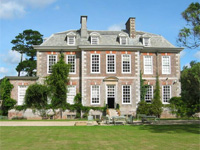
Sutton Place, Surrey - owned by Alisher Usmanov (Image: © Country Life Picture Library)
Sutton Place, Surrey – owned by Alisher Usmanov (Image: © Country Life Picture Library)

2/ Alisher Usmanov (£10.65bn) – surprisingly, considering the limitless opportunities afforded to his peers in this list, Sutton Place, Surrey, is the only country house (as we would understand it) which can be included. It is certainly one of the most interesting. Built in 1524, it displays some of the earliest use of Italian Renaissance design details in the country, which has naturally led to a grade-I listing.  The house was originally built around a courtyard but the north wing was demolished in 1782, opening up a rather striking view of the internal entrance front which features a series of terracotta mouldings which give a suggestion as to how the long-lost Nonsuch Palace may once have looked.

Moulded terracotta designs, Sutton Place (Image: © Country Life Picture Library)

Sutton Place and the surrounding 700-acre estate was owned by the Duke of Sutherland until 1959 when it was bought by the reclusive oil billionaire John Paul Getty for $840,000 (now equivalent to about $7m) who filled it with his remarkable art collection. Getty lived there in high-security seclusion for the last 25 years of his life before it was sold, after his death in 1976, to Stanley J Seegar, another American art collector for £8m, who notably lured the famous garden designer Sir Geoffrey Jellicoe out of retirement to work on the gardens (video).  Seegar sold up in 1986 to the American industrialist Frederick Koch, who again used it as a showcase for his art collection, but this time to the public.  He sold it in 1999 for £32m to an unknown party who put it on the market again in 2003 for £25m. Not finding a buyer, the estate was reduced to 300-acres and was bought by Alisher Usmanov in 2004 for £10m.
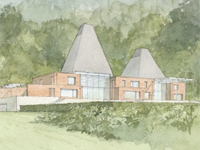
Proposed Alderbrook Park, Surrey (Image: PRS Architects)

3/ Lakshmi Mittal and family (£10.25bn) – a global metals magnate whose main home is in a city, in this case, London, and specifically, a huge Victorian Italianate mansion in Kensington Palace Gardens. Sadly, though, no country estate – though he was linked at one point with the bravely modern Alderbrook Park in Surrey.

4/ Leonard Blavatnik (£10bn) – a man with diversified interests including oil, gas, and pop music, but it seems that one of them isn’t in owning a country house, though he does have a sumptuous mansion in Kensington Palace Gardens.

5/ Ernesto and Kirsty Bertarelli (£9.75bn) – an Italian who married a lady from Staffordshire but who choose to live in London or on the shores of Lake Geneva in Switzerland.

6/ John Frederiksen and family (£9.25bn) – the current ‘Tanker-King’ of the world, Frederiksen lives in the ‘Old Rectory’ in Chelsea, for which Roman Abramovich (q.v.) once reputedly offered him £180m for – and which he turned down.  He also owns homes in Cyprus and Florida.

Piercefield House, Monmouthshire (Image: darkcell / flickr)
Piercefield House, Monmouthshire (Image: darkcell / flickr) – click to see large version

7/ David and Simon Reuben (£9bn) – although the brothers own a lot of real estate, including Cambridge House, once Lord Palmerston’s London home then later the ‘In and Out Club’ (or ‘Naval and Military Club’ for its official name), they don’t live in a country estate.  That said, they do own one very important country house, Piercefield, as part of Chepstow racecourse, which to their shame, they have let fall into an even deeper state of dereliction and have ignored various attempts for it to be bought so that it might be restored.

8/ Kirsten and Jörn Rausing (£8.8bn) – another couple whose main home is in London but Kirsten’s passion for horse-racing has led to the purchase of nearly 1,000-acres around Newmarket, primarily around her Lanwades stud.  This estate used to be centred around the red-bricked Lanwades Hall, which was built in 1907 using the winnings of a bet placed on the 1898 Derby, but was donated to the Animal Health Trust in 1948 with 140 acres, with a new Lanwades House built in 1931 for the stud.

9/ Roman Abramovich (£8.52bn) – although Mr Abramovich seems to be working through a checklist of ‘Things Every Billionaire Should Own’ including five yachts (including the world’s biggest), a jumbo jet, and an art collection, his property has also spanned the globe. However, his portfolio of houses – which includes homes in London, St Barts, New York, Cap d’Antibes, Moscow, and Colorado – now doesn’t include a country house after giving his now ex-wife Irina the 420-acre Fyning Hill estate in Sussex as part of his £1bn-2bn divorce settlement in 2007.  Perhaps the seclusion was her preference as he hasn’t bought a replacement and instead has concentrated on London, having also bought in Kensington Palace Gardens.

The many Halls of Eaton: (l-r) Samwell, 1664 / Porden, 1803, Burn, (1845) / Waterhouse, 1870 / Dennys, 1971, Percy Thomas Partnership, (1989)

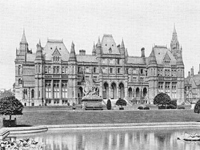
10/ The Duke of Westminster (£8.5bn) – finally, a proper country house. Sort of. The first notable Eaton Hall was designed by William Samwell and built in 1664 but was replaced by a vast Gothic creation by William Porden in 1803, which was then enlarged by William Burn in 1845. This was then replaced by the Victorian Gothic of Alfred Waterhouse in 1870, before the whole edifice was swept away in 1961 as the trustees of the then young Duke couldn’t imagine anyone living in such splendour again.  Faced with being a Duke with no seat in his 11,500-acre estate in Cheshire, in 1971 the 5th Duke commissioned a starkly white modernist country house from John Dennys, (who also happened to be the Dukes’ brother-in-law) which was as striking as it was controversial.  This was then given a vaguely ‘chateau’ style makeover in 1989 for the 6th Duke, to designs by the Percy Thomas Partnership. So of the five major houses which have been graced with the name Eaton Hall, the current one, though impressive, still doesn’t quite have the gravitas of the others. Perhaps, in time, a future Duke may decide to replace it again.

So, out of the UK 2014 Top Ten, only two are living in ‘proper’ country houses with estates. It’s a bit disappointing really, especially when compared with the first rich list in 1989…which is something to be covered in a future article. In the meantime, we’ll have to hope that our resident billionaires decide to step up and live the role their wealth affords – it’s not as if there is a shortage of fine country houses for sale.

——————————————————-

Is this right?

If you know that one of the above billionaires does actually have a country house/estate (particularly in the UK, but also abroad), then please do add a comment below or, if you’d like to stay anonymous, email me.

Thanks

——————————————————-

The front line: the campaigners for country houses

Apethorpe Hall, Northamptonshire (Image: English Heritage)

Despite the image of wealth and power a country house might create, in reality their existence is far more precarious – as can be seen with nearly 1,800 houses lost over the last two centuries.  A house facing the threats of being uninhabited without a concerned, well-funded owner with an inclination to keep it in good repair can quickly deteriorate leaving another gap in the tapestry of the countryside.  Sometimes it requires someone other than concerned locals and architectural historians to highlight and campaign on behalf of those ‘at risk’ so here’s a quick round-up of the main English organisations fighting on behalf of country houses and who are very worthy of support.

English Heritage inhabits a prime position in view of its role in defining and, in conjunction with local authorities, implementing the statutory protection of our built heritage.  Its role can be traced back to the Ancient Monuments Act of 1882 – though the legislation specifically excluded privately owned houses. The responsibilities were exercised through various government departments until it became a quango in 1984.  As well as being responsible for the listing system and the annual production of the various ‘at risk’ registers (focussing mainly on grade-I and -II* properties), EH is also directly responsible for various country houses including Brodsworth Hall (Yorkshire), Rufford Abbey (Nottinghamshire), Hill Hall and Audley End (Essex), Kirby Hall (Northamptonshire), Witley Court (Worcestershire), Stokesay Castle (Shropshire), and Apethorpe Hall (Northamptonshire).   It’s at the grade-I listed Apethorpe where EH has done some of it’s most interesting work; taking a direct role in the restoration of one of the finest Elizabethan/Jacobean houses in the country following a long period of neglect. Since 2008, the house has been for sale for around £5m – though there is a compulsory £4m list of renovations, and if you want complete privacy expect to pay another £8m to fully reimburse EH otherwise you have to open it for 28 days a year; so a nice round £20m to restore, furnish and keep as your own. However, this is a role that I fully support them in taking on – they should be there as owner and restorer of last resort for threatened grade-I houses.  Now perhaps we can interest them in the sadly deriorating Melton Constable Hall in Norfolk…?

Another important group of campaigners are recognised in the 1968 Town and Country Planning Act which formalised the role of what are known as ‘amenity societies‘; that is, well-established voluntary societies who are experts in their areas, who must, by law, be informed of any applications for listed building consent to demolish listed buildings in whole or in part in England and Wales.

One of the best known is the Georgian Group who cover a period broadly from 1700-1837.  The society was established in 1937 and has long campaigned for the sensitive restoration and retention of not only the buildings but the many important, and sometimes sadly overlooked, internal features which are a key part of the character of a building.  Current active campaigns and cases they are involved in include Bank Hall in Lancashire and Trewarthenick House in Cornwall and many others. They also produce a scholarly annual research journal which provides a much more in-depth view of aspects of Georgian architecture.  Access for the wonderful trips to houses not normally open to the public are worth joining for alone.

Eaton Hall, Cheshire (by Alfred Waterhouse - dem. 1961) (Image: Lost Heritage)

The Victorian Society (which also covers Edwardian buildings too) was formed in 1958 at a time when almost all things Victorian were disliked and an easy target for demolition.  Founded at the suggestion of Anne, Lady Rosse, along with her influential friends such as Sir John Betjeman and Sir Nicklaus Pevsner, the Society has fought some notable battles; losing some such as Euston Station but winning others, such as the soon-to-reopen St Pancras Midland Grand Hotel building.  Victorian country houses have suffered badly as, although designed by eminent architects such as Richard Norman Shaw and Alfred Waterhouse, they were often built on a much grander and therefore less economically sustainable scale and at the times of greatest threat (the 1930s and 1950s) had few friends to argue on their behalf.  Luckily though this has changed – but with the predominant ‘gothic-revival’ style being quite polarising, threats to houses from this period will always be present. Again, well worth joining.

Perhaps more controversially for this blog, it’s also worth bearing in mind the Twentieth Century Society.  Although the focus of the houses usually covered is before 1900, there has been a growing recognition that some of the country houses built in the 20th-century were well-planned and architecturally pleasing, even if they sometimes replaced a much more attractive Georgian or Victorian house.  It does seem to take about 50 years after a style has passed from being fashionable for it to be appreciated, so I suspect there will be a growing realisation that we need to protect the work of those such as Francis Johnson, Craig Hamilton, Quinlan Terry, and Robert Adam (amongst many others) in the future.

The Society for the Protection of Ancient Buildings (SPAB) is, as its name makes clear, not usually concerned with country houses as they are relatively ‘modern’ in terms of its remit.  However, they do immensely important work in promoting good repair practice to all buildings and their courses have taught generations of owners and craftsmen to respect the country houses and to approach any work required with a more ‘heritage’ mindset.

Although not ‘amenity societies’, two other organisations deserve a mention. The first is the Historic Houses Association which acts on behalf of the private owners of country houses and often lobby government to make them aware of the immense work done by the individual owners to maintain their slice of the national architectural heritage.  It may seem unfashionable in wider society to support the wealthy but they are the ones not only maintaining their homes to the exacting standards of English Heritage, but also restoring and rescuing houses and converting them back into homes again – and for that they deserve our thanks.

The Grange, Hampshire (Image: mpntod / Wikipedia)

The other organisation is one in which I have an interest having worked with them for several years: SAVE Britain’s Heritage.  Founded in 1974, SAVE have taken a very active stance on campaigning, willing to create media interest at short notice, but also to take time to produce some excellent research on houses at risk with thoughtful proposals for their re-use.  These campaigns have saved houses such as Calke Abbey in Derbyshire, The Grange in Hampshire, Barlaston Hall in Staffordshire (where SAVE bravely took on the house for £1!), and, working with Kit Martin, have acted as a catalyst for the saving of other houses through conversion into apartments.  Supporting SAVE’s work and becoming a Friend also gives access to their extensive ‘Buildings at Risk Register’ which features over 800 properties, including several country houses, which are in need of rescue – could it be you?

It is also worth keeping an eye out for local activists and campaigns which can also be remarkably successful at highlighting buildings at risk but can also sometimes take a more direct role; see the wonderful work at Poltimore, Devon, Bank Hall, Lancashire, and Copped Hall, Essex.  These are just three examples where concerned locals have organised themselves and presented a credible alternative and prevented the complete loss of the house.

All of these organisations are worth joining but economics being what they are it can be best to join a national organisation and then another to focus on the period which you prefer.  Joining up means that you are helping to support research but also active campaigns to ensure that as much of our built heritage is passed on to future generations.

———————————————————

I realise this selection is not comprehensive and is quite national in focus and deficient in regional organisations but this will be remedied in another post once I’ve had time to learn a bit more about who’s out there.

– Matthew

———————————————————

The future of the country house? Alderbrook Park, Surrey

Proposed Alderbrook Park, Surrey (Image: PRS Architects)

Within any established pattern there is always the shock of the new. Most people when asked to imagine an English country house will usually think of red-brick Jacobean or light-stone Georgian but the design of new country houses is always in flux and what has gone before is no guarantee of what will come. Following World War II, the aftermath of which led to the demise of many large houses, the fashion changed to have a smaller but more modern house – one which required fewer staff and perhaps used more contemporary architectural language; however much it was derided by others.

Queen's House, Greenwich (Image: Bill Bertram / wikipedia)

The nature of architectural innovation has usually been one of gradual change – subtle at first and then growing bolder.  For example, Palladianism is widely seen to have arrived rather dramatically with the building of the Queen’s House in Greenwich in 1616 to a design by Inigo Jones.  Jones had recently studied Palladian architecture in Rome for three years and this commission was his chance to put this into practice.  One can imagine the surprise of Londoners, long used to timber, gables, and red-brick, to the square, stuccoed, and very white, Queen’s House.  Yet Sir John Summerson argues that there is evidence of Palladianism in the plan of Hardwick Hall in Derbyshire, built in the 1590s by Robert Smythson.  Here, the placing of the hall on the central axis of the main entrance and the colonnades between towers front and back, echo the layout of Palladio’s Villa Valmarana featured in his Second Book of Architecture, making Hardwick the first known use of Palladio by an English architect.  This quiet use would have meant that visitors would have become accustomed to a symmetrical, regularised interior, paving the way for the same style to appear externally.

As much as the role of ‘architect’ took time to develop, so to did the responses to their work.  In 1624, Sir Henry Wotton, writing in his ‘Elements of Architecture‘, bemoaned the lack of ‘artificiale tearmes’ – that is, language with which to describe architecture.  Yet William Webb, writing in 1622, managed to praise the then new Crewe Hall in Cheshire, saying that the owner, Sir Randolph Crew;

“…hath brought into these remote parts a modell of that most excellent for of building which is now grown to a degree beyond the building of old times for loftiness, sightlines and pleasant habitation…”

So, ever since we’ve had architects, we’ve had critics (who were also sometimes architects); Jones, Wren, Ruskin, Pugin, Morris, Lutyens, Pevsner, etc have all made their opinions known.  Overseas visitors were also apt to compare what they had seen.  Jean Barnard le Blanc, visiting in 1737-8, was well educated and travelled and critical of the emerging use of Italian designs in England saying;

“These models have not made the English architects more expert; for whenever they attempt to do anything more than barely to copy, they erect nothing but heavy masses of stone, like of Blenheim Palace…”

As the language developed and architecture became more academic it became more rigorous and perhaps dry, with light relief afforded by more waspish commentators such Sacheverell Sitwell.

So why are some houses criticised more than others?  It seems that houses which appear without the ground being prepared before them suffer most.  The shock of the new is unmitigated and particularly where there is a strong local vernacular, the language of the new house will be a greater change.  More broadly, where a house is seen to be breaking with old traditions and what is seen as the ‘appropriate’ style for a family or an area, criticism can be swift and strong.

Eaton Hall by John Dennys for the Duke of Westminster (Image: Kathryn Gammon)

One example of this is Eaton Hall in Cheshire following the unfortunate demolition between 1961-63 of the vast Victorian masterpiece designed by Alfred Waterhouse.  The loss of the house left a gaping hole at the centre of the estate with large gardens and long tree-lined avenues leading to nowhere.  The 5th Duke decided to rebuild and commissioned his brother-in-law, the architect John Dennys, to design a very modern replacement.  The resulting house, although striking, was regarded as unsuccessful, with John Martin Robinson saying,

“The sad fact is that, while from a distance the new Eaton has some of the classic Modern impact of the Corbusier dream…close up it is rather disappointing…”

Yet rather than criticising the house for not being in the traditional language of the English country house, Robinson is saying that it’s not Modern enough.  Others disagreed, with perhaps the most amusing response coming from the Duke of Bedford before it was even built.  Writing in 1970 after the unveiling of the design, he wrote;

“I was interested to see…a sketch model of Eaton Hall.  It seems to me one of the virtues of the Grosvenor family is that they frequently demolish their stately home [Waterhouse’s being the third on the site]. I trust future generations will continue this tradition if this present edifice, that would make a fine office block for a factory on a by-pass, is constructed.”

Proposed Grafton New Hall, Cheshire (Image: Ushida Finlay Architects)

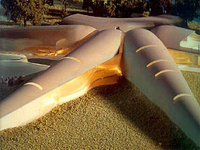
In more recent times, one design which met with critical acclaim but was perhaps a step too far was the Ushida Findlay design for Grafton New Hall, Cheshire.  Their house was a response to a 2001 RIBA competition to ‘design a country house for the 21st century’.  In creating their radical ‘star-fish’ layout they were rejecting the established patterns and trying to create a new response to the same requirements for the functions of a country house.  Yet the house never found a patron and, tellingly, the house now being constructed is a classic of modern Palladianism, designed by the pre-eminent Classical architect, Robert Adam.

There are, of course, many other examples of intelligent but unpopular designs for modern country houses – for example, Wadhurst Park in Sussex for TetraPak billionaire Hans Rausing.  And it’s in this constant stylistic flux into which Lakshmi Mittal has pitched the very radical designs for his new house on the 340-acre Alderbrook Park estate which he bought four years ago for £5.25m.  The original house by Richard Norman Shaw for the Ralli family was demolished in 1956 as too large, with a poor, inadequate substitute built in the 1960s.  The estate was sold with the express intention of demolishing this house and in its place Mittal is proposing a £25m, carbon neutral ‘eco-home’.  To help achieve this, the design of the house is driven by the functional requirements to minimise heat loss, to be cooled by natural ventilation, and have hot water provided by pyramid chimneys which incorporate solar thermal collectors which will help also vent heat in summer.  This house is a rejection of the idea of the house as an aesthetic construct in a particular architectural style but is more Corbusier-like; a ‘machine for living’ – a somewhat depressing prospect.

Grafton New Hall, Cheshire (Image: Robert Adam Architects)

So what does the future hold?  The natural course of the development of the country house has been its adaptation to the whims and preferences of the owners.  As younger generations have taken the reins they’ve chosen different and perhaps more fashionable styles – and without change we wouldn’t have the Georgian mansions or Lutyens to love. However, each of the previous styles could be seen as natural evolution which reused a broad architectural vocabulary which was instantly recognisable as distinctively rural.  What seems to jar with the very modern designs is that they seem to use a more urban, industrial language to interpret the form of the country house.  This seems to sit somewhat uneasily with our preconceived notions as to what a country house should look like – but who knows, perhaps in 50 years maybe it’ll be accepted and appreciated and we’ll be concerned about the next stylistic evolution.  I still prefer Georgian Palladian.

The growth of smaller country houses: Harewood Park, Herefordshire

The size of a country house was traditionally the physical embodiment of the wealth (or aspirations) of the owner.  Yet as the role of the country house changed and the emblems of power altered, new, smaller forms of houses to emerge for both the aristocracy and minor gentry.  The acceptability of a smaller house was to prove valuable in the financial crises of the 20th-century – though this is not to say that the later houses lacked anything in terms of quality of interiors or the richness of the architectural language used outside.

Puslinch House, Devon (Image: Devon Rural Archive)

Wealth was obviously the most important consideration when deciding on the size of the house.  However, the learned sophistication of many of the lesser aristocracy meant that although their funds may not be able to provide a palace, they were well-versed in the aesthetics of good (often Classical) architecture. This meant they were able to commission or design for themselves coherent and elegant smaller houses, giving us the much-coveted Queen Anne or Georgian smaller houses we see today up and down the country, such as Puslinch House in Devon.

The considerations in the 20th-century were also financial but driven by a different set of demands.  The financial pressures of the early part of the century, particularly the agricultural slump and the Wall Street crash, naturally limited the size of the houses built (though not all e.g. Gledstone Hall by Sir Edwin Lutyens built in 1926). Yet, the changing social climate also meant that not only was it considered somewhat insensitive to build such large palaces, it was also unnecessary as the houses no longer required so many bedrooms to accommodate the now vanished armies of staff and house guests who used to turn up for the large weekend parties.

Hurtwood Edge, Surrey

Yet smaller didn’t have to mean less interesting as architects faced up to the new challenges with intelligent interpretations of Georgian, whilst others sought to experiment with different styles, such as at the now grade-II listed Hurtwood Edge in Surrey, where the builder/architect Arthur Bolton created an Italian villa in the English countryside.

In the immediate period following World War II, many larger houses, having been requisitioned and mistreated, were demolished, but the families often retained the ancestral estate but now required a new seat.  The tight restrictions on materials, particularly for ‘luxury building’ under the Socialist Attlee government, naturally limited the ambitions of the owners.  Yet the election of Conservatives in 1951 ushered in the gradual lifting of the restrictions until their abolition in 1954 which allowed a new wave of construction.  The war seemed to have had a lasting effect – or maybe fear of a future Socialist government enacting a tax based on house size – as many of the houses were significantly smaller than those in previous eras.

Eaton Hall by John Dennys for Duke of Westminster (Image: Kathryn Gammon)

An example of this is Eaton Hall, seat of the Dukes of Westminster, where, following the demolition between 1961-63 of Sir Alfred Waterhouse’s high Gothic-Revival masterpiece, it was decided that a new house should be built.  The commission went to John Dennys, who happened to be the Duke’s brother-in-law, for a starkly modern house which sat cross-wise on the main axis of the old house.  Unfortunately in this case the new house was overwhelmed by the grandeur of the setting, appearing too small against the remaining buildings and the as the focus for the grand gardens.  Worse, the house was unsuccessfully remodelled again in the late 1980s in an almost French chateau-style to create a larger house.

In recent years, planning restrictions have usually limited the size of new houses (though not always; see my recent post on large houses).  The lack of architecturally educated clients has naturally led to a growth in crass, ugly smaller country houses, but all is not lost as determined clients are still able to demand and produce good designs, such as the one proposed for Harewood Park in Herefordshire, now mooted as the potential marital home for Prince William and Kate Middleton.

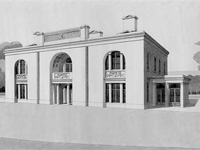
Harewood Park (proposed), Herefordshire (Image: Craig Hamilton Architects)

Ever since the Harewood Park estate was bought by the Duchy of Cornwall in 2000 as part of a larger purchase of 12,000 acres, rumours had been circulating that it would be for one of the Princes.  The original house had been demolished in 1959 so the expectation was that another would have to be built if it was to have such a role.  Considering the views of the Prince of Wales on modern architecture there was little surprise when a planning application was submitted in 2006 for a strongly Classical small country house by Craig Hamilton Architects.

Craig Hamilton originally prepared three designs but the final design (shown above) complements the existing stables and is perhaps the most interesting and the one successfully submitted for approval.

The house is based around the motif of the triumphal arch but, apparently drawing on the influence of Sir John Soane, it presents a simplified version rather than the more decorated versions often seen.  Soane was schooled in the Classical style but re-invented the language to create a new direction for Neo-Classicalism; a much simpler version with an emphasis on the effective use of space and most importantly, light.  Soane spent several years in Italy and was well-versed in Roman architecture and incorporated the three-arch motif into his designs, notably the entrance front to his own house at Pitzhanger Manor, Ealing, west London, and in one of his most impressive commissions for the old Bank of England (scandalously demolished in the the 1920s) as seen in the internal Lothbury Court.

The new Harewood Park is an inventive extension of this Soanian language and it’s encouraging that the planners had the courage to approve what will surely be one of the most interesting smaller country houses built in the UK.  Sadly, I suspect that for security reasons, we won’t see the house featured in Country Life but I keep my fingers crossed.


Competition: nominate your choice for ‘England’s Favourite House’

Competition: 'England's Favourite House'

This seems a good moment to mention the competition to find the best smaller country house (i.e. with less than seven bedrooms).  Most people have a favourite and usually it’s not so much the grand palaces of Chatsworth or Blenheim but the smaller houses of our local areas which form part of our local heritage.  The competition is being run by Country Life magazine and Savills the estate agents and the house should be in private ownership and not currently for sale. The deadline is Wednesday 24 November 2010 so submit your suggestions as soon as possible.

To nominate a house simply either print this form [pdf] and send it in or email favourite_house@ipcmedia.com

More information: ‘England’s Favourite House‘ [Country Life]


The rise and fall of French taste on UK country houses

Wrest Park, Bedfordshire (Image: English Heritage)

For all the traditional antipathy towards the French, the influence of their architecture has been felt throughout Britain’s country houses.  Although initially the use of the French architectural vocabulary was a sign of wealth and education only available to the best families, the style was regarded as sullied by the later, more energetic, constructions of the Victorians – an association which still sadly lingers today.

The first wave of Anglo-French design started in the Elizabethan period; a time when it was acceptable to display one’s knowledge conspicuously. The French style, with its dramatic rooflines, dovetailed with the traditional English manor house and its own profusion of gables and chimneys.  Houses such as Burghley in Northamptonshire made dramatic use of the style with the central, three-storey pavilion, dated 1585, based on the French triumphal arch but oddly includes a traditional mullioned window on the third floor. Burghley was the product of the owner, Lord Burghley, an architectural enthusiast who as far back as 1568 was known to have been writing to France to obtain specific architectural books.

This early use of the French style was relatively restrained – probably more by the conservatism of the ruling gentry who were most likely to be building these houses.  Yet, our impressions now are more strongly influenced by the bolder, more assertive French style which was so popular during the Victorian era – though this same popularity was to also lead to it being derided.

The first of the Victorian nouveau-riche were keen to be accepted by society and so built houses which largely followed the same designs used by the local families.  The end of the Napoleonic wars in 1815 led to a rush across the Channel leading to a revival of interest in French design, particularly in relation to interiors, such as the Elizabeth Saloon at Belvoir Castle, Rutland, built c.1825.  By the mid-nineteenth century this was being more confidently expressed in dramatic houses which sought to boldly make their mark.

The second French Renaissance was influenced by lavish works such as the new block at the Louvre in Paris, built between 1852-70.   However, there were earlier examples such as the complete Louis XV chateau at Wrest Park in Bedfordshire, designed by the owner Earl de Grey, built in 1834-39, and Anthony Salvin’s French roofs added to Oxonhoath in Kent in 1846-47.  Yet, after the Louvre, the fashion gathered pace with designs such as R.C. Carpenter’s redesign of Bedgebury in Kent in 1854-55, and Salvin’s work at Marbury Hall in Cheshire in 1856-8.  Less successfully, the architect Benjamin Ferrey built Wynnstay in Denbighshire for Sir Watkin Williams-Wynn which, for all its dramatic high roofs and pavilions, was thought rather gloomy.  Another dramatic, albeit slightly awkward, design was that of Plas Rhianfa, Wales, built in 1849, which seems to mix both Scots baronial and French, whilst Sir Charles Barry completed a more successful use of the two styles at Dunrobin Castle for the Dukes of Sutherland in 1845.  Also of note was Nesfield’s design for Kinmel Hall, described as a Welsh ‘Versailles’.

These houses were largely for the existing gentry who found the impressive skylines met their needs for a dramatic statement as was fashionable at the time.  With the fashion spreading into London and being used for luxury hotels, clubs and offices it was inevitable that the newly wealthy would wish to emulate in the country the world they already enjoyed.  The last burst of ‘aristocratic French’ could be seen in the designs for Hedsor House in Buckinghamshire, 1865-68 for Lord Boston, Alfred Waterhouse’s Eaton Hall in Cheshire, 1870-72 for the Duke of Westminster, and T.H. Wyatt’s Nuneham Paddox in Warwickshire for the Earl of Denbigh, built in 1875.  From around this time, its fashionability declined.

One of the earliest of this new wave was Normanhurst in Sussex, built in 1867 for Thomas Brassey, son of the famous railway contractor.  Reputedly, Lady Ashburnham from nearby Ashburnham Place (note the very different architectural style of house) would snootily refer to him as ‘that train driver over the hill’.  In Worcestershire, the equally dramatic red-brick Impney Hall – later Chateau Impney – was built in 1869-75 for local salt tycoon John Corbett, who employed Auguste Tonquois, who had extensive experience around Paris.  In County Durham, the foundation stone of the Bowes Museum, originally designed to be part-home also, was laid in 1869 for John and Josephine Bowes.  Designed by Jules Pellechet with J.E. Watson of Newcastle-upon-Tyne, the house reflected their love of France but also made a statement as to their wealth – and possibly sought to hide their less-than-solid social position as illegitimate son of an Earl and an actress.  In Yorkshire, the additions to Warter Priory were considered unsuccessful, either due to the strange proportions or because the style had simply fallen out of favour.  More successfully, St Leonard’s Hill, Berkshire, was transformed from a Georgian house in the mid-1870s to create a dramatic chateau visible from Windsor Castle.

Waddesdon Manor, Buckinghamshire (Image: National Trust)

Interestingly though, perhaps the most famous of the English chateau was also one of the latest.  Waddesdon Manor in Buckinghamshire was built in 1889 for Baron Ferdinand de Rothschild to a design by French architect Gabriel-Hippolyte Destailleur, mixing elements from various famous French chateaux such as Blois, Chambord and Anet.  The last of these grand French imports was Halton House, designed by William R. Rogers and built in 1882-88, also in Buckinghamshire and also for a Rothschild, Alfred Charles; Baron Ferdinand’s cousin.  Equally grand, this house also featured a wonderful winter garden, though this was sadly demolished to make way for an accommodation block for the RAF who bought the house and turned it into an officer’s mess.

Perhaps one of the final straws as to the desirability of the French style was the spectacular collapse of the Victorian financier Baron Grant who, in 1875, spent over £270,000 (approx. £20m) building a huge house in Kensington before his crimes were exposed in 1879 with the subsequent public disgrace, and the demolition the house in 1883.  Such a high-profile scandal and its flash monument would have been felt in society and tarnished the style for no-one would wish to be associated with such disgrace.  However, fashion would have played a more significant role, with taste moving on to new styles, leaving these extravagant mementos to an earlier, brasher architectural exuberance which now give us an unexpected glimpse of France in the British countryside.


Credit: a wonderful insight into the period is Mark Girouard’s ‘The Victorian Country House’ which was most useful in the research for this post.

For more information on Chateau Impney; ‘Chateau Impney – the story of a Victorian country house’ by John Hodges