Monumental follies: current large country houses in the UK

Hampton Court Palace, Surrey (Image: Andreas Tille/Wikipedia)

In previous centuries the country house was primarily a home, but also included other functions such as storehouse, dormitory, dairy, bakery, laundry.  This inevitably led to their size increasing to the point where they could be regarded as small villages – but despite the scale of houses such as Knole or palaces such as Hampton Court we still admire their elegance and charm.   So what’s changed now that the modern ‘palaces’ so lack the beauty of those which went before?  Is it because so many have been demolished that we have no sense of how to design the largest of country houses?

The size of a country house has always been used as a simple measure of the owner’s wealth – and subsequent owners could also argue it would equally symbolise the size of their burden.  In the UK, traditionally the name ‘palace’ was reserved for the homes of the monarchy or bishops with few landowners being bold enough to take the name for their own houses – regardless of size.  One of the few to do so were the Dukes of Hamilton, whose home – Hamilton Palace in Scotland – could truly be said to justify the name.  A vast Classical edifice with a north front stretching over 260-ft long, the interiors and collections were easily a match for any other house in Europe.  Yet, financial circumstances, wartime damage and apparent mining subsidence condemned the house and it was demolished in 1921.
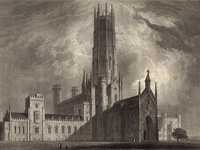
Fonthill Abbey, Wiltshire (Image: Wikipedia)

Other houses were conceived on an even grander scale.  Perhaps the most famous is Fonthill Abbey in Wiltshire, designed by James Wyatt for the immensely wealthy William Beckford. Inspired by a love of the Gothic, Beckford set out to create what was effectively a residential cathedral.  The vast 300-ft tower and huge 35-ft tall doors all contributed to an awe-inspiring impression for the few visitors able to see it before it collapsed under its own ambition in 1825.  Wanstead House in Essex, built in 1715, was also conceived on a similar scale to the later Hamilton Palace but again was lost – this time when creditors tore it down so the materials could be sold to pay debts in 1825.  The roll call of other huge houses includes Eaton Hall in Cheshire, Worksop Manor and Clumber House in Nottinghamshire, Nonsuch Palace in Surrey, and Haggerston Castle in Northumberland.  Yet what distinguishes all these houses in that they have been demolished – their very size eventually condemning them as later economic circumstances rendered them unsupportable.  However, each was architecturally an interesting house, one that, if it still survived, would be admired today (well, perhaps less so the bulky Haggerston Castle).

No modern palace has yet matched the beauty of the UK’s largest private country house still standing – Wentworth Woodhouse in Yorkshire.  From the end of one dome-capped wing to the other, the house, built largely in the 1730s, runs for over 600-ft but is an object lesson in Classical elegance.  The huge and imposing portico towers over the façade provide balance and a natural harmony with the scale of the flanking wings. Other large house still in existence which were built on a similar scale include Blenheim Palace and Castle Howard.

Updown Court, Surrey (Image: Savills)

So what have lost that means that the houses built to a similar scale today are so poor architecturally?  Perhaps one of the best (worst?) examples of this problem is Updown Court in Surrey. Completed at the end of 2006, this vast mansion is described on the official sales website as symbolising “the grand and imposing presence of the Great Houses of England.” (stop sniggering at the back!).  Although the ‘in excess of £70m’ price tag will naturally limit the pool of potential buyers, is it just the size or the price causing the problem? Perhaps it is the curse of the American ‘McMansion’ which leaves it to languish?  The derogatory term ‘McMansion’ was coined in the US in the 1980s to describe the huge houses being constructed which valued sheer size over architectural merit.  The architect of Updown, the American John B Scholz, can truly be said to pay fervent homage to such excess.  Extending to over 50,000 sq ft – bigger than Hampton Court or Buckingham Palace – the house is a exemplar of the type of house which simply is built with little thought to design beyond the ill-considered use of architectural elements to just decorate the house.

However, is no design better than too much? At Hamilton Palace in Surrey the owner, the notorious Nicholas van Hoogstraten, has taken great pains to ensure the design reflects his character.  Over-bearing and rather menacing, it was designed by Anthony Browne Architects (who are no longer involved), with work starting in 1985 and still ongoing though so far it includes a huge copper dome and a massive floor reserved for Hoogstraten’s art collection. The east wing is designed as a mausoleum where he can be hubristically entombed after death with his art collection in the manner of the Pharoahs. Yet for all the attention which has been lavished on the design and a reputed £30m spent so far, it has none of the grace and elegance of the earlier palaces.  Perhaps this is the ultimate expression of ‘self’ – a shameless design, built without a care as to what others think.  Which is probably a good things as it has been described by The Observer as “a cross between Ceausescu’s palace and a new civic crematorium” and by John Martin Robinson in The Independent Magazine (October 1988) as “Post-Modern Classical with a touch of meglomania”.

One final example, which although not strictly a country house, exemplifies this rush for scale over beauty is the proposed replacement for Athlone House in Hampstead, north London.  Owned by a Middle Eastern billionaire, this 50,000 sq ft pile is being designed by Robert Adam, a pre-eminent neo-Classical architect.  Despite this he has managed to produce a design described by one local critic as a ‘cross between a Stalinist palace and a Victorian lunatic asylum’ – and yet Mr Adam is responsible for some elegant examples of country houses such as the proposed Grafton Hall, Cheshire.

Obviously the scale of a modern palace is way beyond the realm of normal domesticity – and that’s fine.  The house has long been an expression of power and prestige but it was also one of taste, a refined justification as to the choice of a particular architect or style.  The modern ‘palace’ (and I use the word simply to suggest scale not beauty) is sometimes just the product of an architect interpreting vague notions from clients who seem unwilling to invest the time to become educated.  The end results are over-sized houses which lack the intellectual justification which underpinned the Fonthills and Eaton Halls of their day.  Nowadays, the need to spend the budget on a sad checklist of gimmicks seems to be pushing houses away from architecture and simply into a form of ‘decorated construction’ – a largely functional building given a variety of architectural fig leaves to hide its naked purpose as simply a Corbusier-esque ‘machine for living’ – but on a monumental and unpalatable scale.

Original story: ‘Hot property: Palaces‘ [ft.com]

Official website: ‘Updown Court, Surrey

Property details: ‘Updown Court, Surrey‘ [savills.com]

More criticism of Athlone House by Simon Jenkins ‘Greed, egos and yet another blot on the horizon‘ [thisislondon.com]

How tourism split a house from the estate: Warwick Castle, Warwickshire

Warwick Castle, Warwickshire (Image: Gernot Keller/Wikipedia)

A small advert tucked away in a recent Country Life marks the final split of a house from it’s estate. With the sale of the parkland associated with Warwick Castle in Warwickshire, another house loses control over an important asset – though this separation is very much tied up with the history of the opening of country houses to tourists, and this castle in particular.

Country house visiting is perhaps thought of as a more modern phenomenon but Warwick Castle was one of the first houses to be truly exploited as a tourist attraction with visitors coming in significant numbers from 1815 onwards. The growth of the industrial Midlands in the Victorian era and consequently a growing middle class seeking excursions, shifted the pattern of ‘show-houses’ (that is, ones regularly open to the public when the family were absent or on specific days) northwards, away from the more aristocratic 18th-century London-Bath axis.  The Midlands were particularly well provided for with many houses open to the public from the 1850s including Eaton Hall, Chatsworth House, Haddon Hall, Newstead Abbey, and Belvoir Castle amongst perhaps a hundred.  This reached a peak in the 1880s when the most popular houses would receive tens of thousands of visitors a year, reflecting a popular interest in the houses of ‘Olden Time‘ as popularised by writers such as Joseph Nash and Sir Walter Scott.

Warwick Castle, with it’s prized medieval origins, was particularly popular – to the extent that not opening it was considered unthinkable.  That the public expected to be allowed to see inside these houses could be shown in a comment in the Daily Telegraph in 1871 which said:

An Earl of Warwick who would make his whole castle his own in the spirit of an inhospitable curmudgeon, who would shut out all eyes but his own from the feast within those walls, is a being so opposed to every English tradition that it is difficult to realise him.

For the aristocratic owners, economics certainly played a stronger role than any sense of public generosity.  For some, having a popular house in the country was no inconvenience as, such as at Dunster Castle in Somerset, it was remarked in 1845; ‘The owner, an inveterate Bachelor, lives in London and hardly ever comes here‘.

Especially convenient for trippers from Birmingham and the nearby resort of Leamington Spa, Warwick Castle was hosting as many as 6,000 visitors per year in 1825-26 and when the Earl of Warwick’s housekeeper died in 1834 she was said to have left £30,000 earned from tips.  Yet it was the devastating fire of December 1871 which firmly moved the castle from being simply a home to a business. The fire destroyed the family apartments but luckily left the oldest parts of the castle untouched.  The Earl of Warwick’s financial situation meant that he simply could not afford to restore the house to its former glory, a prospect which scared the local tradespeople, fearing the loss of the tourist trade and so a restoration fund was created.  However, to ensure the Earl’s pride was not dented it was presented as recognition of the burden he bore as owner of a national treasure.

However, a furious response from no lesser figure than John Ruskin marked the start of a backlash, saying ‘If a noble family cannot rebuild their own castle, in God’s name let them live in the nearest ditch till they can‘.  Behind this was the growing social democratic movement which moved from support of national treasures privately-owned towards a more socialist belief that national assets ought to be owned by the ‘people’.  The purchase of Aston Hall by Birmingham Council in 1864 as a public museum and park was no doubt playing on the minds of both certain radical sections of society and Lord Warwick – though for different reasons.  The appeal eventually raised £9,000 which paid for restoration by Anthony Salvin but the importance of opening the house as an attraction was highlighted as a way of not only funding costs but also as a way of keeping the public happy that they had ‘access’ to what they now felt of as ‘theirs’.

From this point, the house was never really a private home again.  The Earl and his son embraced the tourist industry but in 1885 closed the castle for a year to re-organise the showing on a more commercial basis.  Gone were the old servants acting as guides; in came professionals paid for by the one shilling admission tickets.  The new system was a success, with 20,000 visitors in the first full year of the new regime.  The new domestic arrangements were confirmed by the 5th Earl who inherited in 1893 and preferred to live at his wife’s estate Easton Lodge in Essex.  In the same year, the castle staged its first historical pageant, which was repeated on a grander scale in 1906.  The 6th Earl, who took over in 1924, further promoted the tourist business, pushing visitors to a peak in 1930 of over 80,000.  Even during the war years, there were over 10,000 visitors in 1943-44, and numbers had recovered to their pre-war peak by 1949-50.

All this increasingly showed that the wider estate, for all its charms – landscaped by Capability Brown in 1747 and much admired by Horace Walpole, it was considered secondary to the primary purpose of the enterprise; to get people into the castle. When the 8th Earl decided to abandon Warwick Castle once and for all in 1978, selling it to the Madame Tussauds group which underlined just how much a tourist attraction it had become, the estate was included but farmed by tenant farmers leaving the grounds as a mere sideshow.  The 679-acres now under offer (guide price: £3m) is the bulk of the estate bar a few acres around the castle.  Land and house have been separated as assets and are unlikely to be reunited. This leaves a house without control of the setting which, although sidelined, has been an important part of what made it into such a popular tourist attraction, and leaving fans of our country houses sad that another has been split up in this way.

Property details: ‘Warwick Castle Park, Warwickshire‘ [John Shepherd]

For more history on country house tourism I can strongly recommend ‘The Fall and Rise of the Stately Home’ by Peter Mandler which proved very useful in relation to this article.

Views of seats; the mixed relationship between houses and motorways

Hardwick Hall, Derbyshire (Image: Bolsover Online)

Our best motorways draw us through beautiful landscapes, by turns revealing hills, valleys, broad vistas and narrow glimpses, sometimes punctuated with a country house.  Yet, country house owners have long fought many battles to keep the roads from carving up their precious parks and ruining the Arcadian views.

A recent article in the Guardian (‘Britain’s best views: motorway mansions‘) highlighted three great houses of Derbyshire each visible from the M1 motorway: Bolsover Castle, Sutton Scarsdale, and Hardwick Hall.  In our haste to get to destinations it’s easy to forget that where we drive was once part of great estates and previous owners would have wielded sufficient political power to ensure roads were routed away from their domains.  The echoes of this power can still be seen today if you look at aerial views of some of the great houses – major roads circle the gardens and immediate parkland such as at Chatsworth, Eaton Hall, and Clumber Park (though for the latter the house was demolished in 1938).

Yet, in other cases, officials either due to sheer bureaucratic efficiency, malice, or philistinism have carved roads through some historic parklands, cutting off the house from its setting, sometimes playing their part in step towards the eventual demise of the house. Sometimes the motorway is the gravestone; tarmac lies across the original sites of two lost houses so spare a thought for Tong Castle as you drive northbound just past junction 3 on the M54, or for Nuthall Temple, just north of junction 26 on the M1.

For planners, bypasses naturally need space and the obvious choice would be through the convenient estate which often borders a town.  From their perspective, taking on just single owner seems the easiest option, especially as it can be difficult to muster public support to defend a private landowners personal paradise.

One country house owner who has had several run-ins with roads is the National Trust, with varying degrees of success.  When they accepted Saltram House in Devon in 1957 they knew that a road was proposed which would cut across the parkland to the east of the house.  However, as a matter of principle they had to fight when finally earmarked for action in 1968, particularly as the road was much wider than originally proposed – though ultimately they were unsuccessful. For the private owners of Levens Hall in Cumbria, it was their research which prevented a link road to the M6 cutting across an avenue by proving it was originally planted in 1694 by garden designer Guillaume de Beaumont.  Yet other battles were lost; Capability Brown’s work at Chillington, Staffordshire was butchered by the M54, with the road now running just 35 yards from the grade-I listed Greek Temple.  At Tring Park in Hertfordshire the A41 slashes through the original tree-lined avenue.

The longest running, and most successful battle has been by the National Trust at Petworth House in Sussex.  The Trust has long accepted evolutionary changes but opposes drastic alterations regardless of the possible benefits to the local area – convenience does not trump heritage.  The village of Petworth suffers from heavy traffic so in the 1970s a four-lane bypass was approved which would run through the middle of the 700-acre, Capability Brown parkland, forever destroying the celebrated views painted by J.M.W. Turner in the early 1800s.  After objections were raised, an alternative, but equally damaging plan was suggested which used a ‘cut and cover’ tunnel – causing just as much destruction, particularly to the gardens, but then hiding their vandalism.  However, after a spirited public campaign, which included a dramatic poster showing the house with tyre tracks rolling over it (designed by David Gentleman for SAVE Britain’s Heritage), the plan was blocked and has almost certainly been killed off permanently.

So although the motorway has helped us to visit our wonderful country houses they also have, and continue to, pose a threat to them.  Thanksfully, stronger planning legislation which recognises the value of historic parkland has made it harder for the planners to simply draw a line between A and B without regard for the beautiful and important landscapes they would destroy.

Article: ‘Britain’s best views: motorway mansions‘ [The Guardian]