Guided missel: the rise of the country house guide book

‘Dear Picture Editor for the 2017 National Trust Handbook

National Trust Guide Book 2017

Yours is a challenging job. Faced with selecting one cover image to represent the National Trust for an entire year and with the myriad opportunities presented by having over two hundred country houses (unfortunately now minus Clandon), hundred of thousands of acres of countryside, and 775 miles of coastline, such a welter of natural and man-made beauty makes your task both enviable and daunting.

It’s therefore somewhat odd that the 2017 image is a close-up of a couple and their slightly disdainful-looking dog getting caught in a wave on a beach. The lady in the couple looks distinctly unhappy, the chap is possibly saying a swear word. Perhaps the oddest thing about it is that the bloke is wearing a bowler hat. For a walk on a beach. Of course, you would know that the bowler was created in August 1849 by the famous London hat-maker, James Lock, for the Coke family at Holkham Hall to help protect their gamekeepers from branches; both those attached to trees and those wielded by poachers. Holkham Hall, awkwardly, is not one of the many country houses (minus Clandon) under NT care so this image is, on many levels, a bit silly.

For next year, may I personally suggest a country house. Though I fear that they, as a class, appear to somewhat out of favour in the upper echelons of the NT, hopefully by appearing on the cover of the handbook, it may remind them that they are custodians of one of the finest groups of country houses one could dream to care for in perpetuity (minus Clandon).’

Guide books have long been a source of fascination for those who visit country houses. Topographical guides have been written for hundred of years to help those of us fascinated by country houses to determine which we might be able to gain entry to and revel in, whether in splendour or shabbiness.

Country house tourism is not a modern phenomenon.  Whether pilgrim or royalty, the idea of visiting houses was an ingrained part of the tapestry of life in the Middle Ages for providing hospitality.  One key difference can be seen in the preferences of Henry VIII who largely visited his own houses compared to Elizabeth I who frequently visited those of her favoured courtiers. Thus the concept of the country house (or palace) being built as much for display and prestige as the more mundane practicalities of large scale domestic occupation became a core characteristic of aristocratic life.

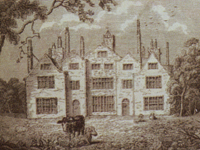
An Historical Account of Corsham House in Wiltshire, the seat of Paul Cobb Methuen [1806]
An Historical Account of Corsham House in Wiltshire, the seat of Paul Cobb Methuen by John Brittan [1806]
In the Georgian era, the burgeoning wealth of the expanded upper classes afforded increased leisure opportunities for travel and cultural pursuits. Their desire to assimilate themselves into the attitudes of the existing aristocracy fuelled a natural curiosity about their lives and tastes.  With frequent wars on the Continent often thwarting the traditional Grand Tour destinations, travellers now looked more domestically to visit their extended families and their friends. Even without the wars, it’s likely that the opportunities for women to travel were more restricted and to visit other ‘good’ families in their homes would have been an acceptable way for them to broaden their knowledge and tastes, thus cross-pollinating ideas, styles and fashions.

However, a family’s immediate social circle might contain only a limited number of contemporaries with whom they would be comfortable lodging.  Therefore, when visiting an area, either as a family guest or staying in accommodation, for example during the Season in Bath, day trip visits to other country houses was a favoured activity.  Despite the expectation that an owner would, as part of their duty to better society, open their house, the key question was how to find them and to determine whether they would even be amenable to visitors, no matter how genteel. Much as today, in fact, and hence the birth of the country house guidebook.

Opening Times in 'An Historical Account of Corsham House in Wiltshire, the seat of Paul Cobb Methuen' by John Brittan [1806]
Opening Times in ‘An Historical Account of Corsham House in Wiltshire, the seat of Paul Cobb Methuen’ by John Brittan [1806]
By the latter part of the eighteenth-century, an infrequent stream of visitors had become something of a torrent, if not a flood. Houses near large conurbations were particularly susceptible as Horace Walpole found at his charming neo-Gothic villa at Strawberry Hill, near Twickenham, described as ‘the prettiest bauble you ever saw’.  Writing to his friend Sir Horace Mann in July 1783, Walpole complained that ‘I am tormented all day and every day by people that come to see my house, and have no enjoyment of it in summer.’  Areas with a higher density of fine houses, which were within a day or two ride of a city or existing tourist destinations, such in as Norfolk, Derbyshire or Wiltshire, were soon part of an unofficial British Grand Tour. This was a natural progression for a society structured around the idea of circuits; domestically through suites of rooms and socially through visiting friend’s houses and at functions and balls.

Shirburn Castle, Oxfordshire (J. Skelton, 1825)

As the idea of country house visiting grew, so did the need to manage the number of visitors and their conduct whilst in the houses. Some simply refused access – a galling experience for those who might have travelled long distances such John Byng, who despite being just a civil servant, toured widely.  On being refused access to Shirburn Castle, Oxfordshire, he splenetically cried ‘Let people proclaim that their great houses are not to be view’d, and then travellers will not ride out of their way with false hopes.’ Owners increasingly favoured knowing when visitors may appear and so started having set days of admission. By 1760, Chatsworth was specifically open on two days per week. In 1774, Walpole, though ‘very ready to oblige any curious persons with the sight of his house and collection’ started personally issuing tickets and rules for good conduct.

The internal tours of country houses were usually conducted by the housekeeper who would provide rich accounts of the history of the building and family and details about the works of art – and sometimes the information was even true.  Unfortunately many myths about a family’s history and unwarranted artistic attributions for paintings are likely to have been started by the imagination of the unwitting guide. As the hobby of visiting grew in popularity so too did demand for more accurate accounts; giving birth to the new concept of the guidebook. The earliest from the 1730s-40s were more for reference at home rather than from a carriage and usually focused on individual houses, giving a history,  a catalogue of art works and sometimes a plan for the route to take through the house. These quickly spawned more democratic versions from competing booksellers, sometimes for the same property such as Benton Seeley’s ‘A Description of the House and Gardens…at Stow‘ (first published 1744, totalling twenty-two subsequent editions)

'Plan of the Library Story' from 'The Peak Guide; containing the topographical, statistical, and general history of Buxton, Chatsworth, Edensor, Castlteon [sic], Bakewell, Haddon, Matlock, and Cromford' by Stephen Glover of Derby [1830]
‘Plan of the Library Story’ from ‘The Peak Guide; containing the topographical, statistical, and general history of Buxton, Chatsworth, Edensor, Castlteon [sic], Bakewell, Haddon, Matlock, and Cromford’ by Stephen Glover of Derby [1830]
The guidebooks were both guide and tutor, ushering the visitor through an agreed route around a house but also providing sometimes detailed entries on each individual art work with the expectation that the visitor would view and gain a deeper understanding. This can be seen in ‘The Peak Guide‘ by Stephen Glover [1830] where the entry for the most significant house in the county, Chatsworth, runs to a generous thirty-seven pages. Starting with a description of the immediate vicinity, the bulk of the text runs to great detail on the Cavendish family, the architectural history (including the architects, painters, plasterers, even the plumber’), and the expected walking tour of the house.  A typical entry reads

The second Drawing-room is 36ft by 30ft hung with Gobelins’ tapestry, representing the Death of Ananias and Sapphira, Peter and John healing the cripple, and Paul and Barnabas at Lystra. In an oval compartment in the ceiling is painted the discovery of Mars and Venus. In this room are the following portraits, viz. William, first Earl of Devonshire, in his state robes, ascribed to Mytems; and declared by Mr. Walpole to be one of the finest single figures he had ever seen. Two fine whole-length portraits, said to be the Earls of Pembroke, with pointed beards, whiskers, vandyke sleeves and slashed hose; James, Duke of Ormond, and an Earl of Devonshire, in the costume of the seventeenth century

The level of detail created almost the sensation of a virtual tour, allowing those who could afford a copy of the book, or at least get access to one, the chance to imagine inhabiting the palaces and houses which may be socially or physically out of reach.

Guidebooks have evolved continuously as the requirements of owners and visitors have demanded. Early National Trust books were written by noted historians such as John Cornforth and maintained the seventeenth-century principle of guidance and education. However more recent editions have dispensed with much of the in-depth information in lieu of more pictures of daffodils or scones (and let’s not even get started on the paucity of information about the houses on the National Trust website *sigh*). Happily, other private owners have created lavish books very much in the form of those earlier versions – Woburn Abbey, Bedfordshire, and Boughton, Northamptonshire, are notable examples.

Whatever their role, the guidebooks are an essential component to the experience of the country house. Without them, the rooms would simply be an anonymous store of gilded treasures, without context or understanding. The books remain the key which unlocks the secrets of the houses; the owners and their motivations, their collections and tastes.

Handbook reviews

Hudson's Historic Houses & Gardens, Museums & Heritage Sites 2017
Hudson’s Historic Houses & Gardens, Museums & Heritage Sites 2017

Hudson’s Historic Houses & Gardens, Museums and Heritage Sites 2017

Content (design/layout): Having now been published for 30 years, the Hudson’s guide is a unique oracle for identifying ‘historic houses & gardens, museums and heritage sites’ for your visiting pleasure. In slightly-larger-than-A4 format, this is a book to be enjoyed as much at home, with full-page entries for leading houses, enhanced by full-colour photos. Bonus features include interviews and number of interestingly varied articles (including location filming / James Paine / The Clive Collection / Indian influences on the Royal Pavilion) and thematic guides such as dog friendly sites, events venues, and which properties have guided tours. If there is any criticism it’s that some of the smaller entries for houses read as though it were copied from their usual leaflet and sounds a little off-key.  However, given the comparatively almost lavish space, most sites have an informative, rather than purely functional, write-up with history and details on the art and architectural features.

Comprehensiveness: Unrivalled – the guide is invaluable when in an unfamiliar area and need to plan days out. It includes private properties, National Trust, HHA, plus other heritage sites.

Convenience: The larger-than-A4 format and number of pages means this is not one for the pocket and would be a bit hefty to carry all day. That said, the design means that planning your itinerary is both practical and a pleasure.

Verdict: Even if you get other member handbooks for free, for those wanting more detail or looking to visit a broader range of heritage sites, the Hudson’s guide is unequalled and definitely worth the modest investment. (Available on Amazon or all good bookshops)

*Transparency notice: Hudson’s did send me free copy to review but had no editorial input to any part of this blog post and I’d buy a copy anyway.

National Trust Members Handbook 2017

Content (design/layout):  As the product of many years of refinement, the guide is an excellent way to plan your visits. Set out with listings by county, each property or location has a brief write-up though some properties eclectically get more space and further details. All the useful information is in there including opening times and facilities. Bonus content includes a clever themed index highlighting which properties tick boxes for ‘Adventure playground, boat hire, bicycle hire, camping and caravanning, gardens, ghosts, and industrial heritage’. Note that neither ‘art’ nor ‘architecture’ make the cut as categories. Ghosts though, do.

Comprehensiveness: Unsurprisingly, it only covers National Trust properties.

Convenience: About the dimensions of a paperback novel so easy to leave in the glove box of the car or add to a rucksack.

Verdict: A benchmark for member organisation guides – one that marries convenience to practical information to help plan visits. Just wish it felt able to give equal billing to the houses and their contents as much to the playgrounds and cafes.

Historic Houses Association Friend’s Handbook / English Heritage

Unfortunately I’m not a member (there are limits to funds and time, you see) so I haven’t seen a copy of the latest version – but if said organisations would like to send me this year’s edition, I’ll add details to this page.

Other suggestions

If anyone can suggest other guides (either members or general) then please do comment below.

Find out more

A mansion tax is a pox on all our country houses

It’s a widely accepted principle that even if trying to achieve a noble goal, it is not a justification to do harm in doing so.  Whether one is trying to fund the NHS or provide kittens and puppies for all, if ever such an ill-thought out idea as a mansion tax is introduced, it is likely that the law of unintended consequences will find myriad ways to demonstrate itself.  In few sectors will the damage be greater than in that of our nation’s cultural and architectural heritage where decades of hard work and conservation of our country houses will be sacrificed to play a short-term political game.

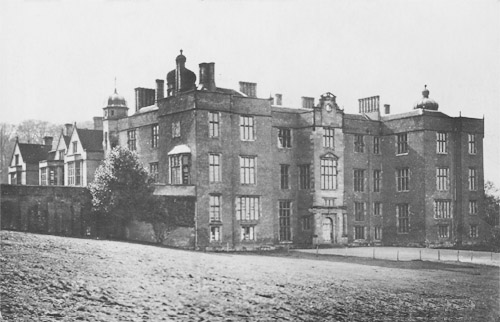
Beaudesert Hall, Staffordshire - demolished 1935 due to demands of heavy taxation (Image: Lost Heritage)
Beaudesert Hall, Staffordshire – demolished 1935 due to demands of heavy taxation (Image: Lost Heritage)

Let me make clear that this objection is not party political – I would object as vigorously regardless of whoever tried to propose it. Obviously the devil is in the detail but if we assume a tax levied on homes valued at £2m or more at 1% of the property value to be paid annually there are many obvious and profound flaws with the idea – below are a few of them:

  • Fallacy of numbers: there are more expensive houses than there are rich people who could afford the tax. Many houses which would be affected have been inherited thus exchanging the large liquid capital requirements of purchase for the more manageable (though not insubstantial) cost of on-going maintenance.
  • Value suppression: a house valued at £2m will immediately not be worth £2m when a mansion tax is introduced (thus reducing the projected tax receipts).  This will lead to a very hard ceiling on house prices, stagnating the market far below that level as it will prevent others trading up by imposing a disproportionate penalty on anyone purchasing over that price level. Think of all the disadvantages of the current crude banding of Stamp Duty, but magnified.
  • Incentive to neglect: if your house is worth just over £2m, there is a benefit to allowing your property to deteriorate so that it can be assessed at being below the threshold. But how often will they be valued? Will it lead to a cycle of neglect and repair to coincide with this? Who will wish to improve their property for fear that it will push it over the punitive threshold?

Perhaps the greatest threat is to the contents of country houses; the art, sculpture, books, tapestries which combine in such an intangible emotive way to create that atmosphere unique to each.  When the financial effects of the 1870-80s agricultural depression began to be felt, the first items to be sold were the contents – the Titians, Rubens, Caxtons, Shakespeares, Nollekens, Canovas were taken from their pride of place and sent to auction or dealers, the resulting funds merely delaying the inevitable sale of the house.  If we thought the National Lottery Fund was sorely stretched at the moment to acquire for the nation the occasional fine work which appears at auction, there is little chance of them being saved if the volume increases, meaning they will, in many cases, go overseas. Additionally, if the best works have already been sold, then death duties will be a final hammer blow to shatter the cultural and historical unity of the country house, with nothing left to sell or offer in lieu.

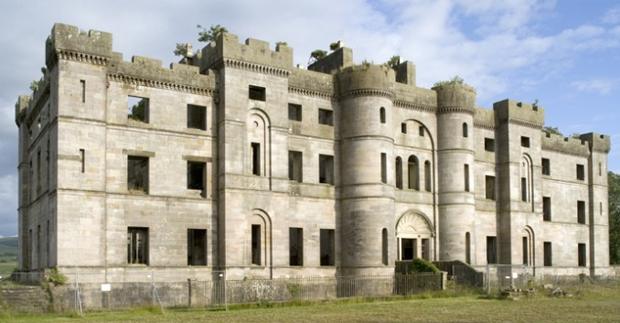
This type of crude taxation has been tried before and it is always heritage which pays the price.  The many gaunt shells of Scottish country houses, such as Dalquharran Castle or New Slains Castle, which were un-roofed to avoid punitive taxes are sad testament to the folly of this approach.  Supporting a mansion tax is to accept a probable return to an era where empty country houses become derelict – ironically coming so soon after the 40th anniversary of the ‘Destruction of the Country House’ exhibition. The National Trust will not be able to take them on without an endowment and English Heritage are sorely underfunded already – leaving either neglect or a hope for an influx of foreign wealth to purchase these houses. Without a local owner living there full time, there are likely to be fewer jobs reducing tax revenues and, with the dearth of rural jobs, leading to higher numbers relying on the State for assistance or an exodus to larger urban areas, further damaging the rural environment.

Dalquharran Castle, Ayrshire - built by Robert Adam c1785-1790, un-roofed 1967 (Image: RCAHMS)
Dalquharran Castle, Ayrshire – built by Robert Adam c1785-1790, un-roofed 1967 (Image: RCAHMS)

Perhaps there could be exemptions for houses which are open a certain number of days a year or which support useful charitable activities but the danger is that these would be used to justify an idea that is inherently wrong.

This article is deliberately painting a rather bleak picture, partially because there is a real likelihood of any of these outcomes, but also to emphasise just how badly-thought out this crude idea is.  It offers no benefits except as a bone to be thrown to a few class warriors but it should seriously worry anyone who cares about the UK’s cultural, artistic and architectural heritage.  Owning a country house is a responsibility, not only as a home for the owner and their family, but one owed to society as a whole.  It is inevitable and right that tax should be raised to pay for the society we hope to live in, but to wilfully sacrifice four centuries of heritage is an immoral and culturally destructive way to do so, no matter how noble the intended reason.

England’s most ‘at risk’ country houses; English Heritage 2013 report

Though he his House of polish’t marble built
Yet shall it ruine like the Moth’s fraile cell.*

Nymans, West Sussex - gutted by fire in 1947 (Image: sjr60 via flickr)
Nymans, West Sussex – gutted by fire in 1947, now a romantic ruin (Image: sjr60 via flickr)

There is a long tradition of the romanticisation of ruins and decay, but watching once grand houses slide into dereliction is thankfully now seen as a failure; on the part of the owner, and of the official bodies charged with the preservation of our shared architectural heritage. With those local experts disgracefully being seen as expendable by councils, it’s important that English Heritage has produced the 2013 ‘Heritage at Risk Report‘ [PDF] – a sad national roll call from which the priority sites list contains a surprising selection of country houses.

To be included in the list is not to say that a house is derelict, but is more a reflection that there are concerns about the long-term future of the house and current signs of deterioration.  Owners can often find that there are significant projects which require substantial investment which may not be currently possible through their own means, though inclusion on the ‘Priority’ list does open doors to grants and other funding.

Knebworth, Hertfordshire (Image: June Buck / Country Life Picture Library)

Perhaps one of the best known to appear is Knebworth House, Hertfordshire, a Victorian fantasy that is now faced with a modern reality.  Home to the Lytton family since 1492, the house was originally a mid 16th-century courtyard house before losing three sides in 1811, leaving just the west wing which was remodelled externally in 1820 and 1843 in the Tudor-revival style, with interior alterations by Lutyens in 1907 (see Listing description for details).  Still a family home, the Lytton-Cobbolds (as they now are) have worked hard to open the grade-II* house and, famously, host vast pop concerts in the park.  Major grant-funded repairs in the late 1990s restored half the house, but now, as a priority case, a further £240,000 has been allocated for works on the roof and to restore the upper rendering and two pinnacles.

Sockburn Hall, County Durham (Image: Sockburn Hall Project)

For an estate once reputedly tormented by a dragon, the modern threats to Sockburn Hall, Darlington were much more prosaic, but which have meant years of restoration work.  The current house was built in 1834 for the younger brother of Sir William Blackett (1758-1816) in whose family it remained until sold in 1920.  A varied ownership history led to the period which left it in the current damaged state, when the house was owned by two sisters who were later convicted of keeping many dogs in terrible conditions in Sockburn Hall.  The accumulated excrement rotted the floors and a lack of maintenance led to water ingress.  New owners and a dedicated team of volunteers have rallied and started restoration, part-funded by English Heritage grants, though work clearly has some way to go before the house will be safe again.

Scraptoft Hall (Image: wikipedia)

Scraptoft Hall, Leicestershire has long been a cause for concern, faced as it is with threats from the weather, vandals and poor local planning decisions.  Originally built in the 1720s, this elegant smaller house, although still on the edge of Leicester, had earlier suffered the usual short-sighted urban development, which now encroaches on it and its condition had deteriorated significantly.  However, the setting of the house is still worth preserving, though previous proposals would have unsympathetically left it as a mere architectural bauble in the middle of a much larger development.  Sadly, in 2010, despite going against English Heritage advice, the local planning department, council, and MP, were all happy to cast this fine piece of local architectural heritage onto the scrapheap of their own inadequate vision.  A reduced scheme was approved in July 2013, which although at a more appropriate scale, still contains some regrettable choices such as separating the house from the lake and ruining the approach to the hall by lining the drive with houses (See Planning Documents: Presentation Layout). This plan will result in the house being restored as eight apartments, but neither the local council or the developer can claim any sort of credit from this outcome.

Scarisbrick Hall, Lancashire (Image: Paul Barker / Country Life Picture Library)

For anyone stumbling across the Gothic Revival majesty of Scarisbrick Hall, Lancashire, it might seem as thought they had found a university rather than a house – in fact, they had found one of the most remarkable buildings of the Victorian age.  On inheriting in 1833, Charles Scarisbrick embarked on a huge project to embellish his home, initially spending £5,500 between 1836-1846 on old antique carvings.   As one of the oldest Recusant families, the Scarisbricks had an affinity to the Gothic style and one of the reasons for the Hall’s grade-I listing is the creation in 1812-16 of the first new domestic ‘great hall’, to designs by Thomas Rickman and John Slater. One of the key reason for the highest listing is that the house is one of the greatest surviving examples of the work of A.W.N. Pugin, especially after the ruination of his masterpiece, Alton Towers.  Pugin was the architect who thought Gothic was the only ‘true’ architectural path for a Christian nation and, although Charles Scarisbrick initially only asked for a garden seat and a fireplace, Pugin eventually re-designed the interiors before being asked to alter the exterior, creating a more picturesque aspect.

Scarisbrick Hall, Lancashire - the bell tower (Image: Alexandre R. dos Santos via flickr)
Scarisbrick Hall, Lancashire – the bell tower (Image: Alexandre R. dos Santos via flickr)

Pugin died in 1852, and Charles Scarisbrick in 1860, after which, Charles’ sister inherited and employed Pugin’s son, Edward Welby, to continue the alterations including the spectacular tower – though without the planned clock so rendering it somewhat pointless.  The house passed out of the family in 1872, and was eventually sold for demolition in 1962 but became a school instead, a role it retains today. However, a mounting repair bill (estimated at £2.46m in 2008) has led to the house being added to the ‘at risk’ register, with particular concern about the main hall, and east and west wings.  On all counts, this is a remarkable house and warrants close monitoring and support to ensure that this magnificent example of the Gothic Revival doesn’t fall into a more parlous state.

An estate can contain many more buildings than just the main house, such as stables or follies, which form an important part of the a part of the character of an estate, but which can also become at risk. Below are examples from the same priority report:

In more positive news, although the grade-I Castle Goring, West Sussex, is included in the list, it also notes that this remarkable house has been sold and work to rectify the maintenance backlog has now started.  Congratulations to the South West and West Midlands regions which have no country houses or related buildings included in the 2013 list.

These Registers are a valuable opportunity to highlight the ongoing threats to our shared national architectural heritage, for although many of these country houses and buildings are in private ownership, we all enjoy the wider benefit of their beauty and history. If anyone demands justification as why anyone should care, why we should protect them, just ask them to imagine our country without them.

Ruins of Ravensworth Castle, County Durham (Image: Webb Aviation)
Ruins of Ravensworth Castle, County Durham which also feature on the ‘Priority’ list (Image: Webb Aviation)

—————————————————–

Full list (PDF): ‘Heritage at Risk Register – 2013‘ [English Heritage]

Previous blog post: ‘How to get depressed quickly: the English Heritage Buildings at Risk Register 2010

—————————————————–

* – Quote by Gaston Boissier, ‘Rome and Pompeii‘ (1896), as quoted in ‘The Pleasure of Ruins‘ by Rose Macaulay

A country house at risk of demolition: Winstanley Hall – and how you can help save it

Winstanley Hall, Lancashire (Image: Paul Barker / SAVE Britain's Heritage)
Winstanley Hall, Lancashire (Image: Paul Barker / SAVE Britain’s Heritage)

That the headline above is even possible today is shocking; that it almost came with the acquiescence of English Heritage is even worse.  The wealth of Britain allowed the creation of thousands of wonderful country houses; stores of learning, art, literature, music and much more.  Yet hundreds have been lost, the contents scattered, the fixtures and fittings sold for a fraction of their worth and the history and visual value of these beautiful buildings lost to the demolisher’s pickaxe.  Many a country house has been restored from a serious state of dereliction, so for demolition to even be proposed is to be deplored. Winstanley Hall, near Wigan, has long been a cause for concern but a new campaign, run by SAVE Britain’s Heritage, hopes to quickly raise the funds needed to rescue this fascinating house.

The Country Seat blog is an off-shoot of my earlier interest and research into the lost country houses of England.  Initially sparked by the ruins of Guys Cliffe House in Warwickshire, I have been building on the remarkable work of Peter Reid, John Harris and Marcus Binney who produced an initial list of nearly 1,200 houses which had been lost since 1800.  This list formed the backbone of the ground-breaking 1974 exhibition at the Victoria & Albert Museum in London which dramatically brought home the shock that so much of our architectural heritage had been lost already and the then legal constraints were insufficient to stop it continuing. My list now totals over 1,800 houses which have been lost since 1800 – every county has been affected and each has their own sad roll-call of losses.

Hall of Lost Houses, from the 1974 Destruction of the Country House exhibition at the V&A
Uppark House, Sussex - on fire, 30 August 1989 (Image: National Trust)
Result of a bad workman and his tools: Uppark House, Sussex – on fire, 30 August 1989 (Image: National Trust)

Houses can be lost for a number of reasons but two of the main causes are fire and finances. Country houses are unfortunately particularly susceptible to fire; the wooden construction, the flammable contents, the open fires and the restoration work which often brings careless workmen with their blowtorches.  Beyond mitigating the risk, preventing these devastating blazes has always been a challenge.  Yet, diminishing or insufficient finances are equally pernicious but harder to combat as the decay can quietly take place over generations, with the realisation of the seriousness only coming too late.

Many houses were traditionally supported by their estates but the agricultural crisis of the 1880s led to a reduction in income which was largely staved off through the sale of contents, until, in the early 20th century, this was no longer sufficient and the houses themselves were demolished – at a stroke removing the running costs and raising funds through the sale of the materials.  This continued through that century, spiking in the 1920-30s and again in the 1950s, reaching a nadir in 1955 when a significant house was being demolished every five days.  This fascinating video below shows rare footage of a country house in Kent, Pickhurst Manor, as it was destroyed in the 1930s:

The impact of the ‘The Destruction of the Country House‘ exhibition cannot be over-stated in heritage terms. It can be said to have jump-started the heritage movement, creating the current mass interest in country houses which can still be seen today in the popularity of the National Trust and the many individual owners who open their houses to the public. It also led to the formation of SAVE Britain’s Heritage, which has since then been one of the countries most effective campaigning charities; saving not just country houses, but working to find viable uses for a broad range of historic buildings including factories, churches, offices, and, most recently, terraced housing threatened by the wasteful and pointless Pathfinder Scheme. In the interests of transparency: I am involved with SAVE as a member of the Committee which is consulted about current cases, but this post was not written at their request and the views expressed are my own.

Winstanley Hall, Lancashire - print
Winstanley Hall, Lancashire – print showing the original Elizabethan house

Which brings us to the Grade-II* Winstanley Hall. One of only three surviving Tudor buildings in that borough, the house was built shortly after James Bankes, a London goldsmith, bought the estate in 1595.  The core of the Elizabethan house, with its two projecting wings, can still be seen on the garden front of the house, thought the original gables were replaced by parapets during alterations designed by Lewis Wyatt in 1818-19.  It was Wyatt who created the new entrance tower to the west with its Ionic portico and his work can still be seen inside with some surviving plasterwork and the fine cantilevered staircase.  What makes Winstanley particularly interesting is that it contains layers of work but with each grafted onto the last making the house quite ‘readable’.  A new wing to the south-west was added in 1780, with further changes, marked by keystones, in 1843 and 1889.

The stable court is especially fascinating architecturally as it contains a range of different styles, chosen at the whim of the owner; Meyrick Bankes II.  This delightfully eccentric but still functional range of buildings reflect his life as a well travelled, well educated man and includes Norman, Tudor, and Baroque motifs (and even his own likeness) in the masonry which creates a varied design which adds to the charm of the setting.  The visual interest of the courtyard, combined with the house, really does set Winstanley apart as many houses have lost one or the other of these core elements which make up an estate.

The house started declining in the 1930s and was last occupied in the early 1980s, with the parkland being open-cast mined during the post-war period and later the M6 being built along the edge of the parkland.  However, the parkland has now been restored and the road, which is some distance to the west of the house, is hidden in a cutting and by banks of trees, resulting in the Winstanley estate forming a precious rural space on the edge of Wigan, still approached from the east along a long, secluded drive which dips in between romantically landscaped woodland.

When the family sold up, the house and 10-acres were bought by a local developer who submitted a scheme which proposed enabling development, even though, as Green Belt land, it was unlikely to succeed.  With the failure of this scheme, the house remained unused, sliding further into dereliction to the point where another scheme was suggested which would have involved the conversion of the buildings in the courtyard but would have resulted in the demolition of the main house – and it’s this shocking scheme which English Heritage almost approved in 2011 (though EH, to be fair, also cannot be praised highly enough for their saving of Danson House and Apethorpe Hall – which is still for sale, by the way).

Proposed restoration of Winstanley Hall (Image: Huw Thomas / SAVE Britain's Heritage)
Proposed restoration of Winstanley Hall (Image: Huw Thomas / SAVE Britain’s Heritage)

SAVE stepped in and prevented the demolition and has been working with leading consultants to draw up plans for emergency repairs but also to find a long-term, sustainable solution which not only preserves the house through re-use but also brings the other buildings in the complex to life.  The leading country house conversion architect Kit Martin along with the Morton Partnership, a leading firm of heritage surveyors, have been working with Roger Tempest of Broughton Hall (who has a track record of creating business space in estate buildings), in conjunction with the Landmark Trust, and the Heritage Trust for the North West, who have been consulted about creating heritage training skills opportunities.  The overall aim is to create a community which is not just residential but also hosts businesses and events, with public access via an exhibition space and café.

How you can help: English Heritage have agreed a major grant of £217,000 for the emergency works but SAVE urgently needs to raise a £50,000 contribution.  Any donation, large or small, will help rescue this wonderful house and estate and help prevent the loss of yet more of our heritage.  Since 1974 no house of this size or quality has been lost, so, if you can, please do help.

Ways to donate:

  • Online via the SAVE website
  • Phone: donate £3 or £5 by texting RESTORE3 (for £3) or RESTORE5 (for £5) to 70500. (This will cost £3 or £5 plus your standard message rate and 100% of your donation will go to SAVE Britain’s Heritage.)
  • Cheque: made payable to ‘SAVE Britain’s Heritage’ and sent to SAVE Britain’s Heritage, 70 Cowcross Street, London, EC1M 6EJ.

Thank you!

——————————————————————————

Full SAVE campaign brochure: ‘Help us Save Winstanley Hall‘ [PDF – SAVE Britain’s Heritage]

Photos of the house in better days ‘Winstanley Hall: gallery‘ [SAVE Britain’s Heritage]

A very unofficial tour: ‘Winstanley Hall‘ [YouTube]

A view of the interior: ‘Winstanley Hall‘ [WiganWorld]

Aerial view of the house and outbuildings: ‘Winstanley Hall‘ [Bing]

Listing description: ‘Winstanley Hall

Guest blogger: Jeremy Musson – ‘English Ruins: an odyssey in English history’

Having written all nearly 200 posts since I started writing this blog I now thought it would be interesting to try and broaden the voices involved.  So as the first post in this new direction/experiment, I am delighted and honoured that one of our leading architectural historians, Jeremy Musson, kindly agreed to write a piece on country house ruins linked to his new book published this month, ‘English Ruins‘, a fascinating look at their role in shaping our perceptions of the past and our architecture.

——————————————————————————————-

Jeremy Musson
Jeremy Musson

The English landscape is a landscape of ruins. Fragmentary or sometimes only roofless and windowless, these part dismantled buildings stand out to mark our national history in a number of different ways, and above all, provide a sense of historic scenery for our journeys, physical and imagined – and glimpsed from motorways and footpath alike. In this new book, photographer Paul Barker and I wanted to explore something of this particular cultural landscape and through this exploration trace something of how the English see themselves and their past.

I feel that we live in an old country, and the past is always there, to paraphrase T.S.Eliot, “pressing on the future”. Some love the past, some hate it, many are indifferent to it, happy enough to take pleasure in a good day out, with a dash of historic scenery. But the whole process of our encounter with ruins, is somewhat special – a deeply subjective, and in effect, an almost artistic experience. It is personal and often emotional, while it is also formed and shaped by a whole series of sometimes opposing cultural inheritances: Romanticism, anti-establishment, veneration for the classical, veneration for the Gothic, history seen through the very shape of the landscape.

There is something that seems to appeal about ruins to the English imagination over the centuries. Think of how John Aubrey, for instance, the late seventeenth antiquary and author of that amusing volume of English biography Brief Lives, observed that

“the eie and mind is no less affected with these stately ruines than they would be if they were standing and entire. They breed in generous mindes a kind of pittie; and set the thoughts aworke to make out their magnificence as they were in perfection.”

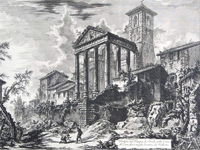
Piranesi: 'Temple of Hercules, at Cori' - 1769 (Image: Mattia Jona Gallery)

During the 18th century, the Grand Tour, part of the expected education of a gentleman or aristocrat, consisted of a journey through Holland and France to visit the great monuments of the Roman world, excited the aesthetic and cultural awareness of the 18th-century English gentleman, who was in turn the patron of artists and architects following the same path in trying to import the drama and excitement of great classical ruins to an English audience. Walk through any major house built in the 18th century, with anything of its original collections still in situ and the ruin is visible in painting after painting, and then echoed in the classical temples of the park.

The phenomenon of creating artificial ruins, in which the English seem to be pioneers, belongs to this period, and while the earliest garden temples seem to be classical, the contrivance of designing ‘ruined’ structures, was largely sourced in England’s own Gothic past. Horace Walpole the 18th-century diarist, who designed his own Gothic style house, Strawberry Hill, hugely admired the work of Sanderson Miller who designed a ruined tower at Hagley Park, with the perhaps slightly teasing phrase that it had “the true rust of the barons’ wars” referring to the Wars of the Roses.

When making this tour of England in tandem with photographer Paul Barker, I could not help noticing that we were often treading in the footsteps of the great landscape painter, J.M.W.Turner, for whom the evocative power of the ruin played a central role in his career, although we perhaps think of him most naturally as a landscape painter, and a painter of skies.

In the last years of the 18th century he exhibited numerous studies of great historical ruins in landscapes, appealing to the Romantic spirit of his audience – characteristically these are the foil for dramatic expositions of sky or sea. He continued to make special studies of ancient ruins, castles and abbeys on tours around the whole of England, for his ambitious Liber Studiorum project, and many were published in different histories, especially in Charles Heath’s Picturesque Views in England and Wales.

Turner looked principally at abbeys and castles, but abandoned country houses have come to be a feature of our landscape too. The dramatic changing status of the country house from the first world war, into the great depression of the late 20s and early 30s, becomes even more intense after the second world war – think of John Harris’s memoir, No Voice from the Hall. This was a period which resulted in so much change in English life, that it is easy to overlook the symbolic collapse of the world of the English country house. This was a feature of interwar life too, with the rise of income tax and death duties, but the upheaval of the Second World War, the widespread institutional use of country houses for military and other government purposes often hastened their subsequent abandonment.

Cowdray House, Sussex (Image: Cowdray Heritage Trust)

Inevitably, given my interest, the country house looms large in our new book. We focus on the story of buildings from different themes and for the ruins of country house, beginning with Cowdray House, in Sussex, a substantial Elizabethan mansion damaged by a fire in the late eighteenth century, and then abandoned, partly as a result of complications over inheritance; but quickly becoming a destination for artists, for instance, Turner visited the ruins while staying at Petworth – it is now looked after by a newly formed trust, and feels like the sets left over from a Grand Opera, standing amongst the meadows and paddocks on the edge of Midhurst.

We also visited the ruin of an elegant early-seventeenth-century lodge at Wothorpe Towers, a lodge once part of the Burghley estate, which was used as a dower house and then, apparently, part dismantled to provide an eye-catcher in the new landscaped park. It was falling into serious decay and has recently been taken on by the Griffin family, who putting the main house into a trust, which is restoring the gardens, are converting the ancillary seventeenth century buildings into a new home.

Seaton Delaval Hall, Northumberland (Image: Alan J. White / wikipedia)

The classical country house tradition is represented in our book, by 1720s Seaton Delaval Hall, near Newcastle – one of the finest houses by Sir John Vanbrugh, re-roofed after a major fire, the interiors are otherwise the very picture of a ruin. In Derbyshire, we encountered the memorable and mournful spectacle of Sutton Scarsdale Hall in Derbyshire, also built in the early 18th century. The latter, partly due to its proximity to mine-works, acquired in 1919, by businessman out to profit from its materials and fittings. The panelling was sold United States collectors, and some at least found its way into the Museum of Fine Arts in Philadelphia. Its demolition was in fact prevented by local landowner Sir Reresby Sitwell, whose family later presented it to the state.

James Lees Milne, looked at the Sutton Scarsdale ruins for the National Trust, but said that “classical ruins in England are much satisfactory than Gothic ones, the lack picturesque gloom.” English Heritage look after it now, as they do Witley Court, a multi-layered great house and former seat of the Earl of Dudley, a splendid Italianiate palace with a vast portico by John Nash, was burnt out in 1937, and by some chance was not demolished during the 1950s, like so many abandoned houses, and it was subject to preservation order in the 1970s, and in the early 70s taken into state protection. Christopher Hussey thought that it conjured the beauties of the classical ruins visited by the Grand Tourist in the 18th century, as much as anything else.

Lowther Castle, Cumbria

Forgotten Victorian Gothic mansions such as Lowther Castle in Cumbria, possibly become more Romantic in their ruined state. Lowther, the historic seat of the Earls of Lonsdale, designed by Smirke in Gothic baronial style was not re-occupied after the second world war, and in 1957, de-roofed and only the exterior walls preserved. A haunting presence in the beautiful Cumbrian landscape, a new trust has been created to protect the runs and open them and the overgrown Edwardian gardens to the public, in the course of 2011.

For myself, as a historian of the English country house, there is no doubt that the ruin occupies a special place in English culture; the castle, the abbot’s lodgings, the country houses of the sixteenth century onwards, when they stand open to the elements, draw us in to a dialogue with our history and the mutability of fortune.

Jeremy Musson’s ‘English Ruins‘ with photographer Paul Barker, is published by Merrell publishers.

Text by Jeremy Musson, choice of links and images by Matthew Beckett.

——————————————————————————————-

Dear Readers – as always I welcome your comments and feedback.