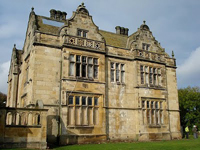
Sockburn Hall, County Durham (Image: Sockburn Hall Project)
A project to restore the long-neglected Sockburn Hall has received a boost with a grant for £37,000 from English Heritage. This is in addition to the £38,000 it was also awarded last year as part of a long-term project to make the house watertight, eliminate the dry rot and then restore the interiors.
The grade-II* listed Sockburn Hall was originally built in 1834 in a neo-Jacobean style for the Blackett family on the site of a lost Jacobean house built for the Conyers family which had vanished by 1823. The house became notorious in 2000 when the sisters who lived there were prosecuted for keeping animals in squalid conditions in the various rooms of the house. Listed on the English Heritage ‘Buildings at Risk’ Register it had long been a cause for concern as water penetration and vegetation growth threatened the structure of the house.
The family have taken on the house as a restoration project to avoid selling it and risking it being developed and have created a small group of volunteers who are valiantly clearing the grounds and restoring features whilst specialist firms are working on the house. The grant in 2009 enabled emergency repair work to be undertaken on the roofs and guttering to remove the temporary tin sheeting and to ensure good drainage to help stop water ingress into the building. This project will take years but hopefully, one day, the family will be able to move back into this house and make it a home again.
You can follow the progress of the work either on their website or via the Sockburn Hall Facebook group where you can also volunteer to help out.
Often the course of the country estate over the last 100 years has been for the land to be gradually sold off, starting with the outlying areas, and moving closer until just the house and it’s immediate gardens remain intact. At Leonardslee in Sussex the process was eventually taken one step further with the house being sold off. This, however, may about to be reversed.
Sir Edmund Loder bought the manor house and 225-acre gardens from his inlaws in 1889 and soon opened them to the public. Over the next five generations, the Loder family added to the planting and landscaping to create what is now one of the only 163 grade-I listed gardens in the country. Despite the family still owning the gardens the grade-II listed Italianate manor house, built in 1853 and featuring a 900 sq ft central hall decorated with Ionic columns, was sold off separately in the 1980s and became offices. The gardens grew in reputation so it was something of a shock when in April 2008 it was announced that they were being put up for sale by Robin Loder for £5m through the estate agency Savills. Cleverly, the company who owned the house also announced they were open to offers at around £3.25m for the house.
The Times is now reporting that after nearly two years on the market, the gardens have been sold to a private businessman and are likely to close to the public. They are also reporting that the house may also be under offer at £2.75m to the same businessman giving him a perfect opportunity to once again recreate a stunning small estate which, with the addition of the house, could be worth in the region of £10m. Though a sad day for the many garden-lovers who have made many a pilgrimage to wander among the wallabies, it’s an encouraging reversal of the trend for houses to lose the control of the landscape which so often perfectly frames them.
There is always a temptation when any country house and estate comes to the market for the land to be built over with residential developments which provide a quick and relatively easy profit – even if it does ruin forever the setting of the house. Usually the houses are snuck through under the cover of ‘enabling development’ with a promise that this will secure the long-term future of the house. Grade-II* listed Sandhill Park in Somerset is an interesting example of where this fails if the development is build in an inappropriate location and a council who apparently haven’t ensured that at least some of the profits are invested in the house.
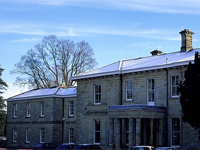
The main house at Sandhill Park was built around 1720, for the John Perriam, the MP for Minehead and inherited in 1767 by his grandson John Lethbridge (who was knighted in 1804) and remained in the Lethbridge family until 1913. On inheriting Sandhill Park in 1815, Sir Thomas Buckler Lethbridge, the 2nd Baronet (b. 1778 – d.1849) added a grand portico to the main house and large wings to the rear. The main house was substanially rebuilt in the 19th century giving it the distinctive and elegant sandstone ashlar look it retains today. These changes were funded through debt which burdened the family for years but ensured that no further major changes were made. However, following the death in 1902 of Sir Wroth Acland Lethbridge, the 4th Baronet, the family moved out and the house was let until it was sold, along with 4,000 acres, in 1913. It was subsequently bought in 1929 by Somerset County Council for use as a hospital and was requisitioned as a military hospital during WWII. After the war, it became a psychiatric hospital until it closed in 1992 since which the house has remained unused.
The assumption appears to have been that the house could not be returned to being a family home which appears to have given the green light to the estate being built on and the conversion of the house with further building works to the rear, again turning a wonderful country house into a mere afterthought in a large development. Planning permission was initially refused for what is now known as the Lethbridge Park housing estate which has been built to the east of the main house with the nearest property being just 100-metres away. The only access for this estate is a small road to the north – the opposite direction to the town – which forces all traffic through a country lane before joining the main road back to Bishops Lydeard. It’s not possible to walk to the town so even to get a paper the residents must use their car. Surely it would have been better to site the estate away from the house and use the parkland nearest the town? The isolated residents gain no benefit from being so close to the house and the council’s decision has merely ensured more traffic on the local roads whilst compromising the setting of the main house.
This development has made it harder to sell the house as a home as the roofs of the new houses are visible from the main house. But perhaps this was part of the plan as the Knight Frank sales particulars explain that planning permission has been granted for the conversion of the main house into apartments with many more houses being built to the rear of the house. However, as the house and 145-acres are now for sale for £2.75m it appears that after completing the residential development, the owners have decided to pocket the profits, sell the ‘difficult’ part and run. This is apparently a prime example of a fine, though misused house being failed by the local council who are supposed to protect it. How did they get planning permission for such an inappropriately sited development? Why did the council not insist that the house be restored? Why are the old derelict hospital buildings still standing – surely they should have been removed as a minimum? The council seem to have decided that it’s better to have two inappropriately sited developments rather than looking after an important part of their local architectural heritage.
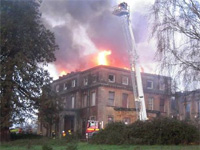
Update – 22 November – Sandhill Park seriously damaged by fire
Fire at Sandhill Park - 22 Nov 2011 (Image: Lucy Robert Shaw / This is Somerset)
Sadly, as so often happens with uninhabited country houses, Sandhill Park has suffered a serious fire which has affected large parts of the house. The mysterious blaze started on the first floor (and considering there are no services to the house, this has to be suspicious) and quickly spread through the rest of the first and upper floors. The huge quantities of water the fire brigade would have had to have used have almost certainly brought down the ceilings in the rooms below and the now serious damp house will be extremely vulnerable to wet rot. If it is proved that the fire was arson, it’s a terrible indictment of the NHS for abandoning the property and the local council for approving such a ridiculous housing scheme which has made it harder to sell the house – compounded by their ineffectiveness in getting the old hospital buildings removed and the house restored in the first place.
I can only hope the owner was insured and is able to take protective measures to mitigate the fire and water damage and to somehow get ownership of this fine house into the hands of someone who can care for and restore it. Anything less would be an architectural tragedy and would reflect badly on those involved. However, if history is any guide, I suspect we will shortly see an application to demolish, claiming that it is ‘dangerous’ (usually this is not remotely true and just a developers excuse) and more bland housing will march across this once fine parkland, a poor memorial to the heritage of the town.
The project to restore an important Devon country house, which is finally being rescued after being neglected since the 1970s, has received a significant boost. English Heritage has awarded a £500,000 grant which will allow major work to continue on making Poltimore House watertight and safe for the ongoing restoration work.
The grade-II*-listed house has been a familiar sight to anyone who has driven on the M5 near Exeter who would have seen it slowly deteriorating since it ceased being a hospital in 1975. Originally the Bampfylde family seat, Poltimore was originally built in the 1550s with this part now forming a still visible core section of the house. It was greatly extended in 18th-century with the work including a Rococo-style saloon and then again in the 19th-century with the addition of a grand imperial staircase.
The decline started when the Bampfyldes finally left the house in 1921 after the death of the third Baron Poltimore, and put it up for sale. For many houses this was a prelude to demolition but Poltimore escaped by becoming a boarding school for until 1939 when it then became temporary home for Dover College during WWII. After the war the house became a nursing home and remained in use as a hospital until 1975. Once empty, the decline accelerated rapidly with thefts of lead, fireplaces and other fittings including the entire balustrade from the staircase. The damage was compounded by serious arson attack which destroyed the roof.
The journey back from total dereliction started in 1997 when the house was acquired by the Buildings at Risk Trust before being taken over by the Poltimore House Trust in 1999. Their intention is fully restore the house for mixed use with commercial aspects combined with community and arts use. A large and active group of Friends of the house have tirelessly campaigned to save this important piece of Devon’s heritage and English Heritage are to be congratulated for such a large contribution towards the estimated £5.5m restoration bill.
More information including details of the planned restoration: ‘Poltimore House‘
Shaw House was built in 1581 for Thomas Dolman, a local cloth maker, whose family lived in the house for six generations until 1728. It was subsequently the country retreat of the Duke of Chandos, before being being home to the Andrews and Farquhar families until it eventually requisitioned for use by troops in WWII, before it then became a school.
The £6m project rescued the house from disuse and neglect after it ceased to be a school in 1985. As part of the project, inappropriate modern additions to the house were removed, and repairs made using traditional materials. The house is now open for visitors and events giving new life to this beautiful house.



 The Country Seat