#Repton200: Humphry Repton, landscape gardener – and architect?

Although principally known as a ‘landscape gardener’ – a job title he invented even if the role was already well-defined – Humphry Repton was clearly a man who understood that an estate was a composition of many parts and that architecture had a vital role to play in the success of his schemes. The challenge in assessing Repton’s contribution to architecture is that of his collaborations; what sprang from his inventive and knowledgeable mind, and what came from those he worked with, including his sons, John and George, and also that leading proponent of the Picturesque, John Nash.

Detail from Humphry Repton by Henry Bryan Hall, published by Longman & Co, after Samuel Shelley (1839) (NPG D5801 © National Portrait Gallery)
Detail from Humphry Repton by Henry Bryan Hall, published by Longman & Co, after Samuel Shelley (1839)
(NPG D5801 © National Portrait Gallery)

Humphry Repton (b.1752 – d.1818) had a lifelong passion for gardening, but it was not his first career.  After starting in business as a general merchant in Norwich, which failed, Repton decided to retire to the countryside and live with his sister and husband in Sustead, near Aylsham, in Norfolk.  With his father’s prosperity and sister’s indulgence, he developed his interest in botany and gardening.  After a brief period in 1783 as private secretary in Ireland to his neighbour William Windham of Felbrigg (he resigned after a month), Repton took a cottage near Romford, Essex, and decided to focus on turning his interest into a career.  Fortunately, circumstances meant that he was well placed to do so with his deep horticultural knowledge, his superlative skills as a watercolourist, which he used to create his visions in his beautifully produced Red Books, plus opportune timing, with the death of Lancelot ‘Capability’ Brown in 1783 creating a gap for someone with Repton’s grand ideas.

Although the setting of a house was a key consideration for any architect of the era, few  thought of themselves as landscape gardeners (Decimus Burton (b.1800 – d.1881) was something of an exception).  However, those who were of that profession seemed to not only have an opinion on architecture but also apparently felt confident that they could also practice in this as well as their primary domain. For Repton, although not trained as an architect, he saw architecture as ‘an inseparable and indispensable auxiliary‘ to his efforts. Repton was usually brought in after the house was complete and his plans would be presented in one of his famous Red Books, leather-bound volumes of his ideas for a specific property, in which he set out his vision of the landscape as it was, including the current house.  In it, Repton would often include his criticisms of what was there and include his suggestions for sympathetic alterations which would better enable the house to fit within his vision.

Detail showing example of possible changes to example house - Plate III of Repton's 'Sketches and hints on landscape gardening' (1794)
Detail showing possible changes to example house – Plate III, State B from Repton’s ‘Sketches and hints on landscape gardening‘ (1794) – source: copy held by University of Wisconsin and kindly shared online

A measure of Repton’s boundless confidence in his own abilities can be seen in whom he felt able to criticise for their architectural efforts, including Sir John Soane, probably the leading architect of his era.  Repton was commissioned to create a landscape at several of Soane’s commissions, usually appearing a year or two after completion, including at Mulgrave Castle, Moggerhanger House, Aynhoe Park, Holwood House and Honing Hall. In the case of the latter house, Soane had made extensive alterations in 1788, and in Repton’s Red Book, produced in 1792, he criticised Soane’s work saying:

The proportions of the house are not pleasing, it appears too high for its width, even where seen at any angle presenting two fronts; and the heaviness of a dripping roof always takes away from the elegance of any building above the degree of a farm house; it would not be attended with great expence to add a blocking course to the cornice, and this with a white string course under the windows, would produce such horizontal lines as might in some measure counteract the too great height of the house. There are few cases where I should prefer a red house to a white one, but that at Honing is so evidently disproportioned, that we can only correct the defects by difference of colour, while in good Architecture all lines should depend on depths of shadow produced by proper projections in the original design. (1)

In the illustrations in the Red Book for Honing Hall, Repton boldly showed the house, not as it was, but with his suggested improvements. Repton had form for his criticisms of Soane, having been asked, in 1790, to review the newly completed Tendring Hall, Suffolk, (demolished 1955) where he wrote:

…had I been previously consulted the house would neither have been so lofty in its construction nor so exposed in its situation.

For a man with no formal architectural training to be so forthright in his judgements gives a sense of Repton’s confidence in his own abilities.  Luckily (for Repton), it’s likely that the notoriously sensitive Soane never saw these criticisms and they maintained cordial relations for many years. Repton’s comment about rarely preferring a red house to a white one is also corroborated by other Red Books, including the designs for Stansted Hall, and Rivenhall Place, in Essex and Hatchlands Park, Surrey.
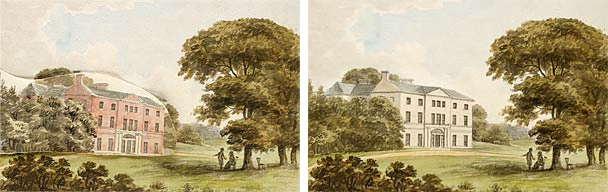
Images showing proposed exterior changes from H. Repton's Red Book for Hatchlands Park, Surrey (1800)
Images showing proposed exterior changes from H. Repton’s Red Book for Hatchlands Park, Surrey (1800) – source: The Morgan Library & Museum

Repton’s architectural contributions are often overlooked as he was never enough of an architect to be considered as one, and, in general, those primarily interested in his landscapes are insufficiently interested in his architecture.  A prime example of this (not mentioned in Colvin, or Stephen Daniels’ book, except buried in an endnote) is Repton’s vision for Port Eliot, Cornwall, the seat of Lord Eliot.  In 1792, in one of his earlier commissions, he was brought in for his advice on the estate. Repton assumed the role of architect and provided, in the Port Eliot Red Book, a broader set of broadly Gothic proposals which brought house, church, estate and even the nearby town into his remit. This expansive approach to his brief was a challenge for Sir John Soane who was asked in 1794 to contribute his ideas – but now within a Gothic framework set by Repton (a style to which Soane was hostile), whose designs had found a level of favour with Lord Eliot, and which he adapted.

One of the key questions when considering the architectural improvements suggested by Repton is to what degree they were his and what had been conceived by his eldest son John Adey Repton (b.1775 – d.1860). J.A. Repton had been a pupil to William Wilkins where he developed a profound understanding of Gothic architecture.  He had then moved in 1796 to the office of John Nash, with whom the elder Repton had established an arrangement to pass on any architectural commissions in exchange for 2.5% of the cost of the work – an agreement which Nash failed to honour, leading to the partnership being terminated in 1800.

Nash has a chequered reputation professionally and this extended to those in his office, including J.A. Repton but left to become his father’s assistant when the agreement between Nash and his father ended.  Nash was unfortunately a champion of the Picturesque but not of his assistants; he never acknowledged J.A. Repton’s significant contribution in various schemes. Unfortunately, John was to suffer the same issue to a certain extent with his father, though he was later clearly credited for his assistance ‘in the architectural department‘ for designs for a number of houses including Stratton Park, Scarisbrick, Panshanger, and others.

Detail from Port Eliot Red Book showing the house as found (© Eliots of Port Eliot)
Detail from Port Eliot Red Book showing the proposed changes to the house (© Eliots of Port Eliot)

In the Port Eliot Red Book, eighteen of the drawings are signed by the son and are probably his designs, however the scheme as a whole is attributed to the elder Repton, though he may have been angling for this to be a major commission for his son. Unfortunately for the Reptons, their grand vision for Port Eliot was never going to be realised, mainly due to financial constraints, though Soane was to provide an alternative scheme which he diplomatically managed to agree with Lord Eliot – much to Repton’s chagrin, later writing:

my beautiful plan for Port Eliot…my design for bringing together the house and the Abbey did not suit the fancy of my fanciful friend [Soane] (who knows but little about Gothic) so the plan was totally changed.

Repton’s architectural work was significant enough to merit inclusion in Howard Colvin’s seminal reference work, ‘A Biographical Dictionary of British Architects 1600-1840’.  The most important was the work at Welbeck Abbey in 1790 to remodel the east and west fronts (and the Red Book contains designs for an entirely new house) but the other entries are relatively insignificant – minor works in 1792 at Honing Hall, the enclosing of the courtyard at Sarsden House in 1795 to create a domed ‘hall of communication’, and a new entrance to Uppark in 1805. Beyond that, his association with John Nash meant he had an insight into the ‘cottage orne’ style and which Repton used in his design for a new ‘lodge of a new and singular description‘ comprising two thatched cottages on the Isle of Wight, one either side of the road.

Lodges at the entrance to Mr Simeon's grounds on the Isle of Wight, designed by H. Repton (Image from 'A New Picture of the Isle of Wight' by W. Cooke (1808)
Lodges at the entrance to Mr Simeon’s grounds on the Isle of Wight, designed by H. Repton (Image from ‘A New Picture of the Isle of Wight‘ by W. Cooke (1808)

Beyond that, his architectural contributions were mainly the designs within the books on landscape gardening.  The most important of these were ‘Sketches and hints on landscape gardening : collected from designs and observations now in the possession of the different noblemen and gentlemen, for whose use they were originally made : the whole tending to establish fixed principles in the art of laying out ground’, published early in his career in 1794, and the posthumous collection published in 1840, ‘The Landscape Gardening and Landscape Architecture of the late Humphry Repton’.

So, can Repton be considered an architect as well as a landscape gardener? On balance, his position seems to be more that of ‘frustrated architect but successful critic’. Repton doesn’t seem to have been able to establish a reputation as an expert on architecture, possibly because his commentary was often only available in the Red Books, with their naturally limited circulation. Also, his work was usually after the house was already built and often only recently finished, meaning the owner was unlikely to consider making significant changes very quickly, leaving few opportunities for him to showcase the talents he clearly thought he had.

However, his work was influential on the practices of contemporary and later architects, forcing them to acknowledge that their buildings did not exist in splendid isolation and had to be considered as whole; a three-dimensional, interactive, ever-changing landscape painting. Open, expansive parklands had the effect of placing the building on a visual plinth, majestic but with an aloof air. Repton firmly brought all the elements together, blending both Gothic with greenery and the Palladian with the planting.  His architectural contributions reflect this sensitivity and with more opportunities he may have been even more influential in the field of architecture, much as he dominated the landscapes represented so beautifully in his famous Red Books.


Further reading:


Sources:

(1) – Humphry Repton, Red Book for Honing Hall [1792], quoted in ‘The Surprising Discretion of Soane and Repton’ by Gillian Darley, in the Georgian Group Journal vol. XII 2002


Apologies for the long gap between articles – happily, just after I posted the last one in September 2017, our beautiful son was born. Mother and baby were, and remain, fine and his sister clearly loves him. However, as anyone with experience of small children knows, they’re justifiably demanding and, combined with having a day job, it’s meant I haven’t had the time to write, but as he gets a little older hopefully I should now be able to again…at least in some capacity, though they’ll remain sporadic.  Tweeting is easier to do regularly, so please do follow @thecountryseat and @lostheritage.  OK, on with the show…
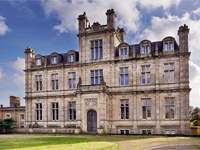

Bylaugh Hall: the hidden history to a remarkable restoration opportunity

Bylaugh Hall, Norfolk (Image: Chesterton Humberts)

Many country houses we can visit today are innately interesting; the design, the contents, the occupants, all tell a tale.  Sometimes though there are houses with a much richer past which not only have an immediate story to tell but also a much more complex history, one fascinating for anyone with an interest in how these houses came to be created. One such house which was recently launched – and amusingly described on Rightmove as a ‘60 bedroom detached house for sale‘ – is the remarkable Bylaugh Hall in Norfolk, an engineering marvel and architectural delight, which had a forced birth through litigation, which wasn’t wanted by the first owner, and where credit for the design hasn’t truly been given to the right architect.

Bylaugh is remarkable in many ways; some obvious, others less so.  Even its genesis came from beyond the grave as the controversial inherited wish of the last owner, Sir John Lombe Bt (b. c1731 – d.1817), a man whose fortune came from the family’s silk throwing mill in Derbyshire.  The Lombe’s were established Norfolk gentry whose original estate was at Great Melton, centred around Melton Hall (built in 1611 by the Anguish family) but now a ruin having been first tenanted and then, by the end of the 19th-century, abandoned.

Allegedly won by Sir John in a skewed card game, the Lloyds had owned the Bylaugh estate for a number of years, and even if the story is false, it was legitimately Sir John’s by c1796.  The Lombe’s were unusual in that their wealth largely came from industry, and one which was located outside of the county, but they quickly used their fortune to create the fourth largest estate in Norfolk, at over 13,000-acres by 1883.

Whatever house was already at Bylaugh was insufficient for Sir John so he resolved to build an entirely new one.  However, the house he had in mind was not the house which was built.  Sir John must have had a fair idea that he would not survive to see his grand plan to fruition but he certainly wasn’t going to let mere death cheat him of his ambition.  Having placed £20,000 in trust for the express purpose of building the house – though without approving a design – he died in 1817 (unmarried and childless), leaving his estate and his firm directions to his brother Edward. Here, the family history becomes a little complicated as Edward was his half brother, the product of an affair with a Norwich doctor’s wife.  Edward adopted the Lombe surname but was reluctant to take on the grand role envisioned by his late brother – which is perhaps why Sir John’s will was so prescriptive, and which led to a quite extraordinary court case.

Edward Lombe disputed with the executors of the estate the instruction to build the new house.  However, Sir John had been quite clear, including this fascinating clause in his will:

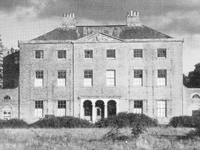
And whereas it is my wish and intention that a mansion house and suitable offices fit for the residence of the owner of my estate shall be erected on some convenient spot in the parish of Bylaugh in the county of Norfolk either in my lifetime or after my death and that if I shall not erect the same in my lifetime then that my said trustees shall forthwith after my death erect the same according to such plan as I shall in my lifetime approve of or if I shall die before such plan shall be prepared and completed then according to such plan as the trustees or trustee for the time being under this my will with the consent of the person for the time being beneficially entitled to the immediate freehold of my said manors &c under this my will shall think proper to adopt adhering as closely as possible situation and other incidental circumstances being considered to the plan of the house now the residence of Robert Marsham esquire at Stratton Strawless in the said county of Norfolk. (source)

Yet Edward resisted, delaying the start of the build for years by arguing with the executors, Mr Mitchell and Mr Stoughton, and stating that even if they built the house he wouldn’t live in it.  Finally, in 1828, he went to the Court of Chancery and demanded that the money, now having grown to £43,000, be placed with it and a judgement made as to whether he could overturn the provisions of his brother’s will. The case was still undecided in 1839, by which time the fund had grown to over £63,500, when Edward again pressed his case, with a decision finally being made in 1841 – against him.  The Vice-Chancellor said:

It appears to me to be impossible to read this passage in the will without seeing that there is in the plainest language an express trust for the erection of the mansion house which the trustees are forthwith after his death to commence and to proceed with the erecting of. I cannot conceive any words more plain.

Stratton Strawless Hall, Norfolk - pre 1960 (Image: 'The Country Houses of Norfolk' by David Clarke)
Stratton Strawless Hall, Norfolk – pre 1960 (Image: ‘The Country Houses of Norfolk’ by David Clarke)

Which rather settled that. In the meantime, the executors had not been idle in their duties – but they weren’t as obedient as they might strictly have been.  Sir John had clearly stated that the house was to follow ‘as closely as possible‘ Sir Robert Masham’s house at Stratton Strawless; a three-storey (now two), strictly classical, almost Palladian house with a Tuscan-columned porch.  However, the executors ignored this provision and with possibly an eye to emphasising the esteemed family line and to help the new house blend in with the other seats in the area, they chose to create a historical ‘Jacobethan’-style house – but even that is not the one we see today.

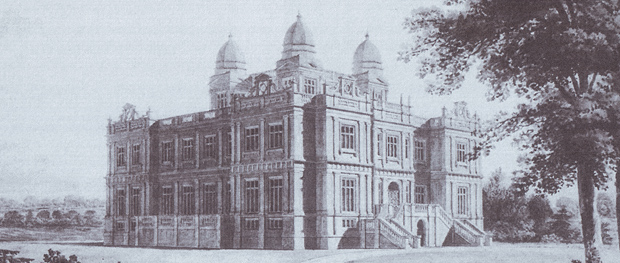
Interestingly, although the current Bylaugh is rightly described as being designed by Charles Barry the younger and his partner, Robert Robinson Banks, few are aware that in 1822 the trustees had originally asked another noted architect, William Wilkins (b.1778 – d.1839), to draw up a plan, and his design showed a remarkable stylistic similarity to the one actually built 27 years later.

Unexecuted design for Bylaugh Hall by William Wilkins, 1822 (Image: Public Record Office MPA. 66.1 / 'William Wilkins, 1778-1839' - R.W. Liscombe)
Unexecuted design for Bylaugh Hall by William Wilkins, 1822 (Image: Public Record Office MPA. 66.1 / ‘William Wilkins, 1778-1839’ – R.W. Liscombe)

Although a noted proponent of the Greek Revival, Wilkins, like many an architect, was well-educated in other styles and could turn his hand if asked. Clearly inspired by the style of ‘Prodigy‘ houses such as Burghley and Longleat, he also drew on elements of buildings he had seen and studied – for example, the polygonal domes capping the raised central hall are copied from the Porta Honoris at Gonville and Caius College, Cambridge, on which Wilkins had written a scholarly article for the esteemed ‘Vetusta Monumenta‘ in 1809. Although each façade was similar, the entrance front was enlivened by a projecting centre bay above the door which was on the piano nobile, reached by an elegant split stair.

The plan of the house was also modern, rejecting a rambling layout, and firmly following the Palladian 3×3 grid on the ground floor.  Centred around a double-return staircase, this was an innovative layout for an early Victorian design – though one Wilkins the classicist would have been entirely comfortable with.  Essentially, he had designed a Palladian villa, dressed in the architectural garb of the ‘Jacobethan’ style.

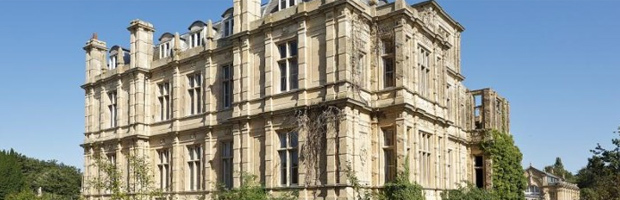
Bylaugh Hall today (Image: Chesterton Humberts)

Bylaugh Hall, as attributed to Barry and Banks in 1849, was perhaps better described as an updated version of Wilkins earlier plan – the core 3×3 layout remained, as did the external style, though some of the details such as the raised central hall and domes were removed, and the central staircase replaced by a saloon.  The construction did display some innovation, being one of the earliest steel-framed buildings and was considered a success with one rather giddy local newspaper exclaiming ‘Neither Holkham nor Houghton, those Norfolk wonders, can compare with it for either appearance or comfort‘.  Such wild exaggeration aside, this was a house at the forefront of domestic convenience and was commended in The Builder for having no corridors in the main block, which maximised the space.  It was completed in 1852 at a cost of £29,389, and by 1869 it was reported that £38,000 had been spent on the project, which would have included further works on estate buildings and landscaping (see photos of the house and grounds c1917).  An interesting aside is that during the delay in starting the money had grown to quite a considerable sum, more than enough for all the works.  Edward Lombe applied for the remainder but the Court demanded it be spent on bricks and mortar and so a 4-mile perimeter wall was constructed to satisfy this.

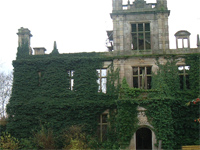
Ruined shell of Bylaugh Hall before restoration (Image: The Burrell Partnership)

It seems that no descendent ever loved the house.  By 1878, the then owner, Edward Henry Evans-Lombe, was renting the handsomely Classical Thickthorn Hall, before buying Marlingford Hall, whilst selling off outlying parts of the estate.  In 1917, Bylaugh Hall and the 8,150-acre estate were put up for auction in 140 lots but Edward sold it whole for £120,000, and the hall and 736-acre park were subsequently sold to the Marsh family.  Used by the RAF in WWII, it was sold in 1948 to a new owner who unsuccessfully planned to turn it into a nursing home.  At that nadir of country houses generally, a familiar pattern started; parts of the house were demolished and in June 1950 a 350-lot demolition sale was held which stripped the interiors of the house, creating a gaunt and sad shell.  So it remained until, in 1999, the house and a lodge was sold to a local sculptor who dreamt of fully restoring the house but with insufficient funds he was forced to restore just the Orangery (article by the engineers with lots of photos), intending it to be a wedding venue.  Other parts of the main house were parcelled up as investments and rebuilt but the plan faltered and then failed, leaving the partially restored house we see today.

So Bylaugh Hall is a house paid for by a man who never got to see it, with a design chosen by two men who ignored the last wishes of the patron, with credit for that design going to two men who relied heavily on another architect now obscured, for a beneficiary who really didn’t want it in the first place. A brilliant story richly illustrating the fascinating complexities of our country houses.

So what should happen to this superb house? Interestingly, the 557-acre Pavilion farm which surrounds the east and south of the house, and includes one of the original lodges, is also for sale, providing the opportunity for the right person to combine them both.  It would require real vision – the restoration work at Bylaugh Hall may be sound but the aesthetics are dire.  Given the budget, much of the existing restoration should be stripped right back and the interiors given the lavish attention they demand.  This is a house which cries out for sumptuous plasterwork and panelling, for grand rooms with fine wallpaper and filled with artworks and quality furniture. With the funds and the vision to take advantage of this rare opportunity, a restored Bylaugh Hall, combined with the farm and more land later, could once again create one of the finest estates in Norfolk.

—————————————————————————–

Property details

1917 auction catalogue:

Listing description: ‘Bylaugh Hall‘ [British Listed Buildings]

Houses of gods: country houses converted to religion and the sale of Hawkstone Hall

The 1920s and 30s may be remembered for many things, but it probably wouldn’t be for having any great public affection for the grand houses which had so dominated the landscape agriculturally, economically and politically.  Faced with the reality of the long slump in revenue from the land and wider economic difficulties, country house owners found themselves between the rock of their own financial situations and the hard place of a nation broadly unsympathetic to their difficulties.  Many an owner may have offered up a prayer for some form of divine intervention to alleviate their situation – and the miracle which appeared which saved their house, though not their lifestyles, was religious orders purchasing these grand piles for their ministries.  With the recent launch on the market of the impressive Hawkstone Hall in Shropshire, the cycle turns again, as it looks like the wealthy will rescue the religious.

Hawkstone Hall, Shropshire (Image: Gerard Carroll via flickr)

A nobleman’s residence in the medieval period was often a castle but this dramatically changed following Henry VIII’s Dissolution of the Monasteries between 1536-41.  The aftermath created one of the greatest transfers of land (in the 1530s, they were estimated to hold approx 16% of England) and property as the riches of these institutions were either given to favoured courtiers or sold, creating instant country estates.  Yet, at that time, they were seen more as industrial units; great agricultural establishments which brought in great wealth, with the beautiful priory churches often stripped for their materials. However, for some owners, the buildings were a fine opportunity to create a house – and what better way of creating the impression of an ancient family than with an ancient seat, especially if it came with prized feudal rights.

Lacock Abbey, Wiltshire (Image: Arnhel de Serra / National Trust)

The suppression of the monasteries and convents brought to an end many of the longest standing communities but did give a boost to the secular, non-defensive country house. Many older houses today, both large and small, can trace their origins back to monastic roots, including (a small sample, admittedly):

Mapledurham, Oxfordshire (Image: scoutjacobus via flickr)

Of course, there is a long history of country houses being used for religious purposes as many recusant families continued practising their Catholic faith at great risk to themselves both financially and physically, such as at Mapledurham in Oxfordshire or Hintlesham Hall in Essex.  This secrecy led to the creation of many ingenious methods of hiding not only the chapels (either in attics such as at Ufton Court, Berkshire, or by being disguised as bedrooms) and items of their faith but also the priests themselves, usually in ‘priest holes‘ which could be concealed behind panelling and walls (e.g. at Harvington Hall – still owned by the Archdiocese of Birmingham), in chimneys, under fireplaces and so on.

Despite Catholic worship becoming legal again in 1791, there were still restrictions on Catholics in public office until 1829, and it was still viewed with some suspicion. A further influx in the 1790s was due to the French Revolution which forced many orders back across the Channel.  For any order seeking to establish itself, it was certainly easier to take over a country house as it would often meet their requirements in terms of seclusion and accommodation but without the challenges of trying to build a new convent or monastery. One of the earliest was the purchase of East Bergholt Old Hall, Suffolk which was bought in the 1850s but there have been many others since, including:

Mentmore Towers, Buckinghamshire (Image: EPR Architects)

Catholics may have had the longer history but others have also taken the same route. Perhaps the most famous of these was the spectacular Mentmore Towers, Buckinghamshire, designed by Joseph Paxton and built between 1852-54 for the Rothschilds, which was bought by the followers of the Marharishi Yogi to serve as the UK headquarters for the World Government of the Age of Enlightenment. This followed the scandalous refusal by the then Labour government to accept it for the nation with its incredible collections in lieu of just £2m inheritance tax and the subsequent sale which netted several times that. Others include:

There don’t appear to be any clear records of which houses have been used as convents/monasteries so it remains anecdotal (there’s probably a good PhD topic in there somewhere) but it’s possible that hundreds of houses have served in this use, especially if convent schools and retreats (e.g Capernwray Hall and Kinmel Hall) are included. For many of these, it’s likely that this alternative use saved them from joining the ranks of those demolished.

For the past 85 years, grade-I listed Hawkstone Hall has been a seminary and also a retreat for Catholic clergy.  The house was originally built in 1720 for Richard Hill (b.1655 – d.1727), a traveller and diplomat who had made a fortune through what was described as ‘lucrative arithmetick‘, and consisted of just the main block.  The design of this section is quite unique, certainly to the area, and pre-dates designs later shown in Campbell’s ‘Vitruvius Britannicus‘ published in 1715-25.  Although it shares certain elements with other houses (Buckingham House, Chatsworth – east front), neither the listing description nor Colvin have details on the original architect so it is open to conjecture as to who designed it and where they got their inspiration (if anyone does know/have any suggestions, please do add a comment below or contact me).

Hawkstone Park, Shropshire (Image: Peter-snottycat via flickr)

Hawkstone was then inherited by his son Sir Rowland Hill, 1st Baronet (1705–1783), who added the wings as part of an enlargement in 1750, but who also, more importantly, started the landscaping for which the estate was to become famous.  Taking advantage of a natural rocky outcrop, Hill created a series of walkways on the cliffs, view points and follies which attracted many visitors.  This grew to such an extent that Sir Richard Hill, 2nd Baronet (b.1733 – d.1808) wrote the first guidebook for the park and also built the ‘Hawkstone Inn’ to cater for the visitors. Such was its reputation that Dr Samuel Johnson came to see and was duly impressed, remarking on “…the awfulness of its shades, the horror of its precipices….“. Johnson also commented that he thought there ought to be more water and so Sir Richard commissioned landscape designer William Emes, who created the Hawk River which still flows to the north-west of the house.  Hawkstone Park had become one of the most popular attractions in the country by the time of his death in  1808 and remained so under the care of his brother, Sir John Hill, 3rd Baronet (b.1740 – d.1824), who inherited.

Sadly, it was to be the next generation who sowed the seeds of the families financial troubles.  The house and park were inherited by Sir Rowland Hill, 4th Baronet Hill of Hawkstone, 2nd Viscount Hill (1800–1875) who, through extravagance or mismanagement, lost much of the family fortune. Inside, he commissioned, between 1832-4, various alterations including a new drawing room from Sir Matthew Wyatt, whilst in the grounds he carved a hugely expensive new drive through a cliff and built The Citadel, a strange castle-like dower house.  He even toyed with the idea of relocating the entire house to the other side of the river.

Such spending was always likely to lead to difficulties and the 3rd Viscount, Rowland Clegg-Hill, (b.1833 – d.1895), never managed to re-establish the fortune and was bankrupt by the time of his death.  This forced a sale of the contents and then the splitting up of the estate in 1906.  The park, with the many follies, tunnels and caves, was sold off and is now run as part of the Hawkstone Park hotel. The Hall was bought by George Whitely, later Baron Marchamley of Hawkstone, a wealthy mill and brewery owner and MP, who made minor alterations; reducing the height and length of the projecting wings and to the interior.

The house was then sold to the Roman Catholic Redemptorists who have remained there until a recent review of their activities prompted them to put the house, with its 7-acres of gardens and 81-acres of grounds, up for sale for £5m.  Any purchaser looking to make this a home again will need to demolish the ugly accommodation block tucked away behind the left wing and will also have to consider what they wish to do with the large chapel which was added in 1932; perhaps if bought by a non-religious family it would make a superb music room.  For a house which exhibits such architectural interest and grandeur, it seems like a fair price and one hopes it will attract someone willing to invest to recreate what could be one of the finest homes in Shropshire.

———————————————————–

Property details:

News story: ‘Hawkstone Hall goes up for sale with a £5m price‘ [Shropshire Star]

Official website: ‘Hawkstone Hall

Country House Rescue – Season 4: Colebrooke Park, N. Ireland

Colebrooke Park, Co. Fermanagh, Northern Ireland (Image: Colebrooke Park)

Country House Rescue has proved to be one of the most interesting of programmes featuring the many varied mansions which the UK is lucky to enjoy.  Rather than the more glamorous recent series showing life at Chatsworth, or Jeremy Musson’s brilliant ‘Curious House Guest‘, Country House Rescue has shown the sometimes harsh reality of owning these homes, despite the lazy jibes in the wider media about families living in a state of supposed luxury.  The programmes have shown the hard work and sense of duty these families possess, though this is sometimes overshadowed by the friction which change can bring, and which is often what is broadcast.  Yet, with a new presenter for the new series (starting Thursday 14 June), perhaps the commitment of the owners and the sheer beauty of their houses will come more to the fore.

In the first three series, Ruth Watson has proved to be an entertaining, if no-nonsense, deliverer of some rather stark home truths to owners up and down the country. For series four, a new presenter, Simon Davis, (favourite houses: Sezincote, Blenheim, Mount Stuart, Villa Emo, Babington House) takes the helm and steers a more collaborative and involved course as he stays at the houses, with the families, to experience their day-to-day life, including the hardships; at one house he spent an extremely cold night after the family admitted they never turn on the heating as it costs £30 per hour to run. It will be interesting to see how the new messenger is received and whether a less assertive style will bring greater success – though many will undoubtedly miss Ruth’s acerbic commentary.

The houses to feature in the new series are now known: Colebrooke Park, Bantry House, Chapel Cleeve Manor, Craufurdland Castle, Great Fulford, Meldon Park (thank you Andrew); starting with Colebrooke Park in Co. Fermanagh in Northern Ireland; the first time the show has been to that part of the UK.

Colebrooke Park is a fascinating example of the varied fortunes of the country house over the last two centuries; a story marked by wealth and also decline, but also one driven by a continued commitment to a house by generations of one family. Home to the Brooke family for over 350 years, the current owner, the 3rd Viscount Brookeborough (a prominent peer, one of the 92 hereditaries sitting in the House of Lords) received what many would regard as an unenviable inheritance in 1980 when he took on the decaying and empty family seat.

Of course, as with many houses, they had had a heyday.  Once the centre of one of the five largest estates in the area, which had reached a peak of almost 28,000-acres in 1876, the house had been home to a succession of prominent politicians and soldiers including the 1st Viscount, the longest serving Prime Minister of Northern Ireland (1943-63). However, agricultural changes, taxation, and the Troubles, meant that the estate slowly shrank to just over a thousand acres, with a similarly reduced income insufficient to maintain a house of this size.

Castle Coole, Northern Ireland (Image: Stephen McKay / Geograph.ie)

The house itself is a rather austere neo-Classical design; a two-storey, nine-bay block only enlivened by a grand pedimented portico with Ionic columns.  The house was built in 1820 for Henry Brooke (b.1770 – d.1834) who was created a baronet in 1822 (second creation), as a statement of his position, but one which was to be built on a budget – though a substantial one; the house was completed for £10,381 – approx £7m today.  Sir Henry had inherited the house and estate from a rather profligate uncle and clearing the debts and establishing a comfortable fortune had taken three decades – the house was a reward and a monument to his sound management.  Despite being a cautious man, Sir Henry still succumbed to the suggestions of his architect that he compete with the nearby Castle Coole by James Wyatt (built 1790-97), increasing the dimensions of the house so that it was larger, and then later in the summer, approving the enlargement of the Library to 36ft by 18ft.

Rise Hall, Yorkshire (Image: Pastscape)

For those who regularly watch TV programmes featuring country houses, Colebrooke Park may trigger a vague sense of deja vue.  This is because the house is, bar a few details, quite similar in design to Sarah Beeny’s Rise Hall in Yorkshire (mentioned in this previous blog post).  Both houses were built around the same time but by different architects; Colebrooke in 1820 by William Farrell and Rise Hall in 1815-20 by Watson and Pritchett.  Yet it is likely that this was more co-incidence than copying as there is a clear architectural lineage for the ‘rectangular block with portico’ style of house which goes back to Colen Campbell‘s masterpiece of architectural propaganda, Vitruvius Britannicus.  Published in 1715, this collection of designs helped shift the national preference away from the more florid Baroque houses of Vanbrugh toward a simpler architectural style; one which Campbell himself exemplified with his quite radical first design for Wanstead Hall, Essex. Although Wanstead as built was significantly different in the detailing, the core architectural idea was for a rectangular central block, fronted by a bold, pedimented portico.  This was to be one of the most influential designs produced by an architect; shaping national taste, it was widely imitated for decades afterwards – see Prior Park in Bath, built in the 1730s and 40s, and Adlington Hall, Cheshire, built in the 1750s, and even today.  Of course, this design is a derivative of the rectangular, double-pile plan developed by Sir Roger Pratt at Coleshill, Berkshire (built 1650-64, burnt down 1952).

Wanstead House I by Colen Campbell - first proposed design - 1715
Wanstead House I by Colen Campbell – first proposed design – 1715

Despite the grandeur, the agricultural depression in the 1880s hit the estate and the decline began. This was only arrested by the return in 1918 after WWI of Sir Basil Brooke who instituted changes to bring the estate back. It was, though, a struggle; many rooms were left unused in the 1930s and by 1939 the timber was being felled as ‘the only way to save Colebrooke’.  Poor tax planning meant that when Lord Brookeborough died in 1973 the contents of the house had to be sold to pay the death duties, leaving a rather forlorn house for the present Lord Brookeborough when he took over in 1980.  Realising the scale of the challenge, an architect was engaged to explore what options were available; including the dreaded conversion to a golf club with the grounds becoming fairways.

Colebrooke Park, Northern Ireland (Image: Colebrooke Park)

Luckily, a better solution was found; the house became an exclusive country sports destination, with sporting rights over 10,000-acres and the Viscount and Viscountess welcoming the guests as though friends into their home.  The house was sensitively adapted to meet both the requirements of discerning visitors and official regulations whilst preserving the architectural fabric of the house to the greatest extent.  Despite their success, the Viscount and his wife wish to pass on the house and 1,100-acre estate to their nephew in an even more robustly healthy condition; hence the invitation to Country House Rescue.   It will be fascinating to see if this series presents radically different ideas to those proposed by Ruth Watson.  Obviously one hopes that whatever happens, the solutions enable the families to remain in their homes whilst providing sufficient income to not only maintain them but invest in them to give them a stronger future.

—————————————————————

A more detailed history of Colebrooke Park [Colebrooke Park]

TV makeover for stately home‘ [Belfast Newsletter]

Country House Rescue – Series 4 [Channel 4] – Colebrooke Park (episode 1: Thursday 14 June – 20:00)

Country House Rescue – Series Listing [Wikipedia]

‘On behalf of a grateful nation’: country houses given to military leaders

Nations have always found ways to reward those subjects who have rendered some greater or lesser service.  In earlier centuries, this often took the form of positions at Court which came with a salary, prestige, and unrivalled opportunities to feather one’s nest.  Titles have also always been popular, ranging from a baronetcy for those who have hosted the monarch for a weekend, to dukedoms and earldoms for the upper echelons of Court and on the battlefield – and it’s this latter category who have also enjoyed that rare gift of an entire country estate, in recognition of their services.  Such largesse is now unthinkable but the practice of rewarding military leaders in this way only fell from favour perhaps later than might be imagined.

Blenheim Palace, Oxfordshire (Image: Blenheim Palace via flickr)

The grandest and most spectacular of these gifts is Blenheim Palace in Oxfordshire – though the intrigues for both monarch, recipient, recipient’s wife, and architect make it something of a mixed blessing.  The recipient was certainly worthy of such a grand prize; John Churchill, 1st Duke of Marlborough had risen through numerous victories to elevate and secure Britain’s place in the world, defeated the ambitions of various European leaders, and created the peace which ushered in the Georgian era.  These glorious victories provoked such a feeling of patriotic pride that even his critics praised him.  So how to reward such a man for such remarkable achievements?

Great Hall and Eastern Corridor, Blenheim Palace (Image: Country Life Picture Library)

Blenheim Palace was to represent many things – explicitly a national monument to the defeat of Louis XIV’s plans for European domination at the Battle of Blindheim in 1704, the considerations of it as a house were somewhat secondary. It embodied the idea that whereas previously the glory of the nation was demonstrated through the palaces of the Monarchy, Blenheim was the first which sought to do this though a private individual.  However, Marlborough’s close ties with Queen Anne would inevitably mean the prestige would reflect onto her and the nation. Work started in 1705 and, writing in 1709, the architect of the house, Sir John Vanbrugh stated,

‘Tho’ ordered to be a Dwelling house for the Duke of Marlborough and his posterity [it was] at the same time by all the world esteemed and looked on as a publick edifice, raised for a Monument of the Queen’s glory.’

The Queen had already resolved to gift the estate at Woodstock but the agreement on paying for the construction of the house was a murkier affair.  Royal patronage could cut both ways as the Marlboroughs and Vanbrugh found out.

Vanbrugh was the ideal choice for a building of this nature.  His background in theatre design gave him an understanding of dramatic effect and his relative inexperience and lack of formal training meant his imagination was bolder than others.  The commission at Blenheim required such a mind; the resulting spectacular building was a monument to power and prestige, incorporating military forms and details to reflect the occasion, but was also one of the most complete expressions of English Baroque.  Yet despite his fabulous wealth, the Duke was determined that the state would show its gratitude by paying for the construction, though he had originally intended the budget to be no more than £40,000 (approx £5m).  Wren had estimated £90,000 – £100,000, however the final cost totalled nearly £300,000 (approx £38m) for which the Treasury eventually was liable (proving that for government projects it was ever thus!).

Castle Howard, Yorkshire (Image: Castle Howard)

Such overruns were to be expected where the intention had been to build something like Castle Howard – only bigger. However, the Duchess opposed such a scheme saying: ‘I never liked any building so much for the show and vanity, as for its usefulness and convenience.‘ With such an attitude, friction with Vanbrugh was inevitable. Political changes hadn’t helped; a new government and Treasurer in 1710 slowed payments to almost nothing.  In 1711, the Duchess also fell out quite acrimoniously with her childhood friend, the Queen, leading, in part, to the Duke losing his official posts and the Marlborough’s going into self-imposed exile.  The accession of George I in 1714 brought them back into favour and work progressed again, though constant conflict between the Duchess and Vanbrugh led to his resignation in November 1716, saying: “You have your end Madam, for I will never trouble you more.  Unless the Duke of Marlborough recovers so far [he had suffered a stroke in 1716], to shelter me from such intolerable Treatment.‘ Work proceeded under Vanbrugh’s right-hand man, Nicholas Hawksmoor, to the original plans, with the family taking up residence in 1719, and work largely complete by 1725. Sadly though, the Duke never got to see this, having died in 1722; his monument incomplete, his reputation assailed, and his architect grievously estranged from his masterpiece.

It seems only some of the lessons of Blenheim had been remembered by the time the next gift was proposed for an equally illustrious general, Arthur Wellesley, 1st Duke of Wellington.  Again, a superb leader who had defeated plans for European domination, Wellington – the Iron Duke – was certainly worthy of such a reward. Rather than receiving a direct gift from the monarch, it was decided that the nation would provide £600,000 (approx £38m) for the purchase of an estate and the building of a suitable house. Rather than just provide the money, in 1817, Parliamentary trustees were appointed to oversee the purchase.  The Duke knew his limitations and called upon the architect Benjamin Dean Wyatt (son of James Wyatt) who promptly, even before a site had been found, drew up plans for a ‘Waterloo Palace’ which, in his words, would have “…a very magnificent & imposing effect” without “the monstrous expense of a Fabrick extended to the dimensions of Blenheim [or] Castle Howard“.  Despite his professed aim, this would have been an enormous house; designed around three sides of a courtyard, it featured two flanking pavilions, with the main house centred on a huge domed hall, with suites of grand rooms surrounding it.  Perhaps of particular interest was the severely Neo-Classical decoration, with few of the architectural flourishes which distinguish Blenheim.  This might have reflected the notably austere Duke’s taste but even this plan was rejected.

Stratfield Saye, Hampshire (Image: Historic Houses Association)

Given the Duke’s preference to be near London, the house and estate chosen was Stratfield Saye in Hampshire, after rejecting Uppark in Sussex due to the poor land, and was bought from the Pitt family for £263,000; a significant portion of the funds available. Though this may have been a factor in the eventual rejection of the plans in 1817, another was that the Duke was in the process of spending £40,000 anonymously purchasing Apsley House in London, for the use of his almost bankrupt brother who had previously lived there with his soon-to-be-ex wife.  That house also required significant work and, faced with the need to maintain two houses, the Duke abandoned the plans for the new palace, and concentrated on updating and modernising the existing house at Stratfield Saye.  Both houses are still lived in by the Wellesley family, though Apsley is now part-owned by English Heritage and open to the public – and absolutely worth a visit if in London.

Bemersyde House, Scotland (Image: Kevin Rae / Geograph)

We may think the practice of the nation buying a country seat for a military leader was the product of the more deferential Georgian and Victorian eras when such actions by government would be less subject to widespread scrutiny, but the latest example occurred in the 1920s.   Field Marshal Douglas Haig, 1st Earl Haig, was a controversial figure as commander of British forces in WWI. Although he won, the horrendous loss of life left him with battered reputation which has only recently been revised. In the immediate aftermath of WWI, we, the victors, did feel grateful and Haig was created the 1st Earl Haig (with a subsidiary viscountcy and a subsidiary barony), given the thanks of both Houses of Parliament, plus £100,000 (though he had asked for £250,000) to enable him to live in the manner befitting a senior peer.  Haig chose Bemersyde House in the Scottish Borders, originally built in 1535 as a pele tower, to become, as it still is, the seat of the Haig family, the purchase funded by the grateful taxpayer.

Cefntilla Court, Monmouthshire (Image: Knight Frank)

It wasn’t only the ultimate leaders who could benefit from public largesse, though in the case of Cefntilla Court, Wales, the gift missed the mark by a generation.  Field Marshal FitzRoy James Henry Somerset, 1st Baron Raglan, was the Duke of Wellington’s right-hand man who was later blamed (then exonerated) for the huge losses resulting from the ill-fated Charge of the Light Brigade in the Crimean War.  Lord Raglan’s health suffered from the stress of the campaign and he died whilst on duty in June 1855.  However, such was the admiration for the man that a ‘Raglan Memorial Committee’ was formed and by 1858 was able to present Cefntilla Court, as commemorated by a plaque at the house which reads:

This house with 238 acres of land was purchased by 1623 of the friends, admirers and comrades in arms of the late Field Marshal Lord Raglan GCB and presented by them to his son and his heirs for ever in a lasting memorial of affectionate regard and respect.

Sadly, it seems that ‘for ever’ is a shorter time than they imagined as the house and estate are now for sale following a strange inheritance whereby the 5th Lord Raglan wrote his younger brother, now the 6th Lord Raglan, and the brother’s son, out of his will.  The house was instead left to another nephew, Henry van Moyland, who currently lives in Los Angeles and works as a recruitment consultant. With no deep ties to the estate, he has chosen to sell, splitting the title and estate for the first time since the gift was bestowed.  Legally, there is nothing to be done but it does seem regrettable that the whim of one Lord Raglan should lead to such an outcome, especially as it was the express intention of the donors that it should remain in the family.

That said, it is remarkable that three out of the four houses featured here are still owned by the families who were given them – a continuous link to the thanks of the nation as expressed through architecture and prestige. Though it may not happen now, or again in the future, such gifts are another part of the rich tapestry of our country house history.

——————————————————————–

Sales particulars: ‘Cefntilla Court‘ [£2m, 350-acres – Knight Frank]

More details: ‘The disinheritance of Lord Raglan’s nephew and future title holder causes split in family‘ [Wales Online]