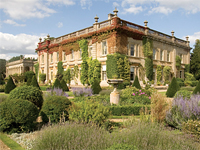
The modern smaller country house: Home Farm, Yorkshire

Home Farm, Yorkshire (Image: Francis Johnson & Partners)

Despite the rather understated name, Home Farm in Hartforth, Yorkshire is a classic example of the long tradition of grand downsizing which has been a hallmark of UK country house owners, particularly since 1900.  The pressures on the large country house in the 1930s and then again from the late 1940s until 1960s sparked a surge in the construction of new, smaller country houses which reflected the financial reality of the times.  Yet today smaller country homes are a deliberate choice for the discerning owner reflecting their own wishes and desires which has led to some very successful designs.

In previous eras (and particularly before the restrictions of the 1970s heritage legislation), a country house owner faced with a house which was too big could simply remove wings (as the 12th Duke of Bedford did at Woburn Abbey in the late 1940s) or floors of the house to make them more manageable (as happened at Hodnet Hall in Shropshire). Unfortunately for many owners it was simply easier to demolish the house entirely giving them the option to convert the stables into a home (the choice of the Earls of Lansdowne at Bowood in 1955) or rebuild either on the site of the old house or in a new location on the estate.  It was this latter course of action which offered the best opportunities for an owner to preserve their estate but dramatically reduce their expenses by building a new house.  John Martin Robinson in his 1983 book ‘The Latest Country Houses’ estimated that over 200 new country houses were built between 1950s-1980s.

The new country houses today are largely either grand statements but there are also examples of smaller houses which quietly succeed in delivering an important contribution to the traditions of the UK country house.  Winner of the 2009 award for ‘New building in a Georgian context‘, Home Farm was a carefully considered response to a particular location and circumstances.

The client behind the commission was Sir Josslyn Gore-Booth Bt. who had inherited the Hartforth estate but unfortunately not the main house, the early Georgian classical Hartforth Hall, which had been divorced from the estate and become a hotel.   The Gore-Booth’s family seat had traditionally been Lissadell in County Sligo, Ireland, built for the 4th Baronet in the 1830s.  In 2003, Sir Josslyn put the house on the market for €3m and was determined that the new house would be very different from the sombre and severe Neo-Classical house he had just left.

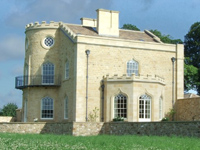
Home Farm, Yorkshire (Image: Francis Johnson & Partners)

Home Farm is a clever response to a number of challenges.  Firstly, both the new house and Hartforth Hall would be visible simultaneously due to their proximity and so had to make their own architectural statements without competing, ruling out a classical design.  Secondly, the new house was to replace an old estate farmhouse and would join the group of existing Georgian farm buildings.  The architect, Digby Harris, came up with a novel solution – a two-faced house which projected an elegant classical facade to complement the farm buildings but a Gothick facade contrasting to the classical Hartforth Hall.  Usually a client seeks a unified design so these type of buildings are rare in the UK and feel somewhat disconcerting; two examples are Castle Ward in Northern Ireland (Classical front / Gothick front) and Castle Goring in Sussex (Classical front / Gothick front).

The ‘classical’ front draws on a draft design by the late Francis Johnson but also historically the compact Georgian villas of Sir Robert Taylor (1714–1788), James Paine (1717-1789) and John Carr (1723-1807).   The Gothick facade mirrors the style applied to some estate buildings in the 19th-century and features an elegant ogee window on one side looking out on a small canal-type pond with the main front boasting a full height bow bringing to mind other older houses such as Corngreaves Hall with other elements taken from Batty Langley (1696-1751), specifically his ‘Gothic Architecture, improved by Rules and Proportions‘ (pub. 1747)

Home Farm proves that a modern classical country house can be both practical and architecturally interesting without needing to be physically large.  The long tradition of country house building in the UK seems to be alive and pushing forward the architectural boundaries which should prove inspiring to anyone contemplating the building of a new home of any size as the centrepiece of an estate.

More details and photos: ‘Home Farm, Yorkshire‘ [Francis Johnson & Partners]

Credits: thanks to Austen Redman of Francis Johnson & Partners for the photo and information on the house.
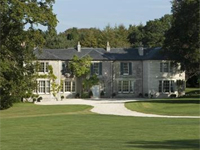
The start of the rush? Country houses for sale in the Sunday Times Home section

Sandley, Dorset (Image: Knight Frank)

The usual spring rush of country houses coming to market has been later this year – a combination of the hangover from the uncertainty in the market of the last couple of years along with that of the General Election.  That traditional shop-window of the country house – the Home section of the Sunday Times – has this week (16 May 2010) heralded what it sees at the start of the rush by including three pages of those for sale.

For those who like their country houses to look traditional from the outside but prefer a more modern interior then the Grade-II listed, six-bedroom Sandley in Dorset, set in 178-acres, might be perfect – if you have the necessary £9m.  The owners decided that the rather ‘quaint’ style of the house was not for them and so they spent ‘a couple of million pounds’ and over two years to strip it back and then make it look very ‘London’.  Personal taste is the final arbiter for whether you think this is a good thing – but not all tastes are the same and it can mean that the appeal of the country house is taken to new markets.

Ebberly House, Devon (Image: Savills)

However, if your tastes are more usual and traditional then there are other options. Holt Manor in Wiltshire, set in 94-acres, mixes both old and new with a more traditional interior cleverly concealing the latest in sound, television and security systems.  With parts dating back to the 12-th century, the Grade-II listed house has been thoroughly modernised whilst still being a recognisably English country house. £5.95m [Holt Manor: Knight Frank]

If, however, you are looking for a more architecturally impressive house, the Ebberly House, near Winkleigh in Devon, could well be the house for you.   Designed by Thomas Lee, a student of Sir John Soane, Ebberly was described by Pevsner as an ‘unusual and attractive house’ and was the first to sell in Devon for over £1m when it sold in 1997.  The Grade-II* listed house possibly benefited from Soane’s personal influence as he was working nearby at Castle Hill which may explain the elegant, and very Soanian, top-lit oval stair hall with its fine cantilevered wooden staircase and curved doors, or the drawing room divided using three shallow arches. Set in  250-acres it has a wonderful estate featuring 20-acres of woodland, estate cottages generating £20,000 p/a in rental income, and spectacular views across to Dartmoor. It was also given an excellent and detailed write-up in Country Life – always a good seal of approval.  [Ebberly House: Savills]

Chapel Cleeve Manor, Somerset (Image: Webbers)

Perhaps one of the most interesting of the houses featured is unfortunately only given a photo and no details is Chapel Cleeve Manor in Minehead, Somerset. Perhaps now not strictly a country house as it only has 7-acres, at £1.695m for 17+ bedrooms, it may seem a bargain for someone who wants to live in a country house but doesn’t want the responsibility of an estate. Although such a situation a hundred years ago could have led to the demolition of the house as happened to so many others. Yet, with so much wealth now generated without the need for a large estate to support the house, it’s now entirely reasonable for someone to take on and enjoy such a pleasing Gothic-Revival house. The house has been used as a conference venue for a number of years but with careful restoration this could be rescued from commercial use and be a spectacular home for someone who requires a lot of space. [Chapel Cleeve Manor: Webbers]

So has the rush started?  Nobody really knows and asking estate agents is never an exact science.  Several house which have been launched recently are still waiting to find new owners but the right house launched at the right time for the right price usually does find the right buyer.

Full story: ‘The landscape has changed‘ [The Sunday Times: Home section]

Ferne Park, Wiltshire: the building of a modern Classical masterpiece

Ferne House, Wiltshire (Image: Q&F Terry, Architects)

The English country house is considered our greatest contribution to the field of architecture – the unified vision of house and landscape combined with fine interiors, superb furnishings and exceptional art collections.  Yet in the 20th-century, it seemed that after Lutyens we largely lost our ability to excel in their creation – the new country houses seemed shadows of our earlier confidence, lacking the grand flair, and certainly the detailing, which had so defined the Georgian Classical house.  This was partially due to financial circumstances but also due to the influence of modernism which sought to re-interpret the country house in a new language – and it often didn’t translate well.

Yet, there are signs that given the right client and the right architect, we can again create the sort of country houses which will be admired in 200 years. Country Life magazine this week (5 May 2010) features one of the best country houses to be built in the last 70 years; Ferne Park in Wiltshire, winner of the Georgian Group award for the Best Modern Classical House in 2003.

This is a house built in the finest traditions of the English country house – with its clear use of the Palladian vocabulary but skilfully reinterpreted for the location and the needs of the client, Lady Rothermere.  The architect responsible, Quinlan Terry, has been responsible for some excellent buildings but this may well be his best.  The new house, built in 2000-2, was on the site of a previous Georgian mansion called Ferne House which was demolished in 1965 having fallen into a poor condition.  By rebuilding on the same site, Terry had a setting which was simply waiting for a new house to be created.

The local authority had already set the requirement that the new house must be Classical so both client and architect drew on other houses they knew such as Came House (Dorset) and Castletown Cox (Ireland), and were able to develop a distinctive plan for the site.  The house also cleverly has contrasting fronts with the dramatic views to the north matched by the stately columns and pediment, whilst the south, with the gentler views into Dorset, using a simpler facade.

Ferne Park has revived hope that it is possible to build a successful Classical house which is recognisably a continuation of the the glorious Georgian traditions which have created so many of the houses we love today.

More pictures of the house: Ferne House, Wiltshire [Quinlan & Francis Terry, Architects]


Part II of the article will be published in the 12 May 2010 edition of Country Life.

Kiddington Hall sold – but as a home or an investment?

Kiddington Manor, Oxfordshire (Image: Country Life)

After many viewings and some speculation, the Sunday Times is reporting that Kiddington Hall has finally been sold for £15m to Jemima Goldsmith, the wealthy socialite.  The grade-II listed house, originally built in 1673 but largely rebuilt to designs by Sir Charles Barry, comes with 466-acres of gardens and parkland designed by ‘Capability’ Brown.  The Sunday Times quotes a ‘property source’ as saying “It was a romance. She just fell in love with it.”.

The sale was ordered by the court to fund the divorce settlement of the owner, Erik Maurice Robson, who needed to raise £8m to provide for his ex-wife (for a detailed estimation of the likely proceeds see the comments on a previous post: ‘The economics of selling a country house‘).  The estate, described as a ‘jewel in the heart of Oxfordshire’, was one of the most important estates to be launched onto the market last year as rarely do prime estates with a manageable house, fine gardens and a productive estate, come up for sale in the prime Home Counties and this was reflected in the original asking price of £42m for the entire 2,000-acres and house.

However, considering Jemima’s previous successful forays into property development, is Kiddington Hall to be a family home or will she take the advice of some who say that if she spends a couple of million on refurbishment the property could be worth £20m?  It will certainly be one to watch as if it is relaunched in a year or two, it will provide a useful barometer as to the recovery of prime country property.

The sale of the main house will also mean that the sale of the remainder of the estate, encompassing 1,600-acres plus several farms and houses can proceed.  These sales were contingent on the main sale as without the sale of the main house the rest of the estate could not be sold.  The Sunday Times is reporting that Alec Reed, founder of the Reed recruitment agency, is the purchaser.

More details: ‘Jemima Goldsmith jumps on £15m stately home‘ [The Sunday Times]

Ury House restoration project still in doubt a year on

Ury House, Scotland (Image: Geograph)

When the developers FM Developments went into administration in 2009, it put in jeopardy a huge development scheme which was to fund the restoration of the historic Ury House.  The size of Ury House meant that any scheme was going to have to be ambitious to provide sufficient funding and this one involved the building of 230 homes and the creation of a Jack Nicklaus-designed golf course.  The developers had been praised for consulting with local residents and had the full support of the council for bringing jobs and no small measure of glamour to Stonehaven. Now, a year after the collapse, it’s still not clear if the scheme will proceed at all, leaving the spectacular ruins of Ury House at further risk of decline.

The first house had burnt down in 1645, and the second house was subsequently completely rebuilt as the Ury House we see today in 1855 for Alexander Baird in a fine Elizabethan style by the architect John Baird.  Baird was one of the most successful of the architects working at this time even if he rarely followed fashion.  His work at Ury was a continuation of the style of Wilkins and Burns they had developed 40 years earlier but was of a high quality which is still visible even today in the shell of the house. As a first stage of the work of the restoration, extensive scaffolding had been erected around the house in January 2009.

The proposals for redevelopment of the 1,500-acre estate included the conversion of the house into nine townhouses.  Unlike in many other cases of ‘enabling development’ where the setting of the house is compromised through the encroachment of the housing, the plan put forward placed the residential estate well to the east of the house, thus protecting it.  With the bankruptcy of FM Developments these plans have  been thrown into doubt and local planning officers are now working on the assumption that the development will not go ahead – despite local councillors being determined to resurrect the scheme.  Unfortunately the danger is now that another, less sympathetic, developer will take on the project but may try to cram more houses in or extend the area of the estate taken for housing. This would be a real shame. Although the ideal but unlikely outcome would be the restoration of the house as a single family home, this project had developed as a good example of enabling development practiced in the right way, with sensitive restoration of the main house, protection of the setting of the house, and productive use of the estate.

More details: ‘Future of Ury mansion site in doubt‘ [The Press and Journal]

Future of Ury mansion site in doubt