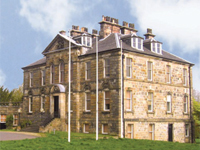
When enabling development makes things worse: Sandhill Park, Somerset

Sandhill Park, Somerset (Image: English Heritage)

There is always a temptation when any country house and estate comes to the market for the land to be built over with residential developments which provide a quick and relatively easy profit – even if it does ruin forever the setting of the house.  Usually the houses are snuck through under the cover of ‘enabling development’ with a promise that this will secure the long-term future of the house.  Grade-II* listed Sandhill Park in Somerset is an interesting example of where this fails if the development is build in an inappropriate location and a council who apparently haven’t ensured that at least some of the profits are invested in the house.

The main house at Sandhill Park was built around 1720, for the John Perriam, the MP for Minehead and inherited in 1767 by his grandson John Lethbridge (who was knighted in 1804) and remained in the Lethbridge family until 1913.  On inheriting Sandhill Park in 1815, Sir Thomas Buckler Lethbridge, the 2nd Baronet (b. 1778 – d.1849) added a grand portico to the main house and large wings to the rear.  The main house was substanially rebuilt in the 19th century giving it the distinctive and elegant sandstone ashlar look it retains today. These changes were funded through debt which burdened the family for years but ensured that no further major changes were made.  However, following the death in 1902 of Sir Wroth Acland Lethbridge, the 4th Baronet, the family moved out and the house was let until it was sold, along with 4,000 acres, in 1913.  It was subsequently bought in 1929 by Somerset County Council for use as a hospital and was requisitioned as a military hospital during WWII.  After the war, it became a psychiatric hospital until it closed in 1992 since which the house has remained unused.

The assumption appears to have been that the house could not be returned to being a family home which appears to have given the green light to the estate being built on and the conversion of the house with further building works to the rear, again turning a wonderful country house into a mere afterthought in a large development.  Planning permission was initially refused for what is now known as the Lethbridge Park housing estate which has been built to the east of the main house with the nearest property being just 100-metres away.  The only access for this estate is a small road to the north – the opposite direction to the town – which forces all traffic through a country lane before joining the main road back to Bishops Lydeard. It’s not possible to walk to the town so even to get a paper the residents must use their car.  Surely it would have been better to site the estate away from the house and use the parkland nearest the town?  The isolated residents gain no benefit from being so close to the house and the council’s decision has merely ensured more traffic on the local roads whilst compromising the setting of the main house.

This development has made it harder to sell the house as a home as the roofs of the new houses are visible from the main house. But perhaps this was part of the plan as the Knight Frank sales particulars explain that planning permission has been granted for the conversion of the main house into apartments with many more houses being built to the rear of the house.  However, as the house and 145-acres are now for sale for £2.75m it appears that after completing the residential development, the owners have decided to pocket the profits, sell the ‘difficult’ part and run.  This is apparently a prime example of a fine, though misused house being failed by the local council who are supposed to protect it.  How did they get planning permission for such an inappropriately sited development?  Why did the council not insist that the house be restored? Why are the old derelict hospital buildings still standing – surely they should have been removed as a minimum?  The council seem to have decided that it’s better to have two inappropriately sited developments rather than looking after an important part of their local architectural heritage.

Sales details:  ‘Sandhill Park, Somerset‘ [Knight Frank]

———————————————————————-

Update – 22 November – Sandhill Park seriously damaged by fire
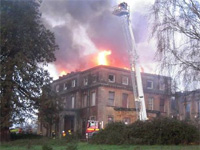
Fire at Sandhill Park - 22 Nov 2011 (Image: Lucy Robert Shaw / This is Somerset)

Sadly, as so often happens with uninhabited country houses, Sandhill Park has suffered a serious fire which has affected large parts of the house.  The mysterious  blaze started on the first floor (and considering there are no services to the house, this has to be suspicious) and quickly spread through the rest of the first and upper floors.  The huge quantities of water the fire brigade would have had to have used have almost certainly brought down the ceilings in the rooms below and the now serious damp house will be extremely vulnerable to wet rot.  If it is proved that the fire was arson, it’s a terrible indictment of the NHS for abandoning the property and the local council for approving such a ridiculous housing scheme which has made it harder to sell the house – compounded by their ineffectiveness in getting the old hospital buildings removed and the house restored in the first place.

I can only hope the owner was insured and is able to take protective measures to mitigate the fire and water damage and to somehow get ownership of this fine house into the hands of someone who can care for and restore it.  Anything less would be an architectural tragedy and would reflect badly on those involved. However, if history is any guide, I suspect we will shortly see an application to demolish, claiming that it is ‘dangerous’ (usually this is not remotely true and just a developers excuse) and more bland housing will march across this once fine parkland, a poor memorial to the heritage of the town.

News story: ‘Blaze strikes Somerset mansion that was left to rot‘ [This is Somerset]
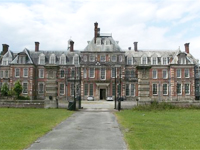
Welsh ‘Versailles’ still awaiting saviour: Kinmel Hall for sale

Kinmel Hall, Conwy (Image: Hannells)

When Kinmel Hall was bought in March 2006 by an investment company it was almost immediately advertised on their website as a ‘a unique development opportunity’ with plans for use as either hotel, spa, offices, conference venue or apartments.  Yet, nearly four years later, this impressive mansion is still languishing without a clear future.

The Kinmel estate was bought in 1786 using the vast wealth generated for the Hughes family in the eighteenth century through their half-ownership of the copper mine in Parys mountain which generated up to £150,000 a year at it’s peak (equivalent today to about £200m measured against average earnings).  The Hughes family lived in the house already there until it was rebuilt in 1842-3 in a Palladian style designed by the famous Georgian architect Thomas Hopper for the 1st Lord Dinorben.  When this house burnt down shortly afterwards in 1848 their huge income meant that an even larger house could be built to replace it.  Designed by William Nesfield in a monumental chateau-style and built between 1871-76 it was for an age of lavish house parties and featured 52 bedrooms and accomodation for 60 live-in staff.  The Hughes family lived there until 1929 when it became a health spa, then a hospital during WWII and then a school from 1945 until a large fire forced them out in 1975.  Restored in the 1980s, it was sold several times before being purchased by Derbyshire Investments who still own it today.

The original descendants of the Hughes’ still own the 5,000-acre Kinmel estate – all that remains of their original holding of 85,000 acres they once owned across the area.  The grade-I listed Hall and the 18 acres of walled gardens would make a magical location for what ever final purpose is decided – but the important task is to determine that future.  I suppose it’s too much to hope that it will again be a family home but any sensitive use which preserves this historic house as part of Wales’ architectural heritage is to be encouraged.

More details: ‘Kinmel Hall, North Wales‘ [Derbyshire Investments]

Midmar Castle – all that glistens isn’t quite golden

Midmar Castle, Aberdeenshire (Image: The Times)

It seems that an interesting story used to help speed up the sale of a house but for Midmar Castle in Aberdeenshire even a tale of sunken gold hasn’t helped secure a sale a year after the house was launched. The category-A listed castle was launched on the market on February 2009 with a fulsome write-up in The Times relating how the value of the house had underwritten a risky – but ultimately successful – expedition to recover £50m in Russian gold which had gone down with HMS Edinburgh in WWII.

The castle was originally started in 1411 but was greatly extended in the late sixteenth-century by the remarkable local granite-masons known as the Midmar school. They were responsible for Midmar and four other castles built nearby – Crathes, Frazer, Drum, Craigievar – all of which are now owned by the National Trust apart from Midmar.  Based on the traditional defensive z-plan with three main towers, this is an impressive and historic home.

The original price tag of £5m (set by Knight Frank who have now been replaced by Savills) for the house, gardens, outbuildings and surrounding 185-acres has now dropped to £3.5m – which represents an average drop of over £100,000 for each month it has remained on the market.   This may reflect some over-optimistic valuations but it’s still a superb, historic castle set in a perfect mini estate – ideal for anyone who wishes to experience the Scottish country lifestyle but doesn’t want the thousands of acres which often come with a house of this quality.

Property details: ‘Midmar Castle, Aberdeenshire‘ [Savills]

An architectural gem – but still slow to sell: Iver Grove

Iver Grove, Buckinghamshire (Image: The Listed Property Owners Club)

When it was completed in 1724, Iver Grove was one of the first houses in Britain built using the then radical Palladian styling; pre-dating even Lord Burlington’s famous Chiswick House.  Iver Grove is a beautiful and compact red brick essay in the use of the Classical elements with a Doric portico and topped with an elegant pediment.  Although originally attributed to either Sir Christopher Wren or Nicholas Hawksmoor, it’s now more widely accepted to be the work of John James who worked with Wren on St Paul’s Cathedral and succeeded him as the surveyor of the Commissioners’ Churches.  The front steps lead into a spacious and light entrance hall featuring the original oak staircase.

That the house is here today is remarkable in itself as after WWII it was in a parlous state and at risk of becoming one of the many hundreds of country houses demolished in the 1950s.  The house was smothered in ivy, riddled with dry rot and had been subject to various thefts of lead and fixtures and vandals who had smashed all but one of the Wedgewood stained-glass panels in window over the staircase.  The house was one of the first to be bought by the Government in an effort to save it – although this led to angry questions in the House of Commons from philistine MPs who demanded to know why we had spent more saving an “extremely beautiful house” (Lord John Hope) than we had sent to aid the Congo.  Such amazing short-sightedness still prevails today with those asking why we spend any money on heritage with similarly spurious justifications.

Anyway, thanks to the Government, the house was rescued through a programme of works which included demolishing the collapsed Victorian wing – and in so doing bring the house back to it original scale, and conveniently making it more manageable.  So when the this grade-I listed house was first launched in 2007 with much press coverage including a glowing write-up by Marcus Binney in The Times (‘A fast track to perfection‘) and later in Country Life (‘Georgian estate for sale‘) it was thought it would sell quickly.  However, £6.5m price tag was probably boosted by its architectural importance above the fact that it was a six-bedroom house with just 17-acres near to the M25.  The price was probably quickly identified as the issue as in The Times article in May the price is £6.5m, by the time the Country Life article was published in December the price was given as ‘offers over £5m’.  Now, two and half years later the price has dropped to a more reasonable £4.25m, and hopefully this will entice a new sympathetic purchaser with a desire to live in an important country house with manageable grounds but who will appreciate being just 17 miles from Hyde Park corner.  Actually, if I win the lottery, I’ll probably go for it.

Full details: ‘Iver Grove, Buckinghamshire‘ [Knight Frank]

Want to work in an Adam-designed office? Cumbernauld House for sale

Cumbernauld House, Lanarkshire

One alternative to demolition for a country house whose time as a home had come to an end was conversion to offices.  Many houses were thus saved from the wreckers pickaxe although some conversions were more sensitive than others, with some unfortunate houses being reduced to shells with the historic interiors severely compromised.  Some were very successful such as Donington Hall (headquarters to BMI), Mamhead House (formerly HQ to a local construction firm but well looked after and now back as a home) and Gaddesden Place (now home to a software company).

One such house which was converted in 1955 and in need of a sympathetic new owner is the grade-A listed Cumbernauld House in North Lanarkshire, currently for sale at offers over £1m.  Built for the Earl of Wigton in 1731, the house was designed by William Adam (1689-1748), one of the leading architects of his day, and includes some of his typical flourishes such as arched windows, channelled masonry and carved tympana.  Although the Adam interiors were lost in a serious 1877, the reconstructed interior is still noteworthy.  Currently empty, this house deserves a new lease of life and would make a suitable and impressive headquarters – although part of me does faintly hope that someone might want to take on the challenge of turning it back into a home.

More details: ‘Cumbernauld House‘ [SAVE Britain’s Heritage] – as Building of the Month this link may not work after Feb 2010 but there is a dedicated website at : www.cumbernauldhouse.com