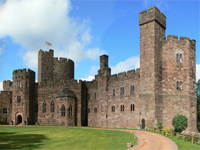
Soane’s happy commission: Tyringham Hall for sale

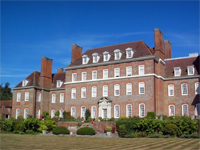
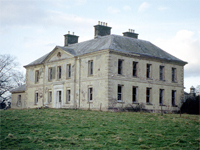
Tyringham Hall, Buckinghamshire (Image: Savills)

Six of the most happy years of my life‘ is how Sir John Soane described his commission to build what is regarded as one of his finest works: Tyringham Hall, Buckinghamshire.  Although altered, the house forms an important link in the development of both Soane’s architectural and professional skill; an ideal commission which gave full scope to his genius.  It also has the rare distinction of benefiting from another British architectural giant, Sir Edwin Lutyens, who created some of his best but also smallest work there. Now having been restored, the house is for sale; an early and clear candidate for the most important house to be sold in 2013.
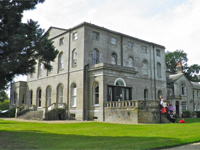
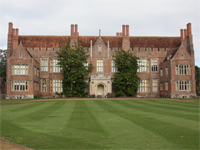
Letton Hall, Norfolk (Image: Chris & Angela Pye via Flickr)

Sir John Soane built only eighteen complete country houses, mainly between 1780-1800, so each house is an important step in tracing the evolution of his distinctive style.  Burnham Westgate was Soane’s first major remodelling (covered in an earlier blog post: ‘For sale: a Soanian springboard‘ Oct 2011) but his first entirely new house was Letton Hall, Norfolk. Built between 1784-92 for B.G. Dillingham, Soane had convinced Dillingham to demolish, rather than alter, the existing Old Hall which he had inherited that year.  Soane’s early working practices, honed through smaller commissions, emphasised extensive discussions with the client at the early stages, and the creation of a wooden model to help them visualise the proposed scheme (created in 1785 – after work had started – at the cost of £6 11s).  Letton also demonstrated several of what we regard as ‘Soanian’ architectural traits: the compact villa design, pale bricks, beautiful proportions and the cantilevered, top-lit staircase.
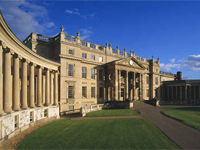
Stowe House, Buckinghamshire (Image: e-architect)

Soane’s practice now progressed steadily with commissions for new houses at Tendring Hall and Shotesham, along with other works on varying scales.  His growing reputation for not only excellent designs but also for completing work on time and within budget led to his name being circulated amongst the right type of clients who could provide the opportunities Soane hoped for. Drawn by his friend, Lord Camelford, into increasingly political circles, he became friends with the powerful Marquis of Buckingham, who owned two great estates at Stowe and Wotton.  In August 1792, it was Buckingham who took Soane to visit the banker William Praed at his property, Tyringham, which his wife had inherited and which was conveniently close to the Marquis, in whom rested his political and business ambitions.  Needing a house to match his intended status, Praed initially commissioned Soane to remodel the existing Elizabethan manor house. However, after some Soanian persuasion, in June 1793 he decided that an entirely new house would best serve his needs – much to the architect’s undoubted relief.

Soane displayed a particular flair when designing an entirely new house.  Although at the  core of his houses was a Palladian villa, as John Summerson notes, Soane was able to ‘…twist it into something much more complicated with sequences of shaped rooms ingeniously interlocked, and lobbies introduced to effect harmonious transitions‘.  It was this imagination which Soane brought to the Tyringham commission and which created one of his early masterpieces, with flashes of brilliance, both inside and out.

One of the first is the now Grade-I listed monumental arch gateway leading from the main road; a building of such elegance and novelty that it had Pevsner in raptures, describing it as ‘a monument of European importance…it is entirely independent of period precendent, a sign of daring only matched at that moment by what Ledoux was designing in France [e.g. Hôtel Thellusson] and Gilly in Germany‘.  Leading to the house, the drive curves gently away, allowing the house to slowly come into view.  Soane designed the approach, incorporating an elegant humpbacked bridge with balustrades which curve at each end, away from the road, creating a delicate curl.  Arriving at the house, the exterior can also immediately be identified as by Soane, with typical details including the bow-front, the beautiful proportions and the superb detailing, such as the giant Ionic columns and Greek-key frieze.

The interior was to be the finest conception of the whole scheme; a dramatic, exciting series of spaces which would have delighted the visitor.  At the core of the plan was a device which Soane would re-use in later projects but on a monumental scale; the ‘tribune’, a top-lit inner hall.  To look at the plan is to understand the level of trust that William Praed displayed in Soane as, on entering the house, the first space encountered was dramatic as it was domestically redundant: a windowless ante-chamber lit only by the front door and flanking windows behind you, and through another doorway at the far end.  Passing through the room, flanked by four columns supporting a typical Soane shallow dome, you then stepped through the doorway and into the brightly lit central tribune; a Damascene moment of drama.  Forming the top of the T to the dark antechamber, the tribune then led to either the library, the drawing room or the stairs; each decorated in a typical Soane style. Though compact, the house and estate are both impressive and manageable, the perfect combination for a rising, ambitious banker who mixed in aristocratic company.

However, the house and estate today is not the same one Soane created.  Between 1907-19, a series of unfortunate changes were made to designs by the architect Ernst Eberhard von Ihne, his decorator Florian Kulikowski and another architect, Charles Rees, who implemented Von Ihne’s plans which swept away much of Soane’s interior decoration.  They also added an ill-proportioned copper dome, a tea cosy on a champagne bottle, which has the strange visual effect of elongating the columns.  With an estate of only 59-acres, it’s unfortunate that a series of 9 or 10 houses were built to the immediate north-east of the main house. Equally sad, the most important section of Soane’s considered drive to the house is now in separate ownership; the humpbacked bridge part of the public highway and worse, the road then continues down through that wonderful arch which so delighted Pevesner (how long before some careless driver seriously damages one or the other?) – follow the drive via Google StreetView.
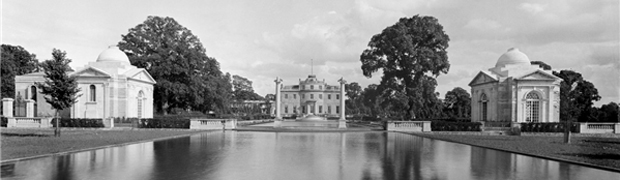
Bathing and Music Pavilions, Tyringham Hall (Image: Country Life Picture Library)

Thankfully what is still intact is one of Sir Edwin Lutyens‘ finest garden schemes.  Between 1924-28, Lutyens was commissioned by the then owners, the Koenigs, a family of Silesian bankers, to create a garden ‘for the recreation of spirit and body‘.  Standing each side of a huge 72m pool, once thought to be the largest of its type in Europe, are two temples; one a bathing pavilion, the other of Music.  Reminiscent of Thomas Archer‘s sublime Pavilion at Wrest Park (1709-11), Lutyens’ interpretation is pared back, less ornamented, but equally impressive – indeed, he himself thought it faultless and would apparently sit in there on his own.

The current vendor, Anton Bilton and family, has lavished millions on restoring the house and grounds (though, he confirms not as much as the £10m previously reported) since buying it for £2.5m in 2001.  However, the £18m asking price quoted in The Sunday Times Home section (28/04/13) seems ambitious; £10m-12m feels more appropriate considering the way the house and estate have been compromised with the now non-private approach, the small housing estate to the east of the main house and the loss of Soane’s original interiors.  Make no mistake, this is still a superb house and sets the bar high for any other house offered for sale this year to be considered as attractive or as interesting.

——————————————————————

Property details: ‘Tyringham Hall‘ – £18m, 59-acres [Savills] Strangely, there is no brochure yet and the launch, through double fold-out spread in Country Life (1 May 2013), feels a touch late.  One wonders whether the Bilton’s were offered a chance to do the Sunday Times piece before Savills were ready and took it anyway?

Excellent selection of photos:

If you wish to find out more about Sir John Soane and are in London, visit his house at Lincolns Inn Fields, which is a museum to his life and work: ‘Sir John Soane’s Museum

Welcome to the market: Lutyens’ The Salutation, Kent

The Salutation, Kent (Image: Knight Frank)

The analogy between language and architecture is one that has often been made, particularly as fluency is the key measure of success in both fields.  An immature architect can make elementary mistakes with the grammar of a building style as much as any tourist abroad can when ordering dinner. In most cases, both novice architect and linguist can be understood but when compared to the more experienced practitioner, skill and mastery come sharply into relief.  Such a lesson by a master architectural linguist has just been launched on the market; The Salutation, in Sandwich, Kent; a beautiful piece of poetry which demonstrates the fluency of the architect in the language of Classicism.

Heathcote, Ilkley (Image: Thursday Dave via Flickr)

Lutyens’ career can largely be seen in three phases; the early years of the ‘Surrey-Tudor’, which evolved into the middle ‘Arts & Crafts’, and then the divergence into the bold ‘Classical’, and its particular variant, ‘Edwardian Baroque’.  That last switch can be seen quite dramatically in the brilliant Heathcote, Yorkshire, built 1906, where Lutyens playfully adopted and adapted the Classical motifs and style of Palladio and Scammozzi to create a wonderfully detailed villa, rich in style and quite unlike his previous work.  After the exuberance of Heathcote (which annoyed Pevsner, who although he commented that it was ‘Only a villa, but how grand the treatment!‘, also dismissed features such as the pilasters which ‘disappear’ into the continuous rustication (see ground floor either side of the windows) as ‘silly tricks‘). On a side note; Heathcote recently sold having previously been bought by a developer/vandal who wished to split the house into two, thus ruining Lutyens’ interior planning – fingers crossed the new owner is sympathetic to this wonderful house.

Lutyens was, of course, part of a longer tradition starting with the first English classical architects practising around the time of Sir Christopher Wren in the mid-17th Century including Hugh May, William Samwell, and Roger Pratt. These pioneers displayed a similar skill in Anglo-Classicism producing buildings such as Cassiobury House (May), the first Eaton Hall (Samwell) and the revolutionary Coleshill (Pratt).  Classicism has long had a place in British architecture, despite other fashions, and has shown its versatility in being used for all sizes of house, from palaces to the smaller country retreat – and it was in this latter requirement that Lutyens was commissioned to build The Salutation.

Located on the site of an old inn of the same name, it was built in 1911-12 in the Queen Anne style as a retreat for Gaspard Farrer, a partner in Barings Bank, and his two bachelor brothers. Lutyens’ clients were typically those who had made money in the decades either side of 1900; that high-point of the country-house lifestyle when staff, materials and labour were relatively cheap. If there is a ‘criticism’ of Lutyens it’s his generosity with regards to space with hallways, alcoves, and large staircases, such as at The Salutation where an extended landing serves as an overflow from the library.  Yet, each space serves a purpose in the plan, typically framing views along axes or as part of a route to the principal rooms which Lutyens often incorporated into houses.

Great Maytham, Kent (Image: Stephen Nunney via Geograph)

The exterior of the house is a smaller derivation of his earlier and much grander Great Maytham, built 1910, for the Liberal MP, H.J. Tennant.  Following the exuberance of Heathcote (which most commentators seem to think came very close to pomposity), Lutyens took a more restrained path through Classicism (compared say, to Richard Norman Shaw at Bryanston House for Viscount Portman) and Great Maytham can be seen as a larger version of Samwell’s Eaton Hall, built 1675, or the smaller Puslinch in Devon, built 1720, with the latter showing clear similarities with The Salutation.

East terrace, The Salutation, Kent (Image: Country Life Picture Library)

The plan of The Salutation is based on the Palladian 3×3 grid but, importantly, Lutyens is able to adapt and amend this without losing the beauty of the proportions.  Gavin Stamp comments that, for Lutyens, his houses were ‘essentially romantic creations; that is, their form is determined by a picture in the architect’s mind‘ and another writer H.S. Goodhart-Rendel compared his ability to that of Wren in that they both had ‘the sculptor’s capacity of making beautiful shapes‘.  Country Life magazine said that it was a ‘dazzlingly suave yet restrained reinterpretation of the old Georgian idiom‘. It was this ability to combine a profound understanding of the Classical rules of architecture with originality which marked Lutyens out as one of the great architects.

To be given a measure of the importance the house, in 1950, it was the first 20th-century building to be given a Grade-I listing.  However, The Salutation suffered in the later 20th-century with the 1980s a particularly difficult time. Repeated attempts by developers were made to either split those graceful internal spaces into apartments or simply demolish it entirely and build on the 3-acre site, over which Lutyens (and possibly his long-term collaborator Gertrude Jekyll) had spent so much time and care crafting.

The Salutation from the garden (Image: Knight Frank)

Salvation for The Salutation came in the form of Dominic and Stephanie Parker who bought it in 2004 for £2.6m and have subsequently spent £3m on its restoration and who now run it as a luxury B&B. Now for sale at £4.5m, for someone with the budget, this could again be a superb home; combining the finest elements of the last boom of the country villa, designed by one of the greatest architects Britain has produced.  For the rest of us, if you’d like to see and experience staying in one of Lutyens finest small houses, I’d suggest booking soon.

———————————————————-

Sale particulars: ‘The Salutation‘ [Knight Frank]

If you’d like to stay; you can book through their website: ‘The Salutation

Video of Mr Parker talking about his decision to buy: ‘The Salutation was ‘like finding a diamond in a river‘ [2009, Kent Online]

Watch the Parker’s competing in a B&B TV competition: ‘Four in a bed‘ [Channel 4]

For more on Lutyens, I recommend Gavin Stamp’s ‘Edwin Lutyens Country Houses‘ [Amazon]

Support the legacy: ‘Lutyens Trust

Listing description: ‘The Salutation‘ [British Listed Buildings]

Houses of gods: country houses converted to religion and the sale of Hawkstone Hall

The 1920s and 30s may be remembered for many things, but it probably wouldn’t be for having any great public affection for the grand houses which had so dominated the landscape agriculturally, economically and politically.  Faced with the reality of the long slump in revenue from the land and wider economic difficulties, country house owners found themselves between the rock of their own financial situations and the hard place of a nation broadly unsympathetic to their difficulties.  Many an owner may have offered up a prayer for some form of divine intervention to alleviate their situation – and the miracle which appeared which saved their house, though not their lifestyles, was religious orders purchasing these grand piles for their ministries.  With the recent launch on the market of the impressive Hawkstone Hall in Shropshire, the cycle turns again, as it looks like the wealthy will rescue the religious.

Hawkstone Hall, Shropshire (Image: Gerard Carroll via flickr)

A nobleman’s residence in the medieval period was often a castle but this dramatically changed following Henry VIII’s Dissolution of the Monasteries between 1536-41.  The aftermath created one of the greatest transfers of land (in the 1530s, they were estimated to hold approx 16% of England) and property as the riches of these institutions were either given to favoured courtiers or sold, creating instant country estates.  Yet, at that time, they were seen more as industrial units; great agricultural establishments which brought in great wealth, with the beautiful priory churches often stripped for their materials. However, for some owners, the buildings were a fine opportunity to create a house – and what better way of creating the impression of an ancient family than with an ancient seat, especially if it came with prized feudal rights.

Lacock Abbey, Wiltshire (Image: Arnhel de Serra / National Trust)

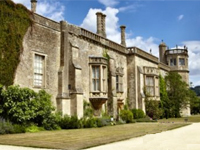
The suppression of the monasteries and convents brought to an end many of the longest standing communities but did give a boost to the secular, non-defensive country house. Many older houses today, both large and small, can trace their origins back to monastic roots, including (a small sample, admittedly):

Mapledurham, Oxfordshire (Image: scoutjacobus via flickr)

Of course, there is a long history of country houses being used for religious purposes as many recusant families continued practising their Catholic faith at great risk to themselves both financially and physically, such as at Mapledurham in Oxfordshire or Hintlesham Hall in Essex.  This secrecy led to the creation of many ingenious methods of hiding not only the chapels (either in attics such as at Ufton Court, Berkshire, or by being disguised as bedrooms) and items of their faith but also the priests themselves, usually in ‘priest holes‘ which could be concealed behind panelling and walls (e.g. at Harvington Hall – still owned by the Archdiocese of Birmingham), in chimneys, under fireplaces and so on.

Despite Catholic worship becoming legal again in 1791, there were still restrictions on Catholics in public office until 1829, and it was still viewed with some suspicion. A further influx in the 1790s was due to the French Revolution which forced many orders back across the Channel.  For any order seeking to establish itself, it was certainly easier to take over a country house as it would often meet their requirements in terms of seclusion and accommodation but without the challenges of trying to build a new convent or monastery. One of the earliest was the purchase of East Bergholt Old Hall, Suffolk which was bought in the 1850s but there have been many others since, including:

Mentmore Towers, Buckinghamshire (Image: EPR Architects)

Catholics may have had the longer history but others have also taken the same route. Perhaps the most famous of these was the spectacular Mentmore Towers, Buckinghamshire, designed by Joseph Paxton and built between 1852-54 for the Rothschilds, which was bought by the followers of the Marharishi Yogi to serve as the UK headquarters for the World Government of the Age of Enlightenment. This followed the scandalous refusal by the then Labour government to accept it for the nation with its incredible collections in lieu of just £2m inheritance tax and the subsequent sale which netted several times that. Others include:

There don’t appear to be any clear records of which houses have been used as convents/monasteries so it remains anecdotal (there’s probably a good PhD topic in there somewhere) but it’s possible that hundreds of houses have served in this use, especially if convent schools and retreats (e.g Capernwray Hall and Kinmel Hall) are included. For many of these, it’s likely that this alternative use saved them from joining the ranks of those demolished.

For the past 85 years, grade-I listed Hawkstone Hall has been a seminary and also a retreat for Catholic clergy.  The house was originally built in 1720 for Richard Hill (b.1655 – d.1727), a traveller and diplomat who had made a fortune through what was described as ‘lucrative arithmetick‘, and consisted of just the main block.  The design of this section is quite unique, certainly to the area, and pre-dates designs later shown in Campbell’s ‘Vitruvius Britannicus‘ published in 1715-25.  Although it shares certain elements with other houses (Buckingham House, Chatsworth – east front), neither the listing description nor Colvin have details on the original architect so it is open to conjecture as to who designed it and where they got their inspiration (if anyone does know/have any suggestions, please do add a comment below or contact me).

Hawkstone Park, Shropshire (Image: Peter-snottycat via flickr)

Hawkstone was then inherited by his son Sir Rowland Hill, 1st Baronet (1705–1783), who added the wings as part of an enlargement in 1750, but who also, more importantly, started the landscaping for which the estate was to become famous.  Taking advantage of a natural rocky outcrop, Hill created a series of walkways on the cliffs, view points and follies which attracted many visitors.  This grew to such an extent that Sir Richard Hill, 2nd Baronet (b.1733 – d.1808) wrote the first guidebook for the park and also built the ‘Hawkstone Inn’ to cater for the visitors. Such was its reputation that Dr Samuel Johnson came to see and was duly impressed, remarking on “…the awfulness of its shades, the horror of its precipices….“. Johnson also commented that he thought there ought to be more water and so Sir Richard commissioned landscape designer William Emes, who created the Hawk River which still flows to the north-west of the house.  Hawkstone Park had become one of the most popular attractions in the country by the time of his death in  1808 and remained so under the care of his brother, Sir John Hill, 3rd Baronet (b.1740 – d.1824), who inherited.

Sadly, it was to be the next generation who sowed the seeds of the families financial troubles.  The house and park were inherited by Sir Rowland Hill, 4th Baronet Hill of Hawkstone, 2nd Viscount Hill (1800–1875) who, through extravagance or mismanagement, lost much of the family fortune. Inside, he commissioned, between 1832-4, various alterations including a new drawing room from Sir Matthew Wyatt, whilst in the grounds he carved a hugely expensive new drive through a cliff and built The Citadel, a strange castle-like dower house.  He even toyed with the idea of relocating the entire house to the other side of the river.

Such spending was always likely to lead to difficulties and the 3rd Viscount, Rowland Clegg-Hill, (b.1833 – d.1895), never managed to re-establish the fortune and was bankrupt by the time of his death.  This forced a sale of the contents and then the splitting up of the estate in 1906.  The park, with the many follies, tunnels and caves, was sold off and is now run as part of the Hawkstone Park hotel. The Hall was bought by George Whitely, later Baron Marchamley of Hawkstone, a wealthy mill and brewery owner and MP, who made minor alterations; reducing the height and length of the projecting wings and to the interior.

The house was then sold to the Roman Catholic Redemptorists who have remained there until a recent review of their activities prompted them to put the house, with its 7-acres of gardens and 81-acres of grounds, up for sale for £5m.  Any purchaser looking to make this a home again will need to demolish the ugly accommodation block tucked away behind the left wing and will also have to consider what they wish to do with the large chapel which was added in 1932; perhaps if bought by a non-religious family it would make a superb music room.  For a house which exhibits such architectural interest and grandeur, it seems like a fair price and one hopes it will attract someone willing to invest to recreate what could be one of the finest homes in Shropshire.

———————————————————–

Property details:

News story: ‘Hawkstone Hall goes up for sale with a £5m price‘ [Shropshire Star]

Official website: ‘Hawkstone Hall

Country House Rescue – Season 4: Great Fulford, Devon

Great Fulford, Devon

If there were a league table of how often a house and family appear on TV or in the papers, an unexpectedly high entry would probably be the Fulfords of Great Fulford in Devon.  Having featured in other programmes and even their own series, it’s almost a surprise that it has taken Country House Rescue this long to visit (Thursday 5 July, 20:00, Channel  4).  Despite the bluff and occasionally hostile exterior of Francis Fulford, the Fulfords are a remarkable family – both this generation and the many which have come before them.  The question is; with so few houses still lived in by the original families, will future Fulfords be able to stay in their notoriously imperfect house?

Great Fulford falls firmly in that category of houses which Hugh Montgomery-Massingberd described as the ‘illustrious obscure‘; those many smaller, privately-owned houses which lie nestled in valleys and hidden by their own land – in this case, a not insubstantial 3,000-acres.  Pevsner described it as ‘…a substantial courtyard mansion, larger than  most in Devon though characteristic of the county in its reticent exterior and its patchy and undocumented history of rebuilding and remodelling…‘. With a core which stretches back to the 1500s, the house has grown and been embellished as funds and whims permitted creating a lengthy listing desciption which would make a larger house very proud. A major remodelling in the 1800s has been suggested as being to designs of Sir Jeffry Wyatville but neither Pevsner nor Colvin mention this and the listing discounts it.

So although some aspects of the actual house remain a mystery, one aspect which is very clear is the remarkable endurance of the family, with the current owner, Francis Fulford, being the 26th (or 27th – he’s not sure) Fulford of Fulford, a line stretching back over 800 years. Very few families are able to trace back their lineage so far, even fewer are still in possession of the original family seat.  Yet they do survive, despite the best efforts of tragedy and unforgiving tax regimes to unseat them.

Kelly House, Devon (Image: English Heritage)

One such family has featured on Country House Rescue before: the Kellys of Kelly, also in Devon, who have a proud history dating back to the 1100s.  In 2010, Ruth Watson visited the beautiful if rapidly deteriorating Kelly House [more on that visit in this previous blog post: ‘A glimmer of hope‘] to find an owner almost in denial as to the decrepit state of their home.  Proving that Country House Rescue can be a positive catalyst for change; the house is now slowly being restored with help from various students of architecture, surveying and other related fields. By contrast, the Fursdon family of Fursdon House (also in Devon!) have fully adapted their estate to offer all the usual activities which have ensured their beautiful 750-acre estate and elegant house (which, in a truly modern way, you can follow on Twitter, @fursdondevon, and Facebook) not only brings in an income but is also a home.

Fursdon House, Devon (Image: Fursdon House)

These smaller houses form the backbone of the local history of an area; so embedded that their name denotes the place.  In a fascinating series of articles in ‘The Field‘ magazine, starting in 1984, Hugh Montgomery-Massingberd toured the length and breadth of the UK seeking out these lesser known seats and their even more private owners.   To read these amazing histories is to realise the depth of history which our nation enjoys, including:

So although not unique, the Fulfords are rare.  In many ways the Fulfords are a refreshing alternative to the slick corporate manicure of many homes or the stately preservation of the National Trust (though all have their place).  This is a notable family who have, against all odds, achieved something exceptionally rare amongst stately home owners.  This has to be admired and although unconventional they are a fascinating part of the tapestry of our nation.  Some part of me hopes that they achieve a beautiful equilibrium of succeeding enough to ensure the survival of the house, but not too much so as to compromise the character of their lives or Great Fulford.

————————————————————————-

Further articles:

Francis Fulford’s Blog

Country House Rescue – Series 4 [Channel 4]

Country House Rescue – Episode 4 [Channel 4]

A Salvin for sale: Mamhead House, Devon

Mamhead House, Devon (Image: Strutt & Parker)

One of the pleasures of running your own blog about country houses is that you get to play favourites.  I’m often asked which is my favourite but this is a difficult one to answer; is it the one I want to live in (currently Bragborough Hall, Northamptonshire), the one I most want to visit (Mereworth Castle, Kent), or one that I think is just stunning (Bruern Abbey, Oxfordshire)?  However, there are some which just hold a special affection – and that, for me, has to be Mamhead House in Devon, partly for its beauty and also for no better reason than it having been local to where I grew up.

Mamhead’s main claim to fame is that it was the project which established one of the best Victorian architects; Anthony Salvin (b.1799 – d.1881).  Described as a pioneer of Gothic Revival architecture, Salvin could be seen as the secular equivalent to the religiously driven Pugin. Both sought to restore Gothic as the traditional form of design most suited to the nation, but whereas Pugin saw this as a devotional mission to return Britain to how it might have been had the Reformation never occurred, Salvin saw Gothic as the form which was best suited to our landscape and aesthetics.  Salvin’s historically rigorous approach saw him create some of the most interesting country houses of the Victorian era – and Mamhead is a rare example which has now been restored to its former glory.

According to Mark Girouard, Salvin’s reputation appropriately rests on his country houses, dismissing his churches as ‘seldom interesting‘, and that it’s ‘hard to regret‘ that his designs for larger buildings such as the new Houses of Parliament and the Carlton Club were never built.  However, in the sphere of the country house; his success rested on his ability to combine three elements; “the domestic or castellated architecture of the Middle Ages and the Tudors; the design techniques of the Picturesque; and the needs of the Victorian upper classes“*.

The first Mamhead House, Devon shown c.1826, demolished c.1828

Salvin specialised in the restoration and modernisation of ancient buildings, building on a precocious interest in medieval architecture which saw him elected to the Society of Antiquaries in 1824, aged just 24.  His obvious scholarly talent marked him as someone to watch but it’s still unclear exactly how he secured his first commission at Mamhead – especially as he replaced a more experienced architect whose plans he then had to adapt.  The owner, a merchant called Robert Newman, had commissioned Charles Fowler, who had designed a classical house to replace the existing house (altered by Robert Adam for the Earl of Lisburne in 1774), which Newman appears to have decided not to proceed with, possibly seeing the winds of fashion shift towards the Gothic.  He may also have been influenced having seen Kitley (now a hotel), also in south Devon, which had been remodelled by George Stanley Repton between 1820-25, in one of the first attempts at authentic Elizabethan.  This change of heart gave Salvin his opportunity.

Moreby Hall, Yorkshire (Image: Country House Picture Library)

For Pevsner, Mamhead was the house which established Salvin as the chief Victorian architect for large country houses in the Tudor style. Salvin was constrained in that he was working from the existing symmetrical plan and denied the chance to introduce the projection and recession of elements so traditional with Gothic.  However, this plan does have tradition in that it has the feel of an Elizabethan E-plan house; though one where the main door has been moved to the corner rather than the expected middle. These minor quibbles were to be later offset by the masterly later additions.  Mamhead’s cost of £20,000 was financed from income, so although work started in 1827-8, the final interiors (strangely being the entrance hall) weren’t finished until seven years later.  During this time Salvin’s knowledge and experience grew – not least through his second commission for a new country house; Moreby Hall in Yorkshire, built between 1828-32. Here he enjoyed a freedom to create and developed his own arrangement of a central, two-storey hall off which came the main rooms and which also allowed warm air to circulate – not only visually impressive but also practical.

Conservatory - Mamhead House, Devon (Image: Devon Life)

It was perhaps the later additions of stables and the conservatory at Mamhead where Salvin clearly demonstrated the flair which marked the original thinking of a great architect.  Rather than continue strictly in the same style, the stables were now to be housed in a mock, red sandstone castle, modelled on Belsay Castle in Northumberland, slightly above and behind the house, with the conservatory in a more correct Gothic design.  The conservatory is a beautifully elegant single-storey extending from the north-west of the main house featuring four Perpendicular windows leading to a two-storey pavilion leading to the garden.  The skyline features many pinnacles with an interior decorated with carved scrolls and verses, shields, and carved panels – all in stark contrast to the rather severe fortifications which Salvin chose for the stables at the other end of the house.

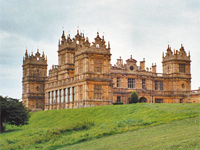
Harlaxton Manor, Lincolnshire (Image: stemurphy4 / flickr)

Mamhead is fascinating as it not only shows early brilliance in an architect’s career but unusually also is a house which shows all the styles in which he worked – both the Gothic and the fortified.  Salvin’s skill with the Gothic form and vocabulary perhaps found its greatest expression in his third country house commission: Harlaxton Manor in Lincolnshire; a fantastical composition which took full advantage of its location and the wealth of the owner.

Harlaxton must be seen to be believed and even when one has seen it, it is not always easy to believe it.” said Mark Girouard – and who can disagree?  Harlaxton takes the elements of Gothic and Elizabethan but then injects the visual flair to give it a skyline to rival Kirby Hall, Burghley or the lost Richmond Palace. The house is almost theatrical but coherent enough that the look isn’t overwhelmed by any element.  Inside, the most spectacular feature is the famous Cedar Staircase which seeks to match the outside with an unexpected Baroque interior.  The design demonstrates how quickly Salvin’s skills had developed, with the work at Harlaxton starting just three years after Mamhead.

Peckforton Castle, Cheshire (Image: the pepper tree / flickr)

By contrast, Peckforton Castle would be recognisable to a medieval knight as a useful fortification.  Rising prominently above the relatively flat Cheshire countryside, the imposing red sandstone castle is very much in the tradition of BurgesCastell Coch for the Marquess of Bute, and the later Castle Drogo by Lutyens.  However, a significant difference is the much greater degree of historical accuracy, perhaps appropriate considering it was visually challenging the truly medieval Beeston Castle on a neighbouring hilltop, but also to reflect the benevolent feudalism of the owner, John Tollemache who spent huge sums on buildings and homes for his workers.  However, the widespread public discontent at that time, with the risks of mobs and rioting, meant that it is also possible that Tollemache chose a castle with the intention that it be defensible.  So successful was Salvin’s design that even a critic (fellow architect George Gilbert Scott) called it a “…a perfect model of a Medieval fortress…“.  I think Salvin enjoyed the challenge of this design; a rare chance to build an uncompromising castle in a way which hadn’t been necessary for 500 years, fully taking advantage of his encyclopaedic knowledge of fortifications.  Today, despite being badly damaged in a recent arson attack, the castle is still a fascinating example of his work.

Apart from ecclesiastical work and alterations to existing houses such as Warwick, Alnwick and Dunster castles, he also designed a number of notable country houses including, in addition to those already mentioned: Cowesby Hall, Scotney Castle, Parham Park, Skutterskelfe Hall (one of Salvin’s rare Classical designs), Crossrigg Hall, Keele Hall, and Thoresby Hall, which still survive today.  Sadly, Flixton Hall, Campsea Ash High House, Congham High House, Stoke Holy Cross Hall and Hodnet Hall have all either been completely demolished or, in the case of the latter, significantly reduced.

Salvin was one of those rare Victorian architects whose work started strongly and just got better.  To have the opportunity to purchase the first major work at Mamhead is a rare privilege and one that I hope the new owner will recognise and appreciate.

Sales details: ‘Mamhead House‘ – £8m, 164-acres [Strutt & Parker]

Lovely article with many photos in ‘Devon Life’: ‘Mamhead House

More details:

———————————————————————————-

* source: foreward to ‘Anthony Salvin: Pioneer of Gothic Revival Architecture‘ by Dr Jill Allibone which I can highly recommend, and which was very helpful for this posting.