Conversion reversion? Wardour Castle, Wiltshire

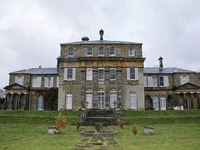
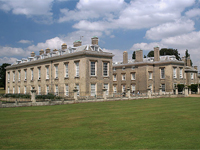
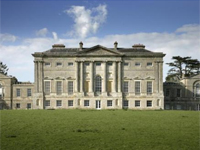
Wardour Castle, Wiltshire (Image: Strutt & Parker)

With so many country houses lost in the twentieth century, almost any alternative which saved them from the demolition crew was to be welcomed; no matter how drastic.  For some this meant institutional use but for many others of all sizes the solution was conversion into flats and apartments – though with varying degrees of success.  However, as these properties come on to the market, is it perhaps time to consider converting them back into the single, glorious houses they were intended to be?

Launched this week (16 June 2010) in Country Life magazine is the principal apartment in what is considered James Paine’s finest creation; Wardour Castle, a supremely elegant essay in Palladian architecture.

Central stairwell and gallery, Wardour Castle, Wiltshire (Image: Strutt & Parker)

Built from 1770 – 76, for the eighth Lord Arundell the most impressive feature is a breath-taking central stairwell with first-floor gallery which Pevsner called ‘the most glorious Georgian interior of Wiltshire’ and which forms the core of Apartment One which is now for sale.  Wardour Castle house has proved to be adaptable becoming Cranborne Chase School in 1960 until it closed in 1990 when it was then converted into ten apartments.  As the divisions appear to have respected the natural sections of the house this seems to be a good example of where someone could convert the house back to a single home.

There are many examples of houses being rescued by conversion.  SAVE Britain’s Heritage have long campaigned to protect these houses and have worked in conjunction with one of the leading architects, Kit Martin, in supporting conversion.  A 1983 SAVE report entitled ‘The Country House: to be or not to be’, written by Kit Martin and Marcus Binney, includes particularly interesting studies of how these houses could be sensitively converted.  These show that although almost any country house could be sensitively adapted some are naturally more suitable particularly where the overall layout of the house is symmetrical, shallow and long.

The study was an important milestone in the practice of country house conversion and saved many houses from complete loss or inappropriate use including The Hazells in Bedfordshire, the grade-I Northwick Park in Gloucesterhire, Dingley Hall in Northamptonshire.  The sensitive approach they championed now means that it should be possible to consider converting a house back if the right opportunity arose.  It should be said that some houses are never going to be converted back due to a variety of factors including there being too many apartments involved such as at Thorndon Hall in Essex which contains 37 flats, or where not enough land has been retained to make the unified house valuable enough to justify reversion.

Perhaps the idea of reversion becomes more realistic where more than one part of the same house comes on the market at the same time such as recently happened with grade II*-listed Ampthill Park House, Bedfordshire.  Built by the Cambridge architect Robert Grumbold in 1687-9 and completed by John Lumley of Northampton in 1704-6, with major additions by Sir William Chambers in 1769 it is certainly one of the most impressive houses in the county. It was rescued from dereliction by conversion into just four large houses; two of which were put on the market in April 2010, the largest of which includes most of the principal rooms.

Although it’s nice to dream about these houses becoming single homes probably the biggest obstacles are not only being able to secure the other apartments but also that the value of the individual properties may be greater than the value of the unified house.  However, it’s not entirely beyond the bounds of possibility that someone with deep pockets and a desire to restore a house could take on one of these conversion reversions and recreate a superb country house.

Property details: ‘Apartment One – Wardour Castle, Wiltshire‘ [Strutt & Parker] – £2.75m

Detailed architectural description: ‘Wardour Castle, Wiltshire‘ [English Heritage: Images of England]
Is Mentmore Towers finally for sale?

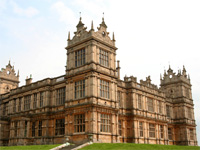
Mentmore Towers, Buckinghamshire (Image: wikipedia)

After various legal battles it seems that Mentmore Towers, one of the finest country houses in the UK may be for sale.  Part of the property empire of Simon Halabi, who was declared bankrupt in April 2010, it was bought with the intention of turning it into six-star country hotel with the ‘In and Out Club’ as the London clubhouse.  The plans were thwarted by the global financial crisis which not only reduced the market for such a venture but also the financing.  Now with the recent £150m sale of Halabi’s prime London West End estate, which included the ‘In and Out Club’, putting Mentmore on the market is the next logical stage of the disposals.

The only source for this story is a blog post by Christian Metcalfe who writes the Legal blog on the Estates Gazette website which has enough details to make it sound very plausible.

The grade-I listed Mentmore Towers was built between 1852-54 for Baron Mayer de Rothschild as one of several country houses built for the Rothschild family in the area.  Designed by Joseph Paxton, architect of Crystal Palace, the neo-Renaissance house was inspired by the Elizabethan ‘Prodigy’ houses such as Wollaton Hall in Nottinghamshire.  Inherited by the Baron’s wife and then his daughter, it then passed to her husband, the Earl of Rosebery, following her early death.  It remained in the Rosebery family until the death of the sixth Earl in 1973 when the then Government stupidly turned down the offer of the house and world-class collections in lieu of death duties, triggering one of the finest country house sales of the 20th-century.  The house plus 81-acres was then sold in 1977 for £220,000 to the Transcendental Meditation foundation as a meditation centre, who cared for the house until it was sold in 1997 to Simon Halabi.  Since then little work has been done on the house and there have long been fears for its condition with English Heritage placing it on the ‘At Risk’ register.

The house is now apparently being quietly offered for sale, by as yet unknown estate agents, for around £16m – but no details on how much land would be included.  At that price, the house would be a bargain on square footage basis alone – but it would require a huge financial commitment from the new owner to not only restore the house but maintain it in the future, ideally as a family home.  The Rothschild’s have remained very much involved with the estate so perhaps this is their opportunity to bring it back into the family – although with Sir Evelyn de Rothschild living at nearby Ascott House perhaps Nat Rothschild, the incredibly successful hedge fund manager said to be worth around £300m, might like to take a look?

Original blog story published June 7, 2010 3:35 PM: ‘Will the real estate agent please stand up, please stand up‘ [Estates Gazette] – @Christian: if I do find out who the estate agent is, I’ll be sure to let you know.

Perfect for a family of five: Knole, Kent

Knole, Kent (Image: Matthew Beckett)

The Sunday Times ‘Home’ section (9 May 2010) features an article which gives some insight into the concerns that might naturally arise when you inherit a huge house in this day and age.  When the 7th Baron Sackville inherited the vast Elizabethan Knole house in Kent in 2004 he and his wife had to decide whether they even wished to move from a four-bedroom cottage on the estate into one of the treasure houses of England with its 365 rooms, 52 staircases, 12 entrances, and 7 courtyards. Luckily shared with the National Trust since 1946 it is still a huge responsibility.

Despite having to share the house with the 80,000 annual visitors, with a house this size it’s quite possible to still hide the several members of the Sackville family who have apartments in the house or estate.  The Baron occupies the south wing whilst his mother lives in the north wing within a building with a footprint of approximately 4-acres with an exotic roofline which gives the impression of a small medieval town.  Even in these restricted quarters the family enjoys nine bedrooms and multiple reception rooms including a room known as the colonnade with superb trompe l’oeil decoration and a huge library along with the more domestic kitchen and ‘flower’ room.

The Sackvilles have long  opened Knole to the public starting in the early 1800s and had it’s first guidebook in 1819.  The fortunes of the town of Sevenoaks, which sits on the edge of the park, was increasingly dependent on the tourists, much as Leamington Spa and Warwick became on the success of Warwick Castle.  However, after the last of the male line of Sackvilles died in 1843, taking the Dukedom of Dorset with it, a series of inheritances left it, after various family challenges, with Lord Buckhurst in 1870, the eldest son of one of the last Duke’s daughters.  Although the house had remained open in the 1874 season, however he decided, for reasons which are not entirely clear, to close the house in October of that year.  He then removed the various access privileges which had been afforded to the people of Sevenoaks.  This prompted first local grumblings, then letters to the paper, then letters to Lord Sackville (as he had now become), until in 1883 it spilled over into the now infamous ‘Knole Disturbances’ where the locals, roused by stirring speeches,  tore up the gates and chains which had blocked their access, before marching to the door of the house.  However, all this left the cantankerous Lord Sackville unmoved and the house and grounds remained closed until after his death in 1888.

One side effect however of this was the raising of questions nationally as to the levels and rights of access to these parks and estates which were increasingly seen as something the public could enjoy at their leisure.  These sort of questions and the resulting answers, which were clearly in favour of the preservation of these open spaces – and later the houses – eventually led to the creation of the National Trust, which is now the current owner of Knole, and very unlikely to ever close the gates again.

Full story: ‘Living it large with 365 rooms‘ [The Sunday Times]

National Trust: ‘Knole, Kent

A labour of love: the restoration of Hammerwood Park

Hammerwood Park, Sussex (Image: South Downs Living)

Once a house has sunk to such a level of dereliction that even the developers won’t take it on, this can easily lead to an application for demolition and the loss of another piece of our architectural heritage.  Yet, as we see in the media, there are often people willing to commit themselves and their money towards saving these beautiful homes – Hammerwood Park is one which certainly falls into this category.

The house was built in 1792 for Benjamin Sperling and is particularly important as the design of the house was the first commission of Benjamin Latrobe (b.1764 – d.1820) who was later to be hugely influential in the direction of American architecture.   Latrobe had studied architecture privately and served for a year from 1789 as an architectural draughtsman in the office of neo-Classical architect S.P. Cockerell. Howard Colvin suggests that Latrobe was also strongly influenced by the work of French architects such as Étienne-Louis Boullée whose own strictly neo-Classical style emphasised the paring back of unnecessary ornamentation and the use of grand scale with repetitive elements.  Through Hammerwood Park it’s possible to see this philosophy in practice with the giant pilasters on the garden front and the miniature temples on the flanking wings.

The early death of Latrobe’s wife in 1793 caused him to abandon Britain and head to America where he made friend’s with President George Washington’s nephew.  It was these contacts which enabled him to obtain further commissions including the Bank of Pennsylvania in Philadelphia which has been described as the ‘first monument of the Greek Revival in America’ (dem. 1867).  It was this and his later work designing the first Capitol building in Washington which so greatly influenced the future of American architecture towards the ne0-Classical which is so evident even today.

That a building as interesting as Hammerwood Park was ever allowed to deteriorate to that extent was unfortunately all too common in the post-WWII era. It is only the dedication of it’s current owner, David Pinnegar, that has probably saved the house from conversion or even demolition.  After various owners it was requisitioned during WWII for use by the Army who left it in their usual poor condition.  Post-war, the Chattell family, who then owned the house, sub-divided the house into flats but as dry rot took hold, the residents moved out and the house was sold in 1973 to the rock group Led Zeppelin for use as a country retreat to work on their music. However, touring commitments meant they never moved in (and rumour has it they even forgot they owned it) and whilst empty, thieves took the roof lead leading to massive wet rot outbreaks.  The house was boarded up in 1976 before finally being offered for sale in 1982 in Country Life magazine with the marvellous understatement that it was ‘in need of modernisation’.

David Pinnegar, then only 21, bought the now grade-I listed house and has since dedicated his life to its restoration.  The vast house has revealed many interesting architectural nuances as he and many volunteers have worked through the vast catalogue of repairs. Although he has secured some grants from English Heritage, the vast majority of the work has been financed through day visitors, B&B guests, and its use as location for a wide variety of films and music video shoots.  In many ways, David’s dedication is proof that all houses, no matter how poor their condition, can find a saviour.

Full story: ‘Hammerwood Park, East Grinstead: Whole Lotta Love‘ [South Downs Living]

House website: ‘Hammerwood Park

Empty walls? The sale of contents to fund the house – Althorp House

Althorp House, Northamptonshire (Image: Andrew Walker @ wikipedia)

For hundreds of years the political power of a country house was in the ownership of the house, and most importantly the estate – acreage equated with power even if the land was mortgaged to the hilt.  The paintings or furniture which furnish these houses were not only decorative but assets which were easy to sell off when financial circumstances demanded that money be raised.  An upcoming sale at Christies highlights how this is still the case today – even if the strength of the art market means that fewer works now need to be sold to raise the totals required.

Althorp House in Northamptonshire has famously been the home of the Spencer family since the 16th-century and sits in a 14,000-acre estate.  The family fortune was founded in livestock and commodities which enabled John Spencer to purchase the red-brick Tudor house at Althorp in 1522.  It was this house which the 2nd Earl Spencer commissioned the architect Henry Holland to modernise in 1787-89, encasing it in white brick and tiles and remodelling the interior to create the grade-I listed house we see today.  The Spencer family then built up their connections becoming politically influential but also extensive art collectors.

Today, Althorp is in the middle of a £10m project to put the house on a sound structural footing.  One major task, along with repairing the ornate stonework and the external tiles, is to fix the roof – an undertaking which is taking nine months and requires over 50-tonnes of lead.  Globalisation means that commodity prices have been rising strongly on the back of growing demand from countries such as China meaning the cost of the project has proved too great to be borne through income.  So the 9th Earl Spencer has been forced to put a selection of art, considered ‘non-core’ to the collection by the trustees, up for auction.  However, the flip side to globalisation is the massive wealth creation and more well-funded collectors chasing the best works.  In this case, the quality of the paintings and the robust prices being achieved at recent auctions, it is possible to raise enough money with just a few works.

The highlight is ‘A Commander Being Armed for Battle‘ by Sir Peter Paul Rubens which is expected to fetch between £8-12m which should cover the restoration bill for the house with the other works, including ‘King David‘ by the Italian Giovanni Francesco Barbieri, known as Il Guercino, providing some financial breathing space.  Ironically, the current Earl publicly criticised his stepmother for selling off four van Dycks and a Stubbs in the 1970s and 80s but this time the difference is that the proceeds will be re-invested in the house and estate rather than just simply for running costs.  It’s a fact of life that ownership of a country house is a constant battle against physical deterioration and with grant aid from the public bodies in such short supply it is unfortunately the artistic heritage which is once again being sacrificed to ensure that the family seat remains intact.

Full story: ‘On their uppers: The great aristocratic art sell-off‘ [The Independent]

Auctioneers: Christies – The Spencer House sale will be on 8 July 2010.