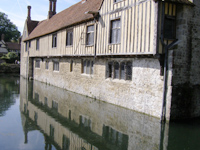
For sale: a Soanian springboard – Burnham Westgate Hall, Norfolk

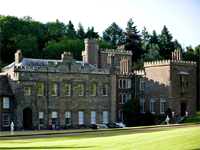
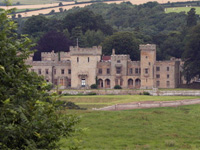
Burnham Westgate Hall, Norfolk (Image: Savills)

For any architect starting out, the early commissions are perhaps the most important; establishing them both in terms of not only their designs but also how they operate in the execution.  In architectural terms, the early buildings of some architects are sometimes less prized, and therefore protected, than their later works which benefit from the full measure of their developed skill and experience.  In that light, Burnham Westgate Hall deserves to be cherished as not only a fine house but also the first substantial country house project of Sir John Soane.  It provided the springboard for one of our finest architects and is important for the promise shown but also for securing one of the most important prizes in the Georgian era: patronage.

For someone who ended up a knight of the realm, with fame and a noble client list, Sir John Soane (b.1753 – d.1837) had a very ordinary start in life as the son of a bricklayer from Goring-on-Thames, near Reading.  Patronage and connections were to define Soane’s personal and professional life, providing opportunities to establish himself in a way that his competitors, often connected from birth, already enjoyed.  Almost nothing is known of his early life but his obvious talent must have been spotted as he entered the office of George Dance the Younger in 1768, though only starting as errand boy, via an introduction by James Peacock, an employee of Dance who knew Soane’s older brother.
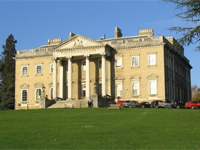
Claremont, Surrey (Image: Claremont Fan Court School)

His talent and work ethic propelled Soane to join the Royal Academy Schools in 1772, where he quickly won the silver medal for a measured drawing of the facade of Inigo Jones’ Banqueting House.  What was particularly clear during Soane’s time at the Royal Academy was his ambition and an industriousness that was to serve him well in later periods, combined with an attention to detail which proved to be a blessing in his professional life.  In 1776, he won the Academy gold medal, which made him eligible to compete for the highly coveted King’s travelling scholarship which, for someone of Soane’s limited financial means, would be his only chance to see Italy first-hand.  Soane had heard that George III thought him a suitable candidate and so he rashly gave up his position with Henry Holland (where Soane was known to have assisted on three country house commissions: Claremont in Surrey, Benham Park in Berkshire, and Cadland in Hampshire (dem. 1953)) only to find out that Sir Joshua Reynolds had intervened to demand the winner of the scholarship be by vote from the Academicians. This delayed his departure by a year but it was put to good use completing smaller tasks for Henry Holland such as estimating bills and measuring work which exposed him to clients such as Thomas Pitt, 1st Baron Camelford; a man of noted taste and an amateur architect who was to prove particularly important in Soane’s career.  Though delayed, in 1777 Soane set off on the single most important trip of his life to Italy; one which was to establish him professionally and socially.

Arch of TItus, Rome - drawing by Sir John Soane
Arch of TItus, Rome – drawing by Sir John Soane

The Grand Tour had become an institution amongst the younger aristocrats as a way of experiencing the glories of classical art and architecture in their native environments.  It was also a fine opportunity for the wealthy to indulge their passion for art collecting but, for novice architects, days were largely spent measuring and recording the wonders of Roman architecture.  On a more practical level, Soane would have seen and experienced during his time with Dance and Holland how useful family and professional networks were in securing commissions.  In Italy, Soane worked assiduously to develop his own connections; travelling with his friend Robert Furze Brettingham (nephew of the famous architect Matthew Brettingham the Elder who had designed the original Burnham Westgate Hall, then called Polstede Hall) and visiting the English Coffee House; a central meeting point for the English nobility abroad, whom Soane courted as clients.

Soane's proposed design for Downhill, Northern Ireland (Image: Sir John Soane's Museum) - click to see full sketchbook page
Soane’s proposed design for Downhill, Northern Ireland (Image: Sir John Soane’s Museum) – click to see full sketchbook page

Patronage could also be a double-edged sword, with the ambitions of the client giving what could turn out to be false hope to an architect.  Of all those Soane met in Italy, Frederick Hervey, Bishop of Derry, later the 4th Earl of Bristol, was a prime example of the capricious client – though despite the Earl’s failure to deliver, he did introduce Soane, once again, to Thomas Pitt, Lord Camelford, and cousin of William Pitt the younger, and who became a lifelong friend, supporter, mentor and patron.  Soane had fallen under the influence of the Earl, a charming, witty aristocrat who had a growing reputation for being a difficult client.  How much Soane knew of this is unclear but after travelling through Naples and Sicily for many weeks together discussing architecture, Soane believed he would be given a handsome commission to improve Downhill (now a ruin), the Earl’s rather bleak seat, set in the coastal hills of County Derry, Northern Ireland. However, after persuading Soane to cut short his travels by a year and luring him over to Ireland in 1780, after six fruitless and frustrating weeks with the disagreeable Earl not committing to any of Soane’s designs, he left Ireland in despair, seriously out of pocket, and with the hopes of his first significant commission of his architectural career in tatters.

Rustic dairy at Hammels Park, Hertfordshire (Image: Sotheran's)
Rustic dairy at Hammels Park, Hertfordshire (Image: Sotheran’s)

Back in London, Soane’s wealthy and well-connected friends, particularly those he had made in Italy, and especially Pitt, sought to ease his plight by asking for his designs for smaller estate buildings or their own houses, such as for his friend John Stuart at Allanbank, Berwickshire.  Again, although the smaller projects were built, the larger plans failed to materialise – the only one of significance being some limited  alterations to Petersham Lodge, one of Lord Camelford’s homes.  After this, Soane took on a few smaller commissions from other clients which allowed him to develop his skills as an architect, not just in designing but the delivery of the projects, including the elegant dairy in the fashionable rustique, Rousseau-esque style at Hammels Park, Hertfordshire for the Hon. Philip Yorke, later 3rd Earl of Hardwick – another of his Italy contacts.

Proposed design for Allanbank, Berwickshire by Sir John Soane (Image: Sir John Soane Museum)

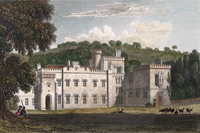
However, it was his main supporter, Lord Camelford, who provided the largest commission in 1783, the one which elevated Soane from dreamer of grand plans but only executor of small estate buildings.  Camelford’s wife had inherited Burnham Westgate Hall and now her husband wished to create a seat of suitable standing near to that other fulcrum of political influence in north Norfolk, Holkham Hall, home of the Earl of Leicester.  Burnham Westgate is curious in that it is one of the early examples of Soane’s practice of reusing his designs.  Compare Burham Westgate Hall today with the unexecuted design illustrated right which Soane completed for John Stuart at Allenbank – the overall form of the house is similar, differing only in the striking chimneys and the size of the flanking wings.  Soane seemed to do this less as he grew as an architect but it can be seen in his bow-fronted design for Saxlingham Rectory and enlarged version seen on the south front of Tendring Hall (dem. 1955), and even more directly between Shotesham Hall in Norfolk and Piercefield near Chepstow.

Burnham Westgate Hall has perhaps been a little overlooked in the literature, perhaps suffering from being overshadowed by Soane’s next project: his first solo, entirely new-build house; Letton Hall, which was started in the following year in 1784.  However, the innovation of Letton could only be created on a sound architectural foundation which Soane had spent years building; the smaller commissions of temples, kennels and interiors, before Burnham Westgate gave him the opportunity to demonstrate that he was capable of working on a project of that size.  Bar the limited and hotly contested public works, private country houses were some of the most significant commissions available to any architect and Burnham Westgate was Soane’s calling card; his proof of his ability, imagination and practical ability to deliver a fine house suitable for those in upper society.  That it is a close variation on a earlier design can be forgiven considering the nascent stage of his career; this sale offers a new owner the chance to own the project which gave Sir John Soane the springboard which helped establish this most brilliant of architects.

————————————————————————————–

Property details: ‘Burnham Westgate Hall‘ – £7m, 38-acres [Savills]

Detailed listing description: ‘Burnham Westgate Hall‘ [British Listed Buildings]

Further information:

————————————————————————————–
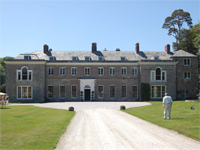
The most expensive UK country house: Park Place, Oxfordshire

A new record price for a UK country house has just been achieved with the sale of Park Place, near Henley-on-Thames, in Oxfordshire.  One of three most notable estates on that stretch of the Thames, it was also the most expensive country house ever sold in its unrestored state in 2007.  Now, after five years and many millions of pounds, the house again has set the record having been sold to an unknown Russian billionaire for £140m.

'A view of Park Place, Henley' - artist unknown - c.1742-3 (Image: Royal Collection) - click to see full image

Park Place is, at its core, a more modest Georgian house built in 1719 for Lord Archibald Hamilton, son of the Duke of Hamilton.  The proximity to London and the beautiful setting has long attracted the wealthy to the area as a convenient escape from the city, with several riverside estates featuring a series of impressive houses.  Starting at Marlow, the first house is Bisham Abbey (now the national sports centre), then the now lost Temple House (dem. 1910), Harleyford Manor (beautiful small villa restored in 1989), Whittington House [pdf] (rebuilt by Reginald Blomfield c1897, now HQ of SAS Ltd), Danesfield House (now a hotel), Medmenham Abbey (now two houses), Culham Court (sold for £38m in 2006), Greenlands (now Henley Management College), Fawley Court (sold for £13m in 2008, possibly for conversion back to a private house), and then finally, just past Henley, lies Park Place.  Of particular interest are the architectural similarities between Fawley Court (built 1684 – reputedly to a design by Sir Christopher Wren), the original Park Place (built c1718), Culham Court (built 1771), and Reginal Blomfield’s 1897 rebuilding of Whittington House, all of which are on based on a red-brick 5- or 7-bay, two storey villa with bulls-eye window inserted into a projecting pediment.

Park Place, Henley - c1810 (Image: Thames Pilot) - click for the full image

Sadly, Park Place is no longer part of this architectural brethren having undergone a series of substantial changes.  The house was sold by Lord Hamilton in 1738 to Prince Frederick, then Prince of Wales and eldest son of King George II, who split his time between there and Cliveden. After Frederick’s death, the house was then bought by General Henry Seymour Conway in 1752 and it was he who made the first significant changes both to the house (including a library by Sanderson Miller in 1757) and, perhaps more importantly to the grounds, which are now grade-II*. His works, to designs by Thomas Pitt, 1st Baron Camelford, included the installation of an ancient stone henge given as a gift from the people of Jersey where he was Governor, the lightning-damaged steeple from St Bride’s Church as an obelisk, four more obelisks as gateposts, an underground cavern, and a bridge, using stones from Reading Abbey, which was subsequently admired by Horace Walpole.  There was also an artificial classical ruin designed by James ‘Athenian’ Stuart.

Park Place, Oxfordshire - c.1900 (Image: henleyonthames.org)

The house was sold to John Noble in 1871 but was largely gutted by fire a year later, giving Noble the opportunity to indulge something of an architectural whim.  The pattern and style of the Victorian country house was much admired around Europe and our expertise was exported widely around the continent – but it rarely flowed back (a topic already covered in an earlier post ‘The rise and fall of French taste on UK country houses‘).  Park Place is one of the few houses in the country build using the French Renaissance style, creating an impressive château in the heart of England.

The design of the rebuilt house is widely attributed to Thomas Cundy [III], the son and grandson of two previous Thomas’ who had also been country house architects. Although the latter two are given sizeable entries in Howard Colvin’s ‘Biographical Dictionary of British Architects‘, the grandson is given only a paragraph as part of his father’s, leaving us somewhat in the dark as to what, bar some London churches, he may have been involved with. However, considering his father had good form with the chateau style having built Grosvenor Gardens in London, so Thomas III would have been schooled in the style before his father’s death in 1867.

The house remained with the Noble family until 1947 when it and the 670-acre estate was parcelled up into 22 lots and sold off.  The main house was bought by Middlesex County Council who converted it into a special school, which it remained until 1988 when it closed. The house was then bought by John Latsis, the Greek shipping tycoon, but it seems unlikely that he lived there as it remained unrestored, with the vestiges of the school – gymnasium, classrooms, a woodwork studio etc – all still in situ, along with various outbuildings, as can be seen from these images of the house.

Those who had a chance to look around the house when it was for sale in 2006 all noted that beneath the shabby institutional veneer, the potential of the house was clear; glimpses of fine tiles, the original stone fireplaces, stained glass, and grand spaces with impressive views.  The house was then sold to a consortium who intended to create a superior country club – until Wokingham council said ‘no’.  Put on the market for £45m, it was finally sold for £42m to Mike Spink, a property developer who specialised in high-end houses in central London. With this experience, Spink transformed this once dilapidated house into a palace fit for a billionaire with all the requisite features such as a helipad, swimming pool, panic room etc.  Somewhat disappointingly, the house now only comes with 200-acres, with the remaining 300 with which it was sold retained by Spink for as yet unspecified ‘development’ – a phrase which will no doubt spark local concerns.

Even when it was first sold, those in the property business were predicting that Park Place would sell for possibly up to £100m, and the rising ‘super prime’ market has proven even those estimates conservative.  Sadly, this record is not for a spectacular historic house at the centre of a large estate but instead one where the location (location, location!) has elevated the price to such a stratospheric level. Nevertheless, many country houses were built as retreats for wealthy industrialists and financiers and this house is proof that the lure of the trophy country estate is as strong as ever – which can only be a good thing for those seeking to prove their desirability in modern times.

———————————————————————–
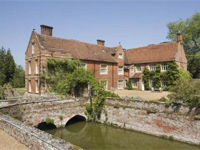
Story about the original sale: ‘Sold for £42m… still in need of renovation‘ [Daily Telegraph]

Latest sale: ‘Park Place: Britain’s most expensive home sold for record £140m‘ [Daily Telegraph]

Country House Rescue: the weight of history – Kentchurch Court, Herefordshire

Kentchurch Court, Herefordshire (Image: mhaswell / flickr)

For some who inherit, the weight of family history can easily overcome the burden of running a historic home on a limited budget.  As we saw in the previous episode of Country House Rescue at Trereife House in Cornwall, the desire to not be the generation which loses the ancestral home, a prospect which faced the Le Grice family who had been there since 1799.  So imagine the weight of responsibility facing the Lucas-Scudamore family who have lived for ten centuries at Kentchurch Court in Herefordshire.

The house itself was originally a Saxon tower with further additions in the 14th-century.  However, the main style of the house as it stands today is due to work commissioned from the famous Regency architect John Nash (b.1752 – d.1835).  More importantly, Kentchurch is a significant as one of a number of houses built in the area around that time which were a visible expression of a new wave of architectural fashion; the Picturesque.

Strawberry Hill, London (Image: D Kendall / EH Viewfinder)

When thinking of Georgian architecture many think of the symmetrical classical façades and strictly proportioned Palladian designs which were so prevalent in that era.  Yet one house, Strawberry Hill in Twickenham, south London, was to be the catalyst for a new way of thinking, breaking these patterns and ushering in a more organic way of viewing architecture. This saw the house as part of a landscape with the design playing its part in the beauty of the view as much as the lakes, gardens and parkland. Originally an unremarkable house, it was bought in 1747 by the wealthy Horace Walpole, 4th Earl of Orford and fourth son of Walpole the Prime Minister, who was an astute observer of society, art, and architecture. Walpole contributed little to art but was particularly well read and as he pursued his academic studies decided to start experimenting with alterations to his house.

Fonthill Abbey, Wiltshire (Image: John Rutter (1823) / RIBA)

His original changes from about 1749 were uncontroversial and, importantly, followed the convention for symmetry.  However, from 1753 onwards the interiors were fashioned in a gothic style with the help of what he called his ‘Committee of Taste’ comprising a few of his equally well-read friends.  This experimentation was confined to the interiors until, in 1759, he broke with architectural convention and had a great circular tower constructed but which, radically, had no matching pair.  The house was to continue to grow in a rather free fashion which can still be admired today (particularly so following the completion of phase one of a fantastic restoration by the Strawberry Hill Trust, the Heritage Lottery Fund and the World Monuments Fund). The house became famous, attracting day trippers in large numbers and spawned imitators; though it was James Wyatt’s Lee Priory (built 1785-90 – dem. 1955) which was said to the be first ‘child of Strawberry’.  Also considered worthy, and also designed by Wyatt were the fantastical Fonthill Abbey (collapsed in 1825) for William Beckford, and Ashridge Park for the 7th Earl of Bridgewater.

Downton Castle, Herefordshire (Image: gardenvisit.com)

One man particularly taken with this new style was Richard Payne Knight, a Herefordshire MP and intellectual with a large inheritance.  Using his wealth, in 1774 Payne Knight started the construction of a new home, Downton Castle, which bore similarities to Strawberry Hill, with the asymmetry and a large circular tower, and an irregular plan which was quite radical for the time.  This house was a prototype for a new ‘castellated’ style of house which was to be popular for fifty years from about 1790.  Driving this new style was the publication of three key books, the first two in 1794; ‘The Landscape, a Didactic Poem‘ by Payne Knight, and ‘Essay on the Picturesque‘, a brilliant reply in support by Uvedale Price (another local landowner), and, in 1795, ‘Sketches and Hints on Landscape Gardening‘ by the landscape-gardener, Humphrey Repton, who formed a successful and highly influential partnership with the architect John Nash that same year.

Nash had moved to Aberystwyth after his bankruptcy following a failed speculative buildings scheme in Bloomsbury in London.  Yet, the contacts he was to make in Wales led to Nash becoming one of the leading architects of the Picturesque.  The early development of his interest in the ideas of the movement can be seen when he designed a castellated triangular lodge for Uvedale Price sometime between 1791-4.  He also worked for Thomas Johnes at the spectacular Hafod estate where Johnes had planted 3 million trees to paradoxically create a more ‘natural’ looking Picturesque landscape.

For Nash, the ideas he developed in that short period from 1790 until he left to go back to London in 1796, were what made him one of the most significant architects of the period. The influence of Downton Castle and Nash also created a strong regional collection of these mock castles – Garnons (dem. 1957), Saltmarshe Castle (dem. 1955), Goodrich Court (dem. 1950), Garnstone Castle (by Nash, built 1806-10 – dem. 1958) Hampton Court Castle (alterations 1830s-40s) and extending down to Devon where Nash designed perhaps one of his best creations; Luscombe Castle (built 1800-4), and into Cornwall, where he designed Caerhays Castle (built 1807-10).

Kentchurch Court from "Views of the Seats, Mansions, Castles, etc. of Noblemen and Gentlemen" (London : 1829-1831)

By their very nature these were large houses and often a little impractical which sadly meant many were demolished.  This is why Kentchurch Court is important – not only is an early work by Nash in the style of house which was to become his trademark, but it’s also one of the survivors of the tragedy of the many demolished country houses.

Perhaps the current Mrs Lucas-Scudamore should be grateful, in some ways, that their branch only inherited some fine carvings from the sale of the other much grander family seat, the grade-I Holme Lacy House (now a hotel) rather than the house itself with its 9 fine rooms with plaster ceilings which Pevsner though to be some of the best in the county.  The story of Kentchurch Court today is a familiar one of a family with an incredible history and a fine house and estate struggling with the usual demands for maintenance and £120,000 per year running costs.  Mrs Lucas-Scudamore and her two children (Mr Lucas-Scudamore being estranged and living away) battle on with determination but managing a house like this requires a money tree not a family tree – but this house is too important to be neglected.

Country House Rescue: ‘Kentchurch Court‘ [Channel 4]

Country House Rescue: efforts misapplied – Trereife House, Cornwall

Trereife House, Cornwall (Image: matt bibbey / flickr)

Inheritance is a double-edged sword – for all the perceived luck of being given a large country house, the reality is that, in many cases, the house requires significant investment.  For some, this is a chance to shine; to put in place the plans they had been making, or develop new talents and unexpected skills. For others it quickly becomes burden as it pushes them into situations they seem unprepared for – as it frequently proves on Country House Rescue.  This week (27 March), heading back down to the south west, Ruth Watson visits Trereife House in Cornwall, to a house threatened by the odd schemes of the owner.

Antony House, Cornwall (Image: mothproofrhubarb / flickr)

Trereife (pronounced ‘treeve’) nestles in the hills above Penzance, an neat pink hued Queen Anne house with an elegant parterre garden laid out below the south front.  The original house was an Elizabethan farmhouse which was home to the Nicholls family, who had become wealthy landowners and minor gentry through farming and marriage.  The first records of them is the marriage of William Nicholls (also known as William Trereife) in 1590, though it is thought the family had been in the area for several generations earlier.  The design of the grade-II* house as we see it today is the result of an extensive rebuilding in 1708 which not only added the wonderful Queen Anne front with its hipped roof but also created some fine interiors with plasterwork ceilings, probably by travelling Italian workmen, who were known to have worked on several houses in the south west.

Boconnoc House, Cornwall (Image: cornishmoth / flickr)

Architecturally, the echoes of the style of Trereife can be seen at the much grander Antony House for the much wealthier Carew family. The house was begun in 1718 shortly after Trereife’s remodelling and so is technically Georgian (Queen Anne died in 1714) but the basic form of the house is similar.  Also Boconnoc House, near Lostwithiel, displays the same two-storey with dormer windows design as Trereife and Antony – though again for a much wealthier family, the Pitts.  Boconnoc features later alterations in 1786 by Thomas Pitt, cousin of Pitt (the Younger) the Prime Minister, in conjunction with Sir John Soane, who he had met in Italy in 1778, which probably explains the serlian window to the projecting bay.  Another house of a similar design was Dunsland House, Devon which was one of the most important houses in the area, with particularly fine plasterwork, which sadly burnt down in 1967.  On a smaller scale than any of these, but possibly even more beautiful, is Great Treverran, near Fowey, a compact (one room deep) house built in 1704 but given a dose of grandeur with fine granite Ionic columns, it was last sold in 2003 for around £650,000 and is now wasted as a holiday cottage.

Trereife is a significant part of a great tradition of Cornish houses with a fine family history with connections to the Romantics such as Coleridge, Wordsworth, Charles Lamb and Leigh Hunt through Revd Charles Valentine Le Grice, affectionately known as ‘CV’.  The house passed to the Le Grice family through inheritance in 1821 following the marriage of Mary Nicholls, whose son had died childless, to ‘CV’ in 1799.  The house is now owned by Tim Le Grice, a solicitor who inherited the neglected house in 1986 from his grandmother and who now lives at Trereife with his family.

Sadly, Tim appears ill-equipped for the role as country house rescuer as a series of slightly eccentric – gypsy caravan theme park anyone? – or badly planned business ventures have taken up significant time and money with little to show for it.  For the family, the £40,000 per year running costs were proving ruinous and so they turned to Ruth for advice; which is typically hard-hitting.  Much as the family would rather avoid having their family finances shared with the nation this appears to be the only way to persuade Tim that he needs to draw on the skills and experience of his literary agent daughter to organise events and his wife to develop the potential for B&B and weddings within the house.  Considering that the house now comes up well in Google searches as a venue for weddings and events it seems that Ruth was right – and has hopefully enabled another family to remain in their ancestral home.

——————————————————————

Country House Rescue: ‘Trereife House‘ [Channel 4]

Official website: ‘Trereife House

Interiors: ‘Trereife House‘ [UK Film Location]

Official Facebook page: ‘Trereife House

More details: ‘Trereife – a family home‘ [Cornwall Life]

If a moat floats your boat: for sale; Playford Hall and Giffords Hall, Suffolk

Baddesley Clinton, Warwickshire (Image: Nala Rewop / flickr)

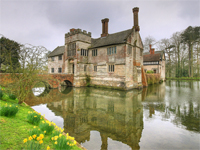
Moated houses are an architectural short cut to a more functional time when where a family lived had to be defensible and not simply a place of relaxation.  Today, of course, we admire them for their ancient charm, the weathered bricks reflected in gently rippling waters.  These houses are an older expression of our love of the natural, which found a more formal form in the later Picturesque movement, their more organic outlines in contrast with the more rigid classicism which followed.

Though once numerous, time has taken its toll and excellent examples are less common – and especially appealing when they come to market, as two have recently. The moated manor house was a result of many factors; the decline of the traditional castle, a more peaceful society, and increased wealth, but still with a need to provide some defence against thieves and attackers.  The latter category was increasingly rare but a moat with gatehouse and even drawbridge had a practical advantage.  However, for families which wished to visually bolster the perceptions of the grandeur of their lineage, a moated house was very evocative of permanence and status, drawing on their architectural ancestry with castles.  As each manor required somewhere for the local owner to stay (sometimes only occasionally if they owned many) each had a house of varying size and status depending on the wealth of the owner.  As each manor often covered a relatively small area this led to the building of thousands of these houses (though not all with moats), particularly in England.

Groombridge Place, Kent (Image: Hans Bernhard / wikipedia)

The organic growth of a moated house often created a pleasing historical collage of styles, such as at Ightham Mote, Kent, though this was sometimes swept away to be replaced by a new house such as at Groombridge Place, also in Kent.  This beautiful house was build in 1662 though in a traditional Jacobean/Elizabethan ‘H’ plan on the footprint of the older, more fortified house – though the diarist John Evelyn thought, following his visit in August 1674, that “…a far better situation had been on the south of the wood, on a graceful ascent.” indicating not everyone found a moat romantic.

Yet not every grand family felt the need to abandon the old house.  The Lygon family (Earls Beauchamp between 1815-1979) have lived at the evocative Madresfield Court, Worcestershire for 28 generations.  At its core, a 15th-century moated manor house, the current building is largely the work of the architect Philip Hardwick in 1865 for the 6th Earl Beauchamp.  The house is a prime example of late Victorian taste; a clever blend of Anglo-Catholic Pugin gothick with extensive Arts-and-Crafts interiors including a wonderful library by C.R. Ashbee of the Cotswold Guild of Handicraft (to read more about this remarkable family and house I can recommend ‘Madresfield: the Real Brideshead‘ by Jane Mulvagh).

Ightham Mote, Kent (Image: Matthew Beckett)

The physical security of a moated house was also a factor in its decline as it limited the space available for expansion as either the family, wealth or ambition of the owner grew. Many a grand country house was constructed elsewhere to replace a smaller manor with the old house either being abandoned, demolished (sometimes for building materials), or used as a secondary or dower house.  Yet, as a harsher economic reality came to pass from the 1880s, and as these smaller houses were lauded in magazines such as Country Life, so their attractiveness grew with many rescued from neglect and sometimes reinstated as a principle house on the estate.

H. Avray Tipping, one of the most influential of the Country Life writers, was a prime supporter of the smaller houses as reflected in his choice of house for the weekly ‘Country Houses and Gardens’ section – nearly a fifth of them in 1910, for example.  This was also a time when John Ruskin was arguing for more honesty in architecture and against the over-enthusiastic renovations of the Victorians which he regarded as ‘ignorant’. This regret at the neglect of manor houses in general can be seen even in the earliest Country Life articles.  Writing in 1897 (the year it was founded), John Leyland writing about Swinford Old Manor, Oxfordshire, said;

“There are manor houses through the length and breadth of the land as charming, it may be, as this, but awaiting, like sleeping beauties, the kiss that is to arouse them to fresh and unsuspected charm, the needed touch of the loving hand invested with creative skill.”

Plumpton Place, Sussex (Image: Knight Frank)

Perhaps one of the best examples of this loving restoration can be seen at Plumpton Place, Sussex for Country Life proprietor Edward Hudson by the architect Sir Edwin Lutyens.  When Hudson bought the it in 1928 the house was semi-derelict though with an intrinsic beauty from its setting on an island in the middle of the uppermost of three lakes.  Lutyens successfully restored and adapted the house to create one of the best current examples of a moated manor house – which was also offered for sale in July 2010 for £8m (and featured in another post: ‘For those who like their houses with pedigree: Plumpton Place, Sussex‘)

So having whetted our collective appetites, those with £3.5m to spare currently have a choice of two historic moated manor houses in Suffolk; Playford Hall, near Ipswich (£3.25m), and Giffords Hall, in Wickhambrook (£3.5m).

Playford Hall, Suffolk (Image: Savills)

Playford Hall has the beauty of the warm red-brick with two wings placed off-centre, hinting at the further wing demolished in the 1750s after a devastating storm in 1721 blew holes in the roof and following a long period of dereliction from 1709 following the death of the owner, Sir Thomas Felton, who had remodelled the house in its current style.  The house then passed by marriage into the estate of the Earls of Bristol, in which it remained until sold after WWII.  The house has been restored and updated – though whoever buys it will probably want to re-do the eye-wateringly pink dining room.

Giffords Hall, Suffolk (Image: Savills)

No such concerns about the wonderful interiors of Giffords Hall – the house abounds with historic woodwork, from the masses of exposed beams to the extensive panelling.  The exterior, in contrast to Playford, is almost entirely timber-framed, with an Arts-and-Crafts style north wing added in 1908 by the owner Mr A. H. Fass who also carefully restored the house following a period of neglect.   Now cleverly brought up-to-date, in co-operation with English Heritage, the house now has a full suite of reception rooms, a new kitchen and a full quota of bathrooms.

So, proving the folly of those who allowed these romantic houses to decay and the wisdom of those who restored them – with thanks to the evangelism of Country Life – another important branch of the nation’s architectural history has been redeemed and now, once again, attracts high valuations which reflect the immediate attraction these houses can exert on us all.

—————————————————————————-

For further reading, the excellent ‘The English Manor House – from the archives of Country Life’ by Jeremy Musson – though unfortunately this appears to be out of print and surprisingly expensive. One for the second-hand bookshop search, I think.

For those looking to visit, a handy list: ‘Manors in England‘ [Britain Express]