“To add a library to a house is to give that house a soul”; the rise of the country house library

Long Library, Eastnor Castle, Herefordshire (Image: Eastnor Castle)

In country houses, perhaps the greatest indulgence is to be able to create on a much grander scale. Not for them a few flowers beds; no, there are acres of careful horticulture, nor do they have small dining rooms, or a few pictures.  Yet few rooms in a large country house are as impressive as one which boasts a well-stocked library; regimented rows of bound knowledge, reflecting the interests and passions of generations. Yet libraries are more fluid than many imagine; with their creation sometimes comes their dispersal, but this is a cycle, with those books then finding another shelf, helping build the portrait of their new owner, one title at a time.

Books have always had a greater intrinsic value than just the words or knowledge they contain.  Having developed from clay tablets, via way of papyrus, to animal skins, books became spectacular art works in their own right in the hands of the monasteries whose illuminated manuscripts spoke of their devotion through beautiful calligraphy and iridescent miniature paintings. The effort involved made them scarce so the wider collecting of books largely only became possible due to mass production following the invention of the printing press by Johannes Gutenberg in 1439.

Although books had formed part of the interests of the royal family since the 14th-century, it wasn’t until the rise of the post-Reformation Tudor bureaucrats who, influenced by the Renaissance, sought to use knowledge, rather than battle prowess, as their means to advancement.  Education was now seen as key and this was reflected in the growth and composition of the gentleman’s library for centuries to come.  Yet, there were still a remarkable number of the gentry who had little interest in books, a trend which grew stronger the further from Court they lived; Girouard notes that in the 1560s, ninety-two out of 146 Northumberland nobles were unable to sign their name, and that in 1601, Bess of Hardwick kept only six books at Hardwick Hall.

Library (1675), Ham House, Surrey (Image: Country Life Picture Library)

As intellectual pursuits became more acceptable so too did acquiring books in larger numbers.  Paintings of ‘gentleman’s closets’, which held all things most precious to the man of the house, often showed books, and in quantity; an inventory in 1556 for Sir William More at Loseley in Surrey records that he had amassed 273.  Earlier libraries are recorded for the fifth Earl of Northumberland who had created both ‘Lord’s’ and a ‘Lady’s’ libraries by 1512 at Leconfield Castle (demolished 17th century). By the late 16th-century there is the first written reference to the building of bookcases in the form we recognise today; two French craftsmen were working at Longleat in 1563 fitting out the library there (though it was sadly lost in the fire in 1567).  The earliest dedicated library to survive in a private house is at Ham House, Surrey which dates from 1675, installed for the Duke of Lauderdale.
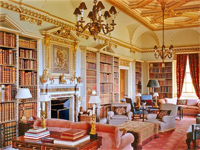
Long Library, Holkham Hall, Norfolk (Image: Holkham Hall)

So how did we arrive at the grand, sumptuous libraries which grace many country houses?  As with so much of that which is beautiful, the elevation of the library can be largely attributed to the Georgians.  The right of passage that was the Grand Tour meant that, increasingly, a wealthy young man would return from several years in Italy having (hopefully) spent his days studying ruins, architecture, art, and sculpture – and, as with all good tourists, he accumulated souvenirs.  Not just any old trinkets; these mementos took the form of paintings and freshly faked statuary but also many books, not only for their education, but also as a way of demonstrating to those back home the wonders which they had seen.  This led to the creation of some of the finest libraries in the country, such as the Long Library created by Thomas Coke at Holkham Hall, as the intellectual interests of the owner found expression through the hundreds, if not thousands, of leather-bound tomes which now lined a dedicated room.
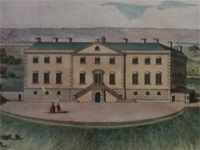
Nanswhyden House, Cornwall (Image: courtesy of Charlie Hoblyn)

Books were now not just the exclusive interest of the man of the house but had become a resource for the whole family and their guests. With the upper-classes now expecting a certain level of culture from those in their social sphere, education became an important part of polite society. To have a library was a reflection on the owner, who gained from them even if he hadn’t read them. Owners provided access to their books to their guests but, as the works were probably also the only significant source of knowledge for many miles, to a select few in local society.  One notable example was at the grand Nanswhyden House, Cornwall which was built in 1740 by Robert Hoblyn and featured a library which “…occupied two rooms, the longest of which was 36ft in length, 24ft broad and 16ft high…” and contained over 25,000 volumes.  Hoblyn intended that his books were “…designed as a standing library for the county, to which, every clergyman and author, who had the design of publishing, were to have the readiest access.”
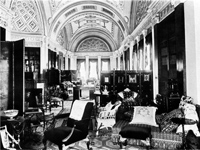
Library (before the fire), Sledmere House, Yorkshire (Image: Country Life)

There was also unofficial access for the staff; at the beautiful Sledmere House, Micheal Kenneally, who arrived as pantry boy and rose to be butler, recalls that when he first arrived he was told to familiarise himself with the house.  In the Library, he noticed a book called ‘Miller’s Sexual Systems‘ on a shelf. “I thought, I’ll read that when I get the  chance. It was seven years before I got the opportunity, and when I opened it, it was the sex life of plants and flowers. After waiting for seven years!“.  The decoration of the Library at Sledmere was designed by the  celebrated plasterer Joseph Rose (b.1723 – d.1780) and completed in 1794.  So proud was Sir Christopher Sykes of this fine and elegant space, he commissioned local draughtsman Thomas Malton to record it.  Two hundred copies of the finished drawing were then created, which Sir Christopher sent to his friends, virally spreading the glory of a spectacular library.  Christopher Hussey, writing about it in 1949, said ‘architecturally designed libraries are a feature of several of Adam’s country houses, notably Kenwood. But this one surpasses them all in majesty of conception, suggesting rather the library of a college or learned and wealthy society; indeed in the space allotted to it, in the amount of shelf room, and in the beauty of its decoration it is surely the climax of the Georgian conception of the library as the heart and soul of the country house‘. Sadly, the original was destroyed in a devastating fire in 1911, though luckily the family still had the original plans, in addition to photographs taken by Country Life in 1897, and so it was rebuilt to exactly the same design as before – after all, how can one improve on such a fine room.
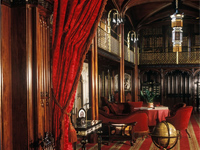
Library, Arundel Castle, Sussex (Image: Country Life)

The role of the library changed in the Regency and Victorian periods.  During the day it was the informal family sitting room, but during evening entertaining it took the mantle of drawing room for the gentleman, as opposed to the formal drawing room which increasingly became the domain of the ladies.  As such, it reflected the status of the man of the house, becoming more masculine, but also richly decorated and furnished to ensure that guests would be comfortable as they admired their surroundings.  Notable libraries of the period include the gloriously gothic Arundel Castle (see also: article in Country Life), the elegant Tatton Park, and the simply spectacular Eastnor Castle (see image at top of the article).

The county house library perhaps reached its zenith in the 1880s as often stable ownership had accumulated a wealth of some of the finest books ever produced.  The intellectualism of the Georgian and Victorian eras had elevated knowledge and learning and exploited them to create the wealth which now funded the artistic pursuits of the social elite.  For all the appreciation of books, notable libraries such as the collection at Stowe had been auctioned off in the 1820s, and following the agricultural depression of the late 19th-century, many libraries up and down the land were plundered as a source of income.  However, today, many still boast thousands of volumes on myriad topics, each part of the historical collage of the family, and creating what are often one of the most admired and beautiful rooms in any country house.

Feel free to add a comment below sharing which is your favourite country house library.

For lots of photos, the ‘Most Beautiful Libraries of the World’ website has a dedicated section: ‘Country House Libraries‘.

—————————————————————————

*NEW* – ‘The Library’ on The Country Seat

To coincide with this I have published a new page on the blog; The Library.  I regularly receive emails asking for book recommendations so this will provide a selection of books on UK country houses which hopefully readers of this blog will find of interest.  The links are to Amazon and I do get a commission if one is bought (though the price you pay is the same) but the money will be re-invested in my library which will benefit the blog.  I now have most of the ‘easier’ books to get hold of and now face the challenge of acquiring the scarcer, more expensive, volumes, so it all helps.
School’s out: seats of learning for sale

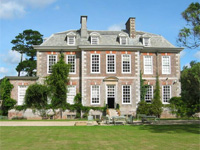
One of the many uses to which our country houses have been successfully adapted to is that of schooling – from the grandest such as Stowe and Bryanston to the many smaller houses which have delighted and terrified children in equal measure for many years.  Even as recently as April 2010, Wispers in Sussex, was sold to a London primary school as a satellite to their main campus. Yet for all the fond memories held by generations of youngsters, private schools and educational colleges are facing their own periods of austerity, forcing some to close.  With closure comes a rare opportunity for a house to once again become a home – though such a move is fraught with practical, and sometimes political, challenges.

Urchfont Manor, Wiltshire (Image: Augustus Photographic via flickr)

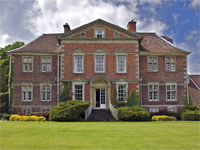
One of the bonuses of writing this blog is to discover houses so little known that, despite their obvious beauty, they seldom appear in books.  Urchfont Manor, Wiltshire is a classic example of this. Currently a residential college, this stunning smaller William and Mary country house was built around 1678 for William Pynsent, a wealthy London barrister, who would have been well-aware of the latest architectural fashions. The architect is unconfirmed but, with the hipped roof and projecting, pedimented centrepiece, it appears to draw inspiration from houses such as Horseheath Hall, Cambridgeshire (though 7-bays to Horseheath’s eleven) designed by Sir Roger Pratt in 1663-5 (dem.1777), and also clear stylistic similarities with houses such as  the north and south fronts of Fawley Court, Buckinghamshire (built 1684-5, by Sir Christopher Wren) and Puslinch, Devon (a late proponent of the style, being built c1720).  One curious anecdote, told to Sir John Julius Norwich, was that the house was substantially altered, creating the elegant east front, about twelve years after construction to designs by William Talman – but Colvin doesn’t mention it and no firm evidence has appeared to support this…so far.

Puslinch House, Devon (Image: Devon Rural Archive)

Urchfont is a fascinating and enchanting smaller manor house which successfully plays the neat visual trick of looking larger than it is – at least from some angles. The two key views of the house are from the main road from the village, which gave a clear view of the east front and the road running below the south front (the house was once more visible; maps from 1880s show only a few clumps of trees, much fewer than there are now).  If one only saw these two fronts, one might think this a large, cube-shaped house – but move round to the north and the house is clearly only one room deep on the east front. A lovely piece of social aggrandisement.  The house passed through various families and was tenanted before being bought by another lawyer, Hamilton Rivers-Pollock, in 1928, who lived there until his death in 1941.  It then became a home for London children suffering from tuberculosis, and was then bought in 1945 by Wiltshire County Council as a residential college.  Now, faced with cutbacks,  the council have decided to sell up, amid much local controversy, giving this beautiful house an opportunity to once again become a home.

The Hill, Abergavenny, Monmouthshire (Image: Cooke & Arkwright)

Across the country in Monmouthshire, The Hill, as the name implies, sits rather proudly on the edge of Abergavenny.  Built in the mid-18th century, the house sits in 20-acres of gardens (which are included on the Register of Parks and Gardens of Special Historic
Interest in Wales) from a once larger estate, the residential spread of the town having crept up towards it.  Sadly, poor planning has led to a small residential estate taking up the grounds to the east of the house, and further buildings associated with its time as a college now stand between them and the house.  This makes it exceptionally unlikely that the house would become a single-family home again but potentially a high-quality development, replacing the modern buildings and respecting the grounds, could offer a workable solution.

Bedgebury Park, Kent (Image: Knight Frank)

On a larger scale, the curse of the associated buildings also blights Bedgebury Park, Kent. The original house of the estate, seat of the influential Culpepper family, financed by a flourishing iron business based on the clay-ironstone on which it sits, was to the east of the current grand mansion (now a lake), and played host to Elizabeth I, who visited in August 1573.  The current house was built in 1688 for Sir James Hayes, a man who had become wealthy through  his wife’s inheritance and financing the recovery of jewels and gold from a sunken Spanish ship.  Sir John Cartier bought it in 1789 and added some impressive plasterwork and the chain of lakes on the estate.  Following Cartier’s death,  Bedgebury was bought by one of the Duke of Wellington’s most trusted men, Field Marshal Viscount Beresford.  He commissioned Alexander Roos c.1838 and the subsequent extensive alterations and the addition of the cross wings to create the H-shape, obscured the red-brick original behind an impressive cladding of warm, honey-coloured sandstone ashlar, creating a house which positively glows in the sun. Inherited by Alexander Beresford Hope in 1854, he made his mark on the house by adding the impressive Neo-Classical stairhall and the striking mansard roof.

Stairhall created c.1850s, Bedgebury Park, Kent (Image: Knight Frank)

The house was bought by the Church Education Corporation with 200-acres in 1919, opening as a school with just five pupils in 1920.  It quickly grew and new buildings were added in the grounds providing extra teaching and residential facilities, before closing in 2006.  Now offered at £7.5m, the grade-II* house sits in a 90-acre estate awaiting its future.  The brochure mentions that the local planning department are open to the idea of it becoming a single unit residence again – a possibly tempting prospect for a billionaire who needs an impressive house, a small estate, and doesn’t mind having to demolish the modern school buildings which have sprung up.  Considering the quality of the interiors, this must surely be a feasible prospect, especially in light of the recent sale of Park Place for £140m which proved that there are those willing to pay exceptional prices for the best quality properties.

Apethorpe Hall, Northamptonshire (Image: English Heritage)

For those seeking to move into a former school which has been partially restored to the highest standards and now only requires the finishing touches (if you have a couple of million pounds available), then possibly the finest option would be Apethorpe, Northamptonshire.  This fascinating Tudor/Jacobean/Elizabethan house has played a supporting role in royal entertainments for 500 years and features some of the finest plaster ceilings in the country – and became a particularly grand school between the late 1940s and 1982, when it closed. Bought by an absentee owner, it languished for years, flirting with dereliction.  Finally, intervention by English Heritage brought it into their care and it’s currently for sale for offers around £5m (English Heritage reputedly spent £7m on the rescue so far), and would require another approximately £4m to complete the restoration.  On an remarkable side note; the fact that Apethorpe was saved from the usual vandalism, arson and theft which so often afflicts empty buildings, was largely due to the tireless efforts of the caretaker, George Kelley, who carried on even though he wasn’t being paid to do so.

The most recent closure (at least partially) is of St Michael’s in Tawstock, Devon.  Originally known as Tawstock Court, it was built in 1787 in a provincial Gothick style to replace an Elizabethan house which burnt down that same year.  Although the staff and parents have made heroic efforts to save it, the concern for them is that the house will fall into the hands of developers who will convert it into flats – and considering the poor job most do of such a task, their concerns are very valid.

In these straitened times, sadly a number of parents and councils will be forced to economise and schools, usually private, may well close.  Sad though this will inevitably be for the many current and former pupils, it does also offer a possibility that these houses may revert to their former role for which they were designed – and few would argue that the spectacular Marshcourt in Hampshire, designed by Lutyens, was better off as a school. However, as the roll call of struggling schools lengthens, it is important that the future of the often wonderful buildings, which gave each school their character, are given due priority to ensure an appropriate transition and restoration if the opportunity arises for them to return to being family homes.

————————————————————————

Original story: ‘Urchfont Manor sale row erupts‘ [Gazette and Herald]

Listed building description: ‘Bedgebury Park, Kent‘ [British Listed Buildings]

A silver lining to an industrial cloud; the Mersey mansions of the Victorian elite

To join the landed gentry you previously needed to have no connection with the vulgar business of actually making money. Even if you had bought a significant house and estate, to be truly accepted (and not be cast off into social Siberia) a gentleman would have to sell all his business interests and retire to live off the proceeds.  Yet, times changed and as it became acceptable to mix business and pleasure, so the requirements of the new gentry altered as they became unwilling to be too far from their sources of wealth, particularly around the great Victorian cities.  Smaller country houses and weekend villas with reduced estates sprang up to meet this new demand, with Liverpool being a prime example of these forces.  Later, as the cities grew, fortunes waned and housing pressures increased, many of these houses were lost; yet, occasionally, a rare survivor appears such as Calderstones Park Mansion House in Liverpool.

Harewood House, Yorkshire (Image: Lee Elvin via flickr)

The Georgian era truly challenged the mystique of inherited wealth and royal patronage being the primary route to social elevation (though both helped).  Money talks, and the vast wealth being created, and the men making it, could not be ignored.  No family exemplified this more than the Lascelles family of Yorkshire. Although the family had been in the county for many years, their purchase of the Harewood estate in 1739 for £63,827 (for an estate of 6000-8000 acres) was with wealth generated only relatively recently.  Henry Lascelles (b. 1690 – d. 1753) had made his fortune largely between 1715 and 1730 as a plantation owner, victualling contractor and Collector of Customs in Barbados. It was his son, Edwin, who, having inherited his father’s vast fortune, set about, between 1759-71, building the grand house we see at Harewood today, to designs by John Carr of York who had already built the stables.  The vast expense of paying Carr, plus Robert Adam for the interiors, Angelica Kauffman and Biagio Rebecca for internal decorative painting, Thomas Chippendale for the superb furniture, and ‘Capability’ Brown for the beautiful grounds hardly made any serious dent in the family fortune.  On Edwin’s death in 1795, he reportedly had an income of £50,000 per year, of which half came from the West Indies business interests.  It was this mercantile wealth which established one of the great houses of the 18th-century, elevated the family to the peerage and enabled them to become a local political force, all in the space of just 60 years – something not possible on the limited and sometimes uncertain income of an estate alone.

Picture gallery, Dawpool, Cheshire (Image: H Bedford Lemere, Bedford Lemere & Co / copyright: English Heritage/NMR)

The 19th-century only saw this trend accelerate with the great wealth of the cities now a serious challenge to the old inherited wealth of the land. This was especially true since, following political reform, land holdings were not always necessary to secure power and influence.  Now the owners could indulge their preferences, as not all of them, having been born, brought up, educated, worked and having made their fortunes in the cities, would feel a natural attachment to the countryside, beyond the social cachet it brought.  Rising land values from the mid-19th-century also would have been a factor which might have put off the hard-headed businessman – better value to invest in the most luxurious house possible.  Yet, the allure of the country seat was still strong as a recognised symbol of success so around each major Victorian city could be found these mini ‘pleasure’ estates; with Liverpool being a classic example.

Hafodunos Hall, Wales in 1954 (Image: RCAHMW) - burnt out in 2004

For some, their fortunes financed the Victorian version of the Lascelles, with the acquisition of large estates and the building of the great houses away from the dirt and noise of the cities, such as at Hafodunos Hall (sadly burnt out by morons in 2004) by George Gilbert Scott for H.R. Sandbach (son of a Liverpool West India merchant). Yet for some of these gentleman there was no shame in being near to the industrial heart which pumped their fortunes – but that didn’t mean they had to compromise on luxury or convenience. Soon, many large houses with small estates populated the edges of the city.  Writing in 1873, the journalist Patricius Walker said:

Crowds of comfortable and luxurious villas besprinkle the country for miles round Liverpool, inhabited by ship-owners, ship-insurers, corn merchants, cotton brokers, emigrant agents, etc, etc, men with “on foot on sea, and one on shore,” yet to one thing constant ever – namely, money-making – and therein duly successful.

These captains of industry and commerce were also able to take advantage of the newly developed railways; becoming early commuters, able to spend the day at the office yet still escape at the end, back to their slice of bucolic charm.

The merchant palaces of Liverpool were, broadly, either those which were built as villas with substantial gardens near the large pleasure parks such as Sefton, or, taking advantage of the rail links, based outside the city in areas such as a the Wirral, just across the Mersey.

Holmestead, Cheshire (Image: openlyJane via skyscrapercity)

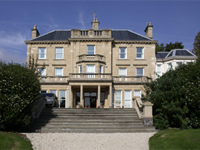
One particularly fine example of ‘rural urban’ villa was Holmestead on Mossley Hill, set in its own extensive grounds just to the east of the elegant and very desirable Sefton Park.  What is remarkable is that many of the larger houses still survive, albeit in an altered form; some becoming flats or care-homes.  The house was originally built in the 1840s in a Gothic style and effectively doubled in size in 1869-70 by the then owner, Michael Belcher, a local cotton broker. Urban ‘society’ of the newly wealthy mirrored the practices of those in the countryside as shown by William Imrie, owner of the house at the turn of the 19th-century and formerly of the famous White Star line, and also a patron of the Arts-and-Crafts movement.  He held regular concerts in his music room – a grand space, decorated with William Morris’ ‘Acanthus‘ pattern wallpaper, with the imposing ‘The Tree of Forgiveness‘ by Edward Burne-Jones on one wall, and Spencer Stanhope’s ‘Why Seek Ye the Living Amongst the Dead‘ on another. Remarkably, the house has survived and is still a single family home.

Dawpool, Cheshire - dem. 1927 (Image: H Bedford Lemere, Bedford Lemere & Co / copyright: English Heritage/NMR)

One of the grandest houses of them all was also connected to the White Star Line.  Dawpool was the pet project of Thomas Henry Ismay, the man who built a company large enough to launch the Titantic. Although was not conceived as the centre of a landed estate, it was certainly designed to showcase the power of his empire.  Designed by the leading architect, Richard Norman Shaw, the house, started in 1882, was a monument to Ismay’s wealth and meant to last – the local red sandstone was finely shaped and even the screws being finest brass.  The house took four years to build at a cost of over £50,000 – equivalent to over £3.5m today, a colossal sum compared to the average £80 per year the skilled ship-worker took home. Yet, the house was to survive less than half a century. After Ismay’s death in 1899, the widowed Mrs Ismay said that the house had given her husband pleasure every day – but without that driving force, it languished before being sold, becoming an orthopaedic hospital in WWI, before being sold again, and then demolished in 1927 [more history and photos available on Lost Heritage: Dawpool].

Calderstones House, Liverpool (Image: Liverpool Confidential)

Although some have been demolished and most of the houses have lost their extensive grounds, one rare survivor, Calderstones House, gives a rare insight into the once-gilded edges of Liverpool.  The now grade-II listed house was built in 1823 for Joseph Need Walker, a lead shot manufacturer, who built an elegant late-Georgian design (architect unknown) with a Doric portico which looked out over carefully tended gardens and parkland.  In 1875, the house and grounds were sold for £52,000 to Charles MacIver, a shipping magnate who had spent 35 years with the Cunard Line. The house and grounds were sold in 1902 to the Liverpool Corporation for £42,000 and became one of the city’s finest parks (John Lennon apparently used to hang about there) with the house used as offices for their Parks departments with a public tea-room and, to the rear, a stage for concerts.

Faced with severe budget cuts, Liverpool Council are now exploring what options are available, with a sale the preferred outcome.  Sadly, it is extremely unlikely to become a home again; to carve out sufficient space and access from a public space would be extremely controversial, with security a further worry.  The two most likely options are that it is taken on as a public facility with commercial aspects such as concerts and refreshments, or that it will languish, becoming progressively more dilapidated.  Sadly, local government generally has often shown a rather careless attitude to heritage assets in their care -though in recent years they have improved markedly from the 1950s and 60s when some (Derbyshire being particularly notorious) would simply demolish the historic buildings, especially country houses.

The current period of austerity is forcing councils to re-examine their assets and objectively analyse the most cost-effective way of operating – a process open to the risk of losing elements of what makes an area locally distinctive.  This is especially true when ‘heritage’ and ‘arts’ are seen (falsely) as relatively ‘high-brow’ interests – this creates a challenge for everyone to be aware of what their councils own, and to monitor whether there are any signs of them seeking to cut corners and creating conditions which threaten the heritage assets.  They hold these in trust for the local area and, if necessary, councils need to be forcefully reminded of their obligations to this generation and the ones which follow to care for the built environment which contributes so much to local identity.

Articles:

Further reading: Merchant Palaces: Liverpool and Wirral Mansions Photographed by Bedford Lemere (Photographers of Liverpool) (disclosure: this is an Amazon associates link – the price you pay is the same but I’m experimenting to see if I can help offset costs with Amazon affiliate links).

The axe falls: route of High Speed 2 rail line announced

Justine Greening, the Secretary of State for Transport has now announced the final route for the HS2 rail line which will carve its way through some of our most beautiful countryside and require the demolition of many homes so that we can get to Birmingham 15 whole minutes quicker! And it will only cost £32bn – honest. Despite claims of popular support, when faced with loud opposition from those living in its path or near enough to be blighted by it, those who care about our heritage and the environment, rail users, road users, opposition politicians, coalition politicians, Cabinet members, and MPs from their own parties, some important improvements have been wrung out as to the route – some of which have significantly enhanced the prospects for some of our country houses previously affected.

Edgcote House, Northamptonshire (Image: Bacab)

One of the most significant houses to be affected by the initial route was Edgcote House, a glorious, grade-I, Georgian gem, which faced having the main view from the house out over the lake terminated by a not inconsiderable viaduct.  However, the new route has moved the line to the east, leaving the lake, and the view, largely preserved.  I wonder how much this change was influenced by the prospect of having to pay compensation for ‘statutory blight’ on a multi-million pound house and estate – a possibly more forceful reason, sadly, than just ruining the setting of a fine country house.

Hartwell House, Buckinghamshire (Image: Giano via Wikipedia)

More broadly, Dame Fiona Reynolds, Director General of the National Trust, has cautiously welcomed the alteration to the route, though, there are still concerns.  Having seen off very early proposals which would have had the route disturb the stunning West Wycombe Park, the later revisions did propose to run the line, with inadequate measures to minimise the impact, rather close to the National Trust’s grade-I Hartwell House in Buckinghamshire.  It seems that the powerful voice of the NT has succeeded in increasing the mitigation measures with extended deep cuttings to minimise the visual and sound impact – but it’s certainly not the tunnel they were hoping for.

Another house which has definitely escaped the blight is Shardeloes, also in Buckinghamshire.  The route originally ran across the other side of the shallow valley in front of the house on the other side of a main road (which already cuts through the parkland).  Although this section was to be in a cutting, under the new plans, the extended tunnelling completely removes the above ground elements near the house.

Of the other houses, Waddesdon Manor was never really going to be affected, the route past Stoneleigh Abbey hasn’t changed, still slicing through the agricultural showground which had already blighted the setting of that fascinating house, nor have there been any changes to the situation for Chetwode Manor.  On the positive side,  The Vache benefits from the extended tunnel at Chalfont St Giles, and that same tunnel means that the route now sweeps well to the south of Pollard Park House.  Grade-II* Doddershall Hall has also gained further protection.

Although it is easy to be sceptical about HS2, I am, in principle, a strong supporter of railways, particularly over domestic flights and more roads.  However, where projects of this scale and expense are proposed, it is even more important that the full costs – financial, social, material, and environmental – are fully understood, especially where irreplaceable built heritage will be compromised.  Commenting on the changes, Justine Greening said: “The changes mean that more than half the route will now be mitigated by tunnel or cutting and there will also be a reduction in the impacts on people and communities, ancient woodlands and important heritage sites. The revised route offers considerable improvements to communities, with the number of dwellings at risk of land take almost halving and the number experiencing increased noise levels reducing by a third.“.

So, overall, the effects on the country houses nearest the line have largely been removed or minimised. But what seems a shame is that so much energy and expense had to be deployed to achieve this – why were these considerations not taken into account as a matter of course when the initial plans were drawn up?  Sadly, it seems that cost pressures demand that civil servants start with the most damaging option and then must be forced to not spoil the nation they are supposed to be looking after.  Perhaps, one day, heritage will be valued so highly that such proposals are not even considered.  One can always hope.

Full plans: ‘HS2 revised line of route maps‘ [Department for Transport]

A stay in the country: country houses as hotels – and a bad plan

Stoke Park, Buckinghamshire (Image: Stoke Park Country Club and Resort)

Although country houses were built primarily as homes, an integral and important function was their use for entertaining.  However, one dramatic change has been the nature of the guests and how they paid for their visits – and the birth of the refined country house holiday now regarded as the best the hospitality industry can offer.  That said, running such a hotel is no guaranteed path to the wealth suggested by the lifestyle; with huge initial costs, large ongoing expenses and the elusive need for profitability leading to the recent troubles for the Von Essen hotel chain which had dominated this niche, including running the finest country house hotel – Cliveden, before collapsing under their own ambition.  The chase for profitability has also led to some shocking schemes for building further accommodation which can be seen in the recent proposals for Wyreside Hall in Lancashire.

Country houses have long been used as accommodation for travellers, be they friends of the owning family or, more spectacularly in medieval and Renaissance periods, for the monarch.  Often considered a great honour (supposedly there are more beds in which Queen Elizabeth I has apparently slept than nights she was alive), the occasion of a royal visit – or the possibility of one – would cause local aristocrats, or those aspiring, to refurbish suites of rooms such as at Burghley, Hatfield House, and Kirby Hall (even though Elizabeth I never came to the latter).  Sometimes, the ruinous expense of hosting the royal retinue would sometimes leave the owner with a title but also debts they’d be paying off for decades.

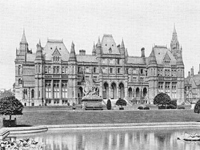
Eaton Hall, Cheshire (by Alfred Waterhouse - dem. 1961) (Image: Lost Heritage)

The heights of country house entertaining were reached by the Victorians and Edwardians who popularised, amongst the aristocracy, the vast weekend house party.  This led to houses being built or extended to create, in effect, large hotels.  The key difference was the guests were pre-selected from a narrow social strata and were expected to ‘pay’ for the hospitality with reciprocal entertainment or with business or political favours.  The greater the social elevation of the guests, so the number of staff required increased, leading to some houses, particularly at the cream of society, such as Eaton Hall and Clumber House, being greatly extended.  Eaton Hall eventually numbered around 150 bedrooms ranging from those for the honoured guests down to the  lowliest servants who would share dormitories.  Sadly, it was these sizeable extensions and aggrandisements which were largely the reason for their demolition in the 20th-century in their hundreds as austerity hit home and these huge palaces became unaffordable.

Sandringham, Norfolk (Image: Sandringham Estate)

Edward VII, when Prince of Wales, was the longest serving Regent and developed a highly cultivated habit of ‘weekending’ at country houses, especially his own at Sandringham, Norfolk.  His preferences have been said to have laid the foundations for not only the practice of weekend visits but also for indulging with grand breakfasts followed by country activities such as shooting, followed by convivial dinners.  Such was his reputation that some owners would fear a visit for the expense involved with one family, the Gurneys of Northrepps Hall in Norfolk, allegedly burning down a wing to forestall such a visit. By contrast, in 1902, when Edward VII visited Burton in Staffordshire an entire wing was built and named after him in his honour at Rangemore Hall.

Country house visiting had been a common activity for the travelling aristocrat in the Georgian era (a topic explored in a previous article ‘How tourism split a house from the estate‘).  Often calling on those they knew, they would also call on the notable houses in an area (an acceptable enough practice to be included by Jane Austen in ‘Pride and Prejudice‘) – and the owners of these ‘show houses’ were happy to parade their good taste.  By the beginning of the 18th-century, Blenheim, Castle Howard, Chatsworth, Wilton and Burghley had become the ‘must-see’ houses for the country house tourist – later joined by Houghton, Holkham, Eaton Hall and Kedleston.  Sadly, visitors weren’t always there for the educational opportunities of seeing some of the finest art in the world – as Horace Walpole lamented regarding the visitors to his father’s Houghton Hall, where he was a guide, the worst were the seers:

 …they come, ask what such a room is called, in which Sir Robert lay, write it down, admire a lobster or a cabbage in a market-piece, dispute whether the last room was green or purple, and then back to the inn for fear the fish should be overdressed.

Tregenna Hotel, Cornwall (Image: lindad4a via flickr)

It’s the last line which is of particular interest – even the well-to-do Georgian guest would be staying in a nearby coaching inn unless they had family nearby.  By the Victorian era, the nature and number of the guests had changed, but still the houses were private residences – until 1878 when the first country house became a hotel; Tregenna Castle near St Ives, Cornwall.  The catalyst was the extension of the railway, and the purchasers of a initial lease on Tregenna, before buying the freehold in 1895, was the Great Western Railway who could not only provide the destination, but the means to get there.

Cliveden, Buckinghamshire (Image: sjm_1974 via flickr)
Cliveden, Buckinghamshire (Image: SJM_1974 via flickr)

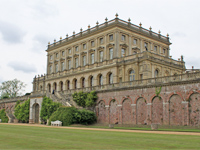
The growth of a paying middle class in the Victorian and Edwardian eras created demand – but most importantly, both eras were about aspiration.  The middle class may not have had the wealth to run a country house (and in the 1930s and 1950s, many owners didn’t either) but they certainly wanted to experience it.  The glut of country houses which became available in the first half of the 20th-century presented many opportunities for the hospitality industry to cater for these new markets.  For the upper classes, although many had been forced to sell up or move out, they still wanted to continue the lifestyle – though not necessarily alongside the nouveau riche. This created another market for the exclusive country club with clear social stratification driving the finest hotels to become bywords for extravagant elegance – something still clear today (though entry is more socially open) when one looks at hotels such as Cliveden or Stoke Park.

Gravetye Manor, Sussex (Image: Patrick Baty)

Though initially slow to take-off, the first half of the 20th-century saw a number of houses become hotels; in 1929, Theobalds Park, Hertfordshire and North Bovey Manor, Devon (another for the Great Western Railway), Welcombe Manor, Warwickshire in 1931, Otterburn Tower, Northumberland and Studley Priory, Oxfordshire, both in 1947 and Greywalls in Scotland in 1948, to name but a few.  Gravetye Manor was sold to Peter Herbert in 1957, when he paid £57,000 and charged £2 per night.  One author reported that the 1995 Egon Ronay guide listed 220 country house hotels, and the Historic Houses Association estimated that a quarter of the country houses sold between 1972-1990 were converted into hotels.  Though some have inevitably failed, the trend continues with one of the most recent being Coworth Park, built in 1776, opening in September 2010.

This potential re-use of the houses has not always been benign.  The nature of hotels is that the bedrooms generate the income so the more you have the better for them – though usually not for the architectural cohesion of the house. In hotel terms, many houses would not be economic which has led to the building of large, and not necessarily sensitive, additions.  Considering the original intentions of country house owners were to demonstrate their wealth and taste and to build a house to last, rarely are the modern extensions designed with anything approaching the same care and expense so there is an inevitable mismatch.  Many a country house hotel is scarred with poor quality and visually flawed wings which are almost designed to detract from the main house – but then buildings designed by accountants never win prizes for beauty.

Wyreside Hall, Lancashire (Image: Lancaster Guardian)

Although there is evidence of a greater sensitivity in recent years where new wings are tucked away from the main house and linked by corridors, it seems that there are still some owners who see the house as merely an ornament to put on the front cover of the brochure whilst they ruin the setting.  It was hoped that the worst schemes were behind us but sometimes one is proposed which is so bad that it would be laughable if it didn’t threaten a fine (though currently not in the best condition) house – Wyreside Hall in Lancashire (hat-tip to Matthew Steeples for flagging this one up).

The house was originally built in the 17th-century but was remodelled in 1790 by the then owner, John Fenton Crawthorne, MP, to a design by the gifted architect, Robert Adam.  Though the full scheme wasn’t implemented, the exterior benefited from a graceful symmetry with the drawing room, dining room and library also completed to his plans (though apparently no evidence of their decoration now remains).  The now Grade-II house remained in the Garrett family until 1936 after which it became a school and then home for a local motorsport legend.  The scheme that has now been proposed learns none of the lessons of sensitive hotel development (or any work involving heritage) over the last 50 years.

Proposed development, Wyreside Hall, Lancashire (Image: Wyre Council planning proposal, via Matthew Steeples)

Yes, it really is that ugly.  The design effectively doubles the size of the house and, as can be seen from the plan (scroll to page 44 – no direct link, sorry), the associated access roads, parking and ‘landscaping’ ruin the immediate setting of the house.  The usual arguments have been made about this bringing jobs to the area but if we must sacrifice the very heritage which gives an area a distinct identity, which attracts tourists or the wealthy (who usually also spend money locally) then it’s a poor bargain.  Wyre Council should throw out this and any subsequent plan which displays equally limited thinking and such an arrogant disregard for the architectural heritage of the area.  As we’ve seen, country house hotels can work – but not when they are at the expense of the original building.

———————————————————————————

Matthew Steeples’ original blog post is available here: ‘Adam would turn in his grave

Listed buildings description: ‘Wyreside Hall, Lancashire‘ [British Listed Buildings]

Planning application documents: ‘Ref 11/00840/LBC – Wyreside Hall‘ [Wyre Council]

———————————————————————————

This is the last post for 2011 – 43 posts in total, now over 350 subscribers to the blog, nearly 210,000 pages served up; and 850 followers of @thecountryseat on Twitter, so all-in-all, a fairly impressive level of interest; thank you! Matthew