The most expensive UK country house: Park Place, Oxfordshire

A new record price for a UK country house has just been achieved with the sale of Park Place, near Henley-on-Thames, in Oxfordshire.  One of three most notable estates on that stretch of the Thames, it was also the most expensive country house ever sold in its unrestored state in 2007.  Now, after five years and many millions of pounds, the house again has set the record having been sold to an unknown Russian billionaire for £140m.

'A view of Park Place, Henley' - artist unknown - c.1742-3 (Image: Royal Collection) - click to see full image

Park Place is, at its core, a more modest Georgian house built in 1719 for Lord Archibald Hamilton, son of the Duke of Hamilton.  The proximity to London and the beautiful setting has long attracted the wealthy to the area as a convenient escape from the city, with several riverside estates featuring a series of impressive houses.  Starting at Marlow, the first house is Bisham Abbey (now the national sports centre), then the now lost Temple House (dem. 1910), Harleyford Manor (beautiful small villa restored in 1989), Whittington House [pdf] (rebuilt by Reginald Blomfield c1897, now HQ of SAS Ltd), Danesfield House (now a hotel), Medmenham Abbey (now two houses), Culham Court (sold for £38m in 2006), Greenlands (now Henley Management College), Fawley Court (sold for £13m in 2008, possibly for conversion back to a private house), and then finally, just past Henley, lies Park Place.  Of particular interest are the architectural similarities between Fawley Court (built 1684 – reputedly to a design by Sir Christopher Wren), the original Park Place (built c1718), Culham Court (built 1771), and Reginal Blomfield’s 1897 rebuilding of Whittington House, all of which are on based on a red-brick 5- or 7-bay, two storey villa with bulls-eye window inserted into a projecting pediment.

Park Place, Henley - c1810 (Image: Thames Pilot) - click for the full image

Sadly, Park Place is no longer part of this architectural brethren having undergone a series of substantial changes.  The house was sold by Lord Hamilton in 1738 to Prince Frederick, then Prince of Wales and eldest son of King George II, who split his time between there and Cliveden. After Frederick’s death, the house was then bought by General Henry Seymour Conway in 1752 and it was he who made the first significant changes both to the house (including a library by Sanderson Miller in 1757) and, perhaps more importantly to the grounds, which are now grade-II*. His works, to designs by Thomas Pitt, 1st Baron Camelford, included the installation of an ancient stone henge given as a gift from the people of Jersey where he was Governor, the lightning-damaged steeple from St Bride’s Church as an obelisk, four more obelisks as gateposts, an underground cavern, and a bridge, using stones from Reading Abbey, which was subsequently admired by Horace Walpole.  There was also an artificial classical ruin designed by James ‘Athenian’ Stuart.

Park Place, Oxfordshire - c.1900 (Image: henleyonthames.org)

The house was sold to John Noble in 1871 but was largely gutted by fire a year later, giving Noble the opportunity to indulge something of an architectural whim.  The pattern and style of the Victorian country house was much admired around Europe and our expertise was exported widely around the continent – but it rarely flowed back (a topic already covered in an earlier post ‘The rise and fall of French taste on UK country houses‘).  Park Place is one of the few houses in the country build using the French Renaissance style, creating an impressive château in the heart of England.

The design of the rebuilt house is widely attributed to Thomas Cundy [III], the son and grandson of two previous Thomas’ who had also been country house architects. Although the latter two are given sizeable entries in Howard Colvin’s ‘Biographical Dictionary of British Architects‘, the grandson is given only a paragraph as part of his father’s, leaving us somewhat in the dark as to what, bar some London churches, he may have been involved with. However, considering his father had good form with the chateau style having built Grosvenor Gardens in London, so Thomas III would have been schooled in the style before his father’s death in 1867.

The house remained with the Noble family until 1947 when it and the 670-acre estate was parcelled up into 22 lots and sold off.  The main house was bought by Middlesex County Council who converted it into a special school, which it remained until 1988 when it closed. The house was then bought by John Latsis, the Greek shipping tycoon, but it seems unlikely that he lived there as it remained unrestored, with the vestiges of the school – gymnasium, classrooms, a woodwork studio etc – all still in situ, along with various outbuildings, as can be seen from these images of the house.

Those who had a chance to look around the house when it was for sale in 2006 all noted that beneath the shabby institutional veneer, the potential of the house was clear; glimpses of fine tiles, the original stone fireplaces, stained glass, and grand spaces with impressive views.  The house was then sold to a consortium who intended to create a superior country club – until Wokingham council said ‘no’.  Put on the market for £45m, it was finally sold for £42m to Mike Spink, a property developer who specialised in high-end houses in central London. With this experience, Spink transformed this once dilapidated house into a palace fit for a billionaire with all the requisite features such as a helipad, swimming pool, panic room etc.  Somewhat disappointingly, the house now only comes with 200-acres, with the remaining 300 with which it was sold retained by Spink for as yet unspecified ‘development’ – a phrase which will no doubt spark local concerns.

Even when it was first sold, those in the property business were predicting that Park Place would sell for possibly up to £100m, and the rising ‘super prime’ market has proven even those estimates conservative.  Sadly, this record is not for a spectacular historic house at the centre of a large estate but instead one where the location (location, location!) has elevated the price to such a stratospheric level. Nevertheless, many country houses were built as retreats for wealthy industrialists and financiers and this house is proof that the lure of the trophy country estate is as strong as ever – which can only be a good thing for those seeking to prove their desirability in modern times.

———————————————————————–

Story about the original sale: ‘Sold for £42m… still in need of renovation‘ [Daily Telegraph]

Latest sale: ‘Park Place: Britain’s most expensive home sold for record £140m‘ [Daily Telegraph]

‘An agreeable surprise’ – the country house and garden sculpture

Statue - Castle Howard, Yorkshire (Image: Paul Barker / Country Life Picture Library)
Statue – Castle Howard, Yorkshire (Image: Paul Barker / Country Life Picture Library)

The country house has long been at a nexus of art, display and tourism with the treasures, mainly statues, collected by the owner shown in a grand gallery which often formed one of the main staterooms.  Whereas the house provided the setting for the art, outdoors, the gardens and parkland provided a setting not only for the house but also for the many sculptural works they had acquired – a trend which continues today, though often with a necessarily more commercial edge.

The first country house owners to place statues in their English gardens were the Romans.  However, as homes became castles, gardens fell from favour and with them, the ornaments to decorate them.   The trend for statuary only really returned with the Tudors and their love of the outdoor space as an extension of the symbolism they incorporated into the architecture of their houses.  One of the earliest collectors, and most acquisitive, was Thomas Howard Arundel, 2nd Earl of Arundel, who, as a youth, had been at the excavation of the Roman Forum, which had sparked a live-long passion for antiquities.  Arundel amassed one of the greatest collections of the age, rivalling that of the King, including a famed selection of Graeco-Roman statues found in Turkey, which became known as the ‘Arundel Marbles‘. These statues were then displayed at both their town and country seats, both indoors and out – though later, by the mid-17th-century, as a result of the uncertainties of the Civil War, John Evelyn found the Marbles “…miserably neglected, & scattred up & downe about the Gardens & other places of Arundell-house.”.  The statues were later donated to the Ashmolean Museum where they remain today.

The later rise and popularity of the Georgian grand tour firmly embedded the desire to purchase statues along with the requisite paintings. They provided a visual clue as to both the learning and wealth of the owner and so were displayed prominently, especially indoors where they might be shown in the entrance hall where guests would inevitably look at them as they waited. Some of the most famous dedicated indoor galleries include those at Holkham Hall, Norfolk, Chatsworth, Derbyshire, and Woburn Abbey, Bedfordshire (though sadly now not as shown in previous link as it’s now a wedding venue).  Other notable galleries, though now lost due to dispersal or demolition, were those at Clumber Park, Ickworth House and Hamilton Palace, the latter described as “…peopled with bronze statuary on Irish black marble bases polished to such a gloss that they reflected the pavement like a mirror.“.

Chiswick House, Middlesex (Image: curry15 / flickr)

Outside, the display was no less formal – symmetry and structure dominated.  However, by the 1730s, the more formal display of statues outdoors gave way to a more naturalistic style whereby they became almost secreted amongst a more informal – but no less planned – landscape.  One thing often forgotten now is that we see gardens after over 250 years of growth, but when first planted they would have been much sparser giving the ornaments greater prominence.  The return of the Roman influence can be closely linked with the rise of Palladianism and the influence of Lord Burlington and his circle; most notably, the brilliant designer William Kent. Other notable influences include Batty Langley, who published his ‘New Principles of Gardening‘ in 1728 and Stephen Switzer’s ‘Ichnographica Rustica‘, published in 1718 – the latter of which was the first to show serpentine walks and streams. Life also imitated art, with the popularity of the Arcadian visions of painters such as Claude Lorrain, Nicholas Poussin, and Salvator Rosa also inspiring those who collected the paintings to attempt to bring them to life.

Temple - Studley Royal Gardens, Yorkshire (Image: Matthew Beckett)
Temple – Studley Royal Gardens, Yorkshire (Image: Matthew Beckett)

The more secure and rising wealth of the 1730s enabled owners to create larger estates and so giving them more space to indulge their plans.  However, no stream will rival a raging river so to create a sense of theatre, the landscape was used and moulded to create a series of views which took advantage or distant landmarks or by introducing elements such as statues, temples and obelisks.  Often these gardens were designed to entertain the knowledgeable visitor with allusions to myths and noble virtues – though in one lesser known example, the owner of the famous Vauxhall Gardens in London, built a darker memento mori‘ garden at Denbies, his home in Surrey.

However, the main aim was to delight and to stimulate emotions. One of the most famous Georgian gardeners, Philip Miller, wrote in his 1739 edition of his ‘Gardener’s Dictionary’:

“In laying out these walks through woods there should be a great regard had to the neighbouring country, so as whenever there are any distant objects which appear to the sight, there should be openings to which the serpentine walks should lead, from whence objects may be viewed, which will be an agreeable surprise to strangers…”

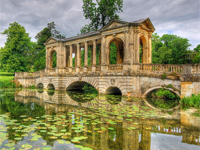
Bridge - Stowe House, Buckinghamshire (Image: Evoljo / flickr)
Bridge – Stowe House, Buckinghamshire (Image: Evoljo / flickr)

These principles were translated according to the whims and finances of owners across the country, leading from the sublime creations of Stowe, Stourhead and Studley Royal to many lesser known and private gardens.

The statuary could sometimes cause the odd drama. Dallam Towers, Cumbria was archly described by Pevsner as “…undoubtedly the finest Georgian facade in the county; but what the visitor may not realise is that, behind all the stucco, there’s the finest Queen Anne facade in the county.“. Between the facade and the landscape once stood (or perhaps still stands) a line of statues standing guard between the garden and the ha-ha. Yet this line is slightly marred by one of the statues being headless – the unfortunate outcome of a 1820s dinner which led to a very ‘well-refreshed’ Lord Milthorpe.  Thinking he had seen a poacher, he grabbed a rifle, and despite the protests of his guests, he duly dispatched the ‘poacher’/statue; a loss for the world of garden ornaments but perhaps a gain for the forces of law and order.

With such vast quantities of marble scattered out the gardens, occasionally a prized statue may slip slowly into obscurity. This can lead to discoveries in the same way that an Old Master may be found in the attic, so they can also be found in the shrubbery, such as this rare Chinese Ming tomb horse or the lucky owner of a castle somewhere in northern Europe who had a statue by the Renaissance sculptor Adriaen de Vries.

The tradition of sculpture in the gardens of country houses is certainly alive and well today and has developed beyond the more formal Roman statuary towards a decidedly more contemporary ethos – though perhaps more commercial than for simple pleasure.

'Huge Sudeley Bench' by Pablo Reinoso at Sudeley Castle (Image: Christies)
‘Huge Sudeley Bench’ by Pablo Reinoso at Sudeley Castle (Image: Christies)

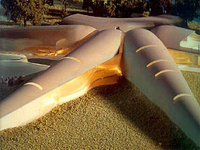
At the beautiful Sudeley Castle in Gloucestershire, Christies are holding their selling exhibition of contemporary sculpture from luminaries such as Marcel Wanders, Marc Quinn and Pablo Reinoso.  Over in Sussex, the Cass Sculpture Foundation at Goodwood, hosts a regularly changing line-up with a focus on supporting emerging talent along with the more established artists such as Lynn Chadwick and Anish Kapoor.  One more recent venue is the Jupiter Artland at Bonnington House in Scotland, just outside Edinburgh.  The vision the Wilsons, who own the house, Jupiter Artland features large-scale works such as the monumental ‘Life Mounds’ by Charles Jencks’ who specialises in landscape art that I suspect would appeal to the likes of ‘Capability’ Brown if he were around today.

These are just some of the examples of contemporary schemes which are taking place across the country. Each is enlivening the grounds of a house and again maintaining that artistic thread which has been spun out over hundreds of years, linking country houses, an owners’ taste and some of the best art in the country.

————————————————————————–

More wonderful examples of works available outdoors can be seen in the Country Life Picture Library collection.

This blog post is a little off my usual patch so I’m grateful for the research of David Stuart in ‘Georgian Gardens

Finest prospects: the artist and the country house (and a challenge)

The country house has always been a trophy to be admired and enjoyed.  Yet, in the age before mass media and transportation made it easier to see these fine houses, often the only way to remind yourself and, more importantly, guests to your London townhouse, of your rural wealth and power was through the rather special branch of art that is the country house portrait.  Though originally European, it found new and invigorating life once it had crossed the Channel, creating an important and fascinating record of the lives, tastes and architecture of the landed classes. We also have a mystery house in a painting to find…

The country house first started appearing in paintings in France, with one of the very earliest depictions being that of the Duc de Berry’s houses and estates in 1416 by Pol de Limbourg.  These paintings served not only as reminders of wealth but also as practical tools for the running of extensive estates. The earliest English contemporary of these paintings is a 15th-century portrait of John of Kentchurch with a view of Kentchurch Court, Herefordshire in the background.  Although the depiction of the country house was a primarily European feature, it was still a relatively niche pursuit until the late 1500s, with painters more usually employed to portray the religious, historical or mythological.

Detail of 'An Aerial View of Tottenham Park, Wiltshire' by Pieter Andreas Rysbrack (after 1737) - this picture hung for many years in the estate office.

The trade in country house views was particularly popular in the Netherlands, where a demand for topographical engravings combined with many estates created a ready market.  The genesis of the English tradition is also to be found here as the Royalist aristocracy fled to the region during the Civil War. The connections made at this time were to prove fruitful for the many painters who followed their current and prospective patrons back across the Channel after the the Restoration in 1660. Before then, views of a country house were usually part of an estate survey, bar a few exceptions such as those of Conway Castle in c.1600, Nonsuch Palace and Richmond Palace c.1620, and the ‘King’s houses’ by Alexander Kierincx in 1639-40.  It was the famous engraver Wenceslas Hollar who completed the first significant set; five views of Albury House in Surrey in the late 1630s. Hollar was also significant in establishing the new fashion for these views once confidence was restored in the late 1650s.

The Restoration of Charles II gave new life to the art, with Dutch artists eager to record the newly invigorated estates of the aristocracy.  Without the artistic constraints often found in Europe, the style of the art in England was largely determined by the owner rather than royal preference.  By the 1680s, the country house portrait was as well established, as well  as those of the family, and reflected both pride and change.  Views were often painted to record the old house before it was swept away or remodelled or after the work had finished to showcase their new seat.

One of the finest artists of this period was Leonard Knyff who had arrived in England in around 1676 but whose first country house painting, completed in 1696, is of Dunham Massey, Cheshire.  A few more paintings followed, but his master work was a collection of eighty engraved views published (by Johannes Kip) in 1707 under the title ‘Britannia Illustrata: Or Views of Several of the Queen’s Palaces, also of the Principal seats of the Nobility and Gentry of Great Britain…’.  It remains one of the finest records of the country houses of the period – today, even individual prints can sell for hundreds of pounds and full copies of the book for tens of thousands.

Detail of 'Westwood, Worcestershire' published 1709 for "Britannia Illustrata: Or Views of Several of the Queen's Palaces, also of the Principal seats of the Nobility and Gentry of Great Britain...." by Johannes Kip & Leonard Knyff
Detail of 'Westwood, Worcestershire' published 1709 for "Britannia Illustrata" by Johannes Kip & Leonard Knyff

From the 1700s, the composition of the paintings shifts to include, and give greater prominence to, sporting activities and also the setting of the house, particularly the gardens. With sports such as riding and hunting being such a key part of the enjoyment and reputation of an estate, it was natural that these should feature in any artistic celebration.   As the fashions for landscaping and elaborate gardens took hold, so to did a desire for these to also be included in such detail that the house became a much smaller element, subsumed into a wider bucolic vision.  The more ‘survey’-like paintings showed in almost cartographic detail the layout of the gardens with the tree-lined rides radiating away from the house.

'Lowther Castle, Westmorland, Seen from a Distance by 'Day' in 1810' - J.M.W. Turner

This trend was not only driven by the owners who were very proud of their new environment but also because it was a natural continuation of the earlier work of these artists, as recorders of landscapes. John Harris argues that it would be difficult to confirm the exact influence which art exerted over landscaping but the popularity of landscape painters such as Claude Lorrain, coincided with the popularity of advocates of the more natural landscape such as Humphrey Repton and Lancelot ‘Capability’ Brown in the 1760s.  Parkland now moved from the more formal ‘boxes’ which Knyff had so accurately portrayed, and was now shown as a more rural, naturalistic form, the landscape now dominating the picture.  How far this style departed from formal country house portraiture can be seen in the works of J.M.W. Turner who frequently reduced the house to a mere smudge in the distance – and even when the house featured clearly, it was subordinate to the overall setting and atmosphere.  That’s not to say that the ‘Claudian’ view was the only one – the preferences of the owners for clear visions of their seats kept artists such as William Hodges, James Barret, William Marlow, and Theodore de Bruyn busy too.

By the mid-1800s there had been a marked decline in the demand for these type of paintings. Improved communications meant that houses were no longer so remote, and with the advent of mass printing, publishing filled the demand for images of the houses as typified by the eleven volumes of J.P. Neale’s ‘Views of the Seats of Noblemen and Gentlemen‘ (1818-1829).  Owners of houses were also now increasingly from the new wealthy who had their powerbases in cities and the country house was merely a retreat. By 1880, photography was also firmly supplanting oil paint as the medium of choice, as shown by the success of photographers such as Bedford Lemere, and, by the 1900s, the success of magazines such as Country Life which placed a high priority on using only the best photos.

Detail of 'Carclew, Cornwall' by Algernon Newton (house built 1720s, burnt out in 1934) - painting commissioned for the family which owned it at the time of the fire

However, in the last twenty years, a resurgent interest amongst country house owners has again created a demand for the country house portrait.  Artists such as Algernon Newton, Julian Barrow, James Hart Dyke, Jonathan Warrender, and Marcus May have led the way in continuing the tradition.  One artist has even been responsible for creating a country house which only existed in one of his paintings. Felix Kelly had painted an imaginary scene of Palladio’s Villa Rotunda within an English landscape; inspired by this, Sebastian de Ferranti then commissioned the architect Julian Bicknell to translate this art into reality, completing the house in 1986.

These important paintings are now, for some houses, the only record of how they were before later changes obscured or obliterated them forever. For many others, they are a wonderful reminder of the beauties of architecture and are a unique and invaluable record of our country houses.

—————————————————————-

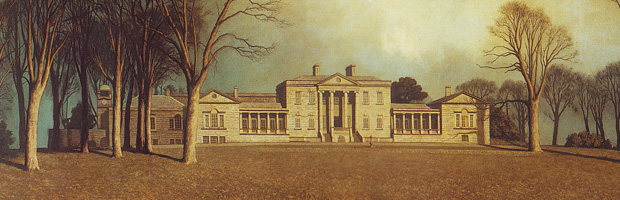
Detail from 'Portrait Group' (1936) - William Bruce Ellis Ranken
Detail from 'Portrait Group' (1936) - William Bruce Ellis Ranken - click for full painting

The Challenge: can you identify the mystery house in this painting?

Detail from 'Portrait Group' (1936) - William Bruce Ellis Ranken

The catalyst for this post about country houses in paintings was an email I received from Wendy & Gordon Hawksley who are working to re-establish the reputation of William Bruce Ellis Ranken (1881-1941). A famous artist in his day, he socialised with the great and good and painted many of them before fading into obscurity after his death.  This painting was exhibited at the Royal Academy in 1936 (this is also the year it was painted) under the title of ‘Portrait Group’ but as yet it has not been possible to identify either the sitters or the house. And so to the challenge: simply, can we identify the house – almost certainly English or Irish, Palladian, engaged columns to the front (a la Kedleston Hall) with flanking curved colonnaded wings facing a large reflecting pool.  Obviously there may be some degree of artistic licence but it seems likely that this was the home of the subjects of the portrait. Suggestions either via the comments below or via email to me.  No prizes I’m afraid beyond a credit here and the happy thought that art history is slightly richer for your efforts.

—————————————————————-

For a more in-depth history and many images (and to which this post is much indebted)  I recommend ‘The Artist and the Country House: from the Fifteenth Century to the Present Day‘ by the ever-brilliant John Harris – unfortunately now out of print.

PPS7 – the saviour of the new build country house

Grafton New Hall, Cheshire (Image: Robert Adam Architects)

The nature of our country houses is one of evolution in design, form, and function.  As society has changed, so too have the requirements of the wealthy and, as their houses have been a direct expression of their wishes, these changes can be traced through the architectural record.  Much as we love the many beautiful houses we have already there will always be the desire to build anew, which will constantly reinvigorate this branch of architecture.  As always, some designs will not stand the test of time and will be replaced but the best houses of today will be appreciated by generations to come.  Estate agents often have sites with planning permission for sale and the most interesting come with a design already approved – and in an interesting trend, they are almost all classical, rejecting the avant-garde in favour of brick, stone and Palladian proportions.

Longleat House, Wiltshire (Image: wikipedia)

Once Britain became a more domestically peaceful land under Elizabeth I, the form of our country houses changed from defensive, to one of show as exemplified by the Prodigy houses such as Longleat, Wollaton and Hardwick.  Gone was the need for walls, keeps and battlements and instead the requirements of the aristocracy became focused on courtly entertainments, sport and the display of one’s level of taste and education. This largely set the pattern which can still be seen today, with only the architectural choices as to style varying according to fashion and whim.

Yet it seems that for the wealthy who commission these houses, the overall exterior style has evolved as far as necessary because, despite the efforts of the last Labour government to promote the bold and radical as the only appropriate response, a majority of the houses designed and built today are in a form that your average 18th-century gentry would broadly recognise.  Although most construction in the countryside is largely forbidden, rules introduced by the Conservative government in 1997 – known as PPG7 section 3.21 – allowed for planners to approve houses where:

“An isolated new house in the countryside may … exceptionally be justified if it is clearly of the highest quality, is truly outstanding in terms of architecture and landscape design, and would significantly enhance its immediate setting and wider surroundings.”

In 2004 the Labour government sought to drop this, ostensibly because they thought it a loophole, but many suspected an undercurrent of class warfare (an early day motion put down that year by the former Member for Denton and Reddish, Andrew Bennett, stated that “this House … further believes that if the countryside is to be preserved by not building ordinary houses, it is even more important that is should not be polluted with big houses for the arrogant, vulgar and rich.“).  After a strong backlash with MPs (well worth reading is Alan Howarth’s spirited defence of the country house) and architects leading the charge, the rules were amended to become PPS7 which largely retained the status quo giving owners the opportunity to continue the fine tradition of new country houses but with a distorting preference for houses which would reflect “the highest standards in contemporary architecture.“. In fact, the market proved that clients know what they want more than misguided politicians and civil servants.

In response to the proposed changes the RIBA put on an exhibition called ‘The New English Country House‘ which looked at houses commissioned between 1997-2004 under PPG7.  Of the 24 houses included, 15 were in a historical style and only 9 contemporary, with a majority of the former being seen through to completion.  Interestingly, of the houses listed, at least half (by my reckoning) are replacements for previously demolished  country houses perhaps providing an object lesson in the folly of their original loss.

Proposed Grafton New Hall, Cheshire (Image: Ushida Finlay Architects)

The poster child for the new ‘modernist’ country house was the design produced by Ushida Finlay in response to the 2001 RIBA competition to build “the country estate of the future”.  The original Tudor Grafton Hall in Cheshire had been demolished in 1963 after becoming derelict but the 200-acres of parkland offered the ideal opportunity to create an excellent smaller country estate. Yet for the limited pool of those wishing to spend the estimated £20m to build this vision the design ticked none of their boxes. After 7 years of marketing by the estate agents, it was decided to commission a new design from one of our best Classicists, Robert Adam, whose new proposal was described as “an exceptionally outstanding design“. However, the opportunity to create this new house is still being marketed with Jackson-Stops for £5m – so the argument hasn’t been decisively won in this instance just yet.

Proposed Alderbrook Park, Surrey (Image: PRS Architects)

In much the same way as those in previous centuries wished to express themselves through their architecture, so it is the case today.  Houses such as the proposed Alderbrook Park in Surrey for the billionaire Lakshmi Mittal are a radical re-interpretation of the country house but driven by the particular requirements of the client.  Also of particular note is  Ferne Park in Wiltshire for Lady Rothermere – easily one of the finest country houses to be completed in the last 100-years and very much the product of the client working in conjunction with her architect, the brilliant Quinlan Terry.  Speculative developments seem less likely to find buyers as they become more an expression of the ego of the architect rather than the reflecting the personality of the buyer. The prime example of this is the poorly designed Updown Court in Surrey, once the most expensive house for sale in the UK at £70m, which now faces being carved up into flats or becoming a hotel.

Nyn Park, Hertfordshire (proposed) (Image: Julian Bicknell & Associates)

So what other architecturally attractive opportunities are out there? One quite close to London is Nyn Park, Hertfordshire to replace a house which burnt down in 1963 with a design by another icon of the Classicists, Julian Bicknell, who designed the brilliant Henbury Rotunda in Cheshire. The proposed plan bears no relation to the former house and shows the type of new design allowed under PPS7. Just to underline the level of wealth required for these projects, the estate is being marketed at £10m, built costs could easily be £1m-2m, and the buyer must lodge £3m with the local council as a Landscape Bond that they will fulfil their obligations with regards to restoration which will be returned in tranches as the work is completed.

The Ridge, Gloucestershire (proposed) (Image: Yiangou Architects / Knight Frank)

Another house which has featured before in this blog is the impressive ‘The Ridge’ in Gloucestershire; another replacement for a lost house designed by Humphrey Repton and demolished in 1934.  Designed by Ross Sharpe (who also designed the Icomb Grange), this 33,000 sq.ft. design takes the form of the original house but adds an extra level of architectural flair.  As expected, this is £5m for the opportunity with build costs on top.  Interestingly, the Knight Frank website also says that alternative plans for a smaller 15,000 sq.ft. house have been drawn up, hoping to draw in a wider pool of potential owners.

The Parkwood Estate in Surrey, designed again by Robert Adam, has also been featured previously on this blog back in July 2010 as part of the discussion around justifiable replacement.

For some, a new build will never be a substitute for a historic country house but for those with specific requirements or where there is a shortage of suitable houses, then the option of creating from scratch will always be enticing.  It is also important that the tradition of country house building is allowed to continue as it is only through development that it is shown that these fine buildings can contribute to, and enhance, the much-loved countryside.  PPS7 provides an important legal support for the principle that architecture should be allowed to flourish where it is justified and supportable and should be defended against any narrow-minded interests who would deny our history and diminish the future.

———————————————————–

The websites of the leading country house architects show the broad range of fascinating projects they are involved with, and that, fingers crossed, will one day be built:

Want to lease a Vanbrugh? Kings Weston House, Bristol for sale

Kings Weston House, Somerset (Image: Knight Frank)

For some, the height of connoisseurship is to own a Picasso or a Rembrandt, and, in the same way, one can also aspire to live in a house designed by one of the great architects.  Yet, although some were prolific, the best were often to be found working on the largest projects, limiting their capacity to turn their hands to other projects, making their surviving buildings rare.  The damage and devastation which subsequent generations have wrought on our architectural heritage have also made these special houses all the rarer.  So it is always of particular interest when the opportunity to own one of these houses arises; such as Kings Weston House, Somerset, designed by the wonderful Sir John Vanbrugh.

Vanbrugh (b.1664 – d.1726) was one of the most interesting architects this nation has ever produced.  Yet to think of Vanbrugh is inevitably to also think of Nicholas Hawksmoor (b.1661 – d.1736) who provided the technical support necessary to ensure that Vanbrugh’s flights of architectural fancy were realisable as solid buildings worthy of his aristocratic patrons. However, this was not a partnership which diminished one through association with the other – both were brilliant architects who each gained from their collaboration. As John Summerson put it in Architecture in Britain (1530-1839): ‘The truth can only be that both Hawksmoor and Vanbrugh were very exceptional men.

Vanbrugh was an intensely private person – the few hundred surviving letters in his hand betray few family details or about his early adventures as a soldier, spy, hostage, East India Company trader, or playwright.  His time in the Forces seems to have imbued his style with a tendency towards the militaristic, most clearly expressed in his work in landscapes where huge sham fortified ‘defenses’ march across parkland, defending nothing and fooling few.  Yet this bombastic nature is part of the flamboyant and theatrical nature of the man, part of what gave him the flair to succeed architecturally in an age when statements in stone were as important as any made in print or Parliament.

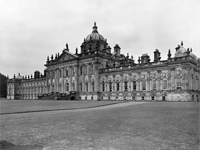
Castle Howard, Yorkshire (Image: Country Life Picture Library)

In his grandest buildings, Vanbrugh appears to almost be designing monuments which happen to have living accommodation – but he was especially pleased that Castle Howard was as practical as it was impressive. Writing in 1713 to Edward Southall, his client at Kings Weston, he states:

“I am much pleased here (amongst other things) to find Lord Carlisle so thoroughly convinced of the Conveniencys of his new house, now he has had a years tryall of it.”

Proud of how draught-free the house was, which helped retain heat, Vanburgh stated;

“He likewise finds, that all his Rooms, with moderate fires Are Ovens.”

Kings Weston House, Somerset (Image: Country Life Picture Library)

Kings Weston (built between 1710-19) was to be Vanbrugh’s fourth commission (after Castle Howard, Blenheim Palace and Kimbolton Castle) and was a house very much to Vanbrugh’s style, creating a ‘Noble and Masculine Shew‘.  The house, dramatically sited above the Bristol Channel, was built for Sir Edward Southall, a well-educated civil servant, well-versed in architecture who had spent considerable time travelling in Italy. Southall clearly had strong ideas as to the influences and design of his house; and Vanbrugh, with his long history of collaboration, was the ideal architect to work with this knowledgeable client.  That said, this is clearly a Vanbrugh house – the imposing giant pilasters, the strong Classical detailing, the almost military look which is reinforced by the unusual arcaded design of the chimneys which emphasised a castle-like quality of a central bastion.

(By the way, it’s interesting the close similarity between the entrance to Kings Weston and that of the smaller Iver Grove in Buckinghamshire (built 1722-24) by John James, who had worked with Sir Christopher Wren).

The house passed through several generations of Southalls including Edward’s great-grandson who employed Robert Mylne in 1763 to add stables and the Shirehampton Lodge and also remodel the principal rooms. Edward’s son, also Edward, lived there until his death in 1832 without issue. The house was then sold in 1833 to Philip John Miles for £210,000 (approx. £17m today) who became the local MP, as had the Southalls been before him.  Three generations of the Miles family lived there until the death of Philip Napier Miles in 1935, marking the last time the house was used as a home. The house was sold at auction for £9,800 (approx. £500,000) with the intention of using it as a school.  This was interrupted by the Second World War when it became a hospital – a role it has also fulfilled in the Great War.  Post-war, it became the Bristol College School of Architecture, before becoming a Police training centre from 1970-1995.

Perhaps one of the saddest aspects is how the setting of this fine house has been compromised: to the north, a road and housing estate, to the west, more houses, and to the south, a golf course.  This is often the outcome of houses which lack a determined owner with the need to keep a large estate, and particularly of houses which fall into the clutches of local authorities who are only too happy to build over the parkland, often with little sensitivity as to the overall setting.

With the departure of the Police, the house was boarded up, neglected and facing an uncertain future.  However, in 2000, it was bought by a local businessman, John Hardy, who converted the house in to a successful wedding and conference venue, apparently pouring significant funds into the project.  His commitment ultimately cost him his marriage and the remaining lease – probably 115-years – is now for sale for £2m (the freehold is still owned by Bristol City Council).  Although this would still make an ideal family home, Mr Hardy has expressed a desire that it remain open to the public.  Whoever buys Kings Weston will certainly be buying one of the finest houses in the country. Perhaps it will remain open to the public, but it would be equally exciting to see the house restored as a home, a private retreat overlooking the Bristol Channel where the owner can contemplate the genius of Vanbrugh and enjoy knowing that an architectural DNA links their domain with the palaces of Castle Howard and Blenheim, a smaller scale distillation of the grand flamboyance which came to define English Baroque.

————————————————————-

Original story: ‘Bristol’s Kings Weston House up for sale for £2 million to help pay for owner’s divorce‘ [Bristol Evening Post]

More details: ‘Love affair with a £2m mansion that ended in divorce… King Weston House’s owner was ‘totally consumed’ by major Georgian renovation‘ [Daily Mail]

Property details: ‘Kings Weston House‘ [Knight Frank] – £2m

More images: ‘Kings Weston House‘ [Country Life Picture Library]

History of the house: ‘Kings Weston House‘ [kingsweston.com]