Guest blogger: Jeremy Musson – ‘English Ruins: an odyssey in English history’

Having written all nearly 200 posts since I started writing this blog I now thought it would be interesting to try and broaden the voices involved.  So as the first post in this new direction/experiment, I am delighted and honoured that one of our leading architectural historians, Jeremy Musson, kindly agreed to write a piece on country house ruins linked to his new book published this month, ‘English Ruins‘, a fascinating look at their role in shaping our perceptions of the past and our architecture.

——————————————————————————————-

Jeremy Musson
Jeremy Musson

The English landscape is a landscape of ruins. Fragmentary or sometimes only roofless and windowless, these part dismantled buildings stand out to mark our national history in a number of different ways, and above all, provide a sense of historic scenery for our journeys, physical and imagined – and glimpsed from motorways and footpath alike. In this new book, photographer Paul Barker and I wanted to explore something of this particular cultural landscape and through this exploration trace something of how the English see themselves and their past.

I feel that we live in an old country, and the past is always there, to paraphrase T.S.Eliot, “pressing on the future”. Some love the past, some hate it, many are indifferent to it, happy enough to take pleasure in a good day out, with a dash of historic scenery. But the whole process of our encounter with ruins, is somewhat special – a deeply subjective, and in effect, an almost artistic experience. It is personal and often emotional, while it is also formed and shaped by a whole series of sometimes opposing cultural inheritances: Romanticism, anti-establishment, veneration for the classical, veneration for the Gothic, history seen through the very shape of the landscape.

There is something that seems to appeal about ruins to the English imagination over the centuries. Think of how John Aubrey, for instance, the late seventeenth antiquary and author of that amusing volume of English biography Brief Lives, observed that

“the eie and mind is no less affected with these stately ruines than they would be if they were standing and entire. They breed in generous mindes a kind of pittie; and set the thoughts aworke to make out their magnificence as they were in perfection.”
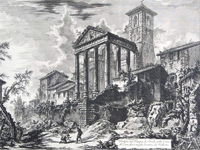
Piranesi: 'Temple of Hercules, at Cori' - 1769 (Image: Mattia Jona Gallery)

During the 18th century, the Grand Tour, part of the expected education of a gentleman or aristocrat, consisted of a journey through Holland and France to visit the great monuments of the Roman world, excited the aesthetic and cultural awareness of the 18th-century English gentleman, who was in turn the patron of artists and architects following the same path in trying to import the drama and excitement of great classical ruins to an English audience. Walk through any major house built in the 18th century, with anything of its original collections still in situ and the ruin is visible in painting after painting, and then echoed in the classical temples of the park.

The phenomenon of creating artificial ruins, in which the English seem to be pioneers, belongs to this period, and while the earliest garden temples seem to be classical, the contrivance of designing ‘ruined’ structures, was largely sourced in England’s own Gothic past. Horace Walpole the 18th-century diarist, who designed his own Gothic style house, Strawberry Hill, hugely admired the work of Sanderson Miller who designed a ruined tower at Hagley Park, with the perhaps slightly teasing phrase that it had “the true rust of the barons’ wars” referring to the Wars of the Roses.

When making this tour of England in tandem with photographer Paul Barker, I could not help noticing that we were often treading in the footsteps of the great landscape painter, J.M.W.Turner, for whom the evocative power of the ruin played a central role in his career, although we perhaps think of him most naturally as a landscape painter, and a painter of skies.

In the last years of the 18th century he exhibited numerous studies of great historical ruins in landscapes, appealing to the Romantic spirit of his audience – characteristically these are the foil for dramatic expositions of sky or sea. He continued to make special studies of ancient ruins, castles and abbeys on tours around the whole of England, for his ambitious Liber Studiorum project, and many were published in different histories, especially in Charles Heath’s Picturesque Views in England and Wales.

Turner looked principally at abbeys and castles, but abandoned country houses have come to be a feature of our landscape too. The dramatic changing status of the country house from the first world war, into the great depression of the late 20s and early 30s, becomes even more intense after the second world war – think of John Harris’s memoir, No Voice from the Hall. This was a period which resulted in so much change in English life, that it is easy to overlook the symbolic collapse of the world of the English country house. This was a feature of interwar life too, with the rise of income tax and death duties, but the upheaval of the Second World War, the widespread institutional use of country houses for military and other government purposes often hastened their subsequent abandonment.
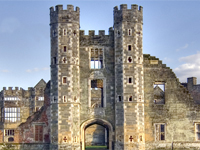
Cowdray House, Sussex (Image: Cowdray Heritage Trust)

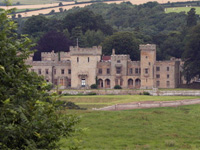
Inevitably, given my interest, the country house looms large in our new book. We focus on the story of buildings from different themes and for the ruins of country house, beginning with Cowdray House, in Sussex, a substantial Elizabethan mansion damaged by a fire in the late eighteenth century, and then abandoned, partly as a result of complications over inheritance; but quickly becoming a destination for artists, for instance, Turner visited the ruins while staying at Petworth – it is now looked after by a newly formed trust, and feels like the sets left over from a Grand Opera, standing amongst the meadows and paddocks on the edge of Midhurst.

We also visited the ruin of an elegant early-seventeenth-century lodge at Wothorpe Towers, a lodge once part of the Burghley estate, which was used as a dower house and then, apparently, part dismantled to provide an eye-catcher in the new landscaped park. It was falling into serious decay and has recently been taken on by the Griffin family, who putting the main house into a trust, which is restoring the gardens, are converting the ancillary seventeenth century buildings into a new home.

Seaton Delaval Hall, Northumberland (Image: Alan J. White / wikipedia)

The classical country house tradition is represented in our book, by 1720s Seaton Delaval Hall, near Newcastle – one of the finest houses by Sir John Vanbrugh, re-roofed after a major fire, the interiors are otherwise the very picture of a ruin. In Derbyshire, we encountered the memorable and mournful spectacle of Sutton Scarsdale Hall in Derbyshire, also built in the early 18th century. The latter, partly due to its proximity to mine-works, acquired in 1919, by businessman out to profit from its materials and fittings. The panelling was sold United States collectors, and some at least found its way into the Museum of Fine Arts in Philadelphia. Its demolition was in fact prevented by local landowner Sir Reresby Sitwell, whose family later presented it to the state.

James Lees Milne, looked at the Sutton Scarsdale ruins for the National Trust, but said that “classical ruins in England are much satisfactory than Gothic ones, the lack picturesque gloom.” English Heritage look after it now, as they do Witley Court, a multi-layered great house and former seat of the Earl of Dudley, a splendid Italianiate palace with a vast portico by John Nash, was burnt out in 1937, and by some chance was not demolished during the 1950s, like so many abandoned houses, and it was subject to preservation order in the 1970s, and in the early 70s taken into state protection. Christopher Hussey thought that it conjured the beauties of the classical ruins visited by the Grand Tourist in the 18th century, as much as anything else.

Lowther Castle, Cumbria

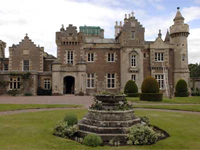
Forgotten Victorian Gothic mansions such as Lowther Castle in Cumbria, possibly become more Romantic in their ruined state. Lowther, the historic seat of the Earls of Lonsdale, designed by Smirke in Gothic baronial style was not re-occupied after the second world war, and in 1957, de-roofed and only the exterior walls preserved. A haunting presence in the beautiful Cumbrian landscape, a new trust has been created to protect the runs and open them and the overgrown Edwardian gardens to the public, in the course of 2011.

For myself, as a historian of the English country house, there is no doubt that the ruin occupies a special place in English culture; the castle, the abbot’s lodgings, the country houses of the sixteenth century onwards, when they stand open to the elements, draw us in to a dialogue with our history and the mutability of fortune.

Jeremy Musson’s ‘English Ruins‘ with photographer Paul Barker, is published by Merrell publishers.

Text by Jeremy Musson, choice of links and images by Matthew Beckett.

——————————————————————————————-

Dear Readers – as always I welcome your comments and feedback.
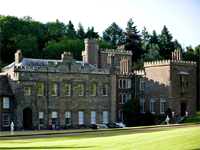
Country House Rescue: the weight of history – Kentchurch Court, Herefordshire

Kentchurch Court, Herefordshire (Image: mhaswell / flickr)

For some who inherit, the weight of family history can easily overcome the burden of running a historic home on a limited budget.  As we saw in the previous episode of Country House Rescue at Trereife House in Cornwall, the desire to not be the generation which loses the ancestral home, a prospect which faced the Le Grice family who had been there since 1799.  So imagine the weight of responsibility facing the Lucas-Scudamore family who have lived for ten centuries at Kentchurch Court in Herefordshire.

The house itself was originally a Saxon tower with further additions in the 14th-century.  However, the main style of the house as it stands today is due to work commissioned from the famous Regency architect John Nash (b.1752 – d.1835).  More importantly, Kentchurch is a significant as one of a number of houses built in the area around that time which were a visible expression of a new wave of architectural fashion; the Picturesque.

Strawberry Hill, London (Image: D Kendall / EH Viewfinder)

When thinking of Georgian architecture many think of the symmetrical classical façades and strictly proportioned Palladian designs which were so prevalent in that era.  Yet one house, Strawberry Hill in Twickenham, south London, was to be the catalyst for a new way of thinking, breaking these patterns and ushering in a more organic way of viewing architecture. This saw the house as part of a landscape with the design playing its part in the beauty of the view as much as the lakes, gardens and parkland. Originally an unremarkable house, it was bought in 1747 by the wealthy Horace Walpole, 4th Earl of Orford and fourth son of Walpole the Prime Minister, who was an astute observer of society, art, and architecture. Walpole contributed little to art but was particularly well read and as he pursued his academic studies decided to start experimenting with alterations to his house.

Fonthill Abbey, Wiltshire (Image: John Rutter (1823) / RIBA)

His original changes from about 1749 were uncontroversial and, importantly, followed the convention for symmetry.  However, from 1753 onwards the interiors were fashioned in a gothic style with the help of what he called his ‘Committee of Taste’ comprising a few of his equally well-read friends.  This experimentation was confined to the interiors until, in 1759, he broke with architectural convention and had a great circular tower constructed but which, radically, had no matching pair.  The house was to continue to grow in a rather free fashion which can still be admired today (particularly so following the completion of phase one of a fantastic restoration by the Strawberry Hill Trust, the Heritage Lottery Fund and the World Monuments Fund). The house became famous, attracting day trippers in large numbers and spawned imitators; though it was James Wyatt’s Lee Priory (built 1785-90 – dem. 1955) which was said to the be first ‘child of Strawberry’.  Also considered worthy, and also designed by Wyatt were the fantastical Fonthill Abbey (collapsed in 1825) for William Beckford, and Ashridge Park for the 7th Earl of Bridgewater.

Downton Castle, Herefordshire (Image: gardenvisit.com)

One man particularly taken with this new style was Richard Payne Knight, a Herefordshire MP and intellectual with a large inheritance.  Using his wealth, in 1774 Payne Knight started the construction of a new home, Downton Castle, which bore similarities to Strawberry Hill, with the asymmetry and a large circular tower, and an irregular plan which was quite radical for the time.  This house was a prototype for a new ‘castellated’ style of house which was to be popular for fifty years from about 1790.  Driving this new style was the publication of three key books, the first two in 1794; ‘The Landscape, a Didactic Poem‘ by Payne Knight, and ‘Essay on the Picturesque‘, a brilliant reply in support by Uvedale Price (another local landowner), and, in 1795, ‘Sketches and Hints on Landscape Gardening‘ by the landscape-gardener, Humphrey Repton, who formed a successful and highly influential partnership with the architect John Nash that same year.

Nash had moved to Aberystwyth after his bankruptcy following a failed speculative buildings scheme in Bloomsbury in London.  Yet, the contacts he was to make in Wales led to Nash becoming one of the leading architects of the Picturesque.  The early development of his interest in the ideas of the movement can be seen when he designed a castellated triangular lodge for Uvedale Price sometime between 1791-4.  He also worked for Thomas Johnes at the spectacular Hafod estate where Johnes had planted 3 million trees to paradoxically create a more ‘natural’ looking Picturesque landscape.

For Nash, the ideas he developed in that short period from 1790 until he left to go back to London in 1796, were what made him one of the most significant architects of the period. The influence of Downton Castle and Nash also created a strong regional collection of these mock castles – Garnons (dem. 1957), Saltmarshe Castle (dem. 1955), Goodrich Court (dem. 1950), Garnstone Castle (by Nash, built 1806-10 – dem. 1958) Hampton Court Castle (alterations 1830s-40s) and extending down to Devon where Nash designed perhaps one of his best creations; Luscombe Castle (built 1800-4), and into Cornwall, where he designed Caerhays Castle (built 1807-10).

Kentchurch Court from "Views of the Seats, Mansions, Castles, etc. of Noblemen and Gentlemen" (London : 1829-1831)

By their very nature these were large houses and often a little impractical which sadly meant many were demolished.  This is why Kentchurch Court is important – not only is an early work by Nash in the style of house which was to become his trademark, but it’s also one of the survivors of the tragedy of the many demolished country houses.

Perhaps the current Mrs Lucas-Scudamore should be grateful, in some ways, that their branch only inherited some fine carvings from the sale of the other much grander family seat, the grade-I Holme Lacy House (now a hotel) rather than the house itself with its 9 fine rooms with plaster ceilings which Pevsner though to be some of the best in the county.  The story of Kentchurch Court today is a familiar one of a family with an incredible history and a fine house and estate struggling with the usual demands for maintenance and £120,000 per year running costs.  Mrs Lucas-Scudamore and her two children (Mr Lucas-Scudamore being estranged and living away) battle on with determination but managing a house like this requires a money tree not a family tree – but this house is too important to be neglected.

Country House Rescue: ‘Kentchurch Court‘ [Channel 4]

The danger of interpretation: Abbotsford House, Scotland

Abbortsford House, Scotland (Image: The Scotsman)
Abbotsford House, Scotland (Image: The Scotsman)

For Abbotsford House in Scotland, home of the famous author Sir Walter Scott, the recent news that it was to receive a £4.85m Heritage Lottery Fund grant is the sort of news which should be welcomed as that level of funding can usually remedy any necessary maintenance or repairs.  However, the grant is not actually to be spent on the house (despite headlines such as ‘Lottery cash means Walter Scott’s beloved Abbotsford will get £10m facelift‘ [The Scotsman]) but mainly on a new, separate visitors centre.

Sir Walter Scott (b.1771 – d.1832) played a key part creating a literary context for the developing Picturesque movement which sought to reject the rigid formality of the Georgians and create a more organic architecture, which he developed in the construction of his own house.

The theory of the Picturesque raised the importance of how one ‘felt’ about a scene or view – a definite break with the austere, ‘correct’ classicism which so dominated.  The exploration of more fluid forms had started in the 1750s and had been adopted by such noted figures as Sir Horace Walpole for his own house at Strawberry Hill in Surrey.  However it was a local Surrey parson, the Rev. William Gilpin, whose guidebooks were to lead the way for those who came afterwards such as Herefordshire squires Sir Uvedale Price and Richard Payne Knight who had the funds to realise these ideas.

Inspired in part by the idealised landscapes of the artists Nicholas Poussin or Claude Lorrain, architects sought to provide an almost ‘arcadian’ vision of buildings integrating naturally with an environment, forcing them to think of the building and environment as a whole rather than simply viewing their particular work in isolation. This also affected the plan of the house, with rooms now being aligned along the best viewing lines rather than simply lined up. One architect who took on this new style was John Nash who met Uvedale Price in about 1790 during Nash’s time in Wales.  Price was at the time building a small summer house and Nash, after meeting him, proposed a typical villa – a design antithetical to Price’s own philosophy.  Price instead guided Nash to design a new house where rooms followed views, and the overall design echoed its rocky coastal location; as he wrote ”The form of it is extremely varied from my having obliged him [Nash] to turn the rooms to different aspects‘.  Castle House, sadly demolished in 1897, was a watershed in the rejection of the dominant Georgian style and Nash quickly developed new designs based on these radical principles which became his distinctive ‘cottage orne‘ style.

Sir Walter Scott didn’t set out to link literature and architecture – in fact his ‘Waverley’ novels were simply a quick way to make some money after financial difficulties.  The books, which he initially wrote anonymously, were the first truly successful historical fiction, and brought Scott considerable wealth and, once his authorship was known, praise.  It was this wealth that enabled him to set about creating his ideal house.  Raised in the Scottish borders he had a close affinity for the natural landscape and so the Picturesque style would have appealed.  However, Scott ensured the existing designs for Abbotsford House had a distinctly Scottish twist, creating what is known today as the ‘Scots Baronial’ style so closely associated with our romantic notions of Scotland today.

Scott bought a small farmhouse in 1811 and engaged William Atkinson (b.c1774 – d.1839) who, between 1814-24, created the house we see today.  Atkinson was not considered one of the best ‘Gothick’ architects, with Howard Colvin thinking that his designs lacked the elegant charm of the 18th-century work and the scholarly accuracy of the 19th-century.  However at Abbotsford, the architectural vocabulary he employed – steeply pitched slate roofs, turrets, bartizans, and crowstepped gables – became the standard language of Scots country houses for anyone not following the Classical style.

So Abbotsford House is an architectural genesis – the first of it’s kind.  It seems a shame to lavish millions on a separate interpretation centre in a modern design which will only compete with the existing architecture of the house and estate.  It’s also a competition the new building is unlikely to win.  Perhaps it would be better for the money to be spent on sensitively incorporating the displays and materials from Scott’s life and work into the home he so lovingly and thoughtfully created.

More details: ‘Lottery cash means Walter Scott’s beloved Abbotsford will get £10m facelift‘ [The Scotsman]

Official website: ‘Abbotsford House

Background: the Picturesque movement [Wikipedia]