The growing silence: how many UK country houses were lost?

Slowly, then suddenly, many estates grew silent. Carriages no longer clattered down the drives. Entrance halls no longer echoed to voices. Kitchens went cold. Staff quarters were emptied. Then, the contents were sent to the auctioneers. Finally, the house was broken apart; hammers and pickaxes the new sounds as hundreds of years of history were reduced to rubble.

One key questions which architectural historians have been trying to answer for a number of years is just how many UK country houses have been lost? The answer, for now, is over three thousand. Each was a world on its own, but also part of the complex jigsaw of our national heritage.

The genesis for this area of research was ‘The Destruction of the Country House‘ exhibition, which ran from 9 October – 1 December 1974 at the Victoria & Albert Museum in London. I have written about it on a number of occasions so if you would like more insights into it, you can read my article on the 40th anniversary or my reflections on the 50th anniversary.

The position of the landed elites was considered the bedrock of society. The families provided political leadership, social aspiration, and were the centre of the local economy through their employment and expenditure. Land ownership was the passport to this elite status; the open market a safety valve which enabled ‘new money’ to mix with the old, to want to emulate them rather than remove them. This allowed new families to fluidly move up from merely wealthy to established gentry or nobility. After a few generations, the land functioned as an older form of ‘green-washing’, the verdant parkland obscuring where the family had started. Within a few short centuries (though sometimes it was just decades), they had become the elite.
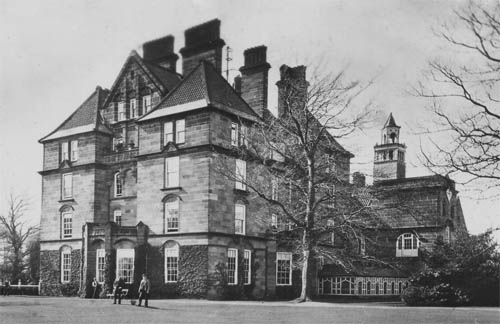
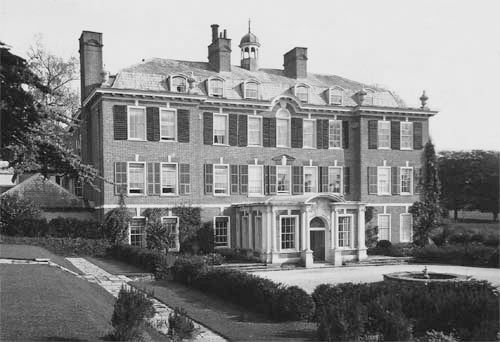
Rounton Grange, Yorkshire – seat of the Bell baronets, of Rounton Grange and Washington Hall (1885). House demolished 1954.

However, the first half of the twentieth century was, for the owner of these large houses, often financially, socially, and politically challenging. The repeal of the Corn Laws in 1846, which opened our markets to cheaper overseas produce, combined with the agricultural depressions of the latter-half of the nineteenth century, had undermined many of the assumptions about the financing of the country house. As debts grew, so the stark financial reality of the situation they were in began to dawn. For many, the path to recovery seemed to be to sell non-core assets such as artworks or outlying estates and hope that this would tide them over until their incomes, usually agricultural, recovered. For those who sold their land early and invested in the stock market, the crash of 1929, was another blow to their planning. As is so often the case, the markets remained against them longer than they could remain solvent.

When Aldous Huxley published his first novel, ‘Crome Yellow‘, in 1921, the challenge to the country house was already significant enough to feature as the fate of the imaginary Gobley Great Park;

‘A stately Georgian pile, with a façade sixteen windows wide; parterres in the foreground; huge, smooth lawns receding out of the picture to right and left. Ten more years of the hard times and Gobley, and all its peers, will be deserted and decaying. Fifty years, and the countryside will know the old landmarks no more. They will have vanished as the monasteries vanished before them.’.

Thankfully, Huxley’s apocalyptic vision wasn’t fully to come to pass. However, from the relatively low levels of losses in the nineteenth-century, the twentieth-century would bring decade after decade of destruction. It’s worth remembering that this was largely a crisis of the country house, not the wider estate. The land was considered more valuable as an income-generating asset and for the social prestige it conferred. Without the expense of the house – the maintenance, the staff, the general running costs – so the income was better able to meet their expenditures. Mr Micawber would be beaming with pride.

So, when seeking to bring their expenditure within the available income, the house was considered a necessary sacrifice. And with so many other families also facing a similar situation, the loss of any one house would be obscured by the loss of so many others. The problem with simple data is that it belies the dramatic local impact the loss of a house would have been. The country house and its estate embodied the idea of stability. The idea of a family owning the house and land and passing it down through the generations was – and arguably still is – embedded firmly in our national psyche, even if the family did change every few hundred years. The key difference in the twentieth-century was that there was often no other family to take their place.

In this dark era, houses languished on the market. This was often evidenced by adverts for the same properties appearing with sad regularity in magazines such as Country Life. It brought reminders of the increasing threats to the established order of the countryside into the drawing rooms and libraries of those most at risk.

Typical advert in Country Life magazine. Key aspects to note: the house is unnamed (though I think it is the infamous Burwell Hall, demolished in 1958), the language emphasises cheapness: ‘moderate price’, ‘modern conveniences’, ‘inexpensive gardens’. (Advert from Country Life, 10 November 1923, pg. XIII)

Each week, beyond the adverts in Country Life, ‘The Estate Market’ page offered a running commentary on the changes. For example, the headline for that page on May 5th 1922, was stark: ‘Demand for small properties’, with the opening paragraph stating, ‘The brightest section of the market is that in which the smaller properties are dealt with…’. Coverage includes the sale of Sudbourne Hall, Suffolk, saying it had sold with 500 acres, having first been offered as a whole but failing to find a buyer, it had been split up. The house was later demolished in 1953.

Another paragraph is headed ‘Mansions as sanatoria’ and writes approvingly of how Lords Londonderry and Boyne have both ‘generously offered’ Seaham Hall and Brancepeth Castle respectively for ‘hospital purposes’. Specifically, it states that Seaham Hall ‘…has had to be closed in consequence of taxation and the heavy cost of upkeep.’ (it survived and is now a hotel). It also mentions that Rendlesham Hall, Suffolk, has been sold for use as a ‘…retreat for drug-addicts and inebriates…’. It was also later demolished in 1949.

Sudbourne Hall, Suffolk, demolished in 1953 (Source: www.lostheritage.org.uk | More images)

During the nineteenth-century, the available data shows that there were fewer losses; approximately one a year. However, when considering the data, there are a few caveats to remember. Critically, the data for the nineteenth-century is thinner than the twentieth-century. Fewer books had been produced, research was sparse, and even confirming if a property was of sufficient stature to be classed as a country house is sometimes challenging. Fire and replacement by a new house were two of the most common reasons.

So how many have been lost?

Quoted in The Daily Telegraph magazine in 2007, the leading country house historian of the lost houses, the late John Harris, said that:

‘At the time [before the V&A exhibition], we reckoned that about 750 houses [in the UK] had been pulled down between 1880 and 1970. Now we know it’s about 1,800.’1

Sadly, John’s estimate was still too low – 1,800 doesn’t even cover England alone.

The gazetteer at the back of ‘The Destruction of the Country House‘ exhibition catalogue listed a total of 1,099 houses (740 for England, 313 Scotland, 46 Wales, with NI not included). This list had been compiled by John, Marcus Binney, and another researcher, Peter Reid, and explicitly stated it was not exhaustive. The total for England was updated with the publication in 2002 of ‘England’s Lost Houses‘ by Giles Worsley which added 445, to total 1,185 for England. However, Ian Gow’s ‘Scotland’s Lost Houses‘ in 2006 listed only 308 (5 fewer than before) but also included examples of houses in cities (which I have excluded from that total).

The task of taking the ground-breaking earlier research forward and to resurrect the memory of these otherwise obscured houses, has now been taken up by amateur enthusiasts, supported by the invaluable work of historians who have focused on specific areas. I started researching the English lost houses in 2006, compiling what I hoped would become the most comprehensive record. All the details, including detailed histories and thousands of images, are shared on the Lost Heritage website.

Using the same model, this was followed over the years by Dr Alastair Disley for Scotland, Dr Mark Baker for Wales, and Andrew Triggs for Northern Ireland (he also took on the much larger task of the Republic of Ireland).

Distribution of English lost country houses since 1800. Source: Matthew Beckett / www.lostheritage.org.uk

The scorecard of architectural losses

Each of these personal efforts has significantly increased the totals of lost houses with Scotland now standing at 545 (Disley), 390 for Wales (Baker), and 100 for Northern Ireland (Triggs – a particular achievement as they hadn’t been tallied previously).

The total number of lost houses for England alone has now exceeded John Harris’ original estimate for the whole of UK, having reached 2,019 (as at November 2024).

Overall, we can be confident that the number of UK country houses lost since 1800 now totals a remarkable 3,054.

Why does this matter? These houses and their particularly grand and hierarchical era and way of living has gone. It died, not in our leafy lanes, but in the battles and social change of the World Wars. The changes forced an evolution – and in that process, there are winners and losers. The tragedy was that the losers were often not inherently weaker houses, and in so many cases, they were some of the most interesting and significant. Beyond the random losses from fire and environmental causes, often what determined whether a house survived was their owners and their circumstances. For some, they were determined to ensure that the houses were reborn, albeit in a new way of living. For others, they were equally determined that that they would not pass what they saw as a burden to another generation.

In the specific losses to a family, and a locality, and to our architectural heritage, they were to be lamented. But in all of them, they possessed something of our shared heritage, and their loss, and the losses of the future, are pieces of the national jigsaw of our identity. As Simon Jenkins said, ‘Through them we hear the echo of our collective selves – and remember who we are.’2. We remember these parts of our history through the memory of these houses, and the roles they played in the life of our nation, both locally and nationally.

Request for help

If anyone has any further information on the lost country houses of England – either history, dates for losses, or family photos or recollections – please do contact me.


References:

1 – Campbell, Sophie, ‘Brideshead Detonated’ Telegraph Magazine, 20/01/2007
2 – Jenkins, Simon, ‘England’s Thousand Best Houses‘ (Penguin, 2004), vii

Country House Rescue – Season 4: Colebrooke Park, N. Ireland

Colebrooke Park, Co. Fermanagh, Northern Ireland (Image: Colebrooke Park)

Country House Rescue has proved to be one of the most interesting of programmes featuring the many varied mansions which the UK is lucky to enjoy.  Rather than the more glamorous recent series showing life at Chatsworth, or Jeremy Musson’s brilliant ‘Curious House Guest‘, Country House Rescue has shown the sometimes harsh reality of owning these homes, despite the lazy jibes in the wider media about families living in a state of supposed luxury.  The programmes have shown the hard work and sense of duty these families possess, though this is sometimes overshadowed by the friction which change can bring, and which is often what is broadcast.  Yet, with a new presenter for the new series (starting Thursday 14 June), perhaps the commitment of the owners and the sheer beauty of their houses will come more to the fore.

In the first three series, Ruth Watson has proved to be an entertaining, if no-nonsense, deliverer of some rather stark home truths to owners up and down the country. For series four, a new presenter, Simon Davis, (favourite houses: Sezincote, Blenheim, Mount Stuart, Villa Emo, Babington House) takes the helm and steers a more collaborative and involved course as he stays at the houses, with the families, to experience their day-to-day life, including the hardships; at one house he spent an extremely cold night after the family admitted they never turn on the heating as it costs £30 per hour to run. It will be interesting to see how the new messenger is received and whether a less assertive style will bring greater success – though many will undoubtedly miss Ruth’s acerbic commentary.

The houses to feature in the new series are now known: Colebrooke Park, Bantry House, Chapel Cleeve Manor, Craufurdland Castle, Great Fulford, Meldon Park (thank you Andrew); starting with Colebrooke Park in Co. Fermanagh in Northern Ireland; the first time the show has been to that part of the UK.

Colebrooke Park is a fascinating example of the varied fortunes of the country house over the last two centuries; a story marked by wealth and also decline, but also one driven by a continued commitment to a house by generations of one family. Home to the Brooke family for over 350 years, the current owner, the 3rd Viscount Brookeborough (a prominent peer, one of the 92 hereditaries sitting in the House of Lords) received what many would regard as an unenviable inheritance in 1980 when he took on the decaying and empty family seat.

Of course, as with many houses, they had had a heyday.  Once the centre of one of the five largest estates in the area, which had reached a peak of almost 28,000-acres in 1876, the house had been home to a succession of prominent politicians and soldiers including the 1st Viscount, the longest serving Prime Minister of Northern Ireland (1943-63). However, agricultural changes, taxation, and the Troubles, meant that the estate slowly shrank to just over a thousand acres, with a similarly reduced income insufficient to maintain a house of this size.

Castle Coole, Northern Ireland (Image: Stephen McKay / Geograph.ie)

The house itself is a rather austere neo-Classical design; a two-storey, nine-bay block only enlivened by a grand pedimented portico with Ionic columns.  The house was built in 1820 for Henry Brooke (b.1770 – d.1834) who was created a baronet in 1822 (second creation), as a statement of his position, but one which was to be built on a budget – though a substantial one; the house was completed for £10,381 – approx £7m today.  Sir Henry had inherited the house and estate from a rather profligate uncle and clearing the debts and establishing a comfortable fortune had taken three decades – the house was a reward and a monument to his sound management.  Despite being a cautious man, Sir Henry still succumbed to the suggestions of his architect that he compete with the nearby Castle Coole by James Wyatt (built 1790-97), increasing the dimensions of the house so that it was larger, and then later in the summer, approving the enlargement of the Library to 36ft by 18ft.

Rise Hall, Yorkshire (Image: Pastscape)

For those who regularly watch TV programmes featuring country houses, Colebrooke Park may trigger a vague sense of deja vue.  This is because the house is, bar a few details, quite similar in design to Sarah Beeny’s Rise Hall in Yorkshire (mentioned in this previous blog post).  Both houses were built around the same time but by different architects; Colebrooke in 1820 by William Farrell and Rise Hall in 1815-20 by Watson and Pritchett.  Yet it is likely that this was more co-incidence than copying as there is a clear architectural lineage for the ‘rectangular block with portico’ style of house which goes back to Colen Campbell‘s masterpiece of architectural propaganda, Vitruvius Britannicus.  Published in 1715, this collection of designs helped shift the national preference away from the more florid Baroque houses of Vanbrugh toward a simpler architectural style; one which Campbell himself exemplified with his quite radical first design for Wanstead Hall, Essex. Although Wanstead as built was significantly different in the detailing, the core architectural idea was for a rectangular central block, fronted by a bold, pedimented portico.  This was to be one of the most influential designs produced by an architect; shaping national taste, it was widely imitated for decades afterwards – see Prior Park in Bath, built in the 1730s and 40s, and Adlington Hall, Cheshire, built in the 1750s, and even today.  Of course, this design is a derivative of the rectangular, double-pile plan developed by Sir Roger Pratt at Coleshill, Berkshire (built 1650-64, burnt down 1952).

Wanstead House I by Colen Campbell - first proposed design - 1715
Wanstead House I by Colen Campbell – first proposed design – 1715

Despite the grandeur, the agricultural depression in the 1880s hit the estate and the decline began. This was only arrested by the return in 1918 after WWI of Sir Basil Brooke who instituted changes to bring the estate back. It was, though, a struggle; many rooms were left unused in the 1930s and by 1939 the timber was being felled as ‘the only way to save Colebrooke’.  Poor tax planning meant that when Lord Brookeborough died in 1973 the contents of the house had to be sold to pay the death duties, leaving a rather forlorn house for the present Lord Brookeborough when he took over in 1980.  Realising the scale of the challenge, an architect was engaged to explore what options were available; including the dreaded conversion to a golf club with the grounds becoming fairways.

Colebrooke Park, Northern Ireland (Image: Colebrooke Park)

Luckily, a better solution was found; the house became an exclusive country sports destination, with sporting rights over 10,000-acres and the Viscount and Viscountess welcoming the guests as though friends into their home.  The house was sensitively adapted to meet both the requirements of discerning visitors and official regulations whilst preserving the architectural fabric of the house to the greatest extent.  Despite their success, the Viscount and his wife wish to pass on the house and 1,100-acre estate to their nephew in an even more robustly healthy condition; hence the invitation to Country House Rescue.   It will be fascinating to see if this series presents radically different ideas to those proposed by Ruth Watson.  Obviously one hopes that whatever happens, the solutions enable the families to remain in their homes whilst providing sufficient income to not only maintain them but invest in them to give them a stronger future.

—————————————————————

A more detailed history of Colebrooke Park [Colebrooke Park]

TV makeover for stately home‘ [Belfast Newsletter]

Country House Rescue – Series 4 [Channel 4] – Colebrooke Park (episode 1: Thursday 14 June – 20:00)

Country House Rescue – Series Listing [Wikipedia]

The Country House Revealed – Clandeboye, County Down

Clandeboye, County Down (Image: Paul Barker / Country Life Picture Library)

One of the great glories of the private incomes afforded to previous generations was the ability to indulge in their passions.  Given the opportunity, many of us would similarly be happy to devote our lives to our interests and, for some, in doing so they have created great collections – not just of art, but in the fields of anthropology, Egyptology, armour, botany…the range is endless.  In this week’s ‘The Country House Revealed‘, Dan Cruickshank visits Clandeboye in County Down, Northern Ireland; seat of a branch of the Guinness family, but also home to an impressive collection of artefacts.

Clandeboye (also sometimes known by the original name Ballyleidy) sits in a 2,000-acre estate in the heart of the Ulster countryside – a smart, elegantly Georgian seat; the design semi-Soanian (originally), part-the-owner (later additions).  The professional architect involved was a former pupil of Sir John Soane, Robert Woodgate, to whose designs the house was built in 1801-4.  Woodgate had a brief career, cut short by his early death in 1805, having joined Soane’s practice as an apprentice in 1788, before graduating in 1791 and then being sent to Ireland to Baronscourt, Co. Tyrone (note the triffid-like march of the wind turbines now marring the skyline!), to supervise the building Soane’s commission of a new house for the Marquess of Abercorn.

Clandeboye, for the 2nd Baron Dufferin, was one of Woodgate’s earliest commissions and is unusual, ignoring the more common ‘Palladian’ central block with flanking wings layout, of houses at the time.  At Clandeboye, whilst still Soanian in it’s style, the layout is focussed on two wings at right-angles to each other with the corner due south taking maximum advantage of both the setting and the sun.  All-in-all, a good, competent design by a well-trained young architect – though perhaps lacking some of the drama a more experienced architect might have brought to the plan.

What is particularly special about Clandeboye today is that it contains the remarkable and diverse collections of the wonderfully named Frederick Temple Hamilton-Temple-Blackwood, 5th Baron Dufferin and Claneboye (note the different spelling of the title).  A prominent politician and administrator, he served as Governor General of Canada  (1872-1879) and Viceroy of India (1884-1888).  The Lord Dufferin was also something of a radical social reformer and fell out with the PM, Gladstone, believing that the land ought to be owned by the farmers.  Not content with just arguing for this, he sold off much of the 18,000-acres the family had amassed, leaving the estate we see today.

Very well-educated, Lord Dufferin, as with many other wealthy Victorians, used the opportunities of his many diplomatic postings to acquire large quantities of objects – not just the usual art and furniture but curiosities from around the globe.  This led to a new programme of work in the mid-19th century to enlarge the house to display these prizes, resulting in a large west wing.  Dufferin had toyed for years with grand plans for the complete rebuilding of Clandeboye to a faux-Elizabethan nostalgic ideal.  After a few years, his tastes changed and he then sought out Benjamin Ferrey to provide a French-chateaux style house – but again this came to nothing.  In 1865, his preferences had ebbed back towards a more ‘romantic’ style and he began a long collaboration with William Henry Lynn, who then advised Dufferin on the alterations to Clandeboye which are what we see today.   One aspect of the process which probably infuriated Lynn was, as Harold Nicolson has described, that Lord Dufferin’s ‘passion for glass roofing was… uncontrolled‘, leading to the broad use of skylights.  Considering how Soane, and therefore probably Woodgate, sought to carefully manage the effects of light, this crude flooding of the interior spaces may not have met with approval from the original architect.

Today, the contents of the house can be seen as a snapshot of the passions and interests of a wealthy aristocrat at the height of the British Empire. Victorian Britain seemed to foment this type of collector with other houses similarly becoming self-indulgent museums – though often with a great intellectual rigour which helped drive forward our understanding of the world and science.

Quex Park, Kent (Image: ..george / flickr)

For example, Quex Park in Kent became the showcase of the Powell-Cotton family, who, over six generations, created a superb collection of natural history with specimens taken during Major Percy Horace Gordon Powell-Cotton’s expeditions to Africa,which has subsequently been expanded by later generations.  Another showcase was Goodrich Court (dem. 1950) which was designed by the owner Sir Samuel Rush Meyrick specifically to accommodate his world-renowned collection of arms and armour which forms an important part of the incredible Wallace Collection in London.

Didlington Hall, Norfolk - demolished 1950/52 (Image: Lost Heritage)

As at Clandeboye, Egypt has long held a fascination in Britain.  One early and noted collection was assembled by William Amherst Tyssen-Amherst (the 1st Baron Amherst) at Didlington Hall in Norfolk (dem. 1950/52).  By chance, Lord Amherst employed a Mr Samuel Carter, a well-known artist to paint at the house, and he would often bring his son, who spent many an hour in the extensive Egyptian museum in the house.  That son was Howard Carter who famously went on to discover Tutankhamun’s Mask with George Herbert, 5th Earl of Carnarvon.  Highclere Castle also holds a small but important collection of Egyptian antiquities amassed by the 5th Earl and which are now on display in a purpose-built gallery in the cellars of the house.

Waddesdon Manor, Buckinghamshire (Image: National Trust)

Perhaps the greatest example of a house built to show a collection is Wadddesdon Manor in Buckinghamshire; that slice of French architecture which enchantingly appears in the middle of the English countryside.  Funded by the vast Rothschild fortunes, the mansion, designed by Gabriel Hippolyte Destailleur, was built between 1874-1889 for Baron Ferdinand de Rothschild primarily to showcase what must easily be one of the finest collections of Dutch and English paintings and French art, tapestries and furniture.  Used only in the summer months for parties and entertaining this was the ultimate expression of the desire to use a private residence as a gallery – or was it merely a gallery with bedrooms?

So Clandeboye is part of a long and fine tradition of the wealthy owners of large houses not merely adding a scattering of objet d’art to show-off the taste of their interior decorators. These houses are true collections, in some cases museums, even monuments, to the eclectic passions of their owners.  The wide-ranging nature of these collections demonstrates one of the many benefits of single family ownership, such as at Clandeboye, where intellect and wealth can be combined over generations to create a rich and interesting tapestry that no public organisation would be likely to be imitate; and our nation would be all the poorer without it.

————————————————————————————–

Official website: ‘The Country House Revealed‘ [BBC2]

A wonderful interview (and slideshow) with the Countess of Dufferin and Ava: ‘The Marchioness‘ [wmagazine]

The Clandeboye estate: official website / history [clandeboye.co.uk]