Converting country houses from commercial to residential: a sound investment?

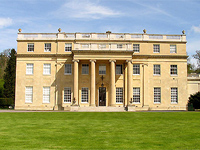
Benham Valence, Berkshire (Image: wikipedia)

As the pressures of the twentieth century forced more country houses owners to face the reality that they could no longer live as they had and would have to move out of their homes they then had to decide what to do with it.  Unfortunately this meant demolition of hundreds of large houses but some owners were more creative and many houses became commercial premises, either as hotels, schools or institutions, and others became some of the grandest office buildings in the country.  However, recent pressures of this century have now seen some of these offices being converted back into homes or being offered for sale as an opportunity to do so.

In many ways the country house has always had an element of the commercial to it with the estate offices usually being based either in a part of the main house or in a nearby building to enable the owner to deal with business without having to travel far from home. The changes of the twentieth century were on an altogether more comprehensive scale with the entire house being changed to accommodate the demands of business.  This not only meant the conversion of the main house with all that entailed for the interiors but also the building of further offices in the grounds.

Sometimes the development was kept a good distance from the main house such as at Ditton Park in Berkshire.  This became the office of the Admiralty Compass Observatory from 1917 until it was sold in the 1990s to Computer Associates who built a huge office building to the west of the main house (which became a conference centre) leaving the setting intact.

Sometimes though it’s possible for smaller businesses to be accommodated just within the main house such as at Gaddesden Place in Hertfordshire.  The house, built in 1768, is a elegant Palladian villa (similar to the White Lodge in Richmond Park) and was James Wyatt’s first country work.  The site is said to have some of the best views in the home counties and the sensitive use of the house has allowed to remain in splendid seclusion.

However, modern concerns mean that a country house has lost some of it’s appeal as offices.  One key issue is that by their nature the houses are isolated meaning that employees must have cars to reach it leading to more cars on the roads and the need to provide huge areas of parking.  Stronger heritage legislation now also means it’s much harder to alter the houses to meet modern business requirements such as air conditioning and computer networking.  The nature of the houses also means that maintenance costs are higher than for a purpose built office.

This has led to some houses which were formerly offices to be converted back into homes.  Mamhead House in Devon, built between 1827-33 and regarded as one of Anthony Salvin‘s finest designs, it was, for many years, a school before becoming offices for a local building company.  It was bought by a businessman who converted the main part of the house back into being a home whilst still letting out part of the house to the Forestry Commission.

Perhaps the grandest and largest opportunity for many years to restore a house into a home is the mansion at Benham Valence in Berkshire.  This superb house was built in 1772-75 for the 6th Earl of Craven and was designed by Henry Holland in collaboration with his father-in-law, Lancelot (Capability) Brown, the famous landscape architect.  The south front features a grand tetrastyle Ionic portico which looks out over a large lake with views into the parkland.  Inside, there are many fine chimney-pieces bought from the sale at Stowe in 1922, including one from the State Dining Room.  It also features a small circular double-height vestibule adjoining the inner hall, a design later adopted by Sir John Soane.

The house was empty in 1946 and remained so until it was sold in 1983 and converted to use as offices with a large wing to the north east of the house being demolished and replaced, in part, by an ugly 80’s complex providing over 100,000 sq ft of space.  Luckily though the main house was largely spared and remains Grade II* with the 100-acres of Grade-II parkland. Now offered for sale at £6m this is a rare opportunity to create a wonderful country house – providing it’s possible to obtain planning permission to convert it back – which, once restored, could be worth £10-12m.  One key requirement would be the demolition of the office complex and the ripping up of the huge car park – but give me a pickaxe and I’ll be happy to lend a hand.

Full property details: ‘Benham Valance, Berkshire‘ [Strutt & Parker]
A glimmer of hope: ‘Country House Rescue’ visits Kelly House

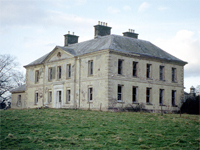
Kelly House, Devon (Image: English Heritage)

Kelly House has a series of long associations; there has been a house there for over 900 years, it has been the seat of the Kelly family for that entire time, and, sadly, has been on the English Heritage Buildings at Risk Register for over five years.  Now the latest twist in the tale is that the house will feature in Channel 4’s ‘Country House Rescue’ on Thursday 1 April when expert Ruth Watson offer possible solutions which will help the Kelly family remain in their ancestral home.

The Kelly’s are one of the very rare families able to trace their lineage back to pre-Conquest times.  Warin Kelly is the 31st squire of the family to live in a house which has been passed down since 1100 through fathers, grandfathers, and brothers.  Described as being ‘in a class of its own’ by Marcus Binney*, the elegant Palladian house was built in 1743 -45 for Arthur Kelly by Abraham Rundle (d.1750), a joiner and provincial but obviously skilled architect who lived in Tavistock.  The house is grade-I listed and features a Portland stone doorcase, sash windows glazed with Crown glass and made in London, with local slat stone walls with moorstone quoins. Inside, the extensive high quality woodwork  features superb carving including panelling, chair rails, and a particularly good staircase with chunky corkscrew balusters.

However, the fine panelling hides serious issues such as the periodic bouts of dry rot which break out. Mr Kelly, as a conservation architect advocating minimal intervention, admirably refuses to treat it with chemicals or by stripping out the panelling.  This ongoing damage is largely the fault of death duties, with two demands being levied in swift succession which have severely limited the family’s ability to maintain the house.  Kelly House is exactly the sort of house which the Historic Buildings Councils would have provided grants for when they were set up in the 1950s.  Today, with English Heritage’s budgets under severe pressure, Mr Kelly was told in 2005 that they were unable to provide funds as the increase in the value of the restored house would be greater than the grant – meaning that they force owners towards the sale of their ancestral homes.

Much as it would appear difficult to argue for the provision of public money to preserve private residences, there has to be a better solution than just letting them slowly grow more derelict despite the often heroic efforts of the family involved.  The current generation doesn’t want to be the one which is remembered for having to sell the family seat, leading to a battle against the elements of decay which saps finances and families and often doesn’t provide a long-term solution.  Outside expertise is to be welcomed as it may show the way to a sustainable future for these beautiful homes. Hopefully Ruth’s suggestions can be taken on by the Kellys and other families to ensure their homes are self-financing and not a burden to either the state or the owners who are then able to look forward to the prospect of handing a home and not a liability to their descendants.

Programme details: ‘Country House Rescue‘ (Channel 4)

More information: ‘TV show could help manor restoration‘ [Western Morning News]

Official Kelly House website: ‘Kelly House

* – ‘Houses to Save’ – article by Marcus Binney in Country Life magazine (8 September 2005)

Ouch – Melville House sold for £1.6m; down from £4.5m

Melville House, Fife

In a cautionary tale of how ambitious restorations can come unstuck, Melville House has been sold for a ‘knock-down’ £1.6m by agents Knight Frank.  The 17th-century Palladian mansion boasted 11 bedrooms, seven receptions plus stables, a tennis court and even a cricket pitch.  It was built in 1697 for George, the 1st Earl of Melville, then secretary of state for Scotland by James Smith.  The 1st Earl died a few years after his creation was finished but the house remained in the Melville family until it was sold – along with the contents – in 1949.

It had been requisitioned by the Army as a barracks during the war (the probable damage from which led to the sale) and then became a hospital and subsequently a residential school before being sold to a developer for £400,000.  It was then sold on again in 2003 for £1m and the new owner then spent over £2m on restoration.  The latest owner has secured a bargain – here’s hoping it’s now in safe hands.

Full story: ‘Repossessed mansion sold for ‘knockdown’ price‘ [stv]