Country House Rescue – Series 4: Meldon Park, Northumberland

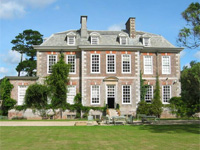
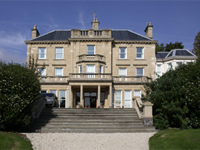
Meldon Park, Northumberland (Image: Meldon Park)

One of the joys of Country House Rescue is to bring to light some of the lesser known houses. The subject of this week’s edition (12 July, 20:00, Channel 4), Meldon Park in Northumberland, can certainly be said to be one of the ‘illustrious obscure‘.  This is also perhaps an apt description of the architect, who was one of the most prolific in the north east of England yet surprisingly little known beyond that, though the house also features later work by another who was certainly famous. Yet, such noble associations do not pay the bills so, despite a 3,800-acre estate, the Cookson family have called in the services of Simon Davis to provide ideas to help keep the house in the family.
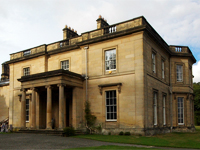
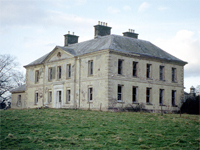
Entrance front, Meldon Park (Image: lawrencecornell via flickr)

Meldon Park is certainly an elegant essay in the neo-Classical; golden brown sandstone in a compact and elegant design with some superb subtle detailing which denotes the hand of a finer architect.  The entrance front, though only three bays wide, features a grand porch with four free-standing (or ‘tetrastyle prostyle’ if you’d prefer the architectural terms) Ionic columns, projecting from a slight recession of the middle bay, with the corners of the building marked by shallow pilasters.

The architect of the now grade-II* Meldon Park was the regionally prolific John Dobson (b.1787 – d.1865) – a name famous in the north east but, due to his geographic focus, one less known nationally.  Dobson was born in Chirton, County Durham, and showed an early talent for drawing which led, at the age of 15, to his becoming a pupil of leading Newcastle architect David Stephenson.  On completing his studies in 1809, Dobson moved to London to develop his skills further, studying under the famous watercolourist John Varley. In London, Dobson became friends with the artist Robert Smirke and his two architect sons Robert (who designed the main facade of the British Museum) and Sydney (who later married Dobson’s daughter).  Despite the urging of his friends to stay in London, Dobson moved back to Newcastle where he established his practice, becoming (reputedly) the only architect between York and Edinburgh, except for Ignatius Bonomi in Durham.

Jesmond Towers, Newcastle (Image: GeordieMac Pics via flickr)

Dobson proved to be an exceptionally capable architect; not only could he produce beautiful and convincing watercolours of proposed projects, he was also technically competent, to the extent that his daughter claimed he ‘…never exceeded an estimate, and never had a dispute with a contractor‘. Dobson is perhaps best remembered for designing much of central Newcastle, and in particular, the beautiful curved train shed at the Central station.  Despite his urban output, Dobson was also extensively involved in projects outside of the towns, designing or altering over sixty churches and more than a hundred country houses; the latter principally commissioned by the beneficiaries of the wealth of the Industrial Revolution. Dobson was a rare architect in that he was competent in designing in both the picturesque style of Tudor Gothic (such as at Beaufront Castle and Jesmond Towers) and the classical style of the Greek Revival – and it was in the latter that he truly excelled. Although Howard Colvin praises his careful siting of the houses, high-quality finish and precise and scholarly detailing, he thought Dobson had a tendency to exaggerate the scaling, creating an overall look which might be considered bleak. Yet, this is more an academic criticism; those today looking on the many houses he worked on would consider them to be handsome examples of the flourishing of the country house which resulted from the new wealth in the north east.
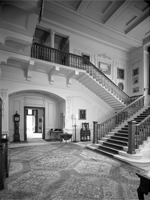
Stair hall, Meldon Park (Image: Country Life Picture Library)

Meldon Park was to be one of Dobson’s finest of his Greek Revival designs.  Built in 1832 for Isaac Cookson, at a cost of £7,188 1s 1d (about £5m today if compared with average earnings), it was a sizeable house with extensive service accommodation and extending to a beautiful Orangery, even if the main house was comparatively small.  That said, the rooms are bright and well-proportioned with a grand Imperial central staircase, with its deep coffered ceiling described by Pevsner as being ‘the size of one in a London club‘.  The staircase was later reworked by no lesser figure than Sir Edwin Lutyens, who replaced the original metal balustrades with wooden ones and added decorative plaster panels.

Isaac Cookson was the third generation to manage the family manufacturing interests and had taken charge of his father’s glass works, developing them into one of the country’s leading makers, along with a very successful chemical works.

Longhirst Hall, Northumberland (Image: Longhirst Hall Hotel)

Cookson had previously employed Dobson to design part of a speculative urban development in Newcastle and combined with his earlier country house work at neighbouring Mitford Hall, Longhirst (with its striking entrance portico) and Nunnykirk halls, Dobson was a natural choice when looking to create his refined country seat.

As owners of a glass works, it was natural that the house would be well-lit; the bright interior a result of the large windows which graced the main rooms on the south and east sides.  Yet, Meldon Park actually marks a turning point.  The brilliant Mark Girouard, writing in Country Life in 1966, pointed out that:

In rooms like this, one realises just how much Georgian architecture developed in the course of the late 18th and early 19th centuries, as windows grew bigger and more and more effort was made to link the inside of the house visually with the landscape.  Meldon shows the development at its final stage; soon a reaction was to begin and the Victorians turned away from the sun and immersed themselves in increasing gloom.   In this as in other aspects Meldon represents in a very convincing way, the last flowering of the Georgian country house tradition.

So Meldon Park represents not only the work of one of the finest architects to have worked in the north east but also marks a key point in the development of British architecture; the high-water mark of Georgian elegance before the more insular and muscular Victorian style swept over the north of England.  The house is also one of those rare survivals where it is still owned and lived in by descendants of the person who commissioned it, sitting in its own huge estate.  This is a house which seems to be clearly loved by the owners who have worked incredibly hard to ensure they can remain there especially when the house is less of an attraction for visitors as previous generations had sold the art collection.  Judging by their new website and other news stories about their expanded and diversified activities it seems that they were also willing to listen to Simon Davis’ advice and act on it and such pragmatism can only be applauded and will hopefully be rewarded.

——————————————————————————

Official website: ‘Meldon Park

Photos from Country Life: Meldon Park [Country Life Picture Library]

Listed building description: ‘Meldon Park, Northumberland‘ [British Listed Buildings]

Want to stay there? Meldon Park: East Wing Apartment

Country House Rescue – Series 4 [Channel 4]

Country House Rescue – Episode 5 [Channel 4]

For more information about the architect: ‘John Dobson 1787-1865: Architect of the North East‘ – Thomas Faulkner & Andrew Greg

Country House Rescue – Season 4: Great Fulford, Devon

Great Fulford, Devon

If there were a league table of how often a house and family appear on TV or in the papers, an unexpectedly high entry would probably be the Fulfords of Great Fulford in Devon.  Having featured in other programmes and even their own series, it’s almost a surprise that it has taken Country House Rescue this long to visit (Thursday 5 July, 20:00, Channel  4).  Despite the bluff and occasionally hostile exterior of Francis Fulford, the Fulfords are a remarkable family – both this generation and the many which have come before them.  The question is; with so few houses still lived in by the original families, will future Fulfords be able to stay in their notoriously imperfect house?

Great Fulford falls firmly in that category of houses which Hugh Montgomery-Massingberd described as the ‘illustrious obscure‘; those many smaller, privately-owned houses which lie nestled in valleys and hidden by their own land – in this case, a not insubstantial 3,000-acres.  Pevsner described it as ‘…a substantial courtyard mansion, larger than  most in Devon though characteristic of the county in its reticent exterior and its patchy and undocumented history of rebuilding and remodelling…‘. With a core which stretches back to the 1500s, the house has grown and been embellished as funds and whims permitted creating a lengthy listing desciption which would make a larger house very proud. A major remodelling in the 1800s has been suggested as being to designs of Sir Jeffry Wyatville but neither Pevsner nor Colvin mention this and the listing discounts it.

So although some aspects of the actual house remain a mystery, one aspect which is very clear is the remarkable endurance of the family, with the current owner, Francis Fulford, being the 26th (or 27th – he’s not sure) Fulford of Fulford, a line stretching back over 800 years. Very few families are able to trace back their lineage so far, even fewer are still in possession of the original family seat.  Yet they do survive, despite the best efforts of tragedy and unforgiving tax regimes to unseat them.

Kelly House, Devon (Image: English Heritage)

One such family has featured on Country House Rescue before: the Kellys of Kelly, also in Devon, who have a proud history dating back to the 1100s.  In 2010, Ruth Watson visited the beautiful if rapidly deteriorating Kelly House [more on that visit in this previous blog post: ‘A glimmer of hope‘] to find an owner almost in denial as to the decrepit state of their home.  Proving that Country House Rescue can be a positive catalyst for change; the house is now slowly being restored with help from various students of architecture, surveying and other related fields. By contrast, the Fursdon family of Fursdon House (also in Devon!) have fully adapted their estate to offer all the usual activities which have ensured their beautiful 750-acre estate and elegant house (which, in a truly modern way, you can follow on Twitter, @fursdondevon, and Facebook) not only brings in an income but is also a home.

Fursdon House, Devon (Image: Fursdon House)

These smaller houses form the backbone of the local history of an area; so embedded that their name denotes the place.  In a fascinating series of articles in ‘The Field‘ magazine, starting in 1984, Hugh Montgomery-Massingberd toured the length and breadth of the UK seeking out these lesser known seats and their even more private owners.   To read these amazing histories is to realise the depth of history which our nation enjoys, including:

So although not unique, the Fulfords are rare.  In many ways the Fulfords are a refreshing alternative to the slick corporate manicure of many homes or the stately preservation of the National Trust (though all have their place).  This is a notable family who have, against all odds, achieved something exceptionally rare amongst stately home owners.  This has to be admired and although unconventional they are a fascinating part of the tapestry of our nation.  Some part of me hopes that they achieve a beautiful equilibrium of succeeding enough to ensure the survival of the house, but not too much so as to compromise the character of their lives or Great Fulford.

————————————————————————-

Further articles:

Francis Fulford’s Blog

Country House Rescue – Series 4 [Channel 4]

Country House Rescue – Episode 4 [Channel 4]

Country House Rescue – Season 4: Chapel Cleeve Manor, Somerset

Chapel Cleeve Manor, Somerset (Image: Webbers)

Many have bought things on a whim; it’s quite something for that thing to be a huge country house which once played host to royalty and celebrity.  When plans don’t work out and problems mount, it can be understandable for a family with generations of emotional attachment to a house to doggedly carry on, but the owner of Chapel Cleeve Manor in Somerset, who features in this weeks ‘Country House Rescue‘ (Thursday 21 June, 20:00, Channel 4), displays a rare level of stoicism.

Chapel Cleeve would be a fascinating house even if it wasn’t on television, but sadly its decline is all to familiar.  The origins of the house lie as a medieval inn for pilgrims visiting the now lost St Mary’s Chapel and travelling to the Cistercian abbey at Cleeve, which owned much of the land in the area until it was surrendered to the Crown in 1536.  The estates then passed to the Earls of Sussex in 1538 who held it until 1602, after which it passed through a number of owners, including Lord Foley of Kidderminster in the early 1700s.

When the new house was built, the remains of the inn, dating from 1423, were then incorporated as part of the north-west wing of the house as it is today.  The house, built between 1818-1823, was designed by Richard Carver (b. c1792 – d.1862) whom Colvin believes to be the ‘R. Carver’, a pupil of Sir Jeffry Wyatville who submitted work for display in The Royal Academy in 1811 and 1812, before establishing his practice in Somerset and eventually rising to be County Surveyor.  Best known for his many churches, Colvin is critical saying “…though occasionally showing some originality in plan (e.g. Theale, and the octagonal Blackford), are poorly detailed, and were despised by serious Gothic Revivalists.” He was damned by the Ecclesiologist in 1844 as having “…proved himself entirely ignorant of the principles of Ecclesiastical Architecture.” He may have been grateful that his Tudor Gothic design for Chapel Cleeve Manor was outside their remit and so escaped their ire.

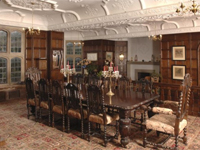
Dining Room - Chapel Cleeve Manor, Somerset (Image: Webbers)
Dining Room – Chapel Cleeve Manor, Somerset (Image: Webbers)

Just under a century after Carver finished, the house was enjoying what was to prove to be its heyday.   Bought by the Lysaght family, wealthy from their corrugated-steel business, the original five bay house, featuring a central octagonal entrance hall with a top-lit staircase, was extended between 1913-14 with a sympathetic addition which increased the size of the house to over 27,000 sq ft, with salons, a ballroom and a 100-ft long gallery. Of particular note are the high-quality interior plasterwork ceilings which were created by one of the leading Arts-and-Crafts sculptors; George Percy Bankart. Staffed by 50 servants, the house played host to the young Princesses Elizabeth and Margaret, and with Fred Perry staying for tennis parties.

The death in 1951 of G.S. Lysaght triggering punitive death duties which forced the sale of the house and, worse, the sale of parts of the grounds as building plots.  The dense woodland which had thus far shielded the manor was now largely obliterated with housing claustrophobically creeping up on three sides. Perhaps the expectation was that the house would not survive and further housing could be built, but the house then enjoyed a resurgence when it became a hotel in the 1960s and 70s, becoming the place to be in the area. However, when that business closed, the rot, both metaphorically and physically, set in, so that when it was bought by the current owner for 14 years of Chapel Cleeve, Jeannie Wilkins, in 1998 ‘there was not one habitable room‘.

Chapel Cleeve Manor, Somerset (Image: Webbers)

Having spent £360,000 purchasing the property with her partner and with the help of two skilled friends, they started the mammoth task of restoring the house.  Correctly starting with the roof, it took two years to complete the task of making it watertight, with the restoration of the Edwardian wing taking many of the subsequent years.  The restoration was to a high standard, with care being taken to reinstate the many various mouldings and panelling, with the overall intention being to create six flats in the house, five of which could then be let – but, as with all the best laid plans, it went awry.

The inevitable challenges of finding an agreeable path through the stringent planning rules governing this Grade-II* listed house caused delays, and, sadly, Ms Wilkins relationship ended, following which she bought out her ex-partner, leaving her in sole charge of a vast partially-restored mansion with its 150-ft façade and spectacular views over the nearby hills.  With an income of just £5,000 per year from renting out a cottage in the grounds she faces a huge backlog of repairs (only 18 rooms are habitable out of 45 in total) and the costs of restoring it, which she estimates at around £500,000 (so, at least £750,000 – as anyone who has watched Grand Designs will know!).

Chapel Cleeve was offered for sale in early 2010 at £1.695m (and featured in a post at the time: ‘The start of the rush? Country houses for sale in the Sunday Times Home section‘), but it is still available. The combination of the restoration challenges, general economic climate and the severely compromised situation of the house – reduced to just 7-acres surrounded by a drab housing estate – have driven Ms Wilkins to call for the help of Simon Davis and ‘Country House Rescue’ to inject some new ideas – which he does, though none are the financial miracle she may have been hoping for.

In many ways, Ms Wilkins’ commitment to the house has to be admired – her dedication has almost certainly saved it from joining the sad, long list of lost houses.  However, it might be argued that her unwillingness to drop the asking price (especially considering the cost of the works outstanding) is also again putting the house at risk. A house of this size would ideally have much larger grounds to provide seclusion and planners ought to insist on a minimum 500-metre ‘green-belt’ around each house which would help protect their long-term viability. Undoubtedly Jeannie Wilkins deserves a just reward for the incredible work she has put in, but a quick sale at a reasonable price would certainly not only be best for her, but also for the long-term future of the house.

——————————————————————————

Sales details: ‘Chapel Cleeve Manor‘ [Fine & Country]

Official website: ‘Chapel Cleeve Manor

Listing description: ‘Chapel Cleeve Manor‘ [British Listed Buildings]

News articles:

Country House Rescue – Series 4 [Channel 4]

Country House Rescue – Season 4: Colebrooke Park, N. Ireland

Colebrooke Park, Co. Fermanagh, Northern Ireland (Image: Colebrooke Park)

Country House Rescue has proved to be one of the most interesting of programmes featuring the many varied mansions which the UK is lucky to enjoy.  Rather than the more glamorous recent series showing life at Chatsworth, or Jeremy Musson’s brilliant ‘Curious House Guest‘, Country House Rescue has shown the sometimes harsh reality of owning these homes, despite the lazy jibes in the wider media about families living in a state of supposed luxury.  The programmes have shown the hard work and sense of duty these families possess, though this is sometimes overshadowed by the friction which change can bring, and which is often what is broadcast.  Yet, with a new presenter for the new series (starting Thursday 14 June), perhaps the commitment of the owners and the sheer beauty of their houses will come more to the fore.

In the first three series, Ruth Watson has proved to be an entertaining, if no-nonsense, deliverer of some rather stark home truths to owners up and down the country. For series four, a new presenter, Simon Davis, (favourite houses: Sezincote, Blenheim, Mount Stuart, Villa Emo, Babington House) takes the helm and steers a more collaborative and involved course as he stays at the houses, with the families, to experience their day-to-day life, including the hardships; at one house he spent an extremely cold night after the family admitted they never turn on the heating as it costs £30 per hour to run. It will be interesting to see how the new messenger is received and whether a less assertive style will bring greater success – though many will undoubtedly miss Ruth’s acerbic commentary.

The houses to feature in the new series are now known: Colebrooke Park, Bantry House, Chapel Cleeve Manor, Craufurdland Castle, Great Fulford, Meldon Park (thank you Andrew); starting with Colebrooke Park in Co. Fermanagh in Northern Ireland; the first time the show has been to that part of the UK.

Colebrooke Park is a fascinating example of the varied fortunes of the country house over the last two centuries; a story marked by wealth and also decline, but also one driven by a continued commitment to a house by generations of one family. Home to the Brooke family for over 350 years, the current owner, the 3rd Viscount Brookeborough (a prominent peer, one of the 92 hereditaries sitting in the House of Lords) received what many would regard as an unenviable inheritance in 1980 when he took on the decaying and empty family seat.

Of course, as with many houses, they had had a heyday.  Once the centre of one of the five largest estates in the area, which had reached a peak of almost 28,000-acres in 1876, the house had been home to a succession of prominent politicians and soldiers including the 1st Viscount, the longest serving Prime Minister of Northern Ireland (1943-63). However, agricultural changes, taxation, and the Troubles, meant that the estate slowly shrank to just over a thousand acres, with a similarly reduced income insufficient to maintain a house of this size.

Castle Coole, Northern Ireland (Image: Stephen McKay / Geograph.ie)

The house itself is a rather austere neo-Classical design; a two-storey, nine-bay block only enlivened by a grand pedimented portico with Ionic columns.  The house was built in 1820 for Henry Brooke (b.1770 – d.1834) who was created a baronet in 1822 (second creation), as a statement of his position, but one which was to be built on a budget – though a substantial one; the house was completed for £10,381 – approx £7m today.  Sir Henry had inherited the house and estate from a rather profligate uncle and clearing the debts and establishing a comfortable fortune had taken three decades – the house was a reward and a monument to his sound management.  Despite being a cautious man, Sir Henry still succumbed to the suggestions of his architect that he compete with the nearby Castle Coole by James Wyatt (built 1790-97), increasing the dimensions of the house so that it was larger, and then later in the summer, approving the enlargement of the Library to 36ft by 18ft.

Rise Hall, Yorkshire (Image: Pastscape)

For those who regularly watch TV programmes featuring country houses, Colebrooke Park may trigger a vague sense of deja vue.  This is because the house is, bar a few details, quite similar in design to Sarah Beeny’s Rise Hall in Yorkshire (mentioned in this previous blog post).  Both houses were built around the same time but by different architects; Colebrooke in 1820 by William Farrell and Rise Hall in 1815-20 by Watson and Pritchett.  Yet it is likely that this was more co-incidence than copying as there is a clear architectural lineage for the ‘rectangular block with portico’ style of house which goes back to Colen Campbell‘s masterpiece of architectural propaganda, Vitruvius Britannicus.  Published in 1715, this collection of designs helped shift the national preference away from the more florid Baroque houses of Vanbrugh toward a simpler architectural style; one which Campbell himself exemplified with his quite radical first design for Wanstead Hall, Essex. Although Wanstead as built was significantly different in the detailing, the core architectural idea was for a rectangular central block, fronted by a bold, pedimented portico.  This was to be one of the most influential designs produced by an architect; shaping national taste, it was widely imitated for decades afterwards – see Prior Park in Bath, built in the 1730s and 40s, and Adlington Hall, Cheshire, built in the 1750s, and even today.  Of course, this design is a derivative of the rectangular, double-pile plan developed by Sir Roger Pratt at Coleshill, Berkshire (built 1650-64, burnt down 1952).

Wanstead House I by Colen Campbell - first proposed design - 1715
Wanstead House I by Colen Campbell – first proposed design – 1715

Despite the grandeur, the agricultural depression in the 1880s hit the estate and the decline began. This was only arrested by the return in 1918 after WWI of Sir Basil Brooke who instituted changes to bring the estate back. It was, though, a struggle; many rooms were left unused in the 1930s and by 1939 the timber was being felled as ‘the only way to save Colebrooke’.  Poor tax planning meant that when Lord Brookeborough died in 1973 the contents of the house had to be sold to pay the death duties, leaving a rather forlorn house for the present Lord Brookeborough when he took over in 1980.  Realising the scale of the challenge, an architect was engaged to explore what options were available; including the dreaded conversion to a golf club with the grounds becoming fairways.

Colebrooke Park, Northern Ireland (Image: Colebrooke Park)

Luckily, a better solution was found; the house became an exclusive country sports destination, with sporting rights over 10,000-acres and the Viscount and Viscountess welcoming the guests as though friends into their home.  The house was sensitively adapted to meet both the requirements of discerning visitors and official regulations whilst preserving the architectural fabric of the house to the greatest extent.  Despite their success, the Viscount and his wife wish to pass on the house and 1,100-acre estate to their nephew in an even more robustly healthy condition; hence the invitation to Country House Rescue.   It will be fascinating to see if this series presents radically different ideas to those proposed by Ruth Watson.  Obviously one hopes that whatever happens, the solutions enable the families to remain in their homes whilst providing sufficient income to not only maintain them but invest in them to give them a stronger future.

—————————————————————

A more detailed history of Colebrooke Park [Colebrooke Park]

TV makeover for stately home‘ [Belfast Newsletter]

Country House Rescue – Series 4 [Channel 4] – Colebrooke Park (episode 1: Thursday 14 June – 20:00)

Country House Rescue – Series Listing [Wikipedia]

School’s out: seats of learning for sale

One of the many uses to which our country houses have been successfully adapted to is that of schooling – from the grandest such as Stowe and Bryanston to the many smaller houses which have delighted and terrified children in equal measure for many years.  Even as recently as April 2010, Wispers in Sussex, was sold to a London primary school as a satellite to their main campus. Yet for all the fond memories held by generations of youngsters, private schools and educational colleges are facing their own periods of austerity, forcing some to close.  With closure comes a rare opportunity for a house to once again become a home – though such a move is fraught with practical, and sometimes political, challenges.

Urchfont Manor, Wiltshire (Image: Augustus Photographic via flickr)

One of the bonuses of writing this blog is to discover houses so little known that, despite their obvious beauty, they seldom appear in books.  Urchfont Manor, Wiltshire is a classic example of this. Currently a residential college, this stunning smaller William and Mary country house was built around 1678 for William Pynsent, a wealthy London barrister, who would have been well-aware of the latest architectural fashions. The architect is unconfirmed but, with the hipped roof and projecting, pedimented centrepiece, it appears to draw inspiration from houses such as Horseheath Hall, Cambridgeshire (though 7-bays to Horseheath’s eleven) designed by Sir Roger Pratt in 1663-5 (dem.1777), and also clear stylistic similarities with houses such as  the north and south fronts of Fawley Court, Buckinghamshire (built 1684-5, by Sir Christopher Wren) and Puslinch, Devon (a late proponent of the style, being built c1720).  One curious anecdote, told to Sir John Julius Norwich, was that the house was substantially altered, creating the elegant east front, about twelve years after construction to designs by William Talman – but Colvin doesn’t mention it and no firm evidence has appeared to support this…so far.

Puslinch House, Devon (Image: Devon Rural Archive)

Urchfont is a fascinating and enchanting smaller manor house which successfully plays the neat visual trick of looking larger than it is – at least from some angles. The two key views of the house are from the main road from the village, which gave a clear view of the east front and the road running below the south front (the house was once more visible; maps from 1880s show only a few clumps of trees, much fewer than there are now).  If one only saw these two fronts, one might think this a large, cube-shaped house – but move round to the north and the house is clearly only one room deep on the east front. A lovely piece of social aggrandisement.  The house passed through various families and was tenanted before being bought by another lawyer, Hamilton Rivers-Pollock, in 1928, who lived there until his death in 1941.  It then became a home for London children suffering from tuberculosis, and was then bought in 1945 by Wiltshire County Council as a residential college.  Now, faced with cutbacks,  the council have decided to sell up, amid much local controversy, giving this beautiful house an opportunity to once again become a home.

The Hill, Abergavenny, Monmouthshire (Image: Cooke & Arkwright)

Across the country in Monmouthshire, The Hill, as the name implies, sits rather proudly on the edge of Abergavenny.  Built in the mid-18th century, the house sits in 20-acres of gardens (which are included on the Register of Parks and Gardens of Special Historic
Interest in Wales) from a once larger estate, the residential spread of the town having crept up towards it.  Sadly, poor planning has led to a small residential estate taking up the grounds to the east of the house, and further buildings associated with its time as a college now stand between them and the house.  This makes it exceptionally unlikely that the house would become a single-family home again but potentially a high-quality development, replacing the modern buildings and respecting the grounds, could offer a workable solution.

Bedgebury Park, Kent (Image: Knight Frank)

On a larger scale, the curse of the associated buildings also blights Bedgebury Park, Kent. The original house of the estate, seat of the influential Culpepper family, financed by a flourishing iron business based on the clay-ironstone on which it sits, was to the east of the current grand mansion (now a lake), and played host to Elizabeth I, who visited in August 1573.  The current house was built in 1688 for Sir James Hayes, a man who had become wealthy through  his wife’s inheritance and financing the recovery of jewels and gold from a sunken Spanish ship.  Sir John Cartier bought it in 1789 and added some impressive plasterwork and the chain of lakes on the estate.  Following Cartier’s death,  Bedgebury was bought by one of the Duke of Wellington’s most trusted men, Field Marshal Viscount Beresford.  He commissioned Alexander Roos c.1838 and the subsequent extensive alterations and the addition of the cross wings to create the H-shape, obscured the red-brick original behind an impressive cladding of warm, honey-coloured sandstone ashlar, creating a house which positively glows in the sun. Inherited by Alexander Beresford Hope in 1854, he made his mark on the house by adding the impressive Neo-Classical stairhall and the striking mansard roof.

Stairhall created c.1850s, Bedgebury Park, Kent (Image: Knight Frank)

The house was bought by the Church Education Corporation with 200-acres in 1919, opening as a school with just five pupils in 1920.  It quickly grew and new buildings were added in the grounds providing extra teaching and residential facilities, before closing in 2006.  Now offered at £7.5m, the grade-II* house sits in a 90-acre estate awaiting its future.  The brochure mentions that the local planning department are open to the idea of it becoming a single unit residence again – a possibly tempting prospect for a billionaire who needs an impressive house, a small estate, and doesn’t mind having to demolish the modern school buildings which have sprung up.  Considering the quality of the interiors, this must surely be a feasible prospect, especially in light of the recent sale of Park Place for £140m which proved that there are those willing to pay exceptional prices for the best quality properties.

Apethorpe Hall, Northamptonshire (Image: English Heritage)

For those seeking to move into a former school which has been partially restored to the highest standards and now only requires the finishing touches (if you have a couple of million pounds available), then possibly the finest option would be Apethorpe, Northamptonshire.  This fascinating Tudor/Jacobean/Elizabethan house has played a supporting role in royal entertainments for 500 years and features some of the finest plaster ceilings in the country – and became a particularly grand school between the late 1940s and 1982, when it closed. Bought by an absentee owner, it languished for years, flirting with dereliction.  Finally, intervention by English Heritage brought it into their care and it’s currently for sale for offers around £5m (English Heritage reputedly spent £7m on the rescue so far), and would require another approximately £4m to complete the restoration.  On an remarkable side note; the fact that Apethorpe was saved from the usual vandalism, arson and theft which so often afflicts empty buildings, was largely due to the tireless efforts of the caretaker, George Kelley, who carried on even though he wasn’t being paid to do so.

The most recent closure (at least partially) is of St Michael’s in Tawstock, Devon.  Originally known as Tawstock Court, it was built in 1787 in a provincial Gothick style to replace an Elizabethan house which burnt down that same year.  Although the staff and parents have made heroic efforts to save it, the concern for them is that the house will fall into the hands of developers who will convert it into flats – and considering the poor job most do of such a task, their concerns are very valid.

In these straitened times, sadly a number of parents and councils will be forced to economise and schools, usually private, may well close.  Sad though this will inevitably be for the many current and former pupils, it does also offer a possibility that these houses may revert to their former role for which they were designed – and few would argue that the spectacular Marshcourt in Hampshire, designed by Lutyens, was better off as a school. However, as the roll call of struggling schools lengthens, it is important that the future of the often wonderful buildings, which gave each school their character, are given due priority to ensure an appropriate transition and restoration if the opportunity arises for them to return to being family homes.

————————————————————————

Original story: ‘Urchfont Manor sale row erupts‘ [Gazette and Herald]

Listed building description: ‘Bedgebury Park, Kent‘ [British Listed Buildings]