Indulging a fantasy; the art of the architectural capriccio

Probably one of the greatest frustrations for an architect must be the commissions which remain unrealised.  For the architecture fan the frustrations can be being unable to see those buildings now lost.  In response to this, one form of art, the capriccio or architectural fantasy, has sought to forever memorialise the works of the architect through portraying them in one single painting which also, in one glorious sweep, provides a fascinating overview of the collected output of some of our finest architects.  These technically demanding works have been created for hundreds of years and an exhibition in London (open until the 2 July 2011) shows the brilliant work of Carl Laubin, the latest artist to create a breath-taking vista, this time using the combined works of one of our greatest architects, Sir John Vanbrugh.

Panini, Giovanni Paolo - Gallery of Views of Modern Rome, 1759 (Image: Web Gallery of Art)
Paini, Giovanni Paolo - 'Gallery of Views of Modern Rome', 1759 (Image: Web Gallery of Art)

The art of the capricci is regarded as having come to prominence through the skill of Marco Ricci (b.1676 – d.1730) who enjoyed popular success with his imagined views of ruins when he came to England in 1710.  The style was later developed by Giovanni Paolo Panini (b.1691 – d.1765) whose works of Rome included views of the architecture arranged as pictures in a gallery. This construct allowed many images of the famous buildings in a city to be accommodated within one picture than any physical viewpoint would permit.

In the 1740s, Giovanni Battista Piranesi created a famous series of engravings entitled ‘Prisons (Carceri)‘ which, instead of the idealised and tourist-friendly views of Rome, created an imagined labyrinth of vaulted, subterranean spaces filled with all manner of industrial machinery.  The creation of entirely imagined spaces moved the art of the capricci out of strict reality and gave artists and architects the space to dream any number of fantastical schemes.

One of the most gifted British architectural artists was Joseph Michael Gandy (b.1771 – d.1843) – a frustrated architect who found a more productive output as the ghost-artist for the brilliant, and eminently more practical and successful, Sir John Soane.  For many years, Gandy produced exquisitely rendered landscape views of Soane’s designs, usually as part of the proposals to clients to win work (aka marketing).  Soane’s sophisticated use of light and elegant façades were particularly suited to Gandy’s dramatic style which cast the buildings within lush landscapes and varied weather.  Soane was especially interested in his own architectural legacy – something which Gandy recognised when he created in 1818 his elaborate ‘Selection of public and private buildings’ parts according to Sir John Soane’s projects RA. FSA., for the metropolis and other places of the United Kingdom between 1780 and 1815‘ (to give it its full title!)

Gandy, Joseph Michael - 'A Selection of Pand Private buildings’ Parts according to Sir John Soane’s projects RA. FSA., for the metropolis and other places of the United Kingdom between 1780 and 1815', 1818 (Image: Cottbus University)
Gandy, Joseph Michael - 'A Selection of Public and Private buildings’ Parts according to Sir John Soane’s projects RA. FSA., for the metropolis and other places of the United Kingdom between 1780 and 1815', 1818 (Image: Cottbus University)

As Brian Lukacher (Joseph Gandy: An Architectural Visionary in Georgian England‘, Thames & Hudson, 2006) points out, this ingenious painting (which shows not only buildings as though models but also paintings of others a la Panini) not only serves the purpose of commemorating the many fine works of Sir John Soane but also records the many renderings which Gandy had produced in the course of their collaboration.

Soane’s successor as Professor of Architecture at the Royal Academy, Charles Robert Cockerell (b.1788 – d.1863), also indulged in this architectural inventiveness in his own capriccio, painted in 1848, called ‘The Professor’s Dream‘. In it, rather than focus on one architect, he encompasses much of the canon of western classical architecture spanning a period of 4,000-years.  Traditionally, timelines are represented as moving from left (oldest) to right (latest), yet Cockerell brilliantly creates a receding perspective with plain earth in the foreground, then moving back in architectural development, starting with Egyptian and then moving back in four ‘terraces’ of evolution – though finishing with the great pyramids at Cheops, which at that time, were still the tallest structures on Earth.
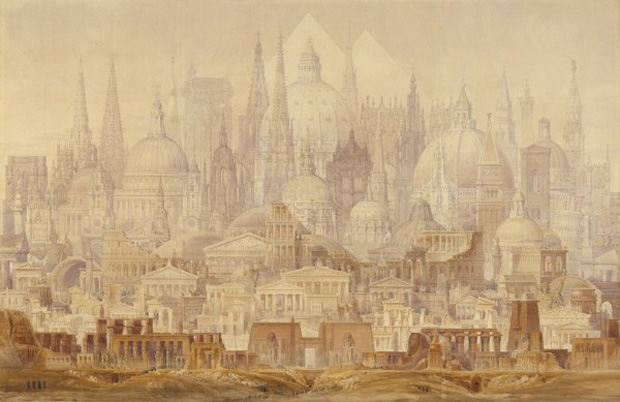
Cockerell, C.R. - 'The Professor's Dream', 1848 (Image: Royal Academy)

This brilliant image was essentially a teaching aid for Cockerell to show his students that the skills and achievements of the past were the foundations for creating good architecture in the future.

So, these paintings are not only commemorative but also allegorical and instructive, but, perhaps most of all, they are beautiful. They are complex evocations of imagined landscapes not bound by the reality of whether buildings existing in the same view – or even at all.  This wonderful tradition of the capricci is now being continued by Carl Laubin, whose latest works, ‘Vanbrugh’s Castles‘ and ‘Vanbrugh Fields‘, capture, in two sweeping landscapes, the varied brilliance of Sir John Vanbrugh. Laubin originally trained as an architect but found his passion for art the stronger influence, but has combined them both, creating a series of capricci on various architectural subjects including the works of Nicholas Hawksmoor and houses of the National Trust.
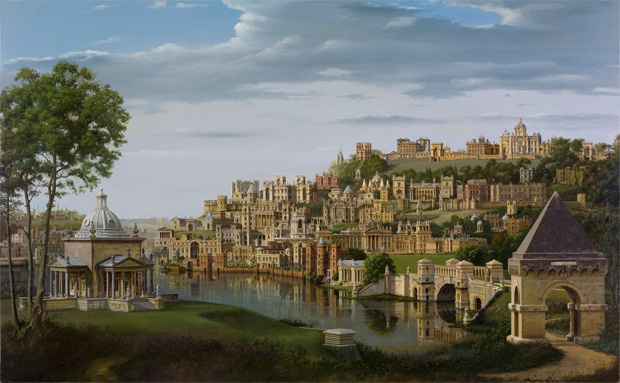
Laubin, Carl - 'Vanbrugh Fields', 2011 (Image: from the artist)

The detailed views in these new paintings include all the buildings designed by Vanbrugh, both executed and unexecuted, and also some only ever vaguely sketched out, which Laubin has then worked up as fully realised buildings in his distinctive hyper-realist style: this is truly architecture as art.  What is particularly fascinating is to see all of an architect’s output in one sumptuous view – as though the finest hill town possibly imagined had been created.  These works are also created on a scale which allows for such detail to be included that every building is identifiable. Laubin has created an indulgence for any architecture fan which provides a simple, but beautifully constructed, way to get a better understanding of Vanbrugh’s creative genius; his ability to vary form, mass and architectural vocabulary but within that rich Baroque tradition of which he was an obvious master.

Capricci require immense amounts of research, planning, and dedication hence their relative scarcity but as an art form they form about as instructive body of work as one could hope for.  Architecture is very much about the physical but sometimes the fantastical can be just as satisfying; creating glorious vistas which bring home the skill of not only the architect but also the artist.

————————————————————————————–

Carl Laubin at the Plus One Gallery, London – until 2 July 2011 – the gallery is a short walk from Sloane Square tube station

More about J.M. Gandy:

More about capricci: ‘Architectural fantasies‘ [jsblog.com]

The Country House Revealed – Clandeboye, County Down

Clandeboye, County Down (Image: Paul Barker / Country Life Picture Library)

One of the great glories of the private incomes afforded to previous generations was the ability to indulge in their passions.  Given the opportunity, many of us would similarly be happy to devote our lives to our interests and, for some, in doing so they have created great collections – not just of art, but in the fields of anthropology, Egyptology, armour, botany…the range is endless.  In this week’s ‘The Country House Revealed‘, Dan Cruickshank visits Clandeboye in County Down, Northern Ireland; seat of a branch of the Guinness family, but also home to an impressive collection of artefacts.

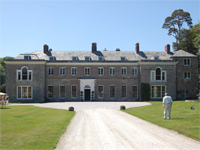
Clandeboye (also sometimes known by the original name Ballyleidy) sits in a 2,000-acre estate in the heart of the Ulster countryside – a smart, elegantly Georgian seat; the design semi-Soanian (originally), part-the-owner (later additions).  The professional architect involved was a former pupil of Sir John Soane, Robert Woodgate, to whose designs the house was built in 1801-4.  Woodgate had a brief career, cut short by his early death in 1805, having joined Soane’s practice as an apprentice in 1788, before graduating in 1791 and then being sent to Ireland to Baronscourt, Co. Tyrone (note the triffid-like march of the wind turbines now marring the skyline!), to supervise the building Soane’s commission of a new house for the Marquess of Abercorn.

Clandeboye, for the 2nd Baron Dufferin, was one of Woodgate’s earliest commissions and is unusual, ignoring the more common ‘Palladian’ central block with flanking wings layout, of houses at the time.  At Clandeboye, whilst still Soanian in it’s style, the layout is focussed on two wings at right-angles to each other with the corner due south taking maximum advantage of both the setting and the sun.  All-in-all, a good, competent design by a well-trained young architect – though perhaps lacking some of the drama a more experienced architect might have brought to the plan.

What is particularly special about Clandeboye today is that it contains the remarkable and diverse collections of the wonderfully named Frederick Temple Hamilton-Temple-Blackwood, 5th Baron Dufferin and Claneboye (note the different spelling of the title).  A prominent politician and administrator, he served as Governor General of Canada  (1872-1879) and Viceroy of India (1884-1888).  The Lord Dufferin was also something of a radical social reformer and fell out with the PM, Gladstone, believing that the land ought to be owned by the farmers.  Not content with just arguing for this, he sold off much of the 18,000-acres the family had amassed, leaving the estate we see today.

Very well-educated, Lord Dufferin, as with many other wealthy Victorians, used the opportunities of his many diplomatic postings to acquire large quantities of objects – not just the usual art and furniture but curiosities from around the globe.  This led to a new programme of work in the mid-19th century to enlarge the house to display these prizes, resulting in a large west wing.  Dufferin had toyed for years with grand plans for the complete rebuilding of Clandeboye to a faux-Elizabethan nostalgic ideal.  After a few years, his tastes changed and he then sought out Benjamin Ferrey to provide a French-chateaux style house – but again this came to nothing.  In 1865, his preferences had ebbed back towards a more ‘romantic’ style and he began a long collaboration with William Henry Lynn, who then advised Dufferin on the alterations to Clandeboye which are what we see today.   One aspect of the process which probably infuriated Lynn was, as Harold Nicolson has described, that Lord Dufferin’s ‘passion for glass roofing was… uncontrolled‘, leading to the broad use of skylights.  Considering how Soane, and therefore probably Woodgate, sought to carefully manage the effects of light, this crude flooding of the interior spaces may not have met with approval from the original architect.

Today, the contents of the house can be seen as a snapshot of the passions and interests of a wealthy aristocrat at the height of the British Empire. Victorian Britain seemed to foment this type of collector with other houses similarly becoming self-indulgent museums – though often with a great intellectual rigour which helped drive forward our understanding of the world and science.

Quex Park, Kent (Image: ..george / flickr)

For example, Quex Park in Kent became the showcase of the Powell-Cotton family, who, over six generations, created a superb collection of natural history with specimens taken during Major Percy Horace Gordon Powell-Cotton’s expeditions to Africa,which has subsequently been expanded by later generations.  Another showcase was Goodrich Court (dem. 1950) which was designed by the owner Sir Samuel Rush Meyrick specifically to accommodate his world-renowned collection of arms and armour which forms an important part of the incredible Wallace Collection in London.

Didlington Hall, Norfolk - demolished 1950/52 (Image: Lost Heritage)

As at Clandeboye, Egypt has long held a fascination in Britain.  One early and noted collection was assembled by William Amherst Tyssen-Amherst (the 1st Baron Amherst) at Didlington Hall in Norfolk (dem. 1950/52).  By chance, Lord Amherst employed a Mr Samuel Carter, a well-known artist to paint at the house, and he would often bring his son, who spent many an hour in the extensive Egyptian museum in the house.  That son was Howard Carter who famously went on to discover Tutankhamun’s Mask with George Herbert, 5th Earl of Carnarvon.  Highclere Castle also holds a small but important collection of Egyptian antiquities amassed by the 5th Earl and which are now on display in a purpose-built gallery in the cellars of the house.

Waddesdon Manor, Buckinghamshire (Image: National Trust)

Perhaps the greatest example of a house built to show a collection is Wadddesdon Manor in Buckinghamshire; that slice of French architecture which enchantingly appears in the middle of the English countryside.  Funded by the vast Rothschild fortunes, the mansion, designed by Gabriel Hippolyte Destailleur, was built between 1874-1889 for Baron Ferdinand de Rothschild primarily to showcase what must easily be one of the finest collections of Dutch and English paintings and French art, tapestries and furniture.  Used only in the summer months for parties and entertaining this was the ultimate expression of the desire to use a private residence as a gallery – or was it merely a gallery with bedrooms?

So Clandeboye is part of a long and fine tradition of the wealthy owners of large houses not merely adding a scattering of objet d’art to show-off the taste of their interior decorators. These houses are true collections, in some cases museums, even monuments, to the eclectic passions of their owners.  The wide-ranging nature of these collections demonstrates one of the many benefits of single family ownership, such as at Clandeboye, where intellect and wealth can be combined over generations to create a rich and interesting tapestry that no public organisation would be likely to be imitate; and our nation would be all the poorer without it.

————————————————————————————–

Official website: ‘The Country House Revealed‘ [BBC2]

A wonderful interview (and slideshow) with the Countess of Dufferin and Ava: ‘The Marchioness‘ [wmagazine]

The Clandeboye estate: official website / history [clandeboye.co.uk]

Country House Rescue: spectacular spats – Hill Place, Hampshire

Hill Place, Hampshire (Image: Historic Houses Association)

The challenges of inheritance have been a recurring theme throughout Country House Rescue.  The obvious challenges are perhaps more tangible; taking on the new house, contents, gardens and the related discoveries – for good or ill.  Yet part of the nature of inheritance is often the bequeathing of disappointment to others who expected to benefit or who disagree with the choices of the new owners.  Country House Rescue this week (17 April) visits Hill Place in Hampshire where Ruth Watson’s skills seem to be in demand to placate some disgruntled aunts rather than to simply identify business opportunities.

Hill Place is an elegant, grade-II listed Georgian villa, built in 1791 on the back of wealth made in India.  The architect is unknown but there is a beautiful simplicity to it, with each side five bays wide with a canted three-bay projection on the entrance front and a graceful three-bay bow front to the south.  The style is in the fine traditions of Sir John Soane and there are even suggestions that it may have been by the man himself.   At some stage, a mansard roof was added and then later removed, leaving an unfortunate flat roof with the stub end of the staircase still rising to a small access extension.  Overall, this is a particularly neat example of the smaller country villa which was to prove so popular at that time.  However, what is of particular interest that the current owner, Will Dobson, inherited the house due to his grandparent’s commitment to the tradition of primogeniture – that of the eldest male inheriting, which, in Will’s case, meant the bypassing of his grandparent’s four daughters, which is the cause of the strife in the programme.

The rules of inheritance in the UK have ensured that ownership of country houses, estates and contents can be passed down as a unified possession.  This has ensured a multi-generational continuity which has benefited the country by embedding a very long-term perspective to plans and that a culture of paternalism was fostered; the spirit of noblesse oblige. Ironically, in France, the Napoleonic code demands equal shares for all potential inheritors, forcing the break-up and sale of large estates, preventing the same depth of connection between the nobility and society.  Yet, for this culture to be preserved it is important that the estate is kept together – especially as it usually has to fulfil its traditional role of funding the main house.

Knighton Gorges, Isle of Wight (Image: wikipedia)

Yet inheritance has caused incredible friction for hundreds of years between those favoured by those who inherit and those who do not, leading to extreme outcomes and court cases.  One example of the former was Knighton Gorges, a manor house on the Isle of Wight, where, in 1821, the owner George Maurice Bisset had the entire ancient house demolished to ensure that his heir (his daughter or nephew – accounts vary) wouldn’t be able to cross his threshold even after his death, their having angered him through an unauthorised marriage.  In Kent, Lynsted Park was originally a huge Elizabethan E-plan house built for Sir John Roper, later Lord Teynham, in 1599, but an inheritance dispute between two Roper brothers in the 1800s led to the one living there demolishing all but the entrance porch (later Georgian additions created the current house) as he thought he would lose the case and have to give the house to his brother.

Gopsall Hall, Leicestershire (Image: Lost Heritage)

Perhaps the most famous litigation from inheritance was that surrounding William ‘the Rich’ Jennens which reputedly took nearly 120 years before the cases finished being heard and was also thought to be the inspiration for Jarndyce v Jarndyce in Charles Dickens’ Bleak House – though recent scholarly opinion now discounts that. The Jennens family had created a huge family fortune as ‘ironmasters’ in Birmingham but due to a lack of heirs and, more importantly, a will, when William died intestate in 1798, his fortune (including houses such as Gopsall Hall, Leicestershire and Acton Place, Suffolk) was passed to three distant – though very aristocratic – relatives.  This was the catalyst for a small cottage industry of claimants who all thought themselves related and therefore due a share of the inheritance.  This was partly due to a popular fad at the time for novels to feature an unexpected inheritance – though, in real life, it was usually just the lawyers who became richer.

So, inheritance can often be a mixed blessing, laden with expectations and complications.  A recent survey by Country Life magazine (6 April 2011) found that 61% of current owners were concerned that estates stay in the family – with only 25% not bothered if their heir were to sell (it would be interesting to see if there was a correlation between whether those in the latter group were also those whose family had owned for the least time).  For some, it’s particularly important to ensure that the family name is preserved. In the same Country Life article, David Fursdon, whose family have been on the Fursdon estate in Devon since 1289, highlights that after 750 years in single ownership the pressure is on to ensure that a male heir is produced to provide that continuity (though with three sons he should be OK).

Holker Hall, Cumbria (Image: andrew_j_w / flickr)

Primogeniture, or full inheritance by the eldest son, has been the rule for hundreds of years.  It was expected that all other children either had to marry or make their own fortune or living with the second son often going into the Army and the third to the clergy.  The strict rules may now be relaxing with parents choosing the child most inclined and best equipped to take on the inheritance – the Country Life article highlights how Holker Hall in Cumbria will be inherited by the middle child, Lucy Cavendish, who has moved back to the estate to learn the ropes before her parents ‘retire’ and move out in a few years time.

The challenge for families such as the Dobson’s is ensuring that the one who inherits feels they have complete ownership and is able to take decisions for the good of the house and estate without sniping from other quarters.  It is no light responsibility to be the owner of a country house and the Dobson’s should be thanked for taking on such a lovely home when others might have simply sold up and enjoyed the spoils.  Here’s hoping they can truly make a success of the house as a business to ensure that they can also pass it on to future generations.

Country House Rescue: ‘Hill Place‘ [Channel 4]

Country House Rescue: see complete previous episodes

Official website: ‘Hill Place

Country House Rescue: efforts misapplied – Trereife House, Cornwall

Trereife House, Cornwall (Image: matt bibbey / flickr)

Inheritance is a double-edged sword – for all the perceived luck of being given a large country house, the reality is that, in many cases, the house requires significant investment.  For some, this is a chance to shine; to put in place the plans they had been making, or develop new talents and unexpected skills. For others it quickly becomes burden as it pushes them into situations they seem unprepared for – as it frequently proves on Country House Rescue.  This week (27 March), heading back down to the south west, Ruth Watson visits Trereife House in Cornwall, to a house threatened by the odd schemes of the owner.

Antony House, Cornwall (Image: mothproofrhubarb / flickr)

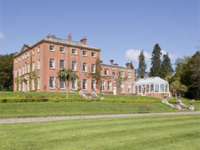
Trereife (pronounced ‘treeve’) nestles in the hills above Penzance, an neat pink hued Queen Anne house with an elegant parterre garden laid out below the south front.  The original house was an Elizabethan farmhouse which was home to the Nicholls family, who had become wealthy landowners and minor gentry through farming and marriage.  The first records of them is the marriage of William Nicholls (also known as William Trereife) in 1590, though it is thought the family had been in the area for several generations earlier.  The design of the grade-II* house as we see it today is the result of an extensive rebuilding in 1708 which not only added the wonderful Queen Anne front with its hipped roof but also created some fine interiors with plasterwork ceilings, probably by travelling Italian workmen, who were known to have worked on several houses in the south west.

Boconnoc House, Cornwall (Image: cornishmoth / flickr)

Architecturally, the echoes of the style of Trereife can be seen at the much grander Antony House for the much wealthier Carew family. The house was begun in 1718 shortly after Trereife’s remodelling and so is technically Georgian (Queen Anne died in 1714) but the basic form of the house is similar.  Also Boconnoc House, near Lostwithiel, displays the same two-storey with dormer windows design as Trereife and Antony – though again for a much wealthier family, the Pitts.  Boconnoc features later alterations in 1786 by Thomas Pitt, cousin of Pitt (the Younger) the Prime Minister, in conjunction with Sir John Soane, who he had met in Italy in 1778, which probably explains the serlian window to the projecting bay.  Another house of a similar design was Dunsland House, Devon which was one of the most important houses in the area, with particularly fine plasterwork, which sadly burnt down in 1967.  On a smaller scale than any of these, but possibly even more beautiful, is Great Treverran, near Fowey, a compact (one room deep) house built in 1704 but given a dose of grandeur with fine granite Ionic columns, it was last sold in 2003 for around £650,000 and is now wasted as a holiday cottage.

Trereife is a significant part of a great tradition of Cornish houses with a fine family history with connections to the Romantics such as Coleridge, Wordsworth, Charles Lamb and Leigh Hunt through Revd Charles Valentine Le Grice, affectionately known as ‘CV’.  The house passed to the Le Grice family through inheritance in 1821 following the marriage of Mary Nicholls, whose son had died childless, to ‘CV’ in 1799.  The house is now owned by Tim Le Grice, a solicitor who inherited the neglected house in 1986 from his grandmother and who now lives at Trereife with his family.

Sadly, Tim appears ill-equipped for the role as country house rescuer as a series of slightly eccentric – gypsy caravan theme park anyone? – or badly planned business ventures have taken up significant time and money with little to show for it.  For the family, the £40,000 per year running costs were proving ruinous and so they turned to Ruth for advice; which is typically hard-hitting.  Much as the family would rather avoid having their family finances shared with the nation this appears to be the only way to persuade Tim that he needs to draw on the skills and experience of his literary agent daughter to organise events and his wife to develop the potential for B&B and weddings within the house.  Considering that the house now comes up well in Google searches as a venue for weddings and events it seems that Ruth was right – and has hopefully enabled another family to remain in their ancestral home.

——————————————————————

Country House Rescue: ‘Trereife House‘ [Channel 4]

Official website: ‘Trereife House

Interiors: ‘Trereife House‘ [UK Film Location]

Official Facebook page: ‘Trereife House

More details: ‘Trereife – a family home‘ [Cornwall Life]

A bad omen: the spring country house relaunch

One rather unscientific barometer of the health of the country house market is the thickness of Country Life magazine as it comes through the letterbox each week.  After the thinning of the issue in the run-up to Christmas it’s always pleasing to feel the first weighty edition of the new year.  Yet, though this week’s issue (2 March) boasts ’70 pages of property for sale’ it’s remarkable that the estate agents have so few significant country houses to offer and of those that are there, it seems, along with last week’s issue, the largest houses are relaunches.

Pyrford Court, Surrey (Image: Savills)

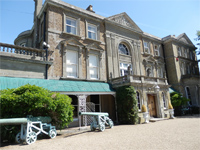
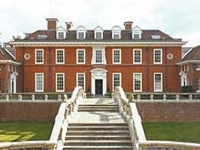
One of the most interesting is grade-II listed Pyrford Court, Surrey.  Originally built in 1910 for the 2nd Lord Iveagh, of the Guinness brewing family, it was one of a group of houses built around that time on the profits of beer (along with Polesden Lacey, Elveden Hall, and Bailliffscourt). The land was sold to Lord Iveagh by his father-in-law, Lord Onslow, whose family had owned the area since the 17th-century.  The house was designed by Clyde Young who had also worked at Elveden, another seat of the Guinness family, though the sensitively designed wings were added in 1927-29 by J.A. Hale of Woking to designs by Lord Iveagh.  The stylish neo-Georgian house is an elegant red-brick composition which originally sat in a 1,000-acre estate – though sadly now reduced to just 21-acres.  Lord Iveagh died in 1967 and the house sat empty until sold in 1977 – apart from a brief burst of fame as a location in the 1976 film ‘The Omen’.  The house then became an old people’s home with all the attendant damage until the current owners started their seven-figure restoration.

Pyrford Court was originally launched on the market in January 2010 for an ambitious £20m, a staggering rise in valuation from the £3.25m paid in 2000 and from the £8m asking price when it was offered for sale in 2002 (reduced, a year later, to £6.5m).  Yet this proved too much for the market to take; even for a ‘super-prime’ house within 25 miles of central London, and despite the high-quality restoration of the impressive interiors.  It subsequently languished and has now been promoted with a double-page advert – though the price is ‘on application’ meaning we won’t yet know quite how far the price has dropped.  However, looking at the other houses Savills have for sale in the area this is by far the most interesting and attractive house.

Brockhampton Park, Herefordshire (Image: Jackson-Stops & Staffs)

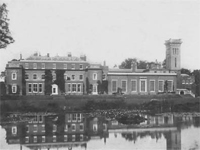
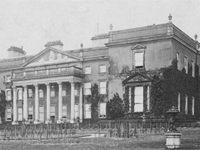
Another impressive house is the classically elegant, red-brick Brockhampton Park, Herefordshire.  Although the architect hasn’t been confirmed, the fact that it is virtually identical to Hatton Grange in Shropshire by Thomas Farnolls Pritchard, means it can probably be attributed to him.  The house was built in the late 1750s for Bartholomew Richard Barneby, probably using the £3,000 brought to him through his marriage in 1756 to one Betty Freeman. The Barneby family had owned the estate since the 15th-century and were to own it until 1946 when John Talbot Lutley (who was a descendent of the  Barneby family) left the house and 1,200-acre estate to the National Trust. Col. Lutley was a no-nonsense man who, on hearing of the NT country houses scheme, wrote them a short letter in 1938 saying that as he was a bachelor whose heirs were rather distant, would they be interested?

James Lees-Milne was duly dispatched – and almost rejected it on sight as it wasn’t pure Georgian due to some relatively small Victorian alterations.  However, after a tour of the estate and on seeing the beautiful Lower Brockhampton Manor, he felt that the latter two would be fine additions for the Trust – even if the big house would be a drain. It was duly left to the NT in 1946 following the Colonel’s death. Neither the house nor the contents were of sufficient quality to justify retaining or opening to the public so they sought to let it.  Unfortunately no private tenant wished to take it on, usually citing its remoteness, however in 1985 an insurance company let the house as offices and undertook a comprehensive restoration programme.  After they moved out in 1996 it was again restored as a private home and is now available with just 8-acres but surrounded by the rest of the NT-owned estate.  Interestingly the house is listed under the ‘Sales’ section of the Jackson-Stops & Staff website but I suspect this is due to it being leasehold – again ‘price on application’ so the price of the privilege is unknown, but the house has been advertised since last summer so it may be cheaper than before.

Ebberly House, Devon (Image: Savills)

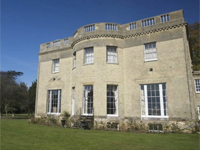
Perhaps the most surprising house to still be available is the grand Ebberly House, Devon.  Rather than the expected provincial house, this is a house which displays remarkable architectural sophistication. Described by Pevsner as ‘unusual and attractive’, whose distinctive rounded ends ‘hint at the variety of room shapes inside; a provisional echo of the interest of contemporary architects such as Nash and Soane’.  Designed by Thomas Lee of Barnstaple, a pupil of Sir John Soane, the grade-II* house compensates for it’s remoteness with a fantastic house set in a fine 250-acre estate.  Offers in excess of £4m on the back of a postcard to Savills in Exeter.

Perhaps there are some clever marketing plans being hatched at the estate agents which means that rather than pushing their best properties in the first big property edition of Country Life of 2011 they’re saving them for…when?  Bonuses have just been announced and those looking to buy are probably active so perhaps there is just a general scarcity of significant country houses coming to the market.  Does this indicate 2011 will be rather thin for the agents as uncertainty limits buyers to the super-rich looking for somewhere in London or will the market pick up and a slew of new houses soon be released to whet our appetites?