The growing silence: how many UK country houses were lost?

Slowly, then suddenly, many estates grew silent. Carriages no longer clattered down the drives. Entrance halls no longer echoed to voices. Kitchens went cold. Staff quarters were emptied. Then, the contents were sent to the auctioneers. Finally, the house was broken apart; hammers and pickaxes the new sounds as hundreds of years of history were reduced to rubble.

One key questions which architectural historians have been trying to answer for a number of years is just how many UK country houses have been lost? The answer, for now, is over three thousand. Each was a world on its own, but also part of the complex jigsaw of our national heritage.

The genesis for this area of research was ‘The Destruction of the Country House‘ exhibition, which ran from 9 October – 1 December 1974 at the Victoria & Albert Museum in London. I have written about it on a number of occasions so if you would like more insights into it, you can read my article on the 40th anniversary or my reflections on the 50th anniversary.

The position of the landed elites was considered the bedrock of society. The families provided political leadership, social aspiration, and were the centre of the local economy through their employment and expenditure. Land ownership was the passport to this elite status; the open market a safety valve which enabled ‘new money’ to mix with the old, to want to emulate them rather than remove them. This allowed new families to fluidly move up from merely wealthy to established gentry or nobility. After a few generations, the land functioned as an older form of ‘green-washing’, the verdant parkland obscuring where the family had started. Within a few short centuries (though sometimes it was just decades), they had become the elite.
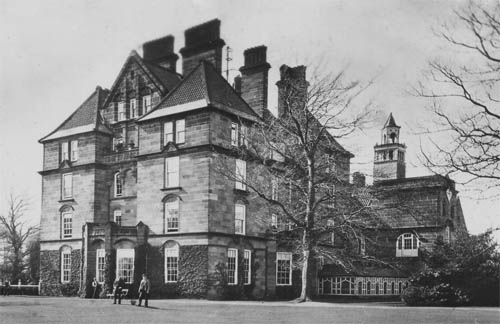
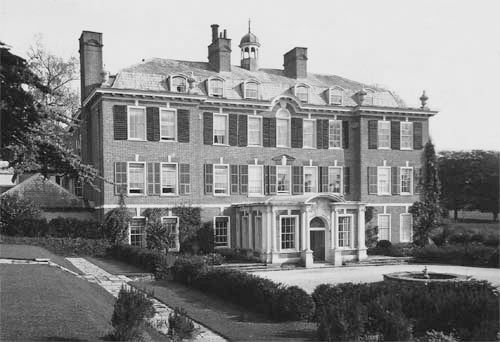
Rounton Grange, Yorkshire – seat of the Bell baronets, of Rounton Grange and Washington Hall (1885). House demolished 1954.

However, the first half of the twentieth century was, for the owner of these large houses, often financially, socially, and politically challenging. The repeal of the Corn Laws in 1846, which opened our markets to cheaper overseas produce, combined with the agricultural depressions of the latter-half of the nineteenth century, had undermined many of the assumptions about the financing of the country house. As debts grew, so the stark financial reality of the situation they were in began to dawn. For many, the path to recovery seemed to be to sell non-core assets such as artworks or outlying estates and hope that this would tide them over until their incomes, usually agricultural, recovered. For those who sold their land early and invested in the stock market, the crash of 1929, was another blow to their planning. As is so often the case, the markets remained against them longer than they could remain solvent.

When Aldous Huxley published his first novel, ‘Crome Yellow‘, in 1921, the challenge to the country house was already significant enough to feature as the fate of the imaginary Gobley Great Park;

‘A stately Georgian pile, with a façade sixteen windows wide; parterres in the foreground; huge, smooth lawns receding out of the picture to right and left. Ten more years of the hard times and Gobley, and all its peers, will be deserted and decaying. Fifty years, and the countryside will know the old landmarks no more. They will have vanished as the monasteries vanished before them.’.

Thankfully, Huxley’s apocalyptic vision wasn’t fully to come to pass. However, from the relatively low levels of losses in the nineteenth-century, the twentieth-century would bring decade after decade of destruction. It’s worth remembering that this was largely a crisis of the country house, not the wider estate. The land was considered more valuable as an income-generating asset and for the social prestige it conferred. Without the expense of the house – the maintenance, the staff, the general running costs – so the income was better able to meet their expenditures. Mr Micawber would be beaming with pride.

So, when seeking to bring their expenditure within the available income, the house was considered a necessary sacrifice. And with so many other families also facing a similar situation, the loss of any one house would be obscured by the loss of so many others. The problem with simple data is that it belies the dramatic local impact the loss of a house would have been. The country house and its estate embodied the idea of stability. The idea of a family owning the house and land and passing it down through the generations was – and arguably still is – embedded firmly in our national psyche, even if the family did change every few hundred years. The key difference in the twentieth-century was that there was often no other family to take their place.

In this dark era, houses languished on the market. This was often evidenced by adverts for the same properties appearing with sad regularity in magazines such as Country Life. It brought reminders of the increasing threats to the established order of the countryside into the drawing rooms and libraries of those most at risk.

Typical advert in Country Life magazine. Key aspects to note: the house is unnamed (though I think it is the infamous Burwell Hall, demolished in 1958), the language emphasises cheapness: ‘moderate price’, ‘modern conveniences’, ‘inexpensive gardens’. (Advert from Country Life, 10 November 1923, pg. XIII)

Each week, beyond the adverts in Country Life, ‘The Estate Market’ page offered a running commentary on the changes. For example, the headline for that page on May 5th 1922, was stark: ‘Demand for small properties’, with the opening paragraph stating, ‘The brightest section of the market is that in which the smaller properties are dealt with…’. Coverage includes the sale of Sudbourne Hall, Suffolk, saying it had sold with 500 acres, having first been offered as a whole but failing to find a buyer, it had been split up. The house was later demolished in 1953.

Another paragraph is headed ‘Mansions as sanatoria’ and writes approvingly of how Lords Londonderry and Boyne have both ‘generously offered’ Seaham Hall and Brancepeth Castle respectively for ‘hospital purposes’. Specifically, it states that Seaham Hall ‘…has had to be closed in consequence of taxation and the heavy cost of upkeep.’ (it survived and is now a hotel). It also mentions that Rendlesham Hall, Suffolk, has been sold for use as a ‘…retreat for drug-addicts and inebriates…’. It was also later demolished in 1949.

Sudbourne Hall, Suffolk, demolished in 1953 (Source: www.lostheritage.org.uk | More images)

During the nineteenth-century, the available data shows that there were fewer losses; approximately one a year. However, when considering the data, there are a few caveats to remember. Critically, the data for the nineteenth-century is thinner than the twentieth-century. Fewer books had been produced, research was sparse, and even confirming if a property was of sufficient stature to be classed as a country house is sometimes challenging. Fire and replacement by a new house were two of the most common reasons.

So how many have been lost?

Quoted in The Daily Telegraph magazine in 2007, the leading country house historian of the lost houses, the late John Harris, said that:

‘At the time [before the V&A exhibition], we reckoned that about 750 houses [in the UK] had been pulled down between 1880 and 1970. Now we know it’s about 1,800.’1

Sadly, John’s estimate was still too low – 1,800 doesn’t even cover England alone.

The gazetteer at the back of ‘The Destruction of the Country House‘ exhibition catalogue listed a total of 1,099 houses (740 for England, 313 Scotland, 46 Wales, with NI not included). This list had been compiled by John, Marcus Binney, and another researcher, Peter Reid, and explicitly stated it was not exhaustive. The total for England was updated with the publication in 2002 of ‘England’s Lost Houses‘ by Giles Worsley which added 445, to total 1,185 for England. However, Ian Gow’s ‘Scotland’s Lost Houses‘ in 2006 listed only 308 (5 fewer than before) but also included examples of houses in cities (which I have excluded from that total).

The task of taking the ground-breaking earlier research forward and to resurrect the memory of these otherwise obscured houses, has now been taken up by amateur enthusiasts, supported by the invaluable work of historians who have focused on specific areas. I started researching the English lost houses in 2006, compiling what I hoped would become the most comprehensive record. All the details, including detailed histories and thousands of images, are shared on the Lost Heritage website.

Using the same model, this was followed over the years by Dr Alastair Disley for Scotland, Dr Mark Baker for Wales, and Andrew Triggs for Northern Ireland (he also took on the much larger task of the Republic of Ireland).

Distribution of English lost country houses since 1800. Source: Matthew Beckett / www.lostheritage.org.uk

The scorecard of architectural losses

Each of these personal efforts has significantly increased the totals of lost houses with Scotland now standing at 545 (Disley), 390 for Wales (Baker), and 100 for Northern Ireland (Triggs – a particular achievement as they hadn’t been tallied previously).

The total number of lost houses for England alone has now exceeded John Harris’ original estimate for the whole of UK, having reached 2,019 (as at November 2024).

Overall, we can be confident that the number of UK country houses lost since 1800 now totals a remarkable 3,054.

Why does this matter? These houses and their particularly grand and hierarchical era and way of living has gone. It died, not in our leafy lanes, but in the battles and social change of the World Wars. The changes forced an evolution – and in that process, there are winners and losers. The tragedy was that the losers were often not inherently weaker houses, and in so many cases, they were some of the most interesting and significant. Beyond the random losses from fire and environmental causes, often what determined whether a house survived was their owners and their circumstances. For some, they were determined to ensure that the houses were reborn, albeit in a new way of living. For others, they were equally determined that that they would not pass what they saw as a burden to another generation.

In the specific losses to a family, and a locality, and to our architectural heritage, they were to be lamented. But in all of them, they possessed something of our shared heritage, and their loss, and the losses of the future, are pieces of the national jigsaw of our identity. As Simon Jenkins said, ‘Through them we hear the echo of our collective selves – and remember who we are.’2. We remember these parts of our history through the memory of these houses, and the roles they played in the life of our nation, both locally and nationally.

Request for help

If anyone has any further information on the lost country houses of England – either history, dates for losses, or family photos or recollections – please do contact me.


References:

1 – Campbell, Sophie, ‘Brideshead Detonated’ Telegraph Magazine, 20/01/2007
2 – Jenkins, Simon, ‘England’s Thousand Best Houses‘ (Penguin, 2004), vii

‘On behalf of a grateful nation’: country houses given to military leaders

Nations have always found ways to reward those subjects who have rendered some greater or lesser service.  In earlier centuries, this often took the form of positions at Court which came with a salary, prestige, and unrivalled opportunities to feather one’s nest.  Titles have also always been popular, ranging from a baronetcy for those who have hosted the monarch for a weekend, to dukedoms and earldoms for the upper echelons of Court and on the battlefield – and it’s this latter category who have also enjoyed that rare gift of an entire country estate, in recognition of their services.  Such largesse is now unthinkable but the practice of rewarding military leaders in this way only fell from favour perhaps later than might be imagined.

Blenheim Palace, Oxfordshire (Image: Blenheim Palace via flickr)

The grandest and most spectacular of these gifts is Blenheim Palace in Oxfordshire – though the intrigues for both monarch, recipient, recipient’s wife, and architect make it something of a mixed blessing.  The recipient was certainly worthy of such a grand prize; John Churchill, 1st Duke of Marlborough had risen through numerous victories to elevate and secure Britain’s place in the world, defeated the ambitions of various European leaders, and created the peace which ushered in the Georgian era.  These glorious victories provoked such a feeling of patriotic pride that even his critics praised him.  So how to reward such a man for such remarkable achievements?

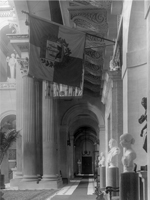
Great Hall and Eastern Corridor, Blenheim Palace (Image: Country Life Picture Library)

Blenheim Palace was to represent many things – explicitly a national monument to the defeat of Louis XIV’s plans for European domination at the Battle of Blindheim in 1704, the considerations of it as a house were somewhat secondary. It embodied the idea that whereas previously the glory of the nation was demonstrated through the palaces of the Monarchy, Blenheim was the first which sought to do this though a private individual.  However, Marlborough’s close ties with Queen Anne would inevitably mean the prestige would reflect onto her and the nation. Work started in 1705 and, writing in 1709, the architect of the house, Sir John Vanbrugh stated,

‘Tho’ ordered to be a Dwelling house for the Duke of Marlborough and his posterity [it was] at the same time by all the world esteemed and looked on as a publick edifice, raised for a Monument of the Queen’s glory.’

The Queen had already resolved to gift the estate at Woodstock but the agreement on paying for the construction of the house was a murkier affair.  Royal patronage could cut both ways as the Marlboroughs and Vanbrugh found out.

Vanbrugh was the ideal choice for a building of this nature.  His background in theatre design gave him an understanding of dramatic effect and his relative inexperience and lack of formal training meant his imagination was bolder than others.  The commission at Blenheim required such a mind; the resulting spectacular building was a monument to power and prestige, incorporating military forms and details to reflect the occasion, but was also one of the most complete expressions of English Baroque.  Yet despite his fabulous wealth, the Duke was determined that the state would show its gratitude by paying for the construction, though he had originally intended the budget to be no more than £40,000 (approx £5m).  Wren had estimated £90,000 – £100,000, however the final cost totalled nearly £300,000 (approx £38m) for which the Treasury eventually was liable (proving that for government projects it was ever thus!).

Castle Howard, Yorkshire (Image: Castle Howard)

Such overruns were to be expected where the intention had been to build something like Castle Howard – only bigger. However, the Duchess opposed such a scheme saying: ‘I never liked any building so much for the show and vanity, as for its usefulness and convenience.‘ With such an attitude, friction with Vanbrugh was inevitable. Political changes hadn’t helped; a new government and Treasurer in 1710 slowed payments to almost nothing.  In 1711, the Duchess also fell out quite acrimoniously with her childhood friend, the Queen, leading, in part, to the Duke losing his official posts and the Marlborough’s going into self-imposed exile.  The accession of George I in 1714 brought them back into favour and work progressed again, though constant conflict between the Duchess and Vanbrugh led to his resignation in November 1716, saying: “You have your end Madam, for I will never trouble you more.  Unless the Duke of Marlborough recovers so far [he had suffered a stroke in 1716], to shelter me from such intolerable Treatment.‘ Work proceeded under Vanbrugh’s right-hand man, Nicholas Hawksmoor, to the original plans, with the family taking up residence in 1719, and work largely complete by 1725. Sadly though, the Duke never got to see this, having died in 1722; his monument incomplete, his reputation assailed, and his architect grievously estranged from his masterpiece.

It seems only some of the lessons of Blenheim had been remembered by the time the next gift was proposed for an equally illustrious general, Arthur Wellesley, 1st Duke of Wellington.  Again, a superb leader who had defeated plans for European domination, Wellington – the Iron Duke – was certainly worthy of such a reward. Rather than receiving a direct gift from the monarch, it was decided that the nation would provide £600,000 (approx £38m) for the purchase of an estate and the building of a suitable house. Rather than just provide the money, in 1817, Parliamentary trustees were appointed to oversee the purchase.  The Duke knew his limitations and called upon the architect Benjamin Dean Wyatt (son of James Wyatt) who promptly, even before a site had been found, drew up plans for a ‘Waterloo Palace’ which, in his words, would have “…a very magnificent & imposing effect” without “the monstrous expense of a Fabrick extended to the dimensions of Blenheim [or] Castle Howard“.  Despite his professed aim, this would have been an enormous house; designed around three sides of a courtyard, it featured two flanking pavilions, with the main house centred on a huge domed hall, with suites of grand rooms surrounding it.  Perhaps of particular interest was the severely Neo-Classical decoration, with few of the architectural flourishes which distinguish Blenheim.  This might have reflected the notably austere Duke’s taste but even this plan was rejected.

Stratfield Saye, Hampshire (Image: Historic Houses Association)

Given the Duke’s preference to be near London, the house and estate chosen was Stratfield Saye in Hampshire, after rejecting Uppark in Sussex due to the poor land, and was bought from the Pitt family for £263,000; a significant portion of the funds available. Though this may have been a factor in the eventual rejection of the plans in 1817, another was that the Duke was in the process of spending £40,000 anonymously purchasing Apsley House in London, for the use of his almost bankrupt brother who had previously lived there with his soon-to-be-ex wife.  That house also required significant work and, faced with the need to maintain two houses, the Duke abandoned the plans for the new palace, and concentrated on updating and modernising the existing house at Stratfield Saye.  Both houses are still lived in by the Wellesley family, though Apsley is now part-owned by English Heritage and open to the public – and absolutely worth a visit if in London.

Bemersyde House, Scotland (Image: Kevin Rae / Geograph)

We may think the practice of the nation buying a country seat for a military leader was the product of the more deferential Georgian and Victorian eras when such actions by government would be less subject to widespread scrutiny, but the latest example occurred in the 1920s.   Field Marshal Douglas Haig, 1st Earl Haig, was a controversial figure as commander of British forces in WWI. Although he won, the horrendous loss of life left him with battered reputation which has only recently been revised. In the immediate aftermath of WWI, we, the victors, did feel grateful and Haig was created the 1st Earl Haig (with a subsidiary viscountcy and a subsidiary barony), given the thanks of both Houses of Parliament, plus £100,000 (though he had asked for £250,000) to enable him to live in the manner befitting a senior peer.  Haig chose Bemersyde House in the Scottish Borders, originally built in 1535 as a pele tower, to become, as it still is, the seat of the Haig family, the purchase funded by the grateful taxpayer.

Cefntilla Court, Monmouthshire (Image: Knight Frank)

It wasn’t only the ultimate leaders who could benefit from public largesse, though in the case of Cefntilla Court, Wales, the gift missed the mark by a generation.  Field Marshal FitzRoy James Henry Somerset, 1st Baron Raglan, was the Duke of Wellington’s right-hand man who was later blamed (then exonerated) for the huge losses resulting from the ill-fated Charge of the Light Brigade in the Crimean War.  Lord Raglan’s health suffered from the stress of the campaign and he died whilst on duty in June 1855.  However, such was the admiration for the man that a ‘Raglan Memorial Committee’ was formed and by 1858 was able to present Cefntilla Court, as commemorated by a plaque at the house which reads:

This house with 238 acres of land was purchased by 1623 of the friends, admirers and comrades in arms of the late Field Marshal Lord Raglan GCB and presented by them to his son and his heirs for ever in a lasting memorial of affectionate regard and respect.

Sadly, it seems that ‘for ever’ is a shorter time than they imagined as the house and estate are now for sale following a strange inheritance whereby the 5th Lord Raglan wrote his younger brother, now the 6th Lord Raglan, and the brother’s son, out of his will.  The house was instead left to another nephew, Henry van Moyland, who currently lives in Los Angeles and works as a recruitment consultant. With no deep ties to the estate, he has chosen to sell, splitting the title and estate for the first time since the gift was bestowed.  Legally, there is nothing to be done but it does seem regrettable that the whim of one Lord Raglan should lead to such an outcome, especially as it was the express intention of the donors that it should remain in the family.

That said, it is remarkable that three out of the four houses featured here are still owned by the families who were given them – a continuous link to the thanks of the nation as expressed through architecture and prestige. Though it may not happen now, or again in the future, such gifts are another part of the rich tapestry of our country house history.

——————————————————————–

Sales particulars: ‘Cefntilla Court‘ [£2m, 350-acres – Knight Frank]

More details: ‘The disinheritance of Lord Raglan’s nephew and future title holder causes split in family‘ [Wales Online]

Country House Rescue: Pen-Y-Lan, Wales

Pen-Y-Lan, Wales (Image: Channel 4)

This week’s episode of Country House Rescue seems to have found one of the most anonymous houses I have come across, with so little information available about it. Perhaps, however, this is indicative of the rather quiet existence so many smaller country houses do enjoy.  Yet, as Ruth Watson discovers (as she has in so many inherited houses), quiet enjoyment and a commitment to a house and the estate by the owner does not translate into being able to look after it.

Pen-Y-Lan is situated at the head of a bucolic valley, in the centre of its 500-acre estate, which straddles the English/Welsh border – indeed Cheshire Shropshire is at the bottom of the hill and across the river.  The house was originally built in 1690 by one of the founders of Lloyds bank, though as Quakers they suffered extreme persecution in Wales and moved to Birmingham in 1689, so I suspect the house was more a rural retreat or symbolic connection as the family’s main homes were in and around Birmingham.  The house was then sold to the Holloway family in 1849, where it has been passed down through the generations to the current owner, Emma Holloway.

The grade-II listed house is in the regionally popular Regency gothic style – essentially a five by four bay house which was re-modelled in 1830 to add crenellations, hood moulds over the windows, decorative turrets, and an imposing entrance.  We have already looked at the particularly strong Welsh Regency gothic tradition in a previous post about Kentchurch Court, which although in Herefordshire, was very much a part of that movement.  In fact, in some ways, King Edward I could be said to have been one of the strongest architectural influences in the Wales. It was his chain of 17 mighty castles which stretched across the country ensured continuing conflicts necessitating defensible houses which filtered out in later years in the architectural vocabulary of the Picturesque movement which drew heavily on castle features such as crenellations, arrow slits, turrets, towers and battlements.

The difficulties in controlling the Welsh were first experienced by the Romans who also were forced to built extensive fortifications and, in fact, established the pattern of requiring large garrisons to defend themselves and the settlers.  The later autonomy granted to the very powerful Marcher lords, who were given the task of securing peace through marriage, trade or force of arms, ensured that the language of building in Wales was mostly either defensive or small-scale.  To help prevent any local challenges to the King’s authority the Marcher lords were mainly English (comprising the Earls of Chester, Gloucester, Hereford, Pembroke and Shrewsbury) whose estates were very much centred around their English seats and the court in London – even if the wealth generated made them some of the richest families in the country.

Penrhyn Castle, Wales (Image: NTPL/Geoff Morgan)

One notable feature of Wales is how few large estates there were.  Considering the size and wealth of the nation, the fact that it was mostly ruled through local clans (where not owned more directly by the Marcher lords) meant that their wealth would limit them to building fine, but smaller, manor houses (for example Gwydir Castle – there is also a superb account of its restoration: ‘ Castles in the Air‘).  This has meant that there are few ‘stately homes’ in the same sense that there are in England. A survey in Country Life magazine in the mid-1960s suggested that of the 200 estates examined, only about 20 would be regarded as ‘stately homes’.  However, within those 20 are such notable houses as Chirk Castle (now National Trust), Erddig (National Trust), Gwrych Castle (now a ruin), Hawarden Castle (still Gladstone family home), Penrhyn Castle (National Trust), Powis Castle (National Trust), Plas Newydd (National Trust), Vaynol (privately owned) and Wynnstay (now flats) – all in north Wales. In the south, the main seats were Dynevor Castle (National Trust), Fonmon Castle (still Boothby family home), Golden Grove (empty), Penllyn Castle (unknown!), Penrice Castle (private home), Stackpole Court (demolished 1963) and Tredegar Court (council owned).  Sadly, as shown in Thomas Lloyd’s ‘Lost Houses of Wales‘, over 350 Welsh country houses were demolished, mainly in the latter half of the 20th-century, as poor finances combined with blinkered Socialism meant that many were lost with little protest.

This means that the smaller Welsh country houses of minor gentry, tucked away in the rolling valleys, should be treasured all the more.  Sadly, as in the case of Pen-Y-Lan, when faced with an owner who had to take out a £300,000 loan for urgent repairs when she inherited in 2007, yet, as she admits “I have absolutely zero business acumen, whatsoever“, creates significant challenges.  Pen-Y-Lan is in a state of considerable disrepair which will require something of a miracle if the owner, Emma Holloway, is to overcome her lack of business skills to pay off the debt, restore the house, and preserve it to hopefully hand it on to the next generation.

Country House Rescue: ‘Pen-Y-Lan‘ [Channel 4]

Official website: ‘Pen-Y-Lan‘ or follow them on Facebook

Country House Rescue: see complete previous episodes

———————————————————————————–

Before you comment…

This particular episode of Country House Rescue was one of the most controversial and provoked much reaction when broadcast and every time it is repeated – some are in sympathy and many not.  This is one family doing what they thought was best and perhaps the editing of the show was designed to present a particular angle.  Either way, the purpose of the comments on this blog are to contribute useful information, particularly anything related to architecture, and so I won’t permit comments I think are intemperate/abusive.  Thank you for your understanding.

———————————————————————————–

Country House Rescue: the weight of history – Kentchurch Court, Herefordshire

Kentchurch Court, Herefordshire (Image: mhaswell / flickr)

For some who inherit, the weight of family history can easily overcome the burden of running a historic home on a limited budget.  As we saw in the previous episode of Country House Rescue at Trereife House in Cornwall, the desire to not be the generation which loses the ancestral home, a prospect which faced the Le Grice family who had been there since 1799.  So imagine the weight of responsibility facing the Lucas-Scudamore family who have lived for ten centuries at Kentchurch Court in Herefordshire.

The house itself was originally a Saxon tower with further additions in the 14th-century.  However, the main style of the house as it stands today is due to work commissioned from the famous Regency architect John Nash (b.1752 – d.1835).  More importantly, Kentchurch is a significant as one of a number of houses built in the area around that time which were a visible expression of a new wave of architectural fashion; the Picturesque.

Strawberry Hill, London (Image: D Kendall / EH Viewfinder)

When thinking of Georgian architecture many think of the symmetrical classical façades and strictly proportioned Palladian designs which were so prevalent in that era.  Yet one house, Strawberry Hill in Twickenham, south London, was to be the catalyst for a new way of thinking, breaking these patterns and ushering in a more organic way of viewing architecture. This saw the house as part of a landscape with the design playing its part in the beauty of the view as much as the lakes, gardens and parkland. Originally an unremarkable house, it was bought in 1747 by the wealthy Horace Walpole, 4th Earl of Orford and fourth son of Walpole the Prime Minister, who was an astute observer of society, art, and architecture. Walpole contributed little to art but was particularly well read and as he pursued his academic studies decided to start experimenting with alterations to his house.

Fonthill Abbey, Wiltshire (Image: John Rutter (1823) / RIBA)

His original changes from about 1749 were uncontroversial and, importantly, followed the convention for symmetry.  However, from 1753 onwards the interiors were fashioned in a gothic style with the help of what he called his ‘Committee of Taste’ comprising a few of his equally well-read friends.  This experimentation was confined to the interiors until, in 1759, he broke with architectural convention and had a great circular tower constructed but which, radically, had no matching pair.  The house was to continue to grow in a rather free fashion which can still be admired today (particularly so following the completion of phase one of a fantastic restoration by the Strawberry Hill Trust, the Heritage Lottery Fund and the World Monuments Fund). The house became famous, attracting day trippers in large numbers and spawned imitators; though it was James Wyatt’s Lee Priory (built 1785-90 – dem. 1955) which was said to the be first ‘child of Strawberry’.  Also considered worthy, and also designed by Wyatt were the fantastical Fonthill Abbey (collapsed in 1825) for William Beckford, and Ashridge Park for the 7th Earl of Bridgewater.

Downton Castle, Herefordshire (Image: gardenvisit.com)

One man particularly taken with this new style was Richard Payne Knight, a Herefordshire MP and intellectual with a large inheritance.  Using his wealth, in 1774 Payne Knight started the construction of a new home, Downton Castle, which bore similarities to Strawberry Hill, with the asymmetry and a large circular tower, and an irregular plan which was quite radical for the time.  This house was a prototype for a new ‘castellated’ style of house which was to be popular for fifty years from about 1790.  Driving this new style was the publication of three key books, the first two in 1794; ‘The Landscape, a Didactic Poem‘ by Payne Knight, and ‘Essay on the Picturesque‘, a brilliant reply in support by Uvedale Price (another local landowner), and, in 1795, ‘Sketches and Hints on Landscape Gardening‘ by the landscape-gardener, Humphrey Repton, who formed a successful and highly influential partnership with the architect John Nash that same year.

Nash had moved to Aberystwyth after his bankruptcy following a failed speculative buildings scheme in Bloomsbury in London.  Yet, the contacts he was to make in Wales led to Nash becoming one of the leading architects of the Picturesque.  The early development of his interest in the ideas of the movement can be seen when he designed a castellated triangular lodge for Uvedale Price sometime between 1791-4.  He also worked for Thomas Johnes at the spectacular Hafod estate where Johnes had planted 3 million trees to paradoxically create a more ‘natural’ looking Picturesque landscape.

For Nash, the ideas he developed in that short period from 1790 until he left to go back to London in 1796, were what made him one of the most significant architects of the period. The influence of Downton Castle and Nash also created a strong regional collection of these mock castles – Garnons (dem. 1957), Saltmarshe Castle (dem. 1955), Goodrich Court (dem. 1950), Garnstone Castle (by Nash, built 1806-10 – dem. 1958) Hampton Court Castle (alterations 1830s-40s) and extending down to Devon where Nash designed perhaps one of his best creations; Luscombe Castle (built 1800-4), and into Cornwall, where he designed Caerhays Castle (built 1807-10).

Kentchurch Court from "Views of the Seats, Mansions, Castles, etc. of Noblemen and Gentlemen" (London : 1829-1831)

By their very nature these were large houses and often a little impractical which sadly meant many were demolished.  This is why Kentchurch Court is important – not only is an early work by Nash in the style of house which was to become his trademark, but it’s also one of the survivors of the tragedy of the many demolished country houses.

Perhaps the current Mrs Lucas-Scudamore should be grateful, in some ways, that their branch only inherited some fine carvings from the sale of the other much grander family seat, the grade-I Holme Lacy House (now a hotel) rather than the house itself with its 9 fine rooms with plaster ceilings which Pevsner though to be some of the best in the county.  The story of Kentchurch Court today is a familiar one of a family with an incredible history and a fine house and estate struggling with the usual demands for maintenance and £120,000 per year running costs.  Mrs Lucas-Scudamore and her two children (Mr Lucas-Scudamore being estranged and living away) battle on with determination but managing a house like this requires a money tree not a family tree – but this house is too important to be neglected.

Country House Rescue: ‘Kentchurch Court‘ [Channel 4]

The rise and fall of French taste on UK country houses

Wrest Park, Bedfordshire (Image: English Heritage)

For all the traditional antipathy towards the French, the influence of their architecture has been felt throughout Britain’s country houses.  Although initially the use of the French architectural vocabulary was a sign of wealth and education only available to the best families, the style was regarded as sullied by the later, more energetic, constructions of the Victorians – an association which still sadly lingers today.

The first wave of Anglo-French design started in the Elizabethan period; a time when it was acceptable to display one’s knowledge conspicuously. The French style, with its dramatic rooflines, dovetailed with the traditional English manor house and its own profusion of gables and chimneys.  Houses such as Burghley in Northamptonshire made dramatic use of the style with the central, three-storey pavilion, dated 1585, based on the French triumphal arch but oddly includes a traditional mullioned window on the third floor. Burghley was the product of the owner, Lord Burghley, an architectural enthusiast who as far back as 1568 was known to have been writing to France to obtain specific architectural books.

This early use of the French style was relatively restrained – probably more by the conservatism of the ruling gentry who were most likely to be building these houses.  Yet, our impressions now are more strongly influenced by the bolder, more assertive French style which was so popular during the Victorian era – though this same popularity was to also lead to it being derided.

The first of the Victorian nouveau-riche were keen to be accepted by society and so built houses which largely followed the same designs used by the local families.  The end of the Napoleonic wars in 1815 led to a rush across the Channel leading to a revival of interest in French design, particularly in relation to interiors, such as the Elizabeth Saloon at Belvoir Castle, Rutland, built c.1825.  By the mid-nineteenth century this was being more confidently expressed in dramatic houses which sought to boldly make their mark.

The second French Renaissance was influenced by lavish works such as the new block at the Louvre in Paris, built between 1852-70.   However, there were earlier examples such as the complete Louis XV chateau at Wrest Park in Bedfordshire, designed by the owner Earl de Grey, built in 1834-39, and Anthony Salvin’s French roofs added to Oxonhoath in Kent in 1846-47.  Yet, after the Louvre, the fashion gathered pace with designs such as R.C. Carpenter’s redesign of Bedgebury in Kent in 1854-55, and Salvin’s work at Marbury Hall in Cheshire in 1856-8.  Less successfully, the architect Benjamin Ferrey built Wynnstay in Denbighshire for Sir Watkin Williams-Wynn which, for all its dramatic high roofs and pavilions, was thought rather gloomy.  Another dramatic, albeit slightly awkward, design was that of Plas Rhianfa, Wales, built in 1849, which seems to mix both Scots baronial and French, whilst Sir Charles Barry completed a more successful use of the two styles at Dunrobin Castle for the Dukes of Sutherland in 1845.  Also of note was Nesfield’s design for Kinmel Hall, described as a Welsh ‘Versailles’.

These houses were largely for the existing gentry who found the impressive skylines met their needs for a dramatic statement as was fashionable at the time.  With the fashion spreading into London and being used for luxury hotels, clubs and offices it was inevitable that the newly wealthy would wish to emulate in the country the world they already enjoyed.  The last burst of ‘aristocratic French’ could be seen in the designs for Hedsor House in Buckinghamshire, 1865-68 for Lord Boston, Alfred Waterhouse’s Eaton Hall in Cheshire, 1870-72 for the Duke of Westminster, and T.H. Wyatt’s Nuneham Paddox in Warwickshire for the Earl of Denbigh, built in 1875.  From around this time, its fashionability declined.

One of the earliest of this new wave was Normanhurst in Sussex, built in 1867 for Thomas Brassey, son of the famous railway contractor.  Reputedly, Lady Ashburnham from nearby Ashburnham Place (note the very different architectural style of house) would snootily refer to him as ‘that train driver over the hill’.  In Worcestershire, the equally dramatic red-brick Impney Hall – later Chateau Impney – was built in 1869-75 for local salt tycoon John Corbett, who employed Auguste Tonquois, who had extensive experience around Paris.  In County Durham, the foundation stone of the Bowes Museum, originally designed to be part-home also, was laid in 1869 for John and Josephine Bowes.  Designed by Jules Pellechet with J.E. Watson of Newcastle-upon-Tyne, the house reflected their love of France but also made a statement as to their wealth – and possibly sought to hide their less-than-solid social position as illegitimate son of an Earl and an actress.  In Yorkshire, the additions to Warter Priory were considered unsuccessful, either due to the strange proportions or because the style had simply fallen out of favour.  More successfully, St Leonard’s Hill, Berkshire, was transformed from a Georgian house in the mid-1870s to create a dramatic chateau visible from Windsor Castle.

Waddesdon Manor, Buckinghamshire (Image: National Trust)

Interestingly though, perhaps the most famous of the English chateau was also one of the latest.  Waddesdon Manor in Buckinghamshire was built in 1889 for Baron Ferdinand de Rothschild to a design by French architect Gabriel-Hippolyte Destailleur, mixing elements from various famous French chateaux such as Blois, Chambord and Anet.  The last of these grand French imports was Halton House, designed by William R. Rogers and built in 1882-88, also in Buckinghamshire and also for a Rothschild, Alfred Charles; Baron Ferdinand’s cousin.  Equally grand, this house also featured a wonderful winter garden, though this was sadly demolished to make way for an accommodation block for the RAF who bought the house and turned it into an officer’s mess.

Perhaps one of the final straws as to the desirability of the French style was the spectacular collapse of the Victorian financier Baron Grant who, in 1875, spent over £270,000 (approx. £20m) building a huge house in Kensington before his crimes were exposed in 1879 with the subsequent public disgrace, and the demolition the house in 1883.  Such a high-profile scandal and its flash monument would have been felt in society and tarnished the style for no-one would wish to be associated with such disgrace.  However, fashion would have played a more significant role, with taste moving on to new styles, leaving these extravagant mementos to an earlier, brasher architectural exuberance which now give us an unexpected glimpse of France in the British countryside.


Credit: a wonderful insight into the period is Mark Girouard’s ‘The Victorian Country House’ which was most useful in the research for this post.

For more information on Chateau Impney; ‘Chateau Impney – the story of a Victorian country house’ by John Hodges