Holnest Park House seriously damaged by fire – may collapse

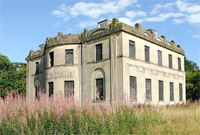
Holnest Park House, Dorset (Image: Bournemouth Echo)

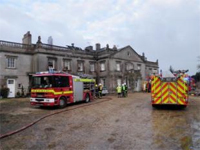
Earlier today, the Grade-II listed Holnest Park House in Dorset suffered a serious fire which has gutted the central section of the house leaving the core at risk of collapse.  The fire started in one of the seven flats through the careless use of an electric blanket which lacked a thermostat and simply heated up until it caught fire.  The fire destroyed the two flats in the central section but the 60 firemen in attendance were able to prevent the blaze spreading to the wings.

The Georgian house was built in 1768, and rebuilt in the 1830s, on land formerly owned by the Bishops of Salisbury. It became a secondary seat of the Sawbridge-Erle-Drax family through marriage, and so was regularly tenented as the family were mainly based at Charborough Park (a large house also in Dorset) and Olantigh Towers in Kent.

The house was sold in 1919 and then used as military hospital for injured servicemen during WWII.  It was subsequently sold to timber merchants who stripped the park of it’s fine trees even felling the avenue to the house, and then selling the land off for agriculture.  The house then became an island in the middle of the fields, neglected until someone decided to ill-advisedly convert this remote house into a nightclub.  The left-hand side was divided up and much damage done to the interior during this process.  The right-hand side became (or was) houses.  After the inevitable failure of the nightclub the rest of the house was converted into further apartments.

Fire is one of the most worrying dangers faced by country houses as they can be started so easily, especially during renovations, and due to the materials used in construction the fire can spread quickly.  Of course, this danger is increased where a house has been split into multiple apartments as there are now more sources of ignition such as kitchens.  Older houses are usually not fitted with many of the modern fire safety features as this would compromise the historic fabric of the building meaning there is a extra responsibility for the owners to be vigilant.

Although the intial reports indicate that the fire-damaged section of the house has been declared structurally unsafe,  it’s hoped that restoration will be possible.  Insurance can cover the cost of re-instatement but it can’t bring back the historical aspect of what’s been lost.

Full story: ‘Fire hit Dorset stately home at risk of collapsing‘ [BBC News] / ‘Fire at stately home caused by electric blanket‘ [Bournemouth Echo]

Lease one of the best Charles II houses in England – but there’s a catch

Ashdown House, Oxfordshire (Image: wikipedia)

If an almost perfect example of a Grade-I listed, Charles II house set in beautiful protected parkland but only an hour from London was available for £4.5m you might think there was a typo.  However, it’s true but there are one or two minor catches.

Firstly, Ashdown House , built in 1661, is owned by the National Trust so your £4.5m only gets you a 60-year lease (or £205 a day if that’s easier).  Secondly, because it’s National Trust, the house is also open to visitors every weekend April to October (approx 2,000 last year) so that they can see the impressive staircase and ascend the 100 stairs to the viewing platform with it’s fine views over the Berkshire Downs.

So, basically, this is possibly the finest second home in the country – although rather than use it at weekends you may wish to be there during the week. The current owner, Mr Max Ulfane, a businessman and well-known philanthropist, has hosted such high-profile events as fund-raising receptions for the Ashmolean Museum.  Alternatively it might be possible to vary the lease to at least exclude some weekends – especially as the lease was offered with the same terms at the same price in May 2009.

*Update* The Sunday Times today (24 January) says that a 83-year lease is available for £5.3m (£175 per day for anyone putting it on expenses) and that the famous artist Anish Kapoor is planning to take a look and it has already been seen by several others including a top executive at Puma.

*Update* – Sept 2010 – The remaining lease has been taken by Pete Townshend of The Who.

Full story: ‘A grand Charles II house fit for a queen‘ [The Times]

Doddington Hall pyramid proposal

Doddington Hall, Lincolnshire (Image: doddingtonhall.com)

The financial pressures of owning a country house usually mean that the priority always has to be the main building with little left over for the kinds of follies, garden buildings and ‘eye-catchers’ which were a common enhancement in previous centuries.

Over the last few decades there have only be a few notable additions to parklands including the strikingly modern garden pavilion designed by I.M. Pei for the Keswicks in Wiltshire.  However even this has a practical use but in the spirit of landscapers such as ‘Capability’ Brown, a proposal has been submitted for a new pyramid to be built as an ‘eye-catcher’ at the end of a 1km walk at Doddington Hall in Lincolnshire.  Doddington is a beautiful, symmetrical, red-brick house designed by the celebrated Elizabethan architect Robert Smythson.  It also has the rare distinction of being one of the few houses to have never been sold since it was completed in 1600.

Fingers crossed that this interesting proposal will be approved and completed to continue an important tradition of folly building in English gardens.

Full story: ‘Plans for pyramid at Doddington Hall‘ [Lincolnshire Echo]

Pell Well Hall finally sold – but will buyer finish the job?

Pell Well Hall (Image from Strutt & Parker)

After abandonment, institutional use, and a serious fire, there is finally some good news for Pell Well Hall.  It’s reported that an offer has been accepted and finally the house can move to what will hopefully be the final stages of restoration.   Originally with an asking price of £750,000 the offer accepted was £550,000 – but with estimated costs of between £2m – £5m to complete the restoration.

With such a huge project and the need for significant financing, the hope is that the new purchaser will complete the work sooner rather than later.  However, after neglect and fire the original interior has been entirely lost meaning that in many senses this is a recreation rather than a strict restoration.  Perhaps leaving some evidence of this sad state would be an honest approach – and heaven forbid that the interior ends up as just some identikit footballers Surrey mansion.  This a special house and deserves a careful hand on the design and budget.

Full story: ‘New owner for historic hall as offer accepted‘ [Shropshire Star]

Beauty – but at what price?‘ [Daily Telegraph]

Caldwell House – a nearly-lost Adam classic

Caldwell House, Scotland (Image: intriguing_rly@livejournal)

Sometimes houses suffer in so many ways and yet, despite their eventual condition, it’s still possible to imagine them being restored to something approaching their former glory.  Caldwell House near Paisley in Scotland is definitely one that would require a purchaser with deep pockets and a slightly cavalier approach to budgeting – but they would be rescuing a classic house by the famous Scottish architect Robert Adam.

In 1773, Baron Mure of Caldwell commissioned Adam to design a grand home for him. For Adam it was to be the last of the ‘castle’ houses he designed, a style he’d started with at Ugbrooke House in Devon (1760s) and Mellerstain House in Berwickshire (1770).

It remained the family home of the Mures until 1909.  In the 1920s the House was sold to Glasgow Corporation and became a hospital for mentally handicapped children. The institutional changes were severe and included the removal of the main staircase to accomodate a lift shaft and the addition of numerous poor-quality outbuildings.  After the hospital closed in 1985 the usual pattern of neglect and vandalism set in, with a major fire in 1995 resulting in serious damage to the interiors and the loss of the roof.  In spite of being a Grade A listed building, it is now empty and has sadly been neglected and allowed to decay and has been on the Scottish Civic Trust’s Buildings at Risk register for some years.

As this shocking set of photos show, the house is now in a terrible condition.  However, the shell still evocative and it’s rural location would ensure privacy and so ought not to be written off yet.  Perhaps the family motto of the Mures – “Duris Non Frangar”, which means, “not to be broken by adversity” – would be an appropriate one to bear in mind when taking on this monumental restoration.