The Country House Revealed – Easton Neston, Northamptonshire

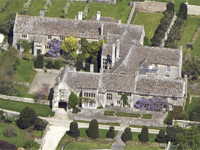
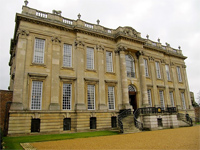
Easton Neston, Northamptonshire (Image: Trish York)

The stated objective of Dan Cruickshank’s series ‘The Country House Revealed‘ is to “…explore Britain’s finest country houses” and after the relatively low-key start with South Wraxall Manor, it upped the ante with the elegant Kinross House, and now it truly reaches one of the finest houses in the country: Easton Neston, Northamptonshire.  The only country house by one of the finest architects of his generation, when it was put up for sale in 2005, it marked the end of one of the great family estates.

Although many fine adjectives can be applied to Easton Neston, one seems to sum it up: noble.  Sitting on a slight rise of ground, this beautifully proportioned house neither lords it over the area but neither does it shirk from elegantly dominating its environment.  That the house looks as it does is due to a unique set of circumstances which gave the opportunity for Nicholas Hawksmoor (b. c.1662 – d.1736) to design his only country house – though he did help with others.

Hawksmoor was born in Nottinghamshire and, after finishing school, was employed as a clerk by a local landowner.  Such was his ‘early skill and genius‘ that word of his talent reached the finest architect in the country, Sir Christopher Wren, who took him on as a clerk at the age of 18.  This employment gave Hawksmoor a role in almost all Wren’s projects from c.1684 onwards, including Winchester Palace, the London City churches and St Paul’s Cathedral. In 1689, thanks to Wren, Hawksmoor obtained the post of Clerk of Works at Kensington Palace – the first in a series of official state roles he was to hold throughout his life, which provided both opportunities and frustrations.

It was this close relationship with Wren which gave Hawksmoor the opportunity to design the house at Easton Neston for Sir William Fermor.  Wren seemed not to display much of an interest in designing country houses but, as he was related by marriage to Sir William, he had originally been consulted about a new house in 1682 and had provided designs for two wings built in the early 1690s, of which one now survives (despite a serious fire in 2002).  Importantly, these two facing wings were 125-feet apart, limiting the size of the main house which would site between them.

Oak model of Easton Neston, c.1690 (Image: Sotheby's?)
Oak model of Easton Neston (as proposed? as built?) (Image: Sotheby's?)

Due to the lack of virtually any drawings or documents relating to Hawksmoor and Easton Neston, there seems to be some debate between such distinguished historians as Howard Colvin, John Julius Norwich and Kerry Downes as to exactly what Hawksmoor designed.  The couple of surviving letters relating to the build from Wren and others indicate that there was possibly a brick house, to Wren’s design, which looked similar but the house as it is today differs in several notable ways, not least the use of engaged columns and giant pilasters.

The first use of the giant pilaster order in English residential architecture can be seen in the south front of Chatsworth, designed by William Talman in 1687 and which also introduced the rectangular silhouette, the echoes of both of which can be seen in Easton Neston.  If the house as modelled is what was proposed or built then it is Wren’s design as Talman’s influence was not yet to be felt.

Staircase, Easton Neston (Image: English Heritage / NMR)

Norwich argues that the form of the house was substantially Wren’s, as was the interior, though Downes argues that, on the evidence of Hawksmoor’s sophisticated alterations for the interior at Ingestre Hall in 1688, with its clever use of internal screens of columns and dramatic spaces, and similarly demonstrated with the original hall and the brilliant cantilevered, shallow-stepped staircase at Easton Neston, he comes down firmly on the side of Hawksmoor.

The overall look of the house as it stands today is clearly Hawksmoor – it’s exciting, erudite, and draws on his extensive knowledge of classical architecture to create  bold fronts but with brilliant proportions which make perfect use of the form.  Hawksmoor also had the advantage of the use of Helmdon stone which, due to its durability and exceptional crispness when carved, ensures the house looks as good today as when it was first built.

Easton Neston as shown in 'Vitruvius Britannicus' (Image: wapedia)
Easton Neston as shown in 'Vitruvius Britannicus' - click for larger image (Image: wapedia)

Hawksmoor never undertook the usual Grand Tour to Italy so his architectural style was essentially drawn from a close study from various books of earlier classical architects.  This gives his work an intellectual quality which others lacked but also gave him the vocabulary to be inventive.  Easton Neston appears as a much bigger house, including a huge forecourt, in Colen Campbell‘s ‘Vitruvius Britannicus‘ though, thankfully they were never executed.  However, the drawing clearly show a clear link between Hawksmoor’s country house and the six London churches (of the 12 built from the proposed 50) he designed: St Alfege’s Church, Greenwich, St George’s Church, Bloomsbury, Christ Church, Spitalfields, St George in the East, Wapping, St Mary Woolnoth, and St Anne’s, Limehouse.

Hawksmoor was also to work, from 1702, with that other genius architect of that age; Sir John Vanbrugh; the playwright turned architect who came to rely on Hawksmoor’s practical skills to translate his fanciful visions into a reality at Castle Howard and Blenheim Palace (even more so when he had to take over following Vanbrugh’s bitter falling out with the Duchess of Marlborough).  Hawksmoor can therefore be seen as a link between Wren’s classicism and the exuberance of Vanbrugh’s particular brand of English Baroque.

Easton Neston remained essentially unchanged (except for some later flamboyant and slightly rampant interior plasterwork by a local artisan in the 18th-century) and in the Fermor-Hesketh family for nearly 500-years until in 2004 Lord Hesketh decided that he was not willing to burden his children with running a house and estate which “…in a good year it loses £500,000 and in a bad year it could lose £1.5m.” and risk seeing the family wealth slowly ebb away on maintenance. He was possibly also influenced by the likely cost of the restoration of Wren’s badly-damaged East wing which suffered a serious fire in 2002. Originally the house and 3,000-acres were put on the market for £50m in a once-in-a-generation opportunity to purchase one of the finest estates to come on the market for decades. Yet with no takers for the whole, Knight Frank sold over 2,200-acres for around £20m leaving just the house and 600-acres for £15m.

In July 2005 it was announced that Easton Neston had been sold to the American clothing retail tycoon Leon Max, the Russian-born owner of the California-based Maxstudio.com retail chain.  For all the fear about overseas buyers, Mr Max appears to have taken his custodianship of this grade-I masterpiece very seriously; hiring the architect Ptolemy Dean to oversee the work and investing an estimated £5m on the restoration to update the services of the house but also to restore the damaged wing to create a European headquarters for his company.  The interiors are equally splendid, overseen by Henrietta Spencer-Churchill (who grew up at Blenheim), with Max taking an ‘almost pedantically historicist approach‘ to sourcing furnishings and furniture which includes Aubusson tapestries from a chateau in France, Louis XVI chairs, and even a couple of the paintings sold by Lord Hesketh as he emptied the house of everything in a series of grand country house sales before moving out.

Easton Neston probably now looks better now than it has done since it was built, with the investment from the new owner likely to have secured the future of one of our greatest and most interesting country houses.

——————————————————————–

Book of the series: ‘The Country House Revealed‘ [Waterstones]

Official listing: ‘The Country House Revealed‘ [BBC2]

Quotes, figures and details in final paragraph come from an interview with Leon Max in the Sunday Times ‘Home’ section – 3 October 2010.

The Country House Revealed – Kinross House, Kinross-shire

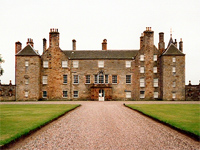
Kinross House, Kinross-shire (Image: The Daily Telegragh)
Kinross House, Kinross-shire (Image: The Daily Telegragh) - click for larger, but different, image from 'buildings_fan' on flickr

For houses which are owned by the same family for hundreds of years, the rhythm of their fortunes can often be read in the architecture of the house as it grows and shrinks accordingly.  This was certainly the case with South Wraxall Manor in Wiltshire, featured last week in ‘The Country House Revealed – A Secret History of the British Ancestral Home‘.  Yet the object of our, and Dan Cruickshanks’, affections this week, Kinross House, Kinross-shire, is a more dramatic, and relatively short-term, reflection of the rise and fall in the fortunes of a key Scottish gentleman architect, Sir William Bruce.

Kinross was described in Country Life magazine (February 16, 1951) as ‘the complete expression in stone of the Renaissance in Scotland’ – a not inconsiderable accolade for a man who combined his passion for architecture with a sometimes turbulent career in politics.  ‘Sir William, the politician’, was certainly ambitious and profited from the fluctuations in the fortunes of Charles II.  Active in the Royalist cause prior to the Restoration, on the King’s return William Bruce, younger son of a small Perthshire laird, was knighted in 1668.  Basking in the King’s favour, and under the patronage of the Earl of Lauderdale, he secured a series of minor but lucrative political appointments, the most important as Surveyor-General of the royal works in Scotland.

His political career was matched with equal vigour by ‘Sir William, the architect’ with an enthusiasm for not only architecture but also horticulture, literature, and languages.  Yet Sir William’s importance is mainly founded on his country houses, approximately ten in total – two of which where built for his own use, which helped establish his position as one of the most important architects in Scotland by breaking away from the widespread practice for nobles to still live in castles.

His early building work was mainly with existing houses, with his involvement first recorded in the enlargement and remodelling of the once magnificent Leslie House, Fife, between 1667-72.  Sir William’s involvement was relatively minor as custodian of the working drawings but he also gave advice with regards to the interior.  Sadly, three of the four sides of this quadrangular house burnt down in a fire in 1763 leaving just one side which was later remodelled again to create the currently Leslie House – though this was also severely damaged in a blaze in 2009 whilst undergoing conversion into apartments.

Balcaskie House, Fife (Image: Morton Design) - click for more views

Sir William’s next project is thankfully still visible today, almost unchanged from the day he  finished.  Balcaskie House, Fife, was bought by Bruce in 1665, and rather than demolish it, between 1668-71 he proceeded to enlarge and improve the existing house. It was here that his official role proved useful, employing some of the plasterers and painters he had also engaged in rebuilding Holyrood Palace, in Edinburgh between 1671-79.

Also in 1670, Sir William undertook several private commissions for his patron, the Duke of Lauderdale, including the remodelling of the Duke’s main Scottish seat at Thirlestane Castle.  Perhaps the most interesting aspect of this work are the interiors which draw heavily on the designs, and indeed the workmen, from Ham House in Richmond, Surrey, owned by the Countess of Dysart, who married the Duke in 1671, bringing that fine and beautiful house into that family.

Moncreiffe House, Perthshire (Image: NMR) - burnt down, 1957

With so many projects it is unsurprising that Sir William’s next major commission wasn’t until 1676; the construction of a new house at Dunkeld for the 1st Marquess of Atholl, described by the Marquess’ son as ‘…extrodinarly convenient though not larg & and it will not cost much expences ether.‘ This house is important as not only was it his first chance to build on a fresh plot but which shows a clear style of design which was to flourish at Kinross.  Sadly the house was pulled down in 1830 as a much larger house had been built for the 4th Duke.  Sir William’s next commission in 1679 was Moncreiffe House, near Perth, which was also to display a very similar style.  This house has also now been lost; demolished after a devastating fire in November 1957, leaving no surviving house to mark the emergence of these new elements of classical architecture in Scotland.

Sir William’s political star continued to shine, providing a fortune which enabled him to purchase the Kinross estate in 1675, and his first opportunity to give full rein to his architectural skills with only himself as client.   Work first started to level the site in 1679 and by 1686 the main outline of the gardens and forecourt were in place, ready for the construction of the house which started in the autumn of that year.  What rose up was one of the finest houses in the country but also one of the most important in Scotland.

Sir William was able to introduce new ideas around the layout of a house, drawing on the same ideas that Sir Roger Pratt and Hugh May were also promoting in England to create the form of the country house we know today. Similarities can be seen between the works of these architects, particularly Pratt at Coleshill, Berkshire (tragically burnt down in 1952) and the use of the double-pile layout.  Another interesting aspect of the design of Kinross is that it is lined up axially with  the ruined island castle of Loch Leven, providing an ‘eye-catcher’ for anyone looking out of the house across the water.

Kinross was to be Sir William’s physical statement of his vision of the country house as the primary stage for the aristocracy to parade.  The house was to be part of a whole, made up of the estate, parkland, gardens, exterior and interiors; each playing their part to create a visible record of the owner’s standing and wealth.  To do so, Bruce took the architectural fashions of England and combined them with his own knowledge of the works of Palladio and Serlio, and some innovative ideas of his own with regards to the use of mezzanines to create extra rooms and corridors for privacy, to create a design which also reflected the new political realities; classicism being aligned with structure, order and symmetry in society.

Craighall, Fife (Image: A.J.B. Hope)

Yet just as his costs mounted, his political career waned with the turmoil following the death of Charles II in 1685.  Having spent at least £10,000 (approx. £15m) with the house still unfinished,  he was forced to scale back the lavish interiors and his ambitions.  He now started taking on commissions again, working on Craighall between 1697-99 (ruined by 1793, demolished 1955), Craigiehall c1699, Hopetoun between 1699-1703, Mertoun c.1703-7, and his final contribution being to design the House of Nairne c.1710 (pulled down c.1760), though illness meant he wouldn’t have supervised the construction. Sir William had earlier made over Kinross to his son and moved back to the old Kinross house before moving to Edinburgh at the end of his life, dying there in 1710.

With limited family wealth the house declined until, in 1777, Kinross was bought by George Graham, a Scot merchant who had made a fortune in Jamaica, and since then had passed down through the family (latterly  Montgomery after a marriage in 1819).  Sadly the house was put up for sale in 2009 having been a family home since it was built and was sold in 2010 along with 75-acres with planning permission for conversion into a hotel – a rather depressing outcome for such an important house.

Book of the series: ‘The Country House Revealed‘ [Waterstones]

Official listing: ‘The Country House Revealed‘ [BBC2]

Note: having watched the first episode it seems that Dan is concentrating more on the family history aspect than the architectural so I hope these entries will balance this out.

New Series: The Country House Revealed – South Wraxall Manor, Wiltshire

South Wraxall Manor, Wiltshire (Image: Traumahawk / flickr)

In contrast to the weekly dramas of Country House Rescue, a new series starting on the BBC, presented by the excitable Dan Cruickshank, looks at some of the finest homes in ‘The Country House Revealed – A Secret History of the British Ancestral Home‘.  The series promises a look behind the estate wall at some homes which have never been open to the public, giving us a rare chance to glimpse houses which enjoy secure, well-funded ownership and demonstrating that the fears of those who thought these houses would never be sustainable have been thankfully proved wrong.

The first in the series (broadcast 10 May on BBC2 at 21:00) visits South Wraxall Manor in Wiltshire; a house which matches a beautiful exterior with impressive interiors dominated by some of the finest chimneypieces and period rooms in the country.  The house was originally built for Robert Long who made a fortune in cloth in the early 15th-century before becoming an MP in 1433, around which time it is thought the core of the house was started.  As was befitting a rich MP, he was keen to show his status and as was often the case with the gentry, his home was the main platform with which to show off his wealth and erudition, creating one of the finest houses in the country today.

England, at the time work started at South Wraxall Manor, was feeling the influence of the Italian Renaissance and elements of the new fashions were often incorporated into the best homes, though often adapted for our native traditions and styles.  This use of wider influences was also a symptom of the gradual shift in power as major building projects were increasingly commissioned by wealthy gentry rather than the Church or Royal Court.  Maurice Howard also highlights that although the Court was highly competitive which might have led to a single architectural style being favoured, in fact, the houses we still have show how tenacious local styles were.

Chimneypiece c.1600, South Wraxall Manor (Image: (c) Nicholas Cooper)

This continuation of the vernacular can be seen in the architectural vocabulary used by those commissioning the houses, drawing still strongly on ecclesiastical traditions.  Reading the full listing description for South Wraxall one might almost believe it to be a local church or monastery – windows with Perpendicular tracery, buttresses, even gargoyles.  The house was significantly remodelled around 1600, creating what John Julius Norwich calls ‘one of the major Jacobean rooms in all England‘.  A vast west window floods the room with light and is matched by one at the other end of the room, providing the illumination to highlight a most impressive fireplaces – a colossal, florid statement of importance.

Each generation of the Long family added to the house, with additional wings and chimneypieces, and extending the estate.  As with other such early houses which have survived subsequent centuries without ‘modernisation’, this was due to a small element of luck in that it was inherited by a branch of the Long family in 1814 who were already well established at Rood Ashton House, Wiltshire (largely demolished c.1950) meaning the house was often rented out.  The house let between 1820-26 and served time as a boys school, before the 1st Viscount Long took over c.1880 following his election as a local MP.  Viscount Long undid much of the damage caused during its time as a school when the linenfold panelling had been painted over and the ornate ceilings plastered over, however he never really took up residence there.  The house was let for the rest of the 19th-century and the early 20th, before the 2nd Viscount Long moved in in 1935.  Used to house refugees in WWII, the family again lived there before finally selling up in 1966, ending over 500-years of family ownership.

South Wraxall then entered a rather uncertain period, until it was bought by a businessman with plans to turn it into a country house hotel but who had some issues with the local planning authority over unauthorised changes (for example, I think he glassed in the loggia without permission).  The house was up for sale again in 2003 for £6.5m after the businessman abandoned his plans.  After languishing on the market for a couple of years – probably due to the extent of the restoration required – it was bought by the current owners: John Taylor (bass player with the band Duran Duran) and his wife Gela Nash (founder of the fashion house Juicy Couture) who apparently have done an excellent and sympathetic job of the repairs, thus rescuing a house that is a quintessential example of an English manor house.

Full listing description: ‘South Wraxall Manor‘ [British Listed Buildings]

Further information: ‘South Wraxall Manor‘ [Wikipedia]

Book of the series: ‘The Country House Revealed‘ [Waterstones]

Rest of the series

This looks to be a fascinating set of programmes – for reference the other houses featured are:

Ripples of Palladio: Forcett Hall, Yorkshire for sale

Forcett Hall, Yorkshire (Image: GSC Chartered Surveyors)

For those of us who love our country houses, the weekly delight of the new Country Life magazine are the many pages of houses for sale.  Although the space is usually dominated by the major players such as Knight Frank, Savills etc, a particular joy is when you discover, tucked away with a smaller agent, an especially good house which deserves to be better known.

One recent house which falls neatly into this category is Forcett Hall, near Richmond in North Yorkshire.  Grade-I listed, this house forms part of the spread northwards of the fashionable ideas of Lord Burlington and the Palladians. ‘Palladianism’ (as it became known) formed a new movement and became the dominant architectural taste from around 1710 until around 1750 but which is still very popular and influential today.

The Palladians were largely influenced by the work of the Italian architect Andrea Palladio (b.1508 – d.1580) whose work, particularly around Vicenza, drew heavily on the ancient classical form of Roman architecture.  The ideas were spread to Britain initially through the work of Inigo Jones, a multi-talented theatrical designer to the Court who also became the Royal Surveyor of Works which gave him the platform to spread the ideas of Italian Renaissance architectural classicism to these shores, starting with the Queen’s House in Greenwich, London.

Wanstead House, Essex

Key to the spread of these new ideas were two books, volumes 1 & 2 of ‘Vitruvius Britannicus‘, which took the form of a folio of one hundred classical buildings, published by the architect Colen Campbell.  Campbell also created one of the most important buildings of early Palladianism, Wanstead House in Essex, (dem. 1824) which re-interpreted the form of Vanbrugh‘s Baroque Castle Howard but in a new, more austere architectural language.  This was then followed by Wilbury House, Wiltshire, designed and built in 1710 by William Benson who succeeded Sir Christopher Wren as Surveyor of Works.  Wanstead inspired several derivatives in the years following its completion including Moor Park, Hertfordshire (1720s by Thornhill and Leoni), Wentworth Woodhouse, Yorkshire (alterations of 1733 by Flitcroft), Nostell Priory, Yorkshire (1733 by Paine) and Prior Park, Wiltshire (1735 by John Wood I).

Chiswick House, Middlesex (Image: curry15 / flickr)

Richard Boyle (b.1694 – d.1753), the 3rd Lord Burlington and 4th Earl of Cork, played a  significant role in firmly establishing Palladianism as a movement through his own influence, patronage and his circle of followers.  Burlington employed Colen Campbell to remodel his London house (taking over the work started by his rival James Gibbs) but Burlington was also a skilled architect, building the beautiful Chiswick House, in west London, in 1729, not so much as a home (it contains only state rooms) but as an architectural statement of his new principles.

One of Burlington’s protégés who assisted him as clerk of works on some of his earlier projects was Daniel Garrett (b.? – d.1753).  A measure of his competency can be seen in a letter sent in 1737 by Sir Thomas Robinson to Lord Carlisle regarding proposed works to complete the Mausoleum at Castle Howard:

“My Lord Burlington has a much better opinion of Mr Garrett’s knowledge and judgement than of Mr Flitcroft’s or any person whatever, except Mr [William] Kent…”

Stanwick Park, Yorkshire - dem. 1923 (Image: Lost Heritage)

However, despite his skill, Garrett was dismissed from his role in the Office of Works in 1737 for ‘not attending his duty’.  This was probably related to his absences caused by his own growing architectural practice in the north of England.  In 1735 he was remodelling Wallington Hall, Northumberland for Sir Walter Blackett, in 1736 he was at Castle Howard, and in 1737 he was working for Lord Derby, and between 1739-40 working for Sir Hugh Smithson, Bart, (later 1st Duke of Northumberland) on the rebuilding of Stanwick Park, Yorkshire (sadly demolished in 1923). He was later to work at other distinguished houses including Raby Castle in Co. Durham, Warwick Castle, Northumberland House in London (dem. 1874), Horton House in Northamptonshire (dem. 1936), Uppark in Sussex, Kippax Park in Yorkshire (dem. 1956-59) and most notably Foots Cray Place in Kent (dem. 1950).

This gives a measure of Garrett’s skill and his client list.  It was following his work at Stanwick that he started work at Forcett Hall in 1740 – though there does seem to be some debate as to what he did.  A list at Alnwick Castle says that the house is by ‘Mr Garrett for Mr Shuttleworth’, the latter being Richard Shuttleworth, the local MP who commissioned the house, whose family owned the estate between 1582-1785.  Although the estate agents state that the design of the house can be attributed to him as a rebuild following a fire in 1726, Howard Colvin thought him an unoriginal architect but skilled in providing handsome houses and instead only gives him a now demolished part of the east wing, the lodges and park entrance, the ceiling of the saloon (copied from the dining room at Chiswick House), and the grotto.

Forcett Hall, Yorkshire - as drawn by Samuel Buck

So if he didn’t design the main block, here’s an alternative theory; the house wasn’t completely burnt down in 1726 but was just seriously damaged, and Garrett gave a Palladian flavour to the house as part of the restoration.  The south front of the original house was drawn by Samuel Buck in his usual technically flawed idiosyncratic style (see right).  This is the same view in the picture of the house at the top of the post but the current house lacks the projecting wings but it does share the exact same form of three storeys over a semi-sunken basement.  Looking at the main house now (there’s an excellent picture on flickr: Forcett Hall – and also see the paintings in the comments), it could be argued that the elements of Palladianism – Ionic pilasters, quoins, external staircase have merely been applied to the house rather than forming a fundamental part of the design.  By excavating the semi-sunken basement (note the level of the lawn to the left), Garrett creates not only the appearance of a piano nobile, but also creates the space to add the staircase which is also in a typical Palladian style (and appears to be a modified form of the one at Stourhead as shown in ‘Vitruvius Britannicus) – but which seems to be an addition rather than a focus.  Elements such as the pilasters with their Scamozzi Ionic capitals almost seem to be copied from the entrance front of Marble Hill House in Twickenham (built 1724-29 by Roger Morris). Conversely, the north (entrance) front of Forcett is almost a different house; looking far more like an Italian villa than a Yorkshire country house (and I’m sure I recognise it from somewhere…).  Or perhaps I’m completely wrong and it is a new house, the design of which exposed the limitations of the architect.

This is a fascinating house, well worthy of it’s grade-I listing, though the photos on flickr show it’s in need of some care and restoration to fully bring out the beauty of this wonderful house.  The interior boasts some fine plasterwork and the house is set in a perfect small park which includes a 17-acre lake, no public footpaths and a grotto.  If someone is looking for a house with privacy but also a history to be explored there are few better houses available.

Property details: ‘Forcett Hall‘ [GSC Chartered Surveyors] – comes with over 230-acres, guide price £5.5m.

Property brochure [PDF]: ‘Forcett Hall‘ [GSC Chartered Surveyors]

——————————————————————————

British and Irish Stately Homes blog – more property for sale

This is also a good point to highlight another blog you should find interesting.  British and Irish Stately Homes is written by Andrew who is a frequent contributor to the comments in this parish.   Featuring houses for sale, TV programmes involving country houses, books on the topic plus much more it covers some more of the areas I just don’t have time to!  Do bookmark it, subscribe and let Andrew know if you spot anything you think ought to be added.

The Royal country house honeymoon

So the happy Royal couple, our new Duke and Duchess of Cambridge, have taken just the long weekend for their honeymoon leaving an interesting question as to whether they are breaking with the tradition of spending their first days of marriage in an British country house?  With the twin demands of luxury and privacy, the country houses of the UK have often proved particularly attractive, though Royal palaces even more so.

Hampton Court Palace, Surrey (Image: Gail Johnson / flickr)

In an earlier age, the Royal family would often simply use one of their own palaces as a convenient venue.  Already secure and well-established for the great demands of catering and supporting a King or Queen, they had a natural advantage.  One often used has been Hampton Court Palace, in Surrey, one of the finest Royal residences ever built and a worthy equal to the splendour of Versailles.  Construction started in 1514 by Thomas Wolsey, an Archbishop of York, who built a palace which rivalled any that King Henry VIII then possessed.  With over a 1,000 rooms and accommodation for 280 guests, Wolsey wisely answered, when asked by the King in 1526 why he had built such a magnificent house, “To show how noble a palace a subject may offer to his sovereign.”

Having now taken ownership, Henry then embarked on his own ambitious programme, adding a third courtyard and stamping his mark on all aspects of the palace. It was in this sprawling residence which he enjoyed at least two of his honeymoons; with Jane Seymour, his third wife, in 1537, and with Kathryn Howard, his sixth, who he married at Hampton Court in 1543.  Due to his unhappiness with the looks of his fourth wife, Anne of Cleves, and the very short marriage (Jan-July 1540), it seems unlikely that he would have made any significant arrangements and so possibly used Hampton Court as his most convenient palace near London.

Henry VIII’s daughter, Mary I, also spent her honeymoon with Philip I at Hampton Court  in 1544. It was used again by King James I on his marriage to Henrietta Maria in 1625 and then by Charles II and Katherine of Braganza in 1662.

Rycote Park (Palace), Oxfordshire (Image: Thame History)

Henry VIII obviously had several opportunities to honeymoon, though his first was more a working tour as, following his marriage to Catherine of Aragon in 1501, he was sent to Ludlow Castle to preside over the Council of Wales and the Marches. His second, with Anne Boleyn in 1533, was at Shurland Hall, Isle of Sheppey in Kent, which has recently become the 70th building to be rescued by The Spitalfields Trust (and which is currently for sale).  His honeymoon with Catherine Howard, his fifth wife, in 1540, was spent at Rycote Park, in Oxfordshire. It’s not entirely clear who originally built this Tudor mansion but it certainly of a status to attract the Royal couple.  The house suffered a devastating fire in 1745, but was rebuilt before being emptied in a contents sale in 1779, and then sold for materials in 1807.

The tradition of the Royal family using their own houses has largely continued, though in more recent times they have also used suitable private houses as the retinues required have shrunk making it unnecessary to require a palace.

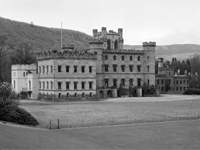
Taymouth Castle, Scotland (Image: RCAHMS)
Taymouth Castle, Scotland (Image: RCAHMS) - click for more images of interior

Queen Victoria and HRH Prince Albert enjoyed only a mini-honeymoon of three days in 1840, which was spent at Windsor Castle. The Queen, unwilling to ignore her duties and responsibilities as monarch which require frequent contact with her ministers, wished to stay close to London – even if her husband might have preferred a quieter break further away.  They did take a belated honeymoon in 1842 to Scotland where they stayed at the impressive Taymouth Castle, seat of the Marquesses of Breadalbane, owners of one of the largest estates covering 450,000-acres, which took over 40 years to build and had only recently been completed but to standard above almost any other seat in Scotland.  Designed by James Gillespie Graham, it was a convalescence home in WWII and a school but is currently unused whilst negotiations continue about turning it into a ‘seven star’ hotel.

Polesden Lacey, Surrey (Image: Matthew Beckett)

In the early part of the 20th-century, King George VI and his new bride, later the Queen Mother, stayed in 1923 with the remarkable society hostess, Mrs Ronald Greville, at her country retreat Polesden Lacey in Surrey (now National Trust).  An accomplished hostess, Mrs Greville and her staff were well used to catering for the cream of society.  Once home to Richard Brinsley Sheridan, after his death it was largely demolished and rebuilt by Thomas Cubitt in 1821 as, essentially, a neo-classical seaside villa.  After being bought by the Grevilles in 1906, she employed Mewes and Davis, architects of the Ritz, to remodel the interior.  The new opulence was matched by with an equal measure of intimacy, with rooms flowing between each other and the outside to create a fluid social space lined with portraits by Lely, Raeburn and Reynolds and cabinets full of Meissen china – a perfect venue for a Royal honeymoon.  Continuing the tradition started by Queen Victoria, they also spent time in Scotland at Glamis Castle, ancestral home of the Earls of Strathmore, and that of the future Queen Mother.

Balmoral Castle, Scotland (Image: Stuart Yeates / flickr)

On her marriage in 1947, our current monarch, Her Majesty Queen Elizabeth II, continued this practice and stayed at Broadlands in Hampshire, one of the best mid-sized Georgian houses, which largely appears to day as it was when it was finished in 1766. Elizabeth II also stayed at the family’s Scottish estates at Balmoral Castle and Birkhall, which were also destinations for the Prince and Princess of Wales in 1981 along with Birkhall which also used by Prince Edward and Sophie Wessex in 1999 and by the Prince of Wales and Camilla in 2005.

Alternatively, if they do wish to go abroad, they have the examples of the Duke and Duchess of Windsor who, in 1937, who spent three months at Castle Wasserloenburg in Austria, or Princess Anne who, in 1973, chose to spend her honeymoon cruising in the West Indies.  So, seeking peace and security, perhaps we’ll see the Duke and Duchess of Cambridge take a short break in a smaller country house before spending time in Scotland – or perhaps jetting off, but either way is in keeping with a long history of Royal honeymoons.

For sale: ‘Shurland Hall, Kent‘ [Jackson-Stops & Staff]

Thanks to Andrew for his help.