Country House Rescue: Pen-Y-Lan, Wales

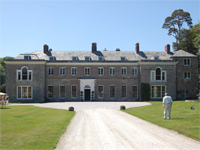
Pen-Y-Lan, Wales (Image: Channel 4)

This week’s episode of Country House Rescue seems to have found one of the most anonymous houses I have come across, with so little information available about it. Perhaps, however, this is indicative of the rather quiet existence so many smaller country houses do enjoy.  Yet, as Ruth Watson discovers (as she has in so many inherited houses), quiet enjoyment and a commitment to a house and the estate by the owner does not translate into being able to look after it.

Pen-Y-Lan is situated at the head of a bucolic valley, in the centre of its 500-acre estate, which straddles the English/Welsh border – indeed Cheshire Shropshire is at the bottom of the hill and across the river.  The house was originally built in 1690 by one of the founders of Lloyds bank, though as Quakers they suffered extreme persecution in Wales and moved to Birmingham in 1689, so I suspect the house was more a rural retreat or symbolic connection as the family’s main homes were in and around Birmingham.  The house was then sold to the Holloway family in 1849, where it has been passed down through the generations to the current owner, Emma Holloway.

The grade-II listed house is in the regionally popular Regency gothic style – essentially a five by four bay house which was re-modelled in 1830 to add crenellations, hood moulds over the windows, decorative turrets, and an imposing entrance.  We have already looked at the particularly strong Welsh Regency gothic tradition in a previous post about Kentchurch Court, which although in Herefordshire, was very much a part of that movement.  In fact, in some ways, King Edward I could be said to have been one of the strongest architectural influences in the Wales. It was his chain of 17 mighty castles which stretched across the country ensured continuing conflicts necessitating defensible houses which filtered out in later years in the architectural vocabulary of the Picturesque movement which drew heavily on castle features such as crenellations, arrow slits, turrets, towers and battlements.

The difficulties in controlling the Welsh were first experienced by the Romans who also were forced to built extensive fortifications and, in fact, established the pattern of requiring large garrisons to defend themselves and the settlers.  The later autonomy granted to the very powerful Marcher lords, who were given the task of securing peace through marriage, trade or force of arms, ensured that the language of building in Wales was mostly either defensive or small-scale.  To help prevent any local challenges to the King’s authority the Marcher lords were mainly English (comprising the Earls of Chester, Gloucester, Hereford, Pembroke and Shrewsbury) whose estates were very much centred around their English seats and the court in London – even if the wealth generated made them some of the richest families in the country.
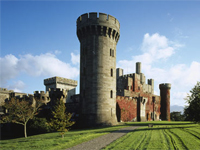
Penrhyn Castle, Wales (Image: NTPL/Geoff Morgan)

One notable feature of Wales is how few large estates there were.  Considering the size and wealth of the nation, the fact that it was mostly ruled through local clans (where not owned more directly by the Marcher lords) meant that their wealth would limit them to building fine, but smaller, manor houses (for example Gwydir Castle – there is also a superb account of its restoration: ‘ Castles in the Air‘).  This has meant that there are few ‘stately homes’ in the same sense that there are in England. A survey in Country Life magazine in the mid-1960s suggested that of the 200 estates examined, only about 20 would be regarded as ‘stately homes’.  However, within those 20 are such notable houses as Chirk Castle (now National Trust), Erddig (National Trust), Gwrych Castle (now a ruin), Hawarden Castle (still Gladstone family home), Penrhyn Castle (National Trust), Powis Castle (National Trust), Plas Newydd (National Trust), Vaynol (privately owned) and Wynnstay (now flats) – all in north Wales. In the south, the main seats were Dynevor Castle (National Trust), Fonmon Castle (still Boothby family home), Golden Grove (empty), Penllyn Castle (unknown!), Penrice Castle (private home), Stackpole Court (demolished 1963) and Tredegar Court (council owned).  Sadly, as shown in Thomas Lloyd’s ‘Lost Houses of Wales‘, over 350 Welsh country houses were demolished, mainly in the latter half of the 20th-century, as poor finances combined with blinkered Socialism meant that many were lost with little protest.

This means that the smaller Welsh country houses of minor gentry, tucked away in the rolling valleys, should be treasured all the more.  Sadly, as in the case of Pen-Y-Lan, when faced with an owner who had to take out a £300,000 loan for urgent repairs when she inherited in 2007, yet, as she admits “I have absolutely zero business acumen, whatsoever“, creates significant challenges.  Pen-Y-Lan is in a state of considerable disrepair which will require something of a miracle if the owner, Emma Holloway, is to overcome her lack of business skills to pay off the debt, restore the house, and preserve it to hopefully hand it on to the next generation.

Country House Rescue: ‘Pen-Y-Lan‘ [Channel 4]

Official website: ‘Pen-Y-Lan‘ or follow them on Facebook

Country House Rescue: see complete previous episodes

———————————————————————————–

Before you comment…

This particular episode of Country House Rescue was one of the most controversial and provoked much reaction when broadcast and every time it is repeated – some are in sympathy and many not.  This is one family doing what they thought was best and perhaps the editing of the show was designed to present a particular angle.  Either way, the purpose of the comments on this blog are to contribute useful information, particularly anything related to architecture, and so I won’t permit comments I think are intemperate/abusive.  Thank you for your understanding.

———————————————————————————–

Country House Rescue: efforts misapplied – Trereife House, Cornwall

Trereife House, Cornwall (Image: matt bibbey / flickr)

Inheritance is a double-edged sword – for all the perceived luck of being given a large country house, the reality is that, in many cases, the house requires significant investment.  For some, this is a chance to shine; to put in place the plans they had been making, or develop new talents and unexpected skills. For others it quickly becomes burden as it pushes them into situations they seem unprepared for – as it frequently proves on Country House Rescue.  This week (27 March), heading back down to the south west, Ruth Watson visits Trereife House in Cornwall, to a house threatened by the odd schemes of the owner.

Antony House, Cornwall (Image: mothproofrhubarb / flickr)

Trereife (pronounced ‘treeve’) nestles in the hills above Penzance, an neat pink hued Queen Anne house with an elegant parterre garden laid out below the south front.  The original house was an Elizabethan farmhouse which was home to the Nicholls family, who had become wealthy landowners and minor gentry through farming and marriage.  The first records of them is the marriage of William Nicholls (also known as William Trereife) in 1590, though it is thought the family had been in the area for several generations earlier.  The design of the grade-II* house as we see it today is the result of an extensive rebuilding in 1708 which not only added the wonderful Queen Anne front with its hipped roof but also created some fine interiors with plasterwork ceilings, probably by travelling Italian workmen, who were known to have worked on several houses in the south west.

Boconnoc House, Cornwall (Image: cornishmoth / flickr)

Architecturally, the echoes of the style of Trereife can be seen at the much grander Antony House for the much wealthier Carew family. The house was begun in 1718 shortly after Trereife’s remodelling and so is technically Georgian (Queen Anne died in 1714) but the basic form of the house is similar.  Also Boconnoc House, near Lostwithiel, displays the same two-storey with dormer windows design as Trereife and Antony – though again for a much wealthier family, the Pitts.  Boconnoc features later alterations in 1786 by Thomas Pitt, cousin of Pitt (the Younger) the Prime Minister, in conjunction with Sir John Soane, who he had met in Italy in 1778, which probably explains the serlian window to the projecting bay.  Another house of a similar design was Dunsland House, Devon which was one of the most important houses in the area, with particularly fine plasterwork, which sadly burnt down in 1967.  On a smaller scale than any of these, but possibly even more beautiful, is Great Treverran, near Fowey, a compact (one room deep) house built in 1704 but given a dose of grandeur with fine granite Ionic columns, it was last sold in 2003 for around £650,000 and is now wasted as a holiday cottage.

Trereife is a significant part of a great tradition of Cornish houses with a fine family history with connections to the Romantics such as Coleridge, Wordsworth, Charles Lamb and Leigh Hunt through Revd Charles Valentine Le Grice, affectionately known as ‘CV’.  The house passed to the Le Grice family through inheritance in 1821 following the marriage of Mary Nicholls, whose son had died childless, to ‘CV’ in 1799.  The house is now owned by Tim Le Grice, a solicitor who inherited the neglected house in 1986 from his grandmother and who now lives at Trereife with his family.

Sadly, Tim appears ill-equipped for the role as country house rescuer as a series of slightly eccentric – gypsy caravan theme park anyone? – or badly planned business ventures have taken up significant time and money with little to show for it.  For the family, the £40,000 per year running costs were proving ruinous and so they turned to Ruth for advice; which is typically hard-hitting.  Much as the family would rather avoid having their family finances shared with the nation this appears to be the only way to persuade Tim that he needs to draw on the skills and experience of his literary agent daughter to organise events and his wife to develop the potential for B&B and weddings within the house.  Considering that the house now comes up well in Google searches as a venue for weddings and events it seems that Ruth was right – and has hopefully enabled another family to remain in their ancestral home.

——————————————————————

Country House Rescue: ‘Trereife House‘ [Channel 4]

Official website: ‘Trereife House

Interiors: ‘Trereife House‘ [UK Film Location]

Official Facebook page: ‘Trereife House

More details: ‘Trereife – a family home‘ [Cornwall Life]

Country House Rescue: Tapeley Park, Devon

Tapeley Park, Devon (Image: chatoul / flickr)

The subject of the 13 March episode of Country House Rescue, Tapeley Park in Devon, carries on the wonderful tradition for country house eccentricities – and eccentrics.  From how the site was chosen to the manner of the inheritance, this beautiful house has a fascinating history – though more recently it’s been a little neglected.

According to Simon Jenkins, “Few Devon houses have so spectacular an outlook” – and few would disagree.  Situated above the pretty seaside town of Bideford, the site of the house was apparently chosen by the builder, Captain William Clevland, who apparently spotted the location through his telescope as he sailed up the Torridge in 1702.  He made good on his wish, rebuilding the existing manor house in an austere and somewhat uninspiring style but which took full advantage of the fine views from its elevated position – though this was later largely negated by an enthusiastic blocking up of windows to avoid the window tax.

Tapeley Park, Devon - before Belcher alterations (Image: tapeleygardens.com)

The house eventually passed to the Christie family through marriage when Agnes Clevland married William Langham Christie in 1855.  The Christie fortune was made when one Daniel Christie joined the East India Company and was later given a fortune in gems by a Sultan in thanks for having prevented troops from pillaging a harem.  On his return he married the daughter of Sir Purbeck Langham of Glyndebourne in East Sussex and Saunton Court in Devon.  His grandson, Augustus Langham Christie, inherited both estates and now being a very eligible and wealthy man was able, in 1882, to marry the daughter of the Earl of Portsmouth, Lady Rosamund, whose family seat was the nearby Eggesford House (demolished in 1917).  Coming from such a grand house she was fairly unimpressed with Tapeley, writing in her diary:

“When I first saw Tapeley it was in the winter of 1881 before my marriage to Augustus Langham Christie. It was a Georgian stucco house, very plain and rather dreary in appearance, for many of the front windows had been blocked and the sunk apertures painted black with halfdrawn paint blinds, cords and tassells, looked very dull. The terrace walk and garden did not exist and the drive approached between iron railings.”

The marriage was not a particularly happy one with Lady Rosamund eventually banishing Augustus to the other Christie estate, the nearby Saughton Court, for his ‘eccentricities’ which apparently included ‘childish behaviour’ such as kicking the furniture repeatedly to annoy her.  In his absence, Lady Rosamund poured her energies into rebuilding Tapeley and engaged one of the leading neo-baroque architects, John Belcher (b.1841 – d.1913).  Due to limited finance, the work was to last from 1896 until 1916 but the professional relationship between client and architect was a happy one – so much so that on his death she had a plaque added to a wall in his memory.

Belcher is not as widely known as perhaps he should be, though his work is well regarded. He worked mainly on commercial buildings and institutions including the Whiteleys department store in London, and the brilliant Mappin & Webb building in the City of London which was scandalously demolished in 1994 to build No.1 Poultry (the only good view is looking out from the top of it!). More prominently, Belcher also designed in 1907  the imposing Ashton Memorial in Lancaster for Baron Ashton.

Belcher transformed the ‘dreary’ house to create an imposing but elegant ‘Queen Anne’ style Georgian villa of brick with stone pilasters, parapet and a pediment, sitting above the impressive terraced gardens. The interiors are also of note, featuring a grand staircase hall and also several good fireplaces and plaster ceilings from the original house.  Lady Rosamund had to fight to keep hold of her creation as, in an act of revenge, Augustus left the house in his will on his death in 1930 to a distant cousin in Canada, forcing her to have to go to court to argue, successfully, that Augustus was obviously insane.

The house and estate were inherited by her son, John Christie, who founded the famous opera at Glyndebourne, where he spent the other half of his time when he wasn’t at Tapeley.  Tapeley was then inherited by his daughter, another Rosamund, who frugally ran the house until her death in 1988 and was known for conducting the tours with a parrot on her head.

The current owner is one Hector Christie, Rosamund’s nephew, who apparently decided with his brother which was to inherit Glyndebourne and Tapeley by flipping a coin whilst in a Brighton nightclub.  Hector, though Eton-educated, is something of a rebel, once sneaking into a Labour party conference to heckle Tony Blair about the Iraq war, and also extending a fairly broad invitation to various hippies to create something of an eco-commune at Tapeley.

Though almost all the hippies have now left, Hector has now decided that he should focus on managing the house and estate on a more commercial basis, and not a moment too soon judging by the deteriorating condition of the grade-II* listed house, where part of the dining room ceiling fell in shortly before Ruth Watson’s first visit.  Fingers crossed her advice can provide a means for the family to stay in their ancestral seat without compromising either the architecture or setting or his principles.

Official site: Tapeley Park, Devon

Country House Rescue: Tapeley Park

The front line: the campaigners for country houses

Apethorpe Hall, Northamptonshire (Image: English Heritage)

Despite the image of wealth and power a country house might create, in reality their existence is far more precarious – as can be seen with nearly 1,800 houses lost over the last two centuries.  A house facing the threats of being uninhabited without a concerned, well-funded owner with an inclination to keep it in good repair can quickly deteriorate leaving another gap in the tapestry of the countryside.  Sometimes it requires someone other than concerned locals and architectural historians to highlight and campaign on behalf of those ‘at risk’ so here’s a quick round-up of the main English organisations fighting on behalf of country houses and who are very worthy of support.

English Heritage inhabits a prime position in view of its role in defining and, in conjunction with local authorities, implementing the statutory protection of our built heritage.  Its role can be traced back to the Ancient Monuments Act of 1882 – though the legislation specifically excluded privately owned houses. The responsibilities were exercised through various government departments until it became a quango in 1984.  As well as being responsible for the listing system and the annual production of the various ‘at risk’ registers (focussing mainly on grade-I and -II* properties), EH is also directly responsible for various country houses including Brodsworth Hall (Yorkshire), Rufford Abbey (Nottinghamshire), Hill Hall and Audley End (Essex), Kirby Hall (Northamptonshire), Witley Court (Worcestershire), Stokesay Castle (Shropshire), and Apethorpe Hall (Northamptonshire).   It’s at the grade-I listed Apethorpe where EH has done some of it’s most interesting work; taking a direct role in the restoration of one of the finest Elizabethan/Jacobean houses in the country following a long period of neglect. Since 2008, the house has been for sale for around £5m – though there is a compulsory £4m list of renovations, and if you want complete privacy expect to pay another £8m to fully reimburse EH otherwise you have to open it for 28 days a year; so a nice round £20m to restore, furnish and keep as your own. However, this is a role that I fully support them in taking on – they should be there as owner and restorer of last resort for threatened grade-I houses.  Now perhaps we can interest them in the sadly deriorating Melton Constable Hall in Norfolk…?

Another important group of campaigners are recognised in the 1968 Town and Country Planning Act which formalised the role of what are known as ‘amenity societies‘; that is, well-established voluntary societies who are experts in their areas, who must, by law, be informed of any applications for listed building consent to demolish listed buildings in whole or in part in England and Wales.

One of the best known is the Georgian Group who cover a period broadly from 1700-1837.  The society was established in 1937 and has long campaigned for the sensitive restoration and retention of not only the buildings but the many important, and sometimes sadly overlooked, internal features which are a key part of the character of a building.  Current active campaigns and cases they are involved in include Bank Hall in Lancashire and Trewarthenick House in Cornwall and many others. They also produce a scholarly annual research journal which provides a much more in-depth view of aspects of Georgian architecture.  Access for the wonderful trips to houses not normally open to the public are worth joining for alone.

Eaton Hall, Cheshire (by Alfred Waterhouse - dem. 1961) (Image: Lost Heritage)

The Victorian Society (which also covers Edwardian buildings too) was formed in 1958 at a time when almost all things Victorian were disliked and an easy target for demolition.  Founded at the suggestion of Anne, Lady Rosse, along with her influential friends such as Sir John Betjeman and Sir Nicklaus Pevsner, the Society has fought some notable battles; losing some such as Euston Station but winning others, such as the soon-to-reopen St Pancras Midland Grand Hotel building.  Victorian country houses have suffered badly as, although designed by eminent architects such as Richard Norman Shaw and Alfred Waterhouse, they were often built on a much grander and therefore less economically sustainable scale and at the times of greatest threat (the 1930s and 1950s) had few friends to argue on their behalf.  Luckily though this has changed – but with the predominant ‘gothic-revival’ style being quite polarising, threats to houses from this period will always be present. Again, well worth joining.

Perhaps more controversially for this blog, it’s also worth bearing in mind the Twentieth Century Society.  Although the focus of the houses usually covered is before 1900, there has been a growing recognition that some of the country houses built in the 20th-century were well-planned and architecturally pleasing, even if they sometimes replaced a much more attractive Georgian or Victorian house.  It does seem to take about 50 years after a style has passed from being fashionable for it to be appreciated, so I suspect there will be a growing realisation that we need to protect the work of those such as Francis Johnson, Craig Hamilton, Quinlan Terry, and Robert Adam (amongst many others) in the future.

The Society for the Protection of Ancient Buildings (SPAB) is, as its name makes clear, not usually concerned with country houses as they are relatively ‘modern’ in terms of its remit.  However, they do immensely important work in promoting good repair practice to all buildings and their courses have taught generations of owners and craftsmen to respect the country houses and to approach any work required with a more ‘heritage’ mindset.

Although not ‘amenity societies’, two other organisations deserve a mention. The first is the Historic Houses Association which acts on behalf of the private owners of country houses and often lobby government to make them aware of the immense work done by the individual owners to maintain their slice of the national architectural heritage.  It may seem unfashionable in wider society to support the wealthy but they are the ones not only maintaining their homes to the exacting standards of English Heritage, but also restoring and rescuing houses and converting them back into homes again – and for that they deserve our thanks.

The Grange, Hampshire (Image: mpntod / Wikipedia)

The other organisation is one in which I have an interest having worked with them for several years: SAVE Britain’s Heritage.  Founded in 1974, SAVE have taken a very active stance on campaigning, willing to create media interest at short notice, but also to take time to produce some excellent research on houses at risk with thoughtful proposals for their re-use.  These campaigns have saved houses such as Calke Abbey in Derbyshire, The Grange in Hampshire, Barlaston Hall in Staffordshire (where SAVE bravely took on the house for £1!), and, working with Kit Martin, have acted as a catalyst for the saving of other houses through conversion into apartments.  Supporting SAVE’s work and becoming a Friend also gives access to their extensive ‘Buildings at Risk Register’ which features over 800 properties, including several country houses, which are in need of rescue – could it be you?

It is also worth keeping an eye out for local activists and campaigns which can also be remarkably successful at highlighting buildings at risk but can also sometimes take a more direct role; see the wonderful work at Poltimore, Devon, Bank Hall, Lancashire, and Copped Hall, Essex.  These are just three examples where concerned locals have organised themselves and presented a credible alternative and prevented the complete loss of the house.

All of these organisations are worth joining but economics being what they are it can be best to join a national organisation and then another to focus on the period which you prefer.  Joining up means that you are helping to support research but also active campaigns to ensure that as much of our built heritage is passed on to future generations.

———————————————————

I realise this selection is not comprehensive and is quite national in focus and deficient in regional organisations but this will be remedied in another post once I’ve had time to learn a bit more about who’s out there.

– Matthew

———————————————————

Make a date: the strange world of the calendar house

Knole, Kent (Image: Matthew Beckett)

One of the main satisfactions of having a house built is that, as it’s your money, you get to decide the style, design, scale and detail according to your whims.  With many of the stranger flights of fancy now curtailed by cost or planning controls it’s interesting to look at earlier houses built without such restraints and, in particular, those which incorporated horological elements creating the phenomena of the ‘calendar house’; that is, where the architecture was influenced according to the number of days, weeks or months in a year.

The genesis of the calendar house appears to have been in the intellectually fertile Elizabethan period when the elite of society revelled in the advances of science,  mathematics and astronomy.  They also had a great love of the ‘device’ which in the 16th-century meant any ingenious or original shape or concept. Mark Girouard, in his excellent book ‘Elizabethan Architecture – Its Rise and Fall, 1540 – 1640‘, states that although there are precursors to the idea of an entire building as a device – which can be seen in the designs of Henry VIII’s forts and and contemporaries’ gatehouses – this was its extent.

Under the Elizabethans, this idea can be seen to grow – from gatehouses to entrance fronts to courtyards (before they disappear) and the whole house is the device.  Yet for all the intellectual attraction, the idea of the form of a house being dictated by the calendar is actually quite rare.   In fact, Girouard’s book doesn’t mention the idea at all, as technically the first house to incorporate these principles, Knole in Kent, was built in 1604 by one of her courtiers, Thomas Sackville, 1st Earl of Dorset, a year after Elizabeth I‘s death.

The principle of the calendar house is that the number of external doors, windows or panes of glass, chimneys, or staircases etc should total either 4 (the number seasons), 7 (days in a week), 12 (months in a year), or 365 (days in a year).  So in Knole’s case, the calendar is represented through the 365 rooms, 52 staircases and 7 courtyards.  It is this choice of the number of which elements that provides the variation to the theme and can lead to the creation of palaces such as Knole. It also helps explain the relative scarcity of these houses as they require a certain commitment from the owner to complete the build and not compromise on the plans for fear of spoiling the totals.

Scout Hall, Yorkshire (Image: boxfriendly / urbexforums)

One of the most compact of the calendar houses was built in 1681 – Scout Hall in Yorkshire. This wonderful house – which would give Hardwick Hall a run for its money for the phrase ‘more glass than wall’ – was built for a local silk merchant, John Mitchell, by an unknown designer and includes 365 panes of glass and 52 doors.  Considering the rarity of calendar houses, it’s interesting to consider how this concept suddenly appeared over 70 years after the first and several hundred miles north.  Perhaps Mitchell’s trade had taken him south and he had been to, or heard of, Knole.  Who knows?  What we do know is that this grade-II* house has been on the ‘buildings at risk register‘ for many years and has been derelict since the 1980s.

aberdeenshire-cairnesshouse
Cairness House, Aberdeenshire

The next appearance of a calendar house is in the far north at Cairness House in Aberdeenshire, designed by the renowned architect James Playfair and built between 1791-97 for Charles Gordon of Cairness and Buthlaw as the centrepiece of his 9,000-acre estate.  What’s particularly remarkable about the house is that it resolutely neo-classical in design – a very unlikely style to marry with such a whim.  Yet Charles Gordon had something of the Elizabethan love of the ‘device’ as the design contains numerous Masonic and pagan symbols with even the overall layout of the house making the initials ‘CH’.

Holme Eden Hall, Cumbria (Image: Smiths Gore estate agents)

It would be another forty years before the idea would be used again – this time in Cumbria in the construction of Holme Eden Hall in 1837. Built in a Tudor gothic style for a local cotton mill owner, Peter Dixon, to designs by John Dobson, a prolific local architect responsible for the remodelling of Newcastle-upon-Tyne and who worked on over one hundred country houses.  Dobson had the rare facility of being able to competently design in many styles so it’s possible that the idea of the calendar house came from the owner; this time featuring 365 panes of glass, 52 chimneys, 12 passageways, 7 entrances and 4 storeys.  The choice of the number of which elements was probably dictated by the budget as Dixon couldn’t have afforded to construct a house on the scale of Knole.  After becoming a convent, the house fell into some decay but was converted by intelligent developers who kept the theme going and created 12 apartments, each named after a month.

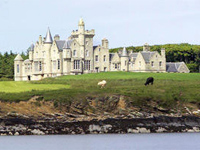
Balfour Castle, Isle of Shapinsay, Scotland (Image: Balfour Castle)

The next house appears in Scotland again; Balfour Castle on the Isle of Shapinsay. This was a remodelling of an existing house by the famous Scottish architect David Bryce, who did so much to popularise the ‘Scots Baronial’ style we now associate with the country.  The owner was David Balfour whose grandfather had originally purchased the house and estate in 1782. The Bryce alterations were completed in just two years from 1847 and the calendar theme this time produced 365 panes of glass, 52 rooms, 12 exterior doors, and 7 turrets.

Bradgate House, Leicestershire - dem. 1925 (Image: Lost Heritage)

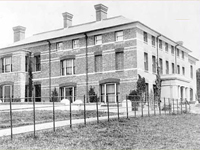
Bradgate House, Leicestershire was built in 1854 for the extravagant George Harry Grey, the 7th Earl of Stamford, though it was only to survive 70 years before being demolished in 1925.  A gentleman sportsman with a liking for the Turf, the 7th Earl was probably inspired by the contemporary Victorian fashion of connecting families with their real (or sometimes imagined) ancestral past and building an Elizabethan style house would remind everyone that the Grey family had first been elevated to the peerage by Queen Elizabeth I.  Exactly why he chose a calendar scheme is unknown but the house included 365 windows, 52 rooms and 12 main chimneys.

The Towers, Didsbury, Lancashire (Image: Paul F Hamlyn)

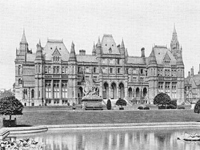
Although perhaps not strictly a country seat, The Towers, in Didsbury, Lancashire was built between 1868-72 as a rural escape for the proprietor and editor of the Manchester Guardian, John Edward Taylor.  Designed by Thomas Worthington in a bold gothic style, it was reputed to have cost £50,000 to build – equivalent to around £3.3m today, and features 365 windows, 52 rooms and 12 towers.  Pevsner appears conflicted about it describing it as both ‘…grossly picturesque in red brick and red terra cotta’ but also as ‘the grandest of all Manchester mansions’.  It was subsequently purchased in 1920 for just £10,000 and became the headquarters for the British Cotton Industry Research Association and became known as the Shirley Institute, before becoming rental offices sadly surrounded by bland office blocks.

Bedstone Court, Shropshire was designed in a completely different style – mock Elizabethan – but again followed the pattern with 365 windows, 52 rooms, 12 chimneys and 7 external doors.  The house was designed for Sir Henry Ripley by Thomas Harris, and had survived largely intact despite changing from use as a home to a school, until a serious fire in 1996 severely damaged large sections of the house necessitating extensive restoration.

Avon Tyrrell, Hampshire (Image: Avon Tyrrell Activity Centre)

Avon Tyrrell, Hampshire, completed in 1891 and now grade-I listed, was, as far as is known, the last calendar house to be built in the UK and incorporates 365 windows, 52 rooms, 12 chimneys, and 7 external entrances. Designed by the distinguished Arts & Crafts architect W.R. Lethaby, a founding member of the architectural conservation charity the Society for the Protection of Ancient Buildings, he was also particularly interested in architectural theory and design, so it is likely that he would have suggested the idea of the calendar house to Lord Manners. The client was a wealthy racehorse owner who built the house on the back of his winnings from a famous bet he made in 1881, that he could buy, train and ride the winner of the 1882 Grand National – which he did.  Lord Manners donated the house to the “Youth of the Nation” and it is now an activity centre.

Considering that the idea of the calendar house was essentially Elizabethan in conception, it’s interesting to note that only one was built in that time, with the next in the late 17th-century, one in the 18th-century, but that it was the Victorians who produced the most.  Perhaps this was a reflection of their interest in time, order and structure but also a revival in the Elizabethan delight in science and challenges.  As a distinct group of houses they deserve to be better known – and in the case of Scout Hall, it deserves to be treated as a priority for rescue and restoration before it runs out of time.

—————————————————————————————–
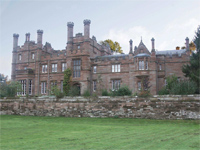
Two other houses may also be calendar houses but I haven’t been able to reliably confirm this:

  • Kinmel Hall, north Wales – said to have 365 windows on the front elevation, 52 chimneys and 12 external doors.
  • Welcombe House, Warwickshire – now a hotel and has undergone significant alterations but is supposed to have 365 windows, 52 chimneys, 12 fireplaces and 7 entrances.

Can anyone confirm these? Thanks, Matthew