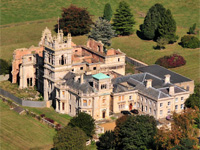
Anyone with deep pockets? Country houses at risk today

It seems remarkable that between the popularity of country houses as tourist attractions or business or simply as homes that any would be at risk.  Yet as the 2010 SAVE Britain’s Heritage Building’s at Risk Register shows there are still a broad selection of fine houses which, for various reasons, are in need of someone with a desire to restore part of our heritage, lots of dedication, and pretty deep pockets.
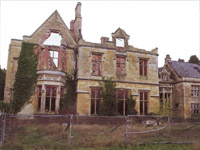
Nocton Hall, Lincolnshire (photo copyright: Tom Vaughan)

One of the saddest is the case of Nocton Hall in Lincolnshire – a county which has lost so many of it’s fine old country houses already.  Fire is still one of the main reasons a house can quickly go from being a secure home to an ‘at risk’ shell.  Grade-II listed Nocton Hall is a warm honey-coloured stone house built for the 1st Earl of Ripon in 1841 to replace the original Jacobean house which burnt down in 1834.  After a stint as an RAF hospital in WWII it became a residential home before being bought by a property developer.  Unfortunately no development took place and the house was allowed to slowly deteriorate before a serious fire severely damaged what had been a perfectly good house.  Still sitting in its own gardens and parkland and near the village Nocton Hall cries out to be restored either as a h,otel or ideally as a grand family home.

Barmoor Castle, Northumberland (Photo: SAVE Britain's Heritage)

To look at the photo, Barmoor Castle in Northumberland looks in pretty good shape – but a picture can hide as much as it shows.  The first issue with Barmoor is that it actually is unused and sits in the middle of a caravan park which has been established in the grounds. Inside, there is some water damage as the roof has been leaking – although recent work, part funded by English Heritage, has alleviated this for the moment. Barmoor was built in 1801 around an older tower by the architect John Patterson of Edinburgh in a castellated Gothic Revival style for Francis Sitwell, in whose family it remained until 1979 when it was sold along with 200-acres.  The current owners have operated the caravan park since then but didn’t live in the house or use it leading to it’s current neglected state.  This is a classic example of where a house could be rescued from an inappropriate use, restored and enjoyed as a fine country house as was intended.

St Botolph's Mansion, Wales (Image: SAVE Britain's Heritage)

St Botolphs Mansion in Pembrokeshire was built in the early 1800’s for General Richard Le Hunt is a house in need of a use rather than repair.  The Doric porch and neat window architraves create an interesting facade which would normally ensure that such a house would be jealously fought over if it came to market.  However it is now owned by the nearby oil refinery (the proximity probably ruling out residential use) but they are exploring options as to how to make use of this elegant Georgian house – perhaps as a conference facility might be more appropriate.  Either way, this is a house which shouldn’t be forgotten.

Other country houses of note in the report include the Grade-II* listed Plas Machen nr Newport, the surviving portion of the 15th-century house of the Morgans who moved up in the world to Tredegar House, which is for sale. Also for sale, since 2007, is Benwell Towers in Newcastle which was a country house when built but is now suburban, achieving fame in later life as the set for the kid’s TV series ‘Byker Grove’.

Even if your pockets can’t stretch to a country house there are many other buildings seeking a saviour so do order your copy of ‘Live or Let Die‘ and certainly consider joining SAVE Britain’s Heritage to help to preserve our architectural legacy for future generations.

‘Live or Let Die’: the 2010 Buildings at Risk Register

'Live or Let Die' - 2010 SAVE Buildings at Risk Register

For anyone interested in architectural conservation the annual SAVE Britain’s Heritage ‘Buildings at Risk Register‘ will always trigger ‘what if’ moments as you contemplate possibly taking on a forlorn building which catches your eye.  Yet the Register should also inspire some concern and disappointment that once again so many wonderful buildings are at risk in the first place.

The 2010 report, entitled ‘Live or Let Die‘, again provides a fascinating snapshot of a broad collection of buildings which we are now at risk of losing.  Some are merely unused and crying out for sympathetic conversion, others are more extreme and would require great quantities of time and money – but they would deliver the most incredible homes or workplaces once finished.  And remember, estate agents almost always value good quality, well-restored period properties higher than a similar but modern property in the same area.

The report features over a hundred properties from the large country houses such as St Botolph’s mansion, in Herbrandston, which was built in the early 1800s, but is now empty and deteriorating.  Other substantial houses include the house featured on the cover; Northwold Manor in Northwold, Norfolk.  However, it’s not just houses, but mills, schools, libraries, town halls and many more.

SAVE Britain’s Heritage has been successfully campaigning for historic buildings since its formation in 1975 by a group of architects, journalists and planners. It is a strong, independent voice in conservation, free to respond rapidly to emergencies and to speak out loud for the historic built environment. It has published a Buildings at Risk Register for England and Wales since 1989 and has had many successes and is responsible for saving many buildings we love today.  Even if you can’t take on a property, if you wish to support their work, please consider becoming a Friend of SAVE and you will not only receive discounts on publications, but newsletters and access to the online version of the Register featuring over a thousand properties in need of care.

Order your copy today: ‘Live or Let Die – 2010 Buildings at Risk Register‘ [SAVE Britain’s Heritage]

A suburban survival at risk: Braunstone Hall, Leicestershire

Braunstone Hall, Leicestershire (Image: East Midlands Oral History Archive))
Braunstone Hall, Leicestershire (Image: East Midlands Oral History Archive)

Two of the most important aspects of campaigning to save country houses are vigilance and visibility – and yet sometimes even this doesn’t always seem to bring about restoration any quicker when faced with a slow-moving owner. Braunstone Hall, a Georgian gem still with significant grounds but now swallowed up in the sprawl of Leicester, has been empty for over ten years but despite a vigorous campaign both in the media and online it still remains very much at risk.

Braunstone Hall, now grade-II listed, was built in 1776 (date on rainwater head) for the Winstanley family by the architect William Oldham (b. 1737 – d. 1814) who also designed an early Leicester racecourse grandstand (1770), Master’s House at Alderman Newton’s School (1789) and the New House of Correction (1803) – all though now demolished.  The red-brick house is two and a half storeys tall by five bays wide with a cornice and hipped roof.  The relatively simple front is enlivened with stone bands marking the ground and first floors with an impressive tripartite doorway with fluted columns, a small pediment and an elegant fanlight with arched glazing bars.  One further very distinctive feature is the giant blind recessed arch in the central bay – an architectural device which seems quite popular in Leicestershire with examples in Burbage, Belgrave House (also 1776), and the beautiful rectory at Church Langton (by William Henderson – 1760).  The interior is largely complete with some impressive detailing.

The Winstanley family bought the estate from the Hastings family in 1650 and remained there until forced out in the 1920’s by the pressure to build houses following the First World War.  Estates on the edge of existing towns and cities were eagerly eyed-up by local councils.  For some families, already facing financial hardships following the war this was a perfect opportunity to sell the family seat and relocate.  Others, including the Winstanleys in the shape of Major Richard Norman Winstanley, fought the prospect of compulsory purchase arguing that this was still a family home and the building work would undermine the value of his recently modernised house.  However, he was unsuccessful and so the house, gardens, parkland and further 949-acres were compulsorily purchased in 1925 for £116,500 (equivalent to £5.2m – 2008).  Most of the land was built over except for the house and 168-acres surrounding it which became a public park.  The house remained in council ownership and was first a secondary school, opening in 1932, before becoming a primary school a year later until it closed in 1996.

Since then the Leicester City Council has failed to either find a viable long-term use or adequately protect Braunstone Hall with the house falling victim to repeated acts of vandalism and arson.  The latter is the most worrying as the incidents have not only included fires outside the building but also now inside.  Over the last few years the Council have been making very slow progress towards finding a solution but, as always, they are claiming poverty when it comes to heritage projects.  A very active campaigning group has been set up on Facebook with the members regularly corresponding with councillors and reporting any damage or deterioration at the hall – effectively a dedicated ‘Neighbourhood Watch’ for the house.

The Council put the house up for sale on a 125-year lease in 2007 and had recently been negotiating to sell the house to a local businessman for conversion to a hotel, conference centre and wedding venue. However this has been delayed by changes to what’s being offered in relation to the land for enabling development.  Each delay increases the risk that the local yobs will finally succeed in their mindless vandalism and burn down this elegant and important part of Leicester’s heritage.  If this happens the blame can be laid firmly at the feet of Leicester City Council and their apathy and indecisiveness over the last 14 years.

Join the Facebook campaign group: ‘Restore Braunstone Hall

Detailed history of the house: ‘Braunstone Hall‘ [Leicester City Council]

Detailed description of the house: ‘Braunstone Hall‘ [English Heritage]

If you thought ‘The Restoration Man’ projects a bit small-fry; try Overstone House

Overstone Hall, Northamptonshire (Image: Martin Sutton on flickr)

Although hated by Samuel Loyd who commissioned it, Overstone House is fondly remembered by the generations of girls who were taught there after it became a school.  A vast, rambling property, it was sold to an obscure evangelical religious group who lived there until a devastating fire in April 2001 destroyed the main part of the house – although Loyd might have been quite relieved.

Overstone House replaced the earlier Overstone Hall and was built in 1862 for the banker Samuel Loyd, who became Lord Overstone for services to finance.  His wife  was keen to have a property commensurate with their status and so her husband decided to rebuild on a grand scale.  However, he inexplicably picked the unknown architect William Milford Teulon (brother of the more famous Gothic revivalist Samuel Sanders Teulon) who was instructed to design with a mixture of Elizabethan and Renaissance features.  This choice led to the creation of one of the most derided houses created in the Victorian era.

Both Girouard and Pevsner were uncomplimentary with the latter describing it as ‘drearily asymmetrical’.  However, the most damning verdict  came from Samuel Loyd himself, who, in what could be regarded as a wonderfully amusing piece of architectural criticism, said:

“The New House I regret to say, is the cause of unmitigated disappointment and vexation.  It is an utter failure – We have fallen into the hands of an architect in whom incapacity is his smallest fault.  The House tho’ very large and full of pretension – has neither taste, comfort nor convenience.  I am utterly ashamed of it … the principal rooms are literally uninhabitable – I shall never fit them up … I grieve to think that I shall hand such an abortion to my successors.”

As if this wasn’t enough, Loyd’s wife died before the project was finished leaving him with this rather large problem – which he promptly ignored by going and living with his daughter at Lockinge house in Berkshire where she had become Lady Wantage. Loyd must have eventually finished it as, on his death in 1883, it passed to Lady Wantage who, along with her husband, used it regularly during the hunting season until 1901.  After her death it was tenanted until sold to become a girls school in 1929.

It remained a girls school until 1979 when the pressures of looking after such a vast pile became too much and it was eventually sold to the New Testament Church of God for £100,000 in 1980 who are the current vendors.  The devastating fire in 2001 destroyed approximately 60% of the building including all the principal rooms and the impressive carved staircase.  Parts of the grade-II listed house remained in use as an old people’s home but the rest became a concern, leading to it being added to the ‘Buildings at Risk’ register.

However, the house is now for sale as a grand project with the opportunity to create a truly palatial home – the original house contained 119 rooms totalling around 20,000 sq ft.  The local council’s preference is that it become a single house – but to do so would require someone with big ideas and very deep pockets, willing to spend at least £5-10m on restoration on top of the £1.5m to buy the house and 50-acres.  However, as the main cause of Loyd’s distress has now been destroyed, this is great opportunity for someone to perhaps create a house which might meet with greater approval.

For anyone with the necessary funds and Kevin McCloud on speed-dial, please call Robert Godfrey of Bidwells (01604 605050).

A detailed history of the house is available on the Overstone School for Girls website.

More details: ‘Property restoration project: Overstone Hall, Northampton‘ [Daily Telegraph]

Lifting the curse of Hampton Gay manor house


Hampton Gay Manor House, Oxfordshire
Hampton Gay Manor House, Oxfordshire (Image: Robert Silverwood on flickr)


The fire which gutted the largely unaltered Elizabethan Hampton Gay manor house in 1887 was seen as the retribution of a curse said to have been put on the house when the inhabitants refused to offer help and shelter when the Paddington-to-Birkenhead Express crashed nearby in 1874.  The fire tore through the building leaving nothing but a shell which has stood for nearly 150 years.  However, with continuing structural deterioration threatening its very survival, an application has been submitted to restore it as a new home.

Even ten years ago the idea of restoring a historic ruin would have probably been immediately refused by English Heritage but over the last decade a series of interesting restorations have shown that ruins need not always remain that way.  This re-evaluation was probably a result of the realisation that it is almost impossible to fully arrest deterioration to a building which is not in use.  However, there is a strong incentive for an owner to ensure that his home remains secure and watertight.

One example of this new permissiveness is Eggesford House in Devon.  Formerly the home of the Earls of Portsmouth, this house, built between 1820-30, was abandoned in preference for their Hampshire estates in 1911 and put up for sale in 1913. It was eventually bought by a local man who slowly stripped it of anything usable in the 1920s leaving a derelict shell.  In the early 1980s it was expected that within a few years the last remaining walls would collapse leaving no sign of the grand house.  However it (plus 80-acres) was sold in the 1990s for around £300,000 to the architect Edward Howell who created a huge new house within the existing walls which successfully uses the old room heights to create Regency-style proportions in a very modern house.

Another project which was driven forward by sheer determination was that of Hellifield Peel in Yorkshire whose story was told as part of a 90-minute special edition of Grand Designs.  At it’s core a 14th-century fortified tower, it had been modernised in the Georgian period but abandoned in the 1950s until it was a roofless shell.  With dereliction threatening total loss, English Heritage decided to allow conversion – albeit with some serious stipulations regarding the archaeology. Architect Francis Shaw had always wanted to live in a castle and this was a labour of love – certainly only someone very dedicated would continue after seeing the central spine wall collapse into hundreds of tons of rubble.  However, anyone who sees the house today would probably agree that English Heritage made the right choice.

Astley Castle in Warwickshire was another ancient home ravaged by a fire in 1978 and a fast deteriorating ruin which the Landmark Trust, with grant support from English Heritage, are in the process of rescuing.  Their plan involves the insertion of a smaller house into the shell of the castle to support the walls and provide holiday accommodation thus ensuring an income to provide a secure future for this historic house.

So the plans for Hampton Gay aren’t as radical as some might believe. However, the 18th-century passion for the ‘Picturesque’ – an appreciation for natural environments and particularly for ruins – is still influential today and some may object to this interference in what is considered one of the most beautiful views in Oxfordshire.  However, without significant intervention there is a real risk that the ruin would simply collapse and be lost forever.  So if the choice is between losing an atmospheric ruin or allowing restoration it seems that the current preference from the official bodies is that the latter is to be allowed – although the heavy restrictions will hopefully ensure that only well-funded restorers with a sympathetic understanding of the building will undertake these projects.  This raises some tantalising prospects; perhaps one day we may even see Kirby Hall in Northamptonshire as a home once again?

Story: ‘Grand design for ruins‘ [Witney Gazette]