The Inadvertent Innovation: Country Life and Property Advertising

Over the last four centuries, the marketing of property has seen relatively few innovations. Those with money and the desire to establish themselves in society would seek out those with knowledge on which estates might be available.  However, the launch of Country Life magazine 120 years ago this month heralded a sea change in the marketing of the landed lifestyle. No longer did the buyer have to rely solely on what they found; now Country Life, through advertising and market reports, brought a selection of the choicest properties right into the drawing rooms of the aspiring elite. The continuing success of the magazine suggests that our desire for the grandeur and leisure of rural society is undimmed over a century later.

Country Life was the idea of Edward Hudson (b.1854 – d.1936), a successful magazine printer, who recognised a gap in the market for a publication which reflected the rural lifestyle of a wealthy elite and, importantly, those who wished to join them.  Conveniently for Hudson, he already had one publication which catered to a significant traditional interest, Racing Illustrated, but lacklustre sales meant it was ripe to be incorporated as a component part of the new magazine. The first issue of Country Life was published on 8 January 1897 and from the outset it was noted for the high quality of the content and, importantly, of the production, with heavy paper and fine photographs.

Country Life Illustrated, 8 January 1897, p. 3

As with most magazines of the time, the front cover and first page were adverts for all manner of essentials such as ‘Cadbury’s Cocoa’ and slightly more obscure (‘Old Grans Special Toddy‘, ‘Vigor’s Horse-Action Saddle – A Perfect Substitute for the Live Horse‘). However, below the grand ‘Country Life Illustrated‘ masthead is a single full page, rich in some of the finest country houses in the land – and all for sale or to let. It’s also noteworthy that this innovative layout was the work of the single firm of land agents, Walton & Lee of Edinburgh, through whom these properties were available.

As today, properties were sold for a number of reasons but, in an age when the loss of the family seat was considered a serious failing in society, financial embarrassment was often the single strongest reason for a property to appear for sale.  Until the twentieth-century, the majority of property transactions for country houses were primarily about the land; the actual house was usually a secondary consideration as, if you felt it wasn’t suitable, you could always rebuild it in a style or scale until it was. Intelligence regarding which estates were for sale was passed around through social networks, partly to preserve privacy, but often as a way of discretely finding a buyer. Local solicitors also played an extensive and dominant role in the sale of property, often using their extensive and intimate knowledge of local families to know who might be open to offers or to find suitable investments, especially as, since 1804, they held the monopoly on conveyancing.

In 1897, the second Agricultural Depression was hitting the income of those landowners who were heavily dependent on income from their estates.  The financial crisis that this created was the catalyst which forced a number of estates to be put on the market. Equally, death dealt its usual cruel blow with estates being sold in part or in total to meet the stipulations of wills, particularly if the only offspring were daughters, often married to a gentleman with his own estate and little need for a part share in another.

'In the Grafton country...' Advert for Writtlebury Lodge, Northamptonshire, Country Life Illustrated, 8 January 1897, p. 3
‘In the Grafton country…’ Walton & Lee advert for Writtlebury Lodge, Northamptonshire, Country Life Illustrated, 8 January 1897, p. 3

The houses shown in that first edition are certainly varied. Ranging from the grandeur of Stowe House to ‘a charming, moderate-sized manorial estate’, each warranted a small but densely-worded description. In contrast to today where a house of the importance of Stowe would most likely be either sold off-market or launched with all the fanfare modern country house estate agency can muster with multi-page, glossy, full page photo adverts. Although, with the exception of Stowe, all were anonymous, of the nine houses advertised, it’s possible to identify six of them:

Column 1

  • SALE: Writtlebury Lodge, Northamptonshire, with 6,700 acres (demolished 1972)
  • SALE: Unidentified ‘moderate-sized Manorial Estate’, South Devon, with 600 acres
  • SALE: Unidentified ‘unique specimen of an early English country house’, Sussex or Surrey, with 42 acres

Column 2

  • TO LET: Maesllwch Castle, Radnorshire, with shooting over 20,000 acres
  • TO LET: Charlecote Park, Warwickshire, with 250 acres (now National Trust)
  • SALE: Apethorpe, Northamptonshire, with 5,000 acres (now a private home again)
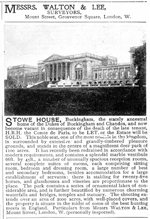
'Stowe House, Buckingham', 'In the Grafton country...' Advert, Country Life Illustrated, 8 January 1897, p. 3
‘Stowe House, Buckingham’, Walton & Lee advert, Country Life Illustrated, 8 January 1897, p. 3

Column 3

  • TO LET or SALE: Stowe House, Buckinghamshire, with 1,100 acres (now a school)
  • TO LET: Addington Manor, Buckinghamshire, with ‘parks and grounds’ (demolished 1926)
  • TO LET: Rigmaden Park, YorkshireUnidentified ‘fine Mansion’, North of England with sporting rights over 4,000 acres (thanks to a reader for the identification)

This selection in one week is almost unimaginable now – to have one house such as Stowe or Charlecote advertised for sale would be remarkable; to have those plus other grand houses showed the scale of the crisis which was quietly afflicting the established rural order. As financial circumstances forced retrenchment for families from the larger houses to their smaller ones (or sometimes from the countryside altogether), so Country Life offered a new and effective route for marketing these properties to those who had risen in the heady world of Victorian industry and finance and who now sought to install themselves as the inheritors of the old social order through the possession of their estates.

The photos of the houses for sale also echoed that Country Life also emphasised a new stylistic aesthetic in the photographs which accompanied the articles on specific houses; one which departed from a common representation of country houses; notably by removing the people and all signs of daily life. Whether this was the choice of Edward Hudson or the photographers is unknown, but engravings and images of country houses from earlier periods often showed them as the hubs of rural and social activity. Outdoor views displayed workers in the fields, the aristocracy enjoying the pleasures of the house and parkland, and coaches riding down lanes, whilst interior views were full of noble pursuits.

The bucolic ideal was important in times of political and social turmoil.  Such scenes, although partly a simple tool for demonstrating scale, also promoted the idea of the paternal landowner to those within the landowning classes, those who wished to join them, and others who had simply obtained a copy, perhaps through a lending library.  Note how often the sky is calm, the lake waters placid, and the animals docile or obedient – there are no signs of disharmony. This can be seen in J.P. Neale‘s famous series of views of country seats published between 1819-1823, soon after the tumult of the Napoleonic Wars:

Detail from 'Sunning-Hill Park, Berkshire' drawn by J.P. Neale (Image from Rare Old Prints)
Detail from ‘Sunning-Hill Park, Berkshire’ drawn by J.P. Neale (Image from Rare Old Prints)

The compliant and dutifully grateful cows enjoying the benefits of the parkland at Langley Park, Buckinghamshire:
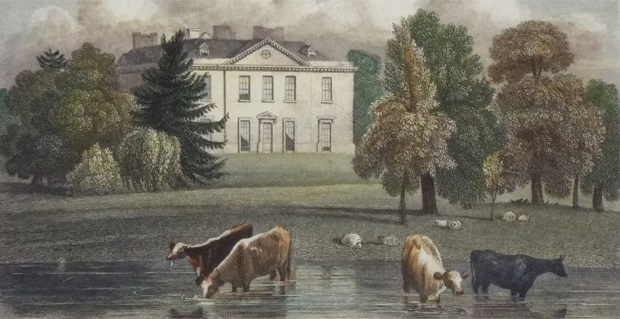
Detail from 'Langley Park, Buckinghamshire' drawn by J.P. Neale (Image from Rare Old Prints)
Detail from ‘Langley Park, Buckinghamshire’ drawn by J.P. Neale (Image from Rare Old Prints)

Take the later scene presented in J.M. Gilbert’s image, drawn in 1832, the year of the Great Reform Bill which extended voting to all men who owned property worth ten pounds or more in yearly rent, of Newlands, Hampshire, which includes a vignette of rural husbandry with the men taking instructions from an agent with the house looking benignly down:
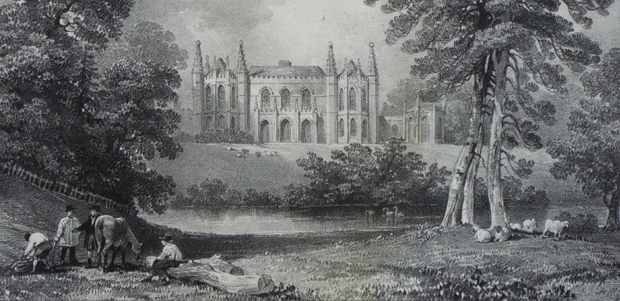
Detail from 'Newlands, The Seat of Mrs Whitby' by J.M. Gilbert, 1832, from 'Grove's Views of Lymington' (Image from Rare Old Prints)
Detail from ‘Newlands, The Seat of Mrs Whitby’ by J.M. Gilbert, 1832, from ‘Grove’s Views of Lymington’ (Image from Rare Old Prints)

Interior views often showed the aristocratic families at leisure. This was partly due to the romanticisation of the country house which can, in part, be attributed to the popular historical novels of Sir Walter Scott who, as noted by the writer Thomas Carlyle, that they

‘have taught all men this truth … that the bygone ages of the world were actually filled with living men, not by protocols, state papers, controversies and abstractions of men’.

For example, in Nash’s ‘The Mansions of England in the Old Time‘ published between 1839-49, the domestic scenes feature prominent groups of people going about their daily lives as imagined as an aristocratic set-piece where all the clothes were fine, the people good looking, and the activities noble.
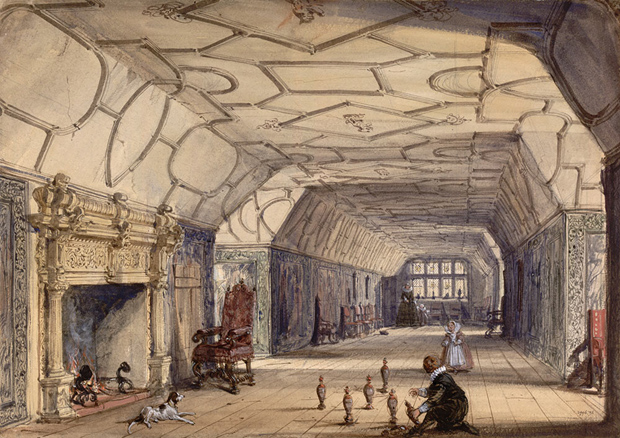
'The Gallery, Knole House, near Sevenoaks, Kent'. Joseph Nash. (Image © Victoria and Albert Museum, London - Museum no. 2996-1876)
‘The Gallery, Knole House, near Sevenoaks, Kent’. Joseph Nash. (Image © Victoria and Albert Museum, London – Museum no. 2996-1876)

This is not to say that all followed such an approach. Many artists such as the Rev. F.A.O. Morris in his famous ‘Picturesque Views of Seats of the Noblemen and Gentlemen of Great Britain and Ireland‘ published 1866 emphasised the houses, showing no signs of people.

Country Life therefore was both following the precedent of some earlier artists but also by so rigorously applying this view of the houses and the popularity of the magazine spreading this ideal far and wide, so the perception of country houses as denuded of evidence of life was one which was almost in contrast to the warm, sympathetic portrayal of the families in the accompanying text.

Walton & Lee maintained their tenacious grip on the important first page of advertising in Country Life from 1897 until 1912.  In that year, as a measure of the success of Country Life in establishing itself as one of the prime avenues for the sale of property, Howard Frank, of Knight, Frank & Rutley, bought Walton & Lee specifically to secure that  coveted advertising space. Though their reign at the forefront of advertising country estates had ended, their influence in the presentation of property was to remain and can be seen today. Evidence of this is in both the continued hold Knight Frank maintain on the first page of advertising, and the stylistic aesthetic which the estate agents and Country Life established as the standard for the photographic presentation of country houses for sale and exalted in numerous publications.


Country Life wrote their own retrospective on property advertising in 2007 for the 110th anniversary: ‘Wanted: Property for a Gentleman’ [Country Life]
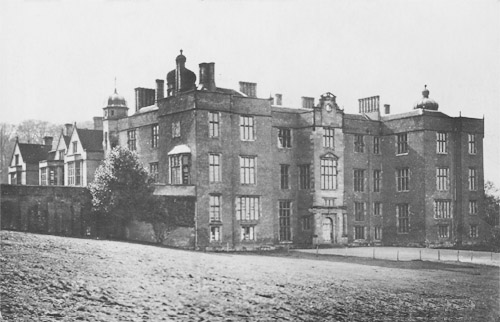
A mansion tax is a pox on all our country houses

It’s a widely accepted principle that even if trying to achieve a noble goal, it is not a justification to do harm in doing so.  Whether one is trying to fund the NHS or provide kittens and puppies for all, if ever such an ill-thought out idea as a mansion tax is introduced, it is likely that the law of unintended consequences will find myriad ways to demonstrate itself.  In few sectors will the damage be greater than in that of our nation’s cultural and architectural heritage where decades of hard work and conservation of our country houses will be sacrificed to play a short-term political game.

Beaudesert Hall, Staffordshire - demolished 1935 due to demands of heavy taxation (Image: Lost Heritage)
Beaudesert Hall, Staffordshire – demolished 1935 due to demands of heavy taxation (Image: Lost Heritage)

Let me make clear that this objection is not party political – I would object as vigorously regardless of whoever tried to propose it. Obviously the devil is in the detail but if we assume a tax levied on homes valued at £2m or more at 1% of the property value to be paid annually there are many obvious and profound flaws with the idea – below are a few of them:

  • Fallacy of numbers: there are more expensive houses than there are rich people who could afford the tax. Many houses which would be affected have been inherited thus exchanging the large liquid capital requirements of purchase for the more manageable (though not insubstantial) cost of on-going maintenance.
  • Value suppression: a house valued at £2m will immediately not be worth £2m when a mansion tax is introduced (thus reducing the projected tax receipts).  This will lead to a very hard ceiling on house prices, stagnating the market far below that level as it will prevent others trading up by imposing a disproportionate penalty on anyone purchasing over that price level. Think of all the disadvantages of the current crude banding of Stamp Duty, but magnified.
  • Incentive to neglect: if your house is worth just over £2m, there is a benefit to allowing your property to deteriorate so that it can be assessed at being below the threshold. But how often will they be valued? Will it lead to a cycle of neglect and repair to coincide with this? Who will wish to improve their property for fear that it will push it over the punitive threshold?

Perhaps the greatest threat is to the contents of country houses; the art, sculpture, books, tapestries which combine in such an intangible emotive way to create that atmosphere unique to each.  When the financial effects of the 1870-80s agricultural depression began to be felt, the first items to be sold were the contents – the Titians, Rubens, Caxtons, Shakespeares, Nollekens, Canovas were taken from their pride of place and sent to auction or dealers, the resulting funds merely delaying the inevitable sale of the house.  If we thought the National Lottery Fund was sorely stretched at the moment to acquire for the nation the occasional fine work which appears at auction, there is little chance of them being saved if the volume increases, meaning they will, in many cases, go overseas. Additionally, if the best works have already been sold, then death duties will be a final hammer blow to shatter the cultural and historical unity of the country house, with nothing left to sell or offer in lieu.

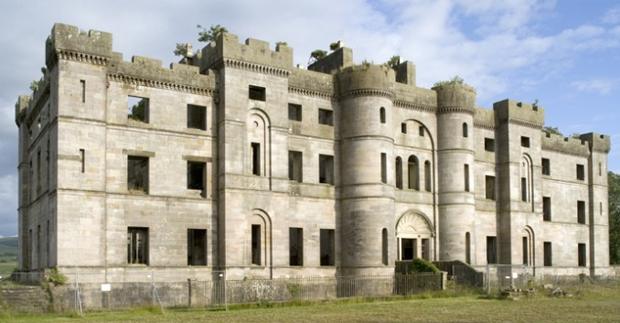
This type of crude taxation has been tried before and it is always heritage which pays the price.  The many gaunt shells of Scottish country houses, such as Dalquharran Castle or New Slains Castle, which were un-roofed to avoid punitive taxes are sad testament to the folly of this approach.  Supporting a mansion tax is to accept a probable return to an era where empty country houses become derelict – ironically coming so soon after the 40th anniversary of the ‘Destruction of the Country House’ exhibition. The National Trust will not be able to take them on without an endowment and English Heritage are sorely underfunded already – leaving either neglect or a hope for an influx of foreign wealth to purchase these houses. Without a local owner living there full time, there are likely to be fewer jobs reducing tax revenues and, with the dearth of rural jobs, leading to higher numbers relying on the State for assistance or an exodus to larger urban areas, further damaging the rural environment.

Dalquharran Castle, Ayrshire - built by Robert Adam c1785-1790, un-roofed 1967 (Image: RCAHMS)
Dalquharran Castle, Ayrshire – built by Robert Adam c1785-1790, un-roofed 1967 (Image: RCAHMS)

Perhaps there could be exemptions for houses which are open a certain number of days a year or which support useful charitable activities but the danger is that these would be used to justify an idea that is inherently wrong.

This article is deliberately painting a rather bleak picture, partially because there is a real likelihood of any of these outcomes, but also to emphasise just how badly-thought out this crude idea is.  It offers no benefits except as a bone to be thrown to a few class warriors but it should seriously worry anyone who cares about the UK’s cultural, artistic and architectural heritage.  Owning a country house is a responsibility, not only as a home for the owner and their family, but one owed to society as a whole.  It is inevitable and right that tax should be raised to pay for the society we hope to live in, but to wilfully sacrifice four centuries of heritage is an immoral and culturally destructive way to do so, no matter how noble the intended reason.

Country House Rescue: Pen-Y-Lan, Wales

Pen-Y-Lan, Wales (Image: Channel 4)

This week’s episode of Country House Rescue seems to have found one of the most anonymous houses I have come across, with so little information available about it. Perhaps, however, this is indicative of the rather quiet existence so many smaller country houses do enjoy.  Yet, as Ruth Watson discovers (as she has in so many inherited houses), quiet enjoyment and a commitment to a house and the estate by the owner does not translate into being able to look after it.

Pen-Y-Lan is situated at the head of a bucolic valley, in the centre of its 500-acre estate, which straddles the English/Welsh border – indeed Cheshire Shropshire is at the bottom of the hill and across the river.  The house was originally built in 1690 by one of the founders of Lloyds bank, though as Quakers they suffered extreme persecution in Wales and moved to Birmingham in 1689, so I suspect the house was more a rural retreat or symbolic connection as the family’s main homes were in and around Birmingham.  The house was then sold to the Holloway family in 1849, where it has been passed down through the generations to the current owner, Emma Holloway.

The grade-II listed house is in the regionally popular Regency gothic style – essentially a five by four bay house which was re-modelled in 1830 to add crenellations, hood moulds over the windows, decorative turrets, and an imposing entrance.  We have already looked at the particularly strong Welsh Regency gothic tradition in a previous post about Kentchurch Court, which although in Herefordshire, was very much a part of that movement.  In fact, in some ways, King Edward I could be said to have been one of the strongest architectural influences in the Wales. It was his chain of 17 mighty castles which stretched across the country ensured continuing conflicts necessitating defensible houses which filtered out in later years in the architectural vocabulary of the Picturesque movement which drew heavily on castle features such as crenellations, arrow slits, turrets, towers and battlements.

The difficulties in controlling the Welsh were first experienced by the Romans who also were forced to built extensive fortifications and, in fact, established the pattern of requiring large garrisons to defend themselves and the settlers.  The later autonomy granted to the very powerful Marcher lords, who were given the task of securing peace through marriage, trade or force of arms, ensured that the language of building in Wales was mostly either defensive or small-scale.  To help prevent any local challenges to the King’s authority the Marcher lords were mainly English (comprising the Earls of Chester, Gloucester, Hereford, Pembroke and Shrewsbury) whose estates were very much centred around their English seats and the court in London – even if the wealth generated made them some of the richest families in the country.

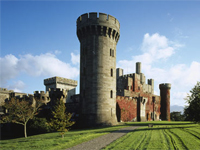
Penrhyn Castle, Wales (Image: NTPL/Geoff Morgan)

One notable feature of Wales is how few large estates there were.  Considering the size and wealth of the nation, the fact that it was mostly ruled through local clans (where not owned more directly by the Marcher lords) meant that their wealth would limit them to building fine, but smaller, manor houses (for example Gwydir Castle – there is also a superb account of its restoration: ‘ Castles in the Air‘).  This has meant that there are few ‘stately homes’ in the same sense that there are in England. A survey in Country Life magazine in the mid-1960s suggested that of the 200 estates examined, only about 20 would be regarded as ‘stately homes’.  However, within those 20 are such notable houses as Chirk Castle (now National Trust), Erddig (National Trust), Gwrych Castle (now a ruin), Hawarden Castle (still Gladstone family home), Penrhyn Castle (National Trust), Powis Castle (National Trust), Plas Newydd (National Trust), Vaynol (privately owned) and Wynnstay (now flats) – all in north Wales. In the south, the main seats were Dynevor Castle (National Trust), Fonmon Castle (still Boothby family home), Golden Grove (empty), Penllyn Castle (unknown!), Penrice Castle (private home), Stackpole Court (demolished 1963) and Tredegar Court (council owned).  Sadly, as shown in Thomas Lloyd’s ‘Lost Houses of Wales‘, over 350 Welsh country houses were demolished, mainly in the latter half of the 20th-century, as poor finances combined with blinkered Socialism meant that many were lost with little protest.

This means that the smaller Welsh country houses of minor gentry, tucked away in the rolling valleys, should be treasured all the more.  Sadly, as in the case of Pen-Y-Lan, when faced with an owner who had to take out a £300,000 loan for urgent repairs when she inherited in 2007, yet, as she admits “I have absolutely zero business acumen, whatsoever“, creates significant challenges.  Pen-Y-Lan is in a state of considerable disrepair which will require something of a miracle if the owner, Emma Holloway, is to overcome her lack of business skills to pay off the debt, restore the house, and preserve it to hopefully hand it on to the next generation.

Country House Rescue: ‘Pen-Y-Lan‘ [Channel 4]

Official website: ‘Pen-Y-Lan‘ or follow them on Facebook

Country House Rescue: see complete previous episodes

———————————————————————————–

Before you comment…

This particular episode of Country House Rescue was one of the most controversial and provoked much reaction when broadcast and every time it is repeated – some are in sympathy and many not.  This is one family doing what they thought was best and perhaps the editing of the show was designed to present a particular angle.  Either way, the purpose of the comments on this blog are to contribute useful information, particularly anything related to architecture, and so I won’t permit comments I think are intemperate/abusive.  Thank you for your understanding.

———————————————————————————–

Guest blogger: Jeremy Musson – ‘English Ruins: an odyssey in English history’

Having written all nearly 200 posts since I started writing this blog I now thought it would be interesting to try and broaden the voices involved.  So as the first post in this new direction/experiment, I am delighted and honoured that one of our leading architectural historians, Jeremy Musson, kindly agreed to write a piece on country house ruins linked to his new book published this month, ‘English Ruins‘, a fascinating look at their role in shaping our perceptions of the past and our architecture.

——————————————————————————————-

Jeremy Musson
Jeremy Musson

The English landscape is a landscape of ruins. Fragmentary or sometimes only roofless and windowless, these part dismantled buildings stand out to mark our national history in a number of different ways, and above all, provide a sense of historic scenery for our journeys, physical and imagined – and glimpsed from motorways and footpath alike. In this new book, photographer Paul Barker and I wanted to explore something of this particular cultural landscape and through this exploration trace something of how the English see themselves and their past.

I feel that we live in an old country, and the past is always there, to paraphrase T.S.Eliot, “pressing on the future”. Some love the past, some hate it, many are indifferent to it, happy enough to take pleasure in a good day out, with a dash of historic scenery. But the whole process of our encounter with ruins, is somewhat special – a deeply subjective, and in effect, an almost artistic experience. It is personal and often emotional, while it is also formed and shaped by a whole series of sometimes opposing cultural inheritances: Romanticism, anti-establishment, veneration for the classical, veneration for the Gothic, history seen through the very shape of the landscape.

There is something that seems to appeal about ruins to the English imagination over the centuries. Think of how John Aubrey, for instance, the late seventeenth antiquary and author of that amusing volume of English biography Brief Lives, observed that

“the eie and mind is no less affected with these stately ruines than they would be if they were standing and entire. They breed in generous mindes a kind of pittie; and set the thoughts aworke to make out their magnificence as they were in perfection.”

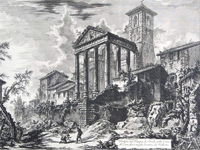
Piranesi: 'Temple of Hercules, at Cori' - 1769 (Image: Mattia Jona Gallery)

During the 18th century, the Grand Tour, part of the expected education of a gentleman or aristocrat, consisted of a journey through Holland and France to visit the great monuments of the Roman world, excited the aesthetic and cultural awareness of the 18th-century English gentleman, who was in turn the patron of artists and architects following the same path in trying to import the drama and excitement of great classical ruins to an English audience. Walk through any major house built in the 18th century, with anything of its original collections still in situ and the ruin is visible in painting after painting, and then echoed in the classical temples of the park.

The phenomenon of creating artificial ruins, in which the English seem to be pioneers, belongs to this period, and while the earliest garden temples seem to be classical, the contrivance of designing ‘ruined’ structures, was largely sourced in England’s own Gothic past. Horace Walpole the 18th-century diarist, who designed his own Gothic style house, Strawberry Hill, hugely admired the work of Sanderson Miller who designed a ruined tower at Hagley Park, with the perhaps slightly teasing phrase that it had “the true rust of the barons’ wars” referring to the Wars of the Roses.

When making this tour of England in tandem with photographer Paul Barker, I could not help noticing that we were often treading in the footsteps of the great landscape painter, J.M.W.Turner, for whom the evocative power of the ruin played a central role in his career, although we perhaps think of him most naturally as a landscape painter, and a painter of skies.

In the last years of the 18th century he exhibited numerous studies of great historical ruins in landscapes, appealing to the Romantic spirit of his audience – characteristically these are the foil for dramatic expositions of sky or sea. He continued to make special studies of ancient ruins, castles and abbeys on tours around the whole of England, for his ambitious Liber Studiorum project, and many were published in different histories, especially in Charles Heath’s Picturesque Views in England and Wales.

Turner looked principally at abbeys and castles, but abandoned country houses have come to be a feature of our landscape too. The dramatic changing status of the country house from the first world war, into the great depression of the late 20s and early 30s, becomes even more intense after the second world war – think of John Harris’s memoir, No Voice from the Hall. This was a period which resulted in so much change in English life, that it is easy to overlook the symbolic collapse of the world of the English country house. This was a feature of interwar life too, with the rise of income tax and death duties, but the upheaval of the Second World War, the widespread institutional use of country houses for military and other government purposes often hastened their subsequent abandonment.

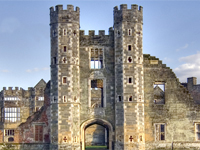
Cowdray House, Sussex (Image: Cowdray Heritage Trust)

Inevitably, given my interest, the country house looms large in our new book. We focus on the story of buildings from different themes and for the ruins of country house, beginning with Cowdray House, in Sussex, a substantial Elizabethan mansion damaged by a fire in the late eighteenth century, and then abandoned, partly as a result of complications over inheritance; but quickly becoming a destination for artists, for instance, Turner visited the ruins while staying at Petworth – it is now looked after by a newly formed trust, and feels like the sets left over from a Grand Opera, standing amongst the meadows and paddocks on the edge of Midhurst.

We also visited the ruin of an elegant early-seventeenth-century lodge at Wothorpe Towers, a lodge once part of the Burghley estate, which was used as a dower house and then, apparently, part dismantled to provide an eye-catcher in the new landscaped park. It was falling into serious decay and has recently been taken on by the Griffin family, who putting the main house into a trust, which is restoring the gardens, are converting the ancillary seventeenth century buildings into a new home.

Seaton Delaval Hall, Northumberland (Image: Alan J. White / wikipedia)

The classical country house tradition is represented in our book, by 1720s Seaton Delaval Hall, near Newcastle – one of the finest houses by Sir John Vanbrugh, re-roofed after a major fire, the interiors are otherwise the very picture of a ruin. In Derbyshire, we encountered the memorable and mournful spectacle of Sutton Scarsdale Hall in Derbyshire, also built in the early 18th century. The latter, partly due to its proximity to mine-works, acquired in 1919, by businessman out to profit from its materials and fittings. The panelling was sold United States collectors, and some at least found its way into the Museum of Fine Arts in Philadelphia. Its demolition was in fact prevented by local landowner Sir Reresby Sitwell, whose family later presented it to the state.

James Lees Milne, looked at the Sutton Scarsdale ruins for the National Trust, but said that “classical ruins in England are much satisfactory than Gothic ones, the lack picturesque gloom.” English Heritage look after it now, as they do Witley Court, a multi-layered great house and former seat of the Earl of Dudley, a splendid Italianiate palace with a vast portico by John Nash, was burnt out in 1937, and by some chance was not demolished during the 1950s, like so many abandoned houses, and it was subject to preservation order in the 1970s, and in the early 70s taken into state protection. Christopher Hussey thought that it conjured the beauties of the classical ruins visited by the Grand Tourist in the 18th century, as much as anything else.

Lowther Castle, Cumbria

Forgotten Victorian Gothic mansions such as Lowther Castle in Cumbria, possibly become more Romantic in their ruined state. Lowther, the historic seat of the Earls of Lonsdale, designed by Smirke in Gothic baronial style was not re-occupied after the second world war, and in 1957, de-roofed and only the exterior walls preserved. A haunting presence in the beautiful Cumbrian landscape, a new trust has been created to protect the runs and open them and the overgrown Edwardian gardens to the public, in the course of 2011.

For myself, as a historian of the English country house, there is no doubt that the ruin occupies a special place in English culture; the castle, the abbot’s lodgings, the country houses of the sixteenth century onwards, when they stand open to the elements, draw us in to a dialogue with our history and the mutability of fortune.

Jeremy Musson’s ‘English Ruins‘ with photographer Paul Barker, is published by Merrell publishers.

Text by Jeremy Musson, choice of links and images by Matthew Beckett.

——————————————————————————————-

Dear Readers – as always I welcome your comments and feedback.

Country House Rescue: school’s out – High Elms Manor, Herts

High Elms Manor, Hertfordshire (Image: Ishin Ryu)

If there was a prize for commitment above and beyond financial sense then the owner of High Elms Manor/Garston Manor could probably win ‘Highly Commended’ for her determination to rescue this once-derelict country house on the edge of Watford, Hertfordshire, which is the next destination of Ruth Watson and Country House Rescue. The house is an interesting example of the various pressures which can affect country houses and the solutions having experienced almost the complete range over the last century with the new owners adding a few more.

Built sometime before 1813 and once the centre of a 500-acre estate, High Elms Manor originally enjoyed fine rural seclusion, its nearest neighbours the St Pancras Industrial School and Metropolitan District Asylum to the west (now demolished and built over) and Bucknalls, a Victorian manor house now home to the Buildings Research Establishment, to the east.  Originally known as High Elms Manor, it was changed to Garston Manor in 1895, though the current owner has apparently decided to go back to using the original name; even if it’s not the one used by Channel 4.

Relentless urban growth over the last 100 years pushed housing estates and industry right up to the boundaries of many country estates – and usually then overwhelmed them.  The sad pattern was often industry moving closer and blighting the views, then the air, ruining the very attributes which had been their reason for being built in the first place.  As workers followed industry so more land was needed for housing and so estates on the edges of towns were particularly vulnerable (as they still unfortunately are today).

Cassiobury House, Hertfordshire (Image: Lost Heritage)

Watford has already lost one major house – Cassiobury – to just these pressures, though this was much closer to the centre of the modern town and was lost back in 1927. The long-time seat of the Capel family, Earls of Essex, who built a fine house which was altered by Hugh May c.1674-80 and which boasted superb interiors, with carvings by Grinling Gibbons, and which was later ‘Gothicised’ by James Wyatt (c.1800).  Visited by Country Life magazine in 1910 it was still rural:

“‘…set in great and delightful grounds and surrounded by a grandly timbered park. Therein is peace and quiet; the aloofness of the old-country home far from the haunts of men reigns there still, and Watford and its rows of villas and its busy streets is forgotten as soon as the lodge gates are passed’.”

Yet by 1922 the house and 458-acre park were for sale and were bought in 1927 by a consortium of local businessmen who stripped the house for materials, sold the carvings to museums and private collectors and then demolished the house, with residential estates over-running that once rural idyll.  Sadly this was the case for so many of our demolished country houses.

High Elms Manor, being further north, escaped these immediate pressures.  The house became home to the Watney brewing family around 1870, who commissioned alterations which enlarged the house.  The house was then sold to the Benskins, another family of brewers, before it was bought in 1911 by Walter Bourne, co-founder of the Oxford Street department store Bourne & Hollingsworth (now split into retail units and offices – history (scroll past the odd photos at top of the page)), who made further changes around 1920, shortly before his death in 1921.  Stafford Bourne, one of the sons of the founder, described High Elms as:

“…one of the finest and most dignified medium-sized estates in the county of Hertfordshire.”

With fine and interesting interiors, this was a house built for entertaining and accommodating large numbers of guests and visitors.  This was to perhaps save the house from demolition as the house was sold once again after Walter Bourne’s death and took on another of the many uses our country houses have been adapted for and became a medical rehabilitation unit, still known as Garston Manor.  It remained in this role until the 1990s when the council, faced with rising maintenance costs, abandoned it and left it to decay.

Sadly, although boarded up, the house suffered from repeated vandalism and theft, with roof lead and floorboards proving particularly attractive.  When the now-owner Sheila O’Neill came to view the house it was a daunting prospect:

‘It had been empty for years when I came to see it,’ says the present owner. ‘It was more or less derelict. Ceilings had fallen in, all the floors had been damaged, the wood panelling had turned green, chimneys had collapsed, lead had been stripped off the roof by vandals, there were 100 broken windows, the garden was a jungle, it was in a terrible state…”

Stowe House, Buckinghamshire (Image: e-architect)

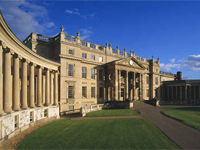
Thankfully, as many other country houses have discovered, they can be rescued from such a parlous state.  High Elms was now adapted to that familiar role for a country house; that of being a school.  There is a long and fine tradition of our country houses educating future generations in grand adapted ballrooms and dining rooms.  In cases such as the spectacular Stowe House in Buckinghamshire, (now being wonderfully restored by the Stowe House Preservation Trust with backing from the World Monuments Fund) it almost certainly saved it from demolition.  Stowe is an especially grand example of the country house as a school but there are hundreds across the UK, each doing their bit to preserve our architectural heritage – though sadly the necessary ancillary buildings can sometimes detract from the setting.

Thankfully though, in the case of High Elms Manor, the needs of the school have been accommodated within the 80-odd rooms of the house with, for example, the ballroom serving as a gymnasium.  However, a house of this size requires significant funding not only in terms of capital investments in the house but also just to meet the £75,000 per year running costs.  Having bought it for £500,000, Sheila O’Neill estimates she has poured at least that much again in her quest to restore the house.  Faced with her own need for a replacement hip, and the relatively low profits from running her Montessori school, Mrs O’Neill has turned to Ruth to provide guidance as to how to make more from the not-very-successful wedding hire business and for any other tips. With strong local competition from the incredibly pretty Hunton Park, it seems that it is the posse of daughters who appear to hold the key to maintaining and improving their situation.

Country House Rescue: ‘Garston Manor‘ [Channel 4]

Country House Rescue: see complete previous episodes

Interview with Sheila O’Neill: ‘Country House Rescue in Garston‘ [Hertfordshire Life]