Converting country houses from commercial to residential: a sound investment?

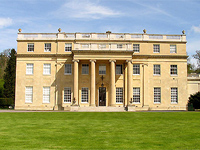
Benham Valence, Berkshire (Image: wikipedia)

As the pressures of the twentieth century forced more country houses owners to face the reality that they could no longer live as they had and would have to move out of their homes they then had to decide what to do with it.  Unfortunately this meant demolition of hundreds of large houses but some owners were more creative and many houses became commercial premises, either as hotels, schools or institutions, and others became some of the grandest office buildings in the country.  However, recent pressures of this century have now seen some of these offices being converted back into homes or being offered for sale as an opportunity to do so.

In many ways the country house has always had an element of the commercial to it with the estate offices usually being based either in a part of the main house or in a nearby building to enable the owner to deal with business without having to travel far from home. The changes of the twentieth century were on an altogether more comprehensive scale with the entire house being changed to accommodate the demands of business.  This not only meant the conversion of the main house with all that entailed for the interiors but also the building of further offices in the grounds.

Sometimes the development was kept a good distance from the main house such as at Ditton Park in Berkshire.  This became the office of the Admiralty Compass Observatory from 1917 until it was sold in the 1990s to Computer Associates who built a huge office building to the west of the main house (which became a conference centre) leaving the setting intact.

Sometimes though it’s possible for smaller businesses to be accommodated just within the main house such as at Gaddesden Place in Hertfordshire.  The house, built in 1768, is a elegant Palladian villa (similar to the White Lodge in Richmond Park) and was James Wyatt’s first country work.  The site is said to have some of the best views in the home counties and the sensitive use of the house has allowed to remain in splendid seclusion.

However, modern concerns mean that a country house has lost some of it’s appeal as offices.  One key issue is that by their nature the houses are isolated meaning that employees must have cars to reach it leading to more cars on the roads and the need to provide huge areas of parking.  Stronger heritage legislation now also means it’s much harder to alter the houses to meet modern business requirements such as air conditioning and computer networking.  The nature of the houses also means that maintenance costs are higher than for a purpose built office.

This has led to some houses which were formerly offices to be converted back into homes.  Mamhead House in Devon, built between 1827-33 and regarded as one of Anthony Salvin‘s finest designs, it was, for many years, a school before becoming offices for a local building company.  It was bought by a businessman who converted the main part of the house back into being a home whilst still letting out part of the house to the Forestry Commission.

Perhaps the grandest and largest opportunity for many years to restore a house into a home is the mansion at Benham Valence in Berkshire.  This superb house was built in 1772-75 for the 6th Earl of Craven and was designed by Henry Holland in collaboration with his father-in-law, Lancelot (Capability) Brown, the famous landscape architect.  The south front features a grand tetrastyle Ionic portico which looks out over a large lake with views into the parkland.  Inside, there are many fine chimney-pieces bought from the sale at Stowe in 1922, including one from the State Dining Room.  It also features a small circular double-height vestibule adjoining the inner hall, a design later adopted by Sir John Soane.

The house was empty in 1946 and remained so until it was sold in 1983 and converted to use as offices with a large wing to the north east of the house being demolished and replaced, in part, by an ugly 80’s complex providing over 100,000 sq ft of space.  Luckily though the main house was largely spared and remains Grade II* with the 100-acres of Grade-II parkland. Now offered for sale at £6m this is a rare opportunity to create a wonderful country house – providing it’s possible to obtain planning permission to convert it back – which, once restored, could be worth £10-12m.  One key requirement would be the demolition of the office complex and the ripping up of the huge car park – but give me a pickaxe and I’ll be happy to lend a hand.

Full property details: ‘Benham Valance, Berkshire‘ [Strutt & Parker]
How to lose money on a country house: Compton Bassett, Wiltshire

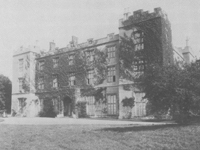
Compton Bassett House, Wiltshire (demolished 1929)

[This article was originally published in 2010]

The news that Robbie Williams is to sell his country house, Compton Bassett in Wiltshire, for a potential £1m loss shows that with the wrong property it is still possible to buck the generally rising trend in prices by overpaying in the first place.

The Basset family (after whom the village was named) had first built a timber-framed house in the 13th-century. By 1553, the new owner of the manor, Sir John Mervyn (d. 1566) rebuilt the house using a reported 260 oaks, which gives some indication of the size of the house. It was still standing in 1659 and was recorded as being on a U-shaped plan, open to the south east. In 1663, the house and estate were sold to Sir John Weld, of the ancient Dorset family. He made significant changes, spending the colossal sum of £10,000 between 1663-1672 to build the sides up to 130ft and 110ft to create a large rectangle and to then cover over the courtyard. Originally, the house was in a soft, white stone but this renewed in brick in 1814, with the rest of the house following in the late 19th-century, during which it also gained the battlements. 

Sir John also added the distinctive corner turrets; a stylistic device which echoed the form of a castle which bears some similarity to the Weld family’s main country seat, Lulworth Castle in Dorset,. This was built as a hunting lodge in 1610 by Thomas Howard, 3rd Lord Bindon, and bought by Humphrey Weld (John’s elder brother) in 1641, but sadly gutted in a devastating fire in 1929. As Humphrey Weld died (in 1684) without a male heir, Lulworth Castle passed to John’s son William who seems to have chosen it as his family seat and sold Compton Bassett in 1700.  

The house passed through various owners until it was inherited by George Walker Heneage (d. 1875) who, by 1828 had established an estate covering 1,813 acres in the area. It was Walker Heneage’s grandson, Godfrey, who eventually inherited the estate in 1901 but then sold it in 1918 to the Co-Operative Wholesale Society who sold it again in 1929.  It was bought by one E.G. Harding who then parcelled up the estate and sold it off piecemeal. 

That period was a dark time for the country house in the UK with many being demolished. The house was bought by Captain Sir Guy Benson who sadly decided that he would rather live in the stables and so this wonderful house was levelled in the early 1930s and the stables converted in 1935 into the new Compton Bassett House.  Unlike other successful conversions of stables, this one was obviously designed as a functional building and lacked the grace of so many of the stable buildings we can still see today and so did not lend itself to being the main house.   Not that it has stopped various owners over the years trying.

Compton Bassett, Wiltshire (former stables) (Image: Panoramio)

The latest project was started in 1998 by the then owner Paul Cripps and was to take six months and cost £500,000 but ended up taking three years and costing £3m.  The house was then launched on the property market in 2007 at an eye-watering £8.5m (no doubt to try and recover some of the lavish overspending on the interior) for the house plus 71-acres.  After languishing for many months Robbie finally bought it for £8.1m but never really settled here, preferring his life in the US.  So now it is back on the market with Savills (but not listed on their website) for a reported asking price of £7.5m – but once you factor in all the costs involved from buying and selling, Robbie should be about a million down from when he bought it.  This also assumes he’d get that price – losses could rise if, remarkably, there was someone else out there who liked the look of the house but decided that it was still too expensive and drove the price down further.  To be honest, when compared with some of the other properties Savills have available in Wiltshire for around £6m (e.g. Langley House or Midway Manor) why anyone would chose this one is beyond me.

n.b. the interior and floor plans can be seen in this article in Variety magazine in 2013 when it was again on the market for £5.5m: In Case You Missed It: Robbie Williams

*Update* 2010

Savills have added Compton Bassett to their website so if you have £7.5m and really feel that this house is the best way to spend it, then have a look at the details: Savills: Compton Bassett

*Update* February 2021

So, it turns out that Mr Williams was not able to sell the house in 2010 or 2013 or 2016 when it was variously reporting as being relisted. Again, in 2021, there is renewed interest as he plans to move with his family to a new house in Switzerland and has no plans to stay in a house he (and his daughter) now feel is ‘creepy’.

Robbie Williams selling £9 million ‘haunted’ Wiltshire mansion in Switzerland move (Evening Standard)


25/02/2021: article updated with further details on the history of the house and the current situation regarding Mr Williams.

A suburban survival at risk: Braunstone Hall, Leicestershire

Braunstone Hall, Leicestershire (Image: East Midlands Oral History Archive))
Braunstone Hall, Leicestershire (Image: East Midlands Oral History Archive)

Two of the most important aspects of campaigning to save country houses are vigilance and visibility – and yet sometimes even this doesn’t always seem to bring about restoration any quicker when faced with a slow-moving owner. Braunstone Hall, a Georgian gem still with significant grounds but now swallowed up in the sprawl of Leicester, has been empty for over ten years but despite a vigorous campaign both in the media and online it still remains very much at risk.

Braunstone Hall, now grade-II listed, was built in 1776 (date on rainwater head) for the Winstanley family by the architect William Oldham (b. 1737 – d. 1814) who also designed an early Leicester racecourse grandstand (1770), Master’s House at Alderman Newton’s School (1789) and the New House of Correction (1803) – all though now demolished.  The red-brick house is two and a half storeys tall by five bays wide with a cornice and hipped roof.  The relatively simple front is enlivened with stone bands marking the ground and first floors with an impressive tripartite doorway with fluted columns, a small pediment and an elegant fanlight with arched glazing bars.  One further very distinctive feature is the giant blind recessed arch in the central bay – an architectural device which seems quite popular in Leicestershire with examples in Burbage, Belgrave House (also 1776), and the beautiful rectory at Church Langton (by William Henderson – 1760).  The interior is largely complete with some impressive detailing.

The Winstanley family bought the estate from the Hastings family in 1650 and remained there until forced out in the 1920’s by the pressure to build houses following the First World War.  Estates on the edge of existing towns and cities were eagerly eyed-up by local councils.  For some families, already facing financial hardships following the war this was a perfect opportunity to sell the family seat and relocate.  Others, including the Winstanleys in the shape of Major Richard Norman Winstanley, fought the prospect of compulsory purchase arguing that this was still a family home and the building work would undermine the value of his recently modernised house.  However, he was unsuccessful and so the house, gardens, parkland and further 949-acres were compulsorily purchased in 1925 for £116,500 (equivalent to £5.2m – 2008).  Most of the land was built over except for the house and 168-acres surrounding it which became a public park.  The house remained in council ownership and was first a secondary school, opening in 1932, before becoming a primary school a year later until it closed in 1996.

Since then the Leicester City Council has failed to either find a viable long-term use or adequately protect Braunstone Hall with the house falling victim to repeated acts of vandalism and arson.  The latter is the most worrying as the incidents have not only included fires outside the building but also now inside.  Over the last few years the Council have been making very slow progress towards finding a solution but, as always, they are claiming poverty when it comes to heritage projects.  A very active campaigning group has been set up on Facebook with the members regularly corresponding with councillors and reporting any damage or deterioration at the hall – effectively a dedicated ‘Neighbourhood Watch’ for the house.

The Council put the house up for sale on a 125-year lease in 2007 and had recently been negotiating to sell the house to a local businessman for conversion to a hotel, conference centre and wedding venue. However this has been delayed by changes to what’s being offered in relation to the land for enabling development.  Each delay increases the risk that the local yobs will finally succeed in their mindless vandalism and burn down this elegant and important part of Leicester’s heritage.  If this happens the blame can be laid firmly at the feet of Leicester City Council and their apathy and indecisiveness over the last 14 years.

Join the Facebook campaign group: ‘Restore Braunstone Hall

Detailed history of the house: ‘Braunstone Hall‘ [Leicester City Council]

Detailed description of the house: ‘Braunstone Hall‘ [English Heritage]

The modern smaller country house: Home Farm, Yorkshire

Home Farm, Yorkshire (Image: Francis Johnson & Partners)

Despite the rather understated name, Home Farm in Hartforth, Yorkshire is a classic example of the long tradition of grand downsizing which has been a hallmark of UK country house owners, particularly since 1900.  The pressures on the large country house in the 1930s and then again from the late 1940s until 1960s sparked a surge in the construction of new, smaller country houses which reflected the financial reality of the times.  Yet today smaller country homes are a deliberate choice for the discerning owner reflecting their own wishes and desires which has led to some very successful designs.

In previous eras (and particularly before the restrictions of the 1970s heritage legislation), a country house owner faced with a house which was too big could simply remove wings (as the 12th Duke of Bedford did at Woburn Abbey in the late 1940s) or floors of the house to make them more manageable (as happened at Hodnet Hall in Shropshire). Unfortunately for many owners it was simply easier to demolish the house entirely giving them the option to convert the stables into a home (the choice of the Earls of Lansdowne at Bowood in 1955) or rebuild either on the site of the old house or in a new location on the estate.  It was this latter course of action which offered the best opportunities for an owner to preserve their estate but dramatically reduce their expenses by building a new house.  John Martin Robinson in his 1983 book ‘The Latest Country Houses’ estimated that over 200 new country houses were built between 1950s-1980s.

The new country houses today are largely either grand statements but there are also examples of smaller houses which quietly succeed in delivering an important contribution to the traditions of the UK country house.  Winner of the 2009 award for ‘New building in a Georgian context‘, Home Farm was a carefully considered response to a particular location and circumstances.

The client behind the commission was Sir Josslyn Gore-Booth Bt. who had inherited the Hartforth estate but unfortunately not the main house, the early Georgian classical Hartforth Hall, which had been divorced from the estate and become a hotel.   The Gore-Booth’s family seat had traditionally been Lissadell in County Sligo, Ireland, built for the 4th Baronet in the 1830s.  In 2003, Sir Josslyn put the house on the market for €3m and was determined that the new house would be very different from the sombre and severe Neo-Classical house he had just left.

Home Farm, Yorkshire (Image: Francis Johnson & Partners)

Home Farm is a clever response to a number of challenges.  Firstly, both the new house and Hartforth Hall would be visible simultaneously due to their proximity and so had to make their own architectural statements without competing, ruling out a classical design.  Secondly, the new house was to replace an old estate farmhouse and would join the group of existing Georgian farm buildings.  The architect, Digby Harris, came up with a novel solution – a two-faced house which projected an elegant classical facade to complement the farm buildings but a Gothick facade contrasting to the classical Hartforth Hall.  Usually a client seeks a unified design so these type of buildings are rare in the UK and feel somewhat disconcerting; two examples are Castle Ward in Northern Ireland (Classical front / Gothick front) and Castle Goring in Sussex (Classical front / Gothick front).

The ‘classical’ front draws on a draft design by the late Francis Johnson but also historically the compact Georgian villas of Sir Robert Taylor (1714–1788), James Paine (1717-1789) and John Carr (1723-1807).   The Gothick facade mirrors the style applied to some estate buildings in the 19th-century and features an elegant ogee window on one side looking out on a small canal-type pond with the main front boasting a full height bow bringing to mind other older houses such as Corngreaves Hall with other elements taken from Batty Langley (1696-1751), specifically his ‘Gothic Architecture, improved by Rules and Proportions‘ (pub. 1747)

Home Farm proves that a modern classical country house can be both practical and architecturally interesting without needing to be physically large.  The long tradition of country house building in the UK seems to be alive and pushing forward the architectural boundaries which should prove inspiring to anyone contemplating the building of a new home of any size as the centrepiece of an estate.

More details and photos: ‘Home Farm, Yorkshire‘ [Francis Johnson & Partners]

Credits: thanks to Austen Redman of Francis Johnson & Partners for the photo and information on the house.

The start of the rush? Country houses for sale in the Sunday Times Home section

Sandley, Dorset (Image: Knight Frank)

The usual spring rush of country houses coming to market has been later this year – a combination of the hangover from the uncertainty in the market of the last couple of years along with that of the General Election.  That traditional shop-window of the country house – the Home section of the Sunday Times – has this week (16 May 2010) heralded what it sees at the start of the rush by including three pages of those for sale.

For those who like their country houses to look traditional from the outside but prefer a more modern interior then the Grade-II listed, six-bedroom Sandley in Dorset, set in 178-acres, might be perfect – if you have the necessary £9m.  The owners decided that the rather ‘quaint’ style of the house was not for them and so they spent ‘a couple of million pounds’ and over two years to strip it back and then make it look very ‘London’.  Personal taste is the final arbiter for whether you think this is a good thing – but not all tastes are the same and it can mean that the appeal of the country house is taken to new markets.

Ebberly House, Devon (Image: Savills)

However, if your tastes are more usual and traditional then there are other options. Holt Manor in Wiltshire, set in 94-acres, mixes both old and new with a more traditional interior cleverly concealing the latest in sound, television and security systems.  With parts dating back to the 12-th century, the Grade-II listed house has been thoroughly modernised whilst still being a recognisably English country house. £5.95m [Holt Manor: Knight Frank]

If, however, you are looking for a more architecturally impressive house, the Ebberly House, near Winkleigh in Devon, could well be the house for you.   Designed by Thomas Lee, a student of Sir John Soane, Ebberly was described by Pevsner as an ‘unusual and attractive house’ and was the first to sell in Devon for over £1m when it sold in 1997.  The Grade-II* listed house possibly benefited from Soane’s personal influence as he was working nearby at Castle Hill which may explain the elegant, and very Soanian, top-lit oval stair hall with its fine cantilevered wooden staircase and curved doors, or the drawing room divided using three shallow arches. Set in  250-acres it has a wonderful estate featuring 20-acres of woodland, estate cottages generating £20,000 p/a in rental income, and spectacular views across to Dartmoor. It was also given an excellent and detailed write-up in Country Life – always a good seal of approval.  [Ebberly House: Savills]

Chapel Cleeve Manor, Somerset (Image: Webbers)

Perhaps one of the most interesting of the houses featured is unfortunately only given a photo and no details is Chapel Cleeve Manor in Minehead, Somerset. Perhaps now not strictly a country house as it only has 7-acres, at £1.695m for 17+ bedrooms, it may seem a bargain for someone who wants to live in a country house but doesn’t want the responsibility of an estate. Although such a situation a hundred years ago could have led to the demolition of the house as happened to so many others. Yet, with so much wealth now generated without the need for a large estate to support the house, it’s now entirely reasonable for someone to take on and enjoy such a pleasing Gothic-Revival house. The house has been used as a conference venue for a number of years but with careful restoration this could be rescued from commercial use and be a spectacular home for someone who requires a lot of space. [Chapel Cleeve Manor: Webbers]

So has the rush started?  Nobody really knows and asking estate agents is never an exact science.  Several house which have been launched recently are still waiting to find new owners but the right house launched at the right time for the right price usually does find the right buyer.

Full story: ‘The landscape has changed‘ [The Sunday Times: Home section]