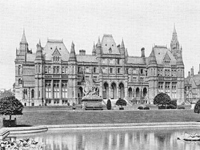
A silver lining to an industrial cloud; the Mersey mansions of the Victorian elite

To join the landed gentry you previously needed to have no connection with the vulgar business of actually making money. Even if you had bought a significant house and estate, to be truly accepted (and not be cast off into social Siberia) a gentleman would have to sell all his business interests and retire to live off the proceeds.  Yet, times changed and as it became acceptable to mix business and pleasure, so the requirements of the new gentry altered as they became unwilling to be too far from their sources of wealth, particularly around the great Victorian cities.  Smaller country houses and weekend villas with reduced estates sprang up to meet this new demand, with Liverpool being a prime example of these forces.  Later, as the cities grew, fortunes waned and housing pressures increased, many of these houses were lost; yet, occasionally, a rare survivor appears such as Calderstones Park Mansion House in Liverpool.

Harewood House, Yorkshire (Image: Lee Elvin via flickr)

The Georgian era truly challenged the mystique of inherited wealth and royal patronage being the primary route to social elevation (though both helped).  Money talks, and the vast wealth being created, and the men making it, could not be ignored.  No family exemplified this more than the Lascelles family of Yorkshire. Although the family had been in the county for many years, their purchase of the Harewood estate in 1739 for £63,827 (for an estate of 6000-8000 acres) was with wealth generated only relatively recently.  Henry Lascelles (b. 1690 – d. 1753) had made his fortune largely between 1715 and 1730 as a plantation owner, victualling contractor and Collector of Customs in Barbados. It was his son, Edwin, who, having inherited his father’s vast fortune, set about, between 1759-71, building the grand house we see at Harewood today, to designs by John Carr of York who had already built the stables.  The vast expense of paying Carr, plus Robert Adam for the interiors, Angelica Kauffman and Biagio Rebecca for internal decorative painting, Thomas Chippendale for the superb furniture, and ‘Capability’ Brown for the beautiful grounds hardly made any serious dent in the family fortune.  On Edwin’s death in 1795, he reportedly had an income of £50,000 per year, of which half came from the West Indies business interests.  It was this mercantile wealth which established one of the great houses of the 18th-century, elevated the family to the peerage and enabled them to become a local political force, all in the space of just 60 years – something not possible on the limited and sometimes uncertain income of an estate alone.

Picture gallery, Dawpool, Cheshire (Image: H Bedford Lemere, Bedford Lemere & Co / copyright: English Heritage/NMR)

The 19th-century only saw this trend accelerate with the great wealth of the cities now a serious challenge to the old inherited wealth of the land. This was especially true since, following political reform, land holdings were not always necessary to secure power and influence.  Now the owners could indulge their preferences, as not all of them, having been born, brought up, educated, worked and having made their fortunes in the cities, would feel a natural attachment to the countryside, beyond the social cachet it brought.  Rising land values from the mid-19th-century also would have been a factor which might have put off the hard-headed businessman – better value to invest in the most luxurious house possible.  Yet, the allure of the country seat was still strong as a recognised symbol of success so around each major Victorian city could be found these mini ‘pleasure’ estates; with Liverpool being a classic example.

Hafodunos Hall, Wales in 1954 (Image: RCAHMW) - burnt out in 2004

For some, their fortunes financed the Victorian version of the Lascelles, with the acquisition of large estates and the building of the great houses away from the dirt and noise of the cities, such as at Hafodunos Hall (sadly burnt out by morons in 2004) by George Gilbert Scott for H.R. Sandbach (son of a Liverpool West India merchant). Yet for some of these gentleman there was no shame in being near to the industrial heart which pumped their fortunes – but that didn’t mean they had to compromise on luxury or convenience. Soon, many large houses with small estates populated the edges of the city.  Writing in 1873, the journalist Patricius Walker said:

Crowds of comfortable and luxurious villas besprinkle the country for miles round Liverpool, inhabited by ship-owners, ship-insurers, corn merchants, cotton brokers, emigrant agents, etc, etc, men with “on foot on sea, and one on shore,” yet to one thing constant ever – namely, money-making – and therein duly successful.

These captains of industry and commerce were also able to take advantage of the newly developed railways; becoming early commuters, able to spend the day at the office yet still escape at the end, back to their slice of bucolic charm.

The merchant palaces of Liverpool were, broadly, either those which were built as villas with substantial gardens near the large pleasure parks such as Sefton, or, taking advantage of the rail links, based outside the city in areas such as a the Wirral, just across the Mersey.
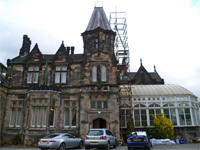
Holmestead, Cheshire (Image: openlyJane via skyscrapercity)

One particularly fine example of ‘rural urban’ villa was Holmestead on Mossley Hill, set in its own extensive grounds just to the east of the elegant and very desirable Sefton Park.  What is remarkable is that many of the larger houses still survive, albeit in an altered form; some becoming flats or care-homes.  The house was originally built in the 1840s in a Gothic style and effectively doubled in size in 1869-70 by the then owner, Michael Belcher, a local cotton broker. Urban ‘society’ of the newly wealthy mirrored the practices of those in the countryside as shown by William Imrie, owner of the house at the turn of the 19th-century and formerly of the famous White Star line, and also a patron of the Arts-and-Crafts movement.  He held regular concerts in his music room – a grand space, decorated with William Morris’ ‘Acanthus‘ pattern wallpaper, with the imposing ‘The Tree of Forgiveness‘ by Edward Burne-Jones on one wall, and Spencer Stanhope’s ‘Why Seek Ye the Living Amongst the Dead‘ on another. Remarkably, the house has survived and is still a single family home.

Dawpool, Cheshire - dem. 1927 (Image: H Bedford Lemere, Bedford Lemere & Co / copyright: English Heritage/NMR)

One of the grandest houses of them all was also connected to the White Star Line.  Dawpool was the pet project of Thomas Henry Ismay, the man who built a company large enough to launch the Titantic. Although was not conceived as the centre of a landed estate, it was certainly designed to showcase the power of his empire.  Designed by the leading architect, Richard Norman Shaw, the house, started in 1882, was a monument to Ismay’s wealth and meant to last – the local red sandstone was finely shaped and even the screws being finest brass.  The house took four years to build at a cost of over £50,000 – equivalent to over £3.5m today, a colossal sum compared to the average £80 per year the skilled ship-worker took home. Yet, the house was to survive less than half a century. After Ismay’s death in 1899, the widowed Mrs Ismay said that the house had given her husband pleasure every day – but without that driving force, it languished before being sold, becoming an orthopaedic hospital in WWI, before being sold again, and then demolished in 1927 [more history and photos available on Lost Heritage: Dawpool].

Calderstones House, Liverpool (Image: Liverpool Confidential)

Although some have been demolished and most of the houses have lost their extensive grounds, one rare survivor, Calderstones House, gives a rare insight into the once-gilded edges of Liverpool.  The now grade-II listed house was built in 1823 for Joseph Need Walker, a lead shot manufacturer, who built an elegant late-Georgian design (architect unknown) with a Doric portico which looked out over carefully tended gardens and parkland.  In 1875, the house and grounds were sold for £52,000 to Charles MacIver, a shipping magnate who had spent 35 years with the Cunard Line. The house and grounds were sold in 1902 to the Liverpool Corporation for £42,000 and became one of the city’s finest parks (John Lennon apparently used to hang about there) with the house used as offices for their Parks departments with a public tea-room and, to the rear, a stage for concerts.

Faced with severe budget cuts, Liverpool Council are now exploring what options are available, with a sale the preferred outcome.  Sadly, it is extremely unlikely to become a home again; to carve out sufficient space and access from a public space would be extremely controversial, with security a further worry.  The two most likely options are that it is taken on as a public facility with commercial aspects such as concerts and refreshments, or that it will languish, becoming progressively more dilapidated.  Sadly, local government generally has often shown a rather careless attitude to heritage assets in their care -though in recent years they have improved markedly from the 1950s and 60s when some (Derbyshire being particularly notorious) would simply demolish the historic buildings, especially country houses.

The current period of austerity is forcing councils to re-examine their assets and objectively analyse the most cost-effective way of operating – a process open to the risk of losing elements of what makes an area locally distinctive.  This is especially true when ‘heritage’ and ‘arts’ are seen (falsely) as relatively ‘high-brow’ interests – this creates a challenge for everyone to be aware of what their councils own, and to monitor whether there are any signs of them seeking to cut corners and creating conditions which threaten the heritage assets.  They hold these in trust for the local area and, if necessary, councils need to be forcefully reminded of their obligations to this generation and the ones which follow to care for the built environment which contributes so much to local identity.

Articles:

Further reading: Merchant Palaces: Liverpool and Wirral Mansions Photographed by Bedford Lemere (Photographers of Liverpool) (disclosure: this is an Amazon associates link – the price you pay is the same but I’m experimenting to see if I can help offset costs with Amazon affiliate links).

A Salvin for sale: Mamhead House, Devon

Mamhead House, Devon (Image: Strutt & Parker)

One of the pleasures of running your own blog about country houses is that you get to play favourites.  I’m often asked which is my favourite but this is a difficult one to answer; is it the one I want to live in (currently Bragborough Hall, Northamptonshire), the one I most want to visit (Mereworth Castle, Kent), or one that I think is just stunning (Bruern Abbey, Oxfordshire)?  However, there are some which just hold a special affection – and that, for me, has to be Mamhead House in Devon, partly for its beauty and also for no better reason than it having been local to where I grew up.

Mamhead’s main claim to fame is that it was the project which established one of the best Victorian architects; Anthony Salvin (b.1799 – d.1881).  Described as a pioneer of Gothic Revival architecture, Salvin could be seen as the secular equivalent to the religiously driven Pugin. Both sought to restore Gothic as the traditional form of design most suited to the nation, but whereas Pugin saw this as a devotional mission to return Britain to how it might have been had the Reformation never occurred, Salvin saw Gothic as the form which was best suited to our landscape and aesthetics.  Salvin’s historically rigorous approach saw him create some of the most interesting country houses of the Victorian era – and Mamhead is a rare example which has now been restored to its former glory.

According to Mark Girouard, Salvin’s reputation appropriately rests on his country houses, dismissing his churches as ‘seldom interesting‘, and that it’s ‘hard to regret‘ that his designs for larger buildings such as the new Houses of Parliament and the Carlton Club were never built.  However, in the sphere of the country house; his success rested on his ability to combine three elements; “the domestic or castellated architecture of the Middle Ages and the Tudors; the design techniques of the Picturesque; and the needs of the Victorian upper classes“*.

The first Mamhead House, Devon shown c.1826, demolished c.1828

Salvin specialised in the restoration and modernisation of ancient buildings, building on a precocious interest in medieval architecture which saw him elected to the Society of Antiquaries in 1824, aged just 24.  His obvious scholarly talent marked him as someone to watch but it’s still unclear exactly how he secured his first commission at Mamhead – especially as he replaced a more experienced architect whose plans he then had to adapt.  The owner, a merchant called Robert Newman, had commissioned Charles Fowler, who had designed a classical house to replace the existing house (altered by Robert Adam for the Earl of Lisburne in 1774), which Newman appears to have decided not to proceed with, possibly seeing the winds of fashion shift towards the Gothic.  He may also have been influenced having seen Kitley (now a hotel), also in south Devon, which had been remodelled by George Stanley Repton between 1820-25, in one of the first attempts at authentic Elizabethan.  This change of heart gave Salvin his opportunity.

Moreby Hall, Yorkshire (Image: Country House Picture Library)

For Pevsner, Mamhead was the house which established Salvin as the chief Victorian architect for large country houses in the Tudor style. Salvin was constrained in that he was working from the existing symmetrical plan and denied the chance to introduce the projection and recession of elements so traditional with Gothic.  However, this plan does have tradition in that it has the feel of an Elizabethan E-plan house; though one where the main door has been moved to the corner rather than the expected middle. These minor quibbles were to be later offset by the masterly later additions.  Mamhead’s cost of £20,000 was financed from income, so although work started in 1827-8, the final interiors (strangely being the entrance hall) weren’t finished until seven years later.  During this time Salvin’s knowledge and experience grew – not least through his second commission for a new country house; Moreby Hall in Yorkshire, built between 1828-32. Here he enjoyed a freedom to create and developed his own arrangement of a central, two-storey hall off which came the main rooms and which also allowed warm air to circulate – not only visually impressive but also practical.

Conservatory - Mamhead House, Devon (Image: Devon Life)

It was perhaps the later additions of stables and the conservatory at Mamhead where Salvin clearly demonstrated the flair which marked the original thinking of a great architect.  Rather than continue strictly in the same style, the stables were now to be housed in a mock, red sandstone castle, modelled on Belsay Castle in Northumberland, slightly above and behind the house, with the conservatory in a more correct Gothic design.  The conservatory is a beautifully elegant single-storey extending from the north-west of the main house featuring four Perpendicular windows leading to a two-storey pavilion leading to the garden.  The skyline features many pinnacles with an interior decorated with carved scrolls and verses, shields, and carved panels – all in stark contrast to the rather severe fortifications which Salvin chose for the stables at the other end of the house.

Harlaxton Manor, Lincolnshire (Image: stemurphy4 / flickr)

Mamhead is fascinating as it not only shows early brilliance in an architect’s career but unusually also is a house which shows all the styles in which he worked – both the Gothic and the fortified.  Salvin’s skill with the Gothic form and vocabulary perhaps found its greatest expression in his third country house commission: Harlaxton Manor in Lincolnshire; a fantastical composition which took full advantage of its location and the wealth of the owner.

Harlaxton must be seen to be believed and even when one has seen it, it is not always easy to believe it.” said Mark Girouard – and who can disagree?  Harlaxton takes the elements of Gothic and Elizabethan but then injects the visual flair to give it a skyline to rival Kirby Hall, Burghley or the lost Richmond Palace. The house is almost theatrical but coherent enough that the look isn’t overwhelmed by any element.  Inside, the most spectacular feature is the famous Cedar Staircase which seeks to match the outside with an unexpected Baroque interior.  The design demonstrates how quickly Salvin’s skills had developed, with the work at Harlaxton starting just three years after Mamhead.

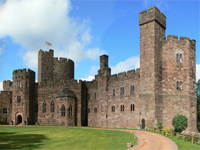
Peckforton Castle, Cheshire (Image: the pepper tree / flickr)

By contrast, Peckforton Castle would be recognisable to a medieval knight as a useful fortification.  Rising prominently above the relatively flat Cheshire countryside, the imposing red sandstone castle is very much in the tradition of BurgesCastell Coch for the Marquess of Bute, and the later Castle Drogo by Lutyens.  However, a significant difference is the much greater degree of historical accuracy, perhaps appropriate considering it was visually challenging the truly medieval Beeston Castle on a neighbouring hilltop, but also to reflect the benevolent feudalism of the owner, John Tollemache who spent huge sums on buildings and homes for his workers.  However, the widespread public discontent at that time, with the risks of mobs and rioting, meant that it is also possible that Tollemache chose a castle with the intention that it be defensible.  So successful was Salvin’s design that even a critic (fellow architect George Gilbert Scott) called it a “…a perfect model of a Medieval fortress…“.  I think Salvin enjoyed the challenge of this design; a rare chance to build an uncompromising castle in a way which hadn’t been necessary for 500 years, fully taking advantage of his encyclopaedic knowledge of fortifications.  Today, despite being badly damaged in a recent arson attack, the castle is still a fascinating example of his work.

Apart from ecclesiastical work and alterations to existing houses such as Warwick, Alnwick and Dunster castles, he also designed a number of notable country houses including, in addition to those already mentioned: Cowesby Hall, Scotney Castle, Parham Park, Skutterskelfe Hall (one of Salvin’s rare Classical designs), Crossrigg Hall, Keele Hall, and Thoresby Hall, which still survive today.  Sadly, Flixton Hall, Campsea Ash High House, Congham High House, Stoke Holy Cross Hall and Hodnet Hall have all either been completely demolished or, in the case of the latter, significantly reduced.

Salvin was one of those rare Victorian architects whose work started strongly and just got better.  To have the opportunity to purchase the first major work at Mamhead is a rare privilege and one that I hope the new owner will recognise and appreciate.

Sales details: ‘Mamhead House‘ – £8m, 164-acres [Strutt & Parker]

Lovely article with many photos in ‘Devon Life’: ‘Mamhead House

More details:

———————————————————————————-

* source: foreward to ‘Anthony Salvin: Pioneer of Gothic Revival Architecture‘ by Dr Jill Allibone which I can highly recommend, and which was very helpful for this posting.

PPS7 – the saviour of the new build country house

Grafton New Hall, Cheshire (Image: Robert Adam Architects)

The nature of our country houses is one of evolution in design, form, and function.  As society has changed, so too have the requirements of the wealthy and, as their houses have been a direct expression of their wishes, these changes can be traced through the architectural record.  Much as we love the many beautiful houses we have already there will always be the desire to build anew, which will constantly reinvigorate this branch of architecture.  As always, some designs will not stand the test of time and will be replaced but the best houses of today will be appreciated by generations to come.  Estate agents often have sites with planning permission for sale and the most interesting come with a design already approved – and in an interesting trend, they are almost all classical, rejecting the avant-garde in favour of brick, stone and Palladian proportions.

Longleat House, Wiltshire (Image: wikipedia)

Once Britain became a more domestically peaceful land under Elizabeth I, the form of our country houses changed from defensive, to one of show as exemplified by the Prodigy houses such as Longleat, Wollaton and Hardwick.  Gone was the need for walls, keeps and battlements and instead the requirements of the aristocracy became focused on courtly entertainments, sport and the display of one’s level of taste and education. This largely set the pattern which can still be seen today, with only the architectural choices as to style varying according to fashion and whim.

Yet it seems that for the wealthy who commission these houses, the overall exterior style has evolved as far as necessary because, despite the efforts of the last Labour government to promote the bold and radical as the only appropriate response, a majority of the houses designed and built today are in a form that your average 18th-century gentry would broadly recognise.  Although most construction in the countryside is largely forbidden, rules introduced by the Conservative government in 1997 – known as PPG7 section 3.21 – allowed for planners to approve houses where:

“An isolated new house in the countryside may … exceptionally be justified if it is clearly of the highest quality, is truly outstanding in terms of architecture and landscape design, and would significantly enhance its immediate setting and wider surroundings.”

In 2004 the Labour government sought to drop this, ostensibly because they thought it a loophole, but many suspected an undercurrent of class warfare (an early day motion put down that year by the former Member for Denton and Reddish, Andrew Bennett, stated that “this House … further believes that if the countryside is to be preserved by not building ordinary houses, it is even more important that is should not be polluted with big houses for the arrogant, vulgar and rich.“).  After a strong backlash with MPs (well worth reading is Alan Howarth’s spirited defence of the country house) and architects leading the charge, the rules were amended to become PPS7 which largely retained the status quo giving owners the opportunity to continue the fine tradition of new country houses but with a distorting preference for houses which would reflect “the highest standards in contemporary architecture.“. In fact, the market proved that clients know what they want more than misguided politicians and civil servants.

In response to the proposed changes the RIBA put on an exhibition called ‘The New English Country House‘ which looked at houses commissioned between 1997-2004 under PPG7.  Of the 24 houses included, 15 were in a historical style and only 9 contemporary, with a majority of the former being seen through to completion.  Interestingly, of the houses listed, at least half (by my reckoning) are replacements for previously demolished  country houses perhaps providing an object lesson in the folly of their original loss.

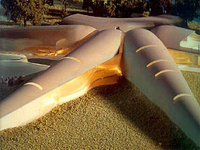
Proposed Grafton New Hall, Cheshire (Image: Ushida Finlay Architects)

The poster child for the new ‘modernist’ country house was the design produced by Ushida Finlay in response to the 2001 RIBA competition to build “the country estate of the future”.  The original Tudor Grafton Hall in Cheshire had been demolished in 1963 after becoming derelict but the 200-acres of parkland offered the ideal opportunity to create an excellent smaller country estate. Yet for the limited pool of those wishing to spend the estimated £20m to build this vision the design ticked none of their boxes. After 7 years of marketing by the estate agents, it was decided to commission a new design from one of our best Classicists, Robert Adam, whose new proposal was described as “an exceptionally outstanding design“. However, the opportunity to create this new house is still being marketed with Jackson-Stops for £5m – so the argument hasn’t been decisively won in this instance just yet.

Proposed Alderbrook Park, Surrey (Image: PRS Architects)

In much the same way as those in previous centuries wished to express themselves through their architecture, so it is the case today.  Houses such as the proposed Alderbrook Park in Surrey for the billionaire Lakshmi Mittal are a radical re-interpretation of the country house but driven by the particular requirements of the client.  Also of particular note is  Ferne Park in Wiltshire for Lady Rothermere – easily one of the finest country houses to be completed in the last 100-years and very much the product of the client working in conjunction with her architect, the brilliant Quinlan Terry.  Speculative developments seem less likely to find buyers as they become more an expression of the ego of the architect rather than the reflecting the personality of the buyer. The prime example of this is the poorly designed Updown Court in Surrey, once the most expensive house for sale in the UK at £70m, which now faces being carved up into flats or becoming a hotel.

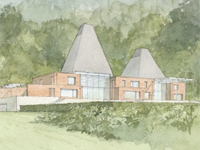
Nyn Park, Hertfordshire (proposed) (Image: Julian Bicknell & Associates)

So what other architecturally attractive opportunities are out there? One quite close to London is Nyn Park, Hertfordshire to replace a house which burnt down in 1963 with a design by another icon of the Classicists, Julian Bicknell, who designed the brilliant Henbury Rotunda in Cheshire. The proposed plan bears no relation to the former house and shows the type of new design allowed under PPS7. Just to underline the level of wealth required for these projects, the estate is being marketed at £10m, built costs could easily be £1m-2m, and the buyer must lodge £3m with the local council as a Landscape Bond that they will fulfil their obligations with regards to restoration which will be returned in tranches as the work is completed.

The Ridge, Gloucestershire (proposed) (Image: Yiangou Architects / Knight Frank)

Another house which has featured before in this blog is the impressive ‘The Ridge’ in Gloucestershire; another replacement for a lost house designed by Humphrey Repton and demolished in 1934.  Designed by Ross Sharpe (who also designed the Icomb Grange), this 33,000 sq.ft. design takes the form of the original house but adds an extra level of architectural flair.  As expected, this is £5m for the opportunity with build costs on top.  Interestingly, the Knight Frank website also says that alternative plans for a smaller 15,000 sq.ft. house have been drawn up, hoping to draw in a wider pool of potential owners.

The Parkwood Estate in Surrey, designed again by Robert Adam, has also been featured previously on this blog back in July 2010 as part of the discussion around justifiable replacement.

For some, a new build will never be a substitute for a historic country house but for those with specific requirements or where there is a shortage of suitable houses, then the option of creating from scratch will always be enticing.  It is also important that the tradition of country house building is allowed to continue as it is only through development that it is shown that these fine buildings can contribute to, and enhance, the much-loved countryside.  PPS7 provides an important legal support for the principle that architecture should be allowed to flourish where it is justified and supportable and should be defended against any narrow-minded interests who would deny our history and diminish the future.

———————————————————–

The websites of the leading country house architects show the broad range of fascinating projects they are involved with, and that, fingers crossed, will one day be built:

Peckforton Castle, Cheshire, seriously damaged in arson attack

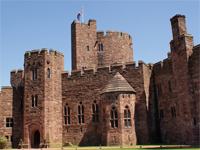
Peckforton Castle, Cheshire (Image: the pepper tree / flickr)

In the early hours of Sunday (19 June 2011) a serious fire broke out in the Drawing Room of grade-I listed Peckforton Castle and has gutted all three floors of that wing, affecting approximately 25% of the building. Sadly, it appears that this terrible destruction in one of the finest mock castles in the country is reported to be the result of an arson attack by the groom, apparently over the wedding bill.  That such a wonderful building could be damaged over something so stupid is beyond belief.  The full extent of the damage – and credit to the fire service for preventing it spreading – will only become truly apparent over the next few days.

Peckforton Castle sits on a Cheshire hill-top, facing down the medieval Beeston Castle on the neighbouring peak.  Yet, Peckforton is a Victorian creation for the 1st Lord Tollemache, who had commissioned Anthony Salvin to marry the conveniences demanded by a Victorian landowner with a scholarly re-creation of an ancient castle, creating the muscular skyline so visible today.  The style of the castle is a reflection of the character of Tollemache – vigorous sportsman, statesman, father to 24 children, and, above, benevolent landlord.  Tollemache had inherited the 26,000-acre estate through his grandmother, co-heiress of the 4th Earl of Dysart, and had particularly Victorian vision of how an estate should be run, saying “The only lasting pleasure to be derived from the possession of a landed estate is to witness the improvement of the social condition of those residing on it.” To this end, he reduced the size of each farm to 200-acres and rebuilt every farmhouse and labourers cottage on the estate at a cost of £280,000 (approx. £20m) and to each cottage he allocated a further 3-acres to help them grow their own produce.

The estate lacked a main house and so Tollemache went against the prevailing fashion of the time and commissioned an authentic re-creation of a medieval castle which was built between 1844 and 1850.  The fashion for sham castles had grown out of the Georgian Picturesque movement which applauded such visions of a castle – symbol of ancient chivalry – and landscape combined to create an aesthetically pleasing view. Yet, in demanding an accurate castle, Tollemache rejected many of the compromises that had previously characterised the lesser shams, such as having a great gatehouse but also acres of glass, which were being roundly criticised by architects such as Pugin who demanded architectural authenticity.

Courtyard, Peckforton Castle, Cheshire (Image: Bob W / flickr)

Tollemache’s architect was Anthony Salvin (b.1799 – d.1881), who, on the strength of the success of Peckforton, was commissioned to also work on Alnwick Castle and the Tower of London, and many more.  Salvin was the perfect architect for the job with his Victorian understanding of the romance of castles and the appeal of the Middle Ages but also a sound practical training with John Nash which gave him the skill to successfully, as Alfred Waterhouse wrote to Lord Tollemache in 1878, “…combine the exterior and plan of an Edwardian [Edward I] Castle with nineteenth-century elegance and comfort.

Castle Drogo, Devon (Image: wikipedia)

Faced with the choice between architectural accuracy and convenience most of Tollemache’s contemporaries opted for more fashionable styles leaving relatively few of these large-scale re-creations.  Other examples of ‘real’ sham castles include William Burges‘ designs for Lord Bute at Castell Coch, Belvoir Castle for the Dukes of Rutland, and the powerfully brooding Penryhn Castle, built between 1840-50, for George Hay Dawkins-Pennant.  The demand for an authentic castle then largely abates until Julius Drewe’s commission, built in the 1910s and 1920s, for Sir Edwin Lutyens which results in the wonderful Castle Drogo.  By their very nature, their stern exteriors make them untraditional country houses yet they hark back to the oldest form of home for the landed gentry, and a symbol of power and prestige.

Sadly, arson attacks on country houses are not unknown – witness the terrible devastation brought to Hafodunos Hall in Wales by two bored idiots in 2004. With Peckforton Castle, the success of the design, both as an exterior composition, but also for the practical yet impressive interiors is why the house is such an important part of the nation’s architectural heritage.  The house was only recently subject to a £1.7m restoration programme by the Naylor family who own it and have worked immensely hard to bring to life a house that had been empty since WWII.  Hopefully the damage will not turn out to be as extensive as feared – though estimates for restoration are already said to be around £1m.  The strength of the construction means that it will almost certainly be restorable and will hopefully again rise soon from the ashes of this terrible fire.

———————————————————————

News stories:

Listing description: ‘Peckforton Castle‘ [britishlistedbuildings]

The front line: the campaigners for country houses

Apethorpe Hall, Northamptonshire (Image: English Heritage)

Despite the image of wealth and power a country house might create, in reality their existence is far more precarious – as can be seen with nearly 1,800 houses lost over the last two centuries.  A house facing the threats of being uninhabited without a concerned, well-funded owner with an inclination to keep it in good repair can quickly deteriorate leaving another gap in the tapestry of the countryside.  Sometimes it requires someone other than concerned locals and architectural historians to highlight and campaign on behalf of those ‘at risk’ so here’s a quick round-up of the main English organisations fighting on behalf of country houses and who are very worthy of support.

English Heritage inhabits a prime position in view of its role in defining and, in conjunction with local authorities, implementing the statutory protection of our built heritage.  Its role can be traced back to the Ancient Monuments Act of 1882 – though the legislation specifically excluded privately owned houses. The responsibilities were exercised through various government departments until it became a quango in 1984.  As well as being responsible for the listing system and the annual production of the various ‘at risk’ registers (focussing mainly on grade-I and -II* properties), EH is also directly responsible for various country houses including Brodsworth Hall (Yorkshire), Rufford Abbey (Nottinghamshire), Hill Hall and Audley End (Essex), Kirby Hall (Northamptonshire), Witley Court (Worcestershire), Stokesay Castle (Shropshire), and Apethorpe Hall (Northamptonshire).   It’s at the grade-I listed Apethorpe where EH has done some of it’s most interesting work; taking a direct role in the restoration of one of the finest Elizabethan/Jacobean houses in the country following a long period of neglect. Since 2008, the house has been for sale for around £5m – though there is a compulsory £4m list of renovations, and if you want complete privacy expect to pay another £8m to fully reimburse EH otherwise you have to open it for 28 days a year; so a nice round £20m to restore, furnish and keep as your own. However, this is a role that I fully support them in taking on – they should be there as owner and restorer of last resort for threatened grade-I houses.  Now perhaps we can interest them in the sadly deriorating Melton Constable Hall in Norfolk…?

Another important group of campaigners are recognised in the 1968 Town and Country Planning Act which formalised the role of what are known as ‘amenity societies‘; that is, well-established voluntary societies who are experts in their areas, who must, by law, be informed of any applications for listed building consent to demolish listed buildings in whole or in part in England and Wales.

One of the best known is the Georgian Group who cover a period broadly from 1700-1837.  The society was established in 1937 and has long campaigned for the sensitive restoration and retention of not only the buildings but the many important, and sometimes sadly overlooked, internal features which are a key part of the character of a building.  Current active campaigns and cases they are involved in include Bank Hall in Lancashire and Trewarthenick House in Cornwall and many others. They also produce a scholarly annual research journal which provides a much more in-depth view of aspects of Georgian architecture.  Access for the wonderful trips to houses not normally open to the public are worth joining for alone.

Eaton Hall, Cheshire (by Alfred Waterhouse - dem. 1961) (Image: Lost Heritage)

The Victorian Society (which also covers Edwardian buildings too) was formed in 1958 at a time when almost all things Victorian were disliked and an easy target for demolition.  Founded at the suggestion of Anne, Lady Rosse, along with her influential friends such as Sir John Betjeman and Sir Nicklaus Pevsner, the Society has fought some notable battles; losing some such as Euston Station but winning others, such as the soon-to-reopen St Pancras Midland Grand Hotel building.  Victorian country houses have suffered badly as, although designed by eminent architects such as Richard Norman Shaw and Alfred Waterhouse, they were often built on a much grander and therefore less economically sustainable scale and at the times of greatest threat (the 1930s and 1950s) had few friends to argue on their behalf.  Luckily though this has changed – but with the predominant ‘gothic-revival’ style being quite polarising, threats to houses from this period will always be present. Again, well worth joining.

Perhaps more controversially for this blog, it’s also worth bearing in mind the Twentieth Century Society.  Although the focus of the houses usually covered is before 1900, there has been a growing recognition that some of the country houses built in the 20th-century were well-planned and architecturally pleasing, even if they sometimes replaced a much more attractive Georgian or Victorian house.  It does seem to take about 50 years after a style has passed from being fashionable for it to be appreciated, so I suspect there will be a growing realisation that we need to protect the work of those such as Francis Johnson, Craig Hamilton, Quinlan Terry, and Robert Adam (amongst many others) in the future.

The Society for the Protection of Ancient Buildings (SPAB) is, as its name makes clear, not usually concerned with country houses as they are relatively ‘modern’ in terms of its remit.  However, they do immensely important work in promoting good repair practice to all buildings and their courses have taught generations of owners and craftsmen to respect the country houses and to approach any work required with a more ‘heritage’ mindset.

Although not ‘amenity societies’, two other organisations deserve a mention. The first is the Historic Houses Association which acts on behalf of the private owners of country houses and often lobby government to make them aware of the immense work done by the individual owners to maintain their slice of the national architectural heritage.  It may seem unfashionable in wider society to support the wealthy but they are the ones not only maintaining their homes to the exacting standards of English Heritage, but also restoring and rescuing houses and converting them back into homes again – and for that they deserve our thanks.

The Grange, Hampshire (Image: mpntod / Wikipedia)

The other organisation is one in which I have an interest having worked with them for several years: SAVE Britain’s Heritage.  Founded in 1974, SAVE have taken a very active stance on campaigning, willing to create media interest at short notice, but also to take time to produce some excellent research on houses at risk with thoughtful proposals for their re-use.  These campaigns have saved houses such as Calke Abbey in Derbyshire, The Grange in Hampshire, Barlaston Hall in Staffordshire (where SAVE bravely took on the house for £1!), and, working with Kit Martin, have acted as a catalyst for the saving of other houses through conversion into apartments.  Supporting SAVE’s work and becoming a Friend also gives access to their extensive ‘Buildings at Risk Register’ which features over 800 properties, including several country houses, which are in need of rescue – could it be you?

It is also worth keeping an eye out for local activists and campaigns which can also be remarkably successful at highlighting buildings at risk but can also sometimes take a more direct role; see the wonderful work at Poltimore, Devon, Bank Hall, Lancashire, and Copped Hall, Essex.  These are just three examples where concerned locals have organised themselves and presented a credible alternative and prevented the complete loss of the house.

All of these organisations are worth joining but economics being what they are it can be best to join a national organisation and then another to focus on the period which you prefer.  Joining up means that you are helping to support research but also active campaigns to ensure that as much of our built heritage is passed on to future generations.

———————————————————

I realise this selection is not comprehensive and is quite national in focus and deficient in regional organisations but this will be remedied in another post once I’ve had time to learn a bit more about who’s out there.

– Matthew

———————————————————