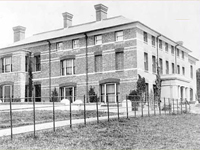
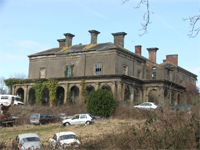
Country House Rescue: efforts misapplied – Trereife House, Cornwall

Trereife House, Cornwall (Image: matt bibbey / flickr)

Inheritance is a double-edged sword – for all the perceived luck of being given a large country house, the reality is that, in many cases, the house requires significant investment.  For some, this is a chance to shine; to put in place the plans they had been making, or develop new talents and unexpected skills. For others it quickly becomes burden as it pushes them into situations they seem unprepared for – as it frequently proves on Country House Rescue.  This week (27 March), heading back down to the south west, Ruth Watson visits Trereife House in Cornwall, to a house threatened by the odd schemes of the owner.

Antony House, Cornwall (Image: mothproofrhubarb / flickr)

Trereife (pronounced ‘treeve’) nestles in the hills above Penzance, an neat pink hued Queen Anne house with an elegant parterre garden laid out below the south front.  The original house was an Elizabethan farmhouse which was home to the Nicholls family, who had become wealthy landowners and minor gentry through farming and marriage.  The first records of them is the marriage of William Nicholls (also known as William Trereife) in 1590, though it is thought the family had been in the area for several generations earlier.  The design of the grade-II* house as we see it today is the result of an extensive rebuilding in 1708 which not only added the wonderful Queen Anne front with its hipped roof but also created some fine interiors with plasterwork ceilings, probably by travelling Italian workmen, who were known to have worked on several houses in the south west.
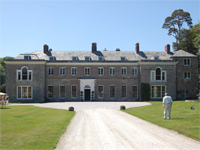
Boconnoc House, Cornwall (Image: cornishmoth / flickr)

Architecturally, the echoes of the style of Trereife can be seen at the much grander Antony House for the much wealthier Carew family. The house was begun in 1718 shortly after Trereife’s remodelling and so is technically Georgian (Queen Anne died in 1714) but the basic form of the house is similar.  Also Boconnoc House, near Lostwithiel, displays the same two-storey with dormer windows design as Trereife and Antony – though again for a much wealthier family, the Pitts.  Boconnoc features later alterations in 1786 by Thomas Pitt, cousin of Pitt (the Younger) the Prime Minister, in conjunction with Sir John Soane, who he had met in Italy in 1778, which probably explains the serlian window to the projecting bay.  Another house of a similar design was Dunsland House, Devon which was one of the most important houses in the area, with particularly fine plasterwork, which sadly burnt down in 1967.  On a smaller scale than any of these, but possibly even more beautiful, is Great Treverran, near Fowey, a compact (one room deep) house built in 1704 but given a dose of grandeur with fine granite Ionic columns, it was last sold in 2003 for around £650,000 and is now wasted as a holiday cottage.

Trereife is a significant part of a great tradition of Cornish houses with a fine family history with connections to the Romantics such as Coleridge, Wordsworth, Charles Lamb and Leigh Hunt through Revd Charles Valentine Le Grice, affectionately known as ‘CV’.  The house passed to the Le Grice family through inheritance in 1821 following the marriage of Mary Nicholls, whose son had died childless, to ‘CV’ in 1799.  The house is now owned by Tim Le Grice, a solicitor who inherited the neglected house in 1986 from his grandmother and who now lives at Trereife with his family.

Sadly, Tim appears ill-equipped for the role as country house rescuer as a series of slightly eccentric – gypsy caravan theme park anyone? – or badly planned business ventures have taken up significant time and money with little to show for it.  For the family, the £40,000 per year running costs were proving ruinous and so they turned to Ruth for advice; which is typically hard-hitting.  Much as the family would rather avoid having their family finances shared with the nation this appears to be the only way to persuade Tim that he needs to draw on the skills and experience of his literary agent daughter to organise events and his wife to develop the potential for B&B and weddings within the house.  Considering that the house now comes up well in Google searches as a venue for weddings and events it seems that Ruth was right – and has hopefully enabled another family to remain in their ancestral home.

——————————————————————

Country House Rescue: ‘Trereife House‘ [Channel 4]

Official website: ‘Trereife House

Interiors: ‘Trereife House‘ [UK Film Location]

Official Facebook page: ‘Trereife House

More details: ‘Trereife – a family home‘ [Cornwall Life]
Country House Rescue: a matter of taste – Monreith House, Galloway

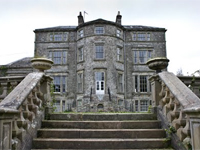
Monreith House, Scotland (Image: Mike Harrison / UK Wildlife Photography)

Country House Rescue heads from Tapeley Park in Devon to the other end of the country to Monreith House in Galloway, Scotland.  A dignified house, it has suffered from a classic problem for those that inherit, as the current owner Sir Michael Maxwell did in 1987, that: “…to put it politely, my relatives’ expenditure exceeded their income by many times.”. The necessary economies forced on Sir Michael have meant some cut corners which Ruth Watson quickly identifies as hindering his attempts to move upmarket.

The Maxwells of Monreith were certainly aristocratic with their baronetcy granted by Charles II in 1681 and various family members marrying well including the 8th Baronet’s wife, Lady Mary, who was a daughter of the Duke of Northumberland, one of the richest and largest landowners in England. The Maxwells had been based at Myrton Castle since they bought it in 1685, obviously needing a house to match their newly elevated status.

Leuchie House, Scotland (Image: John Small - 1883 / buildings fan on flickr)

Monreith House was built in 1791 by Sir William Maxwell, 4th Baronet, to replace Myrton, which was partially demolished to provide building materials for the new one.  The architect was the Edinburgh-based Alexander Stevens, son of a better known Alexander Stevens who specialised in designing and building bridges.  His design at Monreith shows that he was well versed in the Palladian vocabulary but is in contrast to his other principal design; the impressive Raehills in Dumfriesshire, built for the 3rd Earl of Hopetoun in 1786, which is an imitation of Robert Adam‘s castle style.  Monreith shows closer similarities with Leuchie House in Lothian, built for Sir William Dalrymple between 1779-1785, to designs by the little known Alexander Peacock who was also based in Edinburgh.  By the 1790s, the first wave of Palladianism had long ago swept through the country and much provincial design can be traced back to the many architectural pattern books which had been produced.  Stevens’ limited but varied output could indicate he used also used them, though perhaps more competently than most.

The Maxwells of Monreith became one of the most important families in the area with a substantial estate which totalled 17,000-acres.  The house has passed down through the Maxwells, though it never went to the most famous of the family, the writer Gavin Maxwell, heir to the 8th Baronet, Aymer Maxwell, but who died of cancer in 1968.  Gavin’s books were best-sellers, with his most famous being the autobiographical ‘A Bright Ring of Water‘ about his pet otter, the profits of which might have helped the estate but for his profligate ways.  His father also faced financial difficulties and, lacking funds to maintain the house, apparently felt it easier – and cheaper – to let the house deteriorate rather than pay to have it demolished.

When Sir Michael inherited the house from his uncle it was in a seriously neglected state, saying he remembers that “When it rained hard the water would run down the stairs and land in puddles on the floor.”.  Sir Michael had trained as a surveyor so he was able to approach much of the work himself – though this also appears to be part of the problem. One money-making scheme was to convert the top floor into holiday flats but these, and the rest of the house, all show signs of his major flaw – a determination to do things as cheaply as possible leading to various poor choices which compromise his aspirations.

Sir Michael displays an admirable duty towards maintaining the house – a contrast to that displayed initially by Hector Christie of Tapeley Park in the previous episode.  Sir Michael says “It would be too easy if your great-grandfather dropped dead and left you money to end up a drunk in the gutter – so it’s a challenge. Essentially, you’re not given much choice when you inherit a house like this.”.  Thankfully he does appear to want to listen to Ruth Watson’s advice and one hopes that this will put him on the path to a sustainably prosperous future which will ensure the Maxwells remain at Monreith.

Official website: Monreith House, Galloway

Programme website: Country House Rescue: Monreith House [Channel 4]

Country House Rescue: Tapeley Park, Devon

Tapeley Park, Devon (Image: chatoul / flickr)

The subject of the 13 March episode of Country House Rescue, Tapeley Park in Devon, carries on the wonderful tradition for country house eccentricities – and eccentrics.  From how the site was chosen to the manner of the inheritance, this beautiful house has a fascinating history – though more recently it’s been a little neglected.

According to Simon Jenkins, “Few Devon houses have so spectacular an outlook” – and few would disagree.  Situated above the pretty seaside town of Bideford, the site of the house was apparently chosen by the builder, Captain William Clevland, who apparently spotted the location through his telescope as he sailed up the Torridge in 1702.  He made good on his wish, rebuilding the existing manor house in an austere and somewhat uninspiring style but which took full advantage of the fine views from its elevated position – though this was later largely negated by an enthusiastic blocking up of windows to avoid the window tax.

Tapeley Park, Devon - before Belcher alterations (Image: tapeleygardens.com)

The house eventually passed to the Christie family through marriage when Agnes Clevland married William Langham Christie in 1855.  The Christie fortune was made when one Daniel Christie joined the East India Company and was later given a fortune in gems by a Sultan in thanks for having prevented troops from pillaging a harem.  On his return he married the daughter of Sir Purbeck Langham of Glyndebourne in East Sussex and Saunton Court in Devon.  His grandson, Augustus Langham Christie, inherited both estates and now being a very eligible and wealthy man was able, in 1882, to marry the daughter of the Earl of Portsmouth, Lady Rosamund, whose family seat was the nearby Eggesford House (demolished in 1917).  Coming from such a grand house she was fairly unimpressed with Tapeley, writing in her diary:

“When I first saw Tapeley it was in the winter of 1881 before my marriage to Augustus Langham Christie. It was a Georgian stucco house, very plain and rather dreary in appearance, for many of the front windows had been blocked and the sunk apertures painted black with halfdrawn paint blinds, cords and tassells, looked very dull. The terrace walk and garden did not exist and the drive approached between iron railings.”

The marriage was not a particularly happy one with Lady Rosamund eventually banishing Augustus to the other Christie estate, the nearby Saughton Court, for his ‘eccentricities’ which apparently included ‘childish behaviour’ such as kicking the furniture repeatedly to annoy her.  In his absence, Lady Rosamund poured her energies into rebuilding Tapeley and engaged one of the leading neo-baroque architects, John Belcher (b.1841 – d.1913).  Due to limited finance, the work was to last from 1896 until 1916 but the professional relationship between client and architect was a happy one – so much so that on his death she had a plaque added to a wall in his memory.

Belcher is not as widely known as perhaps he should be, though his work is well regarded. He worked mainly on commercial buildings and institutions including the Whiteleys department store in London, and the brilliant Mappin & Webb building in the City of London which was scandalously demolished in 1994 to build No.1 Poultry (the only good view is looking out from the top of it!). More prominently, Belcher also designed in 1907  the imposing Ashton Memorial in Lancaster for Baron Ashton.

Belcher transformed the ‘dreary’ house to create an imposing but elegant ‘Queen Anne’ style Georgian villa of brick with stone pilasters, parapet and a pediment, sitting above the impressive terraced gardens. The interiors are also of note, featuring a grand staircase hall and also several good fireplaces and plaster ceilings from the original house.  Lady Rosamund had to fight to keep hold of her creation as, in an act of revenge, Augustus left the house in his will on his death in 1930 to a distant cousin in Canada, forcing her to have to go to court to argue, successfully, that Augustus was obviously insane.

The house and estate were inherited by her son, John Christie, who founded the famous opera at Glyndebourne, where he spent the other half of his time when he wasn’t at Tapeley.  Tapeley was then inherited by his daughter, another Rosamund, who frugally ran the house until her death in 1988 and was known for conducting the tours with a parrot on her head.

The current owner is one Hector Christie, Rosamund’s nephew, who apparently decided with his brother which was to inherit Glyndebourne and Tapeley by flipping a coin whilst in a Brighton nightclub.  Hector, though Eton-educated, is something of a rebel, once sneaking into a Labour party conference to heckle Tony Blair about the Iraq war, and also extending a fairly broad invitation to various hippies to create something of an eco-commune at Tapeley.

Though almost all the hippies have now left, Hector has now decided that he should focus on managing the house and estate on a more commercial basis, and not a moment too soon judging by the deteriorating condition of the grade-II* listed house, where part of the dining room ceiling fell in shortly before Ruth Watson’s first visit.  Fingers crossed her advice can provide a means for the family to stay in their ancestral seat without compromising either the architecture or setting or his principles.

Official site: Tapeley Park, Devon

Country House Rescue: Tapeley Park

Country House Rescue returns for Series 3: Wyresdale Park, Lancashire

Wyresdale Park, Lancashire (Image: Channel 4)

The history of the country house is sadly often a cycle of rise and fall with the main variable being the speed of each respectively.  The old phrase was ‘one generation made the wealth, the second enjoyed it, and the third lost it’. Over recent decades the trend has changed slightly in that, with longer life expectancies prolonging the older generations, the houses have had fewer chances for the rejuvenation which inheritance often brought.  As an alternative, Ruth Watson uses Country House Rescue as a catalyst for the type of entrepreneurial change which is the only way for these houses to survive – if only the owners would listen!

The first episode in Series 3, to be broadcast at on Channel 4 at 21:00 on 6 March 2011, takes us to Wyresdale Park in Lancashire to meet a father and son who don’t agree on the best way to maximise the obvious potential of the beautiful estate.

Wyresdale Hall was built between 1856-65 for Bolton cotton-magnate-turned-banker, Peter Ormrod, who bought 6,000-acres from the Duke of Hamilton to create his estate.  The house, which cost £50,000 (about £4m at today’s value) at the time, was designed by noted local architect Edward Graham Paley (b.1823 – d.1895) who had an extensive practice, partnering first with his mentor Edmund Sharpe, then, following Sharpe’s retirement, Hubert Austin, before being joined by his son, Henry Paley. The work of Paley & Austin in particular was well-regarded with Pevsner  saying they “did more outstanding work than any other in the county” and was “outstanding in the national as well as the regional context”.

Paley worked on relatively few country houses, being much better known for his ecclesiastical output, with included the design of Lancaster Cathedral.  Paley was brought up in deeply religious home and, working with Edmund Sharpe, who was heavily influenced by Pugin, it was unsurprising that Paley adopted the strict ecclesiastical style with the ‘correct’ use of Gothic elements.  Perhaps looking a little too much like a convent rather than a home, the house is, nonetheless, still a good example of the type of regional interpretations of Pugin’s architectural theories which gained ground in the 19th-century.

The grade-II listed house and estate passed through the Ormrod family before the land was bought by the Whewell family in the 1920s who then bought the house in 1967.  Now the family are facing the usual struggles of a listed house, an extensive list of improvements, and the need to make the changes which sometimes sit uncomfortably with the more traditional older generation.

———————————

Country House Rescue – Series 3

My usual powers have slightly failed me and I haven’t a verified list of all the houses in Series 3 but here are the ones I have identified so far:

See also:

Anyone restoring a country house?

Blackborough House, Devon (Image: Trouserama / Derelict Places)
Blackborough House, Devon (Image: Trouserama / Derelict Places) - currently for sale with Winkworths

Heritage and the dedicated work of those who seek to rescue it can often be overlooked only to be occasionally thrust into the spotlight of TV – though this can be a useful promotion in these times of austerity.  Sadly, the schedules seem to focus on heritage in bursts, giving us ‘The Restoration Man‘ and ‘Country House Rescue‘ at the same time but it’s good to know that their popularity encourages the programme makers to continue to commission this type of series.  Of course these programmes need material so if you know anyone restoring a UK country house, please read on.

One of the most successful of the heritage programmes was the original ‘Restoration‘, a wonderful series presented by Griff Rhys Jones who has personal experience of restoring his own rural Welsh farmhouse.  This series truly caught the attention of the public and raised awareness of the buildings at risk in their own areas.  Keen to tap this interest again, Endemol, the production company behind ‘Restoration’, have a new series, ‘Restoration Home‘, ready for broadcast in Spring 2011 (and flagged up as a comment already on this blog) – though sadly without Griff as the presenter.  The new series focuses on private owners and follows their restoration of ‘at risk’ houses as modern homes.  Although the intention is that these will be sensitive restorations it will be interesting to see exactly what compromises and sacrifices are made in creating the home the owner wishes to achieve.

As a sign of the confidence that Endemol have in likely popularity of the series, they are already looking for houses to feature in a second series with, ideally, work starting in the next few months and reaching completion around March 2012.  To quote Natasha Evans of Endemol Television:

“Each show will chart the restoration process by the owners of one house, as they restore their home to its former glory. Much as the original series, we’ll bring the property to life, setting it in its cultural and historic context. This is a major aspect of each show and will be interwoven with the restoration. At the same time, we’ll be looking at the different stages of its architectural styles.”

One of the key criteria is that the houses must be owned privately by those who are intending to live in them, that they are currently in need of a bit of love and attention, and that the owners are passionate about their house and specifically interested in the history of their house. So if you are undertaking your own project, or know someone who fits the criteria, please contact Natasha Evans on 0208 222 4326 or by email  natasha.evans@endemoluk.com

——

If you are inspired by these programmes and would like to find your own building at risk then one of the best places to start is the ‘Buildings at Risk Register‘ managed by the architectural heritage charity SAVE Britain’s Heritage.  To access the register you need to subscribe but this will give you full access to the register of hundreds of properties in need of a sensitive owner.

If Blackborough House (pictured above) takes your fancy, it’s currently (January 2011) for sale with Winkworths for between £1m – £1.5m, but will require at least that (and probably more) spent again on it to restore it as a home.

——