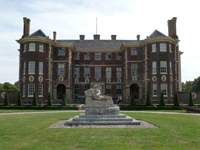
Reflections on the loss of Clandon Park, Surrey

Loss is mainly regret that we will never see something, or that we have known it and will never see it again.  Where the loss is of something of beauty, which embodied ideas, history, culture, it takes on many facets. Fire is a destructive, cruel enemy, consuming all in its path; caring not for the value – either great or small – simply taking whatever it can as fuel for its avaricious need to grow. On 29 April 2015, as the fire at Clandon Park took hold we hoped for the best – yet sadly, less than twelve hours later, all that remained was a gaunt, blackened shell. The loss was not just the building and its beautiful interiors and contents, but also what it represented to UK architectural history.

Clandon Park, Surrey (Image: Matthew Beckett)

News breaks now on social media, the first photos and reports of huge plumes of smoke spreading much as the flames did; slowly at first, rapidly growing. Quickly it became clear that the fire had reached the roof and that the rooms on the ground floor of the south side had already gone – the Green Drawing, Palladio, Hunting, Prince Regent.  Each a small gem in themselves, their contents the result of decades of collecting and curation. As the floors above collapsed, it became clear that this was a very serious situation and thoughts immediately are to hope that, first, everyone is safe, but, secondly, how far would the fire go? Sadly, it soon became clear that the entire house was to be consumed in the inferno.

Clandon Park on fire, 29 April 2015 (Image: © Andrew Blondell / BBC Surrey)

Why was Clandon Park important? It wasn’t just the history and collections.  Most importantly, the design of the house was a key transitional link between two defining periods of British architectural history; the Anglo-Baroque and the Palladian. The house, both interior and exterior, was designed by a Venetian architect, Giacomo Leoni, and built between 1723-29.  Both the architect and the dates are key to understanding why the house was so significant.

Clandon Park on fire - two-thirds of the house was now on fire (Image: © Oliver Dixon)
Clandon Park on fire – two-thirds of the house was now on fire (Image: © Oliver Dixon)

Giacomo Leoni (b.1686 – d.1746) played a key role in bringing the ideas of Palladio to the UK through the publication of that architects’ ‘I Quattro Libri dell’Architettura (which he called ‘The Architecture of A. Palladio, in Four Books’). Although not an entirely accurate recreation (Leoni wasn’t above adding his own improvements) the instalments (published between 1715-20) were a huge success, casting the ideas of the Palladian ideal deep into the aspirational hearts of the British aristocracy.  Leoni’s edition remained the primary source of the nascent Georgian Palladianism until (prompted by Lord Burlington) Issac Ware produced a more accurate translation in 1738.
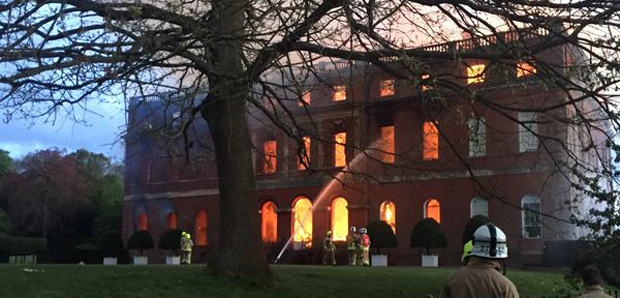
Clandon Park on fire - the flames reached the north side (Image: © Alex Greenwood)
Clandon Park on fire – the flames reached the north side (Image: © Alex Greenwood)

For all his intellectual influence, Leoni’s physical output was relatively meagre for a 45-year career – his earliest designs were for an unexecuted rebuilding of Wrest Park in August 1715 for the 1st Duke of Kent. His first completed work was in London in 1721, Queensberry House, 7 Burlington Gardens, for John Bligh, Lord Clifton, which featured an antique temple front, a reduced version of which appears on the south front of Clandon Park. Leoni’s output was mainly country houses; he designed eleven but only nine were completed (the two unfinished houses being Carshalton Park and Thorndon Hall) of which four have been lost already (Moulsham Hall – dem. 1809, Bold Hall – dem. 1901, Burton (or Bodecton) Park – fire 1826, and Lathom House – dem. 1929/1955).

Comparison of Leoni's 7 Burlington Gardens and south front of Clandon Park (Image: 7BG: Wikipedia / Clandon: Matthew Beckett)
Comparison of Leoni’s 7 Burlington Gardens and south front of Clandon Park (Image: 7BG: Wikipedia / Clandon: Matthew Beckett)

This left just four completed house which survived into the 21st-century; Lyme Park (c.1725-35), Alkrington Hall (1735-36), Wortley Hall (1743)- and Clandon Park (1723-29).

The brilliance of Leoni’s design for Clandon had survived almost unchanged as it had remained in the Onslow family until being handed to the National Trust in 1956. Where Clandon excelled was that the exterior was early-Anglo-Palladian; chaste, restrained decoration, subtle temple motif, but this was married with one of the greatest of the Anglo-Baroque rooms, the Marble Hall (the plasterwork of which Sir Simon Jenkins thought better than the similar room at Houghton Hall), and other rooms rich in beauty. This contrast between the quiet exterior and the exuberant interior is what made Clandon so important as the link between two of the most significant trends in British architectural history.

Marble Hall, Clandon Park (Image: Matthew Beckett)

So, what next? The incredible staff and volunteers of the National Trust swiftly put into place the plans they never hoped to have to use and clearly, the efforts are being directed to the care of the salvaged contents and an examination of what can be recovered from the debris.   Investigations will be undertaken and conclusions reached as to the cause but looking to the future the options are the same as ever; rebuild, re-use, or ruin.
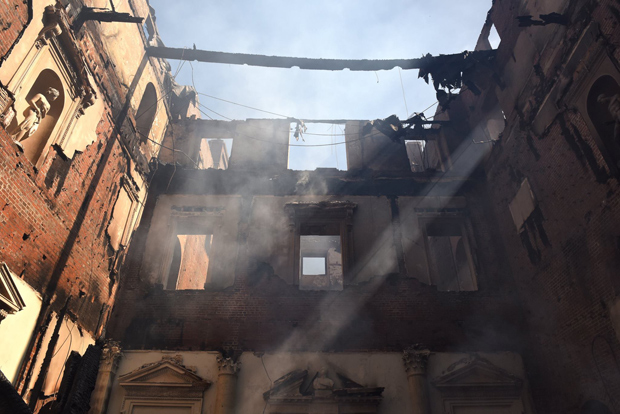
Marble Hall, after the fire (Image: © John Millar / NT Picture Library)

As a nation, we have fetishised ruins for centuries with castles, abbeys, fortifications and now factories celebrated for their managed decay. We have enough derelict country houses (far too many, truth be told), so to consign another to that sad, lonely fate would miss the chance to grasp a recoverable beauty and miss the opportunity to demonstrate and inspire through an educational process around the reconstruction.

The Landmark Trust’s inspired recent work at Astley Castle, Warwickshire, to create a modern living space in a shell created by a fire in 1978, shows that ruins can be re-used intelligently and with great aesthetic success.  However, Astley Castle was a smaller house and also without the spectacular interiors which once graced Clandon Park.
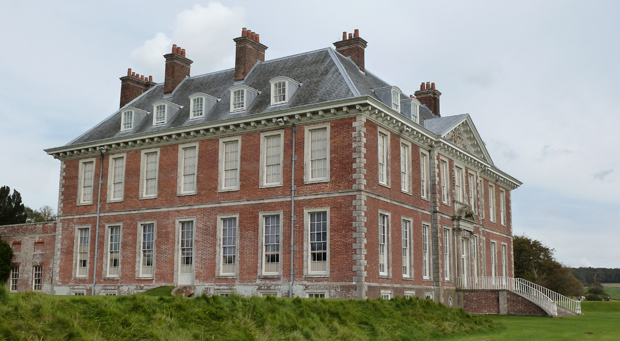
Uppark, Sussex (Image: © Matthew Beckett)

So the remaining option is rebuilding and restoration.  As has been shown at Uppark, Sussex, which also suffered a serious (though not quite as devastating) fire in August 1989, it is possible to restore the house back to as it was before.  This is not pastiche as it’s not conjectural – we have extensive, detailed records of the interiors and, combined with salvaged fabric, it is possible to recreate what was there.  As Sir Simon Jenkins argued in the Sunday Times (03/05/2015), it would be unthinkable not the reinstate the great Marble Hall – because we can.

Modern care and conservation means that the rate of losses of country houses has dropped from the hundreds each year in the 1950s to barely a handful and these are almost always due to fire. All those we have – that which survived this far – are fragile and it’s an uncomfortable truth to understand that they will not last forever.  As the painter Salvator Rosa once wrote:

All our works is fallen and sicken
Nothing is eternal
The Colossei die, the Baths
The worlds are dust, their pomp a nothing…

Rather than despair, we should celebrate and enjoy the architectural heritage which is still available to us and care for it for future generations. The original Clandon Park is lost; that patina of age, the individual details which only it knew are no more. Although the contents have been largely lost, resurrection is the most appropriate option as the main shell of the house has survived – the sterling work of the fire service has saved at least one half of Leoni’s vision. Modern craftsmen with ancient crafts, honed at Uppark, Hampton Court, and Windsor Castle, can recreate the beauty of the interior.  It won’t be the original but from our shock at the loss can come awe at the artistic skills that can recreate such wonders as the Marble Hall.

———————————————————————————

Gallery of images of the aftermath: ‘Clandon Park fire 2015‘ [National Trust Picture Library]

Statement: ‘Fire breaks out at Clandon Park, Surrey‘ [National Trust]
A mansion tax is a pox on all our country houses

It’s a widely accepted principle that even if trying to achieve a noble goal, it is not a justification to do harm in doing so.  Whether one is trying to fund the NHS or provide kittens and puppies for all, if ever such an ill-thought out idea as a mansion tax is introduced, it is likely that the law of unintended consequences will find myriad ways to demonstrate itself.  In few sectors will the damage be greater than in that of our nation’s cultural and architectural heritage where decades of hard work and conservation of our country houses will be sacrificed to play a short-term political game.

Beaudesert Hall, Staffordshire - demolished 1935 due to demands of heavy taxation (Image: Lost Heritage)
Beaudesert Hall, Staffordshire – demolished 1935 due to demands of heavy taxation (Image: Lost Heritage)

Let me make clear that this objection is not party political – I would object as vigorously regardless of whoever tried to propose it. Obviously the devil is in the detail but if we assume a tax levied on homes valued at £2m or more at 1% of the property value to be paid annually there are many obvious and profound flaws with the idea – below are a few of them:

  • Fallacy of numbers: there are more expensive houses than there are rich people who could afford the tax. Many houses which would be affected have been inherited thus exchanging the large liquid capital requirements of purchase for the more manageable (though not insubstantial) cost of on-going maintenance.
  • Value suppression: a house valued at £2m will immediately not be worth £2m when a mansion tax is introduced (thus reducing the projected tax receipts).  This will lead to a very hard ceiling on house prices, stagnating the market far below that level as it will prevent others trading up by imposing a disproportionate penalty on anyone purchasing over that price level. Think of all the disadvantages of the current crude banding of Stamp Duty, but magnified.
  • Incentive to neglect: if your house is worth just over £2m, there is a benefit to allowing your property to deteriorate so that it can be assessed at being below the threshold. But how often will they be valued? Will it lead to a cycle of neglect and repair to coincide with this? Who will wish to improve their property for fear that it will push it over the punitive threshold?

Perhaps the greatest threat is to the contents of country houses; the art, sculpture, books, tapestries which combine in such an intangible emotive way to create that atmosphere unique to each.  When the financial effects of the 1870-80s agricultural depression began to be felt, the first items to be sold were the contents – the Titians, Rubens, Caxtons, Shakespeares, Nollekens, Canovas were taken from their pride of place and sent to auction or dealers, the resulting funds merely delaying the inevitable sale of the house.  If we thought the National Lottery Fund was sorely stretched at the moment to acquire for the nation the occasional fine work which appears at auction, there is little chance of them being saved if the volume increases, meaning they will, in many cases, go overseas. Additionally, if the best works have already been sold, then death duties will be a final hammer blow to shatter the cultural and historical unity of the country house, with nothing left to sell or offer in lieu.

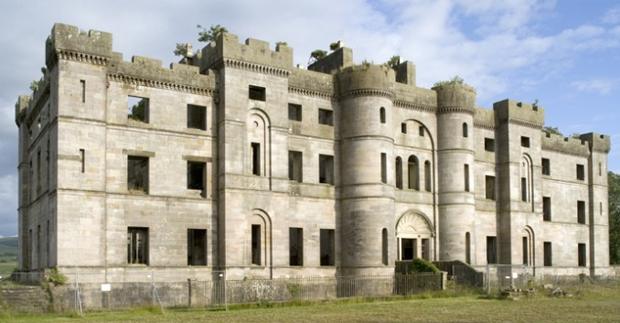
This type of crude taxation has been tried before and it is always heritage which pays the price.  The many gaunt shells of Scottish country houses, such as Dalquharran Castle or New Slains Castle, which were un-roofed to avoid punitive taxes are sad testament to the folly of this approach.  Supporting a mansion tax is to accept a probable return to an era where empty country houses become derelict – ironically coming so soon after the 40th anniversary of the ‘Destruction of the Country House’ exhibition. The National Trust will not be able to take them on without an endowment and English Heritage are sorely underfunded already – leaving either neglect or a hope for an influx of foreign wealth to purchase these houses. Without a local owner living there full time, there are likely to be fewer jobs reducing tax revenues and, with the dearth of rural jobs, leading to higher numbers relying on the State for assistance or an exodus to larger urban areas, further damaging the rural environment.

Dalquharran Castle, Ayrshire - built by Robert Adam c1785-1790, un-roofed 1967 (Image: RCAHMS)
Dalquharran Castle, Ayrshire – built by Robert Adam c1785-1790, un-roofed 1967 (Image: RCAHMS)

Perhaps there could be exemptions for houses which are open a certain number of days a year or which support useful charitable activities but the danger is that these would be used to justify an idea that is inherently wrong.

This article is deliberately painting a rather bleak picture, partially because there is a real likelihood of any of these outcomes, but also to emphasise just how badly-thought out this crude idea is.  It offers no benefits except as a bone to be thrown to a few class warriors but it should seriously worry anyone who cares about the UK’s cultural, artistic and architectural heritage.  Owning a country house is a responsibility, not only as a home for the owner and their family, but one owed to society as a whole.  It is inevitable and right that tax should be raised to pay for the society we hope to live in, but to wilfully sacrifice four centuries of heritage is an immoral and culturally destructive way to do so, no matter how noble the intended reason.

40 years on from the ‘Destruction of the Country House’ exhibition

Many was the time I stood in that exhibition watching the tears stream down the visitors’ faces as they battled to come to terms with all that had gone.’ – Sir Roy Strong [Diaries, 1974]

'Destruction of the Country House' exhibition, 1975 - V&A
‘Destruction of the Country House’ exhibition, 1975 – V&A

In October 1974, one of the most influential exhibitions ever staged by a UK museum opened at the Victoria & Albert Museum.  The ‘Destruction of the Country House‘ laid bare the scale and depth of the losses the UK had suffered, showing how four centuries of architectural tradition and achievement in country houses had been severely damaged by the depredations of the 20th-Century. It was conceived as a dramatic display to waken the nation to the threat faced by country houses and the danger faced by all aspects of heritage.  This was in an age with weak legal protection and which seemed to be growing ever more apathetic, or even hostile, to the idea of preserving what represented the cultural character of the UK.  The exhibition was a huge success, not only in terms of the impact on the public, but also in being the catalyst for a long-term shift in how we seek to save and manage our heritage.  From 13-21 September, a new exhibition at the V&A, ‘Country House – Past, Present & Future‘, seeks to revisit this ground-breaking event and look at the future of the country house.

Thorington Hall, Suffolk - demolished 1949 (Image: Lost Heritage / Tiger Aspect Productions)
Thorington Hall, Suffolk – demolished 1949 (Image: Lost Heritage / Tiger Aspect Productions)

By the 1970s, relatively few people would have been aware of the parlous state of a significant number of country houses and how many had been lost in the demolition binges of the 1930s and the 1950s.  However, that there was a crisis was recognised not only by the owners of the houses, but also by the government which in 1948 had created a committee to look at ‘Houses of Outstanding Historic or Architectural Interest’ and tasked it:

To consider and report what arrangements might be made by the Government for the preservation, maintenance and use of houses of outstanding historic or architectural interest which might otherwise not be preserved, including, where desirable, the preservation of a house and its contents as a unity.

The committee’s conclusions, which became known as the Gowers Report, were published in 1950 and the tone could be determined from the first paragraph which stated that ‘What our terms of reference require us to consider is not whether houses…should be preserved, but how this is to be done‘. The report made a number of recommendations including the creation of the Grade listing system we are so familiar with today, combined with tax concessions to which owners would be entitled, and also financial assistance for which they may be eligible. The aim to create a legal framework where restrictions on the rights of the private owner were compensated by financial incentives to ensure the preservation of these houses.

Trentham Hall, Staffordshire - in its heyday and during demolition in 1912 after being polluted by nearby industry  (Images: Lost Heritage)
Trentham Hall, Staffordshire – in its heyday and during demolition in 1912 after being polluted by nearby industry  (Images: Lost Heritage)

Yet, by the early 1970s it was clear that the crisis had not been solved, as demonstrated by the title of a report published in 1972: ‘Country Houses of Britain – can they survive?‘. Written by noted architectural historian John Cornforth, he sought to explore why the issues surrounding the sustainability of the country house had not yet been resolved, but also to cast the debate in a new era of soaring inflation, economic malaise, and with threatened punitive taxes on the asset rich (though cash poor).

In was at this time that Sir Roy Strong had conversations with Christopher Gibbs but the core of the idea came from John Harris, now noted architectural historian, but also a keen fisherman who, in his youth in the 1950s, had surveyed many an abandoned parkland and empty country house whilst fishing the ornamental lakes (adventures later recounted in his book No Voice from the Hall: Early Memories of a Country House Snooper). Combined with Marcus Binney, then at Country Life, they conceived and created this most remarkable exhibition, quite unlike any before or since.

Hall of Lost Houses, from the 1974 Destruction of the Country House exhibition at the V&A
Hall of Lost Houses, from the 1974 ‘Destruction of the Country House’ exhibition at the V&A

Designed by Robin Wade, the layout took visitors through a short display showing the glories of the country house, but then, as they turned a physical and symbolic corner, were faced with an almost full-height portico tumbling to the ground.  On the pillars and walls were photos of some of the hundreds already lost, whilst in the background, John Harris sombrely intoned a roll-call of their names.

Original poster advertising the Destruction of the Country House exhibition - 1974 (Image: Victoria & Albert Museum)
Original poster advertising the Destruction of the Country House exhibition – 1974 (Image: Victoria & Albert Museum)

The exhibition captured the public imagination, with queues forming to see it at the weekends and the catalogue becoming a best-seller.  Yet, it wasn’t just the public who were captivated by it; in the last week, the Queen, Princess Margaret, Lord Mountbatten, and various government ministers all visited too.  1975 was designated the European Architectural Heritage Year and so focused minds on how to help ensure the survival of the nation’s heritage. This resulted in further legislation which strengthened the legal protection afforded to buildings.   The exhibition also led Marcus Binney to form SAVE Britain’s Heritage, a campaigning charity which took a far more pro-active approach than had traditionally been the case, achieving many notable successes, as it continues to do so today.

Politically, the exhibition could not have opened at a more awkward time – just two days before a general election which brought in a Labour government whose proposed ‘wealth tax’ would have made private ownership of most of these houses unsustainable, probably leading to further wholesale demolition.  Yet, the exhibition also has been identified as ‘…a pivotal moment in the history of country house preservation and heritage politics more generally.’ (Ruth Adams). In truth, a shift had started, as shown by the strong reaction to the proposals by John Baring to demolish The Grange in Hampshire in 1972 which prompted angry exchanges of letters via The Times. However, after the exhibition, no longer were country houses an elite interest for just the owners or art historians, but now the public started to identify with them as part of their national heritage, as something which embodied characteristics and history which they wished to be saved. That broad public sense of attachment to heritage has grown and become almost a natural part of the national psyche (apart from, it seems, in the minds of developers and their occasionally pocket planning committees).

For me personally, the lost country houses were the subject which were the catalyst for my own passion for country houses, leading to the creation of the Lost Heritage website in 2005. The aim is to create the most comprehensive list of all notable lost English country houses – and as far as I’m aware, is the only current ongoing research into the topic. Having seen the ruin of Guy’s Cliffe House about ten years ago, I then started trying to find out more, with two of the most important sources being the superb Catalogue of the exhibition and Giles Worsley‘s later book, the beautiful and elegiac ‘England’s Lost Houses‘.  These contained a gazetteer of known losses – the version in the Catalogue compiled by John Harris and Peter Reid, with Giles’ list building on theirs to take the total to 1,169.  John had estimated that as many as 2,000 had been lost since 1800 and after nearly a decade, sadly my Lost Heritage research has a total of 1,925 (as at Sept 2014), largely proving him correct.

The ‘Destruction of the Country House’ was as much a platform as an exhibition. Although aimed at the public, it was also a touchstone for a wide variety of heritage interests to coalesce and focus their energies and arguments. This helped to create a society which increasingly understood and appreciated heritage but also one which felt there was some collective responsibility towards its defence.  One can only hope that, as a nation, we can continue to recognise the importance of the country house, as well as heritage more broadly, to ensure that those in the future can continue to appreciate their beauty and the rich cultural history they represent.


Events – 2014


Further reading

An academic assessment of the impact of the exhibition: ‘The V&A, The Destruction of the Country House and the Creation of ‘English Heritage‘ – Ruth Adams [Museums & Society]

The glory of the great hall; Dundarave, Co. Antrim

Dundarave, Co. Antrim, Northern Ireland - for sale, June 2012, £5m (Image: Savills)
Dundarave, Co. Antrim, Northern Ireland – for sale, June 2014, £5m (Image: Savills)

Where is the centre of a country house? For some it may be a favoured study or library, or a sunlit parlour facing the gardens. Yet, from the time of the earliest large residential buildings, the great hall has often enjoyed that rare status of being at the core of daily life. However, as times changed, so too did the function, becoming less a space for the whole household to meet and eat, more a statement about the wealth and status of the owner.  The Victorians were keen revivalists for the patterns and forms of ancient aristocratic life and although few used their halls for dining, their role as an impressive reception area, both for receiving guests and entertaining, meant that some embraced the opportunity for grandeur, as can be seen in the recently launched for sale, Dundarave, Co. Antrim, in Northern Ireland.

A medieval country house still reflected the social arrangements of a castle with the lord and his family congregating in the central hall as this was safest and also warmest.  As the designs of homes changed from fortifications to the form we recognise today, the family would still wish to be seen and to entertain in the grandest space in the house.  It was also still probably the warmest.  The huge processions of the Tudor monarchs required a large enough area to accommodate the existing household plus the royal retinue and to have such a capacity was a sign of prestige.  The great hall was therefore as much a practical space as it was a statement of the wealth and power of the owner, as shown by the lavish construction, including spectacular hammer-beam roofs, such as at Eltham Palace (built in 1470s) and Burghley (built much later in 1578 – and the last to have an open timberwork roof), and windows with glass.

Wollaton Hall, Nottinghamshire - view of the inside of the great hall (Image: © d-kav / flickr)
Wollaton Hall, Nottinghamshire – view of the inside of the great hall (Image: © d-kav / flickr)

For the Elizabethans, the great hall was becoming increasingly symbolic, with Burghley the last extravagant flourish of that earlier age.  For houses closely associated with the monarchy or the favoured courtiers, the decorative opportunities that a space such as a great hall offered were irresistible.  At Wollaton Hall, Nottinghamshire, built between 1580-88 by the brilliant Robert Smythson, a soaring central tower was designed to not only be topped by a prospect room from which to watch the hunting but also to contain a lofty interior, rising 50ft to a hammer-beam roof (though this one is decorative rather than structural).  Already the role of the great hall as a daily practical space was diminishing in favour of a more exhibitionist one.

Montacute, Somerset - View of the Great Hall, looking towards the screen which separates the Hall from the Screens Passage (Image: ©National Trust Images/Nadia Mackenzie)
Montacute, Somerset – View of the Great Hall, looking towards the screen which separates the Hall from the Screens Passage (Image: ©National Trust Images/Nadia Mackenzie)

Just over ten years later, in c.1601, the completion of the great hall at Montacute, Somerset, marked the first clear departure in design.  Although at the ground level it still had the same traditional features – porch, screen, bay window, steps at the high end – this hall was only a single story, rejecting the customary double-height space.  The hall was still an important part of the house with the other rooms designed to lead from it, but decisively its role as the daily venue for the entire household to meet and eat together had passed.  Instead the hall became less a space for living and more a space for occasional entertaining; for banquets, balls, and concerts.

Plan showing transverse hall - Worksop Manor Lodge, Nottinghamshire. c1595 (Image: Andor Gomme / Alison Maguire)
Plan showing transverse hall – Worksop Manor Lodge, Nottinghamshire. c1595 (Image: Andor Gomme / Alison Maguire)

The hall was often the centrepiece of the ‘polite’ rooms for guests which formed the main front to a house.  This meant that the main entrance would usually lead to a screens passage separating it from one end, with the hall orientated east-west (especially in H-plan houses).  As the overall plan of country houses started adopting the double-pile, this arrangement was increasingly awkward and so the hall was re-orientated to north-south, often running through the centre of the house, as can be seen in one of the earliest examples of a transverse hall at Worksop Manor Lodge, Nottinghamshire, also designed by Robert Smythson, in c.1595 (which has been shockingly treated over the last 20 years, including a suspicious fire in 2007).  Although exterior fashions were changing to a more austere form, houses such as Forty Hall, Enfield, built in 1629, were still organised internally around a recognisable great hall.

Ham House, Surrey (Image: Matthew Beckett)

The next major change was the elevation of the bedroom into a formal receiving room, a French practice adopted by Charles II after his return at the Restoration in 1660. This is reflected in the layout of Hampton Court Palace, as redesigned by Sir Christopher Wren between 1689–1700, where the state apartments form the centre of the procession towards the presence of the king (though the existing great hall, added in 1532-35, was the last to be built for a monarch).  This fashion had already been adopted by other members of the court, with Charles II’s friend and minister, the Duke of Lauderdale, having created a state apartment  in 1672 at Ham House, Surrey (though, as a rebuilding of an earlier house, it still retained a great hall).

Central stairwell and gallery, Wardour Castle, Wiltshire (Image: Strutt & Parker)
Central stairwell and gallery, New Wardour Castle, Wiltshire (Image: Strutt & Parker)

With the decline in the importance of the hall, it seemed almost inevitable that it would be used as a convenient setting for the ever grander staircases so beloved by the Georgians or even just as a convenient circulation space to pass through between the fine rooms. The broadening of wealth to those who made their money from trade and therefore preferred to live closer to the cities, led to the development of the villa.  Adapted from the Italian model, most famously those of Palladio and Scamozzi, there was neither space nor the social requirement for a great hall.  Chiswick House, designed in 1726, by the arch-Palladian Lord Burlington, had a central octagonal hall.  In larger houses, such as New Wardour Castle, Wiltshire, built 1769-76, is one of the finest examples of the Georgian interpretation of the hall, a cathedral-like space, with curved staircases leading to a columned gallery with a circumference of 144-ft.  Of course, for those favouring the gothic, a great hall was still a core statement of lineal antiquity and so was still included in the plans, leading to beautiful examples such as the Gothic Hall for Henrietta Howard, Countess of Oxford, at Welbeck Abbey in 1751, or as at Ashridge House, Hertfordshire for the Duke of Bridgewater built between 1803-17, decorated with statues of kings.

It was those same intentions to either emphasise a family’s existing heritage or to give the impression that a family had a distinguished past, which led to a broader revival of the great hall in the Victorian era.  By having the benefit of eight centuries of the development of the great hall, a family would be able to design for accuracy, for comfort, but almost always for show. Fuelled by romantic visions of the past by books such as Joseph Nash‘s 4-volume ‘Mansions of England in the Olden Time‘, published in 1839-49,  the hall was now to be a grand display of whatever values they wish to imprint on this most useful of architectural motifs.

A late-Georgian recreation was at Charlecote Park, Warwickshire, in 1830, where the Elizabethan great hall was reinstated.  In 1836, two examples were started independently with accurate medieval revival great halls at Alton Towers, Staffordshire for the Earl of Shrewsbury, and the other for Eustace Tennyson D’Eyncourt at Bayon’s Manor, Lincolnshire.  Each of these represent the two strands to the historic revivalism; Alton Towers being a religious statement, designed by A.W.N. Pugin, and Bayons Manor, of giving substance to a family line. Pugin was one of the keenest exponents for the revival of the great hall. A gothic evangelist who promoted the style as the only true architecture for the country as it was linked to a pre-Reformation England of Roman Catholicism.  The great hall was a symbol of a paternal system which Pugin related strongly to and which could be incorporated into daily life through the use of a great hall where the family could meet and the estate tenants and workers could be fed.

Derelict great hall in 1960s - Bayon's Manor, Lincolnshire (Image: W.T. Jones via Drakes Family)
Derelict great hall in 1960s – Bayon’s Manor, Lincolnshire (Image: W.T. Jones via Drakes Family)

The great hall at Bayons Manor was equally impressive as Pugin’s but was designed by Anthony Salvin. He had probably developed an affection for them whilst working on the restoration of the one at Brancepeth Castle, Co. Durham, in 1829 at the start of his career, throughout which he would create other notable examples including at Harlaxton (1831-38), Mamhead House (1835), and Peckforton Castle (1844). Firmly in the ‘family heritage’ camp is Arundel Castle, West Sussex, where between 1893-98 a vast Baron’s Hall was built, perhaps one of the closest recreations in form and spirit of the medieval great hall.  Although designed by renowned gothic scholar and architect Charles A. Buckler, he worked in exceptionally close co-operation with the 15th Duke, to whom a near constant stream of designs and decisions were passed for his comment and approval. This work was designed to emphasise the great age of the Norfolk family, a re-assertion of their status as one of the premier ducal families.

However, as the nature of the ownership moved increasingly towards those owners whose wealth came from industry and finance rather than landowning, so the need to entertain in large numbers such as the estate workers was less common.  Houses were often for weekend entertaining; smaller groups of business and political associates who would wish to dine in convivial intimacy conducive to discussion.  The role of the great hall moved back towards being a circulation space at the centre of the house, a place where pre-dinner drinks may be served but little more – though, equally, it still had to amaze.

Great Hall - Dundarave, Co. Antrim, N. Ireland (Image: Savills)
Great Hall – Dundarave, Co. Antrim, N. Ireland (Image: Savills)

The hall was often the first room your guests stepped into and so it had to create that all important first impression of your wealth and status.  Lofty, substantial rooms were created with muscular columns, galleries, niches for statues, and space for art.  It’s in this tradition that Dundarave was built between 1846-49 to designs by Sir Charles Lanyon. This top-lit space evokes something of the grand Roman baths and certainly fulfils the requirement to thrill.  The house is currently for sale and I imagine that potential buyers will step through the closed hallway, step out into the great hall and express similar amazement as has been the intention of all owners who have used spaces such as this for centuries; to impress.

—————————————————————-

Sales particulars: ‘Dundarave, Co. Antrim‘ [Savills] – £5m, 549-acres

Article: ‘Selling off the holiday home for £5 million‘ [The Irish Times]

Purchasing the picturesque: Hampton Court and Lasborough Park for sale

Hampton Court, Herefordshire - £12m, 935-acres (Image: Knight Frank)
Hampton Court, Herefordshire – £12m, 935-acres (Image: Knight Frank)

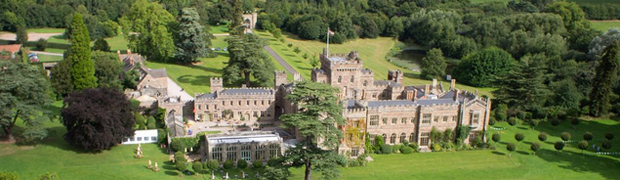
What is beauty? Though it is often in the eye of the beholder, some have attempted to define just what it is. In architecture, this can be seen in the development of the Picturesque ideal which sought to combine natural and man-made elements to compose a vision which would delight the eye and uplift the soul. Hampton Court in Herefordshire, and another house launched this week, Lasborough Park in Gloucestershire, can both be considered part of the Picturesque movement, even though the former took shape before the theory of the sublime and beautiful was brought to life and the latter was built just before the revival took hold.

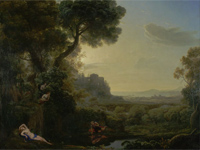
'Landscape with Narcissus and Echo' - Claude Lorrain, 1644 (Image: National Gallery)
‘Landscape with Narcissus and Echo’ – Claude Lorrain, 1644 (Image: National Gallery)

The origin of the Picturesque movement can, in part, be found in the philosophical writings of a much under-rated figure of the 17th-century, Anthony Ashley Cooper, the third Earl of Shaftesbury.  To him, nature ought to be imperfect and that, in turn, we ought to celebrate the untamed trees and serpentine rivers, those dark glades and tumbling crags. Unsurprisingly, the Earl found that the early Italian landscape paintings by Nicolas Poussin, Gaspard DughetClaude Lorrain and Salvator Rosa, reflected best this vision of a wilder natural world.  Landscapes had been unfashionable when Lord Shaftesbury first arrived in Italy in 1686, but by the turn of the century, they were in high demand amongst the grand tourists who carried these canvases back to the UK and into the popular taste of the nation.  These views married with Vanbrugh‘s early call in 1705 for a more natural approach to landscaping at Blenheim Palace, but found its true champion in William Kent in the 1730s, especially in his work at Rousham, Claremont and Stowe. The ideas were then developed further in 1757 in Edmund Burke’s ‘The Origin of our Ideas about the Sublime and the Beautiful‘ which, in its musing on aesthetics, distinguished between the latter, which was all about smooth lines and bold colours, whereas the former is about an awesome beauty on an almost fearful scale.

The death of Lancelot ‘Capability’ Brown in 1783 created a vacuum which led to the revival of the debate as to the most tasteful approach to landscaping.  The arguments were largely between Humphry Repton (who defended Brown’s ‘contrived natural’ approach of smooth curved borders and sweeping lawns which ran right up to the house) versus Sir Uvedale Price, 1st Baronet (b.1747 – d.1829), author of the ‘Essay on the Picturesque, As Compared with the Sublime and The Beautiful’ (1794), who, along with Richard Payne Knight, sought to create a more ‘robustly natural’ approach, where blasted tree stumps and ruins were also important.  This mirrored the first wave of the Picturesque to some extent, but this later flourish created a new passion to rediscover the beauty of the same painters whom Lord Shaftesbury had admired decades earlier.  Although neither Price or Knight worked on any gardens other than their own, their ideas were to have a dramatic impact on the settings of country houses, which were now considered as part of the overall composition rather than separate from it; formal gardens were swept away and snaking carriage drives now swept visitors through glades and past vistas before their arrival.

Detail from 'The Southeast Prospect of Hampton Court, Herefordshire' by Leonard Knyff, c1699 (Image: Wikimedia)
Detail from ‘The Southeast Prospect of Hampton Court, Herefordshire’ by Leonard Knyff, c1699 (Image: Wikimedia)

The grand formalism of the gardens of Hampton Court c1699 (above) contrasted with the asymmetrical grouping of the house. ‘The Southeast Prospect of Hampton Court, Herefordshire‘ by Leonard Knyff, shows how the grounds were a vision of control; of formal avenues and canals (see also the companion North prospect view). The house was, at this time, owned by the Coningsby family, having been bought by Sir Humphrey Coningsby in 1510 from a fellow courtier. His son became the first Earl of Coningsby and it remained in their family for 300 years.  Sir Richard Arkwright (1732-1792), who famously made his fortune from bringing the industrial revolution to the cotton industry, bought the house and 6,220-acres in 1810 for £226,325 (approx. £6.2m). His son, also Richard (1755-1843), made another fortune, before inheriting from his father in 1792, and invested in significant country houses, one for each of his five sons. However, the most significant changes came under his (fourth) son, John, who decided that ‘…of all the situations I know, there is none which suits my taste so well as Hampton Court‘ (funny that). After John’s marriage, the requirements of a growing family persuaded his father that the house needed to be enlarged.

The man chosen to design the work was Charles Hanbury-Tracy, a gentleman architect who had built his own home, Toddington Manor, between 1819-40, in his favoured ‘gothic collegiate’ style at a cost of £150,000 .  Though the style was sympathetic to Hampton Court, the relationship between architect and client became difficult. Another architect, John Atkinson, had pleaded with Hanbury-Tracy not to ‘make Hampton Court a cell to the Abbey of Toddington‘ but his determined views were at odds with Arkwright’s wife, who fell out with Hanbury-Tracy over the nursery arrangements, which led to nearly a decade of alterations and disagreements, especially as the costs mounted to eventually total over £30,000. John certainly preferred working with Joseph Paxton, who created the new conservatory, which was added in 1845-46. That said, the end result is one which successfully married old and new, creating a successful interpretation of domestic gothic and the picturesque.

Lasborough Park, Gloucestershire - £12m, 55-acres (Image: Savills)
Lasborough Park, Gloucestershire – £12m, 55-acres (Image: Savills)

The Picturesque was a constant presence throughout the 18th-century but enjoyed a revival of interest in the 1790s and Lasborough Park represented the style just at the cusp of this.  Built in 1794 for Edmund Estcourt, his architect was James Wyatt, who enjoyed a rare skill in being able to master a number of different architectural styles – something which led later to his being unjustifiably underrated.  At Lasborough, Wyatt provided a continuation of the theme which John Martin Robinson in his book on the architect called a ‘toy-fort model‘; that is, a symmetrical house with battlements and corner turrets.  Wyatt had been using this pattern when working on various schemes for remodelling the interiors of Slane Castle since 1773 but it was only over ten years later that he was able to remodel the exterior, taking an irregular L-shape and bringing symmetry by adding matching towers.

Slane Castle, Co. Meath (Image: Slane Castle)

Wyatt’s design developed the tradition of the castellated residence; houses which had been either adapted from an older fortification or made to look like they might have done. Six decades before Wyatts’ work at Slane Castle, earlier versions, such as Howth Castle, Co. Dublin, which was altered significantly in 1738, are evidence that the style was already favoured and also incorporated an effort to create symmetry with the original keep on the left, mirrored in a new tower on the right.

The Picturesque style was popular in Ireland but initially as an import of the Protestant aristocracy and was viewed by some as an attempt to import a ‘little England’, a form of architectural and landscape colonialism. However, Ireland was particularly suited to the forms of the Picturesque which often worked in harmony with its natural beauty to form a unified creation which led the eye of the visitor from the grounds near the house, towards the middle distance, and then out to the wider landscape – much as a painter would structure their picture.

Hampton Court from south west (Image: Knight Frank)

Hampton Court is one of the most important and impressive country houses to come to the market this year.  As part of our heritage, it embodies architectural developments which brought the country house from fortification to domestication, with a landscape which started with formal terraces but finished with flowing lawns.  The genesis of the more structured medieval revival form of Lasborough Park can be seen in the core of Hampton Court and in each of the subsequent alterations.  Both houses are valuable pieces of the nation’s architectural record and deserve owners who will appreciate them and hopefully both will remain as single family homes, enjoyed as they have for generations, for their Picturesque beauty.

——————————————————————-

For a more in-depth history of the Arkwrights and their time at Hampton Court, I recommend: ‘Champagne & Shambles – The Arkwrights and the Country House in Crisis‘ by Catherine Beale [Amazon]

Sales details:

Articles: