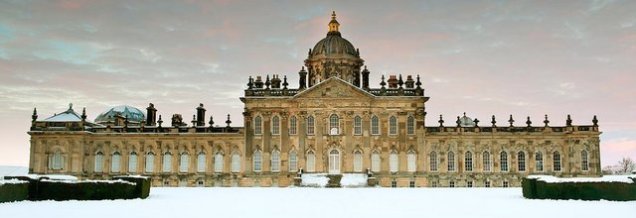
Castle Howard, Yorkshire (Image: Tricky via Flickr)
I started updating this blog regularly in January 2010 so it has been fascinating and humbling to see over the past year just how many others share my love and interest in UK country houses. So, thank you to all those who have visited and a particular thanks to the many kind people who have shared information and commented on the various stories – it is very much appreciated.
The blog will be back next year with more stories about the glories of our country houses, updates on the threats they face, and anything else related. I’m also aiming to visit more houses (including a trip to Derbyshire to see the Cavendish houses and others) and highlighting those which come up for sale in Country Life magazine and elsewhere. There will naturally be fewer updates over the next couple of weeks so I’d like to take the opportunity to wish you all a very Merry Christmas and all the best for 2011!
The size of a country house was traditionally the physical embodiment of the wealth (or aspirations) of the owner. Yet as the role of the country house changed and the emblems of power altered, new, smaller forms of houses to emerge for both the aristocracy and minor gentry. The acceptability of a smaller house was to prove valuable in the financial crises of the 20th-century – though this is not to say that the later houses lacked anything in terms of quality of interiors or the richness of the architectural language used outside.
Wealth was obviously the most important consideration when deciding on the size of the house. However, the learned sophistication of many of the lesser aristocracy meant that although their funds may not be able to provide a palace, they were well-versed in the aesthetics of good (often Classical) architecture. This meant they were able to commission or design for themselves coherent and elegant smaller houses, giving us the much-coveted Queen Anne or Georgian smaller houses we see today up and down the country, such as Puslinch House in Devon.
The considerations in the 20th-century were also financial but driven by a different set of demands. The financial pressures of the early part of the century, particularly the agricultural slump and the Wall Street crash, naturally limited the size of the houses built (though not all e.g. Gledstone Hall by Sir Edwin Lutyens built in 1926). Yet, the changing social climate also meant that not only was it considered somewhat insensitive to build such large palaces, it was also unnecessary as the houses no longer required so many bedrooms to accommodate the now vanished armies of staff and house guests who used to turn up for the large weekend parties.
Hurtwood Edge, Surrey
Yet smaller didn’t have to mean less interesting as architects faced up to the new challenges with intelligent interpretations of Georgian, whilst others sought to experiment with different styles, such as at the now grade-II listed Hurtwood Edge in Surrey, where the builder/architect Arthur Bolton created an Italian villa in the English countryside.
In the immediate period following World War II, many larger houses, having been requisitioned and mistreated, were demolished, but the families often retained the ancestral estate but now required a new seat. The tight restrictions on materials, particularly for ‘luxury building’ under the Socialist Attlee government, naturally limited the ambitions of the owners. Yet the election of Conservatives in 1951 ushered in the gradual lifting of the restrictions until their abolition in 1954 which allowed a new wave of construction. The war seemed to have had a lasting effect – or maybe fear of a future Socialist government enacting a tax based on house size – as many of the houses were significantly smaller than those in previous eras.
Eaton Hall by John Dennys for Duke of Westminster (Image: Kathryn Gammon)
An example of this is Eaton Hall, seat of the Dukes of Westminster, where, following the demolition between 1961-63 of Sir Alfred Waterhouse’s high Gothic-Revival masterpiece, it was decided that a new house should be built. The commission went to John Dennys, who happened to be the Duke’s brother-in-law, for a starkly modern house which sat cross-wise on the main axis of the old house. Unfortunately in this case the new house was overwhelmed by the grandeur of the setting, appearing too small against the remaining buildings and the as the focus for the grand gardens. Worse, the house was unsuccessfully remodelled again in the late 1980s in an almost French chateau-style to create a larger house.
In recent years, planning restrictions have usually limited the size of new houses (though not always; see my recent post on large houses). The lack of architecturally educated clients has naturally led to a growth in crass, ugly smaller country houses, but all is not lost as determined clients are still able to demand and produce good designs, such as the one proposed for Harewood Park in Herefordshire, now mooted as the potential marital home for Prince William and Kate Middleton.
Harewood Park (proposed), Herefordshire (Image: Craig Hamilton Architects)
Ever since the Harewood Park estate was bought by the Duchy of Cornwall in 2000 as part of a larger purchase of 12,000 acres, rumours had been circulating that it would be for one of the Princes. The original house had been demolished in 1959 so the expectation was that another would have to be built if it was to have such a role. Considering the views of the Prince of Wales on modern architecture there was little surprise when a planning application was submitted in 2006 for a strongly Classical small country house by Craig Hamilton Architects.
Craig Hamilton originally prepared three designs but the final design (shown above) complements the existing stables and is perhaps the most interesting and the one successfully submitted for approval.
The house is based around the motif of the triumphal arch but, apparently drawing on the influence of Sir John Soane, it presents a simplified version rather than the more decorated versions often seen. Soane was schooled in the Classical style but re-invented the language to create a new direction for Neo-Classicalism; a much simpler version with an emphasis on the effective use of space and most importantly, light. Soane spent several years in Italy and was well-versed in Roman architecture and incorporated the three-arch motif into his designs, notably the entrance front to his own house at Pitzhanger Manor, Ealing, west London, and in one of his most impressive commissions for the old Bank of England (scandalously demolished in the the 1920s) as seen in the internal Lothbury Court.
The new Harewood Park is an inventive extension of this Soanian language and it’s encouraging that the planners had the courage to approve what will surely be one of the most interesting smaller country houses built in the UK. Sadly, I suspect that for security reasons, we won’t see the house featured in Country Life but I keep my fingers crossed.
Competition: nominate your choice for ‘England’s Favourite House’
Competition: 'England's Favourite House'
This seems a good moment to mention the competition to find the best smaller country house (i.e. with less than seven bedrooms). Most people have a favourite and usually it’s not so much the grand palaces of Chatsworth or Blenheim but the smaller houses of our local areas which form part of our local heritage. The competition is being run by Country Life magazine and Savills the estate agents and the house should be in private ownership and not currently for sale. The deadline is Wednesday 24 November 2010 so submit your suggestions as soon as possible.
Country houses are often launched on the market to catch either bonus money early in the year or those looking to move before the summer. However, circumstances or owner preference can lead to some interesting houses being given a promotional push in the autumn (usually through Country Life magazine) to catch those who fancy Christmas in front a different log fire. So, here’s a quick round-up of some of the better country houses currently for sale.
Upton Pynes, Devon (Image: Upton Pynes website)
Easily one of the most impressive houses is one that has always been a sign for me that I’m nearly home when travelling back to Devon on the train. Just outside Exeter is the beautiful grade-II* listed Upton Pynes, which, despite the very English sounding name, bears a striking resemblance to a French chateau. Built c.1700 by Hugh Stafford with very sympathetic later additions, this large but elegant house sits in a commanding position in the Exe Valley, perfectly positioned to catch the sun throughout the day, giving the red-brick façades a warm glow. Described by Pevsner as “…an excellent example of the stately double-pile house that became popular after the Restoration but is relatively rare in Devon.”, the interior features a particularly grand entrance hall created as part of alterations in 1852 by the architect Ambrose Poynter for Sir Stafford Henry Northcote (later the Earl of Iddesleigh). The main interiors of the house, including an enfilade of rooms on the south front and a notable library, largely dates from 1700. The house also has the claim that it was the one Jane Austen had in mind when describing ‘Barton House’ in ‘Sense & Sensibility’. The house still requires some restoration but will definitely reward whoever completes this grand project.
Sometimes a grand house designed by an interesting architect can remarkably remain unlisted, as is the case with the Edwardian Crendle Court in Dorset which was designed by Walter H. Brierley (b.1862 – d.1926) who has been described as ‘the Yorkshire Lutyens’. A prolific architect, he designed over 300 buildings including schools, churches and several country houses including the elegant neo-Georgian Sion Hill Hall in Yorkshire. Brierley was a versatile architect able to work successfully in various styles though with a preference for ‘Wrenaissance’ – a modern re-working of the architectural language of Sir Christopher Wren. Crendle Court was built in 1909 and features elaborate ornamental plasterwork in the main reception rooms by George Bankart, and sits, well, more luxuriates, in 270-acres of grounds. Considering the architect and the quality English Heritage ought to send someone round to evaluate and spot list it before it gets ruined by someone with more money than taste.
Other significant houses available were launched earlier but are now being promoted following price cuts. One such house is the grade-II* listed Rudby Hall in Yorkshire, which was originally given a guide price of £3.5m but now is offered at £2.75m. Designed by Anthony Salvin in 1838 for the 10th Viscount Falkland, who originally called it Leven Grove, but by the late 19th-century it was known as Skutterskelfe Hall before being given its present name by the company which owned it in the 1990s. The house was restored in the 1980s and comprises the main house but with the ancillary buildings converted into let accommodation bringing in a handy £50,000 p/a – so long as you don’t mind sharing your gardens, grounds and woodlands with them.
For those who fancy something more baronial, then Blairquhan Castle in Ayrshire, Scotland may be perfect. The core of the property is a tower house built in 1346 but was later given a new front by William Burn in 1820-24 to provide the imposing if slightly stern façade we see today. The estate was noted for it beauty with Lord Cockburn writing in 1844: “I rose early…and surveyed the beauties of Blairquhan. It deserves its usual praises. A most gentleman-like place rich in all sorts of attractions – of wood, lawn, river, gardens, hill, agriculture and pasture.”. What more could a squire desire?
Most of these houses seem to be with Savills so to even things up, and to include a house I’m surprised hasn’t sold already, is Beaurepaire in Hampshire. The house was featured on the blog in more detail (‘Phoenix for sale: Beaurepaire House, Hampshire‘) when it was first launched in June this year. The house is what remains after a devastating fire in 1942 destroyed the main block of the house, leaving the current service wing which was extensively refurbished and remodelled after WWII to give the elegant house which is for sale today. Approached down a long drive, what guest couldn’t fail to be impressed by the wonderful gates designed by Sir John Soane which guard the entrance over the moat? Sitting in a 250-acre estate, the £8m price tag is probably justified for the area – and the owner is apparently in no rush to sell so don’t expect any big price cut soon.
Charlton Park, Wiltshire (Image: Chesterton Humberts)
Country houses were always a community with not only the family but also a significant number of staff. Yet as these houses became more uneconomical and houses emptied, large sections often lay dormant, until the family moved out and, in darker times, the house might be demolished. However, conversion of the house into multiple individual homes offered a route to not only save the house but ensure that it was lived in rather than just used as a conference centre or hotel. These apartments are now highly prized and offer the fascinating possibility of living in a grand stately home without many of the burdens – but only if it was converted sensitively and the setting preserved, which sadly isn’t always the case.
The idea of converting country houses into smaller, more manageable units is a fairly modern practice, largely since World War II, though some smaller conversions had taken place previously. A pioneer was the now defunct Country Houses Association which was set up in 1955 to provide shared accommodation, with communal meals, for well-to-do retirees in good health in a style to which many residents had formerly been accustomed. The first house to be bought and converted, in 1956, was the red-brick Elizabethan Danny in Sussex. Next, in 1959, was the grade-I listed Aynhoe Park in Northamptonshire, a Soanian masterpiece with an elegant central block framed by two wings (though this has now been converted back into being a single home). These set the pattern which was successfully repeated for seven other houses, some of which remain as retirement communities despite the collapse of the CHA scheme.
Around the same time, Christopher Buxton formed ‘Period and Country Houses Ltd’ which focused on creating independent units within the house and estate buildings. Buxton had several notable successes such as the restoration of Kirtlington Park in Oxfordshire, keeping the splendid central portion as his own home, and also Charlton Park in Wiltshire, seat of the Earls of Suffolk, who currently still live in a portion of the house and own the 4,500-acre estate surrounding it.
In the 1950s and 60s, sale adverts for country houses often included the phrase “eminently suitable for conversion”. Other developers could now see the potential and developed their own schemes – but with little heritage protection they often did more harm than good. For them the key to getting the maximum profit was to cram in as many units as possible within the house and estate buildings before trying to built in the parkland. This sadly meant that the grandest rooms in the houses – ballrooms, libraries etc, – would be crudely sub-divided, wreaking their proportions and destroying decorative details. Sometimes developers simply developed the houses in the estate and then neglected to restore the main house, often citing the mounting costs of the work.
Northwick Park, Gloucestershire (Image: Cotswold District Council)
A sad example of where the house has been compromised through too many units is at Northwick Park in Gloucestershire, a grade-I listed house of 1686, with later work by Lord Burlington in 1728-30 for Sir John Rushout. An architecturally interesting house with a Classical east front topped with a decorated pediment, which contrasts with Burlington’s work on the east front, which was later, oddly, given shaped gables sometime between 1788-1804. Empty from 1976 with significant thefts of chimneys and doorcases and general deterioration, it was then bought including just 19-acres in 1986 by a local developer for £2m. With repairs estimated at the time to come to at least £1.5m, the local authority permitted some enabling development totalling 68 new units – with just six in the main house itself. However, the new properties had to be sited within the footprint of existing estate buildings leading to an overcrowded development with the house becoming almost an architectural ornament, lost in the rest of the residential development.
Many of the most successful and sensitive conversions have been undertaken by Kit Martin, a gifted architect who has saved some wonderful houses and been instrumental, with assiduous promotion by Marcus Binney of SAVE Britain’s Heritage, in demonstrating that it is possible to convert a house without compromising it. His particular skill was in dividing the houses vertically, rather than horizontally, which gave each residence (as they always are in KM’s developments – never apartments) a range of rooms and usually included one of the fine rooms. Starting with Dingley Hall, a beautiful but terribly derelict house at risk of complete loss, he has worked on a number of significant houses including The Hazells in Bedfordshire, Burley-on-the-Hill in Leicestershire, and Ecton Hall in Northamptonshire. His finest work, however, has been at Gunton Park in Norfolk, grade-II* listed house of 1742 designed by Matthew Brettingham with later work c1785 by Samuel and William Wyatt.
Formerly seat of Lord Suffield it had suffered a serious fire in 1872 leaving a large section of the main house as a burnt out shell. Fortunately for Mr Martin, extensive Georgian estate buildings had been constructed in anticipation of future work to enlarge the house which never happened, leaving him with a perfect opportunity to create a new community. He then proceeded to vertically divide the main house into four large 5,000 sq ft houses, with other smaller houses created in the wings and outbuildings. Having restored the house, he then sought to recreate the 1,500-acre parkland by William Gilpin and Humphrey Repton and has succeeded in re-acquiring over 1,000-acres and has been replanting over 6,000 trees – each one in the place originally marked out on Repton’s plan.
It’s not known in total how many country houses have been converted to multiple residences but it is probably at least between 40-50. Many of these would otherwise likely have been demolished so conversion is preferable but only where it respects the existing architectural heritage and setting. However, where successful, these fascinating properties allow the opportunity for those of lesser means to experience living in the grandeur of a stately home with the cost and responsibility of owning a whole one.
Examples of apartments currently for sale in country houses:
Throughout September, the increasing weight of each week’s ‘Country Life‘ magazine heralds the starts of one of the busy periods for launches of country houses. As an relatively unscientific barometer it would appear that the market is doing well with some impressive estates and houses being offered up to tantalise the armchair enthusiast and serious purchaser alike – but a few houses are still proving difficult to shift.
The September 1 magazine provided a summary of the successes of the year-to-date with glowing reports from estate agents who, despite some fears in January about an uncertain year ahead, are happy to highlight their successes. The article quotes Crispin Holborow of Savills who rightly points out that ‘best in class‘ houses will always sell quickly and for above their guide price if the right buyers start competing. He cites Ropley House in Hampshire which sold at over it’s guide price of £4.25m, as did the grade-I listed Shanks House in Somerset which was offered with 70-acres for £5.5m, but their biggest success was the coveted Chadacre estate in Suffolk with 680-acres which reputedly sold for more than double it’s £10m asking price. Other houses such as the elegant grade-I Worlingham Hall – regarded by Norman Scarfe as ‘the most beautiful house of manageable size in Suffolk’ – also sold over it’s guide price of £3.9m.
Other houses sold close to their guide include Peatling Hall in Leicestershire (mentioned on this blog in July) which was offered at £4.75m, whilst the stunning Compton Pauncefoot Castle in Somerset suffered from an unfortunately timed launch in September 2008 at £17m which knocked buyer confidence meaning that it hung around until Febuary 2010 before selling at £15m. Others had to drop their prices or accept being sold in lots with Kiddington Hall in Oxfordshire selling for £15m to Jemima Khan once the rest of the 2,000-acre estate had been sold (originally offered as one for £42m), whilst Fillongley Hall in Warwickshire has yet to find a buyer even after selling 400- out of the original 500-acres originally offered when it went on the market in 2005 (£3.5m, Savills). Pusey House in Oxfordshire, which was originally launched with 643-acres but when featured as the lead property advert in the September 15 magazine it was offered with just 67.
So who are the awkward squad? Grade-I listed Noseley Hall in Leicestershire is still with Knight Frank with the same acreage; though now at £12m rather than the original £14m asking price, and Iver Grove in Buckinghamshire, a pocket Palladian gem, is still being offered (again with Knight Frank) – though mysteriously with no price, so probably less that the £4.5m guide in February 2010; and way down from it’s original price of £6.5m when it was first launched in 2007. Up country, Yester House in Scotland is still available despite having had it’s price halved from £15m to £8m since the original launch in August 2008.
So, although the property market does seem buoyant, it does seem that some are struggling. Perhaps the flurry of launches will bring an influx of new buyers who may take a renewed interest in the harder-to-sell properties, but they equally may well wonder why they are still available and pass them over. It seems that some owners who are keen to sell are being flexible, either dropping the price or selling in lots, but for owners who refuse to budge the market may take a very long time to rise to meet what they think their property is worth. It seems flexibility is still a vital attribute whatever rung of the property ladder you are on.







 The Country Seat