‘An agreeable surprise’ – the country house and garden sculpture

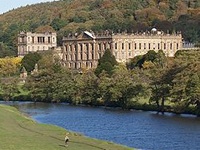
Statue - Castle Howard, Yorkshire (Image: Paul Barker / Country Life Picture Library)
Statue – Castle Howard, Yorkshire (Image: Paul Barker / Country Life Picture Library)

The country house has long been at a nexus of art, display and tourism with the treasures, mainly statues, collected by the owner shown in a grand gallery which often formed one of the main staterooms.  Whereas the house provided the setting for the art, outdoors, the gardens and parkland provided a setting not only for the house but also for the many sculptural works they had acquired – a trend which continues today, though often with a necessarily more commercial edge.

The first country house owners to place statues in their English gardens were the Romans.  However, as homes became castles, gardens fell from favour and with them, the ornaments to decorate them.   The trend for statuary only really returned with the Tudors and their love of the outdoor space as an extension of the symbolism they incorporated into the architecture of their houses.  One of the earliest collectors, and most acquisitive, was Thomas Howard Arundel, 2nd Earl of Arundel, who, as a youth, had been at the excavation of the Roman Forum, which had sparked a live-long passion for antiquities.  Arundel amassed one of the greatest collections of the age, rivalling that of the King, including a famed selection of Graeco-Roman statues found in Turkey, which became known as the ‘Arundel Marbles‘. These statues were then displayed at both their town and country seats, both indoors and out – though later, by the mid-17th-century, as a result of the uncertainties of the Civil War, John Evelyn found the Marbles “…miserably neglected, & scattred up & downe about the Gardens & other places of Arundell-house.”.  The statues were later donated to the Ashmolean Museum where they remain today.

The later rise and popularity of the Georgian grand tour firmly embedded the desire to purchase statues along with the requisite paintings. They provided a visual clue as to both the learning and wealth of the owner and so were displayed prominently, especially indoors where they might be shown in the entrance hall where guests would inevitably look at them as they waited. Some of the most famous dedicated indoor galleries include those at Holkham Hall, Norfolk, Chatsworth, Derbyshire, and Woburn Abbey, Bedfordshire (though sadly now not as shown in previous link as it’s now a wedding venue).  Other notable galleries, though now lost due to dispersal or demolition, were those at Clumber Park, Ickworth House and Hamilton Palace, the latter described as “…peopled with bronze statuary on Irish black marble bases polished to such a gloss that they reflected the pavement like a mirror.“.

Chiswick House, Middlesex (Image: curry15 / flickr)

Outside, the display was no less formal – symmetry and structure dominated.  However, by the 1730s, the more formal display of statues outdoors gave way to a more naturalistic style whereby they became almost secreted amongst a more informal – but no less planned – landscape.  One thing often forgotten now is that we see gardens after over 250 years of growth, but when first planted they would have been much sparser giving the ornaments greater prominence.  The return of the Roman influence can be closely linked with the rise of Palladianism and the influence of Lord Burlington and his circle; most notably, the brilliant designer William Kent. Other notable influences include Batty Langley, who published his ‘New Principles of Gardening‘ in 1728 and Stephen Switzer’s ‘Ichnographica Rustica‘, published in 1718 – the latter of which was the first to show serpentine walks and streams. Life also imitated art, with the popularity of the Arcadian visions of painters such as Claude Lorrain, Nicholas Poussin, and Salvator Rosa also inspiring those who collected the paintings to attempt to bring them to life.

Temple - Studley Royal Gardens, Yorkshire (Image: Matthew Beckett)
Temple – Studley Royal Gardens, Yorkshire (Image: Matthew Beckett)

The more secure and rising wealth of the 1730s enabled owners to create larger estates and so giving them more space to indulge their plans.  However, no stream will rival a raging river so to create a sense of theatre, the landscape was used and moulded to create a series of views which took advantage or distant landmarks or by introducing elements such as statues, temples and obelisks.  Often these gardens were designed to entertain the knowledgeable visitor with allusions to myths and noble virtues – though in one lesser known example, the owner of the famous Vauxhall Gardens in London, built a darker memento mori‘ garden at Denbies, his home in Surrey.

However, the main aim was to delight and to stimulate emotions. One of the most famous Georgian gardeners, Philip Miller, wrote in his 1739 edition of his ‘Gardener’s Dictionary’:

“In laying out these walks through woods there should be a great regard had to the neighbouring country, so as whenever there are any distant objects which appear to the sight, there should be openings to which the serpentine walks should lead, from whence objects may be viewed, which will be an agreeable surprise to strangers…”
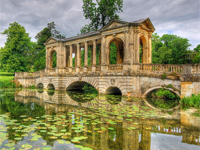
Bridge - Stowe House, Buckinghamshire (Image: Evoljo / flickr)
Bridge – Stowe House, Buckinghamshire (Image: Evoljo / flickr)

These principles were translated according to the whims and finances of owners across the country, leading from the sublime creations of Stowe, Stourhead and Studley Royal to many lesser known and private gardens.

The statuary could sometimes cause the odd drama. Dallam Towers, Cumbria was archly described by Pevsner as “…undoubtedly the finest Georgian facade in the county; but what the visitor may not realise is that, behind all the stucco, there’s the finest Queen Anne facade in the county.“. Between the facade and the landscape once stood (or perhaps still stands) a line of statues standing guard between the garden and the ha-ha. Yet this line is slightly marred by one of the statues being headless – the unfortunate outcome of a 1820s dinner which led to a very ‘well-refreshed’ Lord Milthorpe.  Thinking he had seen a poacher, he grabbed a rifle, and despite the protests of his guests, he duly dispatched the ‘poacher’/statue; a loss for the world of garden ornaments but perhaps a gain for the forces of law and order.

With such vast quantities of marble scattered out the gardens, occasionally a prized statue may slip slowly into obscurity. This can lead to discoveries in the same way that an Old Master may be found in the attic, so they can also be found in the shrubbery, such as this rare Chinese Ming tomb horse or the lucky owner of a castle somewhere in northern Europe who had a statue by the Renaissance sculptor Adriaen de Vries.

The tradition of sculpture in the gardens of country houses is certainly alive and well today and has developed beyond the more formal Roman statuary towards a decidedly more contemporary ethos – though perhaps more commercial than for simple pleasure.

'Huge Sudeley Bench' by Pablo Reinoso at Sudeley Castle (Image: Christies)
‘Huge Sudeley Bench’ by Pablo Reinoso at Sudeley Castle (Image: Christies)

At the beautiful Sudeley Castle in Gloucestershire, Christies are holding their selling exhibition of contemporary sculpture from luminaries such as Marcel Wanders, Marc Quinn and Pablo Reinoso.  Over in Sussex, the Cass Sculpture Foundation at Goodwood, hosts a regularly changing line-up with a focus on supporting emerging talent along with the more established artists such as Lynn Chadwick and Anish Kapoor.  One more recent venue is the Jupiter Artland at Bonnington House in Scotland, just outside Edinburgh.  The vision the Wilsons, who own the house, Jupiter Artland features large-scale works such as the monumental ‘Life Mounds’ by Charles Jencks’ who specialises in landscape art that I suspect would appeal to the likes of ‘Capability’ Brown if he were around today.

These are just some of the examples of contemporary schemes which are taking place across the country. Each is enlivening the grounds of a house and again maintaining that artistic thread which has been spun out over hundreds of years, linking country houses, an owners’ taste and some of the best art in the country.

————————————————————————–

More wonderful examples of works available outdoors can be seen in the Country Life Picture Library collection.

This blog post is a little off my usual patch so I’m grateful for the research of David Stuart in ‘Georgian Gardens

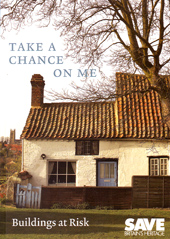
‘Take a Chance on Me’ – Buildings at Risk Register 2011

'Take a Chance on Me' - 2011 SAVE Buildings at Risk Register

Despite the obvious deep and passionate interest society has with historic buildings every year the SAVE Britain’s Heritage Buildings at Risk Register highlights just how many properties are still under threat from neglect and those in power who believe the only good building is a new one with their name on the opening ceremony plaque.  The 2011 BaR register – ‘Take a Chance on Me‘ – has just been published and sadly, as always, it contains some country houses which really deserve a better fate.

Perhaps the one of the most attractive, both architecturally and in terms of being a  case for restoration is Blackborough Hall, near Cullompton in Devon. This elegant, if thoroughly dilapidated grade-II house, is a remnant of the grand building plans of the Earl of Egremont whose many-columned main house, Silverton Park, was demolished in 1902.  The house is actually two, as when built in 1838, it formed one house at the front and a second at the rear for the local rector.  In recent years it became a car scrap yard which covers most of the immediate grounds and would obviously need clearing first – though I suspect the costs could be made back through selling some of the classic cars. The house is currently for sale for a nice round £1m and has been listed with Winkworths who, after an initially poor showing, have now managed to put a few more photos and a floor-plan online.

Elvaston Castle, Derbyshire (Image: Steve Tomkinson / Friends of Elvaston Castle)

Elvaston Castle in Derbyshire has a grade-II* listing putting it in the top 4% of buildings nationally but that hasn’t stopped it making an entry into the Register this year.  Originally built in 1633 for the Earls of Harrington it was largely rebuilt in a ‘Gothick’ style c.1817 to designs by James Wyatt.  Now owned and managed by Derbyshire County Council (who had a fairly poor record in the 20th-century of demolishing country houses in their ‘care’) it is today mostly vacant and with the Council now claiming it can’t afford to maintain it they are seeking a developer to get them out of a hole of their own making.  Luckily an active local campaigning group – the Friends of Elvaston Castle – have been objecting to these plans and trying to force the Council to face up to their responsibilities – though perhaps there is an opportunity for someone else to come up with a viable plan.

Stone Cross Mansion, Cumbria (Image: HiddenShadow / 28dayslater)
Stone Cross Mansion, Cumbria (Image: HiddenShadow / 28dayslater) - click for more images of the house today

Stone Cross Mansion, Cumbria presents the interesting confusion of a Scots Baronial design in England.  Built in the 1870s by a stubborn man, one Myles Kennedy, who wanted to buy Conishead Priory for £30,000, but who met an equally stubborn vendor who wouldn’t accept less than £35,000.  Mr Kennedy may have come to regret his obstinacy when presented with the final bill which totalled nearly £45,000.  The sum reflected the high quality of the workmanship, particularly the impressive High Victorian Gothic grand hall (scroll down) which originally had a fine staircase which was later removed when the house became a special school to make it easier to play indoor football (seriously, where do they find these people?!).  The house then became a corporate headquarters during which it time it was restored to a high-standard before falling into neglect.  Repeated enabling development proposals have been rejected (not that the council is against it) so this house either needs someone willing to restore the house on the back of a sensitive ED proposal – or, ideally, someone to rescue this house and make it a home again.

Plas Gwynfryn, Wales (Image: SAVE Britain's Heritage)

Another house which would make a fantastic home is Plas Gwynfryn in south Wales.  This house has been featured before on this blog (‘Orphan seeks new carers: Plas Gwynfryn, Gwynedd‘) which sparked some passionate debate in the comments about who the owner is – and that same unresolved question is why the house makes an appearance in the BaR this year. Built in 1866 to replace an earlier one, this distinctive house – described in the listing description as ‘romantically assymetrical’ – was a hospital in WWII, before becoming an orphanage and then a hotel before a serious fire in 1982 gutted it.  Although in a derelict condition this house can be restored and would once again be a fine part of the local architectural heritage.

The Register is available from 1 June 2011 priced at £15 (£13 to Friends of SAVE) and can be ordered from the SAVE website. The BaR contains many other types of property so even if your budgets are less lavish than these house might require it is well worth having a look.  Of course, SAVE does superb work across the country to protect our architectural heritage and I would strongly urge everyone to become a Friend to help support their efforts (well, I would say that as I’m on the Committee – but I’d also say it anyway!) which will also give you access to the online version of the BaR register which contains hundreds of other potential future success stories.

——————————————————————————–

A more comprehensive list of country houses currently at risk can be found on my Lost Heritage website: ‘Houses at Risk

Guest blogger: Jeremy Musson – ‘English Ruins: an odyssey in English history’

Having written all nearly 200 posts since I started writing this blog I now thought it would be interesting to try and broaden the voices involved.  So as the first post in this new direction/experiment, I am delighted and honoured that one of our leading architectural historians, Jeremy Musson, kindly agreed to write a piece on country house ruins linked to his new book published this month, ‘English Ruins‘, a fascinating look at their role in shaping our perceptions of the past and our architecture.

——————————————————————————————-

Jeremy Musson
Jeremy Musson

The English landscape is a landscape of ruins. Fragmentary or sometimes only roofless and windowless, these part dismantled buildings stand out to mark our national history in a number of different ways, and above all, provide a sense of historic scenery for our journeys, physical and imagined – and glimpsed from motorways and footpath alike. In this new book, photographer Paul Barker and I wanted to explore something of this particular cultural landscape and through this exploration trace something of how the English see themselves and their past.

I feel that we live in an old country, and the past is always there, to paraphrase T.S.Eliot, “pressing on the future”. Some love the past, some hate it, many are indifferent to it, happy enough to take pleasure in a good day out, with a dash of historic scenery. But the whole process of our encounter with ruins, is somewhat special – a deeply subjective, and in effect, an almost artistic experience. It is personal and often emotional, while it is also formed and shaped by a whole series of sometimes opposing cultural inheritances: Romanticism, anti-establishment, veneration for the classical, veneration for the Gothic, history seen through the very shape of the landscape.

There is something that seems to appeal about ruins to the English imagination over the centuries. Think of how John Aubrey, for instance, the late seventeenth antiquary and author of that amusing volume of English biography Brief Lives, observed that

“the eie and mind is no less affected with these stately ruines than they would be if they were standing and entire. They breed in generous mindes a kind of pittie; and set the thoughts aworke to make out their magnificence as they were in perfection.”

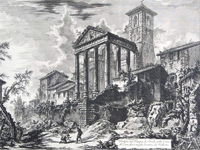
Piranesi: 'Temple of Hercules, at Cori' - 1769 (Image: Mattia Jona Gallery)

During the 18th century, the Grand Tour, part of the expected education of a gentleman or aristocrat, consisted of a journey through Holland and France to visit the great monuments of the Roman world, excited the aesthetic and cultural awareness of the 18th-century English gentleman, who was in turn the patron of artists and architects following the same path in trying to import the drama and excitement of great classical ruins to an English audience. Walk through any major house built in the 18th century, with anything of its original collections still in situ and the ruin is visible in painting after painting, and then echoed in the classical temples of the park.

The phenomenon of creating artificial ruins, in which the English seem to be pioneers, belongs to this period, and while the earliest garden temples seem to be classical, the contrivance of designing ‘ruined’ structures, was largely sourced in England’s own Gothic past. Horace Walpole the 18th-century diarist, who designed his own Gothic style house, Strawberry Hill, hugely admired the work of Sanderson Miller who designed a ruined tower at Hagley Park, with the perhaps slightly teasing phrase that it had “the true rust of the barons’ wars” referring to the Wars of the Roses.

When making this tour of England in tandem with photographer Paul Barker, I could not help noticing that we were often treading in the footsteps of the great landscape painter, J.M.W.Turner, for whom the evocative power of the ruin played a central role in his career, although we perhaps think of him most naturally as a landscape painter, and a painter of skies.

In the last years of the 18th century he exhibited numerous studies of great historical ruins in landscapes, appealing to the Romantic spirit of his audience – characteristically these are the foil for dramatic expositions of sky or sea. He continued to make special studies of ancient ruins, castles and abbeys on tours around the whole of England, for his ambitious Liber Studiorum project, and many were published in different histories, especially in Charles Heath’s Picturesque Views in England and Wales.

Turner looked principally at abbeys and castles, but abandoned country houses have come to be a feature of our landscape too. The dramatic changing status of the country house from the first world war, into the great depression of the late 20s and early 30s, becomes even more intense after the second world war – think of John Harris’s memoir, No Voice from the Hall. This was a period which resulted in so much change in English life, that it is easy to overlook the symbolic collapse of the world of the English country house. This was a feature of interwar life too, with the rise of income tax and death duties, but the upheaval of the Second World War, the widespread institutional use of country houses for military and other government purposes often hastened their subsequent abandonment.

Cowdray House, Sussex (Image: Cowdray Heritage Trust)

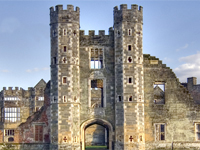
Inevitably, given my interest, the country house looms large in our new book. We focus on the story of buildings from different themes and for the ruins of country house, beginning with Cowdray House, in Sussex, a substantial Elizabethan mansion damaged by a fire in the late eighteenth century, and then abandoned, partly as a result of complications over inheritance; but quickly becoming a destination for artists, for instance, Turner visited the ruins while staying at Petworth – it is now looked after by a newly formed trust, and feels like the sets left over from a Grand Opera, standing amongst the meadows and paddocks on the edge of Midhurst.

We also visited the ruin of an elegant early-seventeenth-century lodge at Wothorpe Towers, a lodge once part of the Burghley estate, which was used as a dower house and then, apparently, part dismantled to provide an eye-catcher in the new landscaped park. It was falling into serious decay and has recently been taken on by the Griffin family, who putting the main house into a trust, which is restoring the gardens, are converting the ancillary seventeenth century buildings into a new home.

Seaton Delaval Hall, Northumberland (Image: Alan J. White / wikipedia)

The classical country house tradition is represented in our book, by 1720s Seaton Delaval Hall, near Newcastle – one of the finest houses by Sir John Vanbrugh, re-roofed after a major fire, the interiors are otherwise the very picture of a ruin. In Derbyshire, we encountered the memorable and mournful spectacle of Sutton Scarsdale Hall in Derbyshire, also built in the early 18th century. The latter, partly due to its proximity to mine-works, acquired in 1919, by businessman out to profit from its materials and fittings. The panelling was sold United States collectors, and some at least found its way into the Museum of Fine Arts in Philadelphia. Its demolition was in fact prevented by local landowner Sir Reresby Sitwell, whose family later presented it to the state.

James Lees Milne, looked at the Sutton Scarsdale ruins for the National Trust, but said that “classical ruins in England are much satisfactory than Gothic ones, the lack picturesque gloom.” English Heritage look after it now, as they do Witley Court, a multi-layered great house and former seat of the Earl of Dudley, a splendid Italianiate palace with a vast portico by John Nash, was burnt out in 1937, and by some chance was not demolished during the 1950s, like so many abandoned houses, and it was subject to preservation order in the 1970s, and in the early 70s taken into state protection. Christopher Hussey thought that it conjured the beauties of the classical ruins visited by the Grand Tourist in the 18th century, as much as anything else.

Lowther Castle, Cumbria

Forgotten Victorian Gothic mansions such as Lowther Castle in Cumbria, possibly become more Romantic in their ruined state. Lowther, the historic seat of the Earls of Lonsdale, designed by Smirke in Gothic baronial style was not re-occupied after the second world war, and in 1957, de-roofed and only the exterior walls preserved. A haunting presence in the beautiful Cumbrian landscape, a new trust has been created to protect the runs and open them and the overgrown Edwardian gardens to the public, in the course of 2011.

For myself, as a historian of the English country house, there is no doubt that the ruin occupies a special place in English culture; the castle, the abbot’s lodgings, the country houses of the sixteenth century onwards, when they stand open to the elements, draw us in to a dialogue with our history and the mutability of fortune.

Jeremy Musson’s ‘English Ruins‘ with photographer Paul Barker, is published by Merrell publishers.

Text by Jeremy Musson, choice of links and images by Matthew Beckett.

——————————————————————————————-

Dear Readers – as always I welcome your comments and feedback.

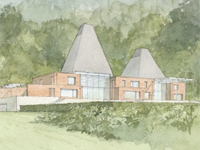
The future of the country house? Alderbrook Park, Surrey

Proposed Alderbrook Park, Surrey (Image: PRS Architects)

Within any established pattern there is always the shock of the new. Most people when asked to imagine an English country house will usually think of red-brick Jacobean or light-stone Georgian but the design of new country houses is always in flux and what has gone before is no guarantee of what will come. Following World War II, the aftermath of which led to the demise of many large houses, the fashion changed to have a smaller but more modern house – one which required fewer staff and perhaps used more contemporary architectural language; however much it was derided by others.

Queen's House, Greenwich (Image: Bill Bertram / wikipedia)

The nature of architectural innovation has usually been one of gradual change – subtle at first and then growing bolder.  For example, Palladianism is widely seen to have arrived rather dramatically with the building of the Queen’s House in Greenwich in 1616 to a design by Inigo Jones.  Jones had recently studied Palladian architecture in Rome for three years and this commission was his chance to put this into practice.  One can imagine the surprise of Londoners, long used to timber, gables, and red-brick, to the square, stuccoed, and very white, Queen’s House.  Yet Sir John Summerson argues that there is evidence of Palladianism in the plan of Hardwick Hall in Derbyshire, built in the 1590s by Robert Smythson.  Here, the placing of the hall on the central axis of the main entrance and the colonnades between towers front and back, echo the layout of Palladio’s Villa Valmarana featured in his Second Book of Architecture, making Hardwick the first known use of Palladio by an English architect.  This quiet use would have meant that visitors would have become accustomed to a symmetrical, regularised interior, paving the way for the same style to appear externally.

As much as the role of ‘architect’ took time to develop, so to did the responses to their work.  In 1624, Sir Henry Wotton, writing in his ‘Elements of Architecture‘, bemoaned the lack of ‘artificiale tearmes’ – that is, language with which to describe architecture.  Yet William Webb, writing in 1622, managed to praise the then new Crewe Hall in Cheshire, saying that the owner, Sir Randolph Crew;

“…hath brought into these remote parts a modell of that most excellent for of building which is now grown to a degree beyond the building of old times for loftiness, sightlines and pleasant habitation…”

So, ever since we’ve had architects, we’ve had critics (who were also sometimes architects); Jones, Wren, Ruskin, Pugin, Morris, Lutyens, Pevsner, etc have all made their opinions known.  Overseas visitors were also apt to compare what they had seen.  Jean Barnard le Blanc, visiting in 1737-8, was well educated and travelled and critical of the emerging use of Italian designs in England saying;

“These models have not made the English architects more expert; for whenever they attempt to do anything more than barely to copy, they erect nothing but heavy masses of stone, like of Blenheim Palace…”

As the language developed and architecture became more academic it became more rigorous and perhaps dry, with light relief afforded by more waspish commentators such Sacheverell Sitwell.

So why are some houses criticised more than others?  It seems that houses which appear without the ground being prepared before them suffer most.  The shock of the new is unmitigated and particularly where there is a strong local vernacular, the language of the new house will be a greater change.  More broadly, where a house is seen to be breaking with old traditions and what is seen as the ‘appropriate’ style for a family or an area, criticism can be swift and strong.

Eaton Hall by John Dennys for the Duke of Westminster (Image: Kathryn Gammon)

One example of this is Eaton Hall in Cheshire following the unfortunate demolition between 1961-63 of the vast Victorian masterpiece designed by Alfred Waterhouse.  The loss of the house left a gaping hole at the centre of the estate with large gardens and long tree-lined avenues leading to nowhere.  The 5th Duke decided to rebuild and commissioned his brother-in-law, the architect John Dennys, to design a very modern replacement.  The resulting house, although striking, was regarded as unsuccessful, with John Martin Robinson saying,

“The sad fact is that, while from a distance the new Eaton has some of the classic Modern impact of the Corbusier dream…close up it is rather disappointing…”

Yet rather than criticising the house for not being in the traditional language of the English country house, Robinson is saying that it’s not Modern enough.  Others disagreed, with perhaps the most amusing response coming from the Duke of Bedford before it was even built.  Writing in 1970 after the unveiling of the design, he wrote;

“I was interested to see…a sketch model of Eaton Hall.  It seems to me one of the virtues of the Grosvenor family is that they frequently demolish their stately home [Waterhouse’s being the third on the site]. I trust future generations will continue this tradition if this present edifice, that would make a fine office block for a factory on a by-pass, is constructed.”

Proposed Grafton New Hall, Cheshire (Image: Ushida Finlay Architects)

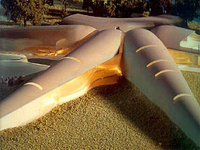
In more recent times, one design which met with critical acclaim but was perhaps a step too far was the Ushida Findlay design for Grafton New Hall, Cheshire.  Their house was a response to a 2001 RIBA competition to ‘design a country house for the 21st century’.  In creating their radical ‘star-fish’ layout they were rejecting the established patterns and trying to create a new response to the same requirements for the functions of a country house.  Yet the house never found a patron and, tellingly, the house now being constructed is a classic of modern Palladianism, designed by the pre-eminent Classical architect, Robert Adam.

There are, of course, many other examples of intelligent but unpopular designs for modern country houses – for example, Wadhurst Park in Sussex for TetraPak billionaire Hans Rausing.  And it’s in this constant stylistic flux into which Lakshmi Mittal has pitched the very radical designs for his new house on the 340-acre Alderbrook Park estate which he bought four years ago for £5.25m.  The original house by Richard Norman Shaw for the Ralli family was demolished in 1956 as too large, with a poor, inadequate substitute built in the 1960s.  The estate was sold with the express intention of demolishing this house and in its place Mittal is proposing a £25m, carbon neutral ‘eco-home’.  To help achieve this, the design of the house is driven by the functional requirements to minimise heat loss, to be cooled by natural ventilation, and have hot water provided by pyramid chimneys which incorporate solar thermal collectors which will help also vent heat in summer.  This house is a rejection of the idea of the house as an aesthetic construct in a particular architectural style but is more Corbusier-like; a ‘machine for living’ – a somewhat depressing prospect.

Grafton New Hall, Cheshire (Image: Robert Adam Architects)

So what does the future hold?  The natural course of the development of the country house has been its adaptation to the whims and preferences of the owners.  As younger generations have taken the reins they’ve chosen different and perhaps more fashionable styles – and without change we wouldn’t have the Georgian mansions or Lutyens to love. However, each of the previous styles could be seen as natural evolution which reused a broad architectural vocabulary which was instantly recognisable as distinctively rural.  What seems to jar with the very modern designs is that they seem to use a more urban, industrial language to interpret the form of the country house.  This seems to sit somewhat uneasily with our preconceived notions as to what a country house should look like – but who knows, perhaps in 50 years maybe it’ll be accepted and appreciated and we’ll be concerned about the next stylistic evolution.  I still prefer Georgian Palladian.

Going to the country: the country houses of UK Prime Ministers – Part 1

Houghton Hall, Norfolk (Image: Dennis Smith / Geograph)

Those in important political roles have often sought to escape the pressures of office by escaping to the calm and tranquillity of the countryside.  This has been particularly true of the holder of the most important role; that of Prime Minister.  With early PMs drawn from the aristocracy, their backgrounds provided them with a seat which became a natural refuge but was also an important part of their political identity.  However, as their origins changed, so too did the nature of the country retreat.  However, for all PMs the country retreat has been a fairly constant feature – though not all aspired to live in grandeur.

To make this broad survey more digestible I’ve split this into PMs by ruling monarch, starting from when the role of Prime Minister was first recognised in 1721 under King George I.

The first holder of the office, Robert Walpole, 1st Earl of Orford, was the epitome of the aristocratic leader.  Walpole was born at Houghton Hall in Norfolk – though the house was a more modest one before Sir Robert engaged Colen Campbell in 1722 to rebuild it, creating one of the finest Palladian houses in the country.  The second PM was Spencer Compton, 1st Earl of Wilmington, who also employed Colen Campbell in 1726 to create a more modest home; Compton Place in Sussex.

The seat of Henry Pelham, who became the 3rd PM in 1743, was (according to Howard Colvin) Esher Place in Surrey which he bough in 1729. In 1733, he commissioned William Kent, who was also to create some garden buildings for Claremont for the Duke of Newcastle (see below), to add wings to the original house, Wolsey’s Tower, in a Gothic style.  The wings and garden buildings at Esher have now been demolished but drawings survive in the Victoria & Albert Museum in London.

Pelham was succeeded as PM by his older brother, Thomas Pelham-Holles, the 1st Duke of Newcastle, whose main seat was Claremont in Esher, Surrey which he had bought from Sir John Vanbrugh who had built a ‘very small box’ as his own home.  The Duke then commissioned Vanbrugh to extend the house, adding two large wings.  This house was subsequently demolished as unfashionable by Clive of India who had bought the estate in 1768 following the Duke’s death, before being rebuilt in the Palladian style we see today.   The Duke also had other homes including in Halland, Sussex, an area the Pelham family had dominated since 1595 when they first bought land there.  Halland Place was also sold in 1768 and later demolished for materials.  [Originally I gave Welbeck Abbey as his seat but it was, in fact, inherited by the Holles Earls of Clare branch of the family creating a bitter feud.  A more detailed history of the feud is given by dennis in this comment below (thank you for the correction).]

One of the most fascinating houses in the country, particularly due to the extensive tunnelling work commissioned by the 5th Duke, but also one of the least known due to the reclusiveness of the Bentinck family and then later due to its role as the Army Sixth Form college which ensured military-level privacy. The house was largely the work of Sir Charles Cavendish who was given the house and estate by his mother, the remarkable Bess of Hardwick. [Corrected in response to comment below]

To complete the list of aristocratic PMs during the reign of George I (1714–1727) and George II (1727–1760), the last was William Cavendish, 4th Duke of Devonshire who lived in the peerless Chatsworth in Derbyshire – then, as now, one of the finest of our large country houses.  Interestingly, at the same time as he took on the role of PM in 1756, he also engaged in building at Chatsworth employing James Paine to add a new office wing and court (later replaced by Sir Jeffry Wyatville), a stable block, a bridge in the park, a bridge at Beeley, a water mill and also alterations to interiors of the house – though this work was not to be completed until 1767, long after his time as PM finished in 1757.

One notable feature of all the first PMs was they were all Whigs, a party nicknamed the ‘Country Party’ for their support was strongest in the shires and amongst the great landowners.  Unsurprisingly, these leaders were already managing vast estates which naturally came with sizeable houses which reflected their status – which then gave them the authority to aspire to be PM.  At this time, elections were rather crude affairs with the major landowners having MPs in their pockets due to ‘rotten boroughs‘ which gave the landowner a disproportionate, not to mention undemocratic, influence in the Houses of Commons.  Their country houses were therefore not a symptomatic trapping of power, something that they had aspired to and then acquired, but, in fact, were the foundation of the power which had secured them the position in the first place.

Chatsworth House, Derbyshire

Architecturally, the apparently only acceptable styles were either Palladian or Classical which reflected the political nature of the landowners – symmetry, structure, proportion and the use of the correct orders would have appealed to those who were against monarchical absolutism (which would have challenged their own power) but also reflected a societal structure which ensured their wealth and status.  The Whigs were also closely associated with the Church of England and, as such, would not have entertained the idea of building their houses in the ‘Catholic’ Gothic style, and anyway, with the neo-Gothic movement only really starting in the 1740s it would be several decades before it gained real influence.

So the early years of the role of PM was dominated by the existing ruling class; the great landowners who now shifted from trying to solely influence events through the levers of Royal favouritism (though their support of the Hanoverian succession and therefore King George wasn’t overlooked) to the use of Parliament – though on their terms.  The houses which had often been built to attract and impress a visiting monarch in the hope of securing influence now shifted to helping build alliances with other landowners – and what better way than creating a home they would feel comfortable in? Architecture had become a key part of the political landscape; a physical expression of certain values but also part of a supporting cast which would build the alliances which elevated men to be Prime Minister.

Next: a change of King, and a new PM.

List of UK Prime Ministers

Thanks to Andrew for the original suggestion for this survey