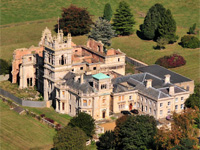
Ferne Park, Wiltshire: the building of a modern Classical masterpiece

Ferne House, Wiltshire (Image: Q&F Terry, Architects)

The English country house is considered our greatest contribution to the field of architecture – the unified vision of house and landscape combined with fine interiors, superb furnishings and exceptional art collections.  Yet in the 20th-century, it seemed that after Lutyens we largely lost our ability to excel in their creation – the new country houses seemed shadows of our earlier confidence, lacking the grand flair, and certainly the detailing, which had so defined the Georgian Classical house.  This was partially due to financial circumstances but also due to the influence of modernism which sought to re-interpret the country house in a new language – and it often didn’t translate well.

Yet, there are signs that given the right client and the right architect, we can again create the sort of country houses which will be admired in 200 years. Country Life magazine this week (5 May 2010) features one of the best country houses to be built in the last 70 years; Ferne Park in Wiltshire, winner of the Georgian Group award for the Best Modern Classical House in 2003.

This is a house built in the finest traditions of the English country house – with its clear use of the Palladian vocabulary but skilfully reinterpreted for the location and the needs of the client, Lady Rothermere.  The architect responsible, Quinlan Terry, has been responsible for some excellent buildings but this may well be his best.  The new house, built in 2000-2, was on the site of a previous Georgian mansion called Ferne House which was demolished in 1965 having fallen into a poor condition.  By rebuilding on the same site, Terry had a setting which was simply waiting for a new house to be created.

The local authority had already set the requirement that the new house must be Classical so both client and architect drew on other houses they knew such as Came House (Dorset) and Castletown Cox (Ireland), and were able to develop a distinctive plan for the site.  The house also cleverly has contrasting fronts with the dramatic views to the north matched by the stately columns and pediment, whilst the south, with the gentler views into Dorset, using a simpler facade.

Ferne Park has revived hope that it is possible to build a successful Classical house which is recognisably a continuation of the the glorious Georgian traditions which have created so many of the houses we love today.

More pictures of the house: Ferne House, Wiltshire [Quinlan & Francis Terry, Architects]


Part II of the article will be published in the 12 May 2010 edition of Country Life.
If you thought ‘The Restoration Man’ projects a bit small-fry; try Overstone House

Overstone Hall, Northamptonshire (Image: Martin Sutton on flickr)

Although hated by Samuel Loyd who commissioned it, Overstone House is fondly remembered by the generations of girls who were taught there after it became a school.  A vast, rambling property, it was sold to an obscure evangelical religious group who lived there until a devastating fire in April 2001 destroyed the main part of the house – although Loyd might have been quite relieved.

Overstone House replaced the earlier Overstone Hall and was built in 1862 for the banker Samuel Loyd, who became Lord Overstone for services to finance.  His wife  was keen to have a property commensurate with their status and so her husband decided to rebuild on a grand scale.  However, he inexplicably picked the unknown architect William Milford Teulon (brother of the more famous Gothic revivalist Samuel Sanders Teulon) who was instructed to design with a mixture of Elizabethan and Renaissance features.  This choice led to the creation of one of the most derided houses created in the Victorian era.

Both Girouard and Pevsner were uncomplimentary with the latter describing it as ‘drearily asymmetrical’.  However, the most damning verdict  came from Samuel Loyd himself, who, in what could be regarded as a wonderfully amusing piece of architectural criticism, said:

“The New House I regret to say, is the cause of unmitigated disappointment and vexation.  It is an utter failure – We have fallen into the hands of an architect in whom incapacity is his smallest fault.  The House tho’ very large and full of pretension – has neither taste, comfort nor convenience.  I am utterly ashamed of it … the principal rooms are literally uninhabitable – I shall never fit them up … I grieve to think that I shall hand such an abortion to my successors.”

As if this wasn’t enough, Loyd’s wife died before the project was finished leaving him with this rather large problem – which he promptly ignored by going and living with his daughter at Lockinge house in Berkshire where she had become Lady Wantage. Loyd must have eventually finished it as, on his death in 1883, it passed to Lady Wantage who, along with her husband, used it regularly during the hunting season until 1901.  After her death it was tenanted until sold to become a girls school in 1929.

It remained a girls school until 1979 when the pressures of looking after such a vast pile became too much and it was eventually sold to the New Testament Church of God for £100,000 in 1980 who are the current vendors.  The devastating fire in 2001 destroyed approximately 60% of the building including all the principal rooms and the impressive carved staircase.  Parts of the grade-II listed house remained in use as an old people’s home but the rest became a concern, leading to it being added to the ‘Buildings at Risk’ register.

However, the house is now for sale as a grand project with the opportunity to create a truly palatial home – the original house contained 119 rooms totalling around 20,000 sq ft.  The local council’s preference is that it become a single house – but to do so would require someone with big ideas and very deep pockets, willing to spend at least £5-10m on restoration on top of the £1.5m to buy the house and 50-acres.  However, as the main cause of Loyd’s distress has now been destroyed, this is great opportunity for someone to perhaps create a house which might meet with greater approval.

For anyone with the necessary funds and Kevin McCloud on speed-dial, please call Robert Godfrey of Bidwells (01604 605050).

A detailed history of the house is available on the Overstone School for Girls website.

More details: ‘Property restoration project: Overstone Hall, Northampton‘ [Daily Telegraph]

Lifting the curse of Hampton Gay manor house


Hampton Gay Manor House, Oxfordshire
Hampton Gay Manor House, Oxfordshire (Image: Robert Silverwood on flickr)


The fire which gutted the largely unaltered Elizabethan Hampton Gay manor house in 1887 was seen as the retribution of a curse said to have been put on the house when the inhabitants refused to offer help and shelter when the Paddington-to-Birkenhead Express crashed nearby in 1874.  The fire tore through the building leaving nothing but a shell which has stood for nearly 150 years.  However, with continuing structural deterioration threatening its very survival, an application has been submitted to restore it as a new home.

Even ten years ago the idea of restoring a historic ruin would have probably been immediately refused by English Heritage but over the last decade a series of interesting restorations have shown that ruins need not always remain that way.  This re-evaluation was probably a result of the realisation that it is almost impossible to fully arrest deterioration to a building which is not in use.  However, there is a strong incentive for an owner to ensure that his home remains secure and watertight.

One example of this new permissiveness is Eggesford House in Devon.  Formerly the home of the Earls of Portsmouth, this house, built between 1820-30, was abandoned in preference for their Hampshire estates in 1911 and put up for sale in 1913. It was eventually bought by a local man who slowly stripped it of anything usable in the 1920s leaving a derelict shell.  In the early 1980s it was expected that within a few years the last remaining walls would collapse leaving no sign of the grand house.  However it (plus 80-acres) was sold in the 1990s for around £300,000 to the architect Edward Howell who created a huge new house within the existing walls which successfully uses the old room heights to create Regency-style proportions in a very modern house.

Another project which was driven forward by sheer determination was that of Hellifield Peel in Yorkshire whose story was told as part of a 90-minute special edition of Grand Designs.  At it’s core a 14th-century fortified tower, it had been modernised in the Georgian period but abandoned in the 1950s until it was a roofless shell.  With dereliction threatening total loss, English Heritage decided to allow conversion – albeit with some serious stipulations regarding the archaeology. Architect Francis Shaw had always wanted to live in a castle and this was a labour of love – certainly only someone very dedicated would continue after seeing the central spine wall collapse into hundreds of tons of rubble.  However, anyone who sees the house today would probably agree that English Heritage made the right choice.

Astley Castle in Warwickshire was another ancient home ravaged by a fire in 1978 and a fast deteriorating ruin which the Landmark Trust, with grant support from English Heritage, are in the process of rescuing.  Their plan involves the insertion of a smaller house into the shell of the castle to support the walls and provide holiday accommodation thus ensuring an income to provide a secure future for this historic house.

So the plans for Hampton Gay aren’t as radical as some might believe. However, the 18th-century passion for the ‘Picturesque’ – an appreciation for natural environments and particularly for ruins – is still influential today and some may object to this interference in what is considered one of the most beautiful views in Oxfordshire.  However, without significant intervention there is a real risk that the ruin would simply collapse and be lost forever.  So if the choice is between losing an atmospheric ruin or allowing restoration it seems that the current preference from the official bodies is that the latter is to be allowed – although the heavy restrictions will hopefully ensure that only well-funded restorers with a sympathetic understanding of the building will undertake these projects.  This raises some tantalising prospects; perhaps one day we may even see Kirby Hall in Northamptonshire as a home once again?

Story: ‘Grand design for ruins‘ [Witney Gazette]

Minister ignores good advice: Scraptoft Hall

Scraptoft Hall (Image: wikipedia)

John Denham, the Secretary of State for Communities, has overruled the experts at English Heritage and approved the view of a local planning inspector which will see Scraptoft Hall forever compromised as a country house and reduced to a mere architectural footnote of a massive retirement village.

As had been previously reported (‘Scraptoft Hall at risk from ‘rescue’‘) a developer had used the standard excuse of ‘enabling development’ to propose building a massive 103-unit retirement village with the restoration of the house as a ‘reward’ to the council for this vandalism.  The house, although in a serious state of disrepair, is an important local house largely built in the 1720s but with a core dating from the 1500s.  A period as accommodation for Leicester University ensured that, although not ideal, the house was in use and maintained.  Once the university had left, the vandals and thieves moved in leaving the house as a juicy target for the developers.

It seems that the entire concept of ‘enabling development’ has been seriously compromised to allow councils (sometimes with the connivance of central government as in this case) to get around inconvenient restrictions on building houses.  Although it’s obviously of some social value to provide housing, it seems crass that the price to be paid for new homes is the irrevocable loss of important local buildings, and particularly country houses which are designed to stand proud in their settings.  Consider the English Heritage guidance on the appropriate extent of ‘enabling development’:

“English Heritage believes that ‘enabling development’ to secure the future of a heritage asset is unacceptable unless …it is demonstrated that the amount of enabling development is the minimum necessary to secure the future of the heritage asset, and that its form minimises harm to other public interests.” – emphasis mine – quoted from pg 9-10 of ‘Enabling development and the conservation of heritage assets‘ [PDF])

Reading that it seems incredible that the minister thinks a 103-apartment residential development is the ‘minimum necessary’.  I imagine that if there was a comprehensive review of the use of the ‘enabling development’ excuse many councils would be found to have waived through inappropriate schemes to meet ulterior motives.

So unfortunately Scraptoft Hall is to be sacrificed with the acquiescence of not only the local planning department, the local council, the local MP but also the minister who should ultimately be the last line of defence against these highly damaging schemes.  A further problem is that each time one of these schemes is approved it creates a damaging precedent which is then used against other houses which sadly find themselves the target of the rampaging developers.  If only English Heritage had a legal right to veto schemes which, in its expert opinion, were a gross abuse of the spirit and letter of the planning legislation.

More details: ‘Villagers hail ‘yes’ to plans for historic Scraptoft hall‘ [Leicester Mercury]

How did Bessingham Manor get into this state?

Bessingham Manor, Norfolk (Image: Eastern Daily Press)

Norfolk has suffered the loss of many of it’s larger country houses but the smaller houses often not only survived but were much cherished as manageable but beautiful examples of local architecture.  Yet, even today it’s possible for one of these lovely red-brick homes to slip into dereliction, at risk from the weather and criminals; Bessingham Manor has become another of these sad examples.

Built in 1870 for the Spurrell family, who had farming connections in Suffolk going back over 500 years, the house originally had 52-acres but this has now been reduced to a more manageable five.  The house remained in the Spurrell family until the last member died in 1952.  It was then bought by Robert Gamble who eventually found maintenance a significant challenge which was compounded by a poor quality roof repair which failed leading to massive water damage to part of the house, including the collapse of sections of the second floor.  The near derelict state of the interior is mirrored in the exterior which is partially supported by scaffolding or probably held together by the extensive ivy.  Perhaps questions should be asked as to why this gradual decay was not spotted by the local conservation department who may have been able to force repairs before the damage became so extensive?

It was in this sorry state that the house was finally put up for auction in September 2009 with the agents, William H Brown, who optimistically thought it might go for around £900,000 – despite a likely £1m bill to fully restore the house.  Unsurprisingly, it failed to reach even the reserve of £640,000 from a starting price of £400,000.  To compound the problems, thieves also broke in and stole a fireplace from one of the ground floor rooms.  Despite this the agents have continued to try to find a buyer but with only limited success.

By the beginning of 2010, there were three offers on the table.  Two were from individuals looking to create family homes but worryingly, one of the offers still in the table was from a developer looking for a commercial project – which is probably an inappropriate enabling development.  With all the wealth still available and our nation’s ostensible love of older buildings, it is sad and mystifying as to it’s been so difficult to find a sympathetic owner.   Once restored the house would probably be worth several million – so if someone has approximately £1.5m needing a profitable use then this would be the ideal opportunity; just please do it sensitively.

Estate agent: William H Brown

—————————————————–

Good news

Despite the initially pessimistic outlook and the subsequent challenges, Bessingham Manor has survived, and more than that, is nearing completion of the restoration – see this comment left on another Country Seat article by William Hickey. This shows that the analysis of developers should often be taken with a measure of scepticism, especially where heritage assets are involved.  The rescue/restoration of Bessingham Manor is to welcomed and the owners congratulated for their success.