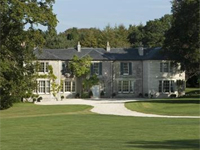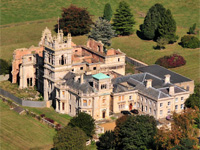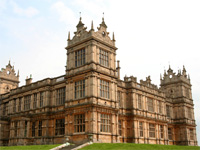
Is Mentmore Towers finally for sale?

Mentmore Towers, Buckinghamshire (Image: wikipedia)

After various legal battles it seems that Mentmore Towers, one of the finest country houses in the UK may be for sale.  Part of the property empire of Simon Halabi, who was declared bankrupt in April 2010, it was bought with the intention of turning it into six-star country hotel with the ‘In and Out Club’ as the London clubhouse.  The plans were thwarted by the global financial crisis which not only reduced the market for such a venture but also the financing.  Now with the recent £150m sale of Halabi’s prime London West End estate, which included the ‘In and Out Club’, putting Mentmore on the market is the next logical stage of the disposals.

The only source for this story is a blog post by Christian Metcalfe who writes the Legal blog on the Estates Gazette website which has enough details to make it sound very plausible.

The grade-I listed Mentmore Towers was built between 1852-54 for Baron Mayer de Rothschild as one of several country houses built for the Rothschild family in the area.  Designed by Joseph Paxton, architect of Crystal Palace, the neo-Renaissance house was inspired by the Elizabethan ‘Prodigy’ houses such as Wollaton Hall in Nottinghamshire.  Inherited by the Baron’s wife and then his daughter, it then passed to her husband, the Earl of Rosebery, following her early death.  It remained in the Rosebery family until the death of the sixth Earl in 1973 when the then Government stupidly turned down the offer of the house and world-class collections in lieu of death duties, triggering one of the finest country house sales of the 20th-century.  The house plus 81-acres was then sold in 1977 for £220,000 to the Transcendental Meditation foundation as a meditation centre, who cared for the house until it was sold in 1997 to Simon Halabi.  Since then little work has been done on the house and there have long been fears for its condition with English Heritage placing it on the ‘At Risk’ register.

The house is now apparently being quietly offered for sale, by as yet unknown estate agents, for around £16m – but no details on how much land would be included.  At that price, the house would be a bargain on square footage basis alone – but it would require a huge financial commitment from the new owner to not only restore the house but maintain it in the future, ideally as a family home.  The Rothschild’s have remained very much involved with the estate so perhaps this is their opportunity to bring it back into the family – although with Sir Evelyn de Rothschild living at nearby Ascott House perhaps Nat Rothschild, the incredibly successful hedge fund manager said to be worth around £300m, might like to take a look?

Original blog story published June 7, 2010 3:35 PM: ‘Will the real estate agent please stand up, please stand up‘ [Estates Gazette] – @Christian: if I do find out who the estate agent is, I’ll be sure to let you know.

‘Live or Let Die’: the 2010 Buildings at Risk Register

'Live or Let Die' - 2010 SAVE Buildings at Risk Register

For anyone interested in architectural conservation the annual SAVE Britain’s Heritage ‘Buildings at Risk Register‘ will always trigger ‘what if’ moments as you contemplate possibly taking on a forlorn building which catches your eye.  Yet the Register should also inspire some concern and disappointment that once again so many wonderful buildings are at risk in the first place.

The 2010 report, entitled ‘Live or Let Die‘, again provides a fascinating snapshot of a broad collection of buildings which we are now at risk of losing.  Some are merely unused and crying out for sympathetic conversion, others are more extreme and would require great quantities of time and money – but they would deliver the most incredible homes or workplaces once finished.  And remember, estate agents almost always value good quality, well-restored period properties higher than a similar but modern property in the same area.

The report features over a hundred properties from the large country houses such as St Botolph’s mansion, in Herbrandston, which was built in the early 1800s, but is now empty and deteriorating.  Other substantial houses include the house featured on the cover; Northwold Manor in Northwold, Norfolk.  However, it’s not just houses, but mills, schools, libraries, town halls and many more.

SAVE Britain’s Heritage has been successfully campaigning for historic buildings since its formation in 1975 by a group of architects, journalists and planners. It is a strong, independent voice in conservation, free to respond rapidly to emergencies and to speak out loud for the historic built environment. It has published a Buildings at Risk Register for England and Wales since 1989 and has had many successes and is responsible for saving many buildings we love today.  Even if you can’t take on a property, if you wish to support their work, please consider becoming a Friend of SAVE and you will not only receive discounts on publications, but newsletters and access to the online version of the Register featuring over a thousand properties in need of care.

Order your copy today: ‘Live or Let Die – 2010 Buildings at Risk Register‘ [SAVE Britain’s Heritage]

A suburban survival at risk: Braunstone Hall, Leicestershire

Braunstone Hall, Leicestershire (Image: East Midlands Oral History Archive))
Braunstone Hall, Leicestershire (Image: East Midlands Oral History Archive)

Two of the most important aspects of campaigning to save country houses are vigilance and visibility – and yet sometimes even this doesn’t always seem to bring about restoration any quicker when faced with a slow-moving owner. Braunstone Hall, a Georgian gem still with significant grounds but now swallowed up in the sprawl of Leicester, has been empty for over ten years but despite a vigorous campaign both in the media and online it still remains very much at risk.

Braunstone Hall, now grade-II listed, was built in 1776 (date on rainwater head) for the Winstanley family by the architect William Oldham (b. 1737 – d. 1814) who also designed an early Leicester racecourse grandstand (1770), Master’s House at Alderman Newton’s School (1789) and the New House of Correction (1803) – all though now demolished.  The red-brick house is two and a half storeys tall by five bays wide with a cornice and hipped roof.  The relatively simple front is enlivened with stone bands marking the ground and first floors with an impressive tripartite doorway with fluted columns, a small pediment and an elegant fanlight with arched glazing bars.  One further very distinctive feature is the giant blind recessed arch in the central bay – an architectural device which seems quite popular in Leicestershire with examples in Burbage, Belgrave House (also 1776), and the beautiful rectory at Church Langton (by William Henderson – 1760).  The interior is largely complete with some impressive detailing.

The Winstanley family bought the estate from the Hastings family in 1650 and remained there until forced out in the 1920’s by the pressure to build houses following the First World War.  Estates on the edge of existing towns and cities were eagerly eyed-up by local councils.  For some families, already facing financial hardships following the war this was a perfect opportunity to sell the family seat and relocate.  Others, including the Winstanleys in the shape of Major Richard Norman Winstanley, fought the prospect of compulsory purchase arguing that this was still a family home and the building work would undermine the value of his recently modernised house.  However, he was unsuccessful and so the house, gardens, parkland and further 949-acres were compulsorily purchased in 1925 for £116,500 (equivalent to £5.2m – 2008).  Most of the land was built over except for the house and 168-acres surrounding it which became a public park.  The house remained in council ownership and was first a secondary school, opening in 1932, before becoming a primary school a year later until it closed in 1996.

Since then the Leicester City Council has failed to either find a viable long-term use or adequately protect Braunstone Hall with the house falling victim to repeated acts of vandalism and arson.  The latter is the most worrying as the incidents have not only included fires outside the building but also now inside.  Over the last few years the Council have been making very slow progress towards finding a solution but, as always, they are claiming poverty when it comes to heritage projects.  A very active campaigning group has been set up on Facebook with the members regularly corresponding with councillors and reporting any damage or deterioration at the hall – effectively a dedicated ‘Neighbourhood Watch’ for the house.

The Council put the house up for sale on a 125-year lease in 2007 and had recently been negotiating to sell the house to a local businessman for conversion to a hotel, conference centre and wedding venue. However this has been delayed by changes to what’s being offered in relation to the land for enabling development.  Each delay increases the risk that the local yobs will finally succeed in their mindless vandalism and burn down this elegant and important part of Leicester’s heritage.  If this happens the blame can be laid firmly at the feet of Leicester City Council and their apathy and indecisiveness over the last 14 years.

Join the Facebook campaign group: ‘Restore Braunstone Hall

Detailed history of the house: ‘Braunstone Hall‘ [Leicester City Council]

Detailed description of the house: ‘Braunstone Hall‘ [English Heritage]

The start of the rush? Country houses for sale in the Sunday Times Home section

Sandley, Dorset (Image: Knight Frank)

The usual spring rush of country houses coming to market has been later this year – a combination of the hangover from the uncertainty in the market of the last couple of years along with that of the General Election.  That traditional shop-window of the country house – the Home section of the Sunday Times – has this week (16 May 2010) heralded what it sees at the start of the rush by including three pages of those for sale.

For those who like their country houses to look traditional from the outside but prefer a more modern interior then the Grade-II listed, six-bedroom Sandley in Dorset, set in 178-acres, might be perfect – if you have the necessary £9m.  The owners decided that the rather ‘quaint’ style of the house was not for them and so they spent ‘a couple of million pounds’ and over two years to strip it back and then make it look very ‘London’.  Personal taste is the final arbiter for whether you think this is a good thing – but not all tastes are the same and it can mean that the appeal of the country house is taken to new markets.

Ebberly House, Devon (Image: Savills)

However, if your tastes are more usual and traditional then there are other options. Holt Manor in Wiltshire, set in 94-acres, mixes both old and new with a more traditional interior cleverly concealing the latest in sound, television and security systems.  With parts dating back to the 12-th century, the Grade-II listed house has been thoroughly modernised whilst still being a recognisably English country house. £5.95m [Holt Manor: Knight Frank]

If, however, you are looking for a more architecturally impressive house, the Ebberly House, near Winkleigh in Devon, could well be the house for you.   Designed by Thomas Lee, a student of Sir John Soane, Ebberly was described by Pevsner as an ‘unusual and attractive house’ and was the first to sell in Devon for over £1m when it sold in 1997.  The Grade-II* listed house possibly benefited from Soane’s personal influence as he was working nearby at Castle Hill which may explain the elegant, and very Soanian, top-lit oval stair hall with its fine cantilevered wooden staircase and curved doors, or the drawing room divided using three shallow arches. Set in  250-acres it has a wonderful estate featuring 20-acres of woodland, estate cottages generating £20,000 p/a in rental income, and spectacular views across to Dartmoor. It was also given an excellent and detailed write-up in Country Life – always a good seal of approval.  [Ebberly House: Savills]

Chapel Cleeve Manor, Somerset (Image: Webbers)

Perhaps one of the most interesting of the houses featured is unfortunately only given a photo and no details is Chapel Cleeve Manor in Minehead, Somerset. Perhaps now not strictly a country house as it only has 7-acres, at £1.695m for 17+ bedrooms, it may seem a bargain for someone who wants to live in a country house but doesn’t want the responsibility of an estate. Although such a situation a hundred years ago could have led to the demolition of the house as happened to so many others. Yet, with so much wealth now generated without the need for a large estate to support the house, it’s now entirely reasonable for someone to take on and enjoy such a pleasing Gothic-Revival house. The house has been used as a conference venue for a number of years but with careful restoration this could be rescued from commercial use and be a spectacular home for someone who requires a lot of space. [Chapel Cleeve Manor: Webbers]

So has the rush started?  Nobody really knows and asking estate agents is never an exact science.  Several house which have been launched recently are still waiting to find new owners but the right house launched at the right time for the right price usually does find the right buyer.

Full story: ‘The landscape has changed‘ [The Sunday Times: Home section]

If you thought ‘The Restoration Man’ projects a bit small-fry; try Overstone House

Overstone Hall, Northamptonshire (Image: Martin Sutton on flickr)

Although hated by Samuel Loyd who commissioned it, Overstone House is fondly remembered by the generations of girls who were taught there after it became a school.  A vast, rambling property, it was sold to an obscure evangelical religious group who lived there until a devastating fire in April 2001 destroyed the main part of the house – although Loyd might have been quite relieved.

Overstone House replaced the earlier Overstone Hall and was built in 1862 for the banker Samuel Loyd, who became Lord Overstone for services to finance.  His wife  was keen to have a property commensurate with their status and so her husband decided to rebuild on a grand scale.  However, he inexplicably picked the unknown architect William Milford Teulon (brother of the more famous Gothic revivalist Samuel Sanders Teulon) who was instructed to design with a mixture of Elizabethan and Renaissance features.  This choice led to the creation of one of the most derided houses created in the Victorian era.

Both Girouard and Pevsner were uncomplimentary with the latter describing it as ‘drearily asymmetrical’.  However, the most damning verdict  came from Samuel Loyd himself, who, in what could be regarded as a wonderfully amusing piece of architectural criticism, said:

“The New House I regret to say, is the cause of unmitigated disappointment and vexation.  It is an utter failure – We have fallen into the hands of an architect in whom incapacity is his smallest fault.  The House tho’ very large and full of pretension – has neither taste, comfort nor convenience.  I am utterly ashamed of it … the principal rooms are literally uninhabitable – I shall never fit them up … I grieve to think that I shall hand such an abortion to my successors.”

As if this wasn’t enough, Loyd’s wife died before the project was finished leaving him with this rather large problem – which he promptly ignored by going and living with his daughter at Lockinge house in Berkshire where she had become Lady Wantage. Loyd must have eventually finished it as, on his death in 1883, it passed to Lady Wantage who, along with her husband, used it regularly during the hunting season until 1901.  After her death it was tenanted until sold to become a girls school in 1929.

It remained a girls school until 1979 when the pressures of looking after such a vast pile became too much and it was eventually sold to the New Testament Church of God for £100,000 in 1980 who are the current vendors.  The devastating fire in 2001 destroyed approximately 60% of the building including all the principal rooms and the impressive carved staircase.  Parts of the grade-II listed house remained in use as an old people’s home but the rest became a concern, leading to it being added to the ‘Buildings at Risk’ register.

However, the house is now for sale as a grand project with the opportunity to create a truly palatial home – the original house contained 119 rooms totalling around 20,000 sq ft.  The local council’s preference is that it become a single house – but to do so would require someone with big ideas and very deep pockets, willing to spend at least £5-10m on restoration on top of the £1.5m to buy the house and 50-acres.  However, as the main cause of Loyd’s distress has now been destroyed, this is great opportunity for someone to perhaps create a house which might meet with greater approval.

For anyone with the necessary funds and Kevin McCloud on speed-dial, please call Robert Godfrey of Bidwells (01604 605050).

A detailed history of the house is available on the Overstone School for Girls website.

More details: ‘Property restoration project: Overstone Hall, Northampton‘ [Daily Telegraph]