Lifting the curse of Hampton Gay manor house


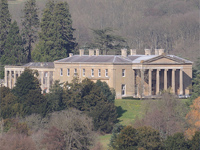
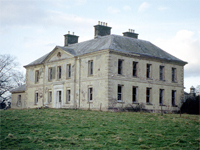
Hampton Gay Manor House, Oxfordshire
Hampton Gay Manor House, Oxfordshire (Image: Robert Silverwood on flickr)


The fire which gutted the largely unaltered Elizabethan Hampton Gay manor house in 1887 was seen as the retribution of a curse said to have been put on the house when the inhabitants refused to offer help and shelter when the Paddington-to-Birkenhead Express crashed nearby in 1874.  The fire tore through the building leaving nothing but a shell which has stood for nearly 150 years.  However, with continuing structural deterioration threatening its very survival, an application has been submitted to restore it as a new home.

Even ten years ago the idea of restoring a historic ruin would have probably been immediately refused by English Heritage but over the last decade a series of interesting restorations have shown that ruins need not always remain that way.  This re-evaluation was probably a result of the realisation that it is almost impossible to fully arrest deterioration to a building which is not in use.  However, there is a strong incentive for an owner to ensure that his home remains secure and watertight.

One example of this new permissiveness is Eggesford House in Devon.  Formerly the home of the Earls of Portsmouth, this house, built between 1820-30, was abandoned in preference for their Hampshire estates in 1911 and put up for sale in 1913. It was eventually bought by a local man who slowly stripped it of anything usable in the 1920s leaving a derelict shell.  In the early 1980s it was expected that within a few years the last remaining walls would collapse leaving no sign of the grand house.  However it (plus 80-acres) was sold in the 1990s for around £300,000 to the architect Edward Howell who created a huge new house within the existing walls which successfully uses the old room heights to create Regency-style proportions in a very modern house.

Another project which was driven forward by sheer determination was that of Hellifield Peel in Yorkshire whose story was told as part of a 90-minute special edition of Grand Designs.  At it’s core a 14th-century fortified tower, it had been modernised in the Georgian period but abandoned in the 1950s until it was a roofless shell.  With dereliction threatening total loss, English Heritage decided to allow conversion – albeit with some serious stipulations regarding the archaeology. Architect Francis Shaw had always wanted to live in a castle and this was a labour of love – certainly only someone very dedicated would continue after seeing the central spine wall collapse into hundreds of tons of rubble.  However, anyone who sees the house today would probably agree that English Heritage made the right choice.

Astley Castle in Warwickshire was another ancient home ravaged by a fire in 1978 and a fast deteriorating ruin which the Landmark Trust, with grant support from English Heritage, are in the process of rescuing.  Their plan involves the insertion of a smaller house into the shell of the castle to support the walls and provide holiday accommodation thus ensuring an income to provide a secure future for this historic house.

So the plans for Hampton Gay aren’t as radical as some might believe. However, the 18th-century passion for the ‘Picturesque’ – an appreciation for natural environments and particularly for ruins – is still influential today and some may object to this interference in what is considered one of the most beautiful views in Oxfordshire.  However, without significant intervention there is a real risk that the ruin would simply collapse and be lost forever.  So if the choice is between losing an atmospheric ruin or allowing restoration it seems that the current preference from the official bodies is that the latter is to be allowed – although the heavy restrictions will hopefully ensure that only well-funded restorers with a sympathetic understanding of the building will undertake these projects.  This raises some tantalising prospects; perhaps one day we may even see Kirby Hall in Northamptonshire as a home once again?

Story: ‘Grand design for ruins‘ [Witney Gazette]
A labour of love: the restoration of Hammerwood Park

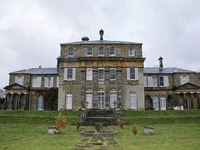
Hammerwood Park, Sussex (Image: South Downs Living)

Once a house has sunk to such a level of dereliction that even the developers won’t take it on, this can easily lead to an application for demolition and the loss of another piece of our architectural heritage.  Yet, as we see in the media, there are often people willing to commit themselves and their money towards saving these beautiful homes – Hammerwood Park is one which certainly falls into this category.

The house was built in 1792 for Benjamin Sperling and is particularly important as the design of the house was the first commission of Benjamin Latrobe (b.1764 – d.1820) who was later to be hugely influential in the direction of American architecture.   Latrobe had studied architecture privately and served for a year from 1789 as an architectural draughtsman in the office of neo-Classical architect S.P. Cockerell. Howard Colvin suggests that Latrobe was also strongly influenced by the work of French architects such as Étienne-Louis Boullée whose own strictly neo-Classical style emphasised the paring back of unnecessary ornamentation and the use of grand scale with repetitive elements.  Through Hammerwood Park it’s possible to see this philosophy in practice with the giant pilasters on the garden front and the miniature temples on the flanking wings.

The early death of Latrobe’s wife in 1793 caused him to abandon Britain and head to America where he made friend’s with President George Washington’s nephew.  It was these contacts which enabled him to obtain further commissions including the Bank of Pennsylvania in Philadelphia which has been described as the ‘first monument of the Greek Revival in America’ (dem. 1867).  It was this and his later work designing the first Capitol building in Washington which so greatly influenced the future of American architecture towards the ne0-Classical which is so evident even today.

That a building as interesting as Hammerwood Park was ever allowed to deteriorate to that extent was unfortunately all too common in the post-WWII era. It is only the dedication of it’s current owner, David Pinnegar, that has probably saved the house from conversion or even demolition.  After various owners it was requisitioned during WWII for use by the Army who left it in their usual poor condition.  Post-war, the Chattell family, who then owned the house, sub-divided the house into flats but as dry rot took hold, the residents moved out and the house was sold in 1973 to the rock group Led Zeppelin for use as a country retreat to work on their music. However, touring commitments meant they never moved in (and rumour has it they even forgot they owned it) and whilst empty, thieves took the roof lead leading to massive wet rot outbreaks.  The house was boarded up in 1976 before finally being offered for sale in 1982 in Country Life magazine with the marvellous understatement that it was ‘in need of modernisation’.

David Pinnegar, then only 21, bought the now grade-I listed house and has since dedicated his life to its restoration.  The vast house has revealed many interesting architectural nuances as he and many volunteers have worked through the vast catalogue of repairs. Although he has secured some grants from English Heritage, the vast majority of the work has been financed through day visitors, B&B guests, and its use as location for a wide variety of films and music video shoots.  In many ways, David’s dedication is proof that all houses, no matter how poor their condition, can find a saviour.

Full story: ‘Hammerwood Park, East Grinstead: Whole Lotta Love‘ [South Downs Living]

House website: ‘Hammerwood Park

A problem shared? Whitbourne Hall visited by Country House Rescue

Whitbourne Hall, Herefordshire (Image: David Cronin on flickr)

The great wealth generated by the Victorians led to the creation of some of our grandest country houses.  Designed to impress guests and provide a showcase for the collections and taste of the owners, these houses were remarkable and beautiful expressions of the power and preferences of the age.  However, in the more straitened circumstances of the 20th-century, this left owners with running costs which far outstripped their wealth and which unfortunately led to hundreds of our country houses being demolished.

Some escaped the wreckers pickaxe through conversion into apartments – but this doesn’t always solve the questions about the long term sustainability of a house, as shown by the visit of the TV programme Country House Rescue to Whitbourne Hall in Herefordshire.

The grade-II* listed house was built for vinegar magnate Edward Bickerton Evans whose father founded the Hill Evans Vinegar works in Worcester in 1830, which was, by 1905, the biggest vinegar producer in the world.  As was standard practice for the discerning Victorian millionaire he decided to build a grand country house and chose a cornfield in Whitbourne as the perfect location.

Despite its Georgian appearance, it was built between 1860 and 1862 to a design by Edmund Wallace Elmslie and inspired by the Erectheum on the Acropolis in Greece. The house was a lavish example of neo-Palladian architecture with a six-column portico, whilst on the south front a huge orangery, now known as the palm house, was added in 1875 and was thought to be the tallest in Europe.  The interior features a fine pillared main Hall with a rare blue and white glass ceiling, and the main reception rooms retain many original features.  At it’s height in 1876, the estate extended to over 2,500 acres with the classically beautiful Whitbourne Hall sitting proudly at the centre.

Remarkably, the Hall remained in the Evans family until 1980, when it was purchased by Whitbourne Hall Community Ltd to be run as a communal housing project with individual apartments and set in eight acres of gardens.  This original arrangement floundered and a commercial company was created to run the house as a more conventional managed community of 23 apartments.  The main rooms have been preserved much as they were with the Morning and Drawing Rooms retaining their original wall coverings.  However the sheer scale of the house means that the average annual maintenance bill is about £42,000 – and due to extensive and significant work required to maintain a house of this quality, that bill is expected to double in 2011, posing serious problems for the residents.  Extensive restoration is now required as the house is now suffering from a catalogue of issues including failing plasterwork as water penetrates through the coffered ceiling of the main hall.    Curiously Whitbourne Hall doesn’t seem to be on the English Heritage Buildings at Risk Register – it would be interesting to know why not.

One of the perennial difficulties of owning a country house is not just the huge costs such as heating but also the ongoing maintenance (as demonstrated by the Earl Spencer’s sale), the costs of which, rise significantly the higher the classification.   With the paucity of public grants for maintenance it falls to the owners to seek innovative ways to make these wonderful houses financially self-sufficient if possible.  However, as Country House Rescue often shows, it’s the owners who can sometimes be the problem who need to be convinced before they become part of the solution.

More details: ‘Country House Rescue‘ [Channel 4]

A glimmer of hope: ‘Country House Rescue’ visits Kelly House

Kelly House, Devon (Image: English Heritage)

Kelly House has a series of long associations; there has been a house there for over 900 years, it has been the seat of the Kelly family for that entire time, and, sadly, has been on the English Heritage Buildings at Risk Register for over five years.  Now the latest twist in the tale is that the house will feature in Channel 4’s ‘Country House Rescue’ on Thursday 1 April when expert Ruth Watson offer possible solutions which will help the Kelly family remain in their ancestral home.

The Kelly’s are one of the very rare families able to trace their lineage back to pre-Conquest times.  Warin Kelly is the 31st squire of the family to live in a house which has been passed down since 1100 through fathers, grandfathers, and brothers.  Described as being ‘in a class of its own’ by Marcus Binney*, the elegant Palladian house was built in 1743 -45 for Arthur Kelly by Abraham Rundle (d.1750), a joiner and provincial but obviously skilled architect who lived in Tavistock.  The house is grade-I listed and features a Portland stone doorcase, sash windows glazed with Crown glass and made in London, with local slat stone walls with moorstone quoins. Inside, the extensive high quality woodwork  features superb carving including panelling, chair rails, and a particularly good staircase with chunky corkscrew balusters.

However, the fine panelling hides serious issues such as the periodic bouts of dry rot which break out. Mr Kelly, as a conservation architect advocating minimal intervention, admirably refuses to treat it with chemicals or by stripping out the panelling.  This ongoing damage is largely the fault of death duties, with two demands being levied in swift succession which have severely limited the family’s ability to maintain the house.  Kelly House is exactly the sort of house which the Historic Buildings Councils would have provided grants for when they were set up in the 1950s.  Today, with English Heritage’s budgets under severe pressure, Mr Kelly was told in 2005 that they were unable to provide funds as the increase in the value of the restored house would be greater than the grant – meaning that they force owners towards the sale of their ancestral homes.

Much as it would appear difficult to argue for the provision of public money to preserve private residences, there has to be a better solution than just letting them slowly grow more derelict despite the often heroic efforts of the family involved.  The current generation doesn’t want to be the one which is remembered for having to sell the family seat, leading to a battle against the elements of decay which saps finances and families and often doesn’t provide a long-term solution.  Outside expertise is to be welcomed as it may show the way to a sustainable future for these beautiful homes. Hopefully Ruth’s suggestions can be taken on by the Kellys and other families to ensure their homes are self-financing and not a burden to either the state or the owners who are then able to look forward to the prospect of handing a home and not a liability to their descendants.

Programme details: ‘Country House Rescue‘ (Channel 4)

More information: ‘TV show could help manor restoration‘ [Western Morning News]

Official Kelly House website: ‘Kelly House

* – ‘Houses to Save’ – article by Marcus Binney in Country Life magazine (8 September 2005)

Minister ignores good advice: Scraptoft Hall

Scraptoft Hall (Image: wikipedia)

John Denham, the Secretary of State for Communities, has overruled the experts at English Heritage and approved the view of a local planning inspector which will see Scraptoft Hall forever compromised as a country house and reduced to a mere architectural footnote of a massive retirement village.

As had been previously reported (‘Scraptoft Hall at risk from ‘rescue’‘) a developer had used the standard excuse of ‘enabling development’ to propose building a massive 103-unit retirement village with the restoration of the house as a ‘reward’ to the council for this vandalism.  The house, although in a serious state of disrepair, is an important local house largely built in the 1720s but with a core dating from the 1500s.  A period as accommodation for Leicester University ensured that, although not ideal, the house was in use and maintained.  Once the university had left, the vandals and thieves moved in leaving the house as a juicy target for the developers.

It seems that the entire concept of ‘enabling development’ has been seriously compromised to allow councils (sometimes with the connivance of central government as in this case) to get around inconvenient restrictions on building houses.  Although it’s obviously of some social value to provide housing, it seems crass that the price to be paid for new homes is the irrevocable loss of important local buildings, and particularly country houses which are designed to stand proud in their settings.  Consider the English Heritage guidance on the appropriate extent of ‘enabling development’:

“English Heritage believes that ‘enabling development’ to secure the future of a heritage asset is unacceptable unless …it is demonstrated that the amount of enabling development is the minimum necessary to secure the future of the heritage asset, and that its form minimises harm to other public interests.” – emphasis mine – quoted from pg 9-10 of ‘Enabling development and the conservation of heritage assets‘ [PDF])

Reading that it seems incredible that the minister thinks a 103-apartment residential development is the ‘minimum necessary’.  I imagine that if there was a comprehensive review of the use of the ‘enabling development’ excuse many councils would be found to have waived through inappropriate schemes to meet ulterior motives.

So unfortunately Scraptoft Hall is to be sacrificed with the acquiescence of not only the local planning department, the local council, the local MP but also the minister who should ultimately be the last line of defence against these highly damaging schemes.  A further problem is that each time one of these schemes is approved it creates a damaging precedent which is then used against other houses which sadly find themselves the target of the rampaging developers.  If only English Heritage had a legal right to veto schemes which, in its expert opinion, were a gross abuse of the spirit and letter of the planning legislation.

More details: ‘Villagers hail ‘yes’ to plans for historic Scraptoft hall‘ [Leicester Mercury]