A stay in the country: country houses as hotels – and a bad plan

Stoke Park, Buckinghamshire (Image: Stoke Park Country Club and Resort)

Although country houses were built primarily as homes, an integral and important function was their use for entertaining.  However, one dramatic change has been the nature of the guests and how they paid for their visits – and the birth of the refined country house holiday now regarded as the best the hospitality industry can offer.  That said, running such a hotel is no guaranteed path to the wealth suggested by the lifestyle; with huge initial costs, large ongoing expenses and the elusive need for profitability leading to the recent troubles for the Von Essen hotel chain which had dominated this niche, including running the finest country house hotel – Cliveden, before collapsing under their own ambition.  The chase for profitability has also led to some shocking schemes for building further accommodation which can be seen in the recent proposals for Wyreside Hall in Lancashire.

Country houses have long been used as accommodation for travellers, be they friends of the owning family or, more spectacularly in medieval and Renaissance periods, for the monarch.  Often considered a great honour (supposedly there are more beds in which Queen Elizabeth I has apparently slept than nights she was alive), the occasion of a royal visit – or the possibility of one – would cause local aristocrats, or those aspiring, to refurbish suites of rooms such as at Burghley, Hatfield House, and Kirby Hall (even though Elizabeth I never came to the latter).  Sometimes, the ruinous expense of hosting the royal retinue would sometimes leave the owner with a title but also debts they’d be paying off for decades.
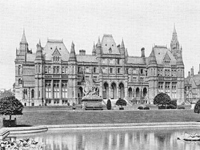
Eaton Hall, Cheshire (by Alfred Waterhouse - dem. 1961) (Image: Lost Heritage)

The heights of country house entertaining were reached by the Victorians and Edwardians who popularised, amongst the aristocracy, the vast weekend house party.  This led to houses being built or extended to create, in effect, large hotels.  The key difference was the guests were pre-selected from a narrow social strata and were expected to ‘pay’ for the hospitality with reciprocal entertainment or with business or political favours.  The greater the social elevation of the guests, so the number of staff required increased, leading to some houses, particularly at the cream of society, such as Eaton Hall and Clumber House, being greatly extended.  Eaton Hall eventually numbered around 150 bedrooms ranging from those for the honoured guests down to the  lowliest servants who would share dormitories.  Sadly, it was these sizeable extensions and aggrandisements which were largely the reason for their demolition in the 20th-century in their hundreds as austerity hit home and these huge palaces became unaffordable.

Sandringham, Norfolk (Image: Sandringham Estate)

Edward VII, when Prince of Wales, was the longest serving Regent and developed a highly cultivated habit of ‘weekending’ at country houses, especially his own at Sandringham, Norfolk.  His preferences have been said to have laid the foundations for not only the practice of weekend visits but also for indulging with grand breakfasts followed by country activities such as shooting, followed by convivial dinners.  Such was his reputation that some owners would fear a visit for the expense involved with one family, the Gurneys of Northrepps Hall in Norfolk, allegedly burning down a wing to forestall such a visit. By contrast, in 1902, when Edward VII visited Burton in Staffordshire an entire wing was built and named after him in his honour at Rangemore Hall.

Country house visiting had been a common activity for the travelling aristocrat in the Georgian era (a topic explored in a previous article ‘How tourism split a house from the estate‘).  Often calling on those they knew, they would also call on the notable houses in an area (an acceptable enough practice to be included by Jane Austen in ‘Pride and Prejudice‘) – and the owners of these ‘show houses’ were happy to parade their good taste.  By the beginning of the 18th-century, Blenheim, Castle Howard, Chatsworth, Wilton and Burghley had become the ‘must-see’ houses for the country house tourist – later joined by Houghton, Holkham, Eaton Hall and Kedleston.  Sadly, visitors weren’t always there for the educational opportunities of seeing some of the finest art in the world – as Horace Walpole lamented regarding the visitors to his father’s Houghton Hall, where he was a guide, the worst were the seers:

 …they come, ask what such a room is called, in which Sir Robert lay, write it down, admire a lobster or a cabbage in a market-piece, dispute whether the last room was green or purple, and then back to the inn for fear the fish should be overdressed.

Tregenna Hotel, Cornwall (Image: lindad4a via flickr)

It’s the last line which is of particular interest – even the well-to-do Georgian guest would be staying in a nearby coaching inn unless they had family nearby.  By the Victorian era, the nature and number of the guests had changed, but still the houses were private residences – until 1878 when the first country house became a hotel; Tregenna Castle near St Ives, Cornwall.  The catalyst was the extension of the railway, and the purchasers of a initial lease on Tregenna, before buying the freehold in 1895, was the Great Western Railway who could not only provide the destination, but the means to get there.
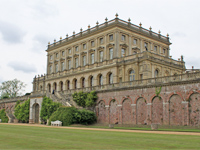
Cliveden, Buckinghamshire (Image: sjm_1974 via flickr)
Cliveden, Buckinghamshire (Image: SJM_1974 via flickr)

The growth of a paying middle class in the Victorian and Edwardian eras created demand – but most importantly, both eras were about aspiration.  The middle class may not have had the wealth to run a country house (and in the 1930s and 1950s, many owners didn’t either) but they certainly wanted to experience it.  The glut of country houses which became available in the first half of the 20th-century presented many opportunities for the hospitality industry to cater for these new markets.  For the upper classes, although many had been forced to sell up or move out, they still wanted to continue the lifestyle – though not necessarily alongside the nouveau riche. This created another market for the exclusive country club with clear social stratification driving the finest hotels to become bywords for extravagant elegance – something still clear today (though entry is more socially open) when one looks at hotels such as Cliveden or Stoke Park.

Gravetye Manor, Sussex (Image: Patrick Baty)

Though initially slow to take-off, the first half of the 20th-century saw a number of houses become hotels; in 1929, Theobalds Park, Hertfordshire and North Bovey Manor, Devon (another for the Great Western Railway), Welcombe Manor, Warwickshire in 1931, Otterburn Tower, Northumberland and Studley Priory, Oxfordshire, both in 1947 and Greywalls in Scotland in 1948, to name but a few.  Gravetye Manor was sold to Peter Herbert in 1957, when he paid £57,000 and charged £2 per night.  One author reported that the 1995 Egon Ronay guide listed 220 country house hotels, and the Historic Houses Association estimated that a quarter of the country houses sold between 1972-1990 were converted into hotels.  Though some have inevitably failed, the trend continues with one of the most recent being Coworth Park, built in 1776, opening in September 2010.

This potential re-use of the houses has not always been benign.  The nature of hotels is that the bedrooms generate the income so the more you have the better for them – though usually not for the architectural cohesion of the house. In hotel terms, many houses would not be economic which has led to the building of large, and not necessarily sensitive, additions.  Considering the original intentions of country house owners were to demonstrate their wealth and taste and to build a house to last, rarely are the modern extensions designed with anything approaching the same care and expense so there is an inevitable mismatch.  Many a country house hotel is scarred with poor quality and visually flawed wings which are almost designed to detract from the main house – but then buildings designed by accountants never win prizes for beauty.

Wyreside Hall, Lancashire (Image: Lancaster Guardian)

Although there is evidence of a greater sensitivity in recent years where new wings are tucked away from the main house and linked by corridors, it seems that there are still some owners who see the house as merely an ornament to put on the front cover of the brochure whilst they ruin the setting.  It was hoped that the worst schemes were behind us but sometimes one is proposed which is so bad that it would be laughable if it didn’t threaten a fine (though currently not in the best condition) house – Wyreside Hall in Lancashire (hat-tip to Matthew Steeples for flagging this one up).

The house was originally built in the 17th-century but was remodelled in 1790 by the then owner, John Fenton Crawthorne, MP, to a design by the gifted architect, Robert Adam.  Though the full scheme wasn’t implemented, the exterior benefited from a graceful symmetry with the drawing room, dining room and library also completed to his plans (though apparently no evidence of their decoration now remains).  The now Grade-II house remained in the Garrett family until 1936 after which it became a school and then home for a local motorsport legend.  The scheme that has now been proposed learns none of the lessons of sensitive hotel development (or any work involving heritage) over the last 50 years.

Proposed development, Wyreside Hall, Lancashire (Image: Wyre Council planning proposal, via Matthew Steeples)

Yes, it really is that ugly.  The design effectively doubles the size of the house and, as can be seen from the plan (scroll to page 44 – no direct link, sorry), the associated access roads, parking and ‘landscaping’ ruin the immediate setting of the house.  The usual arguments have been made about this bringing jobs to the area but if we must sacrifice the very heritage which gives an area a distinct identity, which attracts tourists or the wealthy (who usually also spend money locally) then it’s a poor bargain.  Wyre Council should throw out this and any subsequent plan which displays equally limited thinking and such an arrogant disregard for the architectural heritage of the area.  As we’ve seen, country house hotels can work – but not when they are at the expense of the original building.

———————————————————————————

Matthew Steeples’ original blog post is available here: ‘Adam would turn in his grave

Listed buildings description: ‘Wyreside Hall, Lancashire‘ [British Listed Buildings]

Planning application documents: ‘Ref 11/00840/LBC – Wyreside Hall‘ [Wyre Council]

———————————————————————————

This is the last post for 2011 – 43 posts in total, now over 350 subscribers to the blog, nearly 210,000 pages served up; and 850 followers of @thecountryseat on Twitter, so all-in-all, a fairly impressive level of interest; thank you! Matthew

For sale: a Soanian springboard – Burnham Westgate Hall, Norfolk

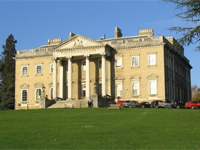
Burnham Westgate Hall, Norfolk (Image: Savills)

For any architect starting out, the early commissions are perhaps the most important; establishing them both in terms of not only their designs but also how they operate in the execution.  In architectural terms, the early buildings of some architects are sometimes less prized, and therefore protected, than their later works which benefit from the full measure of their developed skill and experience.  In that light, Burnham Westgate Hall deserves to be cherished as not only a fine house but also the first substantial country house project of Sir John Soane.  It provided the springboard for one of our finest architects and is important for the promise shown but also for securing one of the most important prizes in the Georgian era: patronage.

For someone who ended up a knight of the realm, with fame and a noble client list, Sir John Soane (b.1753 – d.1837) had a very ordinary start in life as the son of a bricklayer from Goring-on-Thames, near Reading.  Patronage and connections were to define Soane’s personal and professional life, providing opportunities to establish himself in a way that his competitors, often connected from birth, already enjoyed.  Almost nothing is known of his early life but his obvious talent must have been spotted as he entered the office of George Dance the Younger in 1768, though only starting as errand boy, via an introduction by James Peacock, an employee of Dance who knew Soane’s older brother.

Claremont, Surrey (Image: Claremont Fan Court School)

His talent and work ethic propelled Soane to join the Royal Academy Schools in 1772, where he quickly won the silver medal for a measured drawing of the facade of Inigo Jones’ Banqueting House.  What was particularly clear during Soane’s time at the Royal Academy was his ambition and an industriousness that was to serve him well in later periods, combined with an attention to detail which proved to be a blessing in his professional life.  In 1776, he won the Academy gold medal, which made him eligible to compete for the highly coveted King’s travelling scholarship which, for someone of Soane’s limited financial means, would be his only chance to see Italy first-hand.  Soane had heard that George III thought him a suitable candidate and so he rashly gave up his position with Henry Holland (where Soane was known to have assisted on three country house commissions: Claremont in Surrey, Benham Park in Berkshire, and Cadland in Hampshire (dem. 1953)) only to find out that Sir Joshua Reynolds had intervened to demand the winner of the scholarship be by vote from the Academicians. This delayed his departure by a year but it was put to good use completing smaller tasks for Henry Holland such as estimating bills and measuring work which exposed him to clients such as Thomas Pitt, 1st Baron Camelford; a man of noted taste and an amateur architect who was to prove particularly important in Soane’s career.  Though delayed, in 1777 Soane set off on the single most important trip of his life to Italy; one which was to establish him professionally and socially.

Arch of TItus, Rome - drawing by Sir John Soane
Arch of TItus, Rome – drawing by Sir John Soane

The Grand Tour had become an institution amongst the younger aristocrats as a way of experiencing the glories of classical art and architecture in their native environments.  It was also a fine opportunity for the wealthy to indulge their passion for art collecting but, for novice architects, days were largely spent measuring and recording the wonders of Roman architecture.  On a more practical level, Soane would have seen and experienced during his time with Dance and Holland how useful family and professional networks were in securing commissions.  In Italy, Soane worked assiduously to develop his own connections; travelling with his friend Robert Furze Brettingham (nephew of the famous architect Matthew Brettingham the Elder who had designed the original Burnham Westgate Hall, then called Polstede Hall) and visiting the English Coffee House; a central meeting point for the English nobility abroad, whom Soane courted as clients.

Soane's proposed design for Downhill, Northern Ireland (Image: Sir John Soane's Museum) - click to see full sketchbook page
Soane’s proposed design for Downhill, Northern Ireland (Image: Sir John Soane’s Museum) – click to see full sketchbook page

Patronage could also be a double-edged sword, with the ambitions of the client giving what could turn out to be false hope to an architect.  Of all those Soane met in Italy, Frederick Hervey, Bishop of Derry, later the 4th Earl of Bristol, was a prime example of the capricious client – though despite the Earl’s failure to deliver, he did introduce Soane, once again, to Thomas Pitt, Lord Camelford, and cousin of William Pitt the younger, and who became a lifelong friend, supporter, mentor and patron.  Soane had fallen under the influence of the Earl, a charming, witty aristocrat who had a growing reputation for being a difficult client.  How much Soane knew of this is unclear but after travelling through Naples and Sicily for many weeks together discussing architecture, Soane believed he would be given a handsome commission to improve Downhill (now a ruin), the Earl’s rather bleak seat, set in the coastal hills of County Derry, Northern Ireland. However, after persuading Soane to cut short his travels by a year and luring him over to Ireland in 1780, after six fruitless and frustrating weeks with the disagreeable Earl not committing to any of Soane’s designs, he left Ireland in despair, seriously out of pocket, and with the hopes of his first significant commission of his architectural career in tatters.

Rustic dairy at Hammels Park, Hertfordshire (Image: Sotheran's)
Rustic dairy at Hammels Park, Hertfordshire (Image: Sotheran’s)

Back in London, Soane’s wealthy and well-connected friends, particularly those he had made in Italy, and especially Pitt, sought to ease his plight by asking for his designs for smaller estate buildings or their own houses, such as for his friend John Stuart at Allanbank, Berwickshire.  Again, although the smaller projects were built, the larger plans failed to materialise – the only one of significance being some limited  alterations to Petersham Lodge, one of Lord Camelford’s homes.  After this, Soane took on a few smaller commissions from other clients which allowed him to develop his skills as an architect, not just in designing but the delivery of the projects, including the elegant dairy in the fashionable rustique, Rousseau-esque style at Hammels Park, Hertfordshire for the Hon. Philip Yorke, later 3rd Earl of Hardwick – another of his Italy contacts.

Proposed design for Allanbank, Berwickshire by Sir John Soane (Image: Sir John Soane Museum)

However, it was his main supporter, Lord Camelford, who provided the largest commission in 1783, the one which elevated Soane from dreamer of grand plans but only executor of small estate buildings.  Camelford’s wife had inherited Burnham Westgate Hall and now her husband wished to create a seat of suitable standing near to that other fulcrum of political influence in north Norfolk, Holkham Hall, home of the Earl of Leicester.  Burnham Westgate is curious in that it is one of the early examples of Soane’s practice of reusing his designs.  Compare Burham Westgate Hall today with the unexecuted design illustrated right which Soane completed for John Stuart at Allenbank – the overall form of the house is similar, differing only in the striking chimneys and the size of the flanking wings.  Soane seemed to do this less as he grew as an architect but it can be seen in his bow-fronted design for Saxlingham Rectory and enlarged version seen on the south front of Tendring Hall (dem. 1955), and even more directly between Shotesham Hall in Norfolk and Piercefield near Chepstow.

Burnham Westgate Hall has perhaps been a little overlooked in the literature, perhaps suffering from being overshadowed by Soane’s next project: his first solo, entirely new-build house; Letton Hall, which was started in the following year in 1784.  However, the innovation of Letton could only be created on a sound architectural foundation which Soane had spent years building; the smaller commissions of temples, kennels and interiors, before Burnham Westgate gave him the opportunity to demonstrate that he was capable of working on a project of that size.  Bar the limited and hotly contested public works, private country houses were some of the most significant commissions available to any architect and Burnham Westgate was Soane’s calling card; his proof of his ability, imagination and practical ability to deliver a fine house suitable for those in upper society.  That it is a close variation on a earlier design can be forgiven considering the nascent stage of his career; this sale offers a new owner the chance to own the project which gave Sir John Soane the springboard which helped establish this most brilliant of architects.

————————————————————————————–

Property details: ‘Burnham Westgate Hall‘ – £7m, 38-acres [Savills]

Detailed listing description: ‘Burnham Westgate Hall‘ [British Listed Buildings]

Further information:

————————————————————————————–

Inspired by Park Place? Other country houses for sale to restore

The recent restoration and sale of Park Place was certainly on an epic scale – £42m to buy, a further £100m to complete – but thankfully not all projects need be so expensive (though they’ll never be cheap).  The story of the country house has, for many, featured a cycle of ascendency, enlargement, and enjoyment, followed by neglect but – hopefully – rescue. As the annual SAVE Britain’s Heritage ‘Building’s at Risk’ Register sadly makes all too clear there are any number of country houses which have reached quite a serious state of disrepair, even dereliction. Yet even for these there may be someone who is willing to step up and rescue part of the nation’s architectural heritage. Houses in need of a saviour are often for sale, their forlorn state in Country Life magazine a stark contrast to their better loved brethren.

The UK generally has a much more positive attitude towards restoration than many other countries.  The Victorians would often be tempted to restore an ancient seat due to the contemporary popularity of the romantic notions of ‘Ye Olde England’.  Living in an Elizabethan or Jacobean house gave the owner associations with older family lines (not necessarily their own) and was a short-cut to perceived greater respectability.  Today, those who take on a restoration of one of our beautiful older houses are rightly lauded over those who simply buy a super-sized Barrett home.  Yet, restoration requires sensitivity and a willingness to submit an individual’s grand designs to work within the boundaries of the listed building regulations and the character of the house.

Marske Hall, Yorkshire (Image: Carter Jonas)

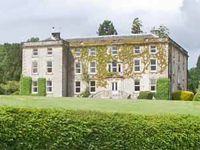
One house with hidden character and which will require careful planning is Maerske Hall, Yorkshire.  Originally built by the Hutton family in 1597, they were still in residence in 1730 when the house was rebuilt and extended in a Classical style. The grade-II* house was mainly used for shooting parties by the family in the 19th-century saving it from alteration but in the 20th it was threatened with requisition by the Army in WWII.  Luckily the family were able to arrange for pupils from Scarborough College to take up residence instead which saved it from the worst damage.  After the war, it again came near to destruction, as it was sold in 1947 to local builders George Shaw and his son George William who intended to demolish it for the materials.  However, they baulked at taking down such a lovely house and so sympathetically converted it into 10 apartments.  Still divided but now empty it is for sale at £2.5m with 19-acres of beautiful, mature gardens, and presents a fascinating opportunity to recreate a single family home. For more on the history, there’s a brochure: ‘Marske Hall‘ PDF [Carter Jonas].

Walton Hall, Derbyshire (Image: Knight Frank)

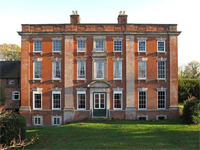
For those wanting a more straight-forward restoration, Walton Hall, Derbyshire perhaps offers a more appealing option.  This fine and elegant grade-II* house, prominently sited above Walton on Trent, was built between 1724 -1729 to designs by the architect Richard Jackson. The most striking feature are the full-height pilasters, giving dignity to a slowly deteriorating house which has become such a concern as to be listed on the English Heritage ‘At Risk’ register.  Inside, the most impressive feature is the grand staircase, reputedly copied from a building in The Hague.  The house is basically habitable but requires significant sensitive restoration, hence the price; £1.5m for the house plus just 7.5-acres.  That said, once restored this will be a quintessential Georgian  house to be enjoyed for generations.

Felix Hall, Essex (Image: Savills)

For those who prefer a real challenge then the next two houses could be ideal.  The first is Felix Hall, situated just outside Kelvedon, Essex – the picture (right) immediately showing the scale of the challenge.  At its core, this house is firmly in the tradition of the Palladian villa with a compact footprint but featuring wonderful architectural flourishes such a fine portico (added in 1825) and, to the rear, four engaged columns and a pediment.  Originally built between 1760-2, it was purchased by the Weston family of Rivenhall Place in 1793 and was significantly extended with flanking wings in the early 19th-century, possibly on the occasion of Charles Callis Weston’s  ennoblement as Lord Weston of Rivenhall in 1833.  However, as with many larger houses, a reduction in  size was thought prudent and so in 1939 the two wings were removed, leaving just a 7-bay central section.  Sadly, during the course of renovations it caught fire, completely gutting the fine interiors leaving the gaunt shell with the proud Ionic columns we can see today.  The remains were bought in 1953 and the basement rooms restored as an occasional country retreat but this is a house crying out for a full restoration (for which there is planning permission).  However, the estate buildings such as the nearby stables have been separately converted and there is only a small amount of land – it would be lovely if the new owner could also purchase the buildings and gardens and if they could also acquire the field in front, they could create a superb small parkland in which to truly display the house.

Piercefield House, Monmouthshire (Image: darkcell / flickr)

Another shell available is the one I would be heading for: Piercefield, near Chepstow, Wales.  Designed by the peerless Sir John Soane in 1785 for George Smith, the actual completion of the house was delayed until 1793.  Of particular interest  here is that the design is not entirely unique – Soane appears to have used very similar plans for Shotesham Park in Norfolk which was also built in 1785, although that house was brick with stone dressings, whilst Piercefield is faced entirely with stone. The house was sold 1794 as Mr Smith had run into some financial difficulties and it was bought by Sir Mark Wood who employed Joseph Bonomi to add a saloon and a winding staircase – though not the two pavilions as has been suggested.  The house was sold in 1926 by the Clay family, who had bought it in 1861, to Chepstow Racecourse who abandoned it, leaving it become increasingly derelict, apparently helped by American troops stationed nearby in WWII who used the house for target practice.  After 90 years of neglect, the house still has the power to impress with its refined façade and elegant temple pavilions.  Although on the market for over six years the price has remained at a rather ambitious £2m (although it does include 129 grade-I listed acres of parkland). However, recent comments by the director of the race course have indicated that they might entertain offers of around £1m; though, of course, the restoration bill would be many times that – but what a prize at the end!

Ruperra Castle, Wales (Image: Jeffrey Ross - Estate Agent)

Even further down the scale of dereliction is another important house, also in Wales, which has been stubbornly mis-priced.  Ruperra Castle near Newport is one of the few ‘mock’ castles designed for pleasure and not as defensive installations – a subject examined in more detail in an earlier blog post related to Ruperra: ‘Developer shows sense; Ruperra Castle for sale‘ (Sept 2010).  Few of these style of houses were built and Ruperra’s importance derives from it being one of the earliest of the country houses of this type, having been built in 1626.  Sadly, many of the other examples have been lost (most recently, fire gutting the interior of Lulworth Castle in 1929) so for someone Ruperra offers the opportunity to not only restore an architectural gem but also to be able to enjoy the same stunning views which attracted Thomas Morgan to build there in the first place.  Unfortunately, although the owner has now switched agents, the price is still ambitious at £1.5m – especially considering the immense challenges and costs of restoration and the location.  Hopefully, as with Piercefield, the owner ought to be willing to entertain realistic offers and allow the house to be saved before it is lost forever.

Perhaps the last is stretching it to call it a restoration opportunity as Bellamour Hall, Staffordshire now exists only as two walls and a few piles of stones!

Restoration is never a cheap or easy approach but the satisfaction and pride in knowing that the work has saved another part of our architectural heritage must be immense.  For too long our country houses have been under threat from neglect, vandalism and poor maintenance and the selection above (and there are more) show that the degrees of restoration and commitment required can vary dramatically.  That said, I can only hope someone is out there with the wealth and sensitivity to take on these houses and bring them back to life.

‘An agreeable surprise’ – the country house and garden sculpture

Statue - Castle Howard, Yorkshire (Image: Paul Barker / Country Life Picture Library)
Statue – Castle Howard, Yorkshire (Image: Paul Barker / Country Life Picture Library)

The country house has long been at a nexus of art, display and tourism with the treasures, mainly statues, collected by the owner shown in a grand gallery which often formed one of the main staterooms.  Whereas the house provided the setting for the art, outdoors, the gardens and parkland provided a setting not only for the house but also for the many sculptural works they had acquired – a trend which continues today, though often with a necessarily more commercial edge.

The first country house owners to place statues in their English gardens were the Romans.  However, as homes became castles, gardens fell from favour and with them, the ornaments to decorate them.   The trend for statuary only really returned with the Tudors and their love of the outdoor space as an extension of the symbolism they incorporated into the architecture of their houses.  One of the earliest collectors, and most acquisitive, was Thomas Howard Arundel, 2nd Earl of Arundel, who, as a youth, had been at the excavation of the Roman Forum, which had sparked a live-long passion for antiquities.  Arundel amassed one of the greatest collections of the age, rivalling that of the King, including a famed selection of Graeco-Roman statues found in Turkey, which became known as the ‘Arundel Marbles‘. These statues were then displayed at both their town and country seats, both indoors and out – though later, by the mid-17th-century, as a result of the uncertainties of the Civil War, John Evelyn found the Marbles “…miserably neglected, & scattred up & downe about the Gardens & other places of Arundell-house.”.  The statues were later donated to the Ashmolean Museum where they remain today.

The later rise and popularity of the Georgian grand tour firmly embedded the desire to purchase statues along with the requisite paintings. They provided a visual clue as to both the learning and wealth of the owner and so were displayed prominently, especially indoors where they might be shown in the entrance hall where guests would inevitably look at them as they waited. Some of the most famous dedicated indoor galleries include those at Holkham Hall, Norfolk, Chatsworth, Derbyshire, and Woburn Abbey, Bedfordshire (though sadly now not as shown in previous link as it’s now a wedding venue).  Other notable galleries, though now lost due to dispersal or demolition, were those at Clumber Park, Ickworth House and Hamilton Palace, the latter described as “…peopled with bronze statuary on Irish black marble bases polished to such a gloss that they reflected the pavement like a mirror.“.

Chiswick House, Middlesex (Image: curry15 / flickr)

Outside, the display was no less formal – symmetry and structure dominated.  However, by the 1730s, the more formal display of statues outdoors gave way to a more naturalistic style whereby they became almost secreted amongst a more informal – but no less planned – landscape.  One thing often forgotten now is that we see gardens after over 250 years of growth, but when first planted they would have been much sparser giving the ornaments greater prominence.  The return of the Roman influence can be closely linked with the rise of Palladianism and the influence of Lord Burlington and his circle; most notably, the brilliant designer William Kent. Other notable influences include Batty Langley, who published his ‘New Principles of Gardening‘ in 1728 and Stephen Switzer’s ‘Ichnographica Rustica‘, published in 1718 – the latter of which was the first to show serpentine walks and streams. Life also imitated art, with the popularity of the Arcadian visions of painters such as Claude Lorrain, Nicholas Poussin, and Salvator Rosa also inspiring those who collected the paintings to attempt to bring them to life.

Temple - Studley Royal Gardens, Yorkshire (Image: Matthew Beckett)
Temple – Studley Royal Gardens, Yorkshire (Image: Matthew Beckett)

The more secure and rising wealth of the 1730s enabled owners to create larger estates and so giving them more space to indulge their plans.  However, no stream will rival a raging river so to create a sense of theatre, the landscape was used and moulded to create a series of views which took advantage or distant landmarks or by introducing elements such as statues, temples and obelisks.  Often these gardens were designed to entertain the knowledgeable visitor with allusions to myths and noble virtues – though in one lesser known example, the owner of the famous Vauxhall Gardens in London, built a darker memento mori‘ garden at Denbies, his home in Surrey.

However, the main aim was to delight and to stimulate emotions. One of the most famous Georgian gardeners, Philip Miller, wrote in his 1739 edition of his ‘Gardener’s Dictionary’:

“In laying out these walks through woods there should be a great regard had to the neighbouring country, so as whenever there are any distant objects which appear to the sight, there should be openings to which the serpentine walks should lead, from whence objects may be viewed, which will be an agreeable surprise to strangers…”

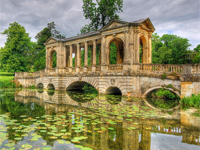
Bridge - Stowe House, Buckinghamshire (Image: Evoljo / flickr)
Bridge – Stowe House, Buckinghamshire (Image: Evoljo / flickr)

These principles were translated according to the whims and finances of owners across the country, leading from the sublime creations of Stowe, Stourhead and Studley Royal to many lesser known and private gardens.

The statuary could sometimes cause the odd drama. Dallam Towers, Cumbria was archly described by Pevsner as “…undoubtedly the finest Georgian facade in the county; but what the visitor may not realise is that, behind all the stucco, there’s the finest Queen Anne facade in the county.“. Between the facade and the landscape once stood (or perhaps still stands) a line of statues standing guard between the garden and the ha-ha. Yet this line is slightly marred by one of the statues being headless – the unfortunate outcome of a 1820s dinner which led to a very ‘well-refreshed’ Lord Milthorpe.  Thinking he had seen a poacher, he grabbed a rifle, and despite the protests of his guests, he duly dispatched the ‘poacher’/statue; a loss for the world of garden ornaments but perhaps a gain for the forces of law and order.

With such vast quantities of marble scattered out the gardens, occasionally a prized statue may slip slowly into obscurity. This can lead to discoveries in the same way that an Old Master may be found in the attic, so they can also be found in the shrubbery, such as this rare Chinese Ming tomb horse or the lucky owner of a castle somewhere in northern Europe who had a statue by the Renaissance sculptor Adriaen de Vries.

The tradition of sculpture in the gardens of country houses is certainly alive and well today and has developed beyond the more formal Roman statuary towards a decidedly more contemporary ethos – though perhaps more commercial than for simple pleasure.

'Huge Sudeley Bench' by Pablo Reinoso at Sudeley Castle (Image: Christies)
‘Huge Sudeley Bench’ by Pablo Reinoso at Sudeley Castle (Image: Christies)

At the beautiful Sudeley Castle in Gloucestershire, Christies are holding their selling exhibition of contemporary sculpture from luminaries such as Marcel Wanders, Marc Quinn and Pablo Reinoso.  Over in Sussex, the Cass Sculpture Foundation at Goodwood, hosts a regularly changing line-up with a focus on supporting emerging talent along with the more established artists such as Lynn Chadwick and Anish Kapoor.  One more recent venue is the Jupiter Artland at Bonnington House in Scotland, just outside Edinburgh.  The vision the Wilsons, who own the house, Jupiter Artland features large-scale works such as the monumental ‘Life Mounds’ by Charles Jencks’ who specialises in landscape art that I suspect would appeal to the likes of ‘Capability’ Brown if he were around today.

These are just some of the examples of contemporary schemes which are taking place across the country. Each is enlivening the grounds of a house and again maintaining that artistic thread which has been spun out over hundreds of years, linking country houses, an owners’ taste and some of the best art in the country.

————————————————————————–

More wonderful examples of works available outdoors can be seen in the Country Life Picture Library collection.

This blog post is a little off my usual patch so I’m grateful for the research of David Stuart in ‘Georgian Gardens

Want to lease a Vanbrugh? Kings Weston House, Bristol for sale

Kings Weston House, Somerset (Image: Knight Frank)

For some, the height of connoisseurship is to own a Picasso or a Rembrandt, and, in the same way, one can also aspire to live in a house designed by one of the great architects.  Yet, although some were prolific, the best were often to be found working on the largest projects, limiting their capacity to turn their hands to other projects, making their surviving buildings rare.  The damage and devastation which subsequent generations have wrought on our architectural heritage have also made these special houses all the rarer.  So it is always of particular interest when the opportunity to own one of these houses arises; such as Kings Weston House, Somerset, designed by the wonderful Sir John Vanbrugh.

Vanbrugh (b.1664 – d.1726) was one of the most interesting architects this nation has ever produced.  Yet to think of Vanbrugh is inevitably to also think of Nicholas Hawksmoor (b.1661 – d.1736) who provided the technical support necessary to ensure that Vanbrugh’s flights of architectural fancy were realisable as solid buildings worthy of his aristocratic patrons. However, this was not a partnership which diminished one through association with the other – both were brilliant architects who each gained from their collaboration. As John Summerson put it in Architecture in Britain (1530-1839): ‘The truth can only be that both Hawksmoor and Vanbrugh were very exceptional men.

Vanbrugh was an intensely private person – the few hundred surviving letters in his hand betray few family details or about his early adventures as a soldier, spy, hostage, East India Company trader, or playwright.  His time in the Forces seems to have imbued his style with a tendency towards the militaristic, most clearly expressed in his work in landscapes where huge sham fortified ‘defenses’ march across parkland, defending nothing and fooling few.  Yet this bombastic nature is part of the flamboyant and theatrical nature of the man, part of what gave him the flair to succeed architecturally in an age when statements in stone were as important as any made in print or Parliament.

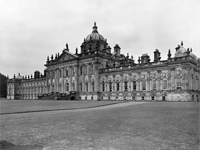
Castle Howard, Yorkshire (Image: Country Life Picture Library)

In his grandest buildings, Vanbrugh appears to almost be designing monuments which happen to have living accommodation – but he was especially pleased that Castle Howard was as practical as it was impressive. Writing in 1713 to Edward Southall, his client at Kings Weston, he states:

“I am much pleased here (amongst other things) to find Lord Carlisle so thoroughly convinced of the Conveniencys of his new house, now he has had a years tryall of it.”

Proud of how draught-free the house was, which helped retain heat, Vanburgh stated;

“He likewise finds, that all his Rooms, with moderate fires Are Ovens.”

Kings Weston House, Somerset (Image: Country Life Picture Library)

Kings Weston (built between 1710-19) was to be Vanbrugh’s fourth commission (after Castle Howard, Blenheim Palace and Kimbolton Castle) and was a house very much to Vanbrugh’s style, creating a ‘Noble and Masculine Shew‘.  The house, dramatically sited above the Bristol Channel, was built for Sir Edward Southall, a well-educated civil servant, well-versed in architecture who had spent considerable time travelling in Italy. Southall clearly had strong ideas as to the influences and design of his house; and Vanbrugh, with his long history of collaboration, was the ideal architect to work with this knowledgeable client.  That said, this is clearly a Vanbrugh house – the imposing giant pilasters, the strong Classical detailing, the almost military look which is reinforced by the unusual arcaded design of the chimneys which emphasised a castle-like quality of a central bastion.

(By the way, it’s interesting the close similarity between the entrance to Kings Weston and that of the smaller Iver Grove in Buckinghamshire (built 1722-24) by John James, who had worked with Sir Christopher Wren).

The house passed through several generations of Southalls including Edward’s great-grandson who employed Robert Mylne in 1763 to add stables and the Shirehampton Lodge and also remodel the principal rooms. Edward’s son, also Edward, lived there until his death in 1832 without issue. The house was then sold in 1833 to Philip John Miles for £210,000 (approx. £17m today) who became the local MP, as had the Southalls been before him.  Three generations of the Miles family lived there until the death of Philip Napier Miles in 1935, marking the last time the house was used as a home. The house was sold at auction for £9,800 (approx. £500,000) with the intention of using it as a school.  This was interrupted by the Second World War when it became a hospital – a role it has also fulfilled in the Great War.  Post-war, it became the Bristol College School of Architecture, before becoming a Police training centre from 1970-1995.

Perhaps one of the saddest aspects is how the setting of this fine house has been compromised: to the north, a road and housing estate, to the west, more houses, and to the south, a golf course.  This is often the outcome of houses which lack a determined owner with the need to keep a large estate, and particularly of houses which fall into the clutches of local authorities who are only too happy to build over the parkland, often with little sensitivity as to the overall setting.

With the departure of the Police, the house was boarded up, neglected and facing an uncertain future.  However, in 2000, it was bought by a local businessman, John Hardy, who converted the house in to a successful wedding and conference venue, apparently pouring significant funds into the project.  His commitment ultimately cost him his marriage and the remaining lease – probably 115-years – is now for sale for £2m (the freehold is still owned by Bristol City Council).  Although this would still make an ideal family home, Mr Hardy has expressed a desire that it remain open to the public.  Whoever buys Kings Weston will certainly be buying one of the finest houses in the country. Perhaps it will remain open to the public, but it would be equally exciting to see the house restored as a home, a private retreat overlooking the Bristol Channel where the owner can contemplate the genius of Vanbrugh and enjoy knowing that an architectural DNA links their domain with the palaces of Castle Howard and Blenheim, a smaller scale distillation of the grand flamboyance which came to define English Baroque.

————————————————————-

Original story: ‘Bristol’s Kings Weston House up for sale for £2 million to help pay for owner’s divorce‘ [Bristol Evening Post]

More details: ‘Love affair with a £2m mansion that ended in divorce… King Weston House’s owner was ‘totally consumed’ by major Georgian renovation‘ [Daily Mail]

Property details: ‘Kings Weston House‘ [Knight Frank] – £2m

More images: ‘Kings Weston House‘ [Country Life Picture Library]

History of the house: ‘Kings Weston House‘ [kingsweston.com]