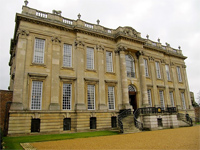
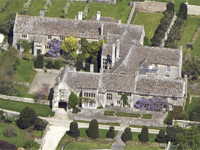
Want to lease a Vanbrugh? Kings Weston House, Bristol for sale

Kings Weston House, Somerset (Image: Knight Frank)

For some, the height of connoisseurship is to own a Picasso or a Rembrandt, and, in the same way, one can also aspire to live in a house designed by one of the great architects.  Yet, although some were prolific, the best were often to be found working on the largest projects, limiting their capacity to turn their hands to other projects, making their surviving buildings rare.  The damage and devastation which subsequent generations have wrought on our architectural heritage have also made these special houses all the rarer.  So it is always of particular interest when the opportunity to own one of these houses arises; such as Kings Weston House, Somerset, designed by the wonderful Sir John Vanbrugh.

Vanbrugh (b.1664 – d.1726) was one of the most interesting architects this nation has ever produced.  Yet to think of Vanbrugh is inevitably to also think of Nicholas Hawksmoor (b.1661 – d.1736) who provided the technical support necessary to ensure that Vanbrugh’s flights of architectural fancy were realisable as solid buildings worthy of his aristocratic patrons. However, this was not a partnership which diminished one through association with the other – both were brilliant architects who each gained from their collaboration. As John Summerson put it in Architecture in Britain (1530-1839): ‘The truth can only be that both Hawksmoor and Vanbrugh were very exceptional men.

Vanbrugh was an intensely private person – the few hundred surviving letters in his hand betray few family details or about his early adventures as a soldier, spy, hostage, East India Company trader, or playwright.  His time in the Forces seems to have imbued his style with a tendency towards the militaristic, most clearly expressed in his work in landscapes where huge sham fortified ‘defenses’ march across parkland, defending nothing and fooling few.  Yet this bombastic nature is part of the flamboyant and theatrical nature of the man, part of what gave him the flair to succeed architecturally in an age when statements in stone were as important as any made in print or Parliament.
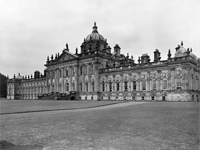
Castle Howard, Yorkshire (Image: Country Life Picture Library)

In his grandest buildings, Vanbrugh appears to almost be designing monuments which happen to have living accommodation – but he was especially pleased that Castle Howard was as practical as it was impressive. Writing in 1713 to Edward Southall, his client at Kings Weston, he states:

“I am much pleased here (amongst other things) to find Lord Carlisle so thoroughly convinced of the Conveniencys of his new house, now he has had a years tryall of it.”

Proud of how draught-free the house was, which helped retain heat, Vanburgh stated;

“He likewise finds, that all his Rooms, with moderate fires Are Ovens.”

Kings Weston House, Somerset (Image: Country Life Picture Library)

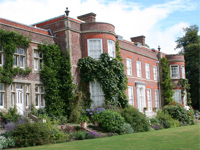
Kings Weston (built between 1710-19) was to be Vanbrugh’s fourth commission (after Castle Howard, Blenheim Palace and Kimbolton Castle) and was a house very much to Vanbrugh’s style, creating a ‘Noble and Masculine Shew‘.  The house, dramatically sited above the Bristol Channel, was built for Sir Edward Southall, a well-educated civil servant, well-versed in architecture who had spent considerable time travelling in Italy. Southall clearly had strong ideas as to the influences and design of his house; and Vanbrugh, with his long history of collaboration, was the ideal architect to work with this knowledgeable client.  That said, this is clearly a Vanbrugh house – the imposing giant pilasters, the strong Classical detailing, the almost military look which is reinforced by the unusual arcaded design of the chimneys which emphasised a castle-like quality of a central bastion.

(By the way, it’s interesting the close similarity between the entrance to Kings Weston and that of the smaller Iver Grove in Buckinghamshire (built 1722-24) by John James, who had worked with Sir Christopher Wren).

The house passed through several generations of Southalls including Edward’s great-grandson who employed Robert Mylne in 1763 to add stables and the Shirehampton Lodge and also remodel the principal rooms. Edward’s son, also Edward, lived there until his death in 1832 without issue. The house was then sold in 1833 to Philip John Miles for £210,000 (approx. £17m today) who became the local MP, as had the Southalls been before him.  Three generations of the Miles family lived there until the death of Philip Napier Miles in 1935, marking the last time the house was used as a home. The house was sold at auction for £9,800 (approx. £500,000) with the intention of using it as a school.  This was interrupted by the Second World War when it became a hospital – a role it has also fulfilled in the Great War.  Post-war, it became the Bristol College School of Architecture, before becoming a Police training centre from 1970-1995.

Perhaps one of the saddest aspects is how the setting of this fine house has been compromised: to the north, a road and housing estate, to the west, more houses, and to the south, a golf course.  This is often the outcome of houses which lack a determined owner with the need to keep a large estate, and particularly of houses which fall into the clutches of local authorities who are only too happy to build over the parkland, often with little sensitivity as to the overall setting.

With the departure of the Police, the house was boarded up, neglected and facing an uncertain future.  However, in 2000, it was bought by a local businessman, John Hardy, who converted the house in to a successful wedding and conference venue, apparently pouring significant funds into the project.  His commitment ultimately cost him his marriage and the remaining lease – probably 115-years – is now for sale for £2m (the freehold is still owned by Bristol City Council).  Although this would still make an ideal family home, Mr Hardy has expressed a desire that it remain open to the public.  Whoever buys Kings Weston will certainly be buying one of the finest houses in the country. Perhaps it will remain open to the public, but it would be equally exciting to see the house restored as a home, a private retreat overlooking the Bristol Channel where the owner can contemplate the genius of Vanbrugh and enjoy knowing that an architectural DNA links their domain with the palaces of Castle Howard and Blenheim, a smaller scale distillation of the grand flamboyance which came to define English Baroque.

————————————————————-

Original story: ‘Bristol’s Kings Weston House up for sale for £2 million to help pay for owner’s divorce‘ [Bristol Evening Post]

More details: ‘Love affair with a £2m mansion that ended in divorce… King Weston House’s owner was ‘totally consumed’ by major Georgian renovation‘ [Daily Mail]

Property details: ‘Kings Weston House‘ [Knight Frank] – £2m

More images: ‘Kings Weston House‘ [Country Life Picture Library]

History of the house: ‘Kings Weston House‘ [kingsweston.com]

Possibly for sale – a landmark for landowners: Crichel House, Dorset

Crichel House, Dorset (Image: BNPS / Daily Mail)

When to believe the rumours? Occasionally one of the old families will decide that they no longer wish to hold onto the estate which has been the family seat for many years – sometimes centuries. When these estates come to market they usually attract a significant price-tag which truly reflects their beauty, significance and acreage.  If the unconfirmed rumours which feature very prominently on page 2 of the Sunday Times (26 June 2011) are to be believed, then the Marten family of Crichel House in Dorset have decided to sell – almost 60-years after the family won a decision against the government of the day which became a landmark in the rights of landowners against government.

Crichel House is widely regarded as one of the best houses in the county – indeed, John Julius Norwich states that it “…possesses the most spectacular series of state rooms in all Dorset.“.  Crichel started off as a modest house in 1743; hastily built to replace a charming Elizabethan house which was burnt down in 1742.  This smaller seat of a country squire – brick-built and just five bays by seven – was for Sir William Napier, who left it to his nephew, Humphry Sturt, in 1765.  Sturt had inherited not only his uncle’s house and wealth but had also married well. He didn’t feel the house was grand enough for a man of his fortune, and so embarked on an impressive rebuild, creating a house “…so immensely enlarged that it has the appearance of a mansion of a prince more than that of a country gentleman.” (Hutchin’s ‘History of Dorset‘ – 1774).

Dining Room, Crichel House, Dorset (Image: A. E. Henson / Country Life Picture Library)

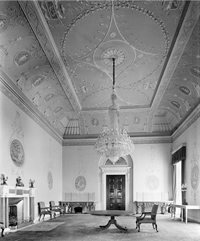
Sturt, using an unknown architect (though thought to be from nearby Blandford), effectively wrapped a new house around the old one to the east and the west, and linking the two on the south front with an impressive recessed portico and suite of rooms on the first floor.  However, the need to accommodate the dimensions of the old house created a slightly cramped feeling to the first floor elevations.  However, all is forgiven by the splendid interiors which are, in parts, a curious mix of early Georgian created late (e.g. the staircase, the library), and fashionable later Georgian, particularly in the stunning Hall, Dining Room and Drawing Room where Adam-style plasterwork reigns.  The latter rooms were probably designed by James Wyatt who was working nearby at Milton Abbey and at Bryanston.  The Dining Room is considered the finest room in the house; a coved ceiling framing delicate plasterwork and decorative panels in the style of Cipriani and Angelica Kauffmann.

So, how did part of the Crichel estate become so significant that it became immortalised as a set of planning procedures known as the ‘Crichel Down Rules’? In part, it was due to the bureaucratic arrogance of the post-War era which meant the Civil Service felt able to deal rather high-handedly with anyone, and particularly landowners who were not popular under Attlee’s socialist government. In 1937, 742-acres of Crichel Down had been compulsorily bought as part of a larger area for use as a bombing range. Churchill had given a very public commitment in the House of Commons in 1942 that land purchased in this way would be offered back to the original owners once it was no longer required for the original purpose.

Hinton Ampner, Dorset (Image: ec1jack / flickr)

However, there was an even greater danger of compulsory purchase for houses which had been adapted for wartime use under the ‘Requisitioned Land and War Works Act (1945)’ (sections 8 & 9 Geo. 6 c.43 in case you were wondering!) which gave officials the right to buy, regardless of the wishes of the former owner or any previous assurances. At Hinton Ampner in Hampshire where Ralph Dutton (the 8th and last Lord Sherborne), having just finished an extensive remodelling in 1939 only to be turfed out by a girls school, received a letter saying that the Royal Observatory were interested as a new Royal Observatory.  Dutton took the day off work at the Foreign Office and was on the doorstep when the officials arrived and gave an impassioned speech about the importance of the house, how it had been in the family for generations and that losing it would be akin to an amputation. The officials apparently looked somewhat embarrassed but gave no sign of retreating until a short note arrived a little later confirming that they were taking Hurstmonceaux Castle instead.

At Crichel Down, the government had decided to retain the land as a new model farm.  Lt-Cdr George Marten (who had married Mary Sturt, the only child of the 3rd Lord Alington), began a vigorous one-man campaign to examine the conduct and procedures of the relevant departments.  In doing so, he exposed a series of administrative errors as officials tried to evade the requirement to offer back the land and retain it for the government’s use.  Eventually, in 1954, public and press criticism led to the minister in charge, Sir Thomas Dugdale, resigning in one of the first examples of a minister taking responsibility even though he had not been involved in the earlier decisions and the land was sold back to the Martens.  To avoid a repeat of such failings, new planning rules regarding compulsory purchase were drawn up which are today known as the ‘Crichel Down Rules’ and are a vital part of the framework protecting landowners from the sometimes autocratic decisions of officials.

The death of Mary Marten in 2010 (her husband pre-deceased her) led to the recent sale of some of the contents of the house including a small collection of Asian jade ornaments which raised some £12.5m.  However, if the rumours are right, the rest of the house and 5,000-acre estate are also quietly on the market with an estimated price tag of around £100m, which, if it sold as a whole estate, would make it the most expensive sale ever outside of London.  It’s always a regret when families no longer wish to keep an estate which has been in the family for centuries, however, with the demands of sibling equality it is understandable that each of the six children – five females, one male – should wish to share their inheritance.  It would be a wonderful outcome if it could be bought in its entirety and remain one of the most important estates in Dorset, with the glorious Crichel House at it’s heart.

————————————————————————-

Update – 7 July 2013: Crichel House has been sold

Daily Mail confirms that the house plus 400-acres has been bought by Richard L. Chilton, a US hedge fund billionaire.  Initial reports indicate that he is a ‘conservationist’ having rescued other houses in the States so it seems promising that he is the right buyer; one with both the right attitude and pockets deep enough to do the house justice.  Though sadly it’s the end of an era for the Marten family, one hopes that this next phase will see the house restored to its former glory.

And if Mr Chilton happens to read this, it would be great to get your perspective – please do email me.

————————————————————————-

More images – both interior and exterior: ‘Crichel House, Dorset‘ [Country Life Picture Library]

The Country House Revealed – Marsh Court, Hampshire

Marsh Court, Hampshire (Image: Country Life Picture Library)

As with artists, some architects start well and then just get better, culminating in masterpieces which are rightly praised.  With buildings, and particularly the usually distant country house, it can be difficult to truly appreciate them; their beauty a pleasure reserved for those invited.  Thus one of the delights of ‘The Country House Revealed‘ series has been to elevate us mere viewers into guests of some lesser known, but wonderful houses – and Dan Cruickshanks’ visit to Marsh Court in Hampshire proves just what gems are nestled in the countryside.

The house is the work of one of the best architects to have been produced by this country; Sir Edwin Landseer Lutyens.  A master at the re-interpretation of traditional building forms and styles, his work is, in many cases, instantly recognisable. Yet, in others, his sensitive updating of existing historic buildings blends so seamlessly it’s hard to distinguish between old and new (one of the best examples of this is Great Dixter, Sussex).  Lutyens was working at the end of the Victorian era and his work grew into the perfect response to the glory days of the Edwardian period; those long summers of country house entertaining from the turn of the 19th-century which were so firmly ended by the horrors of WWI.  Yet this was also a time of a confident nation, with fortunes being made (and lost) in an increasingly mercantile world, in which wealth was not related to the land. This fact was reflected in a new style of country house which required the trappings of the traditional entertainments and accommodation but which didn’t require a vast estate to support it.

Deanery Garden, Berkshire (Image: Country Life Picture Library)

Lutyens was the right man at the right time – and with the right connections.  His rise coincided with a new interest in the countryside, which was now being opened up to the new middle class with their leisure time and the rail network.  Spotting an opportunity, Edward Hudson started ‘Country Life‘ magazine in 1897, which quickly became the publication of the country set – and, more importantly, those who aspired to join them.  Hudson had been impressed with Lutyens’ work, to the extent that he had him design his own house, the brilliant Deanery Garden in Berkshire.  The distinguished architectural writer (and Country Life writer) Christopher Hussey said that it:

“…may be called without overstatement a perfect architectural sonnet, compounded of brick and tile and timber forms, in which his handling of the masses and spaces serve as a rhythm: it’s theme, a romantic bachelor’s idyllic afternoons beside a Thames backwater.”

Replace ‘Thames’ with ‘Hampshire’ and this praise might equally, and perhaps more so, be applied to Marsh Court. However, one other key difference would be the material used in the construction of Marsh Court; clunch, the local hard chalk stone; used for centuries in churches and cottages but never for an entire country house.  It’s a mark of Lutyens’ mastery of materials and style that he would even consider it – and the effect is what helps elevate this house to being one of the finest in the country.

Marsh Court echoes something of the character of the client, Herbert Johnson, who was as an “adventurer, stockjobber, and sportsman” who made a fortune, lost it, and made another.  Lutyens came to the attention of Johnson through the regular articles in Country Life featuring his various commissions which Hudson was only to happy to publicise.  In many ways, Johnson was an ideal Lutyens client – willing to think big, with a suitable budget and, although wishing to join the country life, not excessively bound by tradition.  This suited Lutyens as he was able to develop his ideas around the ‘Tudor’ style house, but marry them with a modern take which dramatically elevated the design to ensure no-one could ever call it ‘pastiche’.

West front - Marsh Court, Hampshire (Image: Country Life Picture Library)

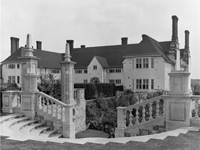
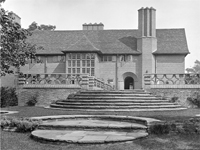
The house, built between 1901 and 1904 with later additions also by Lutyens, is essentially an ‘H-plan’, though without the south-east leg, and goes back to his earlier interest in historic English architecture.  As the architectural writer Lawrence Weaver highlights, this house only works because Lutyens has perfected the balance of local materials through clever groupings of shapes and elevations, combined with contrasts in size and stone.  But even a good design might become too dominant in such an exposed location, sitting on a rise above the river Test.  Again, Lutyens has the ideal answer in his use of the sloped site to create terraces which ease the house into the landscape – note the change from two-storey on the north front to three on the south.  The stark white stone is also softened through the introduction of slates, flint and red-brick into the walls to create a mix of regular and irregular patterns, such as on the west front which gives the impression of tiles sliding down the walls like rain to pool at the bottom.  Only someone of Lutyens’ skill could attempt and succeed with such an architectural fancy.  The interiors are similarly impressive, with grand, almost Baroque, plasterwork in the hallway, combined with the fine panelling elsewhere.

Herbert Johnson moved out in sometime after 1940 and the house became home to evacuated children, and then, in 1948, a prep school.  It remained in this role for nearly 50 years before it was bought, for £800,000, in 1994, by Sir Geoffrey Robinson; industrialist, Labour MP but, most importantly, a heritage-minded multi-millionaire. Working with Michael Edwards, Sir Geoffrey and his wife Marie Elena undertook a comprehensive, yet sensitive, restoration of the house; removing partitions, restoring the ceiling plasterwork and updating the services. It was then sold for £6m in 1999 and then offered at £13m in 2007, before being relaunched in June 2008 at £10m before selling at £11m later that year.

Lutyens’ brilliant output was somewhat overlooked by the wider contemporary architectural world which was more interested in the developing Modern movement. Hudson’s constant championing of this visionary architect ensured that Lutyens’ work and reputation were assured even if he had never gone on to his later, much grander, projects designing the Viceroy’s Palace in New Dehli. In 1909, G. Lloyd Morris, although talking specifically about Marsh Court, provided an elegant summary of the essence of Lutyens’ skill in that the;

‘ unity’ which ‘…is the pre-eminent quality underlying the orderly and tranquil beauty manifest in [his] houses.  He never fails in this respect; one may cavil at certain details, or question the use and treatment of a material, but in the handling of the general conception there is always a breadth and a certainty in the composition that remains in the memory long after the details may have been forgotten.’

Certainly, Marsh Court succeeds overwhelmingly in this respect and is a worthy inclusion in any series looking at the finest country houses in the UK.

————————————————————————————-

Official website: ‘The Country House Revealed‘ [BBC2]

Superb photos of the house and gardens: ‘Marsh Court, Hampshire‘ [Country Life Picture Library]

More on the house and Lutyens:

The Country House Revealed – Easton Neston, Northamptonshire

Easton Neston, Northamptonshire (Image: Trish York)

The stated objective of Dan Cruickshank’s series ‘The Country House Revealed‘ is to “…explore Britain’s finest country houses” and after the relatively low-key start with South Wraxall Manor, it upped the ante with the elegant Kinross House, and now it truly reaches one of the finest houses in the country: Easton Neston, Northamptonshire.  The only country house by one of the finest architects of his generation, when it was put up for sale in 2005, it marked the end of one of the great family estates.

Although many fine adjectives can be applied to Easton Neston, one seems to sum it up: noble.  Sitting on a slight rise of ground, this beautifully proportioned house neither lords it over the area but neither does it shirk from elegantly dominating its environment.  That the house looks as it does is due to a unique set of circumstances which gave the opportunity for Nicholas Hawksmoor (b. c.1662 – d.1736) to design his only country house – though he did help with others.

Hawksmoor was born in Nottinghamshire and, after finishing school, was employed as a clerk by a local landowner.  Such was his ‘early skill and genius‘ that word of his talent reached the finest architect in the country, Sir Christopher Wren, who took him on as a clerk at the age of 18.  This employment gave Hawksmoor a role in almost all Wren’s projects from c.1684 onwards, including Winchester Palace, the London City churches and St Paul’s Cathedral. In 1689, thanks to Wren, Hawksmoor obtained the post of Clerk of Works at Kensington Palace – the first in a series of official state roles he was to hold throughout his life, which provided both opportunities and frustrations.

It was this close relationship with Wren which gave Hawksmoor the opportunity to design the house at Easton Neston for Sir William Fermor.  Wren seemed not to display much of an interest in designing country houses but, as he was related by marriage to Sir William, he had originally been consulted about a new house in 1682 and had provided designs for two wings built in the early 1690s, of which one now survives (despite a serious fire in 2002).  Importantly, these two facing wings were 125-feet apart, limiting the size of the main house which would site between them.

Oak model of Easton Neston, c.1690 (Image: Sotheby's?)
Oak model of Easton Neston (as proposed? as built?) (Image: Sotheby's?)

Due to the lack of virtually any drawings or documents relating to Hawksmoor and Easton Neston, there seems to be some debate between such distinguished historians as Howard Colvin, John Julius Norwich and Kerry Downes as to exactly what Hawksmoor designed.  The couple of surviving letters relating to the build from Wren and others indicate that there was possibly a brick house, to Wren’s design, which looked similar but the house as it is today differs in several notable ways, not least the use of engaged columns and giant pilasters.

The first use of the giant pilaster order in English residential architecture can be seen in the south front of Chatsworth, designed by William Talman in 1687 and which also introduced the rectangular silhouette, the echoes of both of which can be seen in Easton Neston.  If the house as modelled is what was proposed or built then it is Wren’s design as Talman’s influence was not yet to be felt.

Staircase, Easton Neston (Image: English Heritage / NMR)

Norwich argues that the form of the house was substantially Wren’s, as was the interior, though Downes argues that, on the evidence of Hawksmoor’s sophisticated alterations for the interior at Ingestre Hall in 1688, with its clever use of internal screens of columns and dramatic spaces, and similarly demonstrated with the original hall and the brilliant cantilevered, shallow-stepped staircase at Easton Neston, he comes down firmly on the side of Hawksmoor.

The overall look of the house as it stands today is clearly Hawksmoor – it’s exciting, erudite, and draws on his extensive knowledge of classical architecture to create  bold fronts but with brilliant proportions which make perfect use of the form.  Hawksmoor also had the advantage of the use of Helmdon stone which, due to its durability and exceptional crispness when carved, ensures the house looks as good today as when it was first built.

Easton Neston as shown in 'Vitruvius Britannicus' (Image: wapedia)
Easton Neston as shown in 'Vitruvius Britannicus' - click for larger image (Image: wapedia)

Hawksmoor never undertook the usual Grand Tour to Italy so his architectural style was essentially drawn from a close study from various books of earlier classical architects.  This gives his work an intellectual quality which others lacked but also gave him the vocabulary to be inventive.  Easton Neston appears as a much bigger house, including a huge forecourt, in Colen Campbell‘s ‘Vitruvius Britannicus‘ though, thankfully they were never executed.  However, the drawing clearly show a clear link between Hawksmoor’s country house and the six London churches (of the 12 built from the proposed 50) he designed: St Alfege’s Church, Greenwich, St George’s Church, Bloomsbury, Christ Church, Spitalfields, St George in the East, Wapping, St Mary Woolnoth, and St Anne’s, Limehouse.

Hawksmoor was also to work, from 1702, with that other genius architect of that age; Sir John Vanbrugh; the playwright turned architect who came to rely on Hawksmoor’s practical skills to translate his fanciful visions into a reality at Castle Howard and Blenheim Palace (even more so when he had to take over following Vanbrugh’s bitter falling out with the Duchess of Marlborough).  Hawksmoor can therefore be seen as a link between Wren’s classicism and the exuberance of Vanbrugh’s particular brand of English Baroque.

Easton Neston remained essentially unchanged (except for some later flamboyant and slightly rampant interior plasterwork by a local artisan in the 18th-century) and in the Fermor-Hesketh family for nearly 500-years until in 2004 Lord Hesketh decided that he was not willing to burden his children with running a house and estate which “…in a good year it loses £500,000 and in a bad year it could lose £1.5m.” and risk seeing the family wealth slowly ebb away on maintenance. He was possibly also influenced by the likely cost of the restoration of Wren’s badly-damaged East wing which suffered a serious fire in 2002. Originally the house and 3,000-acres were put on the market for £50m in a once-in-a-generation opportunity to purchase one of the finest estates to come on the market for decades. Yet with no takers for the whole, Knight Frank sold over 2,200-acres for around £20m leaving just the house and 600-acres for £15m.

In July 2005 it was announced that Easton Neston had been sold to the American clothing retail tycoon Leon Max, the Russian-born owner of the California-based Maxstudio.com retail chain.  For all the fear about overseas buyers, Mr Max appears to have taken his custodianship of this grade-I masterpiece very seriously; hiring the architect Ptolemy Dean to oversee the work and investing an estimated £5m on the restoration to update the services of the house but also to restore the damaged wing to create a European headquarters for his company.  The interiors are equally splendid, overseen by Henrietta Spencer-Churchill (who grew up at Blenheim), with Max taking an ‘almost pedantically historicist approach‘ to sourcing furnishings and furniture which includes Aubusson tapestries from a chateau in France, Louis XVI chairs, and even a couple of the paintings sold by Lord Hesketh as he emptied the house of everything in a series of grand country house sales before moving out.

Easton Neston probably now looks better now than it has done since it was built, with the investment from the new owner likely to have secured the future of one of our greatest and most interesting country houses.

——————————————————————–

Book of the series: ‘The Country House Revealed‘ [Waterstones]

Official listing: ‘The Country House Revealed‘ [BBC2]

Quotes, figures and details in final paragraph come from an interview with Leon Max in the Sunday Times ‘Home’ section – 3 October 2010.

New Series: The Country House Revealed – South Wraxall Manor, Wiltshire

South Wraxall Manor, Wiltshire (Image: Traumahawk / flickr)

In contrast to the weekly dramas of Country House Rescue, a new series starting on the BBC, presented by the excitable Dan Cruickshank, looks at some of the finest homes in ‘The Country House Revealed – A Secret History of the British Ancestral Home‘.  The series promises a look behind the estate wall at some homes which have never been open to the public, giving us a rare chance to glimpse houses which enjoy secure, well-funded ownership and demonstrating that the fears of those who thought these houses would never be sustainable have been thankfully proved wrong.

The first in the series (broadcast 10 May on BBC2 at 21:00) visits South Wraxall Manor in Wiltshire; a house which matches a beautiful exterior with impressive interiors dominated by some of the finest chimneypieces and period rooms in the country.  The house was originally built for Robert Long who made a fortune in cloth in the early 15th-century before becoming an MP in 1433, around which time it is thought the core of the house was started.  As was befitting a rich MP, he was keen to show his status and as was often the case with the gentry, his home was the main platform with which to show off his wealth and erudition, creating one of the finest houses in the country today.

England, at the time work started at South Wraxall Manor, was feeling the influence of the Italian Renaissance and elements of the new fashions were often incorporated into the best homes, though often adapted for our native traditions and styles.  This use of wider influences was also a symptom of the gradual shift in power as major building projects were increasingly commissioned by wealthy gentry rather than the Church or Royal Court.  Maurice Howard also highlights that although the Court was highly competitive which might have led to a single architectural style being favoured, in fact, the houses we still have show how tenacious local styles were.

Chimneypiece c.1600, South Wraxall Manor (Image: (c) Nicholas Cooper)

This continuation of the vernacular can be seen in the architectural vocabulary used by those commissioning the houses, drawing still strongly on ecclesiastical traditions.  Reading the full listing description for South Wraxall one might almost believe it to be a local church or monastery – windows with Perpendicular tracery, buttresses, even gargoyles.  The house was significantly remodelled around 1600, creating what John Julius Norwich calls ‘one of the major Jacobean rooms in all England‘.  A vast west window floods the room with light and is matched by one at the other end of the room, providing the illumination to highlight a most impressive fireplaces – a colossal, florid statement of importance.

Each generation of the Long family added to the house, with additional wings and chimneypieces, and extending the estate.  As with other such early houses which have survived subsequent centuries without ‘modernisation’, this was due to a small element of luck in that it was inherited by a branch of the Long family in 1814 who were already well established at Rood Ashton House, Wiltshire (largely demolished c.1950) meaning the house was often rented out.  The house let between 1820-26 and served time as a boys school, before the 1st Viscount Long took over c.1880 following his election as a local MP.  Viscount Long undid much of the damage caused during its time as a school when the linenfold panelling had been painted over and the ornate ceilings plastered over, however he never really took up residence there.  The house was let for the rest of the 19th-century and the early 20th, before the 2nd Viscount Long moved in in 1935.  Used to house refugees in WWII, the family again lived there before finally selling up in 1966, ending over 500-years of family ownership.

South Wraxall then entered a rather uncertain period, until it was bought by a businessman with plans to turn it into a country house hotel but who had some issues with the local planning authority over unauthorised changes (for example, I think he glassed in the loggia without permission).  The house was up for sale again in 2003 for £6.5m after the businessman abandoned his plans.  After languishing on the market for a couple of years – probably due to the extent of the restoration required – it was bought by the current owners: John Taylor (bass player with the band Duran Duran) and his wife Gela Nash (founder of the fashion house Juicy Couture) who apparently have done an excellent and sympathetic job of the repairs, thus rescuing a house that is a quintessential example of an English manor house.

Full listing description: ‘South Wraxall Manor‘ [British Listed Buildings]

Further information: ‘South Wraxall Manor‘ [Wikipedia]

Book of the series: ‘The Country House Revealed‘ [Waterstones]

Rest of the series

This looks to be a fascinating set of programmes – for reference the other houses featured are: